Blog

  • Droid drops November 6 for $199 with contract

    Verizon just confirmed that the Moto Droid will arrive next week for $199 with a new, 2-year contract and $100 mail-in rebate. Customers will need a voice plan starting at $39 and a web and email plan for $29 per month.

    See our full Droid coverage here and look for a full hands-on later today.

    HELLO HUMANS: DROID BY MOTOROLA ARRIVES NEXT WEEK

    Verizon Wireless DROID By Motorola: World’s First Smartphone with Android™ 2.0

    BASKING RIDGE, N.J., and LIBERTYVILLE, Ill. – High-speed Web browsing, voice-activated search, customizable large screen, access to thousands of Android applications and hundreds of widgets and the best 3G mobile network in the country: DROID by Motorola arrives on Nov. 6.

    Verizon Wireless, the company with the nation’s largest wireless 3G broadband network, and Motorola, Inc. (NYSE: MOT), a pioneer in the mobile industry, today unveiled DROID by Motorola, the first smartphone powered by Android™ 2.0. DROID by Motorola features the brainpower and breakneck speed of a modern smartphone, designed to outperform where other smartphones fall short.

    “We’re proud to work with Verizon Wireless and Google™ on the first smartphone to feature Android 2.0,” said Sanjay Jha, co-chief executive officer of Motorola and chief executive officer of Motorola Mobile Devices. “DROID by Motorola delivers a rich consumer experience with warp-speed Web browsing, a mammoth screen, and Motorola’s expertise in design and voice quality. Combined with Android’s open, flexible graphical user interface and the power of Verizon Wireless’ 3G network, DROID is a smartphone that simply doesn’t compromise.”

    “This is an exciting announcement for Verizon Wireless, as the DROID by Motorola is the first device that we are bringing to market under our ground-breaking strategic partnership with Google,” said John Stratton, executive vice president and chief marketing officer for Verizon Wireless. “DROID by Motorola gives customers a lifestyle device with access to more than 12,000 applications that will help them stay in touch, up to date and entertained, using the best 3G network in the country.”

    DROID by Motorola has a solid exterior, intelligent interior and is one of the thinnest full-QWERTY slider phones available. It is a no-fuss, high-tech, location-aware, voice-recognizing, over-the-air updating, multi-tasking machine – and it is available just in time for holiday wish lists.

    With DROID by Motorola, you can:
    · Zip through the Web: Access the Internet at 3G speeds via the nation’s largest and most reliable 3G network or from any Wi-Fi hotspot. The multi-window HTML browser with a massive processor delivers the Web the way you expect.
    · See it all in cinema-style: View the Web, e-mail, Google Maps™, videos and more in widescreen on a brilliant 3.7” high-resolution screen. Boasting a width of 854 pixels to reduce the need for side-to-side panning and more than 400,000 pixels total, DROID has more than twice that of the leading competitor.
    · Run multiple applications at once: Customize your DROID with thousands of applications and hundreds of widgets available on Android Market™. Toggle back and forth between up to six applications at a time to juggle the universe and your apps.
    · Perform Google Search™ at the speed of sound: Simply tell DROID what you’re looking for using voice-activated search, and it will serve up Google search results based on your location. If you want more, simply type what you’re looking for into the search bar on the home screen and DROID will also search content on your phone, such as apps and contacts, and the Web.
    · Capture moments: Snap digital camera-quality photos with a 5 megapixel camera loaded with the works, such as a dual-LED flash, AutoFocus and image stabilization, or capture your friend’s antics in 16 million colors with DVD-quality video capture and playback. Store it all on the included 16 GB memory card, so you always have it on hand.
    · Multi-task like a master: Keep tabs on all your messages with integrated Gmail™ and Exchange e-mail pushed directly to you, but don’t let them get in your way. With the handy Android notification panel, go straight to the message or simply ignore it, and get back to the task at hand. And, a smart dictionary learns as you type and automatically includes your contacts.
    · Get where you need to go with Google Maps Navigation (Beta): DROID is the first device with Google Maps Navigation, providing turn-by-turn voice guidance as a free feature of Google Maps. It’s powered by Google and connected to the Internet. Use voice shortcuts and simply say “Navigate to [your destination],” and you’ll be on your way. See live traffic, use Street View or satellite imagery to view your route, and get access to the most recent maps and business information from Google Maps without ever needing to update your device.

    Pre-loaded Applications and Enhancements to Google Mobile Services:
    · Google Maps: With layers in Google Maps, view geographic information, such as My Maps, Wikipedia, and transit lines, right on the map.
    · Gmail: Multiple accounts support and undo for common operations.
    · YouTube™: One-touch recording and playback from homescreen widget or app, one-touch sharing with friends, and the ability to view your own uploaded videos and high-resolution videos.
    · Google Talk™: Easily switch between chats, search your chat history, and preview pictures and videos sent by links.
    · Android Market: Browse and download applications created by third-party developers.
    · Calendar: Ability to see who has R.S.V.P.’d to your meeting invitations.
    · Amazon MP3 Store: Download the latest tracks over the air.
    · Verizon Wireless Visual Voice Mail: Delete, reply and forward voice mail messages without having to listen to prior messages or voice instructions.

    Pricing and Availability:
    · DROID by Motorola will be available in the United States exclusively at Verizon Wireless Communications Stores and online on Friday, Nov. 6, for $199.99 with a new two-year customer agreement after a $100 mail-in rebate. Customers will receive the rebate in the form of a debit card; upon receipt, customers may use the card as cash anywhere debit cards are accepted.
    · Experience the all-new DROID by Motorola at www.droiddoes.com.
    · To get the most from DROID by Motorola smartphone, customers will need to subscribe to a Nationwide voice plan and an Email and Web for Smartphone plan. Nationwide voice plans begin at $39.99 for monthly access for 450 minutes and an Email and Web for Smartphone plan is $29.99 for monthly access.
    · For additional information on Verizon Wireless products and services, visit a Verizon Wireless Communications Store, call 1-800-2 JOIN IN or go to www.verizonwireless.com.


  • Olympus China confirms the E-P2 Micro Four Thirds camera

    olympus-ep2There was a rumor a few weeks ago that Olympus was going to launch another Micro Four Thirds camera before the end of the year dubbed the E-P2. This guy was suppose to have a rangefinder and hopefully be done up in the same retro fashion as the E-P1. Well, it looks like the camera will indeed be announced soon according to this somewhat official leak.

    Photorumors found that Olympus China’s website has the model number listed there for the whole world to see, which seems to confirm that the event Olympus had scheduled for October 31 will probably be the E-P2 announcement. Let’s just hope this guy has the same goods as the original model but a slightly lower price.


  • With Maps Navigation, Google Fires Another Shot at Carriers

    Google is expanding its mobile navigation offerings with a free, GPS-enabled offering for Android 2.0 users, a service that promises to compete with the navigation apps already provided by carriers. The Internet search company held a press event on its campus yesterday to announce a beta version of Google Maps Navigation, which it bills as “an Internet-connected navigation system” that provides turn-by-turn directions as a free feature of Google Maps for mobile. The app enables users to view traffic conditions and search for businesses along their routes, and overlays Google’s satellite imagery and street photos with planned travel circuits. (How it works video below.)

    U.S. carriers can’t be happy about the new service, though. While most operator-branded data offerings have fallen flat, carriers have found success with navigation offerings that generally sell for about $10 a month or are included in larger data bundles. Google Maps has been a big hit with users on all sorts of platforms — not just Android — and the navigation audience is sure to find an audience. Which is yet another reason partnering with Android is a double-edged sword for network operators.


  • Disney Rolls Out iPhone App

    The app features Disney content including characters, music, video and games. Disney says content in the app will be updated regularly with the latest news and entertainment from the company.

    The new Disney App offers a "Click2Life" feature, which works by allowing iPhone users to take pictures of images from Disney.com that will come to life within the app and turn into a 3D image.

    The Disney App will also automatically find other Disney apps and games in the App Store, organizing the content within one destination so fans can access games and entertainment content.

    Other features of the Disney App include:
     

    • Instant access to the latest Disney news and entertainment.
    • The ability to interact with Disney characters via customizable photo frames and audio greetings that can be customized by fans.
    • Access to Radio Disney where fans can paly "Name that Song," watch music videos and buy Disney music from the iTunes Store.

    Jason-Davis "While this app provides seamless access to all things Disney, delivering unmatched entertainment and information directly to mobile devices, we’re not simply recreating Disney.com on your iPhone or iPod touch," said Jason Davis, vice president, Disney.com.  

    "Features like ‘Click2Life’ utilize iPhone’s revolutionary functionality to create exciting new ways to interact with Disney characters and content."   


    Related Articles:

    >Codename Keychest:Disney’s New Film View Technology

    > Disney Online Completes Purchase Of Kaboose

    > Disneyland Paris Now In Google Earth

  • L.A. Approves $7.25 Million Google Apps Contract

    The City of Angels has shown a great deal of faith in Google.  Late yesterday, the Los Angeles City Council unanimously approved a $7.25 million contract that’ll have all branches of the city’s government adopting Google Apps over the next eight or so months.

    Google LogoIf Google’s able to pull off the implementation in a smooth manner (there will be a slow rollout, with law enforcement agencies hanging back), this development could set the stage for all sorts of cities to follow suit.  L.A. might, in fact, represent a key point in relation to Eric Schmidt’s recent "billion-dollar opportunity" comment about enterprise.

    Of course, if Google in some way fails, things won’t go so well.  And the L.A. City Council doesn’t have complete confidence in the search giant’s cloud.

    David Sarno reported, "The contract was approved pending an amendment that would require Google to compensate the city in the event that the Google system was breached and city data exposed or stolen."

    Also, Councilman Paul Koretz said, "It’s unclear if this is cutting edge, or the edge of a cliff and we’re about to step off."

    Google’s no doubt putting some of its best people on the job to make sure L.A.’s gamble is rewarded.

    Related Articles:

    > Schmidt Labels Enterprise "The Next Billion-Dollar Opportunity

    > Google Gets Serious About Marketing Apps

    > Google:It Departments Moving Toward The Cloud

  • Amazon and Walmart Engage in Price War Over Holiday Book Shoppers

    Amazon and Walmart have been engaged in an online price war over holiday sales of bargain books. The whole thing began when Walmart announced that it would let customers preorder 10 of the most highly anticipated upcoming books for as little as $10 each. In a matter of hours, Amazon matched the price for all of the same books. Walmart then dropped the price to $9. Then Amazon did the same.

    After this, Walmart dropped the price to $8.99. At this point, even Target decided to get in on the action and also posted prices for the same books at $8.99 a piece. Then Walmart lowered its price by another penny.

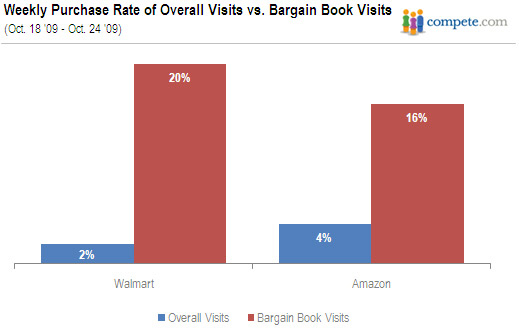
    As a result of this price war, traffic to the product pages of these books jumped. The following graph from Compete shows you how.

    Amazon and Walmart Price Wars

    "Over the course of this war, interest in these books at Walmart has been fickle," says Compete’s Debra Miller. "Despite lowering prices first, Walmart has been unable to unseat the online book king in terms of the number of people shopping for these books.  In fact, over the last few days, interest in these books at Walmart has declined even more while traffic to Amazon has stayed high."

    Here are Compete’s key findings regarding the situation:

    – Despite lowering prices first, Walmart has been unable to unseat Amazon; in fact, over the last few days, interest in these books at Walmart has declined even more while traffic to Amazon has stayed high

    – Traffic to the product pages of the 10 bargain books jumped significantly after the initial price cuts and continued to climb as prices fell

    – Target jumped in late in the game, which proved to be detrimental and has still not been able to drive customers to its site as well as Amazon or Walmart

    – Additionally, Walmart bargain book shoppers are twice as likely to shop for these titles at Amazon as Amazon shoppers are to shop at Walmart.  It seems that when offered comparable prices on books, consumers prefer Amazon.

    Amazon and Walmart Price Wars

    Amazon and Walmart Price Wars

    "So what can we learn from the Book Price War?" asks Miller. "Loss leaders work?  Maybe.  Amazon is a fierce competitor?  Probably.  Customers love a great deal?  DEFINITELY!  If the past 2 weeks are any indication, we are sure to see a highly competitive holiday shopping season packed full of deals for consumers, and perhaps a few more price wars.  Maybe next we will see Toys R Us match Walmart’s selection of toys for $10…"

    It will certainly be interesting to see if other significant price battles between major retailers pop up as the holiday season gets into full swing.

    Related Articles:

    > Promote the Right Landing Page to Maximize Holiday Sales

    > Walmart Brings Other Retailers on Board for Online Sales

    > Amazon Trumps Wal-Mart On Cyber Monday

    > Amazon Launches Same-Day Delivery Option

  • Symbian Dev program tries to limit fragmentation

    By Tim Conneally, Betanews

    Symbian OS logoThough Symbian Foundation Executive Director Lee Williams publicly deemed Google’s approach to spreading Android the “perfect storm of fragmentation,” yesterday the Foundation launched the beta of its developer program for what looks to be a pretty fragmented app store architecture in its own right.

    Here’s how it works: The program is called Symbian Horizon, and in this program, developers have their applications approved through the Symbian Signed identification process. This process adds one of four kinds of “tamper-proof digital certificates” to an app, one of which involves the app’s stamp of approval from one of three independent testing facilities. Each of these facilities charges the developer a different amount, and each runs a different test.

    Once this is done, the app is then listed in the Symbian Horizon Directory, which gets published to various app stores. Currently, there are five app stores: the Ovi Store by Nokia, the Samsung Applications Store, AT&T’s Media Mall, Sony Ericsson’s PlayNow Arena, and China Mobile’s Mobile Market. Within most of these stores, users have to specify their device to access the content catalog: the Ovi store has six device profiles, for example, and PlayNow Arena has nearly 70.

    “We recognize that developers face many challenges in bringing their products to market on Symbian devices,” Williams said in a statement Tuesday. “In particular, the diversity of application stores in our ecosystem increases the burden on developers by requiring multiple submission and review processes. But this diversity can also offer an advantage over competitors’ closed systems, where applications sometimes receive arbitrary or commercially motivated rejections. Symbian Horizon retains this advantage while reducing the burden by becoming a conduit to multiple stores, helping developers reach the largest global mobile market in the world more efficiently.”

    Under the terms of the program, it is now free for developers to list their apps in the Symbian Horizon Directory, and the goal is to provide developers with access to the largest Symbian market with the lowest possible cost of entry.

    According to the Symbian blog, “Approximate figures we’ve worked on suggest we can reduce the cost of publishing apps by about 75% compared to not using Horizon, assuming you want to push your work to six stores…Over the long term however, running Horizon will not be cheap, so the Foundation will open-source the development of the business model.”

    Copyright Betanews, Inc. 2009


    Add to digg
    Add to Google
    Add to Slashdot
    Add to Twitter
    Add to del.icio.us
    Add to Facebook
    Add to Technorati


  • Rove, Dean Trade One-Liners On Health Reform, Senators Offer Their Take

    Former Democratic Party head Howard Dean joined former Bush adviser Karl Rove for a debate on health care reform in Pennsylvania Tuesday night while other Senators are offering their take on the public option’s role in a health care overhaul.

    The Associated Press reports that Dean and Rove sometimes yelled at one another in the hour-plus-long debate in State College, Pennsylvania. “Rove lambasted Democratic proposals as being modeled on broken government programs like Medicare, weighed down by staggering costs. Dean implored that it was imperative that all Americans have the option to obtain affordable health care.” The men were paid $50,000 for their appearance, The AP reports (Armas, 10/27).

    Democratic Sen. Blanche Lincoln, of Arkansas, said Tuesday that she can’t support a public option, The Associated Press/ABC News reports. “She didn’t specifically say she’d vote against Reid’s proposal, but she said she’d prefer a program that would include insurance offered by a nonprofit group instead of the government” (DeMillo, 10/27).

    Lincoln spoke with the Arkansas Farm Bureau Tuesday, the Arkansas News Bureau reports. “‘In terms of states being able to opt out, I think in my visits with our state officials that they would prefer something they could opt into,’” Lincoln said (Lyon, 10/27).

    Sen. Olympia Snowe, R-Maine, told The Associated Press/The Boston Globe that she is “deeply disappointed” that the Senate Majority Leader Harry Reid’s Senate bill doesn’t include her idea for a “trigger” to begin a public option for health care reform only if private insurers can’t rein in costs (10/27).

    Others are more cautious with their statements. Sen. Kent Conrad, D-N.D., said Tuesday that he will “reserve judgment” on the public option in Reid’s plan, the Grand Forks (N.D.) Herald reports. “‘But I will reserve judgment until we see the finished product in writing and have the scores from the Congressional Budget Office’ tallying the costs of the revised bill. ‘This is just the next step in a long line of steps’” (Haga, 10/27).

    Finally, The Hill reports that White House health czar Nancy-Ann DeParle said at a forum Tuesday that liberal critics of President Obama are wrong on whether Obama is wavering on his support for a government-run public option in reform. “‘The president’s talked about the public plan option every single time he’s talked about health reform and he’s said all along that he thought it was a critical tool to help get choice and competition and hold insurance companies accountable,’ DeParle said” (Young, 10/27).

  • Surprise: Sequoia To Open Source Evoting Code

    Sequoia Voting Systems had been one of the “big three” e-voting providers, along with Diebold (Premiere) and ES&S. All three companies were notorious for massive amounts of secrecy and many, many, many reports of faulty machines with weak security. Sequoia’s biggest problem — which showed up in election after election after election after election — was that it seemed to count the votes differently every time. That seems like a rather big flaw. The company also threatened computer security expert Ed Felten after the State of New Jersey asked him to look at Sequoia’s code.

    Just last week there were reports that Sequoia had accidentally revealed some of its source code — but this week Sequoia has surprised a lot of people by announcing plans for a new e-voting system which will have open source e-voting software included. The code will be released to the public next month.

    This is definitely a big (and surprising) step forward. The Wired link above tries to speculate why — but I’d argue the most obvious reason (not mentioned in that article) is that Sequoia’s two largest competitors, ES&S and Diebold/Premiere merged last month, suddenly making Sequoia a much smaller player in the space (I believe it was already the number three player…). Going open source isn’t just a way to improve its code and improve trust in the machines, but also a way to stand out against a much larger competitor.

    Permalink | Comments | Email This Story


  • Newspaper Investigates Dangerous Mix Of Nursing Homes And Psychotropic Drugs

    Illinois nursing home patients often receive psychotropic drugs without cause, which poses various health dangers and even death, the Chicago Tribune reports as part of its Compromised Care series. “Frail and vulnerable residents of nursing homes throughout Illinois are being dosed with powerful psychotropic drugs, leading to tremors, dangerous lethargy and a higher risk of harmful falls or even death, a Tribune investigation has found. Thousands of elderly and disabled people have been affected, many of them drugged without their consent or without a legitimate psychiatric diagnosis that would justify treatment, state and federal inspection reports show.”

    The Tribune identified about 1,200 such violations at Illinois nursing homes since 2001. The newspaper’s “unprecedented review of more than 40,000 state and federal inspection reports found that nursing homes ranging from ‘five-star’ establishments on the North Shore to run-down facilities in urban neighborhoods have been cited for improperly administering psychotropic drugs.” 

    According to the story, the “findings come at a difficult time for Illinois nursing homes, which are already under fire for housing violent felons alongside geriatric patients and for failing to accurately assess the risk posed by the most serious offenders. … The misuse of psychotropics, which some experts say is a nationwide problem in nursing homes, suggests a troubling future for many seniors. … In testimony before Congress two years ago, Food and Drug Administration scientist Dr. David Graham estimated that thousands of nursing home residents die each year because antipsychotic drugs are administered to patients who are not mentally ill” (Roe, 10/27).

    In a separate piece, the Chicago Tribune reports on one such senior’s death. “Just eight hours after he moved into the nursing home, state inspection records show, Lloyd Berkley was approached by four employees, one of whom had a needle behind her back. While three of them held down the 74-year-old man, the fourth injected him with a high amount of the antipsychotic drug Haldol, which quickly sedated him, according to state records.” But hours later, the man fell and injured his head. He died at a hospital. “The worker with the needle, investigators discovered, was not licensed as a nurse and did not have a doctor’s order to give the man the medication. Berkley’s death offers a dramatic example of a common problem in nursing homes: heavily drugged residents falling and suffering injuries — or worse” (Roe and Leonhardt, 10/27).

    The Chicago Tribune, in a separate explainer, also includes five things to know about psychotropic drugs from information provided by the Illinois Department of Public Health (10/27).

  • House Leaders Seek To Unify Dems On Public Option, Unveil Bill


    House Democratic leaders are planning to unveil their version of the health care overhaul that will include a more tempered public insurance plan in which the federal government would negotiate prices with doctors and hospitals, Roll Call reports. No official announcements have been made, and many liberals continued to push for their more “robust” version of the plan that would let the government set prices, rather than negotiating. However, some on the left, like Rep. John Dingell, D-Mich., a long time single-payer advocate, appears to favor moving forward – with or without the robust version of the plan (Newmyer, 10/28).

    Meanwhile, Rep. Steny Hoyer, D-Md., the House majority leader, applauded his Senate counterpart for including any version of the public plan in his bill, the Associated Press reports. Hoyer said Tuesday that Reid’s inclusion of the provision may not change the politics in the House, but that it could influence whether the final legislation includes the public plan. He also said he hoped some moderate House Democrats, who want to avoid passing a bill that wouldn’t clear the more conservative Senate, may view Reid’s decision as political cover (Werner, 10/27).

    Hoyer “said Tuesday that Democratic leaders want to bring their massive health care overhaul legislation to the floor next week, if they can line up a majority behind a single ‘public option’ proposal,” CQ Politics reports. He also said he would keep his promise to Republicans to make the bill publicly available for 72 hours before bringing it to a vote (10/27).

    According to The Hill, a recent count by Democrats showed that 47 members of their caucus would vote against the more liberal option that allows the government to set prices, more than enough to kill the bill if it is also opposed by all Republicans. “The no list includes lawmakers who have said they would support the Medicare-based plan, but oppose the bill for other reasons, such as the income surtax it includes. It also includes several lawmakers who oppose the bill because they believe it will allow taxpayer dollars to fund abortions.” Some Democrats think the leadership could still address those issues and rally the needed votes for the robust option (Allen and Soraghan, 10/27).

    House Speaker Nancy Pelosi appears to be using one standard strategy for unifying her caucus around the controversial public option: changing its name, CBS News reports. “It’s not really a public option, it’s a consumer option,” she said. “As we’re mandating that people buy insurance we are saying to them, you have leverage, you have another choice. This is your consumer option.” Last year, lawmakers tried to rebrand the “bailout” of banks as the “Troubled Asset Relief Program” (Jackson, 10/27).

  • Insurer Stocks Rise After Reid’s ‘Opt-Out’ Announcement

    “A day after Senate Majority Leader Harry Reid proposed an ‘opt-out’ public option plan, health-care insurers’ stocks climbed Tuesday,” Dow Jones Newswires/The Wall Street Journal reports. “Led by Centene Corp.’s (CNC) 6% gain, fueled by an upside earnings surprise, all major carriers were in the black.” But “there may have been more to Tuesday’s action in health-insurer stocks. A fear of added costs incurred due to H1N1 vaccinations for swine flu seemed to subside as Centene still managed to beat Street estimates by a penny when it reported third-quarter earnings Tuesday” (Britt, 10/27).

    Portfolio reports: “It’s not a bad time for insurance companies to come down with a case of the swine flu. The cost of treating and preventing the flu is adding to medical claims, which means health insurers are reporting lower earnings this quarter even as Washington lawmakers accuse them of having inflated profit.” Amerigroup Corp. and UnitedHealth Group Inc. have both recently blamed swine flu for low profits (Chase, 10/27).

    Meanwhile, The Wall Street Journal reports that “WellPoint Inc.’s third-quarter earnings fell 11% amid declining enrollments and asset write-downs, but results were better-than expected” (Stynes, 10/28).

  • Nevada Case Raises Question Of Pharmacies’ Liability In Drug Abuse Accidents

    A Nevada case causes concern for pharmacies about possible liability for actions taken by customers who may abuse drugs. The Wall Street Journal reports on the case of Patricia Copening, who pleaded guilty to reckless driving after her car swerved off a highway and struck and killed a 21-year-old and injured a 33-year-old. “In Ms. Copening’s car, police found prescription bottles and loose pills, 167 in total, of hydrocodone, Soma and other drugs,” according to the Journal article. Before the incident, the Nevada controlled-substance task force had sent letters to 14 pharmacies in the Las Vegas area warning that Copening could be abusing drugs. The Nevada Supreme Court is now reviewing whether pharmacies that supplied the drugs to her could be held accountable by the injured man and the dead man’s family. “The case, Sanchez vs. Wal-Mart Stores et al, asks whether drugstores must use information at their disposal to protect the public from potentially dangerous customers. The Nevada case is part of a broader movement under way to place more responsibility for patients’ prescription-drug use on pharmacies.”

    “Abuse of prescription drugs has risen dramatically over the past two decades, along with a surge in the number of controlled-substance prescriptions being written. … At the same time, pharmacists have much more patient information at their disposal, thanks to pharmacy computer systems and a proliferation of state online prescription-tracking databases. The availability of patient information is only expected to increase as electronic health records are adopted by more and more doctors. As a result, consumers, government officials and pharmacies themselves are increasingly asking what a pharmacy is legally and ethically obligated to do with this newly available information. This week, the National Association of Boards of Pharmacy is convening a task force to discuss pharmacies’ roles in prescription-tracking programs” (Merrick, 10/28).

  • Streaming Live at 9:30: Clean Energy Economy Forum with Secretary Chu and Carol Browner

    Starting at 9:30, Energy Secretary Steven Chu will host a Clean Energy Economy Forum with stakeholders from around the country. Assistant to the President for Energy and Climate Change Carol Browner and other top Administration officials will also be featured speakers at the forum, which will include a focus on science, innovation, and job creation in the emerging clean energy economy.

    Watch live here at WhiteHouse.gov, or watch and take part in the live chat through Facebook. The White House will be monitoring the chat, taking questions, and incorporating feedback from chat participants during the event. 

    Watch live here at WhiteHouse.gov 
    Watch, discuss and engage through Facebook


  • The Storm2 is now availble for masochists

    blackberry-storm-2
    In case you haven’t been paying attention around here the last few weeks, the BlackBerry Storm2 is now available for purchase. That is, of course, if you really want to spend $279 and then mail-in a $100 rebate for a mediocre phone. Personally I can think of a dozen and a half phones I would rather have at that price point. What you really should do is what a week or two until the Motorola Droid hits. That’s the VZW phone to have, not the Storm2.


  • Centrist Democrats Are Cool To Reid’s Plan For Public Option

    With his announcement regarding support for the public option, Senate Majority Leader Harry Reid’s plans to move health legislation to the Senate floor face big challenges.

    The Hill reports that Reid is short of the votes to pass a government-run public option in the Senate bill. Several moderate Democrats — among them Sens. Ben Nelson, of Nebraska; Evan Bayh, of Indiana; and Blanche Lincoln, of Arkansas — decline to say if they’ll support a motion to begin debate on the bill. “They are waiting for a cost estimate from the Congressional Budget Office (CBO) and a chance to review the bill before making a decision” (Bolton and Rushing, 10/27).

    CongressDaily: Divisions among moderate Senate Democrats became obvious on Tuesday, but “Reid asked [them] to stick with him on a vote to let debate begin on the healthcare bill, regardless of whether or not they favor a public insurance plan in the measure that would allow states to opt out” (Edney, 10/28).

    The Los Angeles Times: “Reid needs all 58 Democrats and the two independents who caucus with the Democrats, or some Republican defectors. He is gambling that there are enough carrots and sticks lying around Capitol Hill to line up the votes he needs. A senior Democrat said that there were about 10 Democratic senators whose support had yet to be nailed down” (Hook and Levey, 10/28).

    The New York Times: “Senator Max Baucus, Democrat of Montana, who supports a public plan but shepherded a health bill through the Finance Committee without it because he thought it could never win 60 votes, said he could not predict how senators might line up. ‘I don’t know. I don’t know. I don’t know,’ Mr. Baucus said when asked if he had changed his view of the public plan’s chances. ‘I just really don’t know.’ … The Senate Republican leader, Mitch McConnell of Kentucky, said that in his view a vote to debate the legislation would be tantamount to supporting it, which he said would raise taxes and increase health care costs” (Herszenhorn and Pear, 10/27).

    The Associated Press: “Sen. Tom Carper, D-Del., said he may seek changes on the Senate floor, a move likely to be welcomed by moderates. He backs a government role in states where one or two insurers control the market and premiums are high, along the same lines as a plan supported by Sen. Olympia Snowe, R-Maine” (Alonso-Zaldivar, 10/28).

    The Boston Globe: “Carper’s idea, which he joked he might christen ‘the 60-vote option,’ might bring along Maine’s junior senator, Republican Susan Collins, who said yesterday she could not support Reid’s opt-out proposal. ‘I don’t see the opt-out as being any kind of compromise at all,’ Collins said” (Wangsness and Milligan, 10/28). 

    Politico runs down a list of some of the more prominent moderates in the Senate and where they stand on the legislation. One of “the toughest votes” is Sen. Joe Lieberman of Connecticut, an independent who caucuses with the Democrats (Raju and Frates, 10/28).

    The Washington Post: Lieberman “told reporters that he was ‘inclined to support’ a procedural motion to bring the measure to the floor. But he remains opposed to a government-run insurance plan in any form — even with an ‘opt-out’ provision for states that Reid said Monday he will include in the legislation.” And, unless the public-option provision is removed, he said “he probably will align with Republicans to block the measure” (Murray and Montgomery, 10/28).

    The Wall Street Journal: “Mr. Lieberman says he fears the public option won’t be self-sustaining. ‘I think that a lot of people may think that the public option is free. It’s not,’ Mr. Lieberman said. ‘It’s going to cost the taxpayers and people that have health insurance now, and if it doesn’t, it’s going to add terribly to our national debt’” (Adamy, Yoest and Hitt, 10/28).

  • AHIP, Chamber Of Commerce Ramp Up Opposition To Health Reform

    Insurers and the Chamber of Commerce are stepping up lobbying against a health care overhaul with new television ads.

    “The health insurance industry, which had been taking a relatively tempered approach to health care legislation, has stepped up its opposition to the overhaul efforts as it has become clear that the final product will not be to its liking,” Roll Call reports. America’s Health Insurance Plans “has started running television spots in 10 states, including the home state of Senate Majority Leader Harry Reid (D-Nev.), warning senior citizens that their benefits could be slashed.” AHIP also “blasted” Reid’s decision to include a public option in Senate health legislation (Roth, 10/28).

    The Associated Press: “Looking to build pressure on moderate Democrats, the U.S. Chamber of Commerce says it will begin airing new TV ads in seven states and on national cable television attacking the emerging legislation, including a government-run insurance option. … The ad is slated to start Wednesday” (10/27).

    Meanwhile, other news organizations examine the complexities which some advocacy groups and their lobbyists are confronting.

    The New York Times profiles Billy Tauzin and Karen Ignagni, chief lobbyists for the pharmaceutical and insurance industries respectively. “The story of these two lobbyists — a Republican who found favor with a Democratic White House and a Democrat on the outs — illustrates the complexities Mr. Obama faces in the health care endgame. The president had some early success in bringing industry on board. But as the experiences of Mr. Tauzin and Ms. Ignagni suggest, keeping it there will be easier said than done” (Stolberg, 10/27). 

    Meanwhile, “Republicans in Congress are taking aim at AARP’s financial ties to the health-insurance industry just as the advocacy group is taking a more prominent role supporting an overhaul of the nation’s health-care system,” The Wall Street Journal reports. The House Republican Conference has been circulating talking points among lawmakers and staffers, saying AARP wants an overhaul because its business arm would benefit from legislation in both the House and the Senate” (Zhang, 10/27).

    The doctor’s lobby is also being scrutinized by lawmakers. “After a humiliating defeat in the Senate, the venerable American Medical Association faces a revolt from both its member doctors and one-time political allies as it struggles to influence an overhaul of the nation’s health system,” The Washington Post reports. “The group had pinned its hopes on winning a $247 billion, 10-year reprieve from scheduled reimbursement cuts for physicians who treat Medicare patients in return for supporting the White House push for broader changes in health care coverage. When the pay boost was sidetracked last week in the Senate, it undercut the doctors’ leverage – just as final negotiations on the broader health bill intensify” (Davis, 10/28).

  • TPG Sells Debenhams Stake to Hedge Fund

    LONDON (Reuters) – U.S. buyout house TPG sold its stake in Debenhams Plc (DEB.L) to an unnamed hedge fund, a source familiar with the situation said on Wednesday, netting some 100 million pounds ($163.7 million).

    TPG [TPG.UL] sold its remaining stake of more than 120 million shares — some 9 percent of the department store chain’s stock — at 81.6 pence a share, a slight discount to their market price, down 2 percent at 82.65p by 1111 GMT, the source said on Wednesday.

    Some said the sale could be a precursor to a bid for Debenhams.

    “A bid for the group currently valued at 1.1 billion pounds looks possible,” said Manoj Ladwa, senior trader at ETX Capital. “Though the deal looks good on paper, the question has to be asked where the buyer will come from?”

    But one banker said the stake was unlikely to lead to a bid, given the difficulties raising finance in debt markets.

    TPG declined to comment.

    Debenhams last week bucked the gloomy economic outlook to report profits before tax, goodwill and one-off items up 14 percent to 125.2 million pounds. It has also reduced its weighty debt burden, a throw-back to its private equity-owned days, by almost half over the last year to under 500 million pounds. [ID:nLL67265]

    Och Ziff, the hedge fund which owns a stake in privately-owned budget fashion retailer Peacocks, has been mooted as a possible buyer in press reports. No-one at Och Ziff was available for comment.

    TPG is the second of Debenhams’s original private equity backers to fully exit the business, following Merrill Lynch Private Equity. Only CVC retains a small stake in the business. (Additional reporting by Victoria Howley and Jon Hopkins; Editing by David Holmes) ($1=.6107 Pound)

    ShareThis


  • Nixon Peabody Names M&A Chief

    Nixon Peabody LLP has named David Martland as head of its M&A and private company transactions practice. He joined Nixon Peabody in 2003, and succeeds Philip Taub, who was named chair of the business and finance department.

    PRESS RELEASE

    In ternational law firm Nixon Peabody LLP has named David A. Martland as leader of the firm’s Mergers & Acquisitions and Private Company Transactions practices, which includes approximately 70 attorneys firmwide. Mr. Martland succeeds the practice’s previous leader, Philip Taub, who was recently named chair of the firm’s Business and Finance Department.

    “David has helped expand our global business group through hard work, a strong focus on team effort, and a commitment to top-flight client service,” said Mr. Taub, chair of Nixon Peabody’s Business and Finance Department. “His ability to see the big picture and think strategically enables us to develop creative and effective legal solutions for our clients even in this challenging business environment.”

    Mr. Martland, who is based in the firm’s Boston office, joined Nixon Peabody in 2003. He counsels private and public companies and a variety of private equity funds on the full range of corporate matters.

    Mr. Martland has been recognized for exceptional standing in the legal community in Chambers USA: America’s Leading Lawyers for Business since 2006. He has been selected by his peers for inclusion in Best Lawyers in America since 2007. Mr. Martland has also been recognized every year since 2004 as a “Massachusetts Super Lawyer” and since 2007, as a “New England Super Lawyer” in Business and Corporate Law based on peer surveys by Boston magazine.

    Mr. Martland earned his J.D. from Yale Law School where he was a Senior Editor of the Yale Law Journal. He received his bachelor’s degree from Princeton University.

    About Nixon Peabody
    Nixon Peabody LLP is recognized as a “Global 100” law firm—one of the largest in the world. With 800 attorneys collaborating across major practice areas in 17 cities, including Boston, Chicago, London, Los Angeles, New York, Paris, Rochester, San Francisco, Shanghai, Silicon Valley, and Washington, DC, the firm’s size, diversity, and advanced technological resources enable it to offer comprehensive legal services to individuals and organizations of all sizes in local, state, national, and international matters. Nixon Peabody LLP was recognized as one of FORTUNE magazine’s “100 Best Companies To Work For®” three years in a row. The firm has also been named to the Human Rights Campaign’s 2010 “Best Places To Work For LGBT Equality” list.

    ShareThis


  • Triton Pacific Buys MyPrint

    Triton Pacific Capital Partners has acquired a majority stake in MyPrint Corp., an Irvine, Calif.-based provider of managed print and promotional marketing programs. No financial terms were disclosed.

    PRESS RELEASE

    Triton Pacific Capital Partners, LLC, a well established private equity firm headquartered in Los Angeles, today announced that it has acquired a majority interest in MyPrint Corporation, a leading provider of managed print and promotional marketing programs located in Irvine, Calif.

    “The MyPrint acquisition continues the successful investment strategy Triton Pacific has carried out since its inception, focusing on opportunities where a combination of capital, strategic guidance and operational expertise can accelerate growth in an already well-positioned business,” said Triton Pacific’s Managing Partner Craig Faggen.

    Targeting companies within basic industries, including healthcare services, software/IT, business services, consumer products, financial services, light manufacturing, logistics, and value-added distribution, Triton Pacific has established a set of well-honed business insights used to identify strong portfolio companies.

    “For more than 25 years, MyPrint has established itself as a leading provider of printed and promotional brand collateral to a diverse client base. By applying their unique insight into customer needs, combined with a significant investment in its proprietary eTools technology, MyPrint is now positioned as a leading business process outsourcing (BPO) company,” said Tom Scott, a partner at Triton Pacific.

    “We believe that MyPrint offers customers a unique value proposition with measurable ROI and we look forward to working with them on the many new and exciting growth opportunities that lay ahead,” added Fred Thiel, managing partner and head of Triton Pacific Capital Partners’ Software and IT group. “The functionality of MyPrint’s eTools offering is unique among other participants within the value-added commercial printing, promotional products and fulfillment industries.”

    B. Riley & Co., Inc. served as the exclusive advisor to MyPrint Corporation on the transaction. Paul Donnelly, who led the deal team for B. Riley, commented, “We have advised multiple businesses in this sector and firmly believe that with the capital infusion and strategic support of Triton Pacific, MyPrint is a unique platform with great prospects for continued growth. Triton Pacific was selected among a number of potential financial and strategic investors and we are confident that they will be an excellent partner for the business going forward.”

    “In Triton Pacific, MyPrint has found a private equity partner with an impressive track record of acquiring and building successful companies,” commented Jeff Carlson, MyPrint’s president. “We are all excited about the opportunities to work closely with the Triton Pacific team in growing MyPrint to the next level.”

    About MyPrint Corporation

    MyPrint provides clients with managed print and promotional marketing programs by combining its proprietary e-commerce platform, eTools, with print manufacturing and fulfillment capabilities. Customers across a variety of industries benefit from MyPrint’s integrated online ordering, commercial print manufacturing, direct mail services, digital print-on-demand, fulfillment, inventory management, and reporting capabilities. The company has particular expertise supporting large franchised businesses, and has demonstrated success providing solutions to clients in the restaurant, financial services, multi-level marketing, healthcare, and consumer services markets. For more information visit www.myprint.com.

    About Triton Pacific Capital Partners

    Founded in 2001, Triton Pacific Capital Partners, LLC, with headquarters in Los Angeles, California, is an established private equity firm that acquires controlling interests in profitable entrepreneurial companies. Triton Pacific was recently named to the Inc. 5000 as one of the fastest growing private companies in the U.S. The company seeks to partner with management of established, profitable companies that have compelling, differentiated business propositions. Through its Value Enhancement Program(SM), Triton Pacific employs its time-tested business model in conjunction with a well-developed arsenal of proprietary in-house resources. The firm is able to offer its portfolio companies growth capital, strategic guidance and operational expertise designed to enable companies to their businesses with the ultimate goal of accelerating growth and maximizing value. Today, Triton Pacific maintains a controlling investment in 16 private equity companies with an enterprise value in excess of $200 million. More information can be found at www.tritonpacific.com.

    ShareThis