Blog

  • Reuters – Qatar to Launch New $12bn Investment Firm

    Qatar Holding, a unit of the Gulf Arab state’s sovereign wealth fund, will launch a new investment firm worth $12 billion to purchase assets globally, writes Reuters. Qatar Holding vice-chairman, Hussain al-Abdullah, who is also a board member of Qatar Investment Authority, said the company would be listed on the Doha stock exchange in six to eight weeks.

    Reuters – Qatar Holding, a unit of the Gulf Arab state’s sovereign wealth fund, will launch a new investment firm worth $12 billion to purchase assets globally, a top official said on Tuesday.

    Qatar Holding vice-chairman, Hussain al-Abdullah, who is also a board member of Qatar Investment Authority (QIA), said the company would be listed on the Doha stock exchange in six to eight weeks.

    “You name it – shares, bonds, real estate, private equity. We will look at every sector in every country around the world,” he told reporters in the Qatari capital.

    Qatar Holding is the investment arm of the gas-rich state’s sovereign wealth fund. With an investment appetite of about $30 billion a year, QIA has picked up stakes in high-profile Western assets such as miner Xstrata, automakers Volkswagen and Porsche, and luxury retailer Harrods.

    The post Reuters – Qatar to Launch New $12bn Investment Firm appeared first on peHUB.

  • Samsung announces the Wi-Fi Galaxy Camera

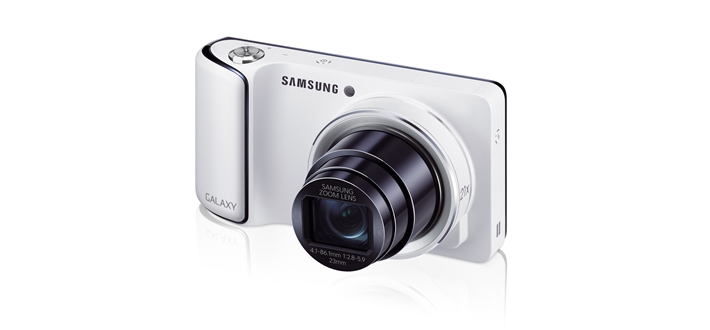
    On Tuesday, Samsung unveiled a new Galaxy Camera model featuring Wi-Fi-only connectivity. The South Korean manufacturer spares no expense, pairing the device with a quad-core processor and the first Jelly Bean iteration, among other noteworthy features.

    With the Wi-Fi-only Galaxy Camera. Samsung drops support for 3G/4G LTE connectivity but maintains most of the specs from the original version. The new model features a 4.8-inch HD display with a resolution of 1280 by 720 and 308ppi density. The camera is powered by a 1.4GHz quad-core processor and a 1,650mAh battery, with the display and processor combination similar to the one found in the company’s flagship Android smartphone, the Galaxy S III.

    The highlight of the Wi-Fi Galaxy Camera is the 16.3MP shooter which comes with a 23mm wide angle lens capable of 21x optical zoom. Available ISO settings include Auto, 100, 200, 400, 800, 1600 and 3200. As you might expect, the camera features 1080p video recording capability. To store all created content and the Android operating system, Samsung throws in 8GB of internal storage as well as a microSD card slot. There is also HDMI 1.4 video output.

    Samsung also adds a number of software features to back-up the hardware offering, namely Smart Mode which comes with 19 different “modes”, such as Best photo or Best face, Share shot, Auto Upload, Remote Viewfinder, Smart Content manager, Paper Artist, Photo Wizard, Video Editor, Voice Control, Slow Motion Video, S Planner, S Suggest, AllShare Play, as well as Dropbox support.

    The operating system of choice is Android 4.1 Jelly Bean coupled with Samsung’s TouchWiz user interface. Galaxy Camera users have access to the typical software features provided by the former, including Google Now, resizable widgets and expandable notifications, among others.

    The Wi-Fi Galaxy Camera comes with Wi-Fi 802.11 a/b/g/n connectivity with support for HT40; GPS with Glonass support, and Bluetooth 4.0. The device measures 128.7 x 70.8 x 19.1 mm and weighs 300 grams.

  • Firefox 19 debuts a built-in PDF viewer and other improvements

    Mozilla has released Firefox 19.0 FINAL for desktop. There are only two notable new features in this new build, but after months stuck in beta, Mozilla has finally enabled its built-in PDF viewer, which allows users to view PDFs directly in the web browser without having to use a third-party viewing utility.

    The other major new feature is a security one, with the Firefox Awesomebar now set up to alert users if the default search provider has been changed. In the meantime, Firefox 19.0 for Android — due for release imminently — will introduce support for themes, plus lower its system requirements to extend its reach to as many as 15 million more smartphones.

    The new inline PDF viewer has been available in Aurora and Beta builds for a number of months, but Mozilla has finally pushed it through to the final build, despite the fact Mozilla has acknowledged the existence of “several UX/rendering/stability concerns”, which it believes can be quickly hotfixed should any issues become major.

    The PDF viewer, which should automatically kick in when a link to a PDF file is clicked, provides users with a number of useful tools via a toolbar at the top of the page — users can quickly move between pages, plus access a slide-out pane that provides thumbnail page views and access to any outlines embedded into the PDF document. In addition, users can access zoom, print and download the document via conveniently situated buttons, plus switch to “Presentation mode” to view the document in full-screen mode.

    Users can disable the new inline viewer in favor of their previous settings by opening the Firefox menu and selecting Options > Options. Switch to the Applications tab, scroll down to Portable Document Format (PDF) and click the Preview in Firefox dropdown menu to switch to another option, such as a third-party plugin, download file or “Always Ask”.

    The other new feature in Firefox 19 FINAL is security related — Firefox will now alert the user and offer to automatically reset the default search provider if it’s changed by a third-party tool or through the about:config dialog.

    Other changes in Firefox 19 include startup performance improvements, HTML5 enhancements involving various CSS properties and some developer tweaks, including a new Browser Debugger for add-on and browser developers. This feature is experimental and is currently disabled — users can switch it on via the about:config menu — set devtools.chrome.enabled and devtools.debugger.remote-enabled to true. Once done, restart Firefox and the feature will be accessible via the Firefox > Developer menu.

    The principle change coming in Firefox 19 for Android is support for themes, allowing users to customize the browser’s look and feel. Version 19 also sees a lowering of Firefox’s system requirements. Previous builds required an 800MHz processor, but Firefox 19 will now run happily on 600MHz devices, along with 512MB memory and a HVGA (480×320 pixels) resolution. This extends the browser’s reach to more low-end phones, including HTC’s Wildfire S and the LG Optimus One.

    Firefox 19.0 FINAL is available now as a free, open-source download for Windows, Mac and Linux.

  • ORIX Acquires Robeco

    Japan-based ORIX Corporation is acquiring approximately 90.01 percent of the equity in Netherlands-based Robeco from Rabobank, for 1.9 billion euros ($2.6 billion). Closing of the transaction is subject to legal and regulatory approvals, which are expected to be completed within six months.

    PRESS RELEASE

    ORIX Corporation (ORIX), Coöperatieve Centrale Raiffeisen-Boerenleenbank B.A., (Rabobank) and Robeco Groep N.V., (Robeco) announce that ORIX is acquiring approximately 90.01% of the equity in Robeco from Rabobank, for EUR 1,935 million (JPY 240.2 billion). Closing of the transaction is subject to legal and regulatory approvals, which are expected to be completed within six months.

    Part of the agreement is a strategic alliance between Rabobank and ORIX. This includes Rabobank retaining a 9.99% share in Robeco, and continuing to cooperate in maintaining and expanding Robeco’s business platform. ORIX will allocate treasury stock to Rabobank as part of the acquisition price, and as a result Rabobank becomes a shareholder of ORIX. Also, ORIX and Rabobank have agreed that Robeco’s banking activities, which are only based in the Netherlands, will be transferred to Rabobank with Robeco retaining its client service relations.

    The financial market has drastically changed since the financial crisis and ORIX believes that it is necessary to pursue a new business model by combining finance with related services in a strategy called “Finance + Services.” As one of the measures to drive this strategy, ORIX has been seeking to build its presence in the global asset management industry in recent years, as evidenced by the 2010 purchase of Mariner Investment Group in the U.S.

    Rabobank decided to sell Robeco to ORIX, on the basis that becoming part of ORIX Group will enhance Robeco’s future growth prospects. Robeco is ORIX’s most significant strategic acquisition to date and it will become ORIX’s primary platform for future growth ambitions in global markets. Robeco will continue to service customers under its existing brand names.

    The rationale for ORIX’s acquisition of Robeco includes the strength of Robeco’s global brand, its diversified range of businesses across asset classes and regions, the breadth of its global distribution network and experienced investments teams. As a well-managed and relatively autonomous group of businesses with a good performance record, Robeco is the ideal vehicle for ORIX to pursue its ambitions in global asset management. Growth opportunities also exist in the pension and asset management markets in Asia and Middle East where ORIX has an established network.

    ORIX is committed to support Robeco’s 2010-2014 strategy, its services to clients, its investment processes and teams, based on Robeco’s long term commitment to deliver value to clients. Robeco’s management board will remain in their current roles with Roderick Munsters continuing as CEO and reporting to ORIX headquarters in Tokyo. Robeco Group NV’s legal structure will remain unchanged, as will the current governance and reporting lines from Robeco’s subsidiaries. ORIX will also retain Robeco’s Supervisory Board structure including both independent members as well as representatives from ORIX.

    Last year Robeco achieved record results, demonstrating the strength and resilience of the business, both in the Netherlands and internationally. Robeco’s assets under management increased by 26% to EUR 189 billion at the end of December (2011: EUR 150 billion). Net new cash was also at a record of EUR 18.4 billion. Net profit increased from EUR 134 million to EUR 197 million. Investment performance was also strong with 65% of Robeco’s assets outperforming their benchmarks.

    Yoshihiko Miyauchi, CEO ORIX Group: “Robeco is a global company with an outstanding brand and excellent management, well-diversified in all aspects including asset management products, investor clientele, managed portfolio, and regional presence. The management team has displayed tremendous performance over the years and we are confident that they will continue to accomplish this going forward. ORIX will pursue further expansion in Europe and the U.S, as well as growth in Asia and Middle East regions where it has a strong platform.”

    For Piet Moerland, Chairman of the Executive Board of Rabobank Group, the sale of Robeco is the start of a new beginning. “Rabobank and Robeco have strengthened each other over the past decades by working closely together in serving their clients. This cooperation will remain. Robeco is a solid asset manager, with a track record of being innovative, for instance by introducing pension solutions. Robeco has now the opportunity to develop further under ORIX’s ownership.”

    Roderick Munsters, CEO Robeco Group: “Just like Robeco, ORIX Corporation is a client focused organization with an entrepreneurial culture. As part of ORIX Group, we will continue to serve our clients’ best interests and achieve attractive investment returns.”

    Ends

    For further information:
    ORIX, Haru Yamada, Telephone +81 3 5419 5042, Email [email protected]
    Rabobank, Hendrik Jan Eijpe, Telephone +31 6 22031978, Email [email protected]
    Robeco, Eliza de Waard, Telephone +31 10 224 3348, Email [email protected]

    About ORIX Corporation
    ORIX Corporation (TSE: 8591; NYSE: IX) is an integrated financial services group based in Tokyo, Japan, providing innovative value-added products and services to both corporate and retail customers. Since its establishment in 1964, the company started with the leasing business and has ventured into various neighboring fields as it acquired expertise in a variety of areas. ORIX’s current activities include corporate financial services such as leases and loans, maintenance leasing of automobiles, rental operations, real estate, life insurance, banking, as well as environmental and energy related businesses. In the overseas, ORIX has expanded its operations to 27 countries and regions since first entering Hong Kong in 1971, and aims to grow further as a global company. For more details, please visit our website at: www.orix.co.jp/grp/en

    About Rabobank Group
    Rabobank Group is a full-range financial services provider that operates on cooperative principles. Its origins lie in the local loan cooperatives that were founded in the Netherlands nearly 110 years ago by enterprising people who had virtually no access to the capital market. In terms of Tier I capital, Rabobank Group is among the world’s 30 largest financial institutions. Rabobank is consistently awarded a high rating by all rating agencies.

    Rabobank Group is comprised of independent local Rabobanks plus Rabobank Nederland, their umbrella organization, and a number of specialist subsidiaries. Overall, Rabobank Group has approximately 61,000 employees (in FTEs), who serve about 10 million customers in 47 countries. Rabobank Group combines the best of two worlds; the local involvement and personal touch of the local Rabobanks with the expertise and economies of scale of Rabobank Nederland and its subsidiaries. More information is available at www.rabobank.com

    About Robeco Group
    Robeco, a mid-sized global asset manager, offers a mix of investment solutions in a broad range of strategies to institutional and private investors worldwide. It manages EUR 189 billion in assets under management at 31 December 2012, of which half are institutional assets. Net Profit was EUR 197 million.

    Robeco’s head office is located in Rotterdam, the Netherlands and the company employs 1507 people in 15 countries (ultimo December 2012). The company has a strong European and US client base and a developing presence in key emerging markets, such as Asia, India and Latin America.

    Robeco Group started in 1929 with Robeco NV, a global Equity Fund. The official performance since March 1933, when the fund was incorporated, has been 8.2% average per year.

    Founded ‘Rotterdamsch Beleggings Consortium’ in 1929 in The Netherlands, Robeco was acquired by Rabobank in 2001. The following subsidiaries and joint ventures are part of Robeco Group: Robeco Boston Partners, Robeco Weiss Peck & Greer, Corestone Investment Management, Harbor Capital Advisors, Transtrend, RobecoSAM and Canara Robeco Asset Management Company. More information is available at www.robeco.com/media

    The post ORIX Acquires Robeco appeared first on peHUB.

  • London Business Angels Backs Sphere Fluidics Early Stage Funding Round

    Early stage, Cambridge-based life science company, Sphere Fluidics, has closed a 1.6 million pounds ($2.5 million) funding round. The investment included a 133,000 pounds pledge by a syndicate of London Business Angels and its EIS Approved Roundtable Syndicate Fund 2012.

    PRESS RELEASE

    Early stage, Cambridge based, life science company, Sphere Fluidics, has closed a £1.6m funding round which included a £133k investment by a syndicate of London Business Angels and its EIS Approved Roundtable Syndicate Fund 2012. The company is commercialising a highly innovative single cell analysis technology which can accelerate new bio-pharmaceutical discovery, generate stem cell therapies and enable novel studies on single cell diseases such as cancer. This picodroplet technology, using a microfluidic chip, can perform up to eight million single cell tests per day and has already been used by a number of Blue Chip clients. This new round of substantial funding will enable the company to expand its management resources, relocate to a new facility and accelerate sales growth.
    Frank Craig, Sphere Fluidics CEO, comments, “We are very pleased to close this round as it gives us the resources to fully develop our business. The London Business Angels were one of the first angel groups we contacted. They were excellent at helping us polish our investment proposition and were key early members of our angel syndicate. I am excited about further applying our exciting technology to the Life Sciences markets and accelerating its commercialisation”.
    Anthony Clarke, London Business Angels CEO, comments, “Sphere Fluidics, led by a highly experienced management team, is commercialising a ground-breaking technology in the single cell analysis sector which has the potential for explosive growth. I am delighted that a group of LBA investors as well as our LBA EIS Approved Roundtable Syndicate Fund 2012 has been able to participate in the round alongside existing renowned institutional early stage investors such as the Royal Society Enterprise Fund who continue to show their support to the company. The company is now well-placed to exploit the potential of its technology and continue to build its relationships with a range of blue-chip customers. My congratulations to Frank and his team.”

    For enquiries please contact: [email protected]

    Alexander Sleigh
    Manager, London Business Angels
    Realising potential through knowledge and investment

    T: 0207 321 5672

    100 Pall Mall,
    St James,
    London,
    SW1Y 5NQ

    Company No. 7055412

    Angel Capital Group comprises London Business Angels Ltd, Angel Capital Innovations Ltd and Angel Capital Ventures Ltd.

    The contents of this email and any attachments are confidential to the intended recipient. They may not be disclosed to, used by or copied in any way by anyone other than the intended recipient. Whilst any information and/or any opinion given is believed to be correct, it is not intended to constitute legal advice; you should seek specific legal advice as appropriate. Please note that Angel Capital Group does not accept any responsibility for viruses and it is your responsibility to scan or otherwise check this email and any attachments.

    The post London Business Angels Backs Sphere Fluidics Early Stage Funding Round appeared first on peHUB.

  • Morning Advantage: Could Biking to Work Improve Your Focus?

    According to a recent study out of Denmark, children who bike to school concentrate better in the classroom. Writing in Atlantic Cities, Sarah Goodyear reports that kids who biked or walked to school, rather than taking public transit or riding in cars, performed better on tasks that required focus — and that the effects lasted up to four hours. In fact, the effect of the exercise was greater than the impact of eating well. “As a third-grade pupil, if you exercise and bike to school, your ability to concentrate increases to the equivalent of someone half a year further in their studies,” said researcher Niels Egelund.

    Of course, this is all well and good for the kiddos, but it selfishly has me wondering what adults could learn from this. Maybe I really am more productive on those days I sneak out for a jog at lunch.

    HELL HATH NO FURY LIKE A TWEETER SCORNED

    Sparse Valentine’s Bouquets from ProFlowers Ignite Social Media Ire (Jezebel)

    Having dated a few frugal fellows, I’ve been on the receiving end of the likes of ProFlowers before, and I know all too well that the lush bouquets pictured on discount florists’ websites are a fiction. But in the Instagram era, the difference between online promise and bedraggled reality is easily documented and shared. What’s especially interesting about this piece are the comments from former ProFlowers employees beneath the main article; suffice it to say, shipping an inferior product results in a lot of long, bad days for your customer service reps. For research on why we turn to social media when we’re enraged, see this smart piece in HBR from Alfredo Behrens, “Social Media as Modern Sorcery.”

    LEVERAGE THE SYNERGIES IMPACTFULLY, DUDE

    Five Evidence-Based Ways to Optimize Your Teamwork (99u)

    Tip #1: Make everyone write down their ideas before they share them. Studies have shown that while groups do make better decisions than individuals, the reason is that you’re getting a diversity of approaches and opinions. But once discussion begins, the more vocal members of the group drown out the shy violets, and everyone starts revising their good ideas towards a mushy middle. Read the full piece for more data-driven advice.

    BONUS BITS:

    Well, It Depends

    What’s the Real ROI on Pre-K? (The New Republic)
    The Exxon Valdez Is Being Dismantled on a Beach in India (Der Spiegel)
    Anne-Marie Slaughter: Forget “Having It All” — Own What You Want (Knowledge@Wharton)

  • Microsoft takes Outlook live

    Perhaps “live” is a poor choice of words, seeing as Windows Live is dead. Early this morning, Microsoft took down the “opening soon” sign and brought Outlook — that’s the .com not the software — out of beta. The webmail service is in “grand opening” mode with 60 million “active users” in tow, and more coming as they migrate from Hotmail.

    Microsoft unveiled the email service nearly six months ago, decked out in Windows 8-logo blue and generous white space. During the beta process, Outlook ran alongside Hotmail. But with the new service launched, “we’ll soon start to upgrade hundreds of millions of Hotmail users to the new Outlook.com experience”, David Law, Outlook.com product management director, says.

    No one will be left behind, and I expect some people to come kicking screaming — seeing the uproar during the partially-aborted Hotmail to Windows Live migration. Stinkers won’t get in the way this time. Microsoft plans to “upgrade every Hotmail user to Outlook.com”, Law says. That means you. Bud.

    “The upgrade is seamless and instant for people who use Hotmail”, he emphasizes. “Everything from their @hotmail.com email address, password, messages, folders, contacts, rules, vacation replies, etc. will stay the same, with no disruption in service”. There will be a process. “We expect all people using Hotmail to be upgraded by this summer”.

    My colleague Mihaita Bamburic wrote an exhaustive review of the Outlook mail service in August that remains highly relevant. While praising the visuals he concluded: “Outlook is commendable, but I wouldn’t recommend it over Gmail at the moment”.

    I would choose Outook over Gmail, even though it’s my primary service. Call me a Gmail hater, but one sadly stuck. I would have adopted Windows Live Hotmail long ago and possibly Outlook if Microsoft supported IMAP. Sorry, but in the cloud-connected device era, where sync is mandatory feature, POP3 isn’t good enough. I’ve got too many devices — as you might, too — and Outlook is no real option without IMAP.

    I did inquire early this morning and heard from a spokesperson: “Nothing to share on IMAP for this release”. That’s standard-like statement going back eight years. So you can forget IMAP.

    That’s too bad, because Outlook offers much, and it’s a feisty, fluid beastie running on Windows 8. I like the service. Design is some ways simplistic appearance, keeping with Microsoft’s newer 2D approach. But I find the layout to be prettier and more functional than Gmail. With access to Documents, Photos, SkyDrive and Skype, Outlook and Gmail stack up fairly evenly for the major cloud extras.

    “Nearly half of the people using Outlook.com have already used SkyDrive to share more than half a billion photos and Office documents”, Law says.

    Both services pack in too many ads — more from Outlook than Gmail. But Microsoft removes them for anyone coughing up $19.95 a year, a previously available option that I’ve used before.

    Law identifies Microsoft’s major objectives for the service:

    Outlook.com was designed as an email service focused on removing barriers and getting people going:

    • Delivering a beautiful, fresh and intuitive experience on modern browsers and devices
    • Keeping people connected to their friends and co-workers across the networks they really use
    • Providing a smart and powerful inbox to handle today’s email needs, including SkyDrive for sharing virtually anything in a single email
    • Putting people in control by prioritizing their privacy

    Does Outlook live up to them? You tell me.

    Microsoft smartly supports the launch with a couple commercials, which I really like, embedded above.

  • Ogio Renegade RSS Backpack Makes For A Solid Hackathon Carry-All

    ogioPack2

    The Ogio Renegade RSS backpack arrived in the mail last week — perfect timing for a business day trip I needed to make and a great test of this backpack’s capability. The bag soft launched in 2012, but they are just now getting review units out because, apparently, consumer demand has been quite high for this backpack.

    How did it work for me? Great. I love it. But why?

    THE GOOD

    Compartments
    The backpack has so many compartments, that you can realistically put every device you carry into a different place. This means that you can easily separate devices from each other (as well as device cords) so that when you want one specific device, you can access it without all the rest tumbling onto the floor — great for air travel.

    Size
    Speaking of air travel, I put it to the test last week and the bag mostly fits under an airline seat (within regulation anyway). The very top could get stepped on by the person sitting next to you, but it didn’t happen to me.

    The pack easily fit through security scanners.

    Profile
    The bag can have a slim profile on your back if it is not completely packed, but still has the ability to stretch out a bit too when you need maximum space. You could easily fit all your gadgets plus a change of clothes or two for short trips, which is nice.

    Protection
    It also has two crush-proof compartments (one large and one small) for laptop and sunglasses, respectively. The laptop sleeve is easily accessible and fits up to a 17” laptop and is actually suspended from the bottom of the bag so it never touches the ground when you set your bag down — hence the name RSS (Reactive Suspension System).

    Labels
    Ogio thoughtfully labeled each compartment with an icon representing what they recommend goes into it. You can, of course, put anything you want in any compartment, but it’s a nice touch to do some of the thinking for you.

    Comfort
    I thought the backpack was pretty comfortable. It’s an electronics backpack so I wasn’t about to thru-hike with it.

    THE BAD

    Profile
    It can have a slim profile, however for a smaller guy like me, it is still a full size backpack and can look a tad large — almost parachute-like. It’s a good thing I don’t rock out skin tight jeggings and a white belt that often or else this backpack could make my butt look HUGE.

    But seriously, it’s just a trade off. If you really need to carry a bunch of stuff, this pack is perfect for it. If you are trying to have a minimalist setup, you might not need this much space.

    WHAT’S DIFFERENT
    The bag is $150. That’s a lot of money. What is different about it to justify the expense?

    Besides the previously mentioned crush-proof, suspended containers (which seem to be the main differentiator) you are getting some pretty good customer service from Ogio. Their website and chat window were helpful. The representative I chatted with was quite knowledgeable about the products and was eager to help me understand the features and differences. It was a good experience, casual and helpful for decision making.

    I also learned that, apparently, the review unit sent is not the 2013 model as that version will be out in a month or so and is not black but rather is more of a grey color.

    THE SPECS

    • $150
    • 19.5” x 14” x 8”
    • 3.6 lbs

    THE VIDEO
    Straight from the product page at Ogio’s website.

    THE BOTTOM LINE

    As you can see from above, there are more good things about this pack than bad. Translation: this is an excellent full-sized backpack. Comfortable and appropriate for the person who has to tote a multitude of gadgets with them, for daily travel. Thumbs up!

    More info at Ogio.com

  • Bina launches box to analyze genomes; cloud on the way

    Bina Technologies is launching its Bina Box for on-premise genome processing, enabling researchers to quickly and cheaply analyze genomes and give doctors data-driven suggestions for custom treatments.

    Use a genome sequencer to see one person’s DNA profile, and you’ll get 6 billion unique characters, or half a terabyte of data, said Bina co-founder and CEO Narges Bani Asadi. Start processing it to find mutations and variations, and you’ll find yourself with more than one terabyte. It’s not small data. As the price of sequencing a genome keeps dropping, scientists will want to do this more and more. It’s a big data problem, Bani Asadi said. The company wants to solve the problem on premises, with hardware and software.

    The Bina Box will run on “high-end Intel processors and very high-bandwidth memory,” Bani Asadi said, and can scale out with additional Bina Boxes as customers processing needs change. Price depends on how much processing customers have in mind. If a customer wants to process 100 samples a month, for instance, it would cost $12,500 per month, or $125 per sample, said Mark Sutherland, Bina’s senior vice president of business development.

    A Bina Cloud to tie in with the Bina Box will come later this year. The Bina Cloud will host just the needle of genomic data isolated from among the haystack of the entire genome, and it will enable scientists to aggregate many genomes, run data visualizations and collaborate to derive big-picture insights. Early customers are already using a pilot version of the cloud.

    The box offering contributes more proof of the notion that, for certain uses, public clouds might not make sense, not yet anyway. (It remains a largely popular perspective in financial services, as my colleague Barb Darrow reported a couple of months ago.) The Bina Box, for its part, “provides security that on-premise solutions have, versus cloud solutions, (which) sometimes people in this industry are not completely ready to move into,” Bani Asadi said. Big pharmaceutical companies are a perfect example, as a breach could hamper product development using genomes. Aside from security, there’s the matter of performance. “It’s impossible to send (half a terabyte of raw data from a sequencer) to the cloud easily,” Bani Asadi said.

    Meanwhile, other genomics-focused startups, including DNAnexus and Appistry, are eschewing hardware and relying exclusively on cloud resources.

    Whether hardware is involved or not, as my colleague Derrick Harris mentioned when he wrote about Bina last year, it’s clear that the rise of big genomics inherently equates to a rise in data.

    The practice of merging life sciences and other industries with big data will come up in conversation when Ayasdi CEO Gurjeet Singh hits the stage at GigaOM’s Structure:Data conference on March 20 in New York.

    Related research and analysis from GigaOM Pro:
    Subscriber content. Sign up for a free trial.

  • New From NAP 2013-02-19 00:00:00

    Final Book Now Available

    Optics and photonics technologies are ubiquitous: they are responsible for the displays on smart phones and computing devices, optical fiber that carries the information in the internet, advanced precision manufacturing, enhanced defense capabilities, and a plethora of medical diagnostics tools. The opportunities arising from optics and photonics offer the potential for even greater societal impact in the next few decades, including solar power generation and new efficient lighting that could transform the nation’s energy landscape and new optical capabilities that will be essential to support the continued exponential growth of the Internet.

    As described in the National Research Council report Optics and Photonics: Essential Technologies for our Nation, it is critical for the United States to take advantage of these emerging optical technologies for creating new industries and generating job growth. The report assesses the current state of optical science and engineering in the United States and abroad–including market trends, workforce needs, and the impact of photonics on the national economy. It identifies the technological opportunities that have arisen from recent advances in, and applications of, optical science and engineering. The report also calls for improved management of U.S. public and private research and development resources, emphasizing the need for public policy that encourages adoption of a portfolio approach to investing in the wide and diverse opportunities now available within photonics.

    Optics and Photonics: Essential Technologies for our Nation is a useful overview not only for policymakers, such as decision-makers at relevant Federal agencies on the current state of optics and photonics research and applications but also for individuals seeking a broad understanding of the fields of optics and photonics in many arenas.

    [Read the full report]

    Topics: Engineering and Technology | Math, Chemistry and Physics

  • Fujitsu Finally Enters Europe’s Smartphone Market With A Senior-Focused Android Device With France Telecom, Starting In June

    STYLISTIC_S01_front_FR

    It was exactly a year ago that news began to surface of Fujitsu’s intention to come to Europe with its Android-based smartphones. Now the Japanese company is finally coming good on those reports: on Tuesday, Fujitsu is launching its first device in Europe, marking its first “extensive foray into the smartphone market outside Japan.”

    But it’s not the company’s high-end Arrow Android phones that will be leading the charge. Instead, it is the Stylistic S-01, a senior-focused, Android 4.0 device with big icons, enhanced audio and a de-sensitized touchscreen aimed at elderly users. The device will sell first in France, starting in June and in partnership with France Telecom/Orange. The first devices will be shown at the Mobile World Congress event in Barcelona next week.

    While targeting elderly users first may seem like a strange tactic for a smartphone market debut, it actually makes sense for a number of reasons.

    According to WPP’s Kantar Worldpanel, there are already countries in Europe where smartphone penetration has passed the 50 percent mark (the UK is 61 percent). France is not quite one of them yet, but it is close at 46 percent.

    That means that in a world where Samsung and Apple are dominating smartphone sales, competition is getting tight to sell to mass market, younger demographics and some more specific targeting is needed.

    Smartphone penetration among seniors in France is only around 20 percent, but some 75 percent of mobile users in the senior age bracket plan to buy a smartphone in the next year, according to one survey. France Telecom tells me that it has more phones in the pipeline for seniors. “We’d like to see what the appetite for this device is but we recognise the senior user segment as a new market for us to target, so we will be considering other devices for these users in the future,” a spokesperson says.

    Indeed, Orange is also bucking the ageist trend that assumes smartphone technology is only for young people. “The senior customers within our customer base are just as hungry for smartphone technology and mobile internet services as anyone else,” noted Yves Maitre, SVP of device and mobile multimedia, France Telecom-Orange.

    Fujitsu says that it has sold some 20 million phones in its Raku-Raku senior phone line since its launch in 2001 in Japan, where it is sold exclusively by NTT Docomo. Fujitsu’s only other foray outside of Japan has been for a trial of smartphones in China.

    The Stylistic S-01 has several features that make it more friendly to the older user. Among them, the homepage icons that appear on the four-inch screen have been simplified and cast in a larger typeface to make them easier to see. The touchscreen, meanwhile, has been made less sensitive, with users required to push extra hard, as they would on a keypad, in order to tap through a command or number. While this might be annoying to the average smartphone user, Fujitsu says this reduces the amount of accidental touches that an older person might make on the device.

    Other features include a personal security alarm and audio technology that slows down fast talkers, and adjusts the frequency of voice callers relative to a person’s age, and water resistance.

    A France Telecom spokesperson says that for now there are no plans announced for further country rollouts, nor has it specified how it will be priced.  It will depend on what Orange France decides to roll into the tariff and what services it ultimately bundles with the device.

    But it looks like Fujitsu, at least, has plans for this to be the first stage in a wider international plan.

    “As Fujitsu’s first extensive entry into the smartphone market outside Japan, we are delighted that Orange – a company that holds a strong position in the European market – will be offering our phone, which features Fujitsu-exclusive human-centric technologies,” said Nobuo Otani, Corporate SVP, Fujitsu Limited, in a statement. “We are committed to the success of this partnership as we strive to expand our smartphone business overseas, while advancing the promotion of Japanese technology worldwide.”

    Full release with more device specs below.

    Fujitsu and Orange Partner to Deliver Smartphones to the Rapidly Growing Senior Market in Europe

    Intuitive, feature-rich STYLISTIC S01 smartphone to debut June 2013 in France

    Tokyo and Paris, February 19, 2013 – Fujitsu Limited and France Telecom-Orange today announced a new partnership to offer mobile phones and services in Europe. The partnership marks Fujitsu’s first extensive foray into the smartphone market outside Japan. The initial offering will be the STYLISTIC S01, a smartphone designed especially for senior users, and will be available through Orange in France in June 2013.

    As the senior population in Europe continues to grow rapidly, smartphone usage in this demographic is expected to rise. With the release of the STYLISTIC S01, Fujitsu and Orange plan on offering users in this market segment an innovative smartphone that provides outstanding usability. The STYLISTIC S01 will include services like Orange Cineday (*1) and Orange et Moi (*2), which are unique to Orange. Based around the human-centric technologies that Fujitsu has cultivated for over a decade, the STYLISTIC S01 also offers a variety of original, convenient functions designed to reduce barriers to smartphone adoption by maximizing ease of use.

    One of these barriers is conventional touchscreens, which do not offer the tactile sensation of pressing a physical button. The STYLISTIC S01, however, employs a unique screen technology that requires users to apply the same level of pressure to on-screen icons as they would to buttons on a keypad. This helps users avoid inadvertent touches, preventing unintended operations and improving input accuracy. Furthermore, the intuitive graphic user interface features extra-large icons and a simplified layout to ensure straightforward navigation for easier operation. The STYLISTIC S01 is also equipped with a loud personal security alarm that can be used to alert people in the surrounding area in emergency situations.

    The handset incorporates audio technology that optimizes the frequency range based on a user’s age, making it easier to hear the voice of the person on the other end of the call. Another user-friendly audio function slows down the speech of callers who speak rapidly without lowering the pitch of their voice or changing the length of the conversation. These and other innovative features are currently in use in the Fujitsu Raku-Raku Phone series for seniors, which has been offered by NTT DOCOMO since 2001 in Japan where it has sold over 20 million units.

    “The senior customers within our customer base are just as hungry for smartphone technology and mobile internet services as anyone else. We are thrilled to be working together with Fujitsu to leverage our combined strengths to provide products for an emerging smartphone market segment in Europe,” said Yves Maitre, Senior Vice President of Device & Mobile Multimedia, France Telecom-Orange.

    “As Fujitsu’s first extensive entry into the smartphone market outside Japan, we are delighted that Orange – a company that holds a strong position in the European market – will be offering our phone, which features Fujitsu-exclusive human-centric technologies,” said Nobuo Otani, Corporate Senior Vice President, Fujitsu Limited. “We are committed to the success of this partnership as we strive to expand our smartphone business overseas, while advancing the promotion of Japanese technology worldwide.”

    The STYLISTIC S01 will be on display at the Fujitsu stand (Hall 5 Stand 5E120) and can also be viewed upon request at the Orange stand (Hall 5 Stand 5H110) during Mobile World Congress 2013, to be held in Barcelona, Spain starting February 25, 2013.

    STYLISTIC S01 Product Specifications

    · 130 x 64 x 10.9 mm
    · 4-inch WVGA (800×480) touchscreen with unique tactile feedback technology
    · Camera: back 8.1 MP; front: 0.3 MP
    · Connectivity: GSM/GPRS/EDGE/UMTS/HSPA, Wi-Fi/Bluetooth, GPS
    · Memory: 4 GB + microSD
    · OS version: Android Ice Cream Sandwich 4.0
    · Chipset: Qualcomm MSM8255 1.4 GHz
    · Battery: 1800 mAh
    · Water- and dust-resistant (IPX5/8, IP5X)

    Glossary and Notes
    1. Orange Cineday
    Allows Orange customers to take a friend to see a movie every Tuesday for free.

    2. Orange et Moi
    A free application enabling Orange customers to understand and manage all their account details directly from their mobile in an efficient and easy manner. Customers can track their consumption, top up their account, take out options, find out about special offers, access Orange help, and also discover all the applications published by Orange with just one click.

  • Ubuntu countdowns to tablet time

    Earlier today, colleague Wayne Williams wrote about Canonical plans to publish images and open-source code for the Touch Developer Preview of Ubuntu for Galaxy Nexus and Nexus 4. Look for them Thursday. Meanwhile, Canonical prepares another trick, posting a countdown clock to “tablet time”. Oh my.

    In October 2011, Canonical CEO Mark Shuttleworth promised Ubuntu would appear on smartphones, tablets and TVs. The company formally announced the smartphone OS in January, with plans to make it available for older Android handsets, at the least. I wonder if Canonical would take a similar approach to tablets.

    Ubuntu for Android is another Canonical project. A docked phone — to monitor and keyboard — launches Ubuntu in tandem with Android, sharing the same kernel (and requiring at least dual-core processor). It’s a neat trick.

    Whatever the tablet plans, Canonical isn’t tying Ubuntu’s future solely to the PC. The promise in tablets is huge, surpassing notebooks for the first time. NPD DisplaySearch forecasts that 240 million tablets will ship this year, compared to 207 million laptops.

    In December, Shutterworth laid out his vision for Ubuntu, and the Unity user interface, in 2013:

    Unity in 2013 will be all about mobile — bringing Ubuntu to phones and tablets. Shaping Unity to provide the things we’ve learned are most important across all form factors, beautifully. Broadening the Ubuntu community to include mobile developers who need new tools and frameworks to create mobile software. Defining new form factors that enable new kinds of work and play altogether. Bringing clearly into focus the driving forces that have shaped our new desktop into one facet of a bigger gem.

    It’s also why we’ll push deeper into the cloud, making it even easier, faster and cost effective to scale out modern infrastructure on the cloud of your choice, or create clouds for your own consumption and commerce. Whether you’re building out a big data cluster or a super-scaled storage solution, you’ll get it done faster on Ubuntu than any other platform, thanks to the amazing work of our cloud community. Whatever your UI of choice, having the same core tools and libraries from your phone to your desktop to your server and your cloud instances makes life infinitely easier. Consider it a gift from all of us at Ubuntu.

    Google and Microsoft tout similar aspirations across devices connected to the cloud. What does that mean for tablets? We’ll know tomorrow.

  • How To Sell A Car To The Mobile-First Generation

    ipad-mini-car-dashboard

    I’m shopping for a car right now. Just something that can handle a little city driving and frequent trips to the cottage in the warmer months, with the ability to haul a decent amount of cargo. I’m weighing factors like size, fuel economy, engine power, cargo space and FWD vs. AWD, but for my purposes most of those points are relatively moot; I really just need something to get me from A to B. But I find myself more concerned with the in-car entertainment system, and how it works with my mobile device of choice.

    I’m far from a car buff, so my priorities might not line up with those of actual automotive enthusiasts, but my smartphone is no less important to me on the road as off. In fact, in many ways it’s more important in a vehicle I’ll be using mostly for long highway drives and the occasional commute caught in traffic. From experience with Zipcar and rentals, I know that the difference between a car that plays nice with my iPhone versus one that doesn’t can mean the difference between a pleasant trip that leaves me feeling rested and relaxed, and a frustrating journey that just ends up fraying my nerves.

    Here’s what I want from an in-car entertainment system in terms of how it handles a smartphone connection, in both an incarnation that should be fully possible given today’s technology, and one that’s maybe less realistic but more ideal:

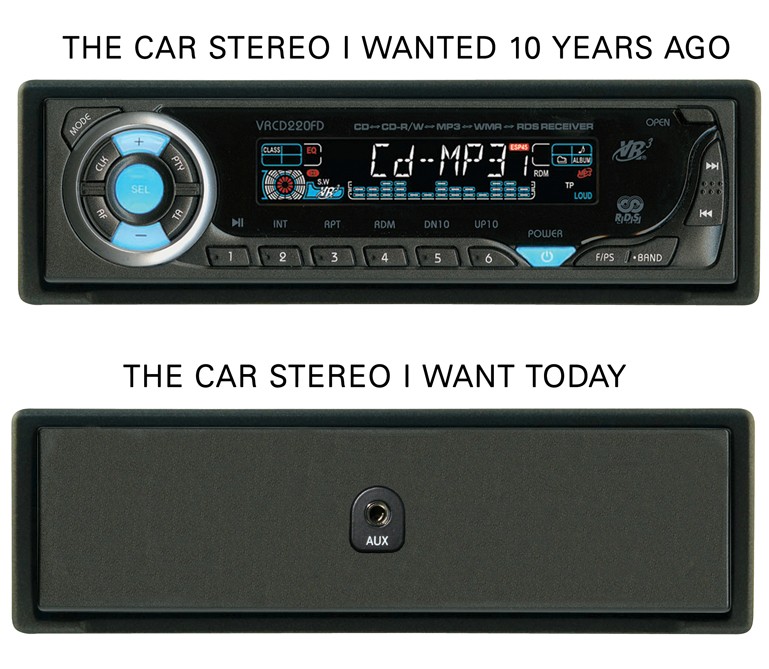
    • Option 1: A Bluetooth or hardwired connection that recognizes that at this stage in the game, there are many more ways to get audio on an Android or iOS-based device than via a locally stored library, and is prepared to handle that. So no confusion when my iPhone is using iTunes Match, Rdio or Spotify instead of a local library; retain the ability to change tracks, recognize metadata for all content, and handle functions like skipping tracks without erratic behavior. I’m fine with an in-car system leaving the heavy lifting to my smartphone of choice and acting mostly as a dumb pipe, but at this stage in the game, we don’t have to be more-frustrating-than-a-simple-aux-connection dumb.
    • Option 2: Custom, target-OS based systems that aren’t car manufacturers-specific, but cater instead to the two dominant mobile operating systems, Android and iOS. This would essentially involve Apple and Google coming in and saying, forget SYNC, forget QNX, forget whatever else you’re doing, let’s put iOS or Android in cars for a perfectly seamless experience with a user’s existing device, apps and services. As far as I’m concerned SYNC and other manufacturer-proprietary systems are little better than heavy-handed, often confusing chromes layered on top of functionality that mobile OSes already do perfectly well on their own. Just throw an iPad mini in the dash.

    (via Reddit)

    Car makers are taking steps in the latter direction, with Siri integration coming to cars from a number of manufacturers including GM, Honda, Audi and more. But this is still taking the form of integrations with existing systems like Chevy’s MyLink, which in my opinion are about as friendly and necessary as overwrought manufacturer skins plopped unceremoniously on top of stock Android.

    Cars that run Android were among the trends spotted at CES this year, but companies have been demoing in-vehicle Android for a while now. The problem is that you often won’t recognize it. What car manufacturers need to realize is that mobile tech has answered a lot of the same problems they have when it comes to navigation apps, in-car entertainments and utility software in ways that don’t require much rethinking or translation. Taking steps to minimize driver distraction is obviously one thing, but from my experience with SYNC and the rest, that hardly ends up being a core focus on most car-focused interface-design choices, so it’s a thin argument for sticking with the existing direction most are headed in.

    A user’s mobile device affects more and more of their lifestyle choices, resulting in the rich ecosystems we see out there today for accessories and appliances that are compatible with iOS and Android. Car makers need to realize this isn’t just a nice-to-have for consumers going forward, but an actual top-tier priority. In other words, the first person to build me a car that replaces the dash entertainment system outright with an iPad (as a standard, factory-installed option) wins.

  • Microsoft NEEDs a Mobile Manhattan Project

    “We didn’t miss cell phones, but the way that we went about it, ah, didn’t allow us to get the leadership. So it’s clearly a mistake.” That’s the chilling admission from Microsoft Chairman Bill Gates during a CBS This Morning interview with Charlie Rose. Referring to CEO Steve Ballmer, the cofounder emphasizes: “He and I are not satisfied that in terms of, you know, breakthrough things, that we’re, ah, doing everything possible”. You think?

    Hallelujah! Praise the Lord (or whomever or whatever you worship, if anything). Change starts with admission of fault, and Gates gives it. So what should Microsoft do about the problem? Take my advice. Please. Starting five years ago, I repeatedly recommend Microsoft lunch a Mobile Manhattan Project — on the order of Internet Explorer in the mid-1990s but only much, much larger. There simply is no other way to catch up in mobile.

    What I Predicted

    In September 2008, writing for Microsoft Watch, I cajoled and warned: “It’s time for Microsoft to launch a Mobile Manhattan Project, something on the scale of Internet Explorer in 1996. If Microsoft cedes the mobile market to Apple and Google, the PC will be the software giant’s final — and declining — legacy. Mobile devices, particularly cell phones, will be the next dominant platform. The PC’s role will reverse, becoming adjunct to the cell phone”.

    But there is greater context. I posted about Google’s browser, then out in beta, not Microsoft mobile:

    Make no mistake, Chrome is the most threatening competitive product Microsoft has faced in a decade. But the threat is more potential, because Google has a long way to go from beta to shipping product and wooing developers to the new runtime along the way. That said, if Microsoft’s mobile strategy weren’t so weak, I wouldn’t be writing this blog post.

    Before continuing on the main topic, I must clearly state something I’ve alluded to in other posts: Microsoft must change its priorities. The company has wasted too much time chasing Google in search. The search wars are over, and Google won. Microsoft must accept this. Where Microsoft should have been pushing hard is the device category where search will be the killer application: the cell phone.

    Would any of our usually sassy commenters like to argue that any of this isn’t true today, as predicted? Have fun trying.

    Once, sometimes twice, a year, I rail about this topic, but the older posts carry more weight. Another, from December 2009: “I tell you this: If Microsoft loses the mobile market, it loses the future. Once again, and I’m exhausted from blogging this, I say that Microsoft must launch a mobile Manhattan Project. If not, it will be buyers of all categories, including enterprises, hanging up on Windows Mobile”.

    Of course, Microsoft hung up on the OS and shifted to Windows Phone. I issued these warnings before iPad launched, or Android gained such overwhelming phone sales share. June 2010: “There is no Mobile Manhattan Project, but leadership living in denial about the future and the kind of resources necessary just to stay in the game. Winning is no longer an option — not at the current level of commitment”.

    Finally, though, Gates admits a “mistake”. If this is the end of denial, then change is possible, but only with deep commitment to leap ahead and redefine the mobile category. Microsoft has no time to waste. Minutes matter. Google activates more than 1.3 million Androids, the majority smartphone, per day. During fourth quarter, combined Android and iOS smartphone share reached 90.1 percent, up from 74.9 percent a year earlier, according to Gartner. Anshul Gupta, Gartner principal research analyst, says that “2013 will be the year of the rise of the third ecosystem as the battle between the new BlackBerry 10 and Windows Phone intensifies”. The operating systems have 3.5 percent and 3 percent sales share, respectively.

    What can Microsoft do

    Mobile Manhattan Project is possible, because Microsoft did something similar before in the 1990s. Netscape got a big head start in browsers, amassing massive market share early on. But in just 18 months, Internet Explorer matched and even exceeded its rival. Microsoft needs to make that kind of commitment in no more time than that.

    The company already is on the right track with Surface tablets, and I strongly encourage Ballmer and team to stay the course, while releasing models with 7-7.9-inch displays. The larger problem is phones. Some recommendations:

    1. Suspend Windows Phone licensing fees for 12 months. Make the operating system free, a strategy that worked well in browsers. Windows Phone competes with Android, which is freely licensed, and iOS, which cost Apple realizes through research and development. Microsoft must match free with free, with the goal being to gain market share. Nothing is more important than grabbing share. Fast.

    Ballmer should know from Windows’ success, an incumbent platform isn’t easily displaced. During the global transition to smartphones, Windows Phone could still make huge share gains. But the opportunity closes quickly and could be over as soon as next year’s major handset release cycle.

    Smartphone sales surged 38.3 percent during fourth quarter, to 207.7 million units, according to Gartner. Meanwhile, feature phone sales fell 19 percent to 264.4 million. Respective share in Q4: 44 percent and 56 percent. At this pace, smartphone sales should surpass feature phones within a couple quarters. Time is short.

    2. Pay some manufacturers to license Windows Phone. You read that right. China is now the largest smartphone market, and sales growth is gangbusters. During fourth quarter, smartphones accounted for 73 percent of all handset shipments to China, up from 40 percent a year earlier, according to Canalys. Shipments soared 113 percent to 64.7 million units, or 30 percent of all smartphones globally.

    Followed by leaders Samsung and Apple. three Chinese manufacturers — Huawei, ZTE and Lenovo — rounded out the top five, according to Canalys. So there are two overlapping trends: Rapid adoption of smartphones in the world’s largest handset market and manufacturers there rapidly reaching the world stage. Android is the common denominator — whether sales to China or by Chinese manufacturers.

    Microsoft must woo both by every means, even if that means paying, perhaps with co-marketing dollars, for Chinese OEMs to license Windows Phone — even preferred placement, but non-exclusive, over Android. Radical thinking is required, if Microsoft is to catch up.

    3. Buy Nokia. I never expected to recommend this, but Microsoft and the Finnish phone maker are tightly-joined through their OS licensing deal. Marriage is the only sensible step left. Such a move would:

    • Spread the Microsoft brand across the globe fast, just like that Apple logo seen everywhere
    • Put Microsoft in control. The company can design compelling hardware and software, as Xbox and Surface show. Nokia’s deep engineering skills are helluva foundation.
    • Meet market trends. Brands not operating systems matter to consumers, and there Apple and Samsung lead, with combined 52 percent smartphone sales share, according to Gartner. Google now sells Nexus phones and owns Motorola. Branded phones and supporting services are the future.

    Channel conflict isn’t much of a concern. Other than Nokia, what other manufacturer does anything for Windows Phone? For example, during Q4, Microsoft partner and global handset leader Samsung accounted “42.5 percent of the Android market globally”, Gupta says, “and the next vendor at just 6 percent share”.

    Microsoft’s success buying and leverage Skype shows that Nokia is possible, too.

    4. Make video calling the future. If Microsoft doesn’t, Apple, Facebook or Google will. Phone calls are passé. The success of services like SnapChat show just how much interest there is in immediate visuals. Skype Video Messages is a great start, alongside other existing video chat features.

    The next big thing in phones should be video calling, and Skype has mature features and global reach to be the means on any platform. Microsoft can make the experience better by cutting deals with carriers for Windows Phone and through aggressive marketing demonstrating the benefits. Apple tried with FaceTime, but the service is restricted to iOS. Skype is everywhere and a huge globally recognized brand that can help raise Windows Phone’s brand visibility.

    5. Launch “Bing Me” service. Google Now and voice search are killer apps, and the best reasons to choose Android. Microsoft, which was a pioneer in so-called New User Interface technologies, let Google leap ahead. That needs to be fixed. Immediately. Microsoft has NUI assets and search capabilities to offer a compelling, competing service. Something else: The company has talked about search as answers to questions for a decade, but Google gives them instead and where they are needed most — mobile. Microsoft needs a “Bing Me” service pronto, and it should be the Mobile Manhattan Project’s first deliverable.

    These are but a few suggestions to start, and don’t go far enough, which would be something that truly transcends and redefines the category. Perhaps that’s topic for a future post.

  • Turtle Beach’s New Seven Series Headphones Are A Gamer’s Audio Dream

    Screen Shot 2013-02-18 at 11.44.08 AM

    If you’re a hard-core gamer, the name Turtle Beach most certainly means something to you. We met with the tournament-grade headset maker to discuss their new Seven series of headsets, originally debuted at CES.

    There are three different models in the line, the XP Seven (meant for all consoles, PC, and mobile), the Z Seven (meant for PC and mobile) and the M Seven (mobile only). Both the XP Seven and the Z Seven come with a special Audio Control Unit (or ACU) that lets you adjust even the most minute details of the audio.

    For example, you can set the speakers to be loudest toward the rear, letting you catch on to anyone who might be sneaking up behind you. You can also adjust the headset so that footsteps and gunshots can be louder, while the actual game sounds are much lower. There are eight different pre-set configurations you can build on your own, making it quick and easy to switch from one game to the next and still enjoy the best possible audio for each.

    Users also have the ability to mix in music from their phone, answer calls, and chat with other players using the XP Seven. You can even remove the microphone and just use these bad boys as your main headphones. Plus, the plates on the ear cups are removable, so you can buy various colors to customize your headset.

    At $279, the XP Seven is on the expensive side, but with the extra advantages they bring it’s well worth it if you game every day.

    The Z Seven model has all the same functionality, but is meant for PC and mobile only, while the M Seven doesn’t come with an ACU but does bring console-quality sound to mobile gaming.

    All three models are available now, so click here if you’re interested in learning more.

  • The best tech demos at TED

    383975_Boaz_Almog_2012G_stageshotCalling all self-proclaimed tech nerds! TED2013, themed “The Young. The Wise. The Undiscovered.,” begins in six days. As we cover the conference live — blogging each and every of the 70 speakers, including those from the worldwide talent search — we will be anxiously awaiting a demo that sets everyone in the theatre a-buzz. In preparation, here’s a look back at 9 memorable tech demos from TED and TEDGlobals past.

    Boaz Almog “levitates” a superconductorBoaz Almog “levitates” a superconductorBoaz Almog “levitates” a superconductor

    On stage at: TEDGlobal 2012
    Boaz Almog uses quantum locking to “levitate” a superconducting disk over a rail, without friction or energy loss. Start at 4:30 to watch a super-thin 3-inch disk levitate something 70,000 times its own weight.
    A robot that flies like a birdA robot that flies like a birdA robot that flies like a bird
    On stage at: TEDGlobal 2011
    Markus Fischer and his team at Festo, a German tech company, developed a lightweight, incredibly lifelike robot that flies like a bird. Watch from 2:00 to 3:00 to see the SmartBird in action as it soars over the audience.
    Tan Le: A headset that reads your brainwavesTan Le: A headset that reads your brainwaves

    Tan Le: A headset that reads your brainwaves
    On stage at: TEDGlobal 2010
    A mind-boggling demo by Tan Le, in which a volunteer is able to “pull” a cube toward him on a screen, just by thinking it.
    Eric Giler demos wireless electricityEric Giler demos wireless electricity
    Eric Giler demos wireless electricity
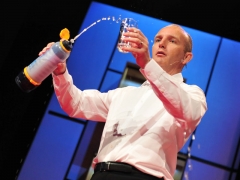
    On stage at: TEDGlobal 2009
    Eric Giler presents wireless electricity, which uses magnetic resonators to transfer power over large distances via a magnetic field. Watch at 6:30 to see a standard TV and three different smart phones powered wirelessly.
    Michael Pritchard: How to make filthy water drinkableMichael Pritchard: How to make filthy water drinkable
    Michael Pritchard: How to make filthy water drinkable

    On stage at: TEDGlobal 2009
    Michael Pritchard introduces his portable 15-nm filters, which can capture the tiniest viruses and make water drinkable. At 3:30 Pritchard takes visibly disgusting water from the Thames, Cherwell and his own pond, runoff from a sewage farm, rabbit droppings and other delights, and pours it through his filter, then drinks the water. TED Curator Chris Anderson takes a swig as well.
    Pranav Mistry: The thrilling potential of SixthSense technologyPranav Mistry: The thrilling potential of SixthSense technology
    Pranav Mistry: The thrilling potential of SixthSense technology
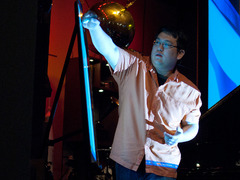
    On stage at: TEDIndia 2009
    Pranav Mistry of MIT Media Lab talks about developing SixthSense, a gesture-interface device that allows you to replicate what you do in the physical world in the digital world. Long before Microsoft Kinect, Mistry showed how he could treat any wall as a digital interface and take pictures just by gesturing with his fingers.
    Johnny Lee demos Wii Remote hacksJohnny Lee demos Wii Remote hacksJohnny Lee demos Wii Remote hacks
    On stage at: TED2008
    At 1:40 Johnny Lee shows how to turn a Wii Remote into a digital whiteboard, touchscreen and a head-mounted 3D viewer, all for $40.
    Blaise Aguera y Arcas demos PhotosynthBlaise Aguera y Arcas demos PhotosynthBlaise Aguera y Arcas demos Photosynth
    On stage at: TED2007
    Blaise Aguera y Arcas of Microsoft demoed Photosynth, a software which uses a giant database of static photos to allow you to navigate a space as if in 3D. It’s a fascinating demo — given pre-Google Street View.
    Jeff Han demos his breakthrough touchscreenJeff Han demos his breakthrough touchscreenJeff Han demos his breakthrough touchscreen
    On stage at: TED 2006
    Well before Apple popularized multitouch technology with the iPhone, Jeff Han had built his own high resolution, low cost and scalable multi-touch screen, shown here.

  • Nine Balls, One Hole Is Totally Just a Cool Golf Video, I Promise

    Trust me, this is SFW.

    “Every month the PGA Golf Management program at Campbell University has a competition between the different classes. The January competition was to see how many people could line up and make a putt at the same time. The winners this month was the Senior Class with nine people.”

    DAMNIT! IS THAT CUP REGULATION SIZE OR WHAT?

    [via Campbell PGAGM]

  • PBS Releases A Tear-Jerking Tribute To Matthew And Mary Crawley

    Still sad about the way the latest Downton Abbey ended? This will do absolutely nothing to cheer you up, but at least you can honor the love that Matthew and Mary Crawley have shared as if they are actually your own loved ones.

    Now, to cheer you up, here’s comedian Patton Oswalt’s livetweeting of the episode.

  • A Multi-Perspective Look At The Ambitious Pebble Smartwatch

    pebble-shots

    Pebble smartwatches have been hitting doorsteps for a little while now, but my colleague Darrell Etherington and I have only just been able to join the party. The reasons for the extra wait differed for the two of us — I was a late backer, and his got stuck in Canadian customs — but the timing seemed right, so here’s our tag-team review of the device that helped kick start a new era of smartwatch hype.

    Darrell: The Pebble has one huge advantage over other smart watches right out of the box: aesthetics. This is a watch that lets your geek flag fly without being ass-ugly. The watch face options aren’t necessarily all that awesome, but set it to the text face that comes pre-installed and don’t worry about the rest. Also, black was the right choice, even if it was the only choice if you wanted one of the first shipping devices. Black watch on black strap in the Pebble looks fantastic on most any wrist.

    The screen is legible enough, but in some light the glue becomes visible to the point of annoyance, which is a rookie mistake and should not make it into production units, if the Pebble team is worth its salt. It affects all the Kickstarter units I’ve come across so far, however, so that’s not a good sign.

    Chris: I don’t think the Pebble is quite as handsome as Darrell does — it’s not bad looking, but it’s hardly a fashion-forward timepiece. Still, some of the promises that Pebble has made to its backers have positively influenced the watch’s look — rather than including something like a standard microUSB port for instance, the Pebble sports a magnetic charger so as to keep the whole shebang waterproof. The included rubber strap is plenty comfortable too, if a bit on the drab side. That’s easily remedied though — the Pebble apparently works fine with any 22mm watch band though, so the sky’s the limit as far as customization goes.

    While we’re talking about design, the Pebble’s iOS and Android companion apps are both intuitively laid out (which is critical since the Pebble would be largely useless without them). The sync process is very brief, and once that’s done you’re quickly guided into setting up notifications — the whole process can be knocked out in just a minute or two. And of course a tiny vibration motor whirrs whenever you get a notification, though the wrong kind of aftermarket watchband may make it harder to feel.

    Darrell: Compared to the MetaWatch, using the Pebble is like a breath of fresh air. It’s almost the difference between proving that a smart watch as a concept is a good idea vs. something no one needs. From display, to overall look, to usefulness and dependability of features, the Pebble just blows the MetaWatch out of the water. Some might miss features like weather, stocks, and more that you get with the MetaWatch, whereas the Strata struck me as a novelty that quickly lost its charm, the Pebble already seems like something I’d have to at least adjust to living without.

    Chris: Unlike Darrell, the Pebble is my first foray into this whole crazy smartwatch thing, and my time spent with the thing has generally been very positive For the past few days I’ve been switching between linking the Pebble with my iPhone and my Droid DNA, and it wasn’t long before I began to prefer the experience on the latter just because of the extra granularity Android affords me. Under Android, I’m able to pass along notifications from Facebook and Google Voice (!) in addition to more standard fare like calendar entries and text messages.

    Thankfully, the four-button navigation scheme used to handle all these notifications and menus is incredibly straightforward. The top and bottom buttons on the right side allow you to (what else) scroll up and down through menus, while the two remaining buttons take you forward and back. Hardly a flashy way to get things done (especially when some smartwatch rivals lean on touchscreens for operation) but it mostly works like a charm.

    Darrell: There are still issues with the Pebble. Email notifications cut out when using it on iOS when it drops the Bluetooth connection and reconnects, for instance. Caller ID and message notifications work consistently, however, so this isn’t a huge issue. The menu system could also use work; it’d be nice to be able to rearrange items in the list to make frequently-needed ones easier to access. Adding watch faces from the app just puts them at the bottom, and that’s going to become a bigger issue once you have third-party apps to manage from the Pebble. The backlight is also immensely inconsistent; don’t even bother with the automatic ambient light sensor, just turn it on at night and off during the day, or keep it on all the time if you’re not that concerned with eking out as much battery life as possible.

    On iOS, despite the fact that limitations are limited, the ones that it does provide work well. I actually prefer it to Android, since the limited support (only iMessage/SMS, email, phone and calendar notifications come through) means you won’t face a constantly buzzing wrist.

    Chris: I’ll agree that notifications work, but the way they’re implemented leaves plenty to be desired. Let’s say you get more than one message within a short period of time — the Pebble will only ever display the most recent one, so you’re going to have to go digging for your phone anyway. Now, I never expected the Pebble to replace my phone(s) for these sorts of tasks, but I was looking for something that would at least help me triage the constant flow of messages and updates and the Pebble isn’t quite there yet.

    I haven’t had much luck with the ambient light sensor, but that really hasn’t been an issue for me. I’ve been leaving the backlight setting on pretty much all the time and haven’t seen a huge loss in terms of battery life — I can get about 5-6 days out of it with everything turned on, and the backlight is off most of the time anyway.

    Since we’re talking about inconsistency though, what about these screens? They’re not always the prettiest things to look at while in direct sunlight, mine in particular — it’s not as notable when the Pebble is just displaying a clock face, but there are some cloudy patches of coloration visible when I navigate the menu outdoors. Apparently it’s just a natural thing, but it’s still sort of unpleasant to see every day.

    Darrell: The Pebble is still a little rough around the edges (visible glue at some angles under the display, which isn’t a problem limited to a few isolated units), but it’s much closer to the vision I had in my mind of a wrist-mounted, smartphone connected computer than anything else I’ve used so far. It still feels like a first-gen device, but it doesn’t feel like a prototype. But now that rumors of an Apple smart watch are swirling, most users who don’t feel a pressing need for this kind of device would do best to take a wait-and-see approach, especially if they’re already using an iPhone.

    Chris: I’m frankly a little torn when it comes to the Pebble — it’s very limited in some key ways, but as a whole it’s a portent of very exciting things to come. People who haven’t already bought into all this smart watch hype probably won’t find anything particularly revelatory or earth-shaking here, though I can’t say I feel like I’ve wasted $150. If anything, I think of it more as investment in what the Pebble platform can actually become as it matures and garners more developer support.


  • LG Announces the 5.5-Inch Optimus G Pro

    As Samsung and Apple continue to corner the smartphone market, other handset manufacturers are still bringing out their competitor smartphones. Whether or not they make any headway may have to do with branding as much as the hardware they are able to pack into the devices.

    Today, LG announced its latest product, the Optimus G Pro. The smartphone will feature a 5.5-inch screen with a 1920 x 1080 resolution – an incredible 400 pixels per inch. It’s a display that’s less than two inches away from mini-tablet territory, and clearly positioned to compete with Samsung’s 5.5-inch Galaxy Note II smartphone.

    The Korean manufacturer has also packed a huge 3,140mAh battery into the G Pro. The processor is a 1.7GHz quad-core Snapdragon, and the smartphone comes with 2GB of RAM. 32GB of memory is standard, but the device will also have a microSD card slot. The cameras (13MP front/2.1MP back) are an upgrade even for this class of smartphone, and the G Pro will ship running Google’s Android 4.1.2 Jelly Bean OS.

    “The Optimus G Pro was developed specifically to deliver vivid and superb picture quality in a large display smartphone form factor,” said Jong-seok Park, CEO of LG Electronics Mobile Communications. “We will continue to expand our position in the premium LTE smartphone segment with our superior display technology and unique user experience.”

    It’s clear that LG is making a play for high-end consumers who want a long-lasting device with which to play HD games and video, and the price of the Optimus G Pro will no doubt reflect that. Whether the company can make a dent in Samsung’s impressive Galaxy Note sales remains to be seen.