Blog

  • The Robot-Driven Data Center of Tomorrow

    google-tapelibrary

    Tape libraries, like this one at Google, provide an early example of the use of robotics to manage data centers. Robotic arms (visible at the end of the aisle) can load and unload tapes. (Photo: Connie Zhou for Google)

    There is an evolution happening within the modern data center. Huge data center operators like Google and Amazon are quietly redefining the future of the data center. This includes the integration of robotics to create a lights-out, fully automated data center environment.

    Let’s draw some parallels. There’s a lot of similarity between the modern warehouse center and a state-of-the-art data center. There is an organized structure, a lot of automation, and the entire floor plan is built to be as efficient as possible. Large organizations like Amazon are already using highly advanced control technologies – which include robotics – to automate and control their warehouses.

    So, doesn’t it make sense to logically carry over this technology to the data center?

    Robotics in the Data Center

    As the reliance on the data center continues to grow, full software and hardware robotics automation is no longer a question of if, but a matter of when, technologists predict. Robotics organizations, like Chicago-based DevLinks LTD are already having conversations and creating initial designs for data center robotics automation.

    Scott Jackson, Senior Robotics Programmer at DevLinks, says it’s becoming quite feasible to have a robot fetch a drive, blade or even a chassis and deliver it to a central bay for replacement.

    “Simple RFID tags, laser and barcode identifiers can create true data center automation,” Jackson explains. “For example, you can tag drives with RFIDs and assign them to be wiped, destroyed and reused as needed.” Conveyor systems are able to run in parallel to robotics within the data center environment.

    There are already working examples of robotics in the data center. Tape archives seen at Google and high-performance computing data centers use robotic arms to locate and retrieve backup storage tapes.  (For an example, see this video of a system in action at the NCAR data center).

    What Will Be Different?

    What might a robot-driven “lights-out” data center look like? There would be rail-based robotics capable of scaling the entire data center. Here’s an interesting wrinkle: the modern data center would no longer be limited by horizontal expansion space. When using robotics, data centers can literally scale upwards. Utilizing space in the best possible manner is always a challenge for data center providers, so having the ability to scale both horizontally and vertically becomes a huge advantage.

    “These robotics can scale the entire rack, which can now be much taller because of these intelligent robots can reach higher,” said Jackson. “Once a part is removed, a conveyer at the bottom can move the part to the appropriate floor space. Furthermore, detailed vision technology has progressed a long way as well. Solutions like Cognex are able to allow machines to take pictures of a device, barcode and many other variables to help identify the part’s destination or origin.”

    Large organizations that invest heavily in their data center infrastructure are actively exploring robotics solutions to help them better control their data centers. IT shops such as Amazon and Google are looking at ways to create a fully automated, lights out data center. AOL has taken a first in that direction with an unmanned data center facility.

    The Cost Equation

    As with any technology, costs for custom data center robotics will start high and come down as time progresses and platforms become smarter. Smaller robotics are already becoming less expensive. Manufacturers like FANUC develop large machines; but they also create smaller, more agile robotics. Models like the LR and the Mate M-1iA are paving the way for super-agile, fast, robotics capable of granular part identification and distribution.

    Both data center, automation, and robotics technologies have come a very long way over the past decade. From the warehousing perspective, robotics already know where everything is located, how to put things in order and are able to directly interact with the human-created automation scenarios. Because of robotics, something very interesting has happened: Instead of the human going to the warehouse, the warehouse comes to the human.

    Soon it will be possible to do this at the data center level.

    This would enable entirely new approaches to operations. Your data center will be able to run at a different temperature level, you won’t need any lights, and you can directly integrate your new robotics platform into a modern-day automation and orchestration platform. From a central command center, the human operator can maintain visibility into their data center environment, the robotics infrastructure and the workloads that are being managed. This can all be done without the need of a single person on the data center floor.

  • The National Map Corps – Volunteers Receive Recognition

    Citizen volunteers are making significant additions to the U.S. Geological Survey’s ability to provide accurate information to the public. Using crowd sourcing techniques, the USGS project known as The National Map Corps (TNMC) encourages citizen volunteers to collect manmade structure data in an effort to provide accurate and authoritative spatial map data for the National Geospatial Program’s web-based The National Map.

    These structures can include schools, hospitals, post offices, police stations and other important public places along with data from other sources, the data currently being collected by volunteers become part of TNM Structures dataset which is made available to users free of charge.

    In an effort to recognize the important work being done by volunteers, TNMC has created a recognition program based on the number of points a volunteer contributes. Levels of recognition are displayed in the form of icons or badges of antique catalog drawings of different and increasingly sophisticated pieces of surveying equipment. Each badge comes with a description of the item and encouragement to achieve the next level. As a volunteer attains each level, a congratulations email is sent, and the accomplishments are recognized via The National Map Twitter site (#TNMCorps) and the USGS Facebook page

    Recognition Categories:

    Recognition Category

    Number of points

    Order of the Surveyor’s Chain

    25 – 49

    Society of the Steel Tape

    50 – 99

    Pedometer Posse

    100 – 199

    Circle of the Surveyor’s Compass

    200 – 499

    Stadia Board Society

    500 – 999

    Alidade Alliance

    1000 – 1999

    Theodolite Assemblage

    2000+


    surveyors chain award theodolite award
    Order of the Surveyor’s Chain award. (Larger image) Theodolite Assemblage award. (Larger image)


    Becoming a volunteer for TNMC is easy; go to The National Map Corps project site to learn more and to sign up as a volunteer. If you have access to the Internet and are willing to dedicate some time editing map data, we hope you will consider participating.

    While some familiarity with the area that a volunteer chooses is helpful, you do not have to live near a particular place to contribute. The tools on TNMC website, along with ancillary information available on the Internet, are generally sufficient to edit a distant area. There are presently nineteen states available for volunteers to choose to update structures in.

    See for yourself how much fun participating can be. Go to The National Map Corps home page, give it a try and before you know it you’ll be hanging out with the Pedometer Posse!

  • Itsdagram for Windows Phone 8 gets new features, ad-supported free version arrives

    The lack of an official Instagram app for Windows Phone opened the door to many third-party offerings looking to make their mark on the ecosystem. Itsdagram, released little under a week ago with a comprehensive feature set, seized the opportunity and climbed to the number one spot in the top paid category in the US Windows Phone Store.

    Daniel Gary, the developer behind the app, decided to further build on Itsdagram’s success by releasing a free, ad-supported, version which comes with unlimited photo uploads and the same feature set as its paid counterpart. Previously, the trial variant only allowed users to post a single photo to Instagram.

    The developer also released an update for Itsdagram, meant to bring new feature and iron out a couple of bugs. The app now boasts a tweaked UI (User Interface), a counter for followers, following and photos on the user’s profile page and a refreshed live tile design which reflects its new icon.

    Users have the ability to approve and deny follow requests, enable private profiles and save photos on the device. The app no longer allows to send feedback directly to the developer as the corresponding page is now removed.

    The latest version of the app also comes with bug fixes and improvements for the finding friends feature, repeating notifications and the registration process.

    Itsdagram (paid version) is available to download from the Windows Phone Store.

    Itsdagram (free version) is available to download from the Windows Phone Store.

  • ‘Pandora Premiers’ streams full albums a week before they launch

    Pandora Premiers Album Streaming
    As Pandora struggles to fight off a new wave of competition from the likes of industry giants like Google and Apple, the company recently announced a new feature that could definitely boost interest in its services. Dubbed “Pandora Premieres,” the new feature allows users to stream new albums in their entirety a week before they are released to the public. Upcoming albums can be streamed on-demand from start to finish for one week until they are released, and then they will be mixed in with Pandora’s standard streaming radio offering. Pandora Premieres is available to Pandora subscribers at pandora.com/premieres, and the company’s full press release follows below.

    Continue reading…

  • Unhappy Tumblrs look for safety nets

    Despite Yahoo CEO Marissa Mayer’s promise not to “screw up” Tumblr following its recent acquisition, the move has caused some disquiet in the user community.

    Posting on Tumblr, of course, many users are worried about the impact advertising may have on the Tumblsphere, others that Yahoo will change the ethos of the site. There was disquiet about rumors Yahoo would push to make it more family friendly by filtering content too — around 1 in 6 Tumblr pages is reckoned to contain porn. Despite assurances, and the fact that the circulating message about the clean up has been exposed as fake, there’s a lot of distrust out there.
    Already websites like www.bluegrownup.com are springing up with the aim of offering disgruntled Tumblrs a new home. There’s also a tool to help users migrate their blogs to WordPress.

    Personally I like Tumblr, though I don’t exactly fit its cool kid demographic. I’ve used it since 2010 and it’s the only blogging platform I’ve stuck with over a long period of time, mainly thanks to its ease of use and its ability to integrate content with other sites. If Yahoo can manage Tumblr in a sensitive way and preserve what’s good about it I’ll be happy to stay. It seems to have managed this trick with Flickr so there is hope.

    It’s worth considering what this means from the Yahoo side of things too. If you can locate a Yahoo user you won’t find them worrying about upcoming changes — Yahoo doesn’t inspire that kind of user loyalty. But Tumblr isn’t the only thing the company has bought recently and there’s a definite pattern to the acquisitions. Earlier this month it purchased Astrid — a smartphone daily organizer app — for an undisclosed amount. In March it bought news aggregation app Summly from British teen entrepreneur Nick D’Aloisio for $30 million. What these and Tumblr have in common is an emphasis on personalizing the web experience. They’re also all targeted heavily towards mobile devices.

    We can expect to see the impact of this shopping spree on the delivery of Yahoo’s news and other services. You can already detect change in the air with the new tablet-friendly Flickr layout, though as with any redesign there are some users who don’t like the new look. Whether all this will be enough to make people really care about Yahoo again only time will tell. In the meantime Tumblr users should probably sit tight for a while and see what happens.

    Photo Credit: fotoscool/Shutterstock

  • Darius Rucker: Racist Tweet Gets Response ‘So The World Can See It’

    In the last few years, former Hootie & the Blowfish singer Darius Rucker has been refashioning himself as a country music artist. And a recent performance and the surprising reaction on Twitter led Rucker to express disbelief at the racism happening in the year 2013.

    One Twitter user took issue with Rucker recently covering the Bob Dylan-inspired Old Crow Medicine Show hit “Wagon Wheel” at the Grand Ole Opry in Nashville.

    “Leave the country to white folk,” said user @pqkullman.

    “WOW is this 2013 or 1913,” tweeted Rucker. “I’ll take my Grand Ole Opry membership and leave your racism. Wow.”.

    He was then asked why he responds to racists on Twitter:

    Since Sunday, Rucker has had to battle even more pointed racist tweets. Like this one, for instance:

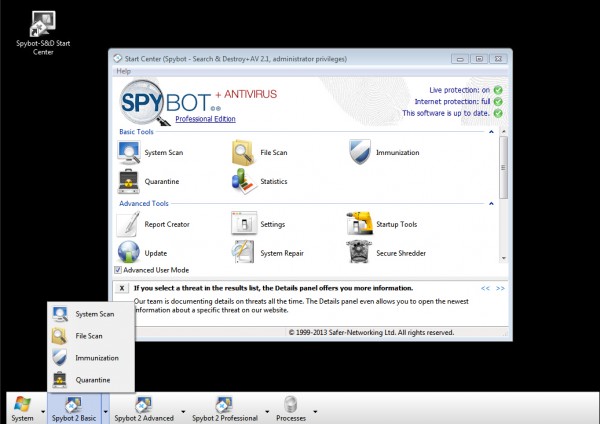
  • Spybot +AV adds full antivirus protection to Home and Professional editions

    Irish security firm Safer-Networking Ltd has announced the release of Spybot +AV 2.1, a major reinvention of the package which sees the addition of virus protection for the Home ($13.99) and Professional ($25.99) versions (the free build removes malware and rootkits only).

    A great deal of this new release is about delivering the framework necessary to support the antivirus engine. An update mechanism delivers antivirus signature files multiple times a day, for instance. The system offers real time protection, too, although this can optionally be turned off if there’s a chance of it conflicting with something else.

    One potential risk with this kind of major change is that you’re affected by false positives, with the program flagging every tiny utility you’ve downloaded recently as a serious threat. Spybot +AV 2.1 allows you to remain fully in control, though, with a new “selective removal” option which means you can review its findings, and decide if you want to remove or keep any suspect files.

    Elsewhere, this new release applies a number of tweaks to further enhance its performance. Smarter use of white listing for system files mean the program has less work to do; multi-core support helps it take full advantage of your system resources; and if you’re in a real hurry, there’s now an option to have the program scan only the most recently used files.

    An integrated proxy server sounds particularly interesting, as it looks out for and blocks “suspicious cookies and access to suspect URLs”. We’ve not been able to test this yet, but clearly there’s major scope for future developments here.

    And other enhancements include a simplified “Protected Repair Environment” (Professional version only), which makes it even easier to clean up an infected PC; new French and English language support; and, of course, the usual interface tweaks to try and simplify program use.

    The major improvements here are to the Home and Professional editions, then, but the free edition of Spybot 2.1 also has enough to justify the upgrade, and it’s available for download now.

  • Cloudcheckr boosts support for Amazon GovCloud

    CloudCheckr, one of several vendors that monitor Amazon Web Services usage for customers, says it is the only one of those rivals that can do that job for  Amazon’s restricted GovCloud. GovCloud is a separate U.S. region set up for state, local and federal agencies that must meet special requirements for cloud use.

    Tools like CloudCheckr’s service can help in the government procurement process — a big deal given the U.S. government’s cloud-first mandate, which requires agencies not only to deploy a different sort of technology, but to readjust how they think about buying and paying for services.

    “They have a hard time dealing with cloud costs because they’re so used to fixed-cost contracts,” said James Hirmas, COO of JHC Technology, an AWS consultancy specializing in government work and a prime contractor for the National Institute of Standards and Technology (NIST). JHC worked with CloudCheckr to integrate its service with GovCloud.

    CloudCheckr

    With that integration, a customer can see if it’s underutilizing compute instances for a certain task and, if so, advise that the work be moved to a smaller, cheaper instance, for example. CloudCheckr performs compliance checks and best practice analysis for GovCloud environments.

    Aaron Klein, COO of Rochester, N.Y.-based CloudCheckr, said the GovCloud service does 90 percent of what it does on the commercial side. “GovCloud is architected differently from other AWS regions,” he said. “First you need access, then you need to delve in and adapt what you have to work best in that environment.” He also pointed out that not all of AWS’s own services are running on GovCloud so far.

    Since GovCloud is compliant  with the International Traffic in Arms Regulations  (ITAR) – only U.S.-born personnel can work there or access it. Its help desk is U.S.-only. Background checks are also required.

    Amazon itself is clearly gearing up for more government work, having received its FedRAMP certification early this week. That accreditation  should make it easier for more government entities to use GovCloud (or other U.S. regions depending on the workload) without having to go through a lot of redundant testing and paperwork.

    Related research and analysis from GigaOM Pro:
    Subscriber content. Sign up for a free trial.


  • Xara Photo & Graphic Designer 9 introduces a wealth of new features

    Veteran UK developer Xara has released a brand new version of its acclaimed creative design tool, Xara Photo and Graphics Designer 9.1.0. Version 9 concentrates on revamping the package’s photo tools, with the introduction of Photo Healing, Background Erase and new masking tools and photo FX plug-ins.

    Version 9 also adds other new features including a Shape Painter tool, support for graphical bulleting and numbers, and improved font support, with multi-weight fonts now accessible from the Fonts menu and direct support for Google Fonts implemented.

    Xara Photo and Graphics Designer 9’s new photo tools are designed to be both easy to use and effective. The new Photo Healing tool — like those in other packages — is designed to quickly erase spots, scratches and other unwanted blemishes from photos, but is also designed to be used in conjunction with the program’s magic erase feature, making it possible to eradicate large unwanted parts of images with the promise of “amazingly seamless results”.

    The Background Erase tool, meanwhile, is designed to allow users to quickly cut complex images out of photos for placing on alternative backgrounds, while the new masking tools are designed to simplify the task of selecting parts of an image for applying selected effects too. These include both region painter and mask painter tools for selecting or protecting parts of the image from alterations.

    Version 9 also debuts 11 new Photo FX plug-ins. These are used for creating striking effects, such as simulating the effect of High Dynamic Range images with the Fake HDR tool, or marking specific parts of an image as color before rendering the rest of the image in black and white.

    Non-photo improvements
    Away from the photo-editing component, Photo and Graphics Designer 9 also implements a new and easier way to recolor elements in complex grouped objects such as clipart or buttons. Users can now simply drag and drop a color onto the group, then pick the color it’s intended to replace.

    Also added in version 9 is a new Shape Painter tool for painting on to an existing shape to enlarge it, add new areas or adjust its shape or outline — it’s designed to offer a simpler alternative to the existing Shape Editor tool.

    Font support has also been improved with support for selecting multi-weighted fonts in the program’s font menu joined by the implementation of direct support for Google Fonts, the free collection of fonts recently made available by the search engine giant. A new Google Font picker makes it easy to select from the entire collection — currently numbering over 600.

    The new build also sports some minor improvements: fly-out toolbars are now easier to use, JPEG/PNG conversion is now quicker and subtly better thanks to a new converter tool, while version 8 also adds compatibility with Windows 8 touch devices. Many of these subtle tweaks mirror those made to Xara’s Web Designer 9 tool, which was also recently released.

    Xara Photo and Graphic Designer 9.1.0 is available now as a free trial download for PCs running Windows XP or later. The full version retails for $89.99 plus VAT.

  • GigaOM Chrome Show 6: Chrome battle plans shown off at Google I/O

    Google I/O has come and gone without any new Chrome OS hardware. Was it a bust for Chromies? Not at all, but most of the news were behind the scenes services and provided context for Chrome’s cross-platform future vision.

    You can see some of that future in Chromium for the Mac, which is getting the Chrome App launcher. Our extension of the week dovetails with Google’s new Play Music All Access subscription service. And while Kevin still loves the Chromebook Pixel, he pleads with Google to add one important function to Chromebooks: Support for Google Play movie and TV downloads.

    Show notes

    Hosts: Chris Albrecht and Kevin C. Tofel

    • So what was Google I/O like, what’s new for Chrome and what new services did Google add?
    • More Intel-powered hardware builds are being tested
    • Chromium for Mac getting the App launcher
    • What’s Google’s vision for Chrome? To take over the world, of course!
    • Extension of week: Better Music for Google Play Music
    • When will Google add movie and TV downloads for Chromebooks?

    Got questions, tips or tricks for an upcoming GigaOM Chrome Show? Find Kevin on Google+, Twitter (@kevinctofel) or via e-mail ([email protected])

    (download this episode)

    Subscribe to RSS

    iTunes

    Stitcher Radio

    Related research and analysis from GigaOM Pro:
    Subscriber content. Sign up for a free trial.


  • Carlyle Plans to Raise $2 Bln for Japan Investments -Sources

    U.S. private equity firm Carlyle Group LP is planning to raise 200 billion yen ($2 billion) for a third Japan fund to succeed its seven-year old second fund, with Japan’s aggressive monetary easing helping to boost investor interest, Reuters is reporting.

    (Reuters) – U.S. private equity firm Carlyle Group LP is planning to raise 200 billion yen ($2 billion) for a third Japan fund to succeed its seven-year old second fund, with Japan’s aggressive monetary easing helping to boost investor interest, people with direct knowledge of the matter said.

    Carlyle, the only global private equity firm with funds specifically designated only for Japanese investments, aims to tap investor appetite for alternative investments as Prime Minister Shinzo Abe’s government pushes monetary expansion to fight deflation, keeping interest rates low.
    A Carlyle official in Japan declined to comment.

    Carlyle co-founders William Conway, Daniel D’Aniello and David Rubenstein, as well as other senior officials, will be meeting investors in Tokyo on Thursday to discuss its new Japan fund as well as its global strategy, said the people, who asked not to be identified as the information was not public.

    The new fund would succeed Carlyle’s second Japan fund, Japan Partners II, which was launched in 2006. The fund’s investment period is due to end this year and has already exited several of its investments, including software maker Broadleaf Co Ltd and restaurant chain operator Chimney Co Ltd.

    Carlyle’s second Japan fund originally raised 215.6 billion yen but was reduced to 165.6 billion yen due to a lack of deals, which dried up in the wake of the global financial crisis.

    Carlyle is raising the new fund at a time when investors have easier access to cash with low interest rates, said one investor who is considering participating in the fund. ($1 = 102.5450 Japanese yen)

    The post Carlyle Plans to Raise $2 Bln for Japan Investments -Sources appeared first on peHUB.

  • Turn off the lights


    In Nepal, it’s not unusual for there to be 16-hour electricity blackouts in the dry season. The Nepal Electricity Authority (NEA) simply cannot meet rising demand. Sadly, no power has been added to the national grid for the past 2 years, even though demand has grown 20% in that time and Nepal is considered to have huge potential for hydropower.

    A house in Baluwatar, Western Nepal displays a solar panel bought on subsidy as part of the Alternative Energy Promotion Centre (AEPC) Programme that promotes alternative energy in rural districts in Nepal.

    Five hydro projects are expected to start operation in the next 5 months; but they will add only 40 MW to the grid when the winter shortfall is estimated to be over 700 MW. Meanwhile, The NEA generates only half of Nepal’s electricity needs and the amount of power it imports from India is not enough to make up the shortfall.

    As a Nepali, what worries me even more are the signs that Nepalese are getting comfortable adapting to the inability of the state to deliver basic necessities. This was exemplified by the hundreds of instant ‘retweets’ and ‘favorites’ when the then Prime Minister proclaimed on twitter that power cuts would be limited to ‘only’ 12 hours a day. Thereafter, the country promptly went about reorganizing their daily lives based on the new power cut schedule.

    Now, I can personally tell you that this troubles me. More so when I have glanced around my neighbourhood and have been struck by the fact that every other house in my neighbourhood has left very bright porch lights on, no doubt fueled by imported generators and relatively cheap (by the city’s living standards) fuel.

    I don’t know how worrying the energy situation really is. I don’t know how much we are risking our futures by being so indulgent in our consumption. But I can tell you this. Last month I spent a good deal of time driving and hiking in western Nepal where I observed the houses in the rural villages were well lit despite lack of access to the national electricity grid. Western Nepal may be one of the most remote regions in the country but the Alternative Energy Promotion Center (AEPC), a government institution supported by DFID that develops and promotes renewable and alternative energy technologies, has been successful in promoting the use of solar energy in these regions. Otherwise isolated households in rural villages have invested in solar energy, subsidized by AEPC, to make it more affordable. As a result, while the capital Kathmandu Valley endures daily scheduled power cuts, households in the remote regions of the country have 24 hour access to electricity.

    However, if the demand for energy in Nepal continues to increase in the next few years as some experts have predicted, it may be difficult even for AEPC to keep up.

    I think that’s worth turning off a few bright porch lights, don’t you?

  • Truecaller API lets third parties tap into database of 600M phone numbers

    Remember Truecaller, the Swedish phone directory service we reported on earlier this year? It’s a service for combatting phone scams – the user gets to see who’s calling them, with Truecaller identifying the caller by their phone number. It’s big in India, apparently.

    Anyway, Truecaller now has 600 million partly crowdsourced names and phone numbers in its database, which is quite a lot, and it’s decided to open up this information to third parties that can make good use of it. “Great,” you might think, “what a boon to telemarketers.” But no, Truecaller is rather sensibly hand-picking those developers who get to tap into its newly-launched, 3scale-managed API, and telemarketers are not welcome at all.

    As for potential uses for this reverse lookup service, that’s up to the developer’s imagination. Here’s what Truecaller CEO Alan Mamedi suggests:

    “Among many other scenarios, the Truecaller API could be used to save time in call centres. Each call centre minute is connected to a cost. By using our API, both local and global, call centres can identify who is calling even before starting the call. Win-win.”

    Truecaller’s database is populated by two main sources: traditional phone directory services and users who are willing to upload their address books. This latter source means it can contain numbers that are unlisted, including pay-as-you-go phone numbers. Numbers in the database come with two types of scores: a “spam score” to rate how likely it is that they are associated with telesales or robocalls, and a “true score” to denote importance.

    Importantly, name search will not be a function associated with the API – it will only be available on the mobile app, meaning the API can only be used for reverse lookup purposes.

    Related research and analysis from GigaOM Pro:
    Subscriber content. Sign up for a free trial.


  • Duo Promoted at Altium

    International investment bank Altium has promoted Andy Clarke to director and Elin Sion to assistant director. Clarke joined Altium in 2009 from Grant Thornton, having previously worked at LDC and KPMG. He specialises in private equity transactions and general mergers and acquisitions. Sion has been at Altium since 2011. She has been involved in a number of private equity and trade transactions in the business and support services and energy waste and renewables teams at Altium.

    PRESS RELEASE

    International investment bank Altium has announced the promotion of Andy Clarke to director and Elin Sion to assistant director.

    Clarke joined Altium in 2009 from Grant Thornton, having previously worked at LDC and KPMG. He specialises in private equity transactions and general mergers and acquisitions (M&A).

    Sion has been at Altium since 2011. She qualified as a chartered accountant with PwC and holds a Master’s degree in Chemical and Process Engineering from the University of Manchester. She has been involved in a number of private equity and trade transactions in the business and support services and energy waste and renewables teams at Altium.

    Altium’s Chief Executive, Phil Adams, said: “Andy and Elin’s promotions have been well earned as they have both made significant contributions to the firm by working on a number of key deals.”

    Altium has offices in Manchester, London, Frankfurt, Madrid, Munich, Milan, Paris and Zurich.

    ENDS

    Press contact: Chris Hopper / Liam Buckley @ MC2 (0161 236 1352)

    About Altium
    Altium provides M&A and corporate finance advice to companies, private equity firms and entrepreneurs. Altium is an international mid-market financial advisory group, employee owned and truly independent. The firm has been a leading advisor for more than 20 years and has developed into a group operating eight offices across Europe.

    Altium has a leading position among European mid-market advisory groups, complemented by strategic alliances in key markets around the world. In North America, Altium has a partnership with Petsky Prunier, a leading investment bank in the technology, media, marketing, and healthcare industries. In India, Altium has a partnership with Allegro Advisors, India’s leading independent full service investment bank

    The post Duo Promoted at Altium appeared first on peHUB.

  • Missed yesterday’s big Xbox One reveal? Watch it here

    Microsoft yesterday took the wraps off its next generation games, TV and entertainment console at a special event held at the Microsoft Xbox campus and we streamed it live right here.

    Don Mattrick, President of the Interactive Entertainment Business at Microsoft, kicked off the event unveiling the Xbox One, a name that dispelled many myths about Infinity, 720 and 8.

    If you wanted to watch the live unveiling but were unable to due to more pressing things — like work perhaps — don’t worry. You can catch up on it here at your leisure. The hour long video is definitely worth watching, and because the presentation is no longer live, you can skip ahead to the really good bits.

  • Microsoft Launches Azure in China Via 21Vianet Group

    windowsazure

    Microsoft is the first major U.S. provider to launch a public cloud in China. Windows Azure is rolling out in China through partner 21Vianet Group, a large carrier-neutral internet data services provider. Windows Azure service in China will be available on June 6.

    Microsoft CEO Steve Ballmer attended an event for the launch with 21Vianet CEO Josh Chen, US Ambassador to China Gary Locke and Shanghai Governor, Jiang Liang.  Also in attendance were CEOs from several of the platform’s initial and potential customers.

    This is a big development for Microsoft, and huge news for 21Vianet. In November 2012, Microsoft, 21Vianet and the Shanghai Municipal Government announced a strategic partnership agreement in which Microsoft licensed the technology know-how and rights to operate and provide Office 365 and Windows Azure services in China to 21Vianet.

    “21Vianet will act as an operation entity for Azure, hosting the service in its data centers and handling the customer relationship,” said Vianet’s CFO, Shang Hsiao. ”We also support the infrastructure too. That’s one of the reasons Microsoft selected 21Vianet – we specialize in China internet infrastructure. We’re considered the biggest Internet data center services provider in China.

    “In China at this moment, we don’t have open cloud services,” Hsiao continued. “This will be the first cloud partner outside of China to serve cloud customers. It’s very important.”

    21Vianet already has several customers lined up for the service. Named in the press release are Pactera, RenRen Inc, PPTV, a leading online video company in China, Kingdee International Software, and QOROS Auto Co. an independent international car company. Many of these names will be unfamiliar to Western audiences, but therein lies why this announcement is huge; China is a massive market whose potential hasn’t been tapped. Microsoft, through 21Vianet, is first in with an outside public cloud.

    “We are extremely excited to officially launch Microsoft Windows Azure services in China and believe 21Vianet will provide great contributions to the growth of cloud infrastructure and services throughout China,” said Chen, Chairman and CEO of 21Vianet. “Our cooperation further enhances 21Vianet’s capabilities in helping to develop China’s cloud infrastructure services and strengthening our core competency for customers.

    “As a cloud enabler, 21Vianet is pleased to offer Microsoft’s world-class cloud services for the first time to businesses in China,” Chen added. “By providing carrier-level services for better public cloud operations, including security and compliance, datacenter networking, maintenance, highly reliable engineering and customer services related to cloud operations, 21Vianet and Microsoft are committed to offering the best cloud services available throughout China.”

  • Cloudbase.io launches shared API to help mobile apps get connected

    Kids these days! There they are, creating all their little mobile apps, yet too many of them aren’t considering the possibilities provided by connections to other apps. That, at least, is the view of Cloudbase.io founder Stefano Buliani, whose London-based backend-as-a-service (BaaS) outfit wants to make it easier to both plug in and cash in.

    As part of reaching that objective, Cloudbase.io has launched a shared API to encourage data-sharing between apps. By way of example, someone coming up with a Foursquare-like idea could decide to use Cloudbase.io to build their application. Cloudbase.io would handle the backend for that app, and the developer could tell the BaaS provider to let other apps access their shared API, allowing those apps to draw on the app’s check-in data and creating opportunities for business deals down the line.

    As Buliani told me:

    “What I found everywhere [as I was promoting] Cloudbase.io was that everybody with a background as a backend developer instantly got it. Mobile developers were questioning the need for their application to be connected to the internet. Most mobile developers are only mobile developers; they’ve never done anything else before – never worked on websites, for example. They had this mentality of building the small game for mobile.

    “The premise for the idea is that we want mobile applications to become platforms. We want them to be able to publish their own layer of APIs, even though it’s hosted on Cloudbase.io. Cloudbase.io becomes invisible in the background. We want to encourage them to be as ambitious as possible and think of themselves as a platform. It’s a chicken-and-egg game of course – what came first, the business or the API? – but we want them to be prepared for it.”

    This perspective is unsurprising coming from Buliani, a developer (he was part of the early Covestor team) who became a management consultant in London’s financial heart before returning to tech. But then again, Cloudbase.io is not the only company trying to help smalltime developers think bigger.

    So what about rivals such as Parse? According to Buliani, there’s a “philosophical difference” between the two outfits.

    “The easiest example is, if you want to build an application on top of Parse you have to register the users of your application within that framework, so your application will have to have authentication. With Cloudbase.io you can have no authentication — it’s entirely up to you,” he said, adding that he was proud of the fact that all of Cloudbase.io’s libraries are open source and available on Github.

    Of course, Cloudbase.io’s new service also crosses over somewhat with the territory of API management specialists such as Apigee and 3scale.

    Cloudbase.ioAs with Parse, it’s free to register with Cloudbase.io and get going. Once the app’s in an app store, users need to start paying – the most basic account costs $11.99 a month, which comes with a gigabyte of data exchange. Above that are professional ($47.99 for 8GB) and enterprise ($119.99 for 20GB) tiers, with the possibility of negotiated pricing for higher volumes.

    Users should take note of how data exchange volume pricing works with the shared API. If the app accessing data from the original, Cloudbase.io-using app is also using the same BaaS platform, it’s that second app that gets charged. If the second app is off-platform, it will obviously be the original app’s developers who get charged (it might be smart to publish the shared API but keep it password protected).

    Incidentally, for those developers who need as much help as possible, Cloudbase.io also partnered up last month with MoSync, a provider of open-source tools for building mobile applications. The idea there is for MoSync to allow the building and compiling of the apps, with Cloudbase.io adding in the connectivity, geo-location and social pieces.

    (And on another note, cloud infrastructure and data-sharing will definitely be on the agenda for discussion at our Structure:Europe conference, which will run in London on September 18-19.)

    Related research and analysis from GigaOM Pro:
    Subscriber content. Sign up for a free trial.


  • Reuters – Alinta Plans Debt Raising in US

    Alinta Energy is planning a $1 billion-plus debt issue in the U.S. term loan B institutional market to refinance maturing debt, writes Reuters. Alinta is owned by TPG Capital.

    Reuters – Private equity-controlled power firm Alinta Energy is planning a $1 billion-plus debt issue in the U.S. term loan B (TLB)institutional market to refinance maturing debt, banking sources familiar with the deal said, joining a growing number of Australian borrowers attracted by the terms and pricing available.

    Alinta, controlled by U.S. buyout giant TPG Capital , is carrying A$1.2 billion ($1.17 billion) in senior term loans, an A$400 million super senior loan, as well as interest rate swaps of around A$210 million on a marked-to-market basis, according to the sources.

    The sources declined to be identified because of the sensitive nature of the deal. Alinta’s spokeswoman declined to comment.

    The emergence of the TLB market is causing grief to loan bankers already grappling with low credit growth in Australia.

    “Every domestic Australian bank should be worried about leakage to this market. It is business we are missing out on,” said John Corrin, Australia & New Zealand Banking Group’s global head of loan syndications.

    U.S. TLB issuance has skyrocketed, driven by a combination of increased money supply and investors’ drive for yield. Total volume year-to-date hit $282 billion, up 57 percent compared to the same period last year according to UBS.

    Issuance by Australasian borrowers this year hit $3.74 billion, more than double the $1.48 billion of leveraged loans done in Australia according to Loan Pricing Corp data.

    ATTRACTIVE TERMS

    The TLB market offers attractive pricing over longer tenors compared to the Australian bank loan market. Currently borrowers can refinance seven-year debt in the TLB market for 300 basis points over Libor, compared with typical three-year leverage loan refinancing starting at 350 basis points over BBSY – Australia’s bank bill bid swap rate.

    The term loan B market is similar to the sub-investment grade or “junk” bond market in that it offers riskier borrowers long-term funding.

    “It maybe attractive for companies going through restructure or a growth change programme to lock in funding on set terms which can take the business through challenging times,” said Chris Champion, head of leverage finance at Goldman Sachs in Australia.

    Cinema operator Hoyts, owned by Australia’s Pacific Equity Partners, and packaging firm Pact Group, owned by New Zealand tycoon Graham Hart, have this week successfully priced debut issues after cutting the margin.

    “Market conditions in the U.S. are very strong at the moment, and certain issuers can achieve more aggressive pricing,” said Andrew Ashman, director Asia-Pacific loan syndicate at Barclays in Singapore.

    The foreign exchange risk is key for borrowers who do not have U.S. dollar revenues to hedge the debt repayment.

    “The market is a legitimate alternative for Australian issuers, but you need to be aware of the cost involved in breaking the foreign exchange swaps for operational or company reasons,” said Alistair Dick, head of debt advisory and restructuring, Rothschild Australia.

    The post Reuters – Alinta Plans Debt Raising in US appeared first on peHUB.

  • Blue Earth Expands Executive Management Team

    Blue Earth has appointed Robert C. Potts and Brett Woodard to its senior management team. Robert C. Potts will be the president and chief operating officer and Brett Woodard will be the chief financial officer of (CFO). Ray Lundberg will be the president of the newly created CHP division of the Company.

    PRESS RELEASE

    Blue Earth, Inc. (OTCQB: BBLU) announced today that Robert C. Potts and Brett Woodard are joining its senior management team effective May 16, 2013. Robert C. Potts will be the president and chief operating officer (COO) and Brett Woodard will be the chief financial officer of (CFO) of BBLU. Ray Lundberg will be the president of the newly created CHP division of the Company.
    “We are delighted that Rob, Brett and Ray are joining the Blue Earth senior management team,” stated Dr. Johnny R. Thomas, CEO. “Their collective wealth of knowledge, strong energy business and project finance backgrounds will help us accelerate our strategic plan for growth.”
    Most recently, Potts, Woodard and Lundberg served as founders, directors and officers of IPS Power Engineering, Inc., a Provo-based engineering, procurement and construction management (EPCM) company specializing in combined heat and power (CHP) projects.
    Rob has been the President and CEO of several portfolio companies for a private equity firm. He was the CEO of the following companies: Prinexus, Finlay Systems, Color By Pergament, Direct Group, Direct Fulfillment, Mack Color Graphics, Halo Design Systems, and Tukan. He has broad experience with successful start-up and turnaround ventures. Rob’s broad understanding of manufacturing companies and integrating new systems into existing companies as well as his ability to execute new business strategies is expected to provide a solid basis for successfully growing Blue Earth into a co-generation company powerhouse. Rob earned his B.S. Mechanical Engineering, at Brigham Young University, and an M.B.A. – Finance at Lehigh University.
    Brett has over 30 years of experience in finance, control and fundraising. Prior to IPS, Mr. Woodard served as the CFO of Wasatch Wind, Inc., an enterprise that developed wind energy projects in the western US and eastern Canada. With over 25 years of experience in structuring turnkey project finance transactions throughout the Americas, Europe and Asia in roles with Nokia (large telecommunications infrastructure), GE Capital and Nortel Networks, he has worked extensively with international financing organizations including several Export Credit Agencies. He holds an MBA, finance from the University of Utah.
    Ray has extensive knowledge of contracting and managing large projects. He is a licensed general contractor in the State of Utah. Ray has over fifteen years of experience owning and operating a construction company for development projects. Ray brings a professional level to managing the analysis, design, and implementation of the pending CHP projects. He received an Associates Degree at Salt Lake Community College.
    “Rob, Brett and Ray are strong additions to the Blue Earth senior management team,” stated Laird Q. Cagan, Chairman of Blue Earth, Inc. “Their diverse and successful business backgrounds in concert with their expertise in CHP project development and implementation will serve us well as we gear up for a very busy 2013 and beyond.”

    About BBLU
    BBLU is engaged in the clean technology industry with a primary focus on the energy efficiency and renewable energy sectors. We strive to participate in the global movement for a sustainable planet by offering products and services that will optimize energy use, reduce harmful environmental emissions and substantially reduce energy costs to our customers.

    Forward Looking Statements
    This press release contains forward-looking statements within the meaning of Section 27A of the Securities Act of 1933 and Section 21E of the Securities Exchange Act of 1934. All statements other than statements of historical facts included in this press release are forward-looking statements. These statements relate to future events or to the Company’s future financial performance, and involve known and unknown risks, uncertainties and other factors that may cause our actual results, levels of activity, performance or achievements to be materially different from any future results, levels of activity, performance or achievements expressed or implied by these forward-looking statements. Investors should not place any undue reliance on forward-looking statements since they involve known and unknown, uncertainties and other factors which are, in some cases, beyond the Company’s control which could, and likely will, materially affect actual results, levels of activity, performance or achievements. Any forward-looking statement reflects the Company’s current views with respect to future events and is subject to these and other risks, uncertainties and assumptions relating to operations, results of operations, growth strategy and liquidity. Such risks, uncertainties and other factors, which could impact the Company and the forward-looking statements contained herein are included in the Company’s filings with the Securities and Exchange Commission. The Company assumes no obligation to publicly update or revise these forward-looking statements for any reason, or to update the reasons actual results could differ materially from those anticipated in these forward-looking statements, even if new information becomes available in the future.

    The post Blue Earth Expands Executive Management Team appeared first on peHUB.

  • Tech Valley Communications Appoints Senior Director

    Tech Valley Communications, a facilities-based telecommunications service provider operating networks in New York and Northern New England, has appointed Maura Mahoney as senior director of marketing and product management effective immediately. Tech Valley Communications is a portfolio company of Boston-based private equity firm Riverside Partners.

    PRESS RELEASE

    Tech Valley Communications (TVC), a facilities based telecommunications service provider operating networks in New York and Northern New England, today announced the appointment of Maura Mahoney as Senior Director of Marketing and Product Management effective immediately. With more than 20 years of experience in marketing and product development leadership within the communications industry, Ms. Mahoney is ideally suited to drive the marketing and product development initiatives on behalf of the Company and to further enhance TVC’s brand awareness.
    “I am pleased to announce the addition of Maura Mahoney to our leadership team,” stated Kevin O’Connor, Tech Valley Communications’ President and Chief Executive Officer. “Maura’s experience and in depth knowledge of the industry will allow us to fully realize the Company’s growth potential by executing on all aspects of Marketing throughout our expanding footprint in the Northeast.”
    Prior to joining Tech Valley Communications, Ms. Mahoney led the marketing efforts for Conterra Broadband Services. Prior to this, Ms. Mahoney served as Vice President of Marketing, Business Development and Systems Engineering for Sidera Networks (and its various predecessors) from 2001 to 2012. In 2011, Ms. Mahoney was recognized by Fierce Telecom as one of the top female leaders in the telecom industry in its annual “Women in Wireline” feature.
    “Joining the Tech Valley Communications team during this phase of aggressive growth and expansion is very exciting,” commented Ms. Mahoney. “I look forward to working with this talented team enhancing the high quality suite of fiber-based services that the Company offers and to tailor solutions that support our customers’ business objectives. I also look forward to building on TVC’s strong reputation as the provider of choice for business and wholesale customers requiring service throughout the New York and New England regions.”
    Additional information on TVC can be found at www.techvalleycom.com or by following us on Twitter and LinkedIn.
    About Tech Valley Communications
    Tech Valley Communications (TVC), headquartered in Albany, NY, provides fiber optic data, voice, and high-speed Internet services to enterprise, carrier and wholesale customers in Upstate New York and New England utilizing its own FirstLight® fiber optic network which spans over 190,000 fiber miles connecting in excess of 1,300 lit buildings. TVC offers a robust suite of advanced telecommunications products, including dedicated Internet access, Metro Ethernet (E-LAN, E-Line), MPLS, traditional TDM solutions, SIP trunks, virtual PBX and audio-conferencing, managed commercial wireless systems, and Data Center Colocation. TVC’s clientele includes national cellular providers and CLECs and many leading enterprises, spanning high tech manufacturing and research, hospitals and healthcare, banking and financial, secondary education, colleges and universities, MDUs (Multi-Dwelling Units) and local and state governments. Tech Valley Communications is the parent company of New Hampshire-based CLEC, segTEL. Tech Valley Communications is a portfolio company of Boston-based private equity firm Riverside Partners.

    The post Tech Valley Communications Appoints Senior Director appeared first on peHUB.