Blog

  • Capitol Report for May 28, 2010

    Double Overtime!

    It appears that the General Assembly may be trying to take a page out of the Chicago Blackhawks playbook. While the Hawks were able to claim victory in overtime in a critical game last week, it’s unclear whether the Illinois General Assembly will be as fortunate.

    The arbitrarily scheduled legislative adjournment date of May 7 came and went.  We anticipated the GA when it returned this week, would resolve the key issues; what funding for public education would look like, what new revenue might be adopted and how the pension payments to the systems might be resolved.  To date, we have little or no resolution on these issues.  Now, lawmakers have recessed, with plans to come back at some uncertain date to address the state budget and pension payments to the systems.

    The question is ”Will they come back prepared to address the needs of the state or just come back and create more uncertainty?”

    The Budget

    The House and Senate concurred on a budget, a budget implementation bill and an emergency budget powers bill for fiscal year 2011.  This is the money we expect to go to schools as grants from the various agencies (Illinois State Board of Education, Illinois Board of Higher Education and the Illinois Community College Board).

    For K-12 schools, the appropriation for FY10, for all grants, according to the ISBE, was $7.2 billion.  The combination of bills this year gives us flat funding for GSA ($4.615 billion) and for mandated categorical funding ($1 billion).  An additional $371 million is appropriated to ISBE for grants to schools in SB 1215.  That comes to a total of $6.9 billion for FY11, $367 million less than the total grant money for FY10, or about the approximate $300 million we’ve been expecting the cut to be for FY11.

    For higher education the appropriation (for operations) is the same for FY11 as it was for FY10, $1 billion.

    Much is still uncertain, given that Gov. Quinn can withhold money from various state agencies to manage the state’s cash flow.  The governor can hold back approximately 20% of the total appropriations.  We don’t yet know how this will play out for education.

    Budget Legislation

    HB 859 (Currie, D-Chicago/Trotter, D-Chicago) contains the state budget. It has passed both Houses and will now go to the Governor’s Desk.

    SB 3660 (Cullerton, D-Chicago/Currie, D-Chicago) contains the Emergency Budget Act, which gives the Governor broad authority on how to implement the budget, allows the Governor the use of interfund transfers, except for funds that have a continuing appropriation, and includes the tobacco securitization. The tobacco securitization provision will allow the state to borrow $1.2 billion against future tobacco settlement money.  In essence, the state forgoes those contributions/payments for a lump sum payment of an estimated $1.3 billion that will be used today to fund the state budget. This is a one-time payment and will make next year’s budget even more difficult to create unless new revenue is found. The bill has passed both houses and will now go to the Governor’s desk.

    SB 3662 (Trotter, D-Chicago/Currie, D-Chicago) is the Budget Implementation Act.  IEA opposed Amendment #3 of this bill because, if the appropriation is insufficient, the Illinois State Board of Education can short the GSA grant and make the full poverty payments.  While this provision may benefit some districts with high concentrations of poverty, it would hurt ALL school districts, as everybody else would get shorted. The bill has passed both houses and now goes to the Governor’s desk. 

    SB 44 (Schoenberg, D-Evanston/Yarbrough, D-Maywood) is an additional $1 per-pack tax on cigarettes. The revenue from this new tax would be used to fund mandated categorical aid payments to school districts. The bill is expected to generate an additional $175 million in revenue for Fiscal Year 2010 and an additional $175 million in revenue for Fiscal Year 2011, for a total two-year gain in cigarette excise and use tax of $350 million.  The legislation has run into resistance in the House and it is uncertain whether it will be acted upon to assist with the education budget.  IEA supports this legislation.

    Pension Payments

    SB 3514 (Schoenberg, D-Evanston/Currie, D-Chicago) is the pension bond legislation that would make it easier for the state to make its payment to the state retirement systems (TRS and SURS included) this year by allowing the State to borrow an estimated $4.1 billion at a low interest rate (4.1%-4.5%). The alternative, legislating a pension payment holiday (delayed payment), would cost the taxpayers $58 billion according the bipartisan Commission on Government Forecasting and Accountability (COGFA).

    The IEA supports this legislation.  The House passed this bill, but the Senate did not act on this legislation before adjourning on Thursday night.

    Pension Continuing Appropriation

    If SB 3514 never makes it to the governor’s desk, the state retirement systems (TRS, SURS, SERS, JRS and GARS) may still receive their required pension payment. This is due to a law called the State Pensions Continuing Appropriations Act (SPCAA). The threat is that the legislature may still decide to change this section of the law and appropriate a lower amount than the current law requires.  There may simply not be enough money in the state’s coffers to make a payment to the retirement systems without creating tremendous hardships for education funding. The required pension payment for this new fiscal year is an estimated $4.5 billion, which is an increase of $500 million from last year’s payment of $4.0 billion.

    This could be the third consecutive year where the SPCAA is used to enact pension funding.  State Comptroller Dan Hynes made all payments required of TRS last year as directed by the Act.  SURS received smaller payments initially, but did end up receiving all of its contributions for last year.  We are concerned that this year may be more difficult for the comptroller to manage this task.

    The IEA has been successful in preventing a change to the State Pensions Continuing Appropriations Act and will continue to vehemently oppose any attempts to legislate a pension payment holiday as contained in HB 543Please contact your state representative and voice your opposition to the pension payment holiday contained in HB 543.

    Special Education Hold Harmless

    HB 2270 (Forby, D-Benton/Bradley, D-Marion) appropriates $17 million to the State Board of Education for school districts who qualify to receive special education–hold harmless funds.  This legislation appropriates funds for the current fiscal year.  This IEA-supported measure passed both houses this week and is now before the Governor.

    Vouchers

    The Illinois House adjourned Thursday without taking another vote on SB 2494, the voucher bill.  House sponsor Rep. Kevin Joyce (D–Chicago) filed a fourth amendment to the bill which called for a gradual sunset and a provision requiring state testing.

    The sunset would allow the voucher program to continue through the 2026-2027 school year.  After the 2019-2020, only the parents of students who had previously received a voucher would continue to be eligible to receive vouchers for those students until they are out of the 8th grade.

    All students in a private school which enrolls voucher students would be state-tested if voucher students exceeded 20% of the school’s enrollment. The IEA believes the State would be responsible for the cost of these tests.

    The IEA opposes SB 2494 in any form, because of the diversion of public funds to any private school or any other private education institution.  This bill would further erode state support of an already underfunded public education system.

    Thank you for your calls to members of the House of Representatives in response to the IEA Calls to Action on the voucher issue.  Since the House could vote on this bill if they reconvene, please take the time over the next few days or next week to call or email your State Representative about this issue.  If your State Representative voted no on the voucher bill the first time it was called, please thank them and reconfirm their no vote. Though the vote was unofficial, click this link to see a video showing how the House members voted.

    Principal Preparation Endorsement

    IEA supported SB 226 (Demuzio, D-Carlinville/Smith, D-Canton) which provides that individuals wanting to become principals before July 1, 2014, must earn a “principal endorsement” through a program at a university or through a not-for-profit organization in a program approved by ISBE and the Board of Higher Education. The individual also would be required to serve a one-year internship if the principal candidate goes through a not-for-profit organization rather than a university. Current principals holding the general administrative endorsement prior to July 1, 2014, shall have their general administrative endorsements converted to a principal endorsement upon request to ISBE if specified conditions are met.  SB 226 was passed by both houses.

    Legislation Sent to Governor

    Freedom of Information Act

    The IEA has sent a letter to the Governor asking for his signature on HB 5154, which prohibits the disclosure of performance evaluations of ESPs and higher education faculty and staff under the Freedom of Information Act.

    Health care management in schools

    The IEA has sent a letter to the Governor to encourage him to use his amendatory veto power to make changes to HB 6065, which would require a school employee to administer insulin to a student.

    HB 6065 creates the Care of Students with Diabetes Act and allows self-administration of medication by a pupil with diabetes and requires teachers and school personnel to volunteer to administer medication to pupils with diabetes. (Download HB 6065 fact sheet).

    IEA issued a “call to action” on this legislation and we encourage you to still take action. All IEA members are urged to:

    1. Call the Statehouse at 217/782-2000 and ask to be connected to the governor’s office.
    2. Once connected, please state your name and the school where you work.
    3. Ask that the following message be given to the governor:

    “I would like the governor to use his amendatory veto to remove the section of House Bill 6065 that requires ‘Delegated Care Aides’ to administer insulin to students. Thank you.”

    Higher Ed Borrowing

    SB 642 (Haine, D-Alton)/Bradley, D-Marion) allows all public universities to borrow money to fund operations and improve their cash flow position.  The state is far behind in payments to all public universities and the bill allows them to borrow against future tuition revenue and future payments from the state.  The bill is supported by IEA and needed to help universities make payroll.  The bill is currently before Gov. Quinn for his action.  He has said that he will hold the university borrowing bill until the pension borrowing issue is resolved. The Governor is considering expanding the pension borrowing bill to include university borrowing.

    G.A. Glossary

    Continuing Appropriation

    A continuing appropriation is a provision in Illinois law that guarantees a payment from the state for a specific purpose. For example: the state of Illinois has a continuing appropriation for pension funding (State Pensions Continuing Appropriations Act.) This appropriation can be changed by a simple majority vote during the regular legislative session but would require a three-fifths vote in overtime. If there is no appropriation made for pension funding in the state budget, the continuing appropriation provision kicks in and ensures that the state retirement systems (TRS, SURS, SERS, GARS, and JRS) receive full funding as required by law, regardless if there was an appropriation or not. This could be the third consecutive fiscal year where the continuing appropriation provision is implemented due to either no appropriation for pensions in the budget or an appropriation that is insufficient to make the required pension payment.

  • Markets Tumble Hard In Final Moments Of The Week: Here’s What You Need To Know (BP, SPY)

    race car indy sad depressed crash

    After falling big on the Spain downgrade announcement, the market avoided an all-out rout. But it was still pretty bad, and after fighting back hard, the bulls ended up blowing it in the final moments of the day.

    This is going to leave investors with a sick feeling in their stomach as they contemplate next week

    As for the month, the 7.9% decline in the Dow was its worst since February 2009, according to WSJ.

    But first, the scoreboard:

    Dow: -122.3 (-1.2%)
    S&P 500: -14 (-1.2%)
    NASDAQ: -20.64 (-0.91%)

    And for the top stories of the day:

    • BP BP BP. Still an ongoing disaster in the Gulf, despite some signs that for now the oil leak has slowed or stop. Still no hard end in sight. BP gave up nearly all of its gains from yesterday.
    • The House has passed the big carried interest tax that private equity managers are worried about it.

    Join the conversation about this story »

  • Fastest Integrated Circuit Doubles the Previous Record, Getting Close to One Terahertz [Circuits]

    Following up on a 2007 world record for the fastest transistor speed, Northrop Grumman announced today that it has shattered the world record for integrated circuit performance, nearing one terahertz. More »


    TechnologyTerahertzPhysicsElectromagnetismTerahertz radiation

  • Strand Craft 122 super yacht comes with supercar and in-boat garage to hold it

    Filed under: , , ,

    Strand Craft 122 Super Yacht – Click above for high-res image gallery

    We know what you’re thinking. What business does a yacht – albeit one as ridiculously lustworthy as the Strand Craft 122 promises to be – have gracing the pages of Autoblog? Somewhat surprisingly, the answer is a garage. And also a supercar. That’s right, this ultra-yacht design study comes with an integrated garage in the stern that houses an 880-horsepower V12-powered supercar.

    Despite the fact that the designer has shared next to nothing about the supposed supercar (other than the fact that it can theoretically travel at speeds of over 230 miles per hour), we’re going to go ahead and start referring to it as the World’s Coolest Tender. Feel free to check out the high-res rendering of the machine in our image gallery below.

    As far as the yacht goes, we guess that’s pretty cool too… what with power coming from twin Rolls-Royce engines along with an optional booster engine sporting over 14,000(!) horsepower and a top speed of 55 knots. Not too shabby, eh? Price? Well, it’s all theoretical at this point, but even so, we’re guessing we could pool the AB staff’s money together and still only come up with enough money for a quick tour of the harbor in one.

    [Source: Strand Craft]

    Strand Craft 122 super yacht comes with supercar and in-boat garage to hold it originally appeared on Autoblog on Fri, 28 May 2010 14:59:00 EST. Please see our terms for use of feeds.

    Read | Permalink | Email this | Comments

  • Small business & rural health care insurance

    MICRO ECO BUSINESS: Besides the organic apple-a-day, The Center for the Micro Eco-Farming Movement is working on a report on quality and affordable health care insurance for small business farms — urban to rural.

    We welcome legitimate information from real farmers or small business owners. We don’t welcome ads for insurance disguised as articles by real farmers or real small business owners.

    Right now, here is an excellent PDF from the non-profit Center for Rural Affairs on how health care reform helps with small business and rural health care now and in the future. — www.MicroEcoFarming.com

  • Leaked Pics: Samsung’s Android-powered i897 confirmed for AT&T, looks pretty great

    Waaay back in April, a handset with strikingly similar specs to the beastly Samsung Galaxy S showed up in the Bluetooth certification database. The big difference here, though, was the model number: SGH-i897. Through good ol’ fashion science (and by that, I mean looking at the model number), we deduced that this guy was headed for AT&T — and we were right.

    The titular guys over at AndroidGuys managed to unearth themselves some shots of the i897, and the branding couldn’t be any clearer.

    Along with the shots came some new details:

    • 5-megapixel camera
    • Android 2.1
    • Snapdragon CPU. The clock speed couldn’t be confirmed, but it’s presumably running at 1Ghz.

    This, in addition to the specs we already knew (Bluetooth, a 4.0″ AMOLED display) are chalking this up into what could very well be AT&T’s first worthwhile foray into Android. (There’s a reason I didn’t review their first Android phone, the Motorola Backflip. My mom always told me: “if you don’t have anything nice to say, don’t say anything at all.)

    Check out a few more shots at AndroidGuys.


  • UPenn students invent Manhacks

    Sweet Jupiter’s Loins! Look at this thing. It’s a quad rotor flyer with 20 independent cameras designed to blow through windows and sneak around tight spaces nary a whisper. I’m not sure what’s scarier – the device itself or the sounds it makes.

    The folks at the GRASP Lab at Penn created this robot. You may remember them from such hits as “self assembling robot” and Little Ben, the self driving car.


  • The Subprime Student Loan Crisis

    The New York Times’ Ron Lieber has an excellent column on the severe hangover left by the cocktail of cheap credit and spiraling college tuitions: the tens of thousands of young people saddled with tens of thousands of dollars of what is, effectively, subprime student loan debt. In some cases, that student debt is more onerous than mortgage or credit-card debt, since it is difficult to get rid of via bankruptcy.

    Lieber elucidates the point by telling the story of Cortney Munna, who lives in pricey San Francisco, makes $22 an hour and owes $97,000 to Citibank and Sallie Mae for her New York University diploma. She is a photographer’s assistant, and has no intention of going into a high-paying career in a field like finance. She is stuck, and her mother might end up selling off her bed and breakfast to rid her of debt.

    Lieber’s story is particularly exceptional for making the argument others are loath to make: that Munna’s education was not worth it, and that she would have been better off dropping out and enrolling somewhere cheaper. Of course, on aggregate, people with college diplomas significantly out-earn those without them. And of course, it is impossible to calculate the value of time spent in school or of education for its own sake. But in Munna’s case, where a college diploma makes no difference in her earning potential in her chosen career, remaining in a pricey institution — New York University is the fourth most expensive out of the nation’s 1,800 private colleges — might not have been the right choice.

  • Kiwi Choice portable solar charger borrows effective technology

    The U-Powered solar charger is a backup power source or charger for portable electronics s...

    Canada’s Kiwi Choice has announced the release of a strangely familiar-looking portable solar charger for mobile devices. The three-panel photovoltaic fan design first used by Solio has found its way to Kiwi’s U-Powered charger. Featuring a powerful battery, LED flashlight and magnetic feet, the product also comes with multiple device connector tips for maximum compatibility…
    Continue Reading Kiwi Choice portable solar charger borrows effective technology

    Tags: ,
    ,
    ,

    Related Articles:


  • Hillary Clinton's Unfortunate Defense of Higher Taxes

    Speaking to a DC crowd at the Brookings Institution, Hillary Clinton made an off-the-cuff comment about raising taxes that might get some play in the political entertainment world:

    “Brazil has the highest tax-to-G.D.P. rate in the Western hemisphere.
    And guess what? It’s growing like crazy. The rich are getting richer,
    but they are pulling people out of poverty. There is a certain formula
    there that used to work for us until we abandoned it — to our regret,
    in my opinion. My view is that you have to get many countries to
    increase their public revenues.”

    I imagine conservatives itching to point out that Brazil’s payroll tax amounts to 40% of employers’ compensation and 15% of employeess wages, and that Brazil boasts a pretty extravagant social welfare system, including universal health care, social security, and early retirement with full pay. This is our gold standard? they’ll ask.

    Brazil is not a good model for the United States’ tax system. It has a wildly different template, with a patchwork of state and federal value-added taxes, marginal income taxes that don’t exceed 25 percent (ours will jump to 38 when the Bush cuts expire) and the aforementioned extravagant payroll contributions. I don’t know enough about Brazil’s tax system to know if it has good lessons for U.S. makers. But I do know that “highest tax-to-GDP rate in the Western hemisphere” isn’t a trophy we should necessary seek for its own sake.

    I don’t like the higher-tax-rates-are-like-Miracle-Grow argument, because our best revenue-raising taxes aren’t sin taxes designed to punish bad things; rather many of them discourage things we consider to be good, like consumption, and income, and profitable investments. We pay these taxes because they support the government we want.

    There’s a better, simpler argument for higher taxes. Americans have collectively and repeatedly voted for federal programs like Medicare, Social Security, a strong national defense, a sturdy welfare net, nice roads and other things that cost more than we’re paying in taxes. The short-term result is a structural deficit. The long-term risk is a rickety debt burden that makes it more expensive to borrow money and harder to run the government programs we like.

    It’s really great that a high-tax country is experiencing a consumer-driven boom. It’s not great that one of two political parties in the United States is against all tax increases, ever, no matter what. But these things don’t necessarily have anything to do with each other.


    Email this Article
    Add to digg
    Add to Reddit
    Add to Twitter
    Add to del.icio.us
    Add to StumbleUpon
    Add to Facebook


    United StatesSocial SecurityBrazilBrookings InstitutionHillary Clinton

  • Sustainable landscape will sequester greenhouse gas

    Onondaga CC will transition its trimmed and mowed lawns and landscape into a more appropriate state of natural flowers and grasses.  …

    …   “implementation of the sustainable master landscape plan will reduce the College’s dependence on lawn-mowing and return portions of the campus landscape to a more natural state of grasses, meadows and wildflowers.  While some areas of the campus may look a bit unkempt initially, natural re-growth in these areas will occur over time.”   …

    Via Onondaga Community College: Master landscape plan.


    Sustainable landscape plan (PDF).

    sustainable-landscape

  • Nico Rosberg Decides Never To Bring His RV to Istanbul

    Nico Rosberg RV

    Nico Rosberg, the Mercedes F1 Driver, is one freak as he avoids staying at hotels in Turkey for the Istanbul GP edition by lodging in his motor home, but the F1 driver has decided it is his last stay at the motor home in Turkey.

    Nico was noticeably frustrated by the Turkish traffic and the transporting charges which he thought were too high compared to the benefits he gained by brining in his personal commuter home to Turkey. Nico openly quipped that it is ‘definitely’ the last time he has endeavored to do it.

    Considering his reasons, we believe he has taken the right decisions.

  • The Week In Green Energy: ‘Plug The Damn hole!’

    Week of May 24 – to – May 28, 2010

    U.S. President Obama tours oils spill disaster on Gulf Coast

    President Obama tours the beach at Port Fourchon with Parish President Charlotte Randolph. The oil spill resulting from the Deepwater Horizon disaster now officially ranks as the worst in U.S. history.

    Eager to place a containment dome over a media cycle, that more and more was drawing uncomfortable parallels with the Bush White House’s botched Katrina response, yesterday President Obama held his first press conference in 10 months. During the hour-long media grilling the President defended his administration’s and the federal government’s handling of the 6-week old oil spill. He again vowed that BP would be held accountable for causing what — as of yesterday – is officially the worst oil spill in U.S. history and announced a six months moratorium on deepwater offshore drilling.  Shortly before the press conference, word came out that Elizabeth Birnbaum, the head of the embedded Mineral Management Service (MMS), was fired. Since the start of the spill MMS had been under fire for its cozy relationship with the oil and gas companies its regulates.

    It was just a few weeks ago that the White House was toying with the idea of pushing through comprehensive immigration reform at the expense of climate change and energy. At the time Arizona had enacted a controversial immigration law that Obama said was “misguided.”  But the BP oil spill is turning out to be a big problem for Obama and his administration.  Upon learning about the extent of the spill, he is reported to have told aides to “plug the damn hole! Because of the events in the Gulf alternative energy and green policies in general have once again become top priorities. Earlier this week, in a speech at a solar module plant, Obama (finally) pushed for immediate action on the Kerry – Lieberman climate change legislation. He said: “We’ve got to have a long-term energy strategy in this country.” And added: “We’ve got to start cultivating solar and wind and biodiesel. And we’ve got to increase energy efficiency across our economy in our buildings and our automobiles.”

    But despite renewed interest by the While House, the question remains: Does Kerry-Lieberman have the votes to pass? Majority Leader Harry Reid (D-Nev.) has said he won’t release the bill for a full floor debate if it doesn’t have 60 votes coming in. Besides the expected “nay” votes from entrenched climate change deniers, Senators Lieberman (I-Conn.) and Kerry (D-Mass.) a legislation that supports offshore oil and gas drilling. The provisions were included before the BP spill to sway Senators, with relatively little interest in actual climate change issues, to back their legislation. But given what’s happening in the Gulf, these could end-up torpedoing the legislation. Senators from key coastal states (New Jersey, Florida) have said they would vote against the legislation if it expanded offshore drilling. In a recent podcast Michael Levi at the Council on Foreign Relations, has a “hard time” believing Senators Kerry and Lieberman could line the 60 votes the bill needs to pass given what’s happening in the Gulf.

    Reverberations from the global financial crisis, which has sent the euro south, is seriously testing China’s green aspirations.  This week photovoltaic panel maker Yingli Green Energy said it would shelve its North American expansion because of the global financial instability. The news is a blow for Phoenix and Austin, which had been lobbying for the plant and the jobs and tax revenues that came with it. Yingli’s decision underscores a more general concern with Chinese green energy companies which can produce cheap PV panels or wind turbines but do not have the deep IP knowledge-base that over the long-term can make their products competitive, in good or bad times.

    After a record-breaking 2009, thanks to unprecedented stimulus funding, the U.S. wind sector is set to experience a soft-landing in 2010, according to a forecast released Wednesday by IHS Emerging Energy Research, which predicted a 40- to -60 percent drop in new wind installations in 2010, compared to last year. IHS blames the slowdown on the ongoing global financial crisis; record-low natural gas prices, and ongoing regulatory uncertainty. “2010 marks the first time since 2004 that the U.S. wind industry will not surpass the previous year’s growth level,” said IHS Senior Analyst Matthew Kaplan, one of the study’s authors.

    VC and PE Watch

    This week we learned that Energate, a Canadian developer of home energy management solutions, is looking to raise as much as  $14 million from current and new investors as part of a Series C that could happen in the next 12 months. On Thursday the company announced a $7.2 million Series B funding co-led by Montreal-based Cycle Capital’s Fund I and the Ontario Emerging Technology Fund (OETF).

    Innova Dynamics, a developer of advanced materials that can be used in cleantech applications, raised $5.5 million in an inaugural financing led by Rho Ventures. MentorTech Ventures also participated in this Series A round.

    Solar power plant developer SunEdison and energy-focused private equity fund First Reserve formed a venture to finance solar projects developed by SunEdison. The two companies will first invest an initial $165 million in the venture, which could eventually hold up to $1.5 billion in investment capital.

    Former British Prime Minister Tony Blair joined cleantech-focused venture capital fund Khosla Ventures as a senior adviser.

    Rambling

    Could the tens – of – thousands of barrels spewing out every day out of the Deep Horizon well be a boon for cleantech? Yes, a controversial question but one worth posing. In the wake of the BP spill what’s for sure is that it will take a longer and it will be more expensive to develop offshore well. Analysts predict that the six months moratorium on deep water drilling announced yesterday could shave off 200,000 – to – 300,000 barrels per day from U.S. production by 2014.  This will help tighten oil supply and increase prices. The reality though is exports from Canada or even the Middle East will easily make up for any decline in U.S. production.  So, no the BP spill alone won’t be a game changer favoring cleantech. It is, however, one more rock-solid argument supporting renewable energies over hard-to – access fossil fuels.

    Image: PicApp

  • Poll: Opera Says 2.6M iPhone Owners Use Opera Mini – Do You?

    Some 2.6 million unique iPhone owners are using Opera Mini, according to its maker’s latest State of the Mobile Web report, the first full dataset since the browser arrived for Apple’s iPhone last month. In fact, the iPhone now tops the U.S. list of devices on which Opera Mini is used and is No. 3 on a worldwide basis. But while that sounds good, some of the numbers don’t seem to add up.

    For starters, in light of the Opera Mini’s reported 58.9 million users in April, 2.6 million of them using the browser on an iPhone is nothing to sneeze at. And given historical data showing iPhone web use to be high, even when its worldwide market share is low, I’d expect them to greatly boost the overall page views served by Opera Mini. But that’s not the case as shown by Opera’s own graph of PVs in April:

    In fact, the browser’s page view trend showed higher growth rates prior to the availability of Opera Mini on the iPhone, not after it. February is an outlier, but that’s likely due to having fewer days in the month. Opera says that in April, the 26.3 million page views transcoded was a scant 1.6 percent higher than in March. Wouldn’t you expect that the web-hungry iPhones would cause April’s numbers to jump? They would — if iPhone users were actually using Opera Mini. Much as I suspected would happen, I believe that Opera Mini is getting installed on iPhones, but it’s not actually being used for browsing in any significant way.

    At last check, Opera Mini was ranked as the No. 3 free productivity application in Apple’s iTunes Store, which adds credence to the installation base. But the current version of Opera Mini has a solidly mediocre three-star rating, with 1,495 users giving it five stars and a nearly equal 1,424 users rating it with just one. Notably, you can’t make Opera Mini the default browser on an iPhone.

    Opera’s data is on one side of the ring, while my own thoughts are in the other. Maybe this is a good time to for our readers that own an iPhone or iPod touch to cast the final punch. Forget what Opera says about who uses Opera Mini on the iPhone — the real question is: Do you?


    Related content on GigaOM Pro (subscription required):


    Atimi: Software Development, On Time. Learn more about Atimi »

  • 5,000 Hurt Locker lawsuits filed: Were you targetted?

    The first Hurt Locker lawsuits are a-flyin’. Were you one of the lucky winners?

    As you know, the movie’s producers hooked up with the U.S. Copyright Group, which, aside from the official-sounding name, is just another one of the many copyright infringement collection agencies out there. It’s about as federal as Federal Express, in other words.

    Their gimmick is to send you a letter saying, “Hi. We have information from your ISP that says you downloaded The Hurt Locker using BitTorrent. You have two options: cut us a cheque right now for $1,500, or face the wrath of the U.S. court system.”

    Five thousand such lawsuits have been sent so far.

    I didn’t download the movie from BitTorrent, so I’m not expecting a letter.


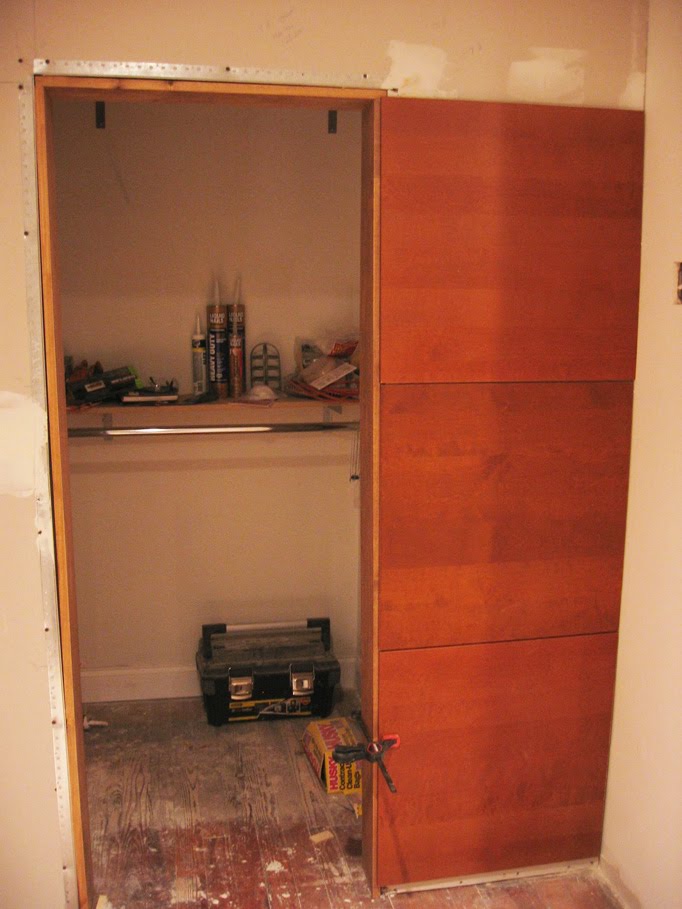
  • Walk in closet from kitchen wall panels

    Materials: Ikea kitchen wall panels

    Description: I didn’t want to have bypassing sliding doors for my bedroom closet and thought one door would save space. My house is old but didn’t have much in the way of good salvageable architectural details. I bought some Ikea kitchen cover panels (look for them in the damaged area, they are expensive otherwise) They usually have a lot there which are only damaged on one side. Got some construction adhesive, clamps, and a nail gun. The sliding mechanism for the door is just stock iron pipes and casters from any home store.

    ~ Mike Izzo, South Jersey


  • AT&T Will Sell iPhone Insurance For $13.99/Month Through App Store [Att]

    Looks like we’ll finally be able to insure our iPhones through AT&T soon. Word is that the carrier will allow us to purchase the iPhone insurance service right through the Apple App Store for $13.99 per month. More »


    App StoreIPhoneHandheldsSmartphonesApple

  • Solar panel installer training

    Course is scheduled for this June 23rd and 24th at Onondaga Community College through SUNY College of Environmental Science and Forestry.  …

    …   “The advanced course is geared toward PV installers and engineers who have experience with PV systems. It offers participants an overview of commercial PV systems in a two-day workshop. The course is recommended for those who have taken an introductory installer course or have previous installer experience.”   …

    Via SUNY: PV Installer Course.

  • DC Circuit refuses evidentiary hearing for Uighur detainees

    Photo source or description

    [JURIST] The US Court of Appeals for the District of Columbia Circuit [official website] on Friday refused to order a new evidentiary hearing [opinion, PDF] in the case of five Chinese Muslim Uighurs detained at Guantanamo Bay [JURIST news archives]. Instead, in a per curiam decision, the court reinstated its original opinion, which gives political branches exclusive power in determining the release of non-citizens being held by the federal government. In April, the Supreme Court ordered the circuit court to reconsider [JURIST report] Kiyemba v. Obama [docket; CCR backgrounder] in light of the fact that each of the remaining Uighurs has received an offer of resettlement by another country. In response, the circuit court denied the petitioners’ request to remand the case to the district court [JURIST report] for an evidentiary hearing on whether any of the resettlement offers were “appropriate,” holding that it was in the power of the political branches to determine whether a country is appropriate for resettlement. The court further explained that even if the detainees had good reason to reject the resettlement offers, they still possessed no right to be released into the US:

    In seven separate enactments – five of which remain in force today – Congress has prohibited the expenditure of any funds to bring any Guantanamo detainee to the United States. Petitioners say these statutes, which clearly apply to them, violate the Suspension Clause of the Constitution. But the statutes suspend nothing: petitioners never had a constitutional right to be brought to this country and released. Petitioners also argue that the new statutes are unlawful bills of attainder. The statutory restrictions, which apply to all Guantanamo detainees, are not legislative punishments; they deprive petitioners of no right they already possessed.

    The Constitution Project [advocacy website], a bipartisan think tank focusing on constitutional issues, immediately denounced the judgment [press release]. The group criticized the court’s ruling for being too broad on the issue of the judiciary’s role the release of detainees. Authoring a separate concurring opinion, Circuit Judge Judith Rogers, agreed with the Constitution Project’s assertion that the ruling was too broad, but held that there was no role for the judiciary in this case because the five Uighurs “hold the keys to their release from Guantanamo. All they must do is register their consent” to the proposed resettlement offers.

    The DC circuit court’s ruling came in a case informally referred to as Kiyemba I, which is separate from a different suit filed by the Uighur detainees, known as Kiyemba II. In March, the Supreme Court declined to rule [JURIST report] in Kiyemba II, on certain issues surrounding the transfer of Guantanamo Bay detainees. Lawyers for four Uighurs detained at Guantanamo were appealing [JURIST report] an April 2009 ruling [opinion, PDF; JURIST report] by the DC circuit court, which held that US courts cannot prevent the government from transferring Guantanamo detainees to foreign countries on the grounds that detainees may face prosecution or torture in the foreign country. Of the 22 Uighurs originally detained at Guantanamo Bay, 17 have accepted offers of relocation to other countries. Two Uighurs were transferred to Switzerland, six to Palau, four to Bermuda and five to Albania [JURIST reports].

  • Harvard Grads Choose Public Service Over Big Bucks

    It’s college graduation season in the United States.

    Even in today’s weak economy, students from prestigious Ivy League universities like Harvard have an extra advantage on the road to financial success. However, not everyone in Harvard College’s Class of 2010 is striving for a lucrative career.

    Career choices

    Graduation is just days away, and Robin Mount is even busier than usual.

    The director of Harvard’s Office of Career Services is matching her students with the right employers and career opportunities, often in the fields of education, international development and public service.

    Read more here.