Blog

  • Goby and TripAdvisor: Two Great Mobile Apps for Your Upcoming Travels

    World Wide Wade
    Wade Roush wrote:

    It’s almost Memorial Day weekend, when thoughts turn to vacation and summer road trips, so I thought I’d write briefly today about two cool travel-related mobile apps, both hailing from the Boston area.

    But first, I want to take a moment to remind you that June is Innovation Month in New England. Similar to the Mass Mobile Month initiative that Xconomy led back in March, Innovation Month is a grassroots social-media campaign designed to draw attention to the unusual abundance of technology-and-entrepreneurship events planned around New England in June. Scott Kirsner of the Boston Globe is the unofficial coordinator of the effort, which is now in its second year. He blogged yesterday about how people in the startup ecosystem around Boston can get involved in promoting Innovation Month activities.

    Our own Xconomy Summit on Innovation, Technology, and Entrepreneurship (XSITE) on June 17 is just one of about two dozen events already listed at the New England Innovation Month website. I’m also looking forward to the Ad Club’s Branded in Boston event on June 24, where I’ll be making an appearance.

    If, for some reason, you run out of technology events to attend next month, there are a bunch of great mobile apps these days that can help you find other fun things to do and fun places to go—not just in June, but throughout the year. I want to write about two of them today: the brand new TripAdvisor app for the iPhone, and the nifty Goby app, which is available for both the iPhone and the iPad.

    Both apps are free. Newton, MA-based TripAdvisor, which I profiled in February, launched its iPhone app just this week, to take the place of a previous, more limited app called Local Picks. Boston-based Goby, which I profiled shortly after its launch last September, released its iPhone app in March, and came out with an iPad version shortly thereafter.

    TripAdvisor iPhone app screenshotThe TripAdvisor app, like the TripAdvisor website, is great for figuring out how you’re going to get to a place, and where you should stay or eat once you get there. The Goby app is a bit different.Once you’re in a place, it’s a fantastic resource for exploring what fun things there are to do there.

    For TripAdvisor’s iPhone offering, the company’s programmers have done the seemingly impossible: they’ve shrunk down the massive information resources of the TripAdvisor website and made them easily navigable on the small screen. This program, which is essentially a self-contained, “appified” version of what you’ll see if you surf to the TripAdvisor site in the iPhone’s browser, includes listings and customer ratings and reviews for popular hotels, restaurants, and attractions in thousands of cities around the world. (In fact, the app is available in 13 languages.)

    With all this information at hand on your phone, there’s much less excuse for reserving a table at a bad restaurant or a room at a subpar hotel. But if you do wind up having a bad experience, the TripAdvisor app includes a simple interface for entering ratings and writing reviews. Which makes a lot of sense on a mobile device. After all, why not contribute your commentary while your feelings are still fresh (or raw, as the case may be)?

    The only thing that doesn’t work quite as well on the mobile app as it does on the Web is TripAdvisor’s flight search engine. The same flight data is all there. But it’s just a lot easier to wade through the Web-based search engine, refine your search, and compare your options when you’re using …Next Page »

    UNDERWRITERS AND PARTNERS


  • America’s Global Outlook, at an ‘Inflection Point’

    Ben Rhodes, right, in the Oval Office with Director of Speechwriting Jon Favreau and President Obama (White House photo)

    “We’re at an inflection point,” Ben Rhodes observed about the United States’ global outlook, a year and a half into the Obama presidency.

    Rhodes speaks from a unique vantage point. He’s the deputy national security adviser for strategic communications, a title that obscures his importance as one of President Obama’s closest and most influential foreign policy advisers. He’s been with Obama since the beginning of his presidential campaign, helping shape and explain the contours of Obama’s foreign policy. And he’s the author of the National Security Strategy of 2010, that policy’s foundational text.

    Image by: Matt Mahurin

    Image by: Matt Mahurin

    The Washington Independent spoke with Rhodes about the document, its implications for American national security, and the “inflection point” it addresses. A lightly edited transcript follows.

    The Washington Independent: The National Security Strategy pledges, “We must pursue a rules-based international system that can advance our own interests by serving mutual interests.” How do you build a constituency in the U.S. for that, after decades of that system being caricatured — sometimes accurately — as ineffectual?

    Ben Rhodes: The tradition in the United States is actually the opposite. Look at the moment of our maximum global power after World War II. We had a clean slate and we chose to build an architecture of international institutions, international standards, international rules, to include the United Nations, to include NATO, to include international financial institutions, treaties, and to apply our power to strengthening that architecture so that it could solve common problems. And I think there was basically a pretty broad, bipartisan consensus that America was served well by an international architecture that could keep the peace and advance prosperity. Sure, there was skepticism about it — there’s always some skepticism about the international order in parts of the American political culture — but I think there’s a broad tradition of support for that because I think the American people are smart enough to know that if we don’t act within that context, we bear a far greater burden ourselves.

    TWI: So this is a matter of reminding people of what’s worked in the past.

    Rhodes: We’re at an inflection point. We’re clear-eyed about the shortcomings. We’re not starry-eyed about the efficacy of the international system as it is today. As the president has said many times, it’s in some instances buckling under the weight of challenges it wasn’t designed for. However, that presents you with a choice. And that choice is you can say there are emerging challenges like terrorism, like nuclear proliferation, climate, a global economy that’s more interwoven. We can deal with those challenges by saying that the international system is fatally flawed and we’re going to step outside the lines and deal with these issues on our own on an ad-hoc basis. Or you can say we are going to channel our strength and influence to reshaping an international order where we can effectively deal with these challenges.

    TWI: Secretary Clinton said at the Brookings Institution yesterday that the document’s main takeaway should be its assertion that American power is fundamentally tied to the sources of our strength domestically. But we’re still in the midst of extraordinarily challenging economic times, and there are parts of the dignity promotion section about food security, global health and priorities that previous strategies considered peripheral. Is the agenda too ambitious?

    Rhodes: No, I don’t think so. We’re actually demonstrating this kind of collective action, in our first 15 months, that we’re trying to describe in the actual document. So international economic coordination can no longer be effectively implemented through the G-8, it’s got to be a broader spectrum of nations at the table, to include both China and India, but also your South Africas, your Brazils, your Indonesias, so it’s the G-20. Climate change can’t be dealt with simply by the Kyoto signatories. You’ve got to bring in all major economies, again, to include China, to include India. So that’s the framework we’ve tried to begin through the Major Economies Forum, through the Copenhagen Accord. It includes us, India, China. So we’re already trying to broaden the circle responsibility to deal with these challenges.

    There is a rebalancing of the application of American resources that this administration is pursuing that we describe in the document. We’re rebalancing in terms of the capabilities that we apply to our problems, in the sense that we are prioritizing investments and factors like education, clean energy that have been under-resourced over the years. Our commitment to draw down in Iraq and our plans to go over the hump in Afghanistan will represent a long-term rebalancing of our military deployments, which obviously take up a good deal of resources. So we have already begun to see shifts in resources that we project over time.

    The second and very important thing, and this gets back to your first question, is an international order that can successfully deal with challenges necessitates less of an allocation of American resources. You were talking about how you make your case to the American people. You make the case to the American people that collective action is far cheaper to America than unilateral action. I mean, that’s just a fact. And if you look at something like the Food Security Initiative, certainly it’s going to take resources, but we pursue that through the G-8 and into the G-20 to try to leverage greater international action.

    Similarly, if you look at the thrust of the dignity promotion and the development policies, a lot of it is trying to see capacity in partners. So that we’ll focus development policy on the kind of economic and social progress that we see as a human rights issue as well as a security issue and a prosperity issue. But frankly, by focusing on building the capacity of our partners, we’re trying through our investments to see progress that will diminish the necessity of foreign assistance over time, insofar as we’re building up the ability of nations to not just combat individual diseases, but to develop their own public health systems. We’re not just trying to help them feed their people in a humanitarian emergency, but the premise of the Food Security Initiative is to help them develop the technique and technologies that will allow them feed themselves over time.

    So I think again the burden sharing is a critical aspect of the kind of force multiplication that you can get, again, through an effective international order. Similarly, just as we want more responsible action by a broader circle of nations, we want more capable partners, so that over time that’s the means through which we’re managing these problems.

    TWI: I noticed some similarities between the National Security Strategy and the Army/Marine Corps Field Manual on Counterinsurgency, from the focus on legitimacy of action; on taking responsibility for promoting dignity in at-risk populations; and in its recognition that too much hard power can be counterproductive. Did you draw on any of the counterinsurgency lessons of Iraq and Afghanistan when writing the document?

    Rhodes: Yeah, absolutely. As the president alluded to at West Point, the war in Afghanistan today is very different in some ways than the war that began nine years ago, as it relates to the nature of the fight and the tactics of the enemy and the lessons that we’ve learned in the application of our power in Afghanistan. And certainly the same would be true in Iraq, that we ended up fighting a war that was different than the kind of war that we, that many people felt like we’d be fighting at the beginning.

    So the lessons, I think, we all learned included the importance of the legitimacy of our actions, as it relates not just to the international community but most immediately from the populations of the countries within which we’re operating. So that certainly informs Gen. McChrystal’s approach in Afghanistan, but it informs, again, our approach more broadly, as it relates to Iraq and also other partners that we’re also going to be having to cooperate with on security issues going forward.

    TWI: As a strategic communicator, what do you want someone living in Miran Shah, in the tribal areas of Pakistan, who might be caught between the Haqqani network and a government program to degrade that network, to get out of this document?

    Rhodes: That the United States is not seeking to control events where they live. Nor do we view their future narrowly through a purely counterterrorism lens. In the first instance, we’re trying to develop the capability in their local area, as well as their national government, to manage the threats within their borders rather than the United States doing so. In the second instance, that we have a broader agenda. We want to speak to their aspirations. America cannot by itself deliver a better life, but it can tilt the scales, as it were, in the direction of greater opportunity, greater human dignity.

    We don’t simply have a negative agenda. We have a positive agenda that is focused upon both the capacity of their institutions to manage problems, as well as the dignity that they seek in their own lives.

    TWI: If, as the document says, the force of American values is foundational for guiding international cooperation, is there a tension with its embrace of indefinite detention without charge?

    Rhodes: Let me take a step back and look at the issues that are touched by this.

    We do believe that post-9/11 there were new realities that Americans were going to have to deal with as it related to terrorism and our response to it. Part of the problem is that we have not been able to, as a nation, forge sustainable, durable approaches to dealing with those issues that were effective and that were in line with our values. Now what we’re trying to wrestle with as an administration is the fact that we do need to recognize that there are unique threats that we’re now facing, but that we have to approach those threats and how we deal with them in line with certain principles. And what this administration has said is there may be circumstances where certain individuals who uniquely pose a threat that is demonstrable but that precludes criminal prosecution.

    Now, we need to figure out a way to deal with this issue in a way that builds in oversight, that is not simply subject to the decisions of one person or the executive branch, but that is basically embedded in the principles of checks and balances, of oversight, of judicial review, that are at the core of our system. And as the document makes clear at the end, in some of these issues are going to take the actions of all three branches of government, because the executive branch alone can’t make these decisions. That’s been part of the problem in the past. So there needs to be buy-in from the executive branch and from the legislative branch and trying to forge a framework that, again, is durable, that can stand up to the test of our laws, that can protect our security and that, again, can be sustained for future administrations so that we’re not continuing to deal with these issues on an ad-hoc basis but rather within a framework that can absorb the threat of terrorism without overturning the principles of our system.

    TWI: Do you expect the guy in Miran Shah to understand that?

    Rhodes: I think so. If you are demonstrating that you’re affording rights to individuals and that you are operating within America’s system of checks and balances, of review and oversight, then that’s the case that you make. But I mean, that’s something that we still need to work at as a country. And again, that’s a responsibility that falls squarely on the executive branch but also falls on all three branches of government because this touched on very fundamental but new issues.

    TWI: Peter Feaver, who helped write the 2006 NSS, blogged that he had some deja vu reading the 2010 version. His document called for “effective, action-oriented multilateralism to address the challenges of the day: to ’strengthen alliances to defeat global terrorism and work to prevent attacks against us and our friends’ and to ‘develop agendas for cooperative action with the other main centers of global power.’” Is it fair to say there’s some overlap with the 2006 document?

    Rhodes: I’d say a couple of things about that. Number one, there’s always certain forms of continuity in American foreign policy. Number two, there were approaches that were pursued in the latter years of the Bush administration that are certainly closer to the approaches that we’ve pursued than some of the decisions that were taken in the first years of the Bush administration.

    But number three, there are also clear distinctions in the approaches that this administration has taken. I mean, I don’t think anybody could stack up the priorities that are embedded in this document as it relates to the focus on the domestic economy as a source of our strength in the world; as it relates to how we define our enemy as narrowly as “al Qaeda and its affiliates”; as it relates to our efforts to end the war in Iraq; as it relates to our focus on climate change and clean energy. I could kinda stack up a whole on a whole number of issues.

    And that’s not even meant to be a criticism of Peter’s document, which I think is a good document. It’s meant to say that this document uniquely represents the worldview and the priorities of this president and this administration, which are different in some respects from the previous administration. And I also do think that, again, the cooperative approaches that we’re trying to foster are ones that we believe do represent more specifically the challenges of our times: the global economy, the focus we place on our nonproliferation agenda, the centerpiece of our efforts to apply pressure to nations like Iran. So, you know, I think that, sure, there are areas of continuity in American foreign policy, areas of continuity to, again, the latter years of the Bush administration, and then there are areas of increased distinction and different priorities that are natural to any worldview.

    TWI: Finally, one of the criticisms I’ve seen of the National Security Strategy is that it doesn’t prioritize amongst its wide-ranging goals. As a foundational text across the national security bureaucracy, how will the government know how to implement the document?

    Rhodes: Within the document you have a clear sense of the focus of the administration and how that relates to resource allocation. We’ve sent pretty clear signals about areas that are going to be prioritized going forward, while also recognizing the limits of what any one nation can do around town. Which again gets to some of the rebalancing around our military deployments, it gets to some of the burden sharing that we’re trying to foster, it gets to some of the deficit reduction that’s embedded in health care and other things that we’re doing.

    On implementation, the Bush documents are much shorter. We made the decision to encompass what really are our key priority initiatives, so that the things that are listed in here represent our priorities This document can basically serve as a measuring stick that I think we would be happy to turn to in six months or a year or several years and say: How did we do in implementing this part of what we said was fundamental to our National Security Strategy? I think that it does stake out those priority areas that are important to us, that are important to American national security, and that we expect to measure ourselves against going forward. So it starts as a strategy document and then it turns into an implementation document.

    Now, aside from that, I think these are actions that need to be taken in concert with other nations. And to try to make them into a list wouldn’t kind of effectively capture the nature of national security in 2010. We are moving in a concerted way on just about everything that is in that document. So I think we’re providing the blueprint.

    TWI: Oh, good, because that allows me to make the Jay-Z reference.

    Rhodes: Yeah, exactly. Blueprint 4: the National Security Strategy.

  • Google Buzz gets Windows Mobile web-app

    Google Buzz on Windows MobileIts not a full-blown mobile client, but at least Google has gone to the effort to make their HTML5-based Google Buzz app a bit more dumbed down for Pocket Internet Explorer.
    The XHTML website is suitable for Android pre-2.0, Blackberry, Nokia S60, and Windows Mobile browsers and can be accessed by visiting buzz.google.com in your phone’s browser.

    Now all we need is a reason to run another twitter clone …

    Via MSMobiles.com


  • USGS Survey Finds Contamination in Public Wells

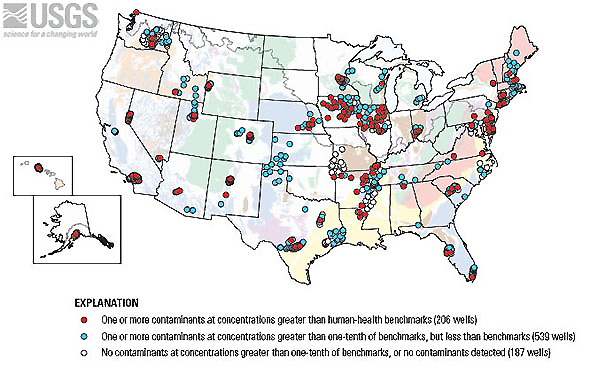
    A new study reveals that 105 million Americans drink from contaminated wells, but further research is needed to explain the health effects of specific contaminants.

    USGS Water Contaminants

    By Heather Rousseau
    Circle of Blue

    More than one-third of the U.S. population uses drinking water from contaminated public wells, according to a 14-year-long study by the U.S. Geological Survey that was released late last week. The study, Contaminants in Groundwater Used for Public Supply, which compiled untreated water samples that were taken between 1993 and 2007, found that 20 percent of the public wells surveyed contained at least one natural or man-made contaminant above government standard concentrations.

    Roughly 80 percent of the wells contained multiple contaminents at concentration levels that were near or above standards. But these levels don’t necessarily cause health concerns, according to one USGS scientist.

    “Detections of contaminants does not necessarily indicate a concern for human health because USGS analytical methods can detect many contaminants at concentrations that are 100-fold to 1,000-fold lower than human-health benchmarks,” said Patricia Toccalino, a lead scientists and hydrologist for USGS.

    “Detections of contaminants does not necessarily indicate a concern for human health because USGS analytical methods can detect many contaminants at concentrations that are 100-fold to 1,000-fold lower than human-health benchmarks.” (Repeats above paragraph)

    “Assessing contaminants in these small amounts helps to track emerging issues in our water resources and to identify contaminants that may warrant inclusion in future monitoring,” Toccalino told Circle of Blue.

    Dieldrin was found at levels that exceed the health benchmarks set by USGS and the U.S. Environmental Protection Agency in roughly three percent of the samples taken. The unregulated man-made contaminant is a potential carcinogen that can have negative effects on a person’s liver and central nervous system if he is exposed to it at high concentrations for a long period of time. Of the 932 wells USGS sampled, higher levels were found in unconfined and shallow aquifers in the Northern Atlantic and coastal plains such as Delaware and New York as well as other principal aquifers in the Southeast U.S.

    The EPA evaluated Dieldrin and determined that it should not be regulated “in part because it has been banned for a long time” says Patricia Toccalino, lead scientist and Hydrologist with USGS.

    Although the unregulated, man-made contaminant was banned in 1987, it degrades slowly, which might be one reason why it’s still detected, according to Toccalino.

    Though it is not required that utility services treat the water for Dieldrin, it is possible that different treatment facilities do remove the insecticide.

    “The research about the health risk of trace amounts of contaminants in water is something that is still being researched. Public water systems are required to treat contaminated water under the Safe Drinking Water Act, if you do that it dramatically reduces the health risks, “ said Cliff Treyens, public awareness director for the National Groundwater Association.

    A smaller study on treated drinking water revealed that man-made organic contaminants were still found in the water at close to pre-treatment levels. Research does not yet fully explain the health risks involved with interactions between multiple contaminants or the health effects on even a single contaminant.

    Until further research is done, Toccalino said the public should approach their water utility for the best available information.

    “The number one thing is to contact your water utility every year to receive your watery quality report.”

    Although the United States has increased population nearly 200 percent in the last 50 years (seen on the horizontal x-axis), the amount of U.S. soil devoted to agricultural use (vertical y-axis) has decreased, as has the income percentage of the GDP from agriculture (size of ball). However, despite these cuts in overall U.S. agricultural production, some contaminants, such as Dieldrin–banned in 1987–have not degraded and remain in the water table at levels that exceed the human health benchmarks.

    Heather Rousseau is a reporter for Circle of Blue. Reach Rousseau at [email protected]. Read more about USGS’ study.

  • Swizz Beatz and Alicia Keys Engaged and Soon-to-be Parents

    Grammy winner Alicia Keys confirmed today that she and her producer boyfriend, Swizz Beatz are engaged to be married and expecting their first child together.

    Musicians Swizz Beatz and Alicia Keys have been together since 2008. This will be the first marriage and child for the 29 year old Grammy winner Alica Keys. Swizz Beatz on the other hand, has two other children from previous relationships.

    The engagement was announced after Alicia Keys, 29, and her 31-year-old fiance, real name Kasseem Dean or most popularly known as Swizz Beatz, attended the Black ball in London, in aid of Keys’ Keep a Child Alive charity. Their representatives told People.com that the couple “are expecting a baby and are engaged to be married in a private ceremony later this year.”

    Alicia Keys is a famous American singer and songwriter. She has won 12 Grammys in her music career and she recently appeared as a mentor on “American Idol” a few weeks ago. Swiss Beatz is a famous American record producer, DJ, and rapper who has worked with Jay-Z, Gwen Stefani and Beyonce, etc.

    Related posts:

    1. Alicia Keys and Swizz Beatz are now Engaged and will be having a Baby! What about Mashonda?
    2. Bono’s Words For Alicia Keys
    3. Simon Cowell Getting Married

  • Power the Future: Harnessing energy from the sun-baked deserts

    solar plant_1_ckhop_69

    With fossil fuel reserves depleting at a rate not many would have imagined in the past, the oil of the 21st century is definitely not what’s buried deep within the earth, but it’s something that falls on the surface as sunshine. Some researchers opine that the earth receives more energy from the sun in just one hour than the world uses in a whole year. The technology to harness the energy already exists and does hold a promise to better the environmental condition of the planet.

    Why deserts:

    Of all the places where solar panels, both photovoltaic and solar thermal, can be installed, deserts do offer better possibilities. The benefits of creating massive solar projects in deserts include:

    • Ample Space:

    sahara space

    Since deserts like the Sahara are mostly barren, the place can easily be used to install solar projects. A research carried out by Greenpeace along with several other groups deduced that deserts are potent enough to meet up to 25 percent of the world’s electricity demands by 2050. In the Sahara desert, with less cloud cover and a better solar angle, one can obtain closer to 83 W/m². The unpopulated area of the Sahara desert is over 9 million km², which if covered with solar panels would provide 750 terawatts of renewable electrical power. The Earth’s current energy consumption is around 13.5TW at any given moment

    • Dry Climate:

    dry desert

    With little to no rain, deserts usually remain hot and sunny, making these places ideal for solar energy generation. The sunny climate is suited for both photovoltaic solar installations and solar thermal installations.

    • Jobs:

    sahara desert tribals

    Besides combating climate change, desert-based power plants would create jobs and improve the economic development of the local communities. Moreover, since there isn’t much use for the land, local residents and environmentalists are pleased with the solar prospect.

    Limitations of desert solar power:

    Overshadowing the advantages there are a few limitations of desert-based solar power.

    • Extremely hot climate:

    sun on desert

    The average temperature of the Sahara desert is about 30 degrees Celsius. Variations may also be huge from over 50 degrees Celsius during the day during summers to below zero degrees Celsius at night in winter. This hot temperature makes solar photovoltaic panels less efficient in converting sunlight into electricity.

    • Dust:

    windy desert

    Winds in these areas will blast solar panels with dense dust, which will reduce the efficiency of both the mirrors used in case of solar thermal installations and the photovoltaic modules used in solar PV installations.

    • Transmission:

    transmission

    Energy generated in deserts will be used in completely different parts of the world. Some percentage of the electricity generated will be lost during transmission.

    • Cost Barrier:

    money

    Electricity produced by even the cheapest solar technology works out at $160/MWh. Moreover, transmitting electricity to distant regions will further increase the cost of electricity, which finally will have be paid by consumers who currently get electricity at rates well below $1/watt.

    • Lack of water:

    water in desert

    While deserts have plenty of sun, they lack another less obvious but equally indispensable resource for a solar thermal power plant – water. Water is the cooling agent for both photovoltaic and solar thermal installations, without which the plants would be overheated and their efficiency will significantly be reduced.

    Some proposals:

    • Solar Energy System in California Desert:

    rice solar energy

    Rice Solar Energy is planning a solar energy installation in an uninhabited part of eastern Riverside County, California. The system will rely on 4.4 million gallons of melted salt placed in a 538-foot tower. Mirrors around the tower reflect sunlight onto it, heating the salt to such great temperatures that it retains a useful amount of heat seven hours after sundown.

    • Mojave Solar Park:

    ibn_iq4dq

    The Mojave Solar Park is a solar thermal power facility currently contracted to be constructed in the Mojave Desert in California. The facility is being constructed by Solel Inc. and is designed to have a capacity of 553MW. Upon completion it will become the world’s largest solar collection facility both in capacity and land size.

    • $70 Billion Solar Installation for Europe:

    dr

    Dr. Anthony Patt, a research scholar at the International Institute for Applied Systems Analysis in Austria, estimates that if a fraction of the Sahara, probably the size of a small country, be covered with solar panels, the energy generated would be sufficient to power all of Europe. Dry climate and the high-intensity of the sun’s rays will benefit the $70 billion installation, making it a highly-efficient venture.

    • Desertec Foundation 100GW Project:

    solar plant_2_uhckx_69

    This project, promoted by Desertec Foundation, will be built by 20 blue chip German companies, and will be able to generate a whopping 100GW of concentrating solar power. Unlike other solar power plants, which are usually built on a single location, this massive plant would be scattered throughout politically stable countries in northern Africa. The collective output of the plant would be 80 times larger than a similar plant being planned for the Mojave Desert. The power output would be transported across the Mediterranean Sea to Europe on high-voltage DC lines that will finally supply 15% of the energy demand.

    • BrightSource Energy Solar Project:

    brightsource energy_1_rbxhl_69

    BrightSource Energy’s solar project has received a $1.37 billion loan from the U.S. government and will include the construction of three solar thermal plants in the Mojave Desert. The plants, which are being claimed to make the world’s largest solar energy complex, are expected to generate up to 400MW of renewable electric power, which will be enough to power up to 140,000 homes.

    • Sahara Forest Project:

    sahara forest project_1

    The Sahara Forest Project is a renewable solar energy “oasis” slated to be built in 2010. Experts are examining arid sites in Australia, the U.S., the Middle East and Africa that could support the facility. The Sahara Forest Project is a holistic approach for creation of local jobs, food, water and energy, utilizing relatively simple solutions mimicking design and principles from nature.

    Space-based solar as an alternative:

    space solar

    The space-based solar power concept is just as attractive as projects being proposed for arid regions. There is no air in space, so the collecting surfaces would receive much more intense sunlight, unaffected by weather. In geostationary orbit, an SPS (solar power satellite) would be illuminated over 99% of the time; such an SPS would be in Earth’s shadow on only a few days at the spring and fall equinoxes; and even then for a maximum of 75 minutes late at night when power demands are at their lowest. Power harvested in space can be transported to earth using microwaves or laser radiation.

    space solar project_1_a1mks_69

    California’s state legislators have already given a green light to a space-based solar project. California’s biggest energy utility company PG&E has announced that they would purchase 200MW of solar power that will be beamed from space by 2016.

    space solar_zkiwh_69

    Moreover, Japan is also planning a $21 billion space solar project that will be capable of generating 1GW of power. The project will be developed by Mitsubishi Electric Corp. and IHI Corp. and will make use of a four square kilometer array of solar panels stationed 36,000km above the surface of earth.

  • Broadband the newest beat for Insight News

    When we started Blandin on Broadband a few years ago I spent a lot of time beating the bushes for anything related to broadband. I was lucky if I could find a dozen or so legitimately broadband-focused stories a month. Well, that has certainly changed. Now there are single days when I could report on a dozen broadband stories. I’ve noted this to myself often – but today I saw evidence that it’s not just that I’m looking for broadband in all the right places.

    This week Insight News introduced their latest hire…

    Ivan B. Phifer this week joins McFarlane Media as a technology reporter supporting efforts to expand broadband awareness and utilization in communities of color. Phifer’s work will appear in newspapers serving African and African American, Latino, Asian and American Indian communities.

    The newspapers are members of Minnesota Multicultural Media Consortium, which, in partnership with University of Minnesota’s innovative Urban Research and Outreach Engagement Center (UROC), and the U’s Office for Business and Community Economic Development, have created a network of community public computer centers (PCC) that provide jobs, training and access to high speed internet technology.

    I happened upon the article while looking at Bernadine Joselyn’s notes from the TISP meeting earlier this week. (Those notes will appear on this blog later today.) I think it’s exciting that they’ve hired someone to focus on broadband. I look forward to reading future stories. Heck, maybe we can even share notes.

  • Obama Heading Back To Gulf To Make It Look Like He’s Doing Something About The Oil Disaster

    President Barack Hussein Obama

    By STEVEN R. HURST, Associated Press Writer

    WASHINGTON (AP) — President Barack Obama returns to the Gulf of Mexico coast Friday, insisting he’s in charge of efforts to shut down what is now estimated as the worst oil spill in U.S. history.

    Still Obama has admitted the U.S. government doesn’t have the technology or expertise and must rely on oil giant BP. It could be late Friday or over the weekend before BP knows if its latest experimental effort has succeeded in stopping the undersea gusher of oil.

    Obama was to attend a briefing Friday at the U.S. Coast Guard Station in Grand Isle, La., by Adm. Thad Allen, who is overseeing the response to the spill. It would be his second visit to the region since the disaster began with an April 20 explosion at the drilling rig Deepwater Horizon that killed 11 workers.

    Obama seized ownership Thursday of what he called a “tremendous catastrophe,” after weeks of loveallowing Cabinet members take the public lead as the crippled BP PLC well spewed millions of gallons (liters) of crude oil into the Gulf from nearly a mile (1,500 meters) below the surface.

    “I take responsibility. It is my job to make sure that everything is done to shut this down,” Obama declared at a White House news conference dominated by the spill.

    For everyone, the stakes grew even higher Thursday as government scientists said the oil has been flowing at a rate 2 1/2 to five times higher than what BP and the U.S. Coast Guard initially estimated.

    Two teams of scientists calculated the well has been spewing between 504,000 gallons (1.9 million liters) and more than 1 million gallons (3.8 million liters) a day. Even using the most conservative estimate, that means about 18 million gallons (68 million liters) have spilled so far. In the worst-case scenario, 39 million gallons (148 million liters) have leaked.

    Even at the lowest estimate, the Gulf spill has far surpassed the size of the previous largest U.S. oil spill, the 1989 Exxon Valdez disaster, in which a tanker ran aground in Alaska, spilling nearly 11 million gallons (42 million liters).

    BP PLC insisted its “top kill” attempt to plug the gusher was progressing as planned, though the company acknowledged drilling mud was escaping from the broken pipe along with the leaking crude.

    “The fact that we had a bunch of mud going up the riser isn’t ideal but it’s not necessarily indicative of a problem,” spokesman Tom Mueller said.

    Early Thursday, officials said the process was going well, but later in the day they announced pumping had been suspended 16 hours earlier. BP did not characterize the suspension as a setback, and Eric Smith, associate director of the Tulane Energy Institute, said the move did not indicate the top kill had failed.

    “The good news is that they pumped in up to 65 barrels a minute and the thing didn’t blow apart,” Smith said. “It’s taken the most pressure it needs to see and it’s held together.”

    A top kill has never been attempted before so deep underwater. If the procedure works, BP will inject cement into the well to seal it permanently. If it doesn’t, the company has a number of backup plans. Either way, crews will continue to drill two relief wells, considered the only surefire way to stop the leak.

    In another troubling discovery, marine scientists said they have spotted a huge new plume of what they believe to be oil deep beneath the Gulf, stretching 22 miles (35 kilometers) from the leaking well head northeast toward Mobile Bay, Alabama. They fear it could have resulted from using chemicals a mile below the surface to break up the oil.

    Obama, meanwhile, has been under mounting criticism — even from members of his own Democratic Party — for seeming aloof to what could be the biggest environmental tragedy in U.S. history.

    Asked about inevitable comparisons between his administration’s handling of the disaster with his predecessor’s response to Hurricane Katrina in 2005, which flooded New Orleans and other areas, Obama said: “I’ll leave it to you guys to make those comparisons. … What I’m thinking about is how do you solve the problem?”

    Comparisons to former President George W. Bush’s paltry response to the devastating storm have come mainly from opposition Republicans.

    “I’m confident people are going to look back and say this administration was on top of what was an unprecedented crisis,” he said. “We’ve got to get it right.”

    Obama is struggling for high ground in the political wars raging in the months before the November congressional elections, where his Democratic majorities in both House and Senate are in danger.

    He has passed through bruising legislative sessions and took a notable battering from Republicans as he pushed through health care overhaul. Now he’s struggling to keep congressional Democrats focused on financial regulatory reform while trying to smooth the Senate confirmation of his second Supreme Court nominee.

    The president, who campaigned on a promise to change the way Washington does business, blasted a “scandalously close relationship” he said has persisted between Big Oil and government regulators.

    Conceding that “people are going to be frustrated” until the well is capped, Obama said he would use the full force of the federal government to extract damages from BP.

    “We will demand they pay every dime they owe for the damage they’ve done and the painful losses they’ve caused,” Obama said.

    He spoke shortly after the head of the troubled agency that oversees offshore drilling resigned under pressure. The departure of Minerals Management Service Director Elizabeth Birnbaum was announced just before Obama’s news conference began.

    While making clear he was leading the response, Obama acknowledged some things could have been better handled.

    He said his administration didn’t act with “sufficient urgency” prior to the spill to clean up the Minerals Management Service, accused of corruption and poor regulation of drilling rigs and wells.

    While Obama defended calling for an expansion of offshore drilling prior to the spill, he said he “was wrong” to believe that oil companies were prepared to respond to worst-case oil spills.

    Obama also said the administration took too long to make its own measurements of the size of the spill, and didn’t push BP hard enough early on to release underwater footage of the gusher.

    Join the conversation about this story »

    See Also:


  • Sorry, But Spain’s Razor Thin Austerity Vote ‘Victory’ Will Soon Prove Itself A Failure

    Spain Fail Bull

    Spain just barely passed a 15 billion euro austerity plan yesterday, by a single vote. The results were 169 votes for the passage, with 168 votes against. There were also 13 abstentions.

    Technically, this austerity plan is now a go, but was the razor thin victory margin essentially a failure?

    Problem is, Spain doesn’t just need to pass its austerity package, but it will need to implement it as well.

    Given enormous visible opposition as shown by the extremely tight vote, we should expect substantial public push back which could prevent the measures from actually happening.

    For example, the New York Times has already reported that the nation’s two largest unions have announced that they’ll strike should austerity measures be ‘hurtful’ of labor market rules. Which means they’ll strike for sure. Civil servants are also expected to strike next month, angered by cuts to their wages.

    The tight vote makes actual implementation of the passed measures doubtful.

    Join the conversation about this story »

  • Se confirma introducción de nuevo motor V8 para Range Rover

    Range Rover confirma introduccion de nuevo motor

    Una carta enviada de forma anónima a World Car Fans indica que el Range Rover 2011 renovará su potencia con un nuevo corazón turbodiésel de 4.4 L, al parecer la información tenía que distribuirse de forma exclusiva entre los concesionarios alemanes del coche.

    Sin embargo gracias a los datos filtrados podemos precisar el precio del futuro todoterreno, pues se menciona que el nuevo motor incrementa el coste del modelo actual a 88.900 euros. Por lo tanto los clientes deseosos de adquirir un nuevo SUV deberán añadir a su presupuesto aproximadamente 3.000 euros.

    El nuevo modelo será presentado en sociedad el 01 de Julio en Londres, de esta forma se aprovechará la celebración por el 40 aniversario de la marca y para mantener el interés de los usuarios se brindarán detalles del Discovery, Freelander y Range Rover Sport el 05 de Agosto.

    Los cuatro modelos iniciarán su gira de exhibición en el Salón de Moscú el 28 de Agosto y unos días después deberían estar disponibles en los concesionarios alemanes con el nuevo motor que produce 308 CV y hasta 700 Nm de par motor.

    Dicha potencia será enviada a las ruedas a través de un sistema de transmisión de 8 velocidades; estas características le permitirán acelerar de 0-100 km en 7.6 segundos y alcanzar una velocidad máxima de 208 km/h. Además la tasa de consumo despierta bastante interés (10.2L/100km), así como el nivel de emisiones que ha disminuido un 10%.

    El modelo con el motor V8 de 5.0L seguirá disponible en el mercado y se comercializará con las características actuales pero su precio se incrementará unos 500 euros con respecto a la versión 2010.

    Vía | World Car Fans


  • Hayley Williams Topless Twitpic

    Paramore vocalist Hayley Williams is creating a big buzz over twitter because her topless photo has been allegedly uploaded to twitpic.

    Hayley William’s nude photo was already removed but many people have already seen it. Her pose in the photo was like staring seductively into the camera, and was tweeted out to her 600,000+ followers of Twitter Thursday. The twitpic quickly got over 5,000 views before being removed, going completely viral. Some people downloaded it so it’s still in the web.

    Many of her fans commented on her topless photo saying “WTF,” “OMG,” or “R U Crazy!?” Then she claims that her account was hacked, she tweeted, “well… my night just changed drastically. got hacked.”

    But many people do not believe that her account was really hacked. There are possibilities that she uploaded the wrong photo or she meant to send it in a direct message. Or maybe it’s some kind of publicity stunt?

    What do you think? Was she hacked or was it a trick to boost her publicity? Let us know in the comments.

    Related posts:

    1. Paul Pierce’s Twitter Account Hacked
    2. Don’t play with Obama’s Twitter Account
    3. Justin Bieber Tweets ‘Ladies Cool Down’ As Kim Kardashian Receive Threats

  • World’s Tallest Married Couple Also Own iPads [Ipad]

    And lo, the iPad went on sale internationally—but not before the record-holding world’s tallest married couple made an appearance at the London Apple store, dressed in full wedding attire. Publicity stunt? Your guess is as good as mine. More »


    SkyscraperDubaiUnited StatesArtsArchitecture

  • Add-ons Don’t Require a Restart with Jetpack SDK 0.4 for Firefox

    Mozilla has released the fourth update to the recently launched Jetpack SDK. Four new high-level APIs have been introduced in Jetpack SDK 0.4 and several other bigger features. Some of the APIs and changes planned for the 0.4 release have been deferred to the upcoming Jetpack SDK 0.5, scheduled to come about a month from now.
    read more)

  • Motorola Launching Two Droid Phones In July With Verizon [Android]

    It’s no secret that the Droid Shadow will be sold exclusively with Verizon Wireless as soon as next month, but the WSJ is reporting that another Motorola smartphone will also be added to Verizon’s shelves in July. More »


    DroidMotorolaAndroidSmartphoneVerizon Wireless

  • Learn the Basics of Flying: You Wouldn’t Know When You’ll Need It

    First thing that you will need to know about the airplane is it’s parts. An airplane is more than a propeller, a wing and an engine.

    The body of airplane is called the fuselage, which holds the pilot and the passengers, along with the baggage.

    The empannage is the tail of the airplane and it consists of horizontal and vertical stabilizers. The horizontal and vertical stabilizer and parts of the wing are movable to provide the pilot means to control the airplane.

    The Basics on how to control an Airplane. Generally, the different movements of your controls would cause the corresponding movements in the airplane.

    Pulling the control wheel towards you will raise the elevator, which in turn would force the tail down and nose up. Doing this will serve more lift than gravity and in turn will let the airplane climb. To help produce the extra lift the air needs to climb, add additional power from the engine. You will need to use the throttle control.

    Pushing away the throttle control wheel away from you would lower the elevator, forcing the nose down and tail up. This reduces the the lift and gravity makes the airplane descend.

    The rudder pedals control the movement of the plane in the same way as the rudder of a boat. Pushing the right rudder pedal produces movement to the right likewise the left pedal produces same movement to the left.

    Turning the control wheel enables you to raise or lower either the right or left wing which enables the plane to turn faster than using only the rudder.

    These are the basics of flying an airplane. Remember that if you are not an expert, do not fly an airplane without professional help. Unless, of course, if unexpected events would need of it.

    Related posts:

    1. Indonesia: Passenger Plane Skids Off
    2. Air India plane crash: 166 people on board, 7 survive
    3. Accident Again with Toyota

  • The luxury of health care in Armenia

    Oxfam’s free health screenings are saving lives in the poor parts of Armenia. Caroline Berger talks to the women who have benefited from the programme.

    Naiza Stepanyan, beneficery of Oxfam's health scheme. Photo: Caroline Berger/Oxfam

    Naiza Stepanyan, beneficery of Oxfam’s health scheme. Photo: Caroline Berger/Oxfam

    Our Armenian taxi driver stares into his coffee cup, an old custom of fortune telling, and muses for a moment on the fate-shaped coffee grounds. His twinkling eyes predict “you will have good fortune”. Fate was as kind to self-assured Naira, who offers us another cup of Turkish coffee at the rural family health clinic. She smiles, “if I hadn’t taken part in Oxfam’s health screenings then I wouldn’t be here today.”

    Five years ago after the birth of her first child, Naira began feeling pain.

    “Everyone told me it was normal but our family doctor pushed me to attend the free screenings,” Naira tells me, explaining that the diagnosis showed she had early stages of cervical cancer. “I felt like my world was falling apart.” A diagnosis of cervical cancer can mean a lifetime sentence of infertility. Luckily for Naira, the cancer was caught early and she is now healthy with three children.

    But there is still a long way to go before Armenia can replace the rose-tinted glasses of a time when healthcare was taken for granted. For many, life behind the Iron Curtain of the Soviet Union was not only an era that lacked freedom; it was also an era that promised and delivered free healthcare for all. Nearly two decades after gaining independence up to 100,000 people are living below the poverty line without basic regular healthcare. In the remote communities of Armenia, over 5,000 poor people rely on Oxfam’s health programme.

    Chances of cancer reduced by 90%

    Breast and cervical cancer are the biggest killers of women in Armenia. For Naira and others in this remote community, Oxfam’s free health screenings are a lifeline. Because these communities are isolated and poverty stricken, many people cannot afford to visit the nearest doctor, based several miles away from the village. Yet for many, regular check ups at the gynaecologist and screenings can mean the difference between life and death. Karine Alekhanyan, the local family doctor, who trained with Oxfam, proudly tells me, “since the introduction of regular screenings in our villages, the chances of developing invasive cancer has been reduced by 90%”. And soon village members will begin receiving lifesaving SMS messages informing them of the next free local screenings.

    Hasmik Khachatiyan, undergoing a regular check up at the clinic in Yerevan. Photo: Caroline Berger/Oxfam

    Hasmik Khachatiyan, undergoing a regular check up at the clinic in Yerevan. Photo: Caroline Berger/Oxfam

    Here in this mountainous village close to the landlocked border of Azerbaijan there are more tales of triumphs over tragedy. 23-year-old Hasmik’s radiant smile is testament to her courage and determination to overcome the fight against cancer. Mother of two young sons, Hasmik was diagnosed with breast cancer after a routine screening. At just 20, Hasmik was faced with an impossible decision – to undergo traumatic surgery or risk the malignant cancer spreading. Oxfam supported Hasmik to attend the mammography centre in Yerevan and, as a result, she underwent lifesaving surgery. She tells me, “If these services weren’t here, then I wouldn’t be alive.”

    Lobbying for quality healthcare

    While the battle against cancer may be prevailing in this remote community, affordable and quality healthcare is still a luxury for most poor Armenians. Ongoing corruption at government level continues to hamper people’s basic health rights, and many residents of this quiet mountainous village have paid large sums of money for surgery that should be free of charge. Hasmik quietly tells me, “I paid $300 (US dollars) for surgery.” The local health ombudsman, Tamara, continues, “people are afraid to speak out for their rights.”

    Tamara, together with Oxfam and its partner Support to Communities, is working with women like Hasmik to raise their voices and lobby the government to ensure a fair health system for all. Huge milestones on the road to free healthcare have already been achieved. This year, our lobbying activities culminated with a successful national hearing at parliament to dispute budget cuts in maternal and child healthcare. And, at least on paper, if not yet in practice, the Armenian government has committed itself to establishing a national scheme that would lead to universal access to basic healthcare services. However, there is still a long road ahead before women like Hasmik and Naira begin to see tangible changes in their poor rural communities.

    I refill my coffee cup and stare into the murky shapes formed by the grounds. The patterns form a fate shaped star – I hope it means that the future of these brave and resilient women is filled with good fortune.

    Where we work: Armenia

    Issues we work on: health

  • Parking Lots to Parks: Designing Livable Cities

    In the guest post below, Lester R. Brown of the Earth Policy Institute discusses transforming our cities into more sustainable and more livable places. (Subheadings and pictures added.)

    by Lester R. Brown

    As I was being driven through Tel Aviv from my hotel to a conference center in 1998, I could not help but note the overwhelming presence of cars and parking lots. It was obvious that Tel Aviv, expanding from a small settlement a half-century ago to a city of some 3 million today, had evolved during the automobile era. It occurred to me that the ratio of parks to parking lots may be the best indicator of the livability of a city—an indication of whether the city is designed for people or for cars.

    Tel Aviv is not the world’s only fast-growing city. Urbanization is the second dominant demographic trend of our time, after population growth itself. In 1900, some 150 million people lived in cities. By 2000, it was 2.8 billion people, a 19-fold increase. Now more than half of us live in cities—making humans, for the first time, an urban species.

    (more…)

  • U-Va. goes to court to fight Cuccinelli’s subpoena of ex-professor’s documents by Rosalind S. Helderman, Washington Post

    Article Tags: Mann Made Climate Change

    RICHMOND — Virginia’s flagship university went to court Thursday to fight an effort by Virginia Attorney Gen. Ken Cuccinelli II (R) to get documents from a former climate scientist at the school, an unusual confrontation that will test the bounds of academic freedom and result in the college facing down its own lawyer in court.

    In a motion filed in Charlottesville, the University of Virginia argued that Cuccinelli’s subpoena for papers and e-mail from global warming researcher Michael Mann exceeds the attorney general’s authority under state law and intrudes on the rights of professors to pursue academic inquiry free from political pressure.

    Cuccinelli, a vocal skeptic of global warming who is suing the Environmental Protection Agency over the issue, has said he is investigating whether Mann committed fraud by knowingly skewing data as he sought publicly funded grants for his research. Mann left U-Va. in 2005 and now works at Penn State.

    Mann’s case has been embraced by academics across the country, who wrote numerous letters encouraging the university founded by Thomas Jefferson to resist the attorney general. The university’s governing board — whose members were appointed by former governors Mark R. Warner and Timothy M. Kaine, both Democrats — had first signaled that it would likely comply with the April order but then hired a major Washington law firm and prepared to take action.

    University President John T. Casteen III said in a statement that Cuccinelli’s order had “sent a chill through the Commonwealth’s colleges and universities.”

    Source: washingtonpost.com

    Read in full with comments »