Blog

  • The Key Focus of Obama’s Security Strategy: What Sustains American Power?

    Despite the easy media and think-tank cynicism about the irrelevance of National Security Strategies — quick, what did George H.W. Bush say? — presidents reveal themselves through the document’s animating focus. For George W. Bush, the question was: how ought the United States respond to terrorism? For Barack Obama, it’s about a theory of how to sustain American power over the long haul.

    There’s a certain caricature of Obama on the right that holds he only accepts American exceptionalism — the view that America has an outsize role to play in global affairs — in the sense that he finds America exceptionally blameworthy. The responsible exercise of U.S. foreign policy for Obama, goes this view, is to restrain it until it withers away. Charles Krauthammer offered that thesis. Mitt Romney put it in hardcover. Sarah Palin put it on Facebook. And it won’t go away with the National Security Strategy, because it was never tethered to reality. But the National Security Strategy demonstrates how it’s the exact opposite of what the Obama presidency is about.

    Every single focus outlined in the National Security Strategy is about the maintenance of American power on the international stage in an era when the international order is less tethered to the traditional power of big alliances of states than ever, thanks to global financial destabilization, super-empowered individual extremists or proliferating nuclear weapons. American power, Obama argues, rests on insolvent foundations if it doesn’t invest in domestic priorities, principally “the long term growth of our economy and competitiveness of our citizens.” It won’t rally global actors to a common purpose if it doesn’t pursue “comprehensive engagement” with the world, predicated on the international institutions that represent and reflect the world’s forums for expression of consensus standards of behavior. And it won’t possess credibility if it violates “respect for universal values at home and around the world.”

    That creates an interlocking series of obligations for implementing the strategy. “National security draws on the strength and resilience of our citizens, communities, and economy,” Obama argues, so that requires the maintenance and integration of not only military, diplomatic, development, intelligence and economic power, but also of domestic prosperity and justice. This is a blueprint for investing in health and education as much as it is a blueprint for investing in the military. When you think about it, how can you really separate the two? The military is worried about the security implications of the obesity epidemic, after all. This is a broad expansion of a military concept known as “interdependent capabilities,” where the assets within one service or branch or department can support and magnify those of others — applied across the government, and across governments.

    Second, it requires a “a rules-based international system that can advance our own interests by serving mutual interests. International institutions must be more effective and representative of the diffusion of influence in the 21st century. Nations must have incentives to behave responsibly, or be isolated when they do not.” International power isn’t a “zero-sum game,” Obama argues — a central refutation of Bush’s insistence that the U.S. ought to never allow a new superpower to develop — with one major conceptual exception. Isolated nations and actors really do face zero-sum situations against an international community united around common norms. And that’s how Obama argues American leadership can marshal institutions for common objectives over the long term.

    Those nations that refuse to meet their responsibilities will forsake the opportunities that come with international cooperation. Credible and effective alternatives to military action—from sanctions to isolation—must be strong enough to change behavior, just as we must reinforce our alliances and our military capabilities. And if nations challenge or undermine an international order that is based upon rights and responsibilities, they must find themselves isolated.

    The logic here requires a recognition that such a thing applies to American power as well. The National Security Strategy ties that recognition to the broader theme of avoiding insolvency. “When we overuse our military might, or fail to invest in or deploy complementary tools, or act without partners, then our military is overstretched, Americans bear a greater burden, and our leadership around the world is too narrowly identified with military force,” the document reads. “And we know that our enemies aim to overextend our Armed Forces and to drive wedges between us and those who share our interests.”

    Obama’s opponents might argue that means he’s got an insufficient appreciation for American military power. But this the exact same recognition contained in the Army and Marine Corps’ Counterinsurgency Field Manual. The manual’s chapter on paradoxes observes, “Sometimes, the more force is used, the less effective it is” and that the more successful a strategy is, “the less force can be used and the more risk must be accepted.” There are sections in the National Security Strategy that clearly drink from the same well as the counterinsurgency field manual, which ought not to be surprising when considering the administration’s embrace of counterinsurgency in Afghanistan and Pakistan.

    So overreaction contributes to the insolvency of power. When it comes to terrorism, the document states, “If we respond with fear, we allow violent extremists to succeed far beyond the initial impact of their attacks, or attempted attacks—altering our society and enlarging the standing of al-Qa’ida and its terrorist affiliates far beyond its actual reach.” John Brennan spoke about that yesterday. But the document doesn’t rule out what civil libertarian critics consider to be fear-based responses: military commissions and indefinite detentions without charge. Nor does it consider their impact on the rules-based order that the document seeks to bolster. After all, if the preservation of American power is based on the expansion of such an order, won’t insolvency occur if the U.S. keeps granting itself exceptions to that order?

  • UPDATE: BP Denies Significant Improvement In Oil Leak, Stock Still Surging

    UPDATE: A tweet from BP denied improvement in the leak: “Top kill” operations continued over the night & are ongoing. There are no significant events to report at this time.

    The tweet was sent at 8:43 a.m., precisely when the LA Times published its article.

    PREVIOUSLY: More good news coming out of the BP camp is sending the stock soaring pre-market. The oil has been stopped, says the Coast Guard according to the LA Times.

    It’s not a done deal yet.

    The whole thing could still give, once pressure is re-established BP needs to pump cement into the hole to entomb the oil. So we’re not out of the woods just yet, but we may be getting there.

    bp

    Join the conversation about this story »

  • Could June 19 be Froyo Rollout Day?

    The graphic pictured to the left is part of a leaked T-Mobile corporate presentation and it pertains to  the upcoming June 2nd launch of the My Touch 3G Slide.  Engadget Mobile has what appears to be the complete roll out plans from T-Mobile corporate are laid out in an interactive slideshow. Especially interesting in the graphic to the left is the statement that during all the launch activities for the MT3G Slide, June 19th is a big day.  Could this be the day that Froyo rolls out to its first handset?

    It would certainly fit what we have been hearing about the official OTA, and it would certainly add the excitement of the launch of this handset if it would be getting Android 2.2 so soon after launch.Stay tuned as we explore this and hear more about what is so big about June 19 for this device.

    The long and short of the rest of the article talks about how much time and money T-Mobile is pouring into this latest iteration of the My Touch series.  They are planing a major media push, along with recruiting 2200 “champions” that will be super educated on the handset.  Their demographic is families, especially dads as they are launching near Father’s Day. They are also making a major play to make sure that their store employees are pushing the special branded accessories to sell along with the handset.

    What is interesting is that Endgadget points out the fact that perhaps the My Touch line is T-Mo’s effort to replace the Sidekick line that they lost when the Danger team went to work on the Kin device.  This has long been thought to be the case, that is until the whole Project Emerald rumor mill started up.  Project Emerald is rumored to be a new Android powered Sidekick device, one that has some pretty cool specs and would help to put T-Mo back on the map as far as the handset game goes.

    Either way, we are going to be inundated with My Touch 3g Slide info as the launch window approaches.  Stay tuned as we get closer to launch date.

    Might We Suggest…

    • T-Mobile myTouch 3G Slide to Bow at $149 Next Month

      One thing noticeably absent from T-Mobile’s  myTouch 3G Slide announcement a few weeks back was the price.  Based on the known and rumored specs, many of us were guessing the phone would launch with…


  • Exploded Andy T-shirts or Poster

    Looking to add another Android-related t-shirt to your complete collection from Android Swag?  You’ll want to check out what graphic artist Garry Booth has created.  He has a designed a shirt that gives a beautiful exploded view of our beloved Andy the robot.

    You can get it on a 100-percent cotton American Apparel T-shirts, printed with soft-hand ink cost only $19.00 (+$6 shipping). Customers can pay with Google Checkout (U.S. Only) or PayPal (International).  There is also a poster version, 18 inches x 24 inches, hand-pulled screenprint on 80lb. Wausau Astrobright Eclipse Black. Rolled and shipped in crush-resistant tubes for $19.00 (+$8 shipping).

    What a great gift this would make for that person who has everything!  Oh, I have a birthday coming up, too.  (Hint, hint)

    Might We Suggest…

    • Vlingo for Android Impresses
      As many of you know, Vlingo for Android was released this week for Android smart-phones running Android 2.0 and above.  For years,  Vlingo has had a strong presence on the Blackberry and iPhone, but t…


  • Road construction threatened by national shortage of traffic paint?

    Filed under:

    We don’t know how much road construction your area is being subjected to, but we’re up to our necks in orange barrels and portable cement barriers. Apparently the government stimulus funds have converged onto our highways and boulevards in one summer, but a report by The New York Times shows that one key element could throw a wrench in the plans to overhaul our nation’s infrastructure. It’s not concrete or even heavy machinery. We’re talking about the paint used to stripe the roads.

    Yellow lines, white lines and dashes of both colors could be tough to come by due to a sudden shortage of a chemical compound called methyl methacrylate. The Associated General Contractors of America reportedly told federal transportation officials last week that the sudden scarcity of the paint has “very significant ramifications for completion of highway projects this summer.”

    Dow Construction Chemical is reportedly running into production problems this year and other chemical companies have cut back on making the striping paint due to the slow economy. Some states, including Texas, Washington and Ohio may be perilously running out of the paint just as the construction season starts to heat up, which could make already annoying traffic delays last even longer.

    Among the short-term solutions being noodled are using more of the raised reflective buttons in place of the stripes and only painting the center lines and not the shoulder lines. Either way, this won’t make construction season any easier.

    [Source: The New York Times via Transport Gooru]

    Road construction threatened by national shortage of traffic paint? originally appeared on Autoblog on Thu, 27 May 2010 08:01:00 EST. Please see our terms for use of feeds.

    Read | Permalink | Email this | Comments

  • European Mining CDS Show Positivity Over Australian Tax

    With doubts emerging as to whether or not Australia will follow through with its super-tax on mining profits, European mining companies are beginning to show signs of relief in their CDS.

    It is still unknown whether or not the mining tax will pass, but certain parts of the market seem to agree that even if it does, it will not matter.

    From CMA Datavision:

    Mining CDS 527

    Join the conversation about this story »

  • When incentives strike out

    Adapted from “Managers: Think Twice before Setting Negotiation Goals,” first published in the Negotiation newsletter.

    The next time you’re tempted to dangle performance incentives in front of your employees, think about whether it could backfire.

    As an illustration, let’s look at Major League Baseball manager Joe Torre’s renegotiation with the New York Yankees in October 2007. Torre had led the Yankees to four World Series titles and to the playoffs in all of his 12 seasons, but his future with the club was uncertain following a string of disappointing postseasons. As he approached contract talks, Torre writes in his book with Tom Verducci, The Yankee Years (Doubleday, 2009), his primary goal was to secure a two-year deal that would eliminate the distraction of knowing he might possibly be fired after a year. His salary was virtually irrelevant, he claims.

    But when they met, team owner George Steinbrenner and his lieutenants told Torre they would only give him a one-year deal. The deal included a 33% pay cut, plus the possibility of three $1 million payments: one for reaching the postseason, a second for reaching the American League Championship Series, and a third for reaching the World Series.

    Torre was insulted by the incentives. “I don’t need motivation to do what I do,” he reportedly told the Yankee executives. With Steinbrenner and his team unwilling to negotiate, Torre walked away. The moral of the story? Incentives won’t work if your employees don’t want them. People often erroneously assume that others are driven more by extrinsic rewards, such as financial bonuses and promotions, than by intrinsic ones, such as the satisfaction of a job well done, according to research by professor Chip Heath of Stanford University. Thus, it pays to take time to explore what truly drives your employees before you offer incentives.

  • What they’re reading

    A survey of top Harvard faculty shows what books they’re reading and enjoying on summer’s edge.

    Cherry A. Murray

    Dean of the School of Engineering and Applied Sciences, and John A. and Elizabeth S. Armstrong Professor of Engineering and Applied Sciences and professor of physics

    “The Siege of Krishnapur”

    “I am a huge fan of historical fiction. In ‘The Siege of Krishnapur,’ J.G. Farrell, an Irish writer who had a rather short life, crafted a stylish novel echoing (well, mocking) the British colonial novel style. It’s written from the perspective of colonists living in a remote outpost (a fictional town in India). It pokes incredible fun at the British, and it was one of the first books to send up the absurdity of colonial arrogance. Farrell goes into great detail in describing the native personalities and invites the reader to watch as a once prim Victorian outpost devolves into chaos during a siege. Incredibly funny, with good character building.”

    New Crobuzon trilogy

    “My daughter and I have swapped our way through China Mieville’s New Crobuzon trilogy (‘Perdido Street Station,’ ‘The Scar,’ and ‘Iron Council’) of science fiction / fantasy books (and I just finished ‘Iron Council’). The sheer inventiveness of Mieville is astounding, from all different civilizations and cultures to the mosquito-like creatures and the entire cast of ‘remades’ (mixed up mechanical and biological life forms). His writing has a definite atmosphere about it. I found the idea of an entirely movable, floating city of interconnected ships in ‘The Scar’ (called the Armada) to be very cool. While the ending of the series is incredibly frustrating, the sheer breadth, amazing wordplay, atmosphere, and energy make the ride worthwhile. And don’t worry … our bioengineers will not be doing this type of thing!”

    “The Logic of Failure: Recognizing and Avoiding Error in Complex Situations”

    “ ‘The Logic of Failure: Recognizing and Avoiding Error in Complex Situations’ by Dietrich Dörner is a management book that has relevance to engineering design. A German psychologist with an interest in early game theory, Dörner basically asked why some leaders fail. By using a ‘paper’ version of SimCity, he concluded that what leads to failure is when a leader asks a whole lot of questions, but never makes any decisions, or when a leader has a preconceived notion of what is right and does it regardless of what anyone else says. I’ve taken Dörner’s insights to heart with my own strategic planning for SEAS. To be successful, you need to ask a few questions, pick a track, and then monitor how things are going (getting feedback as you go). You also have to be very clear about how you define success.”

    Charles Ogletree

    Jesse Climenko Professor of Law, and director of the Charles Hamilton Houston Institute for Race and Justice

    “The Breakthrough: Politics and Race in the Age of Obama”

    “Gwen Ifill’s ‘The Breakthrough: Politics and Race in the Age of Obama’ charts the progress of the new African-American politicians, all born following the early years of the Civil Rights struggles, and how this new generation of leaders emerged.”

    “The Bridge: The Life and Rise of Barack Obama”

    “ ‘The Bridge: The Life and Rise of Barack Obama’ by David Remnick traces President Obama’s path to the White House and how he overcame a host of challenges during the campaign.”

    “Known to Evil”

    “Walter Mosley has written many mysteries, and I have probably read them all. In ‘Known to Evil,’ he introduces us to Leonid McGill, a new character in New York City who’s trying to track down a mysterious woman.”

    Lene Hau

    Mallinckrodt Professor of Physics and of Applied Physics

    “The Selfish Gene”

    “Richard Dawkins’ ‘The Selfish Gene’ is one of these rare gems of a book that leaves you with a different perspective of the world after you’ve read it. Dawkins presents a convincing case for his claim that all species of life seem optimized for one purpose: survival of their DNA. Many of the statements in the book at first encounter seem ludicrous, but Dawkins then goes on to present a wonderfully surprising and convincing argument for his point.”

    “In Search of Memory: The Emergence of a New Science of Mind”

    “ ‘In Search of Memory: The Emergence of a New Science of Mind’ by Eric Kandel describes the history of neuroscience and the amazing discoveries made over the past century. We learn how studies of the workings of the mind moved from psychology over biochemistry to gene manipulation and single neuron measurements. It is really by putting all these measurements and observations together that a real understanding of memory function — how memory is formed and recalled — is achieved. Such studies might lead us more broadly to some understanding of consciousness: how we think and behave.”

    “When Everything Changed: The Amazing Journey of American Women from 1960 to the Present”

    ‘The development of women’s status, options, and possibilities in society over the past 50 years is chronicled in ‘When Everything Changed: The Amazing Journey of American Women from 1960 to the Present.’ Author Gail Collins describes the great progress that’s been achieved, but also how we are currently, in some ways, moving backward. She reminds us that achieving equal opportunity for women requires women’s actual inclusion in the workplace community rather than just an increased number of women hired. Whereas the latter is important, continuous attention must be paid to the former. Collins writes about these issues with great insight and a sense of humor that I just really enjoy.”

    Alan Dershowitz

    Felix Frankfurter Professor of Law

    “Start-up Nation: The Story of Israel’s Economic Miracle”

    “ ‘Start-up Nation: The Story of Israel’s Economic Miracle’ by Dan Senor and Saul Singer tells the story of how Israel changed from a second economy based on agriculture and tourism to a first-world economic superpower, based completely on high-tech innovation. It’s a story that will inspire students, faculty, and alumni.”

    “36 Arguments for the Existence of God: A Work of Fiction”

    “Rebecca Goldstein’s new novel, ‘36 Arguments for the Existence of God: A Work of Fiction,’ is poignant, funny, and brilliant. It’s about the clash between religious fundamentalism and intellectual skepticism, but is about much more as well. A great read!”

    Diane Paulus

    Artistic director, American Repertory Theater; professor of the practice of theater

    “Odysseus in America: Combat Trauma and the Trials of Homecoming”

    “Jonathan Shay’s study of Homer’s ‘Odyssey’ is inspiring me to think about all the ways the ancient Greek texts can speak to the experiences of active-duty soldiers, veterans, military families, and civilians today.  As I plan the A.R.T.’s Greek festival for the 2010-11 season, I am programming productions, readings, and panel discussions that will give audiences many opportunities to participate in civic dialogues about the challenges our nation and world are facing.”

    “Shut Out: A Story of Race and Baseball in Boston”

    “While rehearsing ‘Johnny Baseball,’ the new musical about the Boston Red Sox, I’ve been reading ‘Shut Out: A Story of Race and Baseball in Boston,’ a powerful book by sports journalist Howard Bryant.  A detailed analysis of racial prejudice in major league baseball, ‘Shut Out’ examines critical moments in Red Sox history, including the decision not to sign Jackie Robinson in 1945 and the team’s signing of Pumpsie Green in 1959. A fascinating exploration of the history of a baseball team, a city, and the nation.”

    Mohsen Mostafavi

    Dean of the Graduate School of Design; Alexander and Victoria Wiley Professor of Design

    “The Indian Bride”

    “I usually have numerous writing deadlines, and so my reading tends to be very instrumental, focused on what I am going to write. But, like most people, I also read to switch off — to get away from the stress of deadlines. Detective stories seem to do the trick best. I recently read ‘The Indian Bride,’ an Inspector Sejer mystery by the Norwegian writer Karin Fossum. It takes place in an isolated village where a quiet agricultural machinery salesman decides to travel to Mumbai to bring back an Indian bride — hence the title. Fossum’s subtle description of the Norwegian landscape, the humility of the main character, and the guardedness of the members of the community against all outsiders are chillingly revealing.”

    “Ill Fares the Land”

    “Like many people, I’ve been riveted by the incredible short pieces in the ‘New York Review of Books’ by the British historian Tony Judt, who is paralyzed from the neck down with Lou Gehrig’s disease; he is able to speak but not write. Judt has an astonishing capacity to construct such concise sentences, actually whole articles, in his head. He has just published ‘Ill Fares the Land,’ a book based on the NYR articles. Judt’s reminiscences deal a lot with his life in England, and having spent a large part of my life there too, I am very sensitive — almost nostalgic — about many of his period pieces, such as the ghastly description of the hovercraft, which I remember taking to a cold and remote school on the Isle of Wight as a boy in the 1960s.”

    “The Country Formerly Known as Great Britain”

    “Maybe to get over the sense of nostalgia, or just to extend it, I am now reading ‘The Country Formerly Known as Great Britain’ by Ian Jack. Jack, who now writes for the Guardian newspaper, used to edit the literary magazine Granta. There are certain parallels between these last two books in their consideration of a time gone by, of a Britain that now exists only in memory. Jack’s writing is always such a pleasure to read.”

    “The Arts of Industry in the Age of Enlightenment”

    “On the work front, we have recently announced a new graduate program at the Graduate School of Design on art, design, and the public domain. In part, inspired by this topic, I have started reading Celina Fox’s impressive new book, ‘The Arts of Industry in the Age of Enlightenment.’ “

    David Gergen

    Public service professor at Harvard Kennedy School, and director, Center for Public Leadership

    “Churchill”

    “In times like these, my reading often turns to leaders of the past who have led democracies out of peril. Of late, I have been tackling a brace of new books about Churchill, and enjoying them all. Paul Johnson’s biography, ‘Churchill,’ is the best of the lot: insightful, concise, and graphic — enough so that I have sent it to friends.”

    “The Big Short: Inside the Doomsday Machine”

    “Meanwhile, I’ve been struggling with a stack of books about the roots of our economic turmoil. Michael Lewis has once again weighed in with one of the most readable, ‘The Big Short: Inside the Doomsday Machine’; Andrew Ross Sorkin’s ‘Too Big To Fail’ looks like a must — and yet is forbiddingly long. I have found refuge in thinking more about where we go from here. Even if a bit repetitive, I found some provocative answers in Richard Florida’s new work, ‘The Great Reset.’”

    “Still Surprised: A Memoir of a Life in Leadership” and “Susan”

    “But the most satisfying books of the season are by dear friends. Warren Bennis has just completed his memoir, ‘Still Surprised: A Memoir of a Life in Leadership.’ And when it appears in print soon, readers will find it a delightful intellectual romp through the flowering of social science … after World War II, as well as a meditation on leadership. The other is a soulful work, beautifully written and inspiring, by Susan Tifft. She waged a noble struggle against cancer, captivating legions of friends old and new with her blog entries on CaringBridge.org. At her services at Memorial Church, her husband Alex Jones gave a bound copy to each of those who filled the pews. It is titled simply, ‘Susan’ and, like her, is a treasure.”

  • An explosion of creativity

    Diane Paulus sat perched on the back of a chair in a basement rehearsal space in Harvard Square on a recent afternoon, watching the scene play out before her like an entranced cat observing a mouse.

    Suddenly, she pounced.

    Springing from her seat, the diminutive director stopped the action to emphasize a line, solicit feedback from her actors, tweak an entrance, and perfect the use of a small prop.

    Paulus was carefully preparing the ensemble for the American Repertory Theater’s (A.R.T.) final production of the year, “Johnny Baseball.”

    The new musical, making its world premiere at the A.R.T., fuses fact and fiction with the infamous “curse” that surrounded the Boston Red Sox. The plot follows the intersecting lives of three main characters over a series of decades, addressing the realities of racism, and in particular the ball club’s troubling record on integration. The Red Sox were the last team in major league baseball to hire African-American players, only after having passed on greats like Jackie Robinson and Willie Mays.

    Paulus calls the show a “deeply moving and intellectually stimulating work,” one she hopes will educate audiences about the team’s past while also showcasing a story of love, heartbreak, and redemption.

    “It’s important for people to know the history of this town 50 years ago, and to be able to understand how we are moving forward from that. This show is not so much about looking backward as truly looking forward.”

    Looking ahead, often in untraditional ways, while always keeping a keen eye on what has gone before, is what Paulus is all about. It’s at the heart of her mission to “expand the boundaries of theater” as the new artistic director of the A.R.T.

    After a successful first season, the verdict appears to be a decided mission accomplished, and then some.

    Fresh from a successful revival of the musical “Hair” on Broadway, the New York native took the helm of the A.R.T. and brought her characteristic kinetic drive to the post, developing a number of bold productions around the themes of Shakespeare and the past American century. The works, many of them highly stylized and unconventional, drew new and old audiences to the stage, and sometimes literally onto it.

    As part of the “Shakespeare Exploded” festival, Paulus, in collaboration with the British theater troupe Punchdrunk, converted a nearby vacant school into a haunted theater space for “Sleep No More,” a reimagining of the Bard’s tragedy “Macbeth.” Theatergoers donned white masks as they wandered through a maze of transformed corridors and classrooms to follow the chilling action, largely absent of dialogue.

    Paulus set “The Donkey Show,” based on Shakespeare’s “A Midsummer Night’s Dream,” in the opulent and over-the-top disco era of the 1970s. Glitter, glamour, and a pulsating soundtrack provide the backdrop at club OBERON, the A.R.T.’s theater space on Arrow Street, where the audience doubles as disco dancers on the club’s floor, amid the actors and the action.

    Included in her inaugural season were Clifford Odets’ play “Paradise Lost,” about a family struggling during the Great Depression, and “Gatz,” a seven-hour theatrical reading of the entire text of F. Scott Fitzgerald’s “The Great Gatsby.”

    “I wanted to make as bold a start to my time here as I could,” said Paulus. “We took our mission to the mat, which is to expand the boundaries of theater. What is so encouraging is that the audience met us more than halfway on this bold foray into a new way of thinking about theater.”

    Her work and vision already have paid dividends, with many of her productions generating an almost frantic buzz and attracting countless repeat attendees. “The Donkey Show,” originally scheduled to end its run last fall, has been extended through this summer to accommodate the crowds. In addition, this year the A.R.T. sold more than 1,000 student passes, three times the number of previous years.

    Paulus ’88 has broadened the theater’s reach in part by engaging directly with the community from which she came, working in tandem with Harvard professors to co-teach classes on campus and during the winter break developing a theater workshop for young undergraduates aspiring to careers in theater.

    She sees interacting with the undergraduate community as a central part of her mission, calling students “the future of the theater.”

    “We need to get them to understand that part of the enriching liberal arts experience is the A.R.T.”

    Music, atypical theater spaces, and collaborations with the University community all play important roles in next season’s recently announced program, which will include the musical “Cabaret,” starring Amanda Palmer of Dresden Dolls fame, and what Paulus calls the rock protest musical “Prometheus Bound.” Also on tap are the opera “Death in the Powers,” a work being developed by the MIT Media Lab in partnership with the A.R.T. that will feature state-of-the-art robots, and a show currently in development that she hopes will operate as a type of theatrical scavenger hunt.

    “To me, the mandate for every show is that it grabs the audience, intellectually, emotionally, in certain cases physically,” said Paulus. “Next year’s season will definitely offer that exciting range.”

    To view next season’s schedule.

  • Looking Back: 2009-10

    June 2009

    Harvard Law School Dean Martha Minow (Justin Ide/Harvard Staff Photographer)

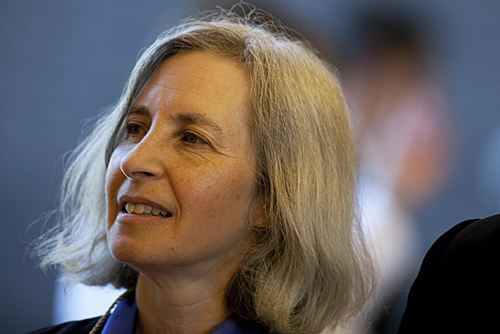
    Martha Minow, the Jeremiah Smith Jr. Professor of Law at Harvard Law School (HLS), is announced as the next dean of the Faculty of Law, beginning July 1. A member of HLS faculty since 1981, Minow is a distinguished legal scholar with interests that range from international human rights to equality, religion, schooling, and other governmental activities.

    Harvard researchers for the first time document variation in intelligence in individual monkeys within a species, a new step in understanding primate intelligence.

    July 2009

    Cherry A. Murray, who was named dean of the School of Engineering and Applied Sciences (SEAS) in March 2009, takes the helm.

    August 2009

    A multidisciplinary team of computer scientists, engineers, and biologists — primarily from the School of Engineering and Applied Sciences — receives a $10 million National Science Foundation Expeditions in Computing grant to fund the development of small-scale mobile robotic devices.

    Erez Lieberman-Aiden, a Ph.D. candidate at the School of Engineering and Applied Sciences, invents a computerized shoe insert that predicts the wearer’s risk of falling.

    Harvard launches a YouTube channel to broadcast everything from the University’s local events to its international research efforts.

    September 2009

    President Faust visits Capitol Hill and meets with House Speaker Nancy Pelosi and other congressional and administration officers to advocate for continued support of science research at U.S. universities.

    The Program in General Education takes effect at Harvard College. Commonly called Gen Ed, the program outlines liberal arts courses that must be taken outside a concentration in order to graduate. The Class of 2013 is the first embraced by the new design, though other undergraduates may opt in.

    A coordinated academic calendar synchronizes the schedules of Harvard’s 13 Schools. Geared toward improving student access to University-wide resources, the calendar makes it easier for students to take classes in more than one School.

    According to “Beyond the Yard: Community Engagement at Harvard University,” in a single year about 7,000 Harvard students collectively performed more than 900,000 hours of community service in and around metropolitan Boston.

    The Department of Stem Cell and Regenerative Biology launches an undergraduate concentration in human development and regenerative biology.

    The Harvard Graduate School of Education (HGSE) announces a tuition-free Doctor of Education Leadership Program (Ed.L.D.) that will be taught by faculty from HGSE, the Harvard Business School, and the Harvard Kennedy School. The program offers an unprecedented approach to preparing leaders for the future. The Ed.L.D. is the first new degree offered in 74 years by HGSE.

    Michael Sandel’s popular course “Justice” is available for anyone to take, thanks to a dedicated Web site and Harvard’s YouTube and iTunes channels, which begin airing Sandel’s lectures. The Anne T. and Robert M. Bass Professor of Government’s arguments become the most-watched videos, with WGBH also airing the 12-part lecture series.

    President Faust appoints Katie Lapp as executive vice president to oversee the financial, administrative, human resources, and capital planning functions of the University’s central administration.

    Harvard Yard is outfitted with colorful tables and chairs for meeting, relaxing, studying, or watching open-air performances. The initiative is a result of the Steering Committee on Common Spaces, charged with developing ideas to ensure that the physical environment better supports the University’s intellectual and social vitality.

    "The Donkey Show" (Justin Ide/Harvard Staff Photographer)

    Diane Paulus ’88, the American Repertory Theater’s (A.R.T.) new artistic director, opens the company’s new drama space Oberon with “The Donkey Show,” a critically acclaimed retelling of “A Midsummer Night’s Dream” — set to disco.

    Lakshminarayanan Mahadevan, Lola England de Valpine Professor of Applied Mathematics and of Organismic and Evolutionary Biology at Harvard’s School of Engineering and Applied Sciences, and Peter Huybers, assistant professor of Earth and planetary sciences in the Department of Earth and Planetary Sciences at Harvard, are named MacArthur Fellows.

    The Harvard Extension School celebrates its centennial with the premiere of Dean Michael Shinagel’s book “The Gates Unbarred,” which traces the School’s evolution.

    Environmental scientists from Harvard and Tsinghua University demonstrate the enormous potential for wind-generated electricity in China. The researchers estimate that wind alone has the potential to meet the country’s electricity demands for 2030.

    October 2009

    Harvard kicks off a yearlong focus on public service with Public Service Week, a series of seminars, lectures, career forums, and service activities highlighting the richness of the service landscape at Harvard. President Faust announces that the University will undertake a yearlong commitment to provide volunteer support of the Greater Boston Food Bank.

    Jack W. Szostak at a press conference at Massachusetts General Hospital in Boston (Justin Ide/Harvard Staff Photographer)

    Genetics professor Jack Szostak at Harvard Medical School and Harvard-affiliated Massachusetts General Hospital wins the 2009 Nobel Prize in physiology or medicine for pioneering work in discovering telomerase, an enzyme that protects chromosomes from degrading.

    Researchers at Harvard, the Broad Institute of Harvard and MIT, the Massachusetts Institute of Technology, and the University of Massachusetts Medical School, decipher the three-dimensional structure of human DNA, detailing complex folding beyond the molecule’s double-helix and paving the way for new insights in genomic function.

    The Radcliffe Institute for Advanced Study turns 10 years old and celebrates by launching an interdisciplinary symposium titled “Crossing Boundaries.”

    Researchers at the Harvard Stem Cell Institute, the School of Engineering and Applied Sciences, and Massachusetts General Hospital announce a breakthrough in making replacement cardiac parts, creating a functioning strip of mouse heart muscle starting with a cardiac master stem cell.

    November 2009

    President Faust visits Africa. During her trip, she meets with Harvard-trained researchers in a state-of-the-art laboratory built and operated by the Botswana-Harvard Partnership for HIV Research and Education, a novel collaboration between the Harvard School of Public Health’s AIDS Initiative and the government of Botswana. Later, Faust visits the University of Johannesburg at Soweto, where she announces that Harvard and the host university are developing an initiative to train school principals in some of South Africa’s most-challenged school districts.

    Harvard becomes the largest institutional buyer of wind power in New England, with an agreement to purchase more than 10 percent of the electricity needed to power the Cambridge and Allston campuses from a wind farm in Maine.

    Harvard Business School Dean Jay Light announces his retirement after 40 years of teaching and leadership as a member of Harvard’s faculty and five years as dean.

    The Task Force on University Libraries releases a report saying Harvard must restructure its fragmented library system and establish shared administrative services to respond to the rapidly changing technological and intellectual landscape of the 21st century.

    Harvard biologists and bioengineers report that a cancer vaccine carried into the body on a fingernail-sized implant is the first to successfully eliminate tumors in mammals.

    Harvard scientists create a quantum gas microscope used to observe the behavior of single atoms at temperatures so low they follow the rules of quantum mechanics.

    December 2009

    In a letter to the Harvard community, President Faust outlines Harvard’s path forward in Allston in three phases: property stewardship and community engagement, campus planning and greening, and campus development. A new work team with expertise in design, urban planning, business strategy, and public policy is charged to work with University leaders to understand the priorities of the University over the next decade, fully integrating them with a vision for Allston as a community.
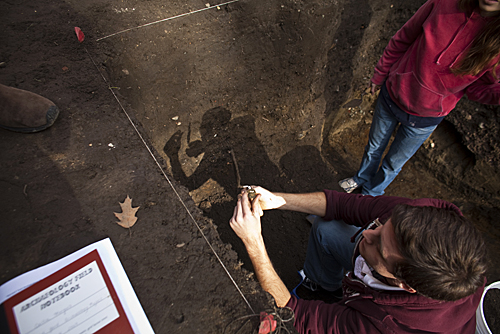
    Harvard Yard is turned into an archaelogical digging site (Justin Ide/Harvard Staff Photographer)

    Archaeologists and archaeology students working near Matthews Hall uncover what they believe to be the bottom of an architectural trench dug for the Indian College that stood on the site from 1655 to 1698, built to house Native American students as part of the University’s original mandate to educate the youth of both European settlers and Native people.

    James R. Houghton ’58, M.B.A. ’62, announces he will step down from the Harvard Corporation after 15 years of service, at the end of the academic year. He is succeeded as senior fellow by Robert D. Reischauer ’63.

    A study from Harvard and the University of Michigan shows that increasing obesity in the country threatens to eclipse health gains from the decline in cigarette smoking.

    President Faust announces formation of the Harvard University Committee on the Arts. The committee is charged with working to enhance the presence of the arts on campus.

    Harvard’s Museum of Comparative Zoology (MCZ) celebrates its 150th anniversary. Digitization is also under way, with museum staffers loading almost 700,000 digital records onto the Web.

    A Harvard and Princeton study shows that even moderate gains in global temperatures could melt ice stored at the poles, leading to dramatic sea level rise.

    January 2010

    A field hospital erected by the Harvard Humanitarian Initiative (Justin Ide/Harvard Staff Photographer)

    Harvard-affiliated doctors spearhead Haiti earthquake medical relief efforts, working at a field hospital erected by the Harvard Humanitarian Initiative.

    After the Jan. 12 earthquake in Haiti, Merrick Lex Berman, a research manager at Harvard’s Center for Geographic Analysis, designs the Haiti Earthquake Data Portal. The portal seeks to improve information flow for responders on the ground. When the Chile quake struck on Feb. 27, Berman created a portal for that country in just a few hours.

    Work begins on the Harvard Art Museum renovation project at 32 Quincy St. to allow students, faculty, scholars, and the public significantly greater access to collections, not only through larger exhibition galleries, but through new, expanded study centers.

    Harvard opens to the community the Harvard Allston Skating Rink in a refitted garage on Western Avenue. On opening night, hundreds of skaters show up for raffle prizes, hot chocolate, and some good old-fashioned falling.

    President Faust leads a delegation of University deans to the 2010 Annual Meeting of the World Economic Forum in Davos-Klosters, Switzerland.

    Researchers at the Harvard Stem Cell Institute and the Joslin Diabetes Center make old mouse stem cells act young again by exposing them to factors in the blood of young mice, an advance that may provide a key to aging.

    Harvard Business School enhances its M.B.A. curriculum by offering intensive seminars, independent study opportunities, and an expanded Immersion Experience Program during winter break.

    February 2010

    Evelynn Hammonds, dean of Harvard College and Barbara Gutmann Rosenkrantz Professor of the History of Science and of African and African American Studies, is appointed by President Barack Obama to the Board of Advisors on Historically Black Colleges and Universities.

    An international team led by Harvard researchers creates a genome-scale map of 26 cancers, revealing more than 100 sites where tumor DNA is missing or abnormally duplicated compared with normal tissue.

    Harvard Law School announces the creation of the Public Service Venture Fund to help graduating students pursue careers in public service. The first program of its kind at a law school, the fund will offer seed money for start-up nonprofit ventures and salary support to students who hope to pursue postgraduate work at nonprofits or government agencies.

    The Harvard Kennedy School receives a $5 million gift from Glenn Dubin to launch the Dubin Graduate Fellowships for Emerging Leaders, which will support and develop new programs for emerging leaders.

    March 2010
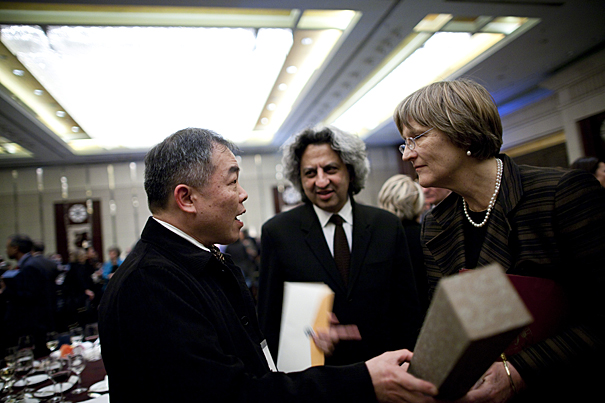
    President Drew Faust travels to Japan (Stephanie Mitchell/Harvard Staff Photographer)

    President Faust travels to Japan, where she meets with alumni at the Harvard Club of Japan and visits with Prime Minister Yukio Hatoyama.

    President Faust leads a delegation to China to mark the Harvard Shanghai Center’s official opening. During the festivities, Faust says, “Increasingly, we are in a world of universities without borders. This new center is a case in point.”

    Harvard launches its iTunes channel. iTunes U is a dedicated area within iTunes allowing students, faculty, alumni, and visitors to tap into the University’s wealth of public lectures and educational materials.

    President Faust announces the appointment of Lisa Coleman as chief diversity officer and special assistant to the president. Faust says, “It is crucial that we ask ourselves if we are doing enough today to foster an environment in which diversity is not simply valued, but cultivated in a systematic way.”

    Harvard Law School announces that Grainne de Burca, a leading authority on European Union law and European human rights law, will join the HLS faculty as a tenured professor of law on July 1.

    The Faculty of Arts and Sciences votes unanimously to approve a new, dedicated undergraduate concentration in biomedical engineering, to be managed by the Harvard School of Engineering and Applied Sciences.

    Researchers discover that amyloid–beta protein, the primary constituent in the plaques found in Alzheimer’s disease, may be part of the body’s immune system, according to a study by Massachusetts General Hospital researchers.

    Researchers at the Harvard School of Public Health and Walter Reed Army Institute of Research find that the risk of multiple sclerosis increases many times after one is infected by the Epstein-Barr virus.

    A collaboration with internationally acclaimed chef Ferran Adrià of El Bulli fame and the School of Engineering and Applied Sciences leads to the creation of a new undergraduate course on science and cooking.

    April 2010

    For the first time in Harvard’s history, more than 30,000 students apply to the College, leading to an admission rate of 6.9 percent for the Class of 2014. Notifications of admission are mailed to 2,110 of the 30,489 applicants. More than 60 percent of the admitted students will receive need-based scholarships averaging $40,000.

    The Harvard Alumni Association launches “Public Service on the Map,” an interactive Web site where alumni, students, faculty, and staff can register service projects around the globe. Within its first month, nearly 1,000 people register; one-third are alumni.

    William F. Lee ’72, a Boston-based intellectual property expert and former Harvard overseer, is selected as the newest member of the Harvard Corporation.

    Harvard recognizes 160 faculty, students, and staff who have made significant contributions to green house gas reduction and sustainability at the first annual Green Carpet Awards.

    Earthwatch Institute, a leading international nonprofit environmental organization, settles into its new world headquarters in Harvard-owned property in Allston, bringing about 50 staff to the former headquarters of WGBH media on Western Avenue.
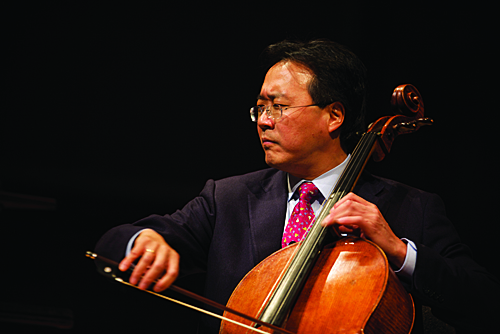
    Yo-Yo Ma ’76 (Justin Ide/Harvard Staff Photographer)

    Harvard President Faust and Yo-Yo Ma ’76, founder and artistic director of the Silk Road Project, announce the relocation of the Silk Road Project from Rhode Island to Harvard-owned property at 175 North Harvard St. in Allston this July, enabling new artistic and cultural opportunities at the University and in surrounding communities.

    Microsoft founder Bill Gates visits Harvard as part of a three-day tour of universities around the United States designed to inspire students and scholars to focus on the biggest problems facing humanity.

    May 2010

    President Faust announces that Nitin Nohria, the Richard P. Chapman Professor of Business Administration at Harvard Business School, will become the School’s 10th dean. A scholar of leadership and organizational change, Nohria previously served as the School’s senior associate dean for faculty development and chair of its organizational behavior unit. Nohria will take up his new role on July 1.

    President Barack Obama nominates and U.S. Solicitor General Elena Kagan

    U.S. President Barack Obama nominates U.S. Solicitor General and former Harvard Law School Dean Elena Kagan to replace Justice John Paul Stevens on the Supreme Court. If appointed, Kagan would join HLS alumni and fellow Justices John Roberts, Antonin Scalia, Anthony Kennedy, and Stephen Breyer.

    Harvard opens its new Center for Biological Imaging (CBI). The facility is unique in that its cutting-edge instruments will be replaced every 24 to 36 months. President Faust says the most important part of the CBI is not its instruments, but rather that “it makes the instruments the instruments of collaboration, as well as the instruments of science.”

    Officials announce that historian Annette Gordon-Reed, J.D. ’84, will join the faculty in July as a professor of law at Harvard Law School and a professor of history in the Faculty of Arts and Sciences. Gordon-Reed will also be the Carol K. Pforzheimer Professor at the Radcliffe Institute for Advanced Study.

    Michael Van Valkenburgh, Charles Eliot Professor in Practice of Landscape Architecture at the Graduate School of Design, is honored with the American Academy of Arts and Letters’ 2010 Arnold W. Brunner Memorial Prize in Architecture.

    Dean Michael D. Smith of the Faculty of Arts and Sciences announces that five FAS professors have been awarded Harvard College Professorships in recognition of their outstanding contributions to undergraduate teaching, advising, and mentoring: Michael Brenner, Glover Professor of Applied Mathematics and Applied Physics; Julie Buckler, professor of Slavic languages and literatures; Emma Dench, professor of the classics and of history; Peter Gordon, professor of history; and Daniel Lieberman, professor of human evolutionary biology.

    — Compiled by Sarah Sweeney

  • Vodafone UK Gets Ready for Nokia N8

    Found under: Vodafone, UK, Nokia, N8,

    Vodafone UK seems to be ready to sell Nokias future flagship phone the N8 a Symbian3 device thats expected to be available at some point this summer. The UK carrier has already posted the Nokia N8 on the companys website and its expected to be coming soon.The phone will probably be offered free of charge like most hot phones Vodafone UK brings to its subscribers but it will come bundled with a 24-month contract of at least 30 per month. Besides the brand new Symian3 OS

    Read More

    Read more in mobile format

  • Markets Withstand 1-2 Punch From GDP And Jobless Claims

    boxeronropes.jpg

    Markets are still pointing significantly higher, but they’ve come off a bit following a weak GDP report and a weak weekly jobless claims report.

    But it really doesn’t matter what the market is doing now (pre-market) and it really doesn’t matter what happens once trading gets rolling.

    What matters is what happens when we get to the final 30 minutes of trading, which is when everything happens nowadays.

    If things are going to stay up, we need a moratorium on loose lips out of Europe.

    Join the conversation about this story »

    See Also:

  • The Facebook News Feed Is Now Available in Yahoo Mail

    Yahoo is continuing its love affair with Facebook with another move towards deeper integration. The Facebook News Feed is now available inside Yahoo Mail for users who linked their Facebook account with their Yahoo one. All updates in the News Feed will show up among the updates from the Yahoo network. The feed works just like the Facebook N… (read more)

  • Logical Therapeutics Closes $16.9M C Round

    Ryan McBride wrote:

    Logical Therapeutics, a developer of drugs for inflammatory conditions, says that it has closed a $16.9 million in a Series C round of funding, according to a press release. Xconomy reported last week that the Waltham, MA-based firm had raised $10 million of a planned $16.9 million round of financing, based on online records from the SEC. The company did not comment at the time, and it wasn’t clear from the records who invested in the financing. Now Logical says it’s closed on the full amount, and that SV Life Sciences led the round, which included investments from Burrill & Co., Novo A/S, and Novitas Capital.


  • Steve Ballmer will be with Steve Jobs at WWDC 2010

    Steve Ballmer will be with Steve Jobs at WWDC 2010The next Apple developer conference, WWDC 2010 can be one of the events that makes history, but not because of the products which will be unveiled, rather because it is anticipated that the CEO of Microsoft , Steve Ballmer is attending the meeting.

    As revealed in Daring Fireball, the analyst Trip Chodhry says Steve Ballmer will make a seven-minute appearance at WWDC 2010 to present a product from Microsoft: Visual Studio 2010 for Mac OS X, iPhone and iPad.

    Also indicates that the intervention of Ballmer will take place within its own presentation of Steve Jobs. If confirmed this move by Apple and Microsoft, would be something that would expand the number of developers creating applications for Mac exponentially.

    Related posts:

    1. Steve Jobs opens the Apple Worldwide Developers Conference, WWDC 2010
    2. Steve Jobs could unveil the new iPhone 4G
    3. Apple market capitalization exceeds Microsoft with the advance of iPad

  • Cupê esportivo Toyota FT-86 poderá chegar apenas em 2013

    Conceito Toyota FT-86

    Lembram do esportivo cupê Toyota FT-86? Ele estava meio esquecido pela mídia, mas reapareceu nas manchetes, onde é especulado que seu lançamento poderá ser adiado para apenas 2013, ao invés de 2012 como esta previsto anteriormente.

    As informações foram divulgadas pela BestCar, uma conceituada revista japonesa de automóveis. Uma das principais razoes seria a intenção da Toyota realizar possíveis alterações no design do carro, especulação que surgiu há algum tempo atras depois que a companhia não estava totalmente satisfeito com o design atual de seu cupê.

    Além disso, dizem que a Toyota estaria esperando um momento mais favorável para o lançamento do esportivo FT-86, certa de que a recuperação do mercado para esse tipo de veiculo é mais lenta que o normal. Em compensação, a Toyota anunciou que o seu futuro cupê esportivo custará no Japão a partir de 18.200 euros, ou cerca de R$ 42.000.

    Fonte: AutoBlog


  • UT, Vandy to Host Institute on Latin American Films for High School Teachers

    KNOXVILLE – The University of Tennessee, Knoxville, and Vanderbilt University are teaming up to host a week-long “Institute on Latin American Film in the High School Classroom,” June 6-11, in the Hodges Library auditorium.

    Faculty from UT Knoxville’s Latin American Studies interdisciplinary program and Vanderbilt’s Center for Latin American Studies will work with high school teachers from across Tennessee to develop curricular plans for increased coverage of Latin American topics in their schools.

    All film screenings will be held in Hodges Library auditorium and are free and open to the public. The schedule includes:

    • “Qué Tan Lejos (How Much Further),” Ecuador – 7 p.m. Sunday, June 6
    • “Morristown: In the Air and the Sun,” U.S.A./Mexico – 7 p.m. Monday, June 7
    • “Si me comprendieras (If You Only Understood),” Cuba – 7 p.m. Tuesday, June 8
    • “Domésticas (Maids),” Brazil – 7 p.m. Wednesday, June 9
    • “Nueve Reinas (Nine Queens),” Argentina – 7 p.m. Thursday, June 10

    For more information on the program, visit http://web.utk.edu/~LatAmer/summer.html.

    C O N T A C T :

    Missy Buice (865-438-5303, [email protected])

    Charles Primm (865-974-5180, [email protected])

  • TechTown, Unity Studios Will Partner to Produce Michigan-Based Film Crews

    Movie Set
    Howard Lovy wrote:

    OK. You’re a Hollywood director, and you’ve come to the Detroit area to film your movie and take advantage of Michigan’s highest-in-the-nation 42 percent tax credit. You’ve set up your home base in a local hotel and your star—let’s say, oh, Meryl Streep—she’s costing you $100,000 a day. You need to find a local crew right now to begin shooting. And …. action!

    What happens next, if all goes well, is that a Michigan-grown crew is available to step in and—for far less than it would cost the director to fly in Hollywood folks—has the expertise and talent to, if you want to use a pure Michigan analogy, put that movie on an assembly line and crank out a quality finished product.

    And that’s where a Detroit business incubator and one of Michigan’s few homegrown film studios and film schools enter the stage, with a soon-to-be-announced collaboration that will make sure local film crews are trained to step in. Wayne State University’s TechTown and Unity Studios of Allen Park, MI, and its affiliated Lifton Institute for Media Skills are expected to announce a formal agreement in the next couple of weeks, under which the institute will teach the would-be crews how to make movies and TechTown will teach them how to become entrepreneurs to sell their services.

    “Everybody in the film industry has to be an entrepreneur because everybody is a freelancer,” says Randal Charlton, TechTown’s executive director. “They have to be. There are very few long-term gigs.”

    Jimmy Lifton, president of the studio and institute, grew up in the Detroit area, then moved out to Hollywood to work in the film industry in the ’80s. He came back to Michigan about four years ago with the hopes of launching his studio. Michigan’s tax incentives made it easier for him to convince partners that, yes, this state really can be a center for filmmaking. He recently graduated his first class of about 100 students, whose average age is about 40. So, these are people whose auto-industry jobs were cut off in mid-career, but whose skills can translate easily into filmmaking. Lifton says he’s doing very little training from the ground up, but more retraining of existing skills.

    Take, for example, people who formerly worked in computer-aided design for the auto industry. That is a skill that lends itself to digital effects and animation in the film industry—a skill that is increasingly in demand in the age of Avatar.

    “These are people that have 20 or 25 years of design experience,” Lifton says. “Twenty years of design experience at Chrysler. Well, that translates immediately into the art department.”

    Digital media training, Lifton says, is an increasing focus at his institute because of the demand. He says he knew he would find great, untapped skills in the Detroit area, but …Next Page »


  • Exploded Andy shows Android’s heart, brain (but where’s the JIT?)

    Exploded Andy

    Just look at that. Somebody’s Android’s gone and exploded all over this poster, spilling the heart and brain for all to see (and putting it in a convenient T-shirt and poster form and making it available for purchase). One thing’s missing, though: The speed-demon Just-in-Time compiler. Maybe that’ll be in Exploded Andy 2.2. [Exploded Andy via Gizmodo]

    This is a post by Android Central. It is sponsored by the Android Central Accessories Store

  • Acer Announces New Android 2.1 Smartphone, the Liquid Stream

    Found under: Acer, Stream Liquid, Android,

    Theres a new Android 2.1 smartphone in the house and its coming all the way from Acer. The Acer Liquid Stream is the device in question and we can already say we wished it was an Android Froyo handset. Can we expect it to get it almost immediately after the official arrival in storesWe dont have any arrival dates and pricing details yet we have a long list of specs and features and youll definitely love some of them if not all 3.7 inch WVGA AMOLED touchscreen displayA

    Read More

    Read more in mobile format