Blog

  • Remove Empty Folders Recursively

    Empty folders are bound to appear on the computer at one point or another, especially when you create a temporary space to hold your work. Getting rid of these items for better managing said space can be pretty tedious when done manually.

    But there are easier solutions, such as Sub4Del, which can complete eliminate the empty spaces in a couple of clicks, literally.read more)

  • Should Data Centers Be Regulated as Utilities? Industry Experts Weigh In

    power-smallorange

    Power infrastructure in a data center (Photo by Tim Dorr via Flickr)

    Last week the New York Times suggested that the data center industry has become a “wildcat power utility” by reselling power to customers at a profit and ripe for regulation. So we reached out to experts who were familiar with both data centers and utilities and asked: Is the data center industry a candidate for regulation as a utility?

    Their answer: Although power is a key component of their offerings, data centers differ from utilities in very significant ways. Another key point is that data center clients are typically sophisticated companies that are paying premium prices, and unlikely candidates for exploitation by service providers – a key historical concern of utility regulation.

    But these experts also noted that some industry practices open the door to greater scrutiny, and data center operators need to be more transparent about their practices to address concerns.

    Times: Power A Central Component of Leases

    In its story last week, The New York Times took a critical look at power provisioning in data centers. “Electrical capacity is often the central element of lease agreements, and space is secondary,” the Times wrote. “A result, an examination shows, is that the industry has evolved from a purveyor of space to an energy broker — making tremendous profits by reselling access to electrical power, and in some cases raising questions of whether the industry has become a kind of wildcat power utility.”

    The paper added that “the capacity pricing by data centers …. appears not to have registered with utility regulators.”

    Regulating data centers as utilities “doesn’t seem plausible to me,” said Coy Stine, Director of Data Center Services at Bluestone Energy, which works with utilities on energy efficiency incentives. “Data centers provide the service of a highly conditioned and very reliable power source. Customers can’t get that by plugging their services into the utility power plug in the wall. Comparing a data center to a utility is similar to saying a car manufacturer is a provider of sheet metal. The automobile has metal as a component, but there’s much more to it. The data center provider is playinhg the same role.”

    “I think data centers are a whole different animal,” said Jon Koomey, a research fellow at Stanford University who has done several landmark studies on data center energy use. “It’s not only the cost of a kilowatt of power. They’re charging for equipment and infrastructure like backup generators. These data centers aren’t like individual households. The key difference is that these (customers) are people who know what they’re doing.”

    Sophisticated Customers

    Both Koomey and Stine said they have heard of concerns being raised about the role of data centers in energy purchasing. But they say that equating data center providers to residential or office landlords is a flawed comparison, as they offer different services and have different types of customers.

    “I think it stems from the old model of tenants being exploited by their landlords,” said Koomey. “The people that are renting data center space are typically pretty sophisticated folks who are paying a lot of money for these services. This idea that they’re taking advantage of these clients doesn’t make sense.”

    “Data center customers have teams of people to negotiate their SLAs (service level agreements) very carefully,” said Stine. “The cost for the data center operator to buy switchgear and UPS gear and generators is factored into the cost to the customer. I think the customers understand this, but the general public does not. Most of the audience of the New York Times doesn’t understand what happens in the data center.”

  • Donkeys Suspected in Hungary Mauling Death

    It’s a given that animals are dangerous. While animals such as the Hippopotamus are known to be very dangerous, even seemingly harmless animals such as beavers can manage to kill a human.

    This week, police in Hungary are investigating the violent death of an older man that involves animals not normally thought of as killers. The suspects? Two donkeys.

    According to an Associated Press report, a 65-year-old man named Sandor Horvath died last week in Magyarszecsod, Hungary. Authorities say that the man was apparently pulled off his motorcycle by two donkeys and mauled to death. Horvath was reported to have been dragged for 50 meters while the animals bit and trampled him. Police are currently investigating the incident to work out exactly what happened. The results of the man’s autopsy have not been revealed.

    The donkeys were reportedly being kept on land adjacent to Horvath’s farm. The animals have not yet been put down, and are being kept “under observation” while the investigation continues.

  • Orcan Energy Raises Round From E.ON, Kleiner, Wellington

    Orcan Energy GmbH said it raised a second round of financing with E.ON as a new investor. Existing investors Kleiner Perkins Caufield & Byers and Wellington Partners participated in the funding. No additional details were available.

    PRESS RELEASE

    Orcan Energy GmbH wins E.ON as new Investor and strategic Partner

    (München, Düsseldorf, Palo Alto) Orcan Energy GmbH (Orcan), the leader in waste heat recovery technology, concluded its second round of financing in early 2013 with the addition of E.ON as a new industry partner and investor. E.ON broadens Orcan’s already prominent list of investors, worldwide leading venture capital firms Kleiner Perkins Caufield & Byers and Wellington Partners, both of whom were part of the original funding round in 2011 and continued to show their support by participating in this subsequent round. The new partner- ship is considered an important stepping stone on the path to fulfill Orcan’s vision: “To play a vital role in securing an ecological and affordable energy supply by tapping the energy source of waste heat”. Orcan offers E.ON the opportunity to extend its range of integrated solutions for its industrial clients through Orcan’s Organic Rankine Cycle (ORC)-products, the so-called ePacks.

    Dr. Urban Keussen, E.ON Senior Vice President Technology & Innovation: “E.ON is constantly seeking out new technology solutions that meet the requirements of our clients and their demand to benefit in a sustainable way, i.e. ecologically and eco- nomically. Orcan’s product, the ePack, offers our clients the opportunity to quickly ac- cess the enormous untapped energy potential of their own easily available waste heat. Additionally, E.ON believes that this new energy solution will be of great interest to potential new clients.”

    Dr. Andreas Sichert, CEO of Orcan Energy GmbH: “We believe our ability to win the commitment of such visionary Partners, even in the current difficult climate for start-up financing in the clean energy sector, is strong en- dorsement of our vision and our commitment to realizing it. Our investors sustained support has already allowed us to offer strategically important partners and clients in the industrial and energy sectors attractive solutions to their energy problems. Our ePacks will enable us to radically contribute to the alternative energy revolution, through the development of a cost-effective and sustainable energy supply.”
    294 Wörter, Anzahl der Zeichen 2.188 (1.904)Background

    Orcan Energy GmbH was founded in 2008, as a spin-out from the Technical University of Munich (“TUM”). Orcan’s ePack offers a compact, service-reduced and cost- efficient “plug-and-play” waste heat power generator based on ORC-Technology. Spe- cific patented innovations enable Orcan to popularize the technology on the mass mar- ket. At the beginning of 2013, Orcan gained sponsorships from the Exist-Research- Transfer-Aid of the Federal Government of Germany and additional grants from the “Wissensfabrik” and various resources from the TUM.

    Invigorated by the second round of financing, Orcan will continue to perfect the ePack and will now be able to supply a number of key accounts and sales partners with its products within the year. Additionally, the cash infusion will allow Orcan to refine its delivery chain and upgrade safety and quality standards during assembly in order to facilitate the expected increase in sales.
    Waste heat represents one of the largest, untapped energy markets. Worldwide more than 1000 Giga Watt of waste heat are being produced by fixed appliances alone. Until recently, and as a result of deficits in the ORC-Technology, this enormous source of reusable energy, equivalent to the energy volume of 100 million liters of diesel burnt per hour each day, has remained unexploited. Orcan’s ePack and its ORC-Technology finally make this vast supply of energy usable. Many of our clients already produce their own power from “energy waste”, utilizing the technology developed by Orcan, which transfers a sizeable share of waste heat into cost efficient, CO2-free energy. While industrial clients are focused on a sustainable, independent, stable and cheap in- digenous power production, energy suppliers’ primary aim is to sell the auxiliary power. Our technology enables even small biogas stations to easily create additional income generated by their waste heat, leading to a higher return on their investment.

    About Orcan Energy

    Orcan Energy GmbH is located in Munich, Germany, and is a worldwide leader in the field of „Organic Rankine Cycle“ (ORC)-Technology in small power ranges. The ePack-Technology of Orcan Energy allows waste heat to be exploited in an intelligent way in the process of power generation, and to enhance the energy efficiency of many industrial and energy producing facilities.

    About E.ON

    E.ON is one of the leading energy companies, acting in the fields of power generation, gas gathering and acquisition, trade, power grid and sales. One third of E.ON’s approx- imately 69 Giga Watt total power generation portfolio comprised low-CO2 output fa- cilities, such as on- and off-shore wind parks. E.ON enterprises include some of the world’s leading enterprises for renewable energies. In addition to energy production, E.ON operates power and gas distribution centers, supplying around 26 million custom- ers with their energy needs. With more than 70,000 employees working in locations throughout Europe, Russia and North America, E.ON posted sales of €113 billion in 2011. E.ON’s goal is to offer its customers innovative solutions while simultaneously adding value for its investors and protecting the environment.

    In short: E.ON offers clean and better solutions in relation to energy.

    The post Orcan Energy Raises Round From E.ON, Kleiner, Wellington appeared first on peHUB.

  • Yahoo swears it isn’t going to screw up Tumblr — but how realistic is that promise?

    As the dust begins to settle from one of the most significant acquisitions in web-land since the Facebook/Instagram deal, the warm glow of euphoria created by Yahoo’s $1.1-billion takeover of Tumblr has given way to the harsh reality of blending — or, more importantly, not blending — two vastly different companies and cultures. In a statement about the deal, Yahoo CEO Marissa Mayer promised not to “screw it up,” a comment undoubtedly aimed at the sensitive community of Tumblr fanatics. But is it even possible for Yahoo to keep this promise?

    Even before the news was confirmed on Monday, critics with long memories were reminding anyone who would listen about Yahoo’s track record with acquisitions, which has some rather notorious bumps in it, including two major ones known as GeoCities and Flickr. Those two deals alone have made many question whether Yahoo will be able to do the right thing with Tumblr — and while it may be unfair to lay the blame for these at Marissa Mayer’s feet, there are plenty of reasons to be skeptical about the future of this latest acquisition.

    GeoCities + Flickr: billions in missed opportunities

    In 1999, Yahoo bought GeoCities for about $3.5 billion, which even at the time was an eye-popping amount. Although it was over a decade ago, which is eons in internet time, there are some broad similarities between what GeoCities was then and what Tumblr is now: both were distinctive and somewhat chaotic communities, focused on allowing individuals to create their own space. Yahoo did a number of things that arguably accelerated the demise of its high-priced acquisition, including trying to monetize it through hosting fees and cheesy banner ads.

    The other stick that many anti-Yahoo types use when they want to beat the company up about its acquisition strategy is Flickr, the pioneering photo community that languished under Yahoo’s ownership until relatively recently. As many of its hard-core fans (including me) have argued in the past, Flickr was — or at least could have been — Instagram before Instagram.

    There have been a number of post-mortems on what happened with Flickr, but in a nutshell Yahoo did almost everything wrong: the larger company took away or smothered much of the photo-sharing community’s most important features, prevented its employees from innovating or growing, and forced all kinds of integration between the two platforms that did nothing to benefit users — in fact, precisely the opposite. It was like the trifecta of failure, and a perfect example of why most large-scale acquisitions don’t work.

    “All Yahoo cared about was the database its users had built and tagged. It didn’t care about the community that had created it or (more importantly) continuing to grow that community by introducing new features.”

    Successful mergers are exceedingly rare

    yahoo-reflected-in-eye-o

    It’s certainly reasonable to argue — as many of her fans in Silicon Valley have since the Tumblr deal was announced — that Marissa Mayer shouldn’t be held to account for these lapses, since she had nothing to do with them and the internet has changed a lot since then. Yahoo is also substantially more desperate than it used to be (if that’s possible), and that has arguably made Mayer more cautious about potential screw-ups.

    But the bottom line is that just because Mayer is a new CEO doesn’t mean she or the company won’t screw Tumblr up somehow anyway — either deliberately or by accident. That’s because large companies like Yahoo have a way of destroying the value of the things they acquire even if they don’t mean to do so, especially when the thing they have acquired is a somewhat unique community with special characteristics, which Tumblr arguably is.

    This is why successful large acquisitions of web communities or services are so rare — rare enough that almost everyone can only point to a single example: namely, Google buying YouTube (although Facebook’s acquisition of Instagram is looking like it may be another one). The question for Yahoo and Mayer is whether Tumblr can be kept as a distinct entity and yet still monetized, as YouTube has been, or whether the process of monetization will inevitably turn Tumblr into the latest example of a MySpace-style failure.

    tumblr_mn5sqwfnbE1s8h2tuo1_500

    Can Yahoo do what Google did with YouTube?

    Former YouTube exec Hunter Walk took a look at what Google did right in the case of YouTube, and boiled it down to five factors, including keeping the product from getting too intertwined with the parent company and maintaining a separate physical identity. But to me the most important ones were:

    Protect Tumblr from “helpful” Yahoos: This is where the accidental destruction of acquisitions often comes from — people who just want to help, but whose requests for features and other attempts at integration wound up almost “hugging us to death,” as Walk puts it. There is a powerful desire to get efficiencies out of acquisitions, but many of those attempts fail badly and ruin the thing they were trying to monetize or grow in the first place.

    Stop short-term monetization that won’t scale: Walk talks about how YouTube managed to avoid the natural desire to build all sorts of easy-win monetization methods into the platform, and focused instead on longer-term approaches that were harder to sell in the early going but built more value. If Yahoo sees Tumblr as a way to bulk up its banner ad or other programs, it could wind up making the exact same mistake that YouTube was able to avoid.

    In the end, much of the answer to the question about Yahoo screwing up Tumblr rests on Marissa Mayer, and her ability to stave off the desires of both the board of directors and the other senior managers who see Tumblr as either a distraction or a digital cow to be milked and then sent to the abbatoir.

    Post and thumbnail photos courtesy of Flickr / Stephen Brace and Getty Images / Chris Jackson and Pamuk Sekerli Tardis

    Related research and analysis from GigaOM Pro:
    Subscriber content. Sign up for a free trial.


  • Samsung reportedly prepping fingerprint scanning tech for Galaxy phones

    Samsung Fingerprint Scanner
    As rumors of Apple readying fingerprint scanning technology for a future iPhone continue to swirl, a new report suggests another company is working on similar tech for future versions of its smartphones: Samsung. SamMobile reports that files uncovered in a leaked firmware build for Samsung’s Galaxy S III included a number of images of fingerprints and other related items. The presence of these graphics suggests Samsung is indeed testing some type of fingerprint scanning technology internally, but they give no indication of exactly what kind of functionality Samsung might have planned. The leaked images pulled from Samsung’s firmware file follow below.

    Continue reading…

  • From Cronkite to Couric: Internet Archive gets $1 million to expand TV news collection

    The 20th century’s printed output is available in digital format, but that’s not the case for television — decades worth of TV broadcasts, which represent a rich news and cultural heritage, are instead locked up and unavailable. The Internet Archive has been trying to change that. Starting in September, the San Francisco non-profit embarked on an ambitious plan to collect all shows going back to the start of TV, and offer clips of them available online.

    The outfit got a big boost this week thanks to a $1 million donation from the John S. and James L. Knight Foundation, which will be used to expand its growing video library and to make it easier for video browsers to find everything from Jon Stewart to Walter Cronkite.

    Right now, the Internet Archive has more than 400,000 news clips dating from 2009 that it offers as a research tool to scholars, journalists and the general public. Users can search them using close captioning tags and other metadata the Archive has assembled.

    “You can discover culture that’s languishing unseen and unheard,” Roger Macdonald, Internet Archive television news project director, told me by telephone.

    He explained that the Internet Archive, which last year began using BitTorrent as a distribution system, had been recording the broadcasts for years — “we ingest, index and make available,” in Macdonald’s words.

    The new money will help the nonprofit afford the petabyte’s worth of broadcast data it collects every year, and stores on servers located at its office, a converted Christian Science church in San Francisco’s Richmond district. Macdonald said the Internet Archive will also hire people to improve what is for now a fairly rudimentary user interface.

    There is also the question of how the Internet Archive will be able to obtain older TV footage — think Dan Rather, Howard Cosell, I Love Lucy and so on. For now, the television networks jealously guard their copyright and make such content available in very limited ways; for instance, users can watch old shows from NBC, ABC and CBS at New York’s Paley Center for Media — but cannot do so online.

    Macdonald said the Internet Archive, which lets users watch 30 second clips or rent DVDs, is in talks with the networks about gaining access to their content in the capacity of a digital librarian.

    Related research and analysis from GigaOM Pro:
    Subscriber content. Sign up for a free trial.


    • Tornado Death Toll Lowered: One Bright Spot In Oklahoma Storm Story

      The estimated death toll for the giant tornado that ripped through Moore, Oklahoma on Monday was drastically lowered today. While earlier reports had at least 51 people dead, including 20 children, the numbers have been revised to 24 confirmed dead, including 9 children.

      State officials announced this morning that fewer people had been killed than previously thought, with a spokesperson for the state medical examiner’s office saying in a news conference that some of the victims had been counted twice. While certainly no death toll could be considered a good thing, a reduced number of deaths is a bright spot in an otherwise ghastly ordeal.

      Emergency personnel continue to search for victims, including two dozen missing children from an elementary school that was destroyed.

      Google has launched a crisis map, providing resources for those affected by the storm.

      Photos and videos of the tornado and its destruction have flooded social media, giving the whole world a glimpse of the terror that ripped through the area. Here, you can see a video of the storm forming in Newcastle, OK. In this one, a woman finds her missing dog in the rubble while being interviewed by CBS.

      Image via reddit

    • Amprius has built a lithium ion battery that can last 25% longer than today’s batteries

      A lithium ion battery that can power a smart phone or tablet for up to 25 percent longer between charges than current alternatives is now out in the marketplace, from a venture capital-backed battery startup that has been very quiet for several years. The company, Amprius, is backed by a group of investors including Google chairman Eric Schmidt, VantagePoint Venture Partners, and Kleiner Perkins Caufield & Byers, among others.

      We included Amprius, which was launched in 2008 as a spin out from Stanford University, on our list of 13 battery startups to watch in 2013. The startup has developed a battery based on research from Stanford’s Yi Cui, and its lithium ion batteries, announced Tuesday, use a nano-structured silicon material for the anode part of the battery.

      A battery is made up of an anode on one side and a cathode on the other, with an electrolyte in between. Amprius’ nanostructured material allows the anode to be shrunk fourfold, delivering a fourfold increase in energy density.

      Battery energy density is the amount of energy that can be stored in a battery per given volume. Amprius said its initial batteries can deliver 580 and 600 watt hours per liter, and its next-gen batteries can deliver 650 and 700 watt hours per liter. Traditional lithium ion batteries are operating at closer to 400 watt hours per liter.

      Another one of the challenges that Amprius said it has overcome when building this battery is that it has had to engineer the silicon to make it stable enough to be charged and discharged repeatedly over time. The more stable the silicon, the longer the life time of the battery. Amprius said the anode can be charged and discharged more than 500 times while retaining 80 percent of the original capacity (a requirement for original equipment manufacturers, or OEMs).

      Amprius is supplying its batteries to unnamed smartphone and tablet OEMs and is also working with OEMs to design its batteries in custom ways to fit into new consumer electronics, it said. The next-gen batteries are supposed to go into pilot production later this year.

      Amprius has raised at least $25 million from investors including the ones listed above as well as IPV Capital, and Trident Capital. The company has an R&D lab in Sunnyvale, Calif., and an R&D lab and pilot production line in Nanjing, China.

      Related research and analysis from GigaOM Pro:
      Subscriber content. Sign up for a free trial.


    • Your tax dollars at work: Apple’s Cook navigates the senatorial theater of the absurd

      Apple CEO Tim Cook did his best to deflect the harsh glare of the national political spotlight this morning by defending how the company pays corporate taxes. Used to being lauded as an exemplary American business success story, the company was also singled out by a Senate subcommittee Tuesday for using legal technicalities to avoid paying billions in taxes over the years. Sen. Carl Levin, the chairman of the Senate’s Investigations subcommittee, described Apple’s nimble minimization of its taxes as the result of “exploiting an absurdity,” and Sen. John McCain labeled the company “one of the biggest tax avoiders in America.”

      Tim Cook Senate testimony taxesBut Cook, for his first time offering public testimony before Congress, acquitted himself quite well despite the scolding his company faced, which makes sense if you think about it: Sen. Levin is probably nowhere near as scary as Steve Jobs. Apple CFO Peter Oppenheimer and its head of tax operations Phil Bullock were tasked with explaining the details of Apple’s accounting, while Cook extolled Apple’s virtues, the jobs it creates and its values as an American company.

      Apple normally gets to choose how it’s shown in the spotlight. So it was an unusually defensive position for the company and its chief executive, known for its preference for privacy, to be in and have the nitty gritty of its corporate accounting practices exposed for all to see.

      But Cook did indeed choose to go to Washington. He probably could have sent a senior vice president, but he showed up to speak for his company. And in doing so, he continued to rewrite our expectations of an Apple CEO. While his predecessor met privately with public officials, Apple was not in the spotlight in years past the way it has been recently. As profits have soared and some of its corporate practices both abroad and at home have come to light, Cook has had to face increased public scrutiny in a way Apple didn’t see quite as much during Jobs’ tenure as CEO. (With the exception of the stock-options backdating controversy, though the penalties for that were minimal.)

      In the same manner he smoothly handled outrage at the practices at Apple’s Chinese manufacturing partners and offered solutions, Cook used his particular experience at Apple to talk about taxes. As the company’s former operations officer, he ably explained pricing transfer and other complex accounting practices his company uses, and laid out suggestions for how to reform the U.S. tax code to encourage more companies like his to bring more of their foreign earnings home.

      Grilling Apple

      Two experts on tax law testified earlier in the morning how Apple allocates some income to a holding company and subsidiaries in Ireland that don’t file corporate tax returns in the U.S. or anywhere else. But as was oft-repeated, what Apple has been doing doesn’t break any U.S. laws. (Sen. Rand Paul twice decried Apple being “harangued and bullied” by the committee and repeatedly made the point that if Apple weren’t minimizing its tax burden, it would be irresponsible to its shareholders.)

      Cook defused some of the more pointed insinuations made by the committee diplomatically, using the same brand of charm and salesmanship we see from him during keynote speeches at Apple events. “We pay all the taxes we owe, every single dollar,” Cook said during his testimony. “We comply with the laws but also the spirit of the laws.”

      Many of the senators present Tuesday admitted to being big fans and users of Apple products. But the reason the company they all admire was being grilled wasn’t completely explained. It did appear Apple was being used as an example of common corporate accounting practices because it is the largest corporate tax payer in the U.S. — and, as Sen. Tom Carper noted, because of the current political climate surrounding the national deficit. Apple and many other U.S. companies have been operating in this manner for years, but in the shadow of the “sequester,” several members present acknowledged that Congress is looking for tax revenue that it’s not getting.

      In the end, Apple’s presence seemed to serve as an intermediary for the senators to argue amongst themselves about how out-of-control the U.S. tax code is. The hearing itself seemed mostly a pointless exercise, as these hearings tend to be, with little promise of any real change. Apple will likely go home to Cupertino and keep doing what its doing, and Congress will continue to disagree over how to appropriately tax businesses.

      Meanwhile, Cook gets to continue to raise his public profile as an elite American businessman and cement his company’s stature as critical to the American economy and the overall tech industry.

      Related research and analysis from GigaOM Pro:
      Subscriber content. Sign up for a free trial.


    • VMware lays out prices for hybrid cloud offering — now customers have the ball

      VMware re-announced its long-awaited vCloud Hybrid Service as an Infrastructure-as-a-Service (IaaS) play for current vSphere customers to use. It will become available in an early access program in June and generally available in the third quarter of the year.

      The company is pitching the platform for both legacy vSphere applications already running in company data centers  and for brand new applications designed from the ground up.  VMware execs up to and including CEO Pat Gelsinger promised “seamless” interoperability between on-premises implementation and vCloud Hybrid Services.

      They promised it will let customers move data from on-premise infrastructure to public clouds on Layer 2 or Layer 3 networks and create the same virtual-networking infrastructure like load balancers and firewalls. Management will happen all inside current VMware software tools. Managing and moving virtual machines will be possible inside vSphere through a free-plugin. The idea is to help customers move existing applications around and develop new applications on the public cloud. Some customers will want to run specified applications on the public cloud and keep key data on premises, said Gelsinger, who will be a featured speaker at GigaOM Structure next month.

      Bill Fathers, VMware’s senior vice president and general manager of hybrid cloud services, described vCloud Hybrid Service as the easiest public cloud to adopt. It will be available through current partners, so licensing won’t be different. And customers can get support for the vCloud Hybrid Service from VMware, just as they can for other services.

      Partners that endorsed the platform included  Tibco, Microsoft, SAP, Puppet Labs (see disclosure) and Pivotal, VMware’s step-brother that is co-owned by VMware and parent company EMC. VMware  holds a significant stake in Puppet. “VMware will be the first and only cloud provider to provide SAP software, including HANA, as a subscription service on premise and in the cloud,” Fathers said.

      The vCloud Hybrid Service actually has two flavors: a Dedicated Cloud mode has “physically isolated and reserved compute resources” for predictable workloads and a Virtual Private Cloud for seasonal workloads that require greater elasticity but are multitenant in nature. The former service will start at 13 cents an hour for a 1 GB virtual machine with a single processor on an annual basis, while the latter will start at 4.5 cents an hour on a monthly basis. But those prices will come as year-long licenses. Fathers said he expects customers to use both in parallel. The pricing model helps, but it doesn’t provide insight into the cost of storage and networking services.

      vmware price 1

      To provide the infrastructure for the vCloud Hybrid Service in the United States, VMware will pull from infrastructure in Santa Clara, Calif.; Las Vegas; Dallas; and Sterling, Va. Fathers said the plan is for “an asset-light model” in which the facilities in those cities are “third-party data centers.”

      Beta customer, Julio Sobral, senior vice president of post production for Fox Broadcasting, said the movement of certain applications to VMware’s public cloud, particularly collaboration tools for dispersed employees, had, in fact, been “seamless.

      vmware price 2

      Other beta customers include the state of Michigan, the city of Melrose, Mass.; and Planview. The question is how many of VMware’s roughly 500,000 customers will move onto the service too, rather than keep using IaaS providers such as Amazon (a amzn) Web Services for certain applications, as some customers have.

      There could also be friction with existing VMware cloud partners. They have been underwhelmed by the offering and the service provider partners not selected to host the offering now feel they are competing with their supplier, as my colleague Barb Darrow has noted.

      DisclosurePuppet Labs is backed by True Ventures, a venture capital firm that is an investor in the parent company of this blog, Giga Omni Media. Om Malik, founder of Giga Omni Media, is also a venture partner at True.

      Related research and analysis from GigaOM Pro:
      Subscriber content. Sign up for a free trial.


    • LAPD Officer Arrested, Charged with Molesting Two Young Girls

      A Los Angeles Police Department officer is due in court on Tuesday, where he will face charges of performing lewd acts with minors inside his Castaic home.

      Officer Miguel Schiappapietra, 28, was arrested on Saturday at his home and charged with two counts of lewd acts with a child. He was held on $100,000 bail.

      According to police, Schiappapietra lured two young girls, both under the age of 10, into his home and molested them. The LAPD provided no other details on the actual assaults, or whether there was any prior relationship between Schiappapietra and the girls. Schiappapietra had only been living in the neighborhood for just over a month.

      The LAPD says that he has been placed on paid administrative leave pending both the criminal investigation and an internal investigation. Schiappapietra has been a member of the LAPD for 6 years.

      Stories of child abuse are always hard to stomach, but they’re even more terrible when the alleged perpetrator holds a position of power – especially one whose job is to protect.

      [via LA Times]

    • January Jones: Son’s Father Is No One’s Business

      January Jones, star of “Mad Men”, has said she refuses to give away the identity of the man who fathered her son, Xander, because it’s no one’s business.

      The 35-year old actress says she’s just heeding advice from Jack Nicholson.

      “Jack Nicholson once told me: ‘You should never give your personal life away, otherwise people will pick you apart. They’ll never believe in your character,’” Jones said.

      Jones has taken some flack in the past–and most recently in a New York Times piece–for being “cold”, much like her “Mad Men” character Betty Draper. The fact that she doesn’t want people prying into her personal life seems to be at the root of her reputation, though she isn’t alone in her preferences. Many stars who spend a lot of time in the public eye would rather keep quiet about their relationships and family, and who can blame them?

      “I’m not trying to sell myself,” Jones said. “I wouldn’t know how.”

    • The Next Xbox Gets A Name – The Xbox One

      During the Xbox event this morning, Microsoft announced its vision for the next-generation of game consoles and entertainment. The philosophy governing the next Xbox is everything going through one console. As such, the next Xbox will be called the Xbox One.

      The Xbox One is being designed to improve a living room that Microsoft sees as fragmented. With the next console, Microsoft hopes to bring games, TV and entertainment into one place with you as the center.

      Instead of showing games first, Microsoft decided to show how the next Xbox is going change entertainment and television. The first major change is that everything is controlled via voice or gestures. The voice commands have also become more conversational.

      The Xbox One will also be bringing a bit of Windows 8 to it with Snap Mode – the multitasking feature in Windows 8 that allows users to have two applications open at once. With the Xbox One, a user can be watching a movie and open Internet Explorer on the side. The side view can then be controlled with a tablet or phone via Smartglass.

      Speaking of television, ESPN on the Xbox One has received a substantial improvement. Fans will now be able to access their fantasy leagues while watching games. Microsoft has also entered into an exclusive contract with the NFL to provide live updates to fantasy football rosters during games.

      Microsoft has also teamed up with Steven Spielberg to produce a live action Halo TV series that will be a premium series only on Xbox One.

      The final addition to the overall Xbox experience is Skype. With it, users can make video calls with the 1080p camera that’s in the new Kinect. It also supports Snap mode so users can make calls while watching movies, and presumably while playing games.

      So, what’s powering all of this? Microsoft said that the next Xbox will sport an 8-core CPU, 8GB of RAM, a Blu-Ray Drive and USB 3.0. It’s also claimed that the machine will be cool and silent.

      Interestingly enough, Microsoft says that the Xbox One will also be powered by three separate operating systems combined into one. The regular Xbox OS will be used by game developers while all other applications will use the Windows kernel. The other OS combines the two together for when you want to instantly switch back and forth between games and applications.

      The new Kinect sensor sports a 1080p camera and more advanced tracking algorithms. Microsoft says that the new Kinect can even read your heartbeat.

      As for the proper Xbox One controller, Microsoft says it has implemented over 40 changes to the design. One of which is impulse triggers that will deliver more feedback. The company also claims to have redesigned the d-pad.

      Xbox Live is by far the most exciting part of the new system, and Microsoft seems to have noticed this. It has upgraded the Xbox Live server count to 300,000 so that players can do more. The first turns every Xbox One into a dedicated DVR capture device that lets players capture game footage and edit the footage on the console itself. Achievements will be revamped to be more about how much you play, and multiplayer games will search for matches while you play other games or watch TV.

      After all of this, Microsoft finally decided to talk about some games. First up was EA Sports with an “unprecedented partnership” that will see four franchises being released on Xbox One – FIFA, Madden, NBA Live and UFC. For FIFA 14, the game’s popular Ultimate Team mode will be exclusive to Xbox.

      Microsoft also announced Forza Motorsport 5 and Quantum Break as titles it’s publishing. The first speaks for itself, but the latter is the latest title from Remedy. It sounds like the guys at Remedy are trying to create a game that ties in with an in-game TV series. Both will influence the other or something. We’ll probably find out more at E3.

      To end the show, Activision showed off the first footage of Call of Duty: Ghosts running on the Xbox One hardware. Of course, all DLC for Call of Duty: Ghosts will still launch first on Xbox.

      As for other games, Microsoft says that there will be 15 exclusive titles for Xbox One in its first year with eight of them being new IPs. We will probably find out more about those titles at Microsoft’s E3 show in early June.

    • Microsoft debuts Xbox One

      The Xbox 360 has been around since 2005 and, despite retaining its popularity, the console grows long in the tooth. That changes today, as Microsoft announces a new generation of its stealth living room takeover device. Speculation around what was coming has been growing for sometime and reached a crescendo when the company finally unveiled the event date.

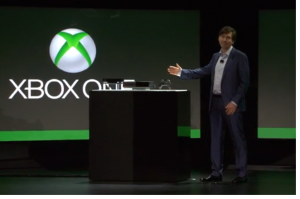
      Don Mattrick, President of the Interactive Entertainment Business at Microsoft, kicked off the event unveiling the Xbox One, a name that dispelled many myths about Infinity, 720 and 8.

      The console packs in 8 gigabytes of RAM, USB 3.0 and a Blu-ray player. All solid hardware inclusions to be sure, but hardly the most impressive part of the event. That was the TV pass-through and incredibly fast voice control, which was shown off in great detail during the course of the show.

      TV pass-through works similar to Google TV: customers can plug their cable or satellite box into the Xbox One and out to the TV, eliminating the need for switching inputs. Changing is controlled by simply speaking a command — “Xbox go to guide”, for instance, shows the guide info for your service. Movies, games, music, and live TV can all be controlled with simple spoken commands.

      ESPN will now include player tracking, enabling users to easily call up their fantasy team roster and check real time stats to keep track of how players are are faring for your team.

      The new Xbox One will also feature trending statistics for games, TV and movies; allow for gesture control; and feature four new sports games from EA — UFC, Madden, NBA and FIFA. Microsoft Studios also plans to release 15 games within the first year, eight of which will be new franchises, and will kick off with Forza Motorsport 5 available at launch.

      Microsoft also unveiled an exclusive TV series, bringing it into direct competition with services such as Netflix and Amazon. The Halo TV show will be directed by Steven Spielberg.

      Perhaps the biggest announcement comes in conjunction with Roger Goodell, as Microsoft announces the NFL on Xbox — an exclusive partnership that will include a range of content.

      The new console will arrive “later this year” and pricing was not revealed, but the show did wrap up with a debut of the next Call of Duty, called COD: Ghosts, which will be another exclusive game for the next-generation Microsoft box.

    • Is ESPN Starting A Round of Layoffs?

      Is the worldwide leader in sports getting ready to start cutting some of their fat? If the report at Deadspin is to be believed, the answer is, it certainly looks that way. In fact, the report indicates “hundreds” will be meeting the ax, which, considering the popularity of, well, everything related to sports–especially in the social media world–the move comes as something of a surprise. Regardless of the moves Fox Sports makes (or are in the process of making), the fact is, ESPN is pretty much a monopoly. Sure, there are sports on other channels, but when it comes to brand proliferation, no other televised sports entity compares. So what would cause the self-proclaimed Worldwide Leader in Sports to consider layoffs, especially in a world where they set the tone, at least regarding sports conversation?

      The Deadspin article features snippets from recently-departed employees who offer the following insight:

      I was laid off from ESPN today after 9 and a half years. Completely out of the blue, no warning at all. I was told it was 10% across the board, which would be roughly 400. I was told the reason was they needed to make their profit margin and they chose to do that via layoff of staff… we were told that the layoffs ARE tied to the profit margin that ESPN needs to meet and the fact they haven’t met that number. Your comments about them buying all of these live rights and now needed to reduce overhead costs is dead on.

      As an example, here are two of the “live rights” deals being discussed in these emails to Deadspin:

      ESPN spends $825 million over 11 years to gain exclusive rights to the US Open (tennis, not golf).

      – ESPN extended its partnership with SEC until 2034, which gives ESPN ownership of the upcoming SEC Network. While the terms of the contract were undisclosed, the two entities will split the SEC Network profits evenly.

      Are these two business acquisitions/partnerships the reason why these layoffs are happening in Bristol, Connecticut? It’s hard to come up with any other conclusion, although, Disney (ESPN’s parent company) has been laying off employees as well. Maybe ESPN is trying to keep with their owners.

    • Bin Laden Death Photos Won’t Be Released, Thanks To Court Ruling

      Three judges on the U.S. Court of Appeals for the District of Columbia Circuit unanimously ruled today that the U.S. government can keep death photos of Osama bin Laden secret. There are apparently over fifty of them.

      Bin Laden was killed on May 2nd, 2011 and President Barack Obama revealed shortly thereafter that the death photos would not be released.

      “The risks of release outweigh the benefits,” Obama said at the time. “Conspiracy theorists around the world will just claim the photos are doctored anyway, and there is a real risk that releasing the photos will only serve to inflame public opinion in the Middle East.”

      “Imagine how the American people would react if Al Qaida killed one of our troops or military leaders, and put photos of the body on the internet,” he added. “Osama bin Laden is not a trophy – he is dead and let’s now focus on continuing the fight until Al Qaida has been eliminated.”

      In January, the U.S. Court of Appeals for the D.C. Circuit heard oral arguments in the case, which stems from a Freedom of Information Act (FOIA) request made by the group Judicial Watch. The group appealed the decision of a U.S. District court, which ruled that the images could harm national security. The group had said in a brief:

      Specifically, Defendants have failed to provide any evidence that all 52 images, including those depicting bin Laden’s burial at sea, pertain to “foreign activities of the United States.” Defendants also have failed to provide any evidence that images depicting the burial at sea actually pertain to “intelligence activities.” Nor have they demonstrated that the release of images of a somber, dignified burial at sea reasonably could be expected to cause identifiable or describable exceptionally grave damage to national security.

      The U.S. Justice department said there were obvious “sensitivities” with the situation, and that releasing the images could lead to violence against Americans.

      Reuters reports that the court ruled today that the risk of violence is indeed a justification to keep the images classified.

      There are some fakes out there, however, easily found with a Google image search.

    • Peak Rock Buys Atlas Paper

      Peak Rock Capital has acquired Atlas Paper Mills. Financial terms weren’t announced. Miami-based Atlas makes tissue paper.

      PRESS RELEASE

      Austin, TX, May 21, 2013 – An affiliate of Peak Rock Capital (“Peak Rock”) announced today that it has acquired Atlas Paper Mills, LLC (“Atlas” or the “Company”), a leading manufacturer of tissue paper.

      Headquartered in Miami, FL, Atlas is a leading company in the manufacture of tissue products, utilizing 100% recycled fiber. The Company produces a complete line of tissue products; including bath tissue, towels and facial tissue, serving leading customers in both the away-from-home and retail channels. This strategic approach has allowed the Company to develop long-term relationships with an attractive customer base. The Company provides both branded (“Green Heritage”) and private label products throughout North America.
      Anthony DiSimone, CEO of Peak Rock Capital, said, “Atlas is a great example of our interest in investing in middle market businesses that can benefit from our resources and expertise to enhance their growth and strategic position; it also highlights our continued interest in the manufacturing and consumer product sectors.”
      Peter Leibman, Managing Director of Peak Rock Capital, added, “Atlas has a strong competitive position as a supplier of ‘green’ tissue products with long-standing customer relationships.  We believe Atlas is an excellent platform for expansion through organic growth and strategic add-on acquisitions and are excited to work with the Company’s outstanding management team in pursuing these opportunities.”

      Joe Tadeo, CEO of Atlas Paper Mills, commented, “We are very pleased that Peak Rock is investing in Atlas and believe we will benefit from Peak Rock’s knowledge of the industry and resources to support investments in strengthening and expanding our core business. This is an exciting time for Atlas, and we look forward to growing our business in partnership with our customers, suppliers and employees.”

      ABOUT ATLAS PAPER MILLS
      Atlas Paper Mills is a Miami, FL based manufacturer of tissue products, utilizing recycled fiber. Atlas supplies private label and branded bath tissue, towels and facial tissue to a diversified mix of customers in the away-from-home and value retail channels. Atlas produces approximately 34,000 tons of recycled tissue products per year and converts approximately three million cases of tissue and towels. For further information about Atlas Paper Mills, please visit www.atlaspapermills.com.
      ABOUT PEAK ROCK CAPITAL
      Peak Rock Capital is an Austin, TX based private equity firm that makes debt and equity investments in middle market companies. Peak Rock invests in companies where it can support senior management in driving rapid growth and profit improvement through operational and strategic changes. Peak Rock’s principals have deep expertise in complex situations, with the ability to provide tailored capital solutions and close transactions quickly where speed and certainty are priorities. For further information about Peak Rock Capital, please visit www.peakrockcapital.com.

      The post Peak Rock Buys Atlas Paper appeared first on peHUB.

    • MessageMe Raises $10M From Greylock, Others

      MessageMe said it raised $10 million in a deal led by Greylock Partners. The round was joined by previous investors, the company said in a blog post. The company received a seed investment in March from True Ventures, First Round Capital, Google Ventures, SV Angel, Resolut.vc, Andreessen Horowitz, Greylock and The Social+Capital Partnership. The company had previously received angel money.

      Here is the blog post.


      The post MessageMe Raises $10M From Greylock, Others appeared first on peHUB.

    • Private equity, top traders mull $1 bln commodity venture

      Former top commodities traders from Deutsche Bank are in talks with U.S. private equity group Riverstone to set up a $0.5-1.0 billion venture that will both invest and trade in commodities, Reuters is reporting.

      (Reuters) – Former top commodities traders from Deutsche Bank are in talks with U.S. private equity group Riverstone to set up a $0.5-1.0 billion venture that will both invest and trade in commodities.
      The venture, which will put money into assets ranging from energy producers to pipelines and refineries, is a rare foray by a private equity firm into commodities at a time when banks are curbing exposure due to tighter regulations and stagnant prices.
      Riverstone, an energy and power-focused private investment firm with around $24 billion of capital raised across seven investment funds, will hold a controlling stake in the venture, TrailStone, to be launched later this year.
      David Silbert, who led Deutsche’s commodities trading team from 2007 before leaving last year as the bank reduced exposure to commodities, will also be investing in TrailStone together with his partners, Silbert told Reuters.

      “TrailStone will be an asset-backed commodities merchant. We will buy refineries and production assets, create joint ventures with people who have assets,” Silbert said.

      “There are loads of upstream producers who need capital. We will be telling them – pay us back in production not cash.”
      Riverstone declined to comment on the investment.

      Silbert had helped build Deutsche into one of the largest commodities players in banking before the German lender reduced exposure for reasons including tougher regulations on proprietary trading.

      Hedge funds have also recently reduced exposure to commodities due to poor returns, giving a large market share to unregulated Swiss trading houses.

      “We will be different from a hedge fund. Our model won’t be very much different from trading companies, which have been generally good at acquiring assets,” said Silbert.

      “But we will be fairly risk averse. There will be no emphasis on proprietary trading,” he added.

      He said the company would invest in assets across all continents and have offices in the United States, Britain and Australia.
      “The venture will be energy-focused but precious and base metals, iron ore and coal will be also big for us. We will be focusing on investing in mid-sized companies with quality assets,” he said.

      Once the venture is running, it could partner with other private equity funds or offer them help in running assets or trading commodities.

      Silbert’s partners at TrailStone will be Troy Martin, previously chief operating officer of Deutsche’s commodities trading, Bill Gebhardt, who as he did at Deutsche will oversee European power and gas, John Redpath, who will look after oil and agriculture, and Raymond Key, who will oversee metals.

      Silbert previously worked at Merrill Lynch and Koch Trading. Riverstone has offices in New York, London and Houston and has invested around $21.8 billion to 98 projects in North America, Latin America, Europe, Africa and Asia.

      The post Private equity, top traders mull $1 bln commodity venture appeared first on peHUB.