Me too, though being in the UK I tend to watch more Formula 1. As part of my job I often come across cool pieces of work done by our customers that we can’t publicise the work for reasons of confidentiality.
This work by Voxdale is an exception though. It was done a couple of years back, not that long after Voxdale was founded, which makes it all the more impressive, and was done for Champ Car, now merged with Indy Car. The project was to optimize the existing Panoz chassis for Conquest Racing’s Champ Car – now unified with Indy Car.
The first hurdle Voxdale encountered was having no CAD files to work from. Their solution was to scan the entire car using a Metris optical laser scanning system to produce a STL point cloud with better than 0.3mm accuracy – reverse engineering at its best!
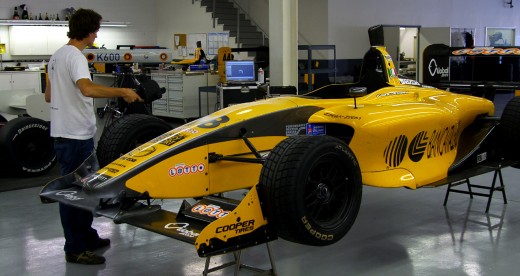
The point cloud was then read into Pro/ENGINEER Wildfire – after which the rest of the design work and all the analysis are done within Pro/ENGINEER. Interactive Surface Design (ISDX) and Advanced Assembly (AAX) features were used to build the CAD model, and Pro/ENGINEER Mechanica was used for the thermal and structural analysis with FloEFD.Pro Concurrent CFD software used for the aerodynamics.
The beauty of Concurrent CFD is that it works directly within the CAD system so everything is done within the one environment. The CAD geometry does not need to be exported and cleaned up for the analysis, it can be used as is, or simplified using Pro/E’s Publish Geometry feature whilst retaining all the model’s parametric features so design changes are carried out in the CAD tool on the native CAD geometry. Here’s an exploded image of a model Voxdale created.

Additional information is needed for the FloEFD.Pro analysis such as surface roughness information, plus the wheels need to be made to rotate and the ground move. Actually this makes the simulation better than most wind tunnel setups where it’s often impossible to achieve this on a full size car!
Once the model is built in the CAD tool, the opportunities to improve the design through analysis is really only limited by the designer’s imagination – specifically their ability to identify aspects of the design to improve and ask themselves the question “What if…?”, and changing the design accordingly to see how key performance parameters like aerodynamic drag change as a result.
Here are some of the flow trajectories and cut plots showing the flow over the whole car, and showing the air flow into the side pods – something discussed in more detail in my next post.


Next time I’ll drill down into more detail about the analyses Voxdale performed and the design benefits they delivered. If you use Pro/ENGINEER Wildfire you can download a free trial of FloEFD.Pro and try it yourself.
Dr. J, Hampton Court

Images courtesy of Voxdale