Author: John Parry

  • Blog Post:The Debate about Liquid Cooled Data Centers

    I’ve been remiss in not posting for a couple of weeks, so I’m trying to get back in the saddle. I’ve been working on other things that have taken up a fair bit of time. One is a web seminar on heatsinks – Heatsink 201 – Even More about Heat Sinks which follows on from Alexandra Francois-Saint-Cyr’s very successful Heat Sink 101 web seminar.

    Back in March I posted about IBM’s work on liquid cooling to take Moore’s Law to 2025. As a side note I observed that, one of the main benefits of liquid cooling in a data center is that the high grade waste heat generated can be used for heating purposes. This changes both the economics of deploying a liquid cooling solution and the environmental impact. The reason this is so important is that data centers are one of the fastest growing consumers of energy.

    (more…)

  • blog post:MicReD Technology Wins Highest Technical Honor

    szekely

    Vladimír Székely

    It was great to read that Dr. Vladimír Székely, has received the Dennis Gabor Award for Innovation for his work leading the team at MicReD on the development of the T3Ster (pronounced “trister”) technology. Congratulations Vladimír, it is richly deserved.

    The Dennis Gabor (original Hungarian: Dénes Gábor) Award is Hungary’s highest technical honor, named after the Hungarian electrical engineer and inventor of holography, for which Gabor received the Nobel Prize in physics in 1971. Dr. Székely is a member of the Hungarian Academy of Sciences. He has published around 400 technical papers and developed the mathematical background of the structure function based thermal transient methodology some 20 years ago.

    (more…)

  • blog post:Sticking Plaster and Light beats Skin Cancer

    Thermal management of LEDs (Light Emitting Diodes) is an important application for CFD software, which is helping designers use LEDs for high-power lighting applications. However, LEDs are changing our lives in so many more ways than simply providing more energy efficient or more aesthetic lighting solutions.

    Last year I posted about a light therapy device that desensitizes the nasal passages, inhibiting the allergic reaction and reducing irritation caused by hayfever – something I suffer from for a couple of months of the year, so I can confirm that it really works. Since then I’ve also come across a treatment for cold sores, using 1072 nm narrow waveband light, which interestingly enough corresponds to the peak emission wavelength of the water molecule light transmission profile. The research was published back in 2001 in The Journal of Clinical and Experimental Dermatology and now appears to have been approved for prescription by the UK’s National Health Service.

    I’ve even seen claims that the same wavelength of light helps protect cells against the adverse effects of ultraviolet light and even reverse the effects of photo-aging! What really got my attention was the following article from the BBC: New skin cancer treatment may reduce hospital time. Ambulight PDT is a light-emitting sticking plaster for the treatment of non-melanoma skin cancer. It works in 3 stages. First, a gel containing a photosensitive drug is applied. This is then absorbed only by the cancer cells. Finally, following absorption the gel is activated using incorporating OLED (Organic Light Emitting Diode) and LED technologies. So, given it can be used to kill skin cancer, the most common cancer in humans, maybe light therapy offering a way to stop aging isn’t so far fetched.

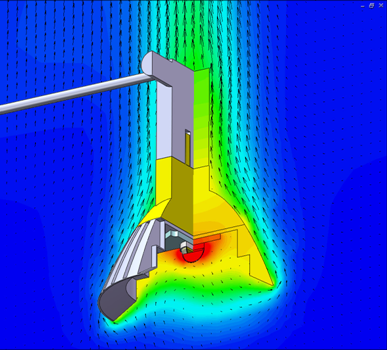
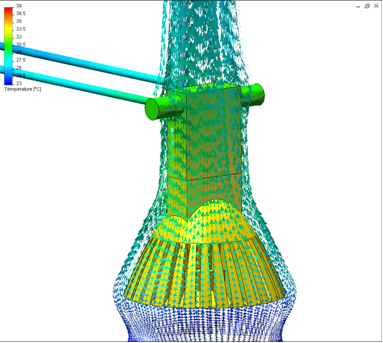
    Mentor has its own story to tell regarding LEDs as we help companies around the world adopt LEDs in place of conventional lighting by providing a complete set of tools for the thermal design and physical (combined thermal and optical) characterization of LED light assemblies, ensuring that they can be kept sufficiently cool to deliver high light output and long life. Here’s a couple of images showing the results of a study of a simple LED fixture in natural convection, but we cover everything from this to high-power applications like car headlights.

    Temperatures on a 2-D slice through the center of the lamp with vectors showing flow caused by natural convection over the outside of the lamp.

    Temperatures on a 2-D slice through the center of the lamp with vectors showing flow caused by natural convection over the outside of the lamp.

    Particle tracks over the lamp, mounted horizontally facing downwards, showing how the natural convection causes the air to flow smoothly over the exterior of the lamp housing. The thermal plume contracts as the flow accelerates above the lamp. Note that conduction through the connector and arms contribute to the cooing of the device
    Particle tracks over the lamp, mounted horizontally facing downwards, showing how the natural convection causes the air to flow smoothly over the exterior of the lamp housing. The thermal plume contracts as the flow accelerates above the lamp. Note that thermal conduction through the connector and arms contribute to the cooling of the device

    Dr J, Hampton Court

  • blog post:IBM Work to take Moore’s Law to 2025

    It was very interesting to read this article about the work IBM are undertaking together with École Polytechnique Fédérale de Lausanne (EPFL) and the Swiss Federal Institute of Technology Zurich (ETH) on a 3D stacked architecture for multiple cores. The four year collaborative project, called CMOSAIC, promises to deliver an interconnection density from 100 to 10,000 connections per square millimetre – 10 to 1000 times that previously possible. Wow!

    One of the main challenges the team face is removing heat from the structure. Each layer in the stack is anticipated to dissipate 100-150W/cm2. With the overall structure measuring just 1-3cm3 the heat dissipation is likely to be in the region of several kW.

    (more…)

  • blog post:Concurrent CFD Explained (Part IV)

    Last time I promised I’d drill down into more detail about the difference between the CAD-integrated up-front approach to CFD and CAD-embedded Concurrent CFD. CAD-integrated CFD tools are essentially stand-alone tools launched from within the CAD system whereas Concurrent CFD is fully built into the CAD system. So what’s the real difference between the two?

    CAD-integrated CFD tools use the same approach for all CAD systems, so perhaps the best way to answer this is to look at what happens when the CFD tool gets launched from within the CAD system: First the original CAD model gets converted into the format required by the solid modeller built into the CFD tool, e.g. Parasolid. This converted geometry is then imported as parts and assemblies into the CFD program. So far, so good – so what’s the snag?

    (more…)

  • blog post:Roundup of SEMI-THERM, FloTHERM IC launch and JEDEC

    I’m just back from a very productive SEMI-THERM Conference where we launched our new FloTHERM IC product. We had meetings with the editors of 5 leading electronics magazines to coincide with the launch, which was made at our vendor presentation during the exhibition at the start of Tuesday afternoon. Well done to all involved! If you want to see what others are saying about FloTHERM IC check out the write ups in Embedded Computing, Business Wire and EE Times to name just a few. It offers massive productivity enhancement for anyone generating package thermal metrics by simulation as it completely automates the process.

    I unfortunately missed the FloTHERM IC presentation as I was showing the publisher of ElectronicsCooling Magazine around the exhibition ahead of the re-launch of the print publication next month. If you’ve not seen it already, check out the cool new web site.

    It was interesting to see a complete off-the-shelf primed and sealed liquid cooling solution for a high end graphics card, capable of cooling well over 400W. The technology is largely in place for this approach to become the standard cooling solution for high-end graphics cards and processors, perhaps allowing a step change in performance provided applications are available to drive demand and make the increased cost worthwhile. Over time the cost increment of liquid cooling solutions will diminish as heat sink size and fan performance demands push up the cost of air cooling.

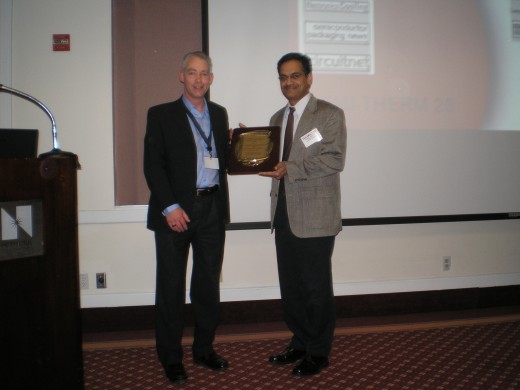
    At the Awards Luncheon on Thursday I presented the “Harvey Rosten Award for Excellence” to Prof. Suresh V. Garimella and Tannaz Harirchian for their paper “Boiling Heat Transfer and Flow Regimes in Microchannels – a Comprehensive Understanding” that was presented at the THERMINIC Workshop last October in Leuven, Belgium. Here’s a link to the abstract.

    p22503102

    Harvey Rosten Award for Excellence 2009, presented to Prof. Suresh V. Garimella (right)

    Next year the SEMI-THERM conference will be in the Doubletree Hotel in San Jose, CA on March 20-24. Well worth marking your calendars, and if you’re in the area don’t forget entrance to the exhibition is FREE!

    I attended the JEDEC JC15 Committee meeting after the conference to report on the progress that’s been made on an XML-based file format for the exchange of thermal resistance network based compact thermal models (CTMs) of electronic components and to re-start a similar activity relating to power maps. Fingers crossed, I’m hoping to make good progress on these in the next few months.

  • blog post:NEW ElectronicsCooling Magazine Website

    Just a very quick post to alert you to the new ElectronicsCooling Magazine web site.  We’ve updated the look of the site to improve navigation ahead of the relaunch of the printed magazine. Here’s just some of the features of the new site:

    • New look and feel
    • Search
    • Improved Article and Content Navigation by author; category (Calculation Corner, New Products, Technical Brief); channel (Industries, Applications) and by tag
    • Improved Home page layout, quick access to subscribe, featured content, new products
    • Improved Article presentation and layout with Tags, Share This, Print This and Links to categories, authors, issues
    • Related Articles
    • HTML Buyer’s Guide and Downloadable Buyer’s guide (PDF)
    • Improved access and layout of past issues
    • RSS Feed for all content
    New ElectronicsCooling Magazine Web Site

    New ElectronicsCooling Magazine Web Site

    If you’re not yet a subscriber to ECM then I’d encourage you register and bookmark the page as the site is the foremost technical resource for information on electonics cooling and thermal design. Also check out Mentor’s Electronics Cooling Community

    That’s me done for this week. Next week I’m at SEMI-THERM so if you’re in the bay area stop by the FREE Exhibition in the afternoon on Tuesday and Wednesday, 23 & 24 February 2010.

    Dr. J, Hampton Court UK

  • blog post:Liquid Cooling – Are We There Yet?

    Back in June I posted ‘Air – Is it Running Out of Gas?’ and put forward the view that for general computing applications air isn’t running out of gas just yet. There are a couple of reasons for that.

    One is that I suspect the general public has concerns about leaks. Most people have passed cars stuck on the highway with a blown heater hose and seen water on the ground, and I’ve had an automotive water pump fail spectacularly on me. Then there are washing machines, which also like to leak – so people’s general experience tells them to be wary of liquid cooling.

    (more…)

  • blog post:Foresight and X-Ray Vision or Hindsight and Regret?

    I was on a conference call and WebEx yesterday with the NAFEMS CFD Working Group, of which Mentor Graphics is a member. One of the people on the call had a lot of background noise on his phone, which turned out to be a due to a fan by his desk to keep his computer cool.

    Computational Fluid Dynamics (CFD) is a memory hungry, CPU intensive activity so I guess he was running a fairly substantial case. Even so, after 20+ years of electronics cooling CFD it’s a little disappointing that end users have to go to such lengths to keep their hardware cool. Particularly so, given it’s the middle of winter in the northern hemisphere and computers should be designed to withstand a 40+°C ambient temperature – that’s a more than most people can comfortably bear in the office!

    (more…)

  • blog post:FREE Exhibition at SEMI-THERM, Santa Clara February 23-24

    I’m off to SEMI-THERM later this month. SEMI-THERM is one of the premier thermal management conferences and has the best exhibition by far.

    The conference runs from 21-25 February, the first two days of which are devoted to professional short courses delivered by a number of leading names in electronics cooling, and past recipients of the IEEE’s THERMI Award. Short courses at SEMI-THERM 26 are eligible for CEU credits through the IEEE which are IACET approved. The short courses can be booked independently from the conference using the form at the back of the Advance Program.

    One of the many things that set SEMI-THERM apart from other conferences is the quality of its exhibition, which takes place in the afternoon on Tuesday 23rd and Wednesday 24th February.

    (more…)

  • blog post:Force Prediction with Concurrent CFD

    Some people think that because Concurrent CFD is so easy to use it must be simplistic. Nothing could be further from the truth. FloEFD has some very sophisticated physical models for cavitation, combustion, etc. plus by being CAD-embedded it’s also easy to use the CFD results to drive other simulation packages within the MCAD environment. Not limited to upfront design, Concurrent CFD can be used continuously during product design, leading to a more fluent design process.

    That brings me on to the last of my entries about Voxdale’s work in Indy Car. A consequence of calculating the air flow over the car is that the simulation also predicts surface pressures, which when integrated over all the surfaces give the overall lift and drag on the car – key parameters that are used to decide whether one design is better than another. In Voxdale’s case they were using FloEFD.Pro inside Pro/ENGINEER Wildfire.

    The aerodynamic forces on the bodywork, wings, etc. cause these structures to deform, changing their shape. To incorporate this, the guys at Voxdale used a beautifully simple and pragmatic approach by first calibrating the strength of the material used for the back wing (see below).

    fish_011

    The surface pressures from the FloEFD.Pro simulation, shown below as a distributed surface load in Pro/MECHANICA.

    efd1-071103-114-pm

    The results of the Pro/MECHANICA simulation are shown below. These can be used to either refine the aerodynamic simulation by using the distorted geometry or directly to modify the body to increase its rigidity where needed, and save weight where it’s not.

    37hma1-08a11-142

    I’ll have more exciting images from Voxdale later this year, so check back soon. If you’re interested in predicting reaction forces using concurrent CFD then check out our latest free on-demand we seminar Simulating and Optimizing Reaction Forces.

    The webinar goes into details of how to calculate forces on a pump’s impeller.

    Dr. J, Hampton Court

    voxdale-logo-150dpi

    Images courtesy of Voxdale

  • blog post:Champcar Exhaust Analysis

    Using CAD-embedded CFD upfront and throughout the design process is the only way to go when it comes to compressing design schedules. We call this approach Concurrent CFD, as the CFD analysis can be done concurrently with design changes, taking upfront CFD to the next level. The product’s performance can be checked at each design iteration, leading to a more fluent CFD process that gives increased confidence as the design is elaborated.

    That’s not the only way to use CFD though. It’s a fantastic diagnostic tool for understanding problems and fixing them post-design. Voxdale’s starting point was the 2007 Champcar chassis, which had an issue where the engines exhaust protruded through the car body. During a pit stop, the exhaust, which was red hot, caused a small fire. Based on the image below I put the temperature at around 700degC where it passes through the body. (more…)

  • blog post:Concurrent CFD Explained (Part III)

    I’ve been getting some positive feedback on my previous posts on Concurrent CFD so I thought I’d continue with the thread. I’ve described traditional CFD, upfront CFD and concurrent CFD as very different entities – which they are, but I ought to point out that they represent the evolutionary spectrum of how the CFD technology itself has been packaged over the years.

    (more…)

  • blog post:Stop Press: New Electronics Cooling Community

    Are you concerned with the thermal design of electronics systems? Are you a thermal, mechanical or electrical engineer wrestling with product design issues? Or are you an engineering manager or director concerned with improving your team’s overall design flow? Then Mentor’s new Electronics Cooling community is for you.

    No electronics cooling or thermal design topic is too small or complex, from die-level heat dissipation right up to data center cooling, and everything in between!

    Feel free to use the community to network with peers, exchange tips, pose questions, share industry news, offer opinions, and read blogs, etc. Mentor Graphics customers can also share models and macros under the Models sub-community, which is visible to those who’ve logged in with a SupportNet login. Otherwise registration just takes a few seconds.

    Dr J, Hampton Court

  • blog post:Interested in Indy Car?

    Me too, though being in the UK I tend to watch more Formula 1. As part of my job I often come across cool pieces of work done by our customers that we can’t publicise the work for reasons of confidentiality.

    This work by Voxdale is an exception though. It was done a couple of years back, not that long after Voxdale was founded, which makes it all the more impressive, and was done for Champ Car, now merged with Indy Car. The project was to optimize the existing Panoz chassis for Conquest Racing’s Champ Car – now unified with Indy Car.

    (more…)

  • blog post:Concurrent CFD Explained (Part II)

    As promised, here’s the second part of the explanation of why Concurrent CFD is different, or to use a cliché, a paradigm shift in CFD.

    The animation below looks more closely at why concurrent CFD is different to conventional and upfront CFD. By expanding the CFD process we can see it involves quite a number of steps. In going through the animation you will see that both conventional and upfront CFD involve transferring geometry from the CAD system and cleaning it up so it’s suitable for analysis. The process has to be repeated as design (geometry) changes are made in the analysis suite and taken back into the CAD system to keep the two in sync, so it’s inherently messy.

    (more…)

  • blog post:Concurrent CFD Explained (Part I)

    Happy New Year everyone. I hope it’s a prosperous and peaceful year for both you and your company.

    As promised, here’s a Flash animation showing the difference between traditional CFD, upfront CFD and concurrent CFD which needs some introduction.

    In traditional CFD, the model geometry is first exported from the CAD system. That’s the easy part. The geometry then needs to be re-imported into the CFD tool, meshed, solved, the results post-processed and then reported back to the design team. Next time I’ll talk about what this entails in more detail, but for now suffice to say this process typically takes 4 weeks or more. The work is usually done by a specialist analysis group, or outsourced so it’s necessary for the design team to explain what needs to be done. By the time the results are in the analysis model has become ‘stale’, as the design has moved on, often making it difficult to act on the results. Consequently companies often find little benefit in using conventional CFD before the detailed design stage is all but complete, with little opportunity to influence the design.

    (more…)