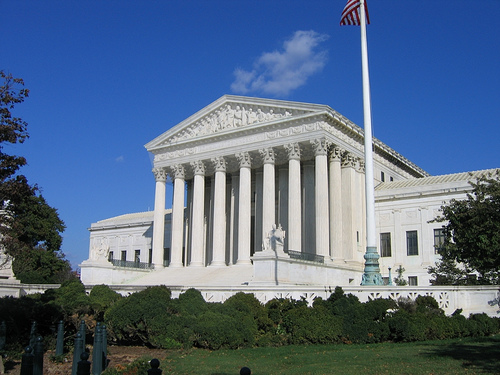
 This week, controversy sparked as the U.S. Supreme Court heard oral arguments on whether the federal government can hold prisoners past the end of their sentence if they are considered “sexually dangerous.” Although the court seemed likely to allow the government to continue the process, Justice Antonin Scalia gave U.S. Solicitor General Elena Kagan an earful about the issue.
Hard for me to say, but this is one of those rare days when I’m actually on board with Scalia here.
More than 20 states have laws that permit keeping mentally ill or sexually violent prisoners behind bars, even after they’ve served their sentences. Such laws were sanctioned in a 1997 Supreme Court ruling, but whether or not the federal government shares that power is still up in the air. In 2006, Congress extended this policy to federal prisoners in the Adam Walsh Act, and now with the case U.S. v. Comstock, the Supreme Court is considering whether the policy oversteps its bounds with the law.
In this particular case, the defendant, Graydon Comstock, was six days from finishing a 37-month sentence for child pornography when he was declared “sexually dangerous” by the attorney general and kept incarcerated. He and other similarly treated inmates have sued the government, arguing that Congress is seizing powers reserved only for the state.
As Scalia has said, “This is a recipe for the federal government taking over everything.”
By contrast, the government argues it has identified only 105 prisoners as “sexually dangerous” — a tiny fraction among the 15,000 federal prisoners with a history of sexual violence or child molestation.
The last problem we have in this country is too-short sentences, but in certain cases, if we need to hand down longer terms (with the possibility of parole) at trial, that practice would be far preferable to the practice of the federal government locking up these inmates indefinitely.
To be sure, there are some prisoners in our country who pose a threat to our society and shouldn’t be released. But it’s the role of our court system — not Congress, not prosecutors — to sentence them and decide.
More from SCOTUSblog, WSJ Law Blog and Reuters.
Photo Credit: Rob Crawley