Don’t worry… I’m not going Sci-Fi on you. I’m talking about reaction forces. What do I mean by reaction forces? Well, when there is a relative motion between a solid object and a surrounding fluid, a force will be placed on the solid due to the pressure variation over the surface of the solid. This force is caused by the change in speed and direction of the fluid. For example, we see reaction forces in action when water flows through a pump.
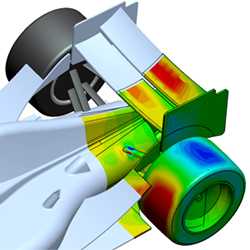
Reaction forces on a rear-wing of an Indy race car. Image courtesy of Voxdale.
Now predicting force or pressure distribution on a surface should be a key design decision factor in the design of any system in which a moving fluid can cause product reliability, stability and usability issues (I’m including safety under this category because unless it is safe to use, it isn’t really usable now is it?). Force prediction can be used to optimize the geometry or to determine what’s required to support the said structure.
Several methods have been used by manufacturers for predicting pressure forces but I always say the one that offers the best combination of speed, affordability and accuracy is Computational Fluid Dynamics (CFD) software. CFD has proven its efficacy for handling these kinds of problems – there are plenty of application stories and customer testimonials out there. For example, a team at Watts Industries Netherlands deals with design issues relating to backflow prevention devices and automatic control valves for domestic, commercial and industrial uses of water. They need to be extremely careful because contamination of drinking water could prove disastrous. So they use CFD software to test their designs. And to further verify the results, they create and test physical prototypes. They have been able to obtain exactly the same results from their chosen CFD software as their test rig; thus allowing them to deploy their products to the field with increased confidence. According to Rene Aarntzen, the R&D Engineering Manager at Watts Industries, “For the past year we have found exactly the same results from FloEFD and our test rig. That’s important because maybe in a few years, after we’ve built an extensive library of results, then we won’t need to build and test physical prototypes anymore.” Personally as a manager, I find any opportunity to save cost without sacrificing quality, safety or purpose a tall cool drink of water on a hot summer day!
If you are interested in learning more about how to harness reaction forces or to optimize your designs, I would suggest your attending our upcoming online presentation titled: Simulating and Optimizing Reaction Forces. The presenter, Nate Hanlon, is one of our consultant engineers based in the States and he has a background in the design of fans, blowers and impellers. So feel free to ask him a few questions. I’m sure he’s got some sage words of advice for everyone. And before I forget, as with all online presentations, anyone who registers for the event will be sent a link to the archived version so even if you can’t attend the meeting at the specified time, you will be able to access the presentation at your convenience after the event.
Lastly, if you like to read more about Mr. Aarntzen’s experience at Watts Industries, please feel free to click here.
Hope to see you at the meeting (now if I could only get the stormtrooper music out of my head, we’d be golden).
Until next time,
Nazita