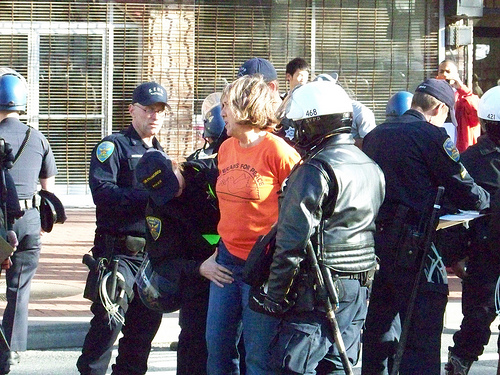
 Videos of police brutality have become fairly commonplace on YouTube, as mobile phones equipped with cameras have proliferated. But what if recording police activity was illegal? As it turns out, in some places, it already is.
For an example of an agency responding to the advances in technology with exactly the wrong tone, look no further than the he Boston Police Department. Rather than embracing technology as a tool to help improve policing, the department is warping a 40-year-old wiretapping law in an attempt to prevent citizen watchdogs from filming raids, arrests, protests and other police activity.
An excellent story in the Boston Globe last week from the New England Center for Investigative Reporting at Boston University explores the controversy in detail. The story is one of two people who were arrested after filming the cops on their cell phones — individuals whose arrests the department continues to stand by, on the ground that recording officers breaks a wiretapping law. “If an individual is inappropriately interfering with an arrest that could cause harm to an officer or another individual, an officer’s primary responsibility is to ensure the safety of the situation,” a spokesperson told the Globe.
The law in question is a “two-party rule,” which 12 states along with Massachusetts have passed. Enacted to stop phone conversations from being secretly recorded, the law says all parties to a conversation must agree to be recorded. But filming in public is a different legal question, and review by higher courts would certainly test the BPD’s interpretation of this law.
So far, higher courts in the state have upheld wiretapping charges for secret videotaping, but public cases like those filming police making arrests have been dropped. If one were to go forward, I have little doubt it would be destroyed on appeal.
But this isn’t just about an (intentional) legal misinterpretation by the Boston police. There’s a deeper issue here: that too often, law enforcement agencies are skeptical of technological advances, seeing only the potential harm.
Citizen-generated media can cut both ways, but it can help the police, too. After all, memory is selective. If a defendant alleges that he was beaten by police during an arrest, it’s likely that there will be a witness willing to confirm his story in a courtroom (“My friend was just helping an elderly woman cross the street, and BAM, this officer bashed him with a nightstick…”). If somebody videotaped this alleged police assault, though, a judge or jury might find that there was no elderly woman crossing the street and something else was going on. If police do their jobs and use force only when necessary, citizen videos will back up their story.
Rather than fighting inevitable shifts inspired by emerging technology, law enforcement agencies should do what makes sense for both cops and regular citizens. When it comes to fairness, technology and transparency benefit both sides.
Photo Credit: DC Atty