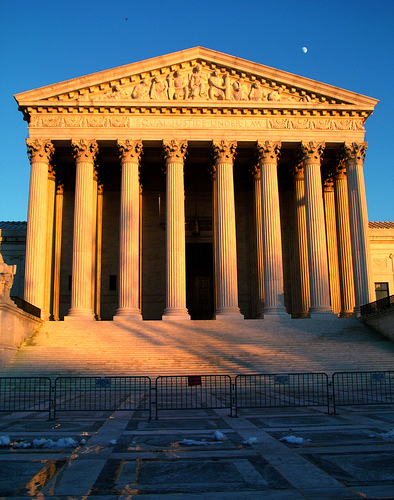
 The justices are serious about the confrontation clause.
It may not be the most well-known part of the Bill of Rights. But the Sixth Amemdment’s confrontation clause, which allows a defendant to confront witnesses testifying against his or her case, is a cornerstone of our justice system. And now, in an important decision, the U.S. Supreme Court has again reaffirmed that principle — finding that any forensic evidence needs to be presented in person (not just by affidavit) so it can be challenged in cross-examination.
Yesterday, the Court tossed out the conviction of Mark A. Briscoe, a Virginia man who was convicted of a drug crime without the testimony of the lab analyst who tested evidence in the case. The court’s move was a strong sign of confidence in last year’s groundbreaking Melendez-Diaz v. Massachusetts decision.
States and district attorneys had complained that Melendez-Diaz would bring the wheels of justice to a grinding halt, putting too much burden on prosecutors to call forensic analysts in thousands of cases. But the Sixth Amendment says a defendant has the right “to be confronted with the witnesses against him” for a reason, and whatever you say about this court, it’s one that stands by the wording of the Constitution.
It was an odd collection of justices committed to defendants’ rights and those committed to the Constitution who decided Melendez-Diaz last year. Justice Antonin Scalia wrote the opinion for a five-justice majority, with John Paul Stevens, David Souter, Clarence Thomas and Ruth Bader Ginsburg joining him. Briscoe v. Virginia — heard just two weeks ago — was reversed by the full court in a per curiam decision (acting anonymously, as a whole).
Some had speculated that the court agreed to hear Briscoe in order to potentially shrink the scope of its decision in Melendez-Diaz, but Scalia addressed this head-on in oral arguments. Crime and Consequences analyzes the court’s decision in a good post, and finds that adding Justice Sonia Sotomayor to the mix didn’t change the outcome. The Blog of Legal Times has a good post on the case as well (with a fun aside on the word orthogonally).
When defendants are denied the right to cross-examine forensic witnesses, chances increase that forensic misconduct or negligence will go unchecked. If we allow that kind of practice in our courts, should we also let police reports take the place of police testimony? Letting prosecutors introduce forensic evidence on paper is too slippery a slope.
Photo Credit: Katmere