U.S. GDP in the last three months of 2009 soared by 5.7%. That’s good news, but the number doesn’t tell the whole story. Dan digs into the figure to find out what’s growing and what isn’t, but to get a more complete picture of our economic growth, check out the Chicago Fed National Activity Index (NAI) — what Barry Ritholz calls “the best economic indicator you’ve never heard of.”
The newest NAI report on 2009’s fourth quarter is out, and it’s not as sanguine as GDP.
Here’s the chart:
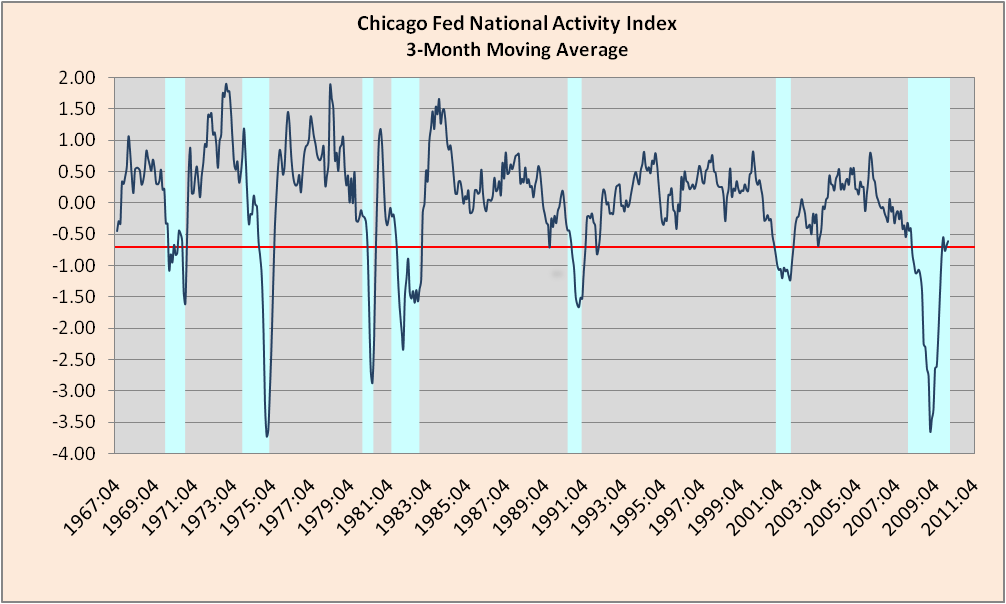
What’s happening here? The short version is this: The economy started
to rally dramatically last summer, but the recovery has stalled since
September.
Here’s the longer, more informative version. NAI tracks 85 economic
indicators, which lumped into four big categories: production and
income (P&I); employment, unemployment, and hours (EU&H);
personal
consumption and housing (C&H); and sales, orders, and inventories
(SO&I). The graph below explains how these categories performed in
the second half of 2009.
 Some
Some
lessons from this chart: Production has been positive for six months.
Employment continues to languish. This shouldn’t surprise us. Not only
does GDP improve faster than employment, but also Larry Summers
admitted to the New Yorker that the stimulus plan specifically targeted production over jobs. (Megan will have more on the prospects of a jobless recovery later today….)
I would be particularly concerned about what the chart says about the
consumer and housing markets. The C&H figure barely budged from
near recession levels (the NAI considers figures below -0.70 consistent
with a recession) in the last six months of 2009. Consumer spending
continues to be anchored down by broad unemployment. The housing market
had a particularly rough December — new home sales fells and
foreclosures, defaults and delinquencies continued to rise.
On the bright side, sales, orders and inventories are up in the NAI —
and have been near positive growth levels for most of the last six
months. This also fits with today’s GDP report that found that changes
in real private inventories made up 3.4% of the 5.7% growth.


