Author: Derek Thompson

  • Hillary Clinton's Unfortunate Defense of Higher Taxes

    Speaking to a DC crowd at the Brookings Institution, Hillary Clinton made an off-the-cuff comment about raising taxes that might get some play in the political entertainment world:

    “Brazil has the highest tax-to-G.D.P. rate in the Western hemisphere.
    And guess what? It’s growing like crazy. The rich are getting richer,
    but they are pulling people out of poverty. There is a certain formula
    there that used to work for us until we abandoned it — to our regret,
    in my opinion. My view is that you have to get many countries to
    increase their public revenues.”

    I imagine conservatives itching to point out that Brazil’s payroll tax amounts to 40% of employers’ compensation and 15% of employeess wages, and that Brazil boasts a pretty extravagant social welfare system, including universal health care, social security, and early retirement with full pay. This is our gold standard? they’ll ask.

    Brazil is not a good model for the United States’ tax system. It has a wildly different template, with a patchwork of state and federal value-added taxes, marginal income taxes that don’t exceed 25 percent (ours will jump to 38 when the Bush cuts expire) and the aforementioned extravagant payroll contributions. I don’t know enough about Brazil’s tax system to know if it has good lessons for U.S. makers. But I do know that “highest tax-to-GDP rate in the Western hemisphere” isn’t a trophy we should necessary seek for its own sake.

    I don’t like the higher-tax-rates-are-like-Miracle-Grow argument, because our best revenue-raising taxes aren’t sin taxes designed to punish bad things; rather many of them discourage things we consider to be good, like consumption, and income, and profitable investments. We pay these taxes because they support the government we want.

    There’s a better, simpler argument for higher taxes. Americans have collectively and repeatedly voted for federal programs like Medicare, Social Security, a strong national defense, a sturdy welfare net, nice roads and other things that cost more than we’re paying in taxes. The short-term result is a structural deficit. The long-term risk is a rickety debt burden that makes it more expensive to borrow money and harder to run the government programs we like.

    It’s really great that a high-tax country is experiencing a consumer-driven boom. It’s not great that one of two political parties in the United States is against all tax increases, ever, no matter what. But these things don’t necessarily have anything to do with each other.


    Email this Article
    Add to digg
    Add to Reddit
    Add to Twitter
    Add to del.icio.us
    Add to StumbleUpon
    Add to Facebook


    United StatesSocial SecurityBrazilBrookings InstitutionHillary Clinton

  • Good News: Income Now Growing Faster Than Spending

    Americans’ income grew faster than spending in April. We’re earning more, we’re saving more and we’re spending the same. Good news for long-term recovery trends, because you don’t want a debt-fueled recovery coming out of debt-powered recession. Bad news in the short-term since consumption accounts for about two-thirds of GDP, by many measures. When consumption stalls, the economy stalls.

    But basically, this is cause for joy. Rising income means rising consumer confidence, which sets the stage for more private spending, and less private spending, in the future.

    Another interesting note for politicos is that when incomes rise, incumbents have a better shot at keeping their jobs. The relationship between growth in real disposable income and House seat losses is statistically significant — much more so than unemployment. Most presidents lose House seats during midterms, but high income growth mitigate those losses, dramatically.


    Email this Article
    Add to digg
    Add to Reddit
    Add to Twitter
    Add to del.icio.us
    Add to StumbleUpon
    Add to Facebook


    Gross domestic productConsumptionHouseUnemploymentRecession

  • One Reason Why the GOP Can't Repeal Health Care Reform

    GOP House leaders introduced a bill on Thursday to repeal the health care reform law … the same day the Obama administration announced that it will begin sending seniors the first Medicare “doughnut hole” rebate checks to demonstrate the HCR’s benefits to some likely voters.*

    Interesting juxtaposition. Stories like this help explain why it’s politically implausible to call for health care reform’s repeal. The public’s opinion of health care reform as a general idea is still mixed. But nothing changes minds like money. Deleting the law means clawing back financial assistance for older Americans with prescription drug bills between $3,000 and $6,000. Seniors are linchpins to midterm success because of their disproportionately high turnout. Republicans know that. Democrats know that. And the administration definitely knows that, which is why it’s waging a PR war against Republicans with early rebates checks.

    As the health care bill moved through the sausage maker, the benefits moved to the front and the pain moved to the back. In the final reconciliation bill, the subsidies grew more generous, but
    they’re also scheduled to grow more slowly until they eventually fall back to the levels
    that existed in the House bill, pre-reconciliation. The excise tax on
    expensive employer insurance plans was delayed until 2018 and hits
    fewer Americans in the first few years, but it is scheduled to grow faster than in the
    Senate or House plan. So what we’re seeing with the Medicare rebates checks is, for better or worse, something of a microcosm of the bill. Democrats are
    front-loading the benefits of the plan and leaving the cost-cutting for the second decade.
    __
    *Medicare Part D helps seniors pay for prescription drugs up to a
    certain level — about $2,700 — and above a “catastrophic level” —
    about $6,100, but not in between. The health care reform bill gradually
    fills that gap, which for whatever reason has come to be known as a
    “doughnut hole.”


    Email this Article
    Add to digg
    Add to Reddit
    Add to Twitter
    Add to del.icio.us
    Add to StumbleUpon
    Add to Facebook


    MedicarePrescription drugUnited StatesPresidency of Barack ObamaMedicare Part D

  • 'Jobs Bill' To Include Perks for NASCAR, Hollywood, Rum

    Today in special interest giveaways, the “jobs bill” edition:

    The pending bill still includes a $38 million extension of a
    depreciation break for “certain motorsport entertainment complexes,”
    otherwise known as the NASCAR break. And television and film producers
    would reap an expensing provision worth $46 million over 10 years.

    Puerto Rican and Virgin Island rum manufacturers would receive
    excise tax breaks worth $131 million over 10 years; a second Puerto
    Rican manufacturing break is worth $185 million. American Samoa would
    receive a payment worth $18 million “in lieu of (an) economic
    development credit,” according to the bill. The bill also extends trade
    protections for the domestic cotton industry.


    Email this Article
    Add to digg
    Add to Reddit
    Add to Twitter
    Add to del.icio.us
    Add to StumbleUpon
    Add to Facebook


    Puerto RicoAmerican SamoaVirgin IslandUnited StatesCaribbean

  • In Praise of the Teacher Bailout

    States are facing record budget shortfalls, which almost always result in huge cuts to education. So the jobs bills moving through Congress propose a $23 billion infusion to public schools to save between 100,00 and 300,000 teacher jobs. Neil McCluskey at the New York Post shrugs at the “teacher bailout,” noting that 300,000 jobs lost would be “only” a 4.8 percent cut to the teacher labor force.

    On the other hand, he’s pretty concerned about the deficit.

    So there is indeed a looming education catastrophe — but it’s not
    funding or job cuts. It is the bailout now moving through Congress that
    ignores the reality of inefficient public schooling, and adds to the
    already crushing burden of our federal debt.

    Well, if we’re playing the put-it-in-context game, $23 billion is “only” 0.6% of the 2010 budget. An unfortunate bailout, perhaps, but hardly catastrophic, especially when you consider that 200,000 lost jobs has a tangible cost on its own: to local demand, to student achievement, and to federal coffers when more people become eligible for benefits like unemployment insurance.

    McCluskey’s point about soaring education costs is fair. The rise in tuition and school fees have outpaced even medical inflation in the last 30 years. Education is one of our greatest job engines, but it’s also something of a black hole where money enters, disappears and makes an ambiguous impact on student test scores. Smart education reform includes clear incentives for administrators to control costs and teachers to demonstrate achievement against a reasonable baseline. But we don’t want schools firing teachers willy nilly in the fog of deep budget cuts that could wipe out programs based on their cost rather than their effectiveness.

    At the risk of invoking a cliche, our education system is a bit like a painkiller junkie who just had his wisdom teeth pulled. In the long term, we probably want to wean the patient off drugs. In the short term, the patient happens to be in dire need of some drugs. Sec. Arne Duncan seems to acknowledge this conflict, and when the fog lifts, I hope he continues to pressure the teachers’ union to loosen its grip on the bottle and allow administrators to better assess which teachers are actually teaching, and which are mostly collecting checks.


    Email this Article
    Add to digg
    Add to Reddit
    Add to Twitter
    Add to del.icio.us
    Add to StumbleUpon
    Add to Facebook


    EducationArne DuncanNew York PostEducation reformCongress

  • Hedge Funds Don't Deserve a Special Tax Break

    Normally, jobs bills don’t raise the ire of Wall Street. But these aren’t normal times.

    The $150 billion Senate stimulus bill that extends unemployment insurance and multiple tax cuts will try to recoup some of that money taxing hedge fund managers — not by raising the income tax, but by applying the income tax.

    Private equity and hedge fund managers tend to get paid according to what’s known as the principle of 2 and 20. They charge 2% annual fees for managing the portfolio of assets, and they collect 20% of the fund’s annual profits.

    There’s nothing strange about this arrangement. It makes sense to align managers’ financial interests with their clients’. There is something strange about the way the government taxes these revenue streams. The 2% fees are considered income, so they’re taxed up to the 35% marginal rate. The 20% profit returns are considered capital gains, so they’re taxed at the long-term capital gains rate of 15%.

    This amounts to quite the tax break for private equity managers. Their primary source of income is taxed at half rate as long-term capital gains, even if the managers’ own capital contributed little or nothing to the gains.*

    The Senate stimulus provision would tax three-quarters of this carried interest as income, bringing in billions of dollars to pay for unemployment benefits and COBRA extensions for the poor. Wrangling over the bill has come to resemble a crucible of class warfare. We’re taxing the rich to pay the poor jobless. From a political standpoint, that’s the point.

    From a policy standpoint, it’s confusing the debate by making senators sound like Robin Hood wannabes rather than sound policy architects. The carried interest loophole has long had critics from across the political spectrum, and Warren Buffet famously rails against it. It’s symptomatic of a financial industry that has cleverly learned to build its revenue streams around rules and taxes and defended the existing rules and taxes with aggressive lobbying.

    Hedge fund managers aren’t evil, they’re just playing by a different set of rules. This is a loophole worth closing.
    _________
    *As Chuck Marr at CBPP notes, “there’s no logical reason why a leveraged buyout (LBO)
    specialist at a private equity firm should be taxed differently than a
    mergers and acquisitions expert at an investment bank (who pays as much
    as 35 percent in taxes), since both people are doing basically the same
    kind of work.”


    Email this Article
    Add to digg
    Add to Reddit
    Add to Twitter
    Add to del.icio.us
    Add to StumbleUpon
    Add to Facebook


    Hedge fundPrivate equityCapital gainBusinessCarried interest

  • Is Social Security 'Sustainable'? Kinda

    Let’s skip straight to the chorus of the deficit reduction song: our debt crisis is our entitlement crisis is our debt crisis. Catchy! But not easily solved. The real long term threat is Medicare spending. The ghost in that machine is rising medical costs, which will take some Herculean efforts to curb. So for now, let’s talk about the other entitlement: Social Security.

    Social Security isn’t in terrible shape. It just needs a fix up. Yes, it’s running a deficit this year, but it should be in the black for most of the decade and we’ve got a $2 trillion fund to wind down before the program goes officially bankrupt. Economic Policy Institute economist Monique Morrissey talked to the House committee yesterday about its sustainability:

    Because of population growth, rising life expectancy does not create a Malthusian dilemma. In fact, the ratio of beneficiaries to covered workers is projected to level off after the Baby Boomer retirement.
     
    Similarly, Social Security outlays are projected to level off–not spiral upward like health care costs.
     
    This isn’t to say that Social Security costs won’t increase, but this increase is manageable–on the order of 1.5% of GDP. And because Social Security is currently running a surplus, the 75-year shortfall is much smaller–around 0.7% of GDP according to the Social Security actuaries, and even less according to the Congressional Budget Office.

    It’s worth pointing out that a shortfall around 0.7% of GDP is manageable, but far from a cinch. Morrissey says that raising the earnings cap to 90% of income (currently the Social Security payroll tax does not touch income above $107,000) and eliminating it altogether on the employer side would account for 70% of the shortfall.

    That’s good money if you can get it, but it’s not easy to tell families making $251,000, “Yes, your Bush tax cuts are disappearing, and your dividend rates are going up, and yeah, you’ll see Medicare tax rates creeping higher under health care reform, oh, and also, we’re slapping a 6.2% tax to the last $100,000 of your income”? Social Security is sustainable, but it’s sustainable provided we make some changes that will be politically difficult in an environment of rising tax burdens.

    It doesn’t take rocket science to solve the SS shortfall. You can raise the tax rate, raise the payroll ceiling, delay retirement, restructure benefit outlays, or means-test the pay outs. In short, you can increase the revenues, or cut the spending, or do a little of both. But the longer those trying to protect Social Security delay reform by claiming there’s nothing to see here, the harder it will be to solve the problem later.


    Email this Article
    Add to digg
    Add to Reddit
    Add to Twitter
    Add to del.icio.us
    Add to StumbleUpon
    Add to Facebook


    Social SecurityCongressional Budget OfficeHealth careBaby BoomerPayroll tax

  • What the Next Jobs Bill Will Look Like

    House and Senate leaders are scrambling this week to glue together a stimulus bill to avert massive teacher layoffs, plug up holes in state spending and keep doctors from taking up to a 20% pay cut with Medicare patients. Today’s House vote could determine the outcome of a final stimulus bill that could be worth more than $140 billion.

    Here’s a short guide to the action.

    Many Democrats and Republicans agree on the broad outline of the job stimulus: extending unemployment insurance (UI) and COBRA health insurance through the end of the year, and renewing a handful of tax cuts, for small businesses, families, and college students. But Republicans are pushing to pay for the bill, which would require cutting spending somewhere else or raising revenue. Democrats are offering to offset for only a portion of the proposed jobs bill.

    House liberals are also clamoring for two additional items: $23 billion to protect
    teacher jobs and $70 billion for states and localities to avert layoffs.

    In the Senate stimulus sweepstakes, the mothership is Sen. Max Baucus’ (grammatically funky) “American Jobs and Closing Loopholes Act of 2010.” In addition to extending UI and COBRA, Baucus would extend additional tax cuts that would let Americans continue to deduct part of their college tuition, property tax, and state and local sales taxes. He would also extend tax cuts for teaching and installing energy-efficient windows. The total sum could be about $150 billion.

    I hesitate to call this bill a “jobs bill,” because most of the money will go to extending current payments rates for Medicare doctors through 2012 ($65 billion), assuming a greater share of states’ Medicaid burden ($24 billion) and renewing up to 99 weeks of jobless benefits through November ($47 billion). Looking out for doctors, rescuing states from crushing Medicaid costs and sending checks to jobless dads unquestionably averts layoffs and juices demand, but the dollars-spent/jobs-created ratio is tough to suss out.

    So is this bill any good? Extending UI is a cinch, and the states need help whether it comes in the form of Medicaid assistance, public school relief, or straight up cash. But as Howard Gleckman at TaxVox points out, there is a lot to hate in the Baucus grab bag.

    It is, for instance, hard to see how continuing to allow generous
    tax depreciation for NASCAR racetracks will create many jobs. It is
    easier, however, to imagine how this will continue a windfall for the
    track owners. It is similarly hard to see how the national economy
    benefits from special tax-exempt bonds for investments in New York
    City’s “liberty zone.” Good for developers and contractors doing work
    in lower Manhattan, as well as investment bankers and bond lawyers. Not
    so good for developers trying to build projects just outside the
    specially-designated zone.

    An election-year stimulus bill will look come out looking like a piñata with goodies for constituency groups where incumbents are running close. That’s unfortunate, and maybe a good reason to let the president edit spending bills and pass them back to Congress for an expedited, no-amendment vote. But a few dumb tax credits shouldn’t take the focus away from what we desperately need: immediate relief for out-of-money states and out-of-work families.


    Email this Article
    Add to digg
    Add to Reddit
    Add to Twitter
    Add to del.icio.us
    Add to StumbleUpon
    Add to Facebook


    Max BaucusUnited StatesMedicaidUnemployment benefitsSenate

  • Apple Bites Microsoft, Becomes World's Most Valuable Tech Company

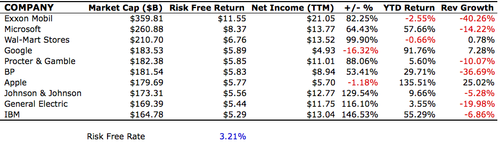
    Apple overtook Microsoft this afternoon as the world’s most valuable technology company, and the second most valuable US company behind Exxon Mobil (as if it needed a spotlight).

    Apple shares rose 1.8
    percent, giving the company a value of $227.1 billion, as shares of Microsoft fell, which gave the company a market
    capitalization of $226.3 billion, according to the New York Times.

    Where’s Google, you wonder? A bit behind, with a market cap value of about $150 billion according to Yahoo Finance. Rounding out the top six, as of March 2010, according to the Financial Times Global 500, are Wal-mart, Berkshire Hathaway, and General Electric.


    Email this Article
    Add to digg
    Add to Reddit
    Add to Twitter
    Add to del.icio.us
    Add to StumbleUpon
    Add to Facebook


    MicrosoftAppleMarket capitalizationGoogleBerkshire Hathaway

  • Facebook's New Privacy Rules Are Simple and Smart

    Facebook CEO Mark Zuckerberg announced new, simple privacy controls today after weeks of withering criticism and multiple reports of users deleting their profiles. Zuckerberg told reporters on a conference call that he agreed with critics that the company’s privacy controls had become arcane and damaging to Facebook’s chief mission: helping its 400 million members connect and share information.

    “People want to connect,” Zuckerberg said. “And the best way is to give them control. We really do believe in privacy.”

    The new privacy control, which will roll out in the next few weeks, is a grid that lets you share various types of information across three categories: everyone, friends of friends only, or friends only. The recommended default (as captured in a screen shot below) would make posts and profiles public to everyone; personal information like photos and birthdays public to friends of friends; and private info like email addresses available to friends only.

    Another privacy lets you sever ties with Facebook applications and third parties with a click, rather than opting out on a per-application and per-party basis. More specific controls are available in the custom settings. In sum, it’s a good move for Facebook provided that they don’t tinker with settings (as they have three times in the last seven months).

    “This is the end of the overhaul that we’re doing,” Zuckerberg said. “One of the big takeaways is, don’t make any privacy changes for a long time.”

    facebook privacy.png
    Much of the talk tried to put Facebook’s new changes in historical context. As Facebook has grown and added features, Zuckerberg argued, it has sometimes struggled to balance two missions: to help people share information across networks and to give them granular controls over how they share they share that information.

    His answer to a question about advertising was surprising.

    “There’s this big misperception that we’re making these changes because it’s good for advertising,” he said. “Anybody who knows me knows that’s crazy. There’s this idea that if people share info more openly it’s good for ad targeting. It’s the opposite.”

    Here was his reasoning: Facebook shows advertisements to users whose private information indicates they might be interested in the product. For example, if LiveNation wants to sell Coldplay tickets, and I say I like Coldplay, Facebook might show me LiveNation ads by my profile. If Facebook makes that information public, Zuckerberg said, it loses proprietary control over the information. The company’s incentive, he said, was to be jealous over its users’ data.

    “We really don’t think about revenue at all,” Zuckerberg said in a moment that slightly strained credibility. “When we’re building platform, it factors in like not at all.”

    Facebook might not care about its potential impact on targeted advertising and the rest of the Internet, but maybe it should. First, as Gawker’s Ryan Tate points out, it sort of has a fiduciary responsibility to think about revenue. The Open Graph protocal, which collects already public information such as users’ “likes” throughout the Web, sounds like it could create living, breathing semantic memory
    of its users’ preferences. This has fascinating implications. Imagine browsing CNN on your smart
    phone downtown, and a mobile ad pops up with a happy hour coupon for a
    restaurant you said you liked on Yelp. Or imagine a better news aggregation
    site, a waterfall of links with all of the articles “liked” by friends
    who self-identify as conservative on Facebook.

    “We listened to the feedback [on privacy concerns] and we agree with it,” Zuckerberg said today. Good thing, that. But as the company has grown from a lively yearbook, to a 21st Yellow Pages, to an Web-wide ecosystem of “likes,” it should think about ways to balance its privacy mandate with its pubic capability to do amazing things for the larger Internet community.


    Email this Article
    Add to digg
    Add to Reddit
    Add to Twitter
    Add to del.icio.us
    Add to StumbleUpon
    Add to Facebook


    FacebookMark ZuckerbergPrivacyLiveNationYellow Pages

  • Are Millennials Private, or Just Savvy?

    BusinessWeek looks at a Pew study on privacy and social media trends and finds many Millennials, long thought to be laissez-faire toward their privacy, are actively guarding their personal information:

    Seventy-one percent of social networking users aged 18 to 29 said
    they’d adjusted privacy settings on social networks in order to make
    some information private, according to the survey. Among members of
    generation X, aged 30 to 49, 62 percent said they’d made such changes.
    And 55 percent of baby boomers aged 50 to 64 said they’d changed from
    the default privacy settings on a social network. “Contrary to common
    assumptions, young people are in many ways the most active managers of
    online identities,”
    says Mary Madden, senior research specialist with Pew and co-author of the study.

    Two things to say about this. First, as Facebook entered the mainstream and became a professional Yellow Pages rather than a streaming college yearbook, kids took notice and blocked more of their information from acquaintances they didn’t know well — or did know well, but professionally, and in a way that is unreceptive to 21st birthday pics.

    Second, this isn’t necessarily about Millennial privacy. It’s about Millennial technological savvy. At the risk of ageism and gross generalization, twentysomethings tend to understand the minutiae of technology better than fifty- and sixtysomethings because they grew up with it. As a result, they know how to block photos from their work acquaintances and keep their list of friends off the Google results page.

    It should be said, however, that if Millennials understood how privacy control worked even better than they do, they might not have made such a huff about Facebook’s recent changes. In a way, we’re all catching up to the technology.


    Email this Article
    Add to digg
    Add to Reddit
    Add to Twitter
    Add to del.icio.us
    Add to StumbleUpon
    Add to Facebook


    FacebookPrivacySocial networkGoogleSecurity

  • The Next Two Years for the World Economy

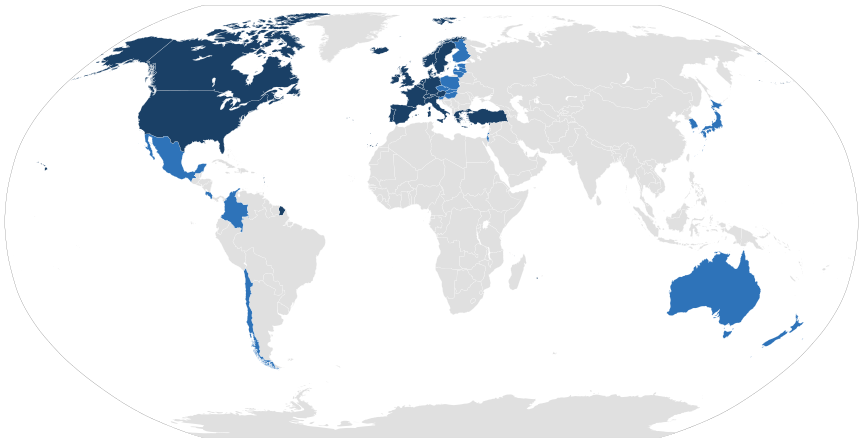
    The OECD has released its economic outlook (pdf) for the United States, Japan and the entire OECD member states (map here). The report projects GDP growth, inflation, unemployment and other stats out through 2011. One broad takeaway is that, in a reversal of fortune, strong recoveries in “emerging” nations like China and India will help fuel demand for goods in next few quarters. It should be noted, however, that as Europe’s debt crisis makes the dollar strong, it hurts the competitiveness of our goods abroad.

    GDP growth in the U.S. is projected to slow in each quarter of 2010, and unemployment is expected to average 9.6 percent in the last few three months of the year. That’s bad news. But it could be worse.

    The Eurozone is in for a horrible two years. It’s hard to create jobs with GDP below 2 percent, and that’s exactly what the OECD projects: Sub-two percent growth for a year between mid-2010 and mid-2011, during which time unemployment will climb above 10 percent. Without monetary stimulus from the European Central Bank, fiscal austerity plans throughout Europe will only cut more public jobs, take more private cash and reduce demand throughout the continent. It will be a rough retrenching.


    Email this Article
    Add to digg
    Add to Reddit
    Add to Twitter
    Add to del.icio.us
    Add to StumbleUpon
    Add to Facebook


    United StatesOrganisation for Economic Co-operation and DevelopmentEuropean Central BankGross domestic productEurozone

  • The Bubble and Squeak Congress

    The spending bills are coming fast and furious in Washington, with the summer deadlines looming and Democrats and Republicans looking to tie a pretty little bow on 111th United States Congress by appeasing valuable constituency groups.

    The spending bills moving through the House and Senate are an American version of Bubble and Squeak: a mess of refried leftovers from months of political wrangling. We want armor for our troops, checks for our jobless, money for our schools, funding for new nuclear reactors, and more troops on the border. But with only weeks remaining until summer recess, everybody’s ideas are trying to leave the train platform at the same time.

    Senators are scrambling to put finishing touches on the war funding bill. Max Baucus is pushing for a weighty tax cut and stimulus bill that we would partially pay for by eliminating a tax loophole that benefits hedge fund managers known as carried interest. In the House, politicians are trying to find space on the mothership that is Obama’s war supplement, by proposing add-ons like disaster
    relief, foreign aid, border patrols, and $23
    billion rescue plan for public schools. The district ragweed known as the “doc fix,” which keeps doctors from taking up to a 20 percent pay cut under Medicare, is back in play, as well.

    Times like these tell you where an administration sees its priorities and its opportunities. The administration is not standing firmly behind the public school rescue plan, despite pleas from Education Secretary Arne Duncan. Instead the White House announced it wants to send thousands of troops to the Mexican border. The calculus here is clear, even if it’s distressing. The White House is afraid of big numbers and is looking for ways to show moderate Americans that it “gets” them.

    It’s too bad. The enemies are at the gates of our fragile recovery. Europe’s debt crisis is making the Dow shiver. Summer demand for new homes could be dry. Broad unemployment is still at 16 percent. Despite months of growth, we’re still on the cusp of deflation, and income growth is practically non-existent. And yet the administration is still spooked by bold spending to juice the economy.


    Email this Article
    Add to digg
    Add to Reddit
    Add to Twitter
    Add to del.icio.us
    Add to StumbleUpon
    Add to Facebook


    Max BaucusUnited StatesUnited States CongressUnited States SenateWashington D.C.

  • Which State Benefits Most From the Mortgage Deduction?

    The mortgage interest deduction has lots of enemies, including urban sprawl critics, tax reformers, deficient hawks, and personal debt gurus. But it also has a lot of friends: namely, the millions of Americans who use it to reduce their tax bills by $80 billion a year.

    For a short refresher, here’s how the deduction works. You buy a house, take out a mortgage, multiply the interest by your income tax bracket and get a number. You get to subtract that number every year from your taxable income. Good for you! But bad, perhaps, for the country. Richer folks tend to have larger mortgages, more interest and a higher tax bracket, which means the deduction is regressive. Moreover, the MID is a subsidy for debt. It rewards home owners for buying houses that are expensive compared to their taxable income. As the country digs its way out of debt valley, policy makers should think about ways to encourage saving instead of spending beyond your means.

    But don’t expect the mortgage interest rate to go anywhere. First, eliminating an $80 billion gift to rich folks with homes is tough sledding. It’s even tougher sledding when you realize that slashing the subsidy would devastate already sickly home prices, since people are incentivized to buy bigger, costlier homes when they can write off the interest. It’s tougher sledding still when you see who is getting the subsidy. It’s not just the rich. It’s the coastal rich. And that often means Democrats.

    Folks who live in Maryland had the highest percent of tax returns claiming a mortgage interest deduction in 2008, according to fresh research from the Tax Foundation. Californians who deducted saved the most on their tax bill, an average deduction of nearly $20,000.

    This is an interesting little gizmo to play around with, but here’s one thing you quickly realize. The states that benefit the most from the mortgage interest deduction look a lot like the states that tend to vote Democratic, from the sapphire coasts to dependable blues like Minnesota. It’s going to take quite an act of political bravery for the Obama administration to gut the deduction.


    Email this Article
    Add to digg
    Add to Reddit
    Add to Twitter
    Add to del.icio.us
    Add to StumbleUpon
    Add to Facebook


    United StatesTaxIncome taxMarylandHome mortgage interest deduction

  • Making College a Three-Year Experience

    Maybe we should start to call it the best three years of your life. Today we’ve got a spat of articles arguing that some colleges should shrink the bachelors degree requirement by a year, either by adding summer classes or requiring fewer courses. The upsides are fairly straightforward: More students get a chance to go to school, each one pays less tuition, and we shave off some of that infamous debt burden.

    The whip-smart Dylan Matthews over at the Washington Post raises an objection: less time in school means less time to think about your career, which might force even more students to fall into the i-bank/consultant cesspool:

    Tucker’s proposal would speed this process up considerably. Instead of
    having three years to find work they love, or to spend studying
    something they love without concern about its marketability, students
    will have only two. These second-year students will probably have less
    idea of what they want to do, panic more, and be more susceptible to
    the streamlined banking/consulting/recruiting process.

    That’s an interesting concern that I wouldn’t have thought of. I’m not sure I find it all that concerning.

    First, there’s nothing special about the number four (for either high school or college). It’s become a Western norm based on ancient Christian church curricula, and all sorts of college customs have grown up inside the four-year mold, from freshman writing seminars, to fall semesters abroad, to sophomore deadlines for declaring your major. Some of those hallmarks might have to change. But if we’re starting with a clean slate and thinking about efficiently educating young guys and gals for 21st century jobs, we should think about whether it makes sense to start with a four-year bachelors degree as a baseline.

    Second, a truncated college experience wouldn’t necessarily make students “more susceptible to
    the streamlined banking/consulting/recruiting process” because it wouldn’t change much on the recruiting supply side. Investment banks and consultant groups hold a lot of sway over
    college graduates not only because students are feeling wayward, but also
    because they offer awesome salaries, plush benefit packages, a truckload of perks and a clear vertical trajectory in your career. It doesn’t matter if college is one year or seven years. Bain consulting will still proffer a higher salary than a local teacher or reporter. Moreover (disclosure: I have three close high school friends at Bain & Company in Boston) I’m not convinced that a consulting job is a bad first gig out of college. It’s not karmic social work exactly, but it’s challenging, collaborative problem-solving (and some of it is even pro bono!). It’s not a monster.

    The more important question here is about college access and affordability. Relative to everyone else, college graduates have never done better than they are doing right now, as David Leonhardt writes (with graphs!) in the New York Times. And yet many of the jobs with the highest growth capacity in the next decade — like some in health care, education and construction — don’t necessitate the debt burden of four years at a university. We’re due for a major rethink in the education sector, and three-year bachelor degrees deserve a place in the conversation.


    Email this Article
    Add to digg
    Add to Reddit
    Add to Twitter
    Add to del.icio.us
    Add to StumbleUpon
    Add to Facebook


  • Don't Fetishize Small Banks

    A friend and source in the finance industry in New York has repeatedly made the argument to me that regulators focusing on the size of banks are missing the point.

    “Small banks did the worst in this crisis,” he once wrote to me. “Making banks smaller would not have changed a thing. If you have 100 little banks with the same portfolio as one giant bank, how are those little banks any more acceptable as failures? If they all go, we’re in the same position. In fact it’s worse, because it’s disorganized and disaggregated.”
    I’ve been torn on this question. On the one hand, if largeness confers implicit and distorting powers to banks (this is the worry behind Too Big to Fail), then by allowing banks to grow without bound, we encourage them to take on cheaper risk. On the other hand, we’ve had small bank calamities before (the Savings and Loan crisis, for example). Lehman Brothers was not a huge bank and its collapse triggered a worldwide financial catastrophe.

    My NY friend will be gratified to see this piece from Vox that warns: “A world with only small and domestic banks is no safer. The key
    benefit of multinational banks – being able to mobilise funds across
    countries – could still be extremely useful for maintaining stability
    in times of distress.

    A view shared by many has gradually emerged during the crisis, that
    a world with relatively small domestic banks is safer than one where
    large global institutions are also important players. This is
    understandable, given that many of the financial firms that had to be
    bailed out or supported with public funds in 2008 and 2009 in Europe
    and in the US were multinational banks and that the size and the scope
    of the activities of these banks have partly been at the root of the
    systemic nature of the financial turmoil (see for example Gros and
    Micossi 2008).

    But this would be a superficial view of the current events.
    Institutions with regional or national frameworks of action also had to
    be supported because of bad investment policies. Examples include
    Nothern Rock in Britain and WestLB in Germany. Moreover, the key
    “raison d’être” of multinational banks – i.e. being able to mobilise
    funds across countries – could in principle be extremely useful to
    support global operations in times of distress and not necessarily be a
    cause of instability.


    Email this Article
    Add to digg
    Add to Reddit
    Add to Twitter
    Add to del.icio.us
    Add to StumbleUpon
    Add to Facebook


    Financial servicesBankGermanyLehman BrothersBusiness

  • Home Buyers Should Celebrate the Greek Debt Crisis

    How might the Greek debt crisis be good for the United States?

    Last week, we counted three possibilities: cheaper oil, greater international investment in the United States (as investors flee the eurozone for America’s embrace), and a longer period of easy money from the Federal Reserve. Today, the Wall Street Journal’s Nick Timiraos finds a fourth, related benefit for the United States in the short term: historic low mortgage rates despite the Federal Reserve pulling back its mortgage-securities purchase program.

    Conventional wisdom held that mortgage rates would rise as the Fed pulled back from propping up the market. Instead,
    many in the industry now say rates could drift as low as 4.5% this
    summer from 4.86% now, instead of rising to 6% as some economists
    projected, making for significantly lower payments for Americans buying
    homes or refinancing their mortgages.

    Here’s what’s happening. The European crisis is making investors nervous about buying bonds from countries across the Atlantic. So they’re flocking to park their cash in US debt. High demand for US debt drives down the yield, or interest rate, on our bonds. Mortgage rates hold hands with the 10-year Treasury yield, which fell to 3.2% last week. That brought rates on 15-year mortgages down to 4.24% last week, “the lowest since Freddie began its survey in 1991,” according to Timiraos. Thirty-year mortgage rates are back to their December 2009 levels.

    This is good news for a home market some feared would face a terrible summer. Since the $8,000 housing credit expired last month, some worried that the demand for new homes had squeezed itself into the first four months of 2010. But the return of low interest rates could make for a buyers market, since every percentage point decline in mortgage rates reduces home prices for the buyer by roughly a 10%. “If the current rates hold,” Timiraos writes, “that could help
    stabilize prices and allow current homeowners to sell existing homes
    without substantial price cuts.”

    Update: The headline comes with a caveat: unless those home owners recently bought stock.


    Email this Article
    Add to digg
    Add to Reddit
    Add to Twitter
    Add to del.icio.us
    Add to StumbleUpon
    Add to Facebook


    United StatesMortgageWall Street JournalDebtRefinancing

  • The White House Finally Explains Keynesian Economics

    Larry Summers gave an interesting speech yesterday defending and explaining the White House’s economic policy at the Johns Hopkins School of Advanced International Studies (SAIS). His thesis was classic Keynesian economics: “Appropriate short-run expansionary budget policy can make an important
    contribution to establishing the confidence necessary for sound
    growth,” Summers said. In other words, deficits are good, for now, because heavy public spending in downturns is still required to juice long-term growth. Good for the administration for making that argument explicitly.

    The Washington Post’s Dana Milbank attended the speech. He chose to focus on the idea that Summers was being obtuse and boring:

    It was the language of the PhD thesis: “Conditions for fiscal policy to
    have an expansionary impact are especially likely to obtain . . .
    considerations militating in favor of sustainable budgets . . . the
    ultimate consequences of stimulus for indebtedness depend critically on
    the macroeconomic conditions.”

    So, look. Milbank writes mainstream political columns that stir snark and analysis into something distinctive and popular, and that’s his thing, and more power to him. But come on. This wasn’t a major public address. It was a speech by a brilliant economic wonk to a graduate school for advanced degrees in government and international affairs. If Summers had stopped to explain to second-year Masters students the definition of a “multiplier effect” or a “catalyzing investment” (other terms Milbank mocks Summers for using), it frankly would have come off as pedantic.

    Economic messaging is really important, and Milbank is right that the administration is still seeking a messenger mixing the panache of Austan Goolsbee with the gravitas of Summers. But it’s unfair to bash Summers for speaking over the heads of “Americans worried about finding or keeping a job” when it’s perfectly clear that his actual audience was much worried about getting an A in Advanced Topics in Monetary Theory.


    Email this Article
    Add to digg
    Add to Reddit
    Add to Twitter
    Add to del.icio.us
    Add to StumbleUpon
    Add to Facebook


    White HouseWashington PostKeynesian economicsFiscal policyGovernment spending

  • In (Partial) Defense of Obama's Spending Cut Gimmick

    President Obama has asked Congress to give him the authority to pare down spending packages and toss them back to Congress for a quick up or down vote. This would let the president burnish his frugal bona fides and give the White House some ammunition when Republicans accuse them of Big Government.

    It is a small step toward thrift, but don’t expect hosannas from the deficit birds on either side of the aisle. Conservatives are chuckling at the idea that a soft edit of the budget will significantly rein in spending. They’re right, it won’t. Liberals will no doubt kvetch that with consumer spending weak and unemployment high, it isn’t the time to reduce spending. They’re right, it’s not.

    At the risk of sounding like the platonic ideal of a TNR column, both sides are right for the wrong reasons. The president has spoken out against the deficit, as if it’s a real enemy (he knows it’s not). He also knows that 2010’s deficit will almost certainly surpass a key emotional threshold for Americans of one trillion dollars. As a result, he has no choice but to fill his deficit-fighting arsenal with water guns and Nerf arrows designed to (1) look like real weapons and (2) not rein in the deficit.

    If passed, the proposal might eliminate some dumb earmarks and retain the vast majority of spending approved by Congress. On the whole, that’s a good thing. It’s hard to find folks stepping up to praise an admittedly gimmicky and probably inconsequential face-saving gesture by the administration. But having acknowledged that it’s admittedly gimmicky, probably inconsequential, and face-saving, I don’t mind it, for precisely that reason. Ideally, the admin would get its nice optics, and states would get their stabilization funds. This year’s deficit should still be higher, and this act wouldn’t stop that.


    Email this Article
    Add to digg
    Add to Reddit
    Add to Twitter
    Add to del.icio.us
    Add to StumbleUpon
    Add to Facebook


  • New War Bill Enough to Make Americans' First $35,000 Tax Free

    How about this for a tax cut: If you take the president’s request for $159 billion of supplemental war spending and send it to American taxpayers instead of Afghanistan, you could make every American’s first $35,000 completely tax free for one year.

    Yes, Rep. Alan Grayson’s War Is Making You Poor Act is a gimmick. No, nobody will vote for it. That’s for the best, because supplemental spending is necessary to keep our soldiers safe, nourished and effective. But as an effort to shine a light on budget games and to force Americans to see war spending on par with domestic spending, it’s a smart piece of PR (via Wonkroom)

    GRAYSON: So I believe that the thing we need to do is to
    take that $159 billion that the President has set aside – we’re not
    saying he has to stop the war, we’re not giving a cut-off date for the
    war – we’re simply saying you need to fund that out of the base budget
    of $549 billion. And we take 90 percent of that and give it back to the
    American people.

    And I think most people would be surprised to learn that
    that is so much money that we’ve been spending on the war in
    Afghanistan and the war in Iraq that every single taxpayer in America
    will be get his first or her first $35,000 of income completely tax
    free.

    Watch it:


    Email this Article
    Add to digg
    Add to Reddit
    Add to Twitter
    Add to del.icio.us
    Add to StumbleUpon
    Add to Facebook