Michigan’s Attorney General Mike Cox has filed a new Supreme Court motion to sever the connection between the carp and the Great Lakes, saying that claims by Illinois of $190 million in annual damages from lock closures are “seriously exaggerated.”
By Steve Kellman
Circle of Blue
Michigan Attorney General Mike Cox filed a new brief with the U.S. Supreme Court Thursday in his effort to sever the ties between carp-invested canals around Chicago and Lake Michigan, following the high court’s rejection of his initial motion.
The legal maneuver comes amid a flurry of activity over the threat that Asian carp pose to the world’s largest freshwater system.
Three Great Lakes governors—Michigan’s Jennifer Granholm, Wisconsin’s Jim Doyle, and Illinois’ Patt Quinn—plan to meet with Obama administration officials Monday to discuss how to combat the spread of the invasive species. The U.S. House of Representatives scheduled an emergency hearing on the carp crisis for Tuesday in response to calls from Michigan’s congressional delegation. The hearing will be held by the Transportation and Infrastructure Subcommittee on Water Resources and Environment.
Joel Brammeier, president of the 40-year-old non-profit, the Alliance for the Great Lakes, plans to testify at the hearing on behalf of closing the locks. In 2008, the Alliance conducted a study for the Great Lakes Fisheries Commission on the feasibility of separating the carp-invested river from the Great Lakes.
“Next week will probably be the biggest spotlight on carp management in months, if not years,” Brammeier told Circle of Blue. “I’ve never seen this level of engagement.”
“What hasn’t been apparent yet is if the agencies are willing to go to the mat and make stopping Asian carp priority one in both word and deed, and I’m very hopeful we’ll see that level of engagement next week.”
While Cox acknowledged the impending White House summit in a statement about the new legal brief, he said immediate legal action is still needed.
“We think the Court should take another look at our request to hit the pause button on the locks until the entire Great Lakes region is comfortable that an effective plan is in place to stop Asian carp,” Cox said. “While we would like to see significant and immediate action as a result of next week’s meeting between the governors and administration, that is an unknown at this time, so our battle to protect the Lakes will continue.”
Meanwhile Asian carp, which can grow up to 100 pounds and four feet long, have displaced native fish along the Illinois and Mississippi rivers.
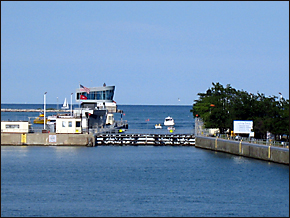
Michigan officials are pressing for an immediate closure of the waterways that connect the carp-infested Illinois River with Lake Michigan, fearing that the invasive species will destroy the lakes’ ecosystem and devastate its $7 billion sportfishing industry. Their efforts have drawn legal support from the Indiana, Minnesota, New York, Ohio, Pennsylvania and Wisconsin, as well as from Ontario, Canada.
Illinois state officials have opposed the move, saying the closure could damage the Chicago region’s shipping industry, which uses the system of canals and locks to transport millions of dollars worth of goods and commodities annually. And the American Waterways Operators, a national trade association representing the U.S. tugboat, towboat and barge industry, has warned that closing the locks could raise transportation prices and cost hundreds of people in the barge transportation industry their jobs.
In his latest Supreme Court motion, Cox cited new information that became known after the court’s Jan. 19 denial of his original motion–the discovery of Asian carp DNA in Lake Michigan, which suggests that efforts by the U.S. Army Corps of Engineers to contain the carp are not working. In a statement on his state Web site, Cox pointedly noted that the DNA evidence “was available three days before the Court made its decision but not provided by the U.S. Army Corps of Engineers until afterward.”
The new motion also includes the results of a transportation study that challenges Illinois estimates of the economic damage from closing the locks. The study, by Wayne State University transportation expert John Taylor, determined that statistics previously submitted to the Supreme Court by Illinois and the federal government on the potential economic costs of lock closure are “seriously exaggerated.”
While Illinois and the federal government claimed that lock closures could cost the region $190 million a year, the new study places the annual costs at less than $70 million. The study also estimated that the number of jobs overall would increase due to the need for new modes of transposition like trucking.
Sources: Michigan Attorney General Mike Cox, Detroit Free Press, Milwaukee Journal Sentinel
See previous Circle of Blue coverage: Asian Carp Knocking at the Great Lakes’ Door; Michigan Attorney General Seeks To Slam It Shut