Author: Steve Kellman

  • No Asian Carp Found in Latest Chicago-Area Fish Kill

    Results reveal that the invasive species may not be as immediately threatening as certain local politicians and activists had previously argued.

    asian carp

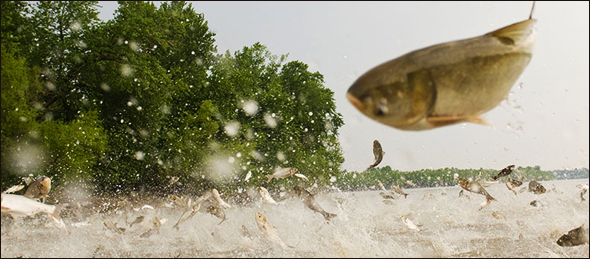
    Photo by Jason Lindsey

    No Asian carp turned up after a massive fish kill last week in the Chicago-area canals, officials announced Tuesday, suggesting that the threat of the invasive species isn’t as immediate as was feared. While more than 40 species of fish were found, none were the high-flying fish.

    Regional politicians had argued the canals threatened to let the menacing fish into the Great Lakes.

    Illinois Department of Natural Resources workers poisoned a two-mile stretch of the Little Calumet River and spent five days scooping up and sorting through the resulting 100,000 pounds of dead fish. The $1.5 million operation was the second such fish kill; a similar $3 million effort conducted in December turned up only one Asian carp.

    Meanwhile federal biologist Duane Chapman has conducted research that found Asian carp tend to sink when poisoned, and told the Milwaukee Journal Sentinel that it could take time for any poisoned carp to surface.

    Asian carp have infested large stretches of the Mississippi and Illinois rivers in recent years, touching off a political battle over whether the Chicago Sanitary and Ship Canal should be sealed off from Lake Michigan to prevent the fish from getting into the lake. Scientists fear that the invasive species could drastically alter the Great Lakes ecosystem and devastate its $7 billion sportfishing industry.

    In March, the U.S. Supreme Court rejected an effort by Michigan’s attorney general to force such a closure—an effort that drew legal support from Ontario and every other Great Lakes state but Illinois.

    Water tests using a recently developed technique known as environmental DNA or eDNA had turned up evidence of Asian carp near Lake Michigan.

    John Rogner, co-chair of the Asian Carp Regional Coordinating Committee that oversaw last week’s fish kill, said more work remains to be done to determine the threat that Asian carp pose.

    “We will now look at the entire body of evidence collected thus far, including eDNA sampling results and all of our conventional sampling with nets and electrofishing gear to see if we can draw any further conclusions about the risk of invasion and establishment of Asian carp in Lake Michigan through the Chicago Area Waterway System,” Rogner said.

    Sources: Chicago Tribune, Detroit Free Press, Milwaukee Journal Sentinel

    Read more about Asian carp on Circle of Blue.

  • Supreme Court Rejects Michigan’s Asian Carp Lawsuit

    Michigan’s Attorney General Mike Cox is “looking at other legal avenues” to pursue the carp battle.

    flying asian carp

    Photo by Jason Lindsey

    By Steve Kellman
    Circle of Blue

    Michigan’s effort to bring the Asian carp fight to the U.S. Supreme Court came to an abrupt end Monday with a terse two-sentence denial from the court.

    The ruling effectively ends Michigan Attorney General Mike Cox’s four-month effort to convince the nation’s highest court to wade into the legal debate over the invasive species threatening Lake Michigan. Cox sought to reopen a decades-old lawsuit against Chicago’s diversion of Lake Michigan water to force the closure of Chicago-area locks that threaten to let the carp into the freshwater body.

    “The fight to protect Michigan’s jobs and environment now falls to President Obama and Congress,” Cox said in a statement. “While President Obama has turned a blind eye to the millions of Great Lakes residents who do not happen to live in his home state of Illinois, it is now up to him to save thousands of Michigan jobs and our environment.”

    Asian carp have been making their way up the Mississippi and Illinois rivers for decades since being imported to clean catfish ponds in southern parts of the country, while government workers also attempted to use the fish for weed control sewage disposal. Established populations now live just a few miles from Lake Michigan, in the Illinois River and the canals that transport Chicago’s municipal waste away from the city.

    “While President Obama has turned a blind eye to the millions of Great Lakes residents who do not happen to live in his home state of Illinois, it is now up to him to save thousands of Michigan jobs and our environment.”
    -Mike Cox

    Midwest officials and environmentalists fear that the invasive fish could devastate the Great Lakes ecosystem and destroy the region’s $7 billion sport fishing industry if a breeding population becomes established in the lakes. DNA tests suggest that at least some fish have already made their way past the electric fish barriers.

    But the high court dismissal does not end the attorney general’s legal options, according to spokesperson Joy Yearout.

    “We are looking at other legal avenues including action in federal district court, but we’re reviewing those options right now,” Yearout told Circle of Blue. “Even while that legal review is happening, the attorney general is still committed to doing what he can to raise public awareness and put pressure on Washington to take action.”

    “Both the president and Congress could take action to solve this problem; it doesn’t need to be a legal solution,” Yearout added.

    Nick Schroeck, executive director of the Great Lakes Environmental Law Center, said the attorney general has several legal options, including suing the state of Illinois and the federal government in federal court. He could also a file suit in state court in Illinois against the Metropolitan Water Reclamation District of Greater Chicago, which oversees the network of locks and canals that threaten to let the carp into Lake Michigan.

    Environmental groups could take up legal action in state court as well, Schroeck said, “perhaps using the Illinois Endangered Species act.”

    “Other states could sue too,” Schroeck noted. “The other interesting case is that Canada may now choose to get involved.”

    The Great Lakes Environmental Law Center, an independent, not-for-profit group of environmental attorneys working to protect the lakes, supported Cox’s efforts.

    Since the case was reopened in December, the Michigan case generated more than two dozen motions, responses, memoranda, appendices and friend of the court briefs. The states of Indiana, Minnesota, New York, Ohio and Washington all weighed in with motions in support of Michigan’s efforts, as did the Queen in Right of Ontario. Ontario is the only Canadian province to border the Great Lakes, and Ontario officials fear that Asian carp could devastate the province’s fishing industry.

    Illinois state officials oppose the closure attempts on economic grounds, noting that the locks and canals are used for flood control and to transport some 7 million tons of cargo a year. The U.S. Solicitor General, Elena Kagan, sided with Illinois and noted that the federal government is already taking several steps to block Asian carp from getting past the locks and into the lake.

    “In a host of ways, the federal government has demonstrated its commitment to protecting the Great Lakes from the expansion of Asian carp,” Kagan wrote in her memorandum in opposition to Michigan’s request. “Nothing in federal law warrants second-guessing its expert judgment that the best information available today does not yet justify the dramatic steps Michigan demands.”

    Kagan’s argument—and the fact that the U.S. government took sides in the dispute—might have helped doom Michigan’s motion to reopen the Illinois lawsuit.

    “The federal government weighing in on Illinois side was a very big hurdle to overcome,” he said.

    “On the other hand, the federal government’s got ownership of the issue now,” Schroeck said. “If the carp get in and there’s a reproducing population of Asian carp in Lake Michigan, the feds are going to have to answer for that.”

    Cox is just one of several Michigan politicians seeking to block the carp from getting into Lake Michigan. U.S. Rep. Dave Camp (R-Mich) has sponsored a bill called the CARP ACT (Close All Routes and Prevent Asian Carp Today) that would close the locks, erect barriers in channels and rivers keep carp out of Lake Michigan during floods, and reinforce the current carp blocking and monitoring efforts. He introduced the bill following the Supreme Court’s first rejection of Cox’s preliminary injunction request.

    The bill has won nine co-sponsors: from Michigan, Minnesota and Ohio, and is now before the House Committee on Transportation and Infrastructure.

    U.S. Senator Debbie Stabenow (D-Mich) introduced a version of Camp’s CARP ACT in the Senate, where it has garnered six co-sponsors and been referred to the Committee on Environment and Public Works.

    On Friday, the day before the opening day of fishing season in Michigan, Camp sent out an e-newsletter to his supporters seeking signatures on a petition supporting his bill.

    Cox, who is running on the Republican ticket for governor, praised current Democratic Governor Jennifer Granholm and the state’s Department of Natural Resources & Environment for their efforts to block Asian carp in his statement on Monday. He also called on Congress to pass the CARP ACT while urging concerned citizens to call the White House, sign the online petition he posted on his StopAsianCarp.com website, and post comments on the campaign’s Facebook page.

    Cox spoke with Circle of Blue during a public rally in Traverse City in February, noting that 80,000 people had signed the petition at stopasiancarp.com.

    Steve Kellman is a reporter for Circle of Blue. Reach Kellman at [email protected] and check out more of our Asian carp coverage here.

  • Bid to Protect Michigan’s Groundwater Draws Opposition, Praise

    Local legislators in Michigan counties battle over a bill that will expand on water protections established by the 2008 Great Lakes Compact.

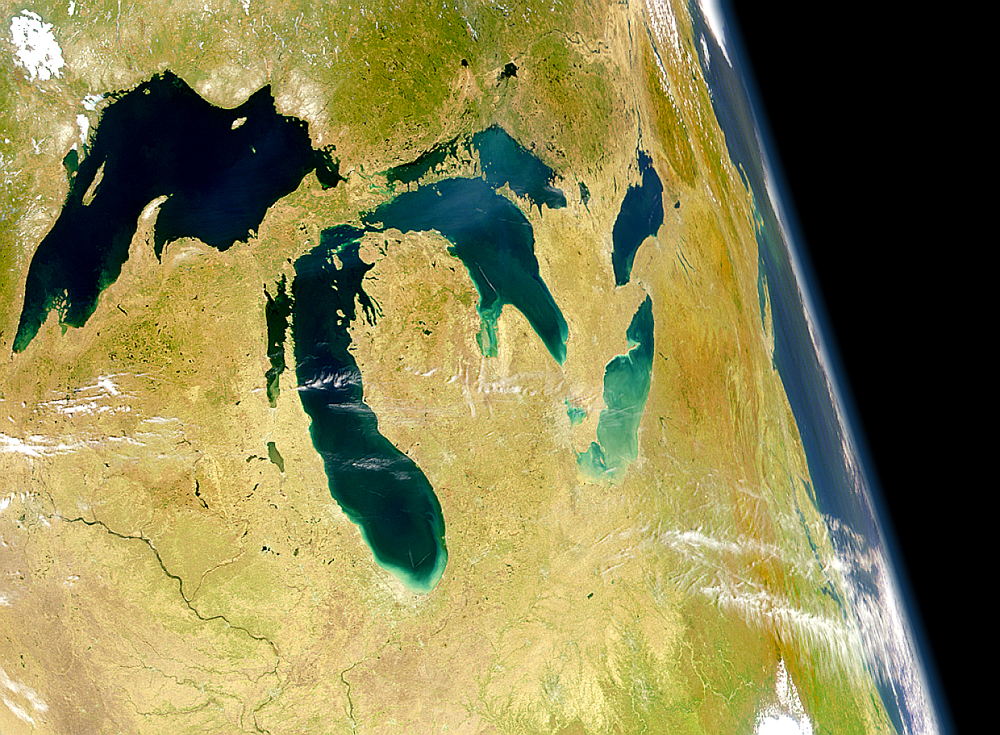
    Great Lakes NASA

    Photo Courtesy NASA

    A proposed bill that declares Michigan’s groundwater a “public trust” has set off a storm of controversy, with opponents claiming that the legislation would expose property owners to new state fees, and supporters arguing that it will protect against outside interests siphoning off the state’s water.

    The latest skirmish came last week, when a panel of the Oakland County Board of Commissioners narrowly passed a resolution asking the state legislature to vote against the bill. The resolution claims that the legislation would interfere with traditional water rights and limit the ability of farmers and lakeside homeowners to use the resource. It passed by a six-to-five vote along party lines in the southeastern Michigan county, with Republicans opposed to the bill and Democrats in support, respectively. The full board is scheduled to vote on the resolution Thursday.

    “I’m trying to end the idea of groundwater as a commodity.”
    -State Rep. Dan Scripps

    The legislator at the center of the upheaval, State Rep. Dan Scripps (D-Leland), said that the bill’s intent is to strengthen property rights rather than reduce them.

    “I’m trying to end the idea of groundwater as a commodity,” Scripps told the Traverse City Record-Eagle in March. Scripps told Circle of Blue that he introduced the bill in September because 2008’s landmark Great Lakes Compact did not go far enough to protect the rest of the state’s waters.

    “Groundwater, surface water, Great Lakes water—these are public resources that should be protected in the future,” he said.

    Since its introduction, House Bill 5319 has been praised by water rights experts, pilloried by the conservative Mackinac Center for Public Policy, and argued over in numerous letters to the editor in newspapers across the state.

    Meanwhile the move by Oakland County politicians has been “sharply criticized” by Clean Water Action, a national citizens’ group working for clean, safe and affordable water.

    “What the vote today says is that the groundwater that feeds Oakland County’s streams, keeps Oakland County lakes alive and is the circulatory system for our entire Great Lakes ecosystem doesn’t deserve to be safeguarded from a state government that is sometimes all too willing to allow our waters to be sold for profit and exported to thirsty countries like China,” Cyndi Roper, Clean Water Action’s special projects director, said in a news release. “We strongly urge the Board of Commissioner to reject those who want to turn Michigan’s waters over to corporate interests so, like our jobs, water can be outsourced in unlimited amounts to China and other places.”

    Jim Olson, an environmental attorney from Traverse City, Michigan, and one of the region’s foremost authorities on water law, called for the passage of Scripps’ bill in a commentary in the Detroit Free Press.

    “If public trust principles are not reaffirmed then the water commons that supports all life and economy here will be diminished in flow, level and quality, and claimed by special or foreign interests under international treaties such as NAFTA… In other words, industries and the jobs they produce, like farming—Michigan’s second largest industry—will be forced to compete with the infinite demand for water anywhere in the country, continent or world,” he wrote.

    Half of the world’s population will be without safe drinking water in less than 30 years if current levels of water waste and pollution are not curbed, Olson noted. He said recent surveys have estimated that the world’s freshwater demands will outstrip the supply by more than 30 percent.

    Scripps has introduced a new bill that he hopes will calm fears of new state fees on water, according to the Michigan Messenger. Introduced last week, the bill forbids state and local governments from imposing “any taxes or fees on water withdrawals from water wells on residential property.”

    Sources: Detroit Free Press, Michigan Messenger, Traverse City Record-Eagle

    Read More: Congress, Michigan Legislature Asked to Fix Leaks in Great Lakes Compact

  • Milwaukee-Area Community Seeks To Tap Lake Michigan for Water

    While Waukesha’s request is the first major test of the Great Lakes Compact, the county supervisor opposes the plan.

    Community Seeks To Tap Lake Michigan for WaterThe city of Waukesha, Wisconsin is seeking permission from eight Great Lakes states to draw its drinking water from Lake Michigan instead of contaminated deep-water wells.

    The application is the first major test of a 2008 compact designed to protect the lakes from large diversions of water, but must win approval from state regulators to become official.

    Waukesha gets most of its water from deep wells contaminated with naturally occurring radium and salt, and, as a result need to be treated to meet federal drinking water standards. After its use and treatment, the water is pumped into the Fox River, where it flows into the Mississippi River and then the Gulf of Mexico.

    But the city needs to find a cleaner water supply by 2018 under a state court order.

    The Waukesha Common Council voted Thursday to apply for access to Lake Michigan water under the Great Lakes–St. Lawrence River Basin Water Resources Compact, a 2008 agreement to protect the lakes from large-scale water diversions. The compact requires approval from the governors of all the states that surround the lakes—Illinois, Indiana, Michigan, Minnesota, New York, Ohio, Pennsylvania and Wisconsin—for any withdrawals from communities that fall outside the Great Lakes basin. Waukesha sits 14 miles north from Lake Michigan’s shore, but falls within the Mississippi River basin.

    The city’s plan for tapping into Lake Michigan involves building a series of pipelines to pump water from the lake and return treated water to the lake via local steams and rivers. The compact requires that water diverted from the Great Lakes be returned to the lakes.

    The plan would cost an estimated $164 million, which is less expensive than continuing to pump and treat the city’s water from deep wells or obtaining water from a combination of deep and shallow wells.

    Relying on deep wells would become increasingly costly due to dropping groundwater levels and the higher cost of pumping water from greater depths, the city argues. Water from deeper in the aquifer also has higher levels of radium and salt, which would lead to increasing treatment costs. Switching to shallow wells would drain water from local rivers, streams and wetlands, according to a city-commissioned study.

    Waukesha’s plan has drawn opposition from the Milwaukee County supervisor, John Weishan Jr., who complained that it could contaminate the local waterways that would be used to return water to the lake. Weishan is sponsoring a resolution to block the plan.

    Weishan’s resolution will be considered April 13 at the next meeting of the county’s Parks, Energy & Environment Committee. If approved by the committee, the county’s board of supervisors could vote on the resolution April 22, which is also the 40th anniversary of Earth Day.

    Sources: Waukesha Draft Application for Lake Michigan Water supply (PDF), <a href=”http://www.jsonline.com/news/waukesha/90324837.html”>Milwaukee Journal Sentinel, Milwaukee and Southeastern Wisconsin Business News

    Read more of Circle of Blue’s reporting on Waukesha’s water woes here.

  • Supreme Court To Take A Second Look at Michigan’s Asian Carp Injunction

    The high court originally rejected a request to order Chicago-area locks closed to keep the invasive fish out of the Great Lakes.

    Attorney General Mike Cox talks about invasive species Asian carp in Traverse City.

    Photo © J. Carl Ganter/Circle of Blue
    Great Lakes’ politicians gathered in Michigan last month to discuss the severity of the Asian carp threat in the area. Michigan Attorney General Mike Cox spoke during the conference. On Friday, the Supreme Court will reconsider a motion Cox filed to block Asian carp from the Great Lakes.

    The Supreme Court has agreed to reconsider Michigan’s motion to force the closure of Chicago-area locks and stop the spread of Asian carp into the Great Lakes.

    Michigan Attorney General Mike Cox talked about the Supreme Court’s plans during a “town hall” forum at Saginaw Valley State University Monday, the Saginaw News reported. Cox hosted a similar forum in Traverse City in February.

    The legal motion, which Cox filed in December, is part of a broader effort by the attorney general to reopen a decades-old lawsuit filed by several states against Chicago and Illinois over the Chicago Waterway System, the century-old network of canals and locks that were built to divert the city’s sewage into the Illinois River instead of Lake Michigan. The ongoing diversion of Great Lakes water, and the canals and locks that are part of it, have allowed a series of invasive species to cross between the Great Lakes and the rivers, including zebra mussels and the round goby.

    Cox’s office confirmed Tuesday that the Supreme Court will reconsider his injunction request Friday, and told Circle of Blue that the court is scheduled to consider Cox’s larger request to reopen the Chicago diversion case on April 16.

    Asian carp—an invasive fish species that has been making its way up the Mississippi and Illinois rivers for years—threaten to disrupt the Great Lakes ecosystem if they get into the lakes. A series of Chicago-area locks and canals are all that that separate the fish from Lake Michigan and the rest of the Great Lakes at this point. While their DNA has been detected in the water on both sides of the locks, they are not known to have established a self-sustaining population in Lake Michigan.

    The bighead carp variety of Asian carp can grow up to 100 pounds and four feet long, eating their weight in plankton daily. The smaller silver carp can grow up to 40 pounds, and are known for jumping out of the water at the sound of boat motors, hitting and injuring boaters. Scientists fear that the carp could disrupt the food chain in the Great Lakes, threatening the game fish population and the region’s $7 billion sportfishing industry.

    Source: The Saginaw News

    Asian Carp Coverage & Videos

  • Q&A : U.S. Congressman Dave Camp On Asian Carp

    Circle of Blue talks with U.S. Rep. Dave Camp (R-Mich.) about fighting the Asian carp battle on the federal front.

    Photo © J. Carl Ganter/Circle of Blue
    Local and federal politicians that hosted an Asian carp conference in Michigan last month urged for immediate action against the Great Lakes’ threat. Officials demanded swift legislative action that goes beyond fiscal budget allocations.

    By Steve Kellman
    Circle of Blue

    U.S. House Representative Dave Camp represents a legislative district that covers a huge swath of Michigan’s lower peninsula including the Leelanau Peninsula that juts into Lake Michigan. In January, the Michigan Republican introduced the Close All Routes and Prevent Asian Carp Today bill, also known as the CARP ACT, to the House.The proposal seeks to make actionable the legal motion filed by Michigan Attorney General Mike Cox to the U.S. Supreme Court in December. The Court rejected the motion to close canals and locks to the Great Lakes a month later.

    In announcing his proposal, Rep. Camp noted that recent environmental DNA tests suggest that at least some Asian carp have already gotten into Lake Michigan.

    Circle of Blue caught up with Rep. Camp earlier this month in Traverse City where he appeared with Attorney General Cox and other state officials during a rally to block the carp from entering the Great Lakes. Camp discussed his legislative efforts to stop the potential Asian carp threat from becoming a reality.

    Can you describe the goals of your legislation?

    What we want to try to do is keep the Asian carp out, and we believe that closing the canals and the locks is the first thing to do. Then we can address how to continue to operate barge traffic and recreation and other things. The concern is that the eDNA sampling results show that it may be too late. It’s important that we act and we act now, and we act decisively.

    Your legislation, the CARP ACT, does have study and mitigation aspects?

    It does. It’s about trying to find solutions to the concerns that the Chicago-and northern Indiana-area has raised. The main one we’ve [Michigan] raised is flooding. We want to make sure there are proper procedures in place so that homes and businesses don’t flood. [Closing the locks] is not a win-win for anybody, but I think it’s important that we do that.

    Obviously they’re also concerned about any economic impact, but I think it’s important to get the information out about what the alternatives are. What actually is the level of barge traffic? What are the economic needs? How many jobs would be lost and what is the tradeoff? How does that compare to the potential job loss and economic damage if Asian carp were to get into the lakes?

    We need to do some education. We need to make sure people understand what their choices are. We’ve gotten some attention with the new federal dollars we got from the appropriations process last year and from the president’s announcement recently. But it’s not just about dollars, we need some action. This is an issue that’s been out there for quit a while.

    How long have you been working on this issue?

    I really got involved in 2006 to try to get funding for the first electronic barrier and then we found out how inadequate that was and obviously there were some succeeding appropriations for other barriers. What really has been most troubling is it’s been a stop-gap approach, with no comprehensive solution or addressing of the concern. So while an electronic barrier is like sticking your finger in the dike, we really need to figure out how to design the berms, the locks, any sluice gates and any barriers. How do you look at the entire area and issue so that we can prevent Asian carp from getting into Lake Michigan?

    There are two petition sites up now. Attorney General Mike Cox is behind one, and Michigan House Democrats have put up another one. Do you worry that the issue might become overly politicized?

    I don’t think it is. I agree with Governor Granholm 100 percent on this issue. She’s called for closing the locks, so have I and so has Sen. Stabenow (D-Mich). Legislation is moving through Congress by a Republican in the House, a Democrat in the Senate, and with bipartisan co-sponsorship. I’m not too worried about Web sites and resolutions, although those are helpful. If we can reach people that check our Web sites, that can only help our issue. I haven’t seen their site, but I think the result is probably very similar to the result we’d like.

    What’s your opinion of the Asian Carp Control Strategy Framework in general?

    So far I think it’s been inadequate. There are several agencies involved and obviously there has to be coordination with state environmental offices as well. I don’t think the coordination has been good enough. I don’t think the agencies have really tried to, in a comprehensive way, address the problem. There’s been some good people working on it and they’ve taken it seriously, but we really need some direction from the top.

    We just had a meeting, House and Senate members from the Great Lakes region, with the secretary of the Army Corps of Engineers where she was mispronouncing the names of the rivers. I asked if she’d been there and she said ‘no.’

    I told her that’s part of the problem–we really don’t have people at the top levels taking this seriously, and making this a priority for federal agencies. We’re starting to get that attention, but we need to continue to push for it.

    Steve Kellman is a reporter for Circle of Blue. Contact Kellman at [email protected] and read more of our carp coverage here.

    Asian Carp Coverage & Videos

  • Block Those Flying Fish: Great Lakes Politicians Pressure Illinois, Washington on Asian Carp

    Asian Carp Conference

    Photo © J. Carl Ganter/Circle of Blue
    Last month local and federal politicians from the Great Lakes region hosted a conference in Michigan to rally support for immediate action against the Asian carp. Officials discussed proposed legislation and the ongoing battle to close off the Great Lakes from the infested Illinois River.

    Michigan’s attorney general and U.S. Rep. Dave Camp host a second event to rally support in Traverse City.

    By Steve Kellman
    Circle of Blue

    More than 100 anglers, business executives and residents packed the glass atrium at Northwestern Michigan College’s Hagerty Conference Center last week to hear Michigan’s attorney general describe the threat to the Great Lakes from Asian carp–an ugly and voracious jumping fish that’s banging on the door to the world’s largest and body of clean, fresh water.

    The Feb. 17 meeting was the second gathering of state and federal officials in Traverse City in the last two weeks. Great Lakes politicians have been rallying the public’s support to seal off Chicago-area locks that are thought to be entryways to the lakes for the invasive species. The effort is part of a broader legal push to seal off the century-old Chicago Waterway System from the Great Lakes, ending the back-and-forth migration of the invasive species that has plagued the lakes and Mississippi River system for decades.

    Posters of the menacing fish, in all their gape-mouthed glory, served as the meeting’s backdrop. The snowy shore and choppy grey waters of Grand Traverse Bay dominated the view through the two-story glass wall, extending into the distance where the bay joins the rest of Lake Michigan.

    Asian carp, which can weigh up to 100 pounds and grow up to four feet long, have overtaken large stretches of the Mississippi and Illinois rivers since being imported into the U.S. While no one is sure how well they would adapt to the colder, deeper waters of the Great Lakes, experts say the risk of major damage is too great.

    A Flipping, Flying Aquatic Menace
    Kelley Smith, fisheries division chief for the Michigan Department of Natural Resources & Environment, told attendees at the meeting last week that the carp would place an added burden on an ecosystem already stressed by the invasive zebra mussel and quagga mussel. The bighead variety of Asian carp can eat up to 40 percent of their weight in plankton each day. While the fish may not overrun the deeper parts of Lake Michigan, they may be right at home in the many rivers and streams that flow into the lake, and could affect the fishing there.

    “Even if these carp don’t affect fishing in those rivers, they will affect the boaters,” Smith said. The silver variety of Asian carp—which can weigh up o 40 pounds—are known for jumping in the air at the sound of motors, injuring boaters and knocking them out of their boats.

    On Feb. 6, four state representatives—Gary McDowell (D-Rudyard), Andy Neumann (D-Alpena), Dan Scripps (D-Leelanau), and Wayne Schmidt (R-Traverse City)—gathered on the banks of the Boardman River to discuss how the invasive fish threatens the Great Lakes’ ecosystem. The legislators used the occasion to announce the launch of a Web site backed by Michigan House Democrats-—NoAsianCarp.com—-with a petition urging Illinois officials to close the locks.

    The Web site is joined by a similar project from Michigan Attorney General Mike Cox, StopAsianCarp.com, which has its own petition that calls on President Obama and the U.S. Congress to close the locks. Cox, a Republican, is a candidate for governor.

    A Rare Issue That Unites Both Parties
    While the earlier riverside rally was dominated by Democrats, and the more recent Hagerty Conference Center meeting was led by Republicans, speakers at both gatherings insisted that the issue has galvanized both parties. Officials have also argued that the state’s two political parties are united in sealing off the waterways.
    U.S. Representative Dave Camp, a Republican from Michigan, opened Wednesday’s meeting with a history of the Asian carp’s long migration up the Mississippi River and a review of his recently introduced CARP ACT (Close All Routes and Prevent Asian Carp Today) legislation, which would close the locks, install other protections and mitigate any impact on Chicago commerce.

    Flying Fish : Asian Carp

    Photo © J. Carl Ganter/Circle of Blue

    “This legislation has support from both Republicans and Democrats in Michigan, New York, Ohio and Wisconsin,” Camp said, noting that Sen. Debbie Stabenow (D-Mich.) has introduced a companion bill in the U.S. Senate.

    Asian carp have been ranked the most threatening invasive species in the world, Camp said. He also rattled off what’s at stake if fish take over the Great Lakes region, including a $7 billion sportfishing industry, a $9 billion boating industry, as well as the 800,000 jobs that both support.

    Attorney General Cox praised Democratic Governor Jennifer Granholm for her work to get the locks to be closed immediately and for disapproving of the federal government’s inaction against the fish. He also noted that his legal efforts have drawn support from most of the other Great Lakes states.

    While the Republican attorney generals of Pennsylvania and Wisconsin as well as the Democratic attorney generals of New York, Ohio and Minnesota have supported Michigan’s stance, Indiana’s Republican leadership remains split on the issue. Indiana Republican Governor Mitch Daniels opposes closing the locks while the state’s Republican Attorney General Greg Zoeller has filed a court brief supporting Cox’s legal actions.

    Illinois Leaders Push Back
    Only political officials in Illinois, home to the carp-infested waterways in question, are united in opposing the immediate closure of the locks. And while President Obama, a resident of Chicago who represented Illinois in the state and U.S. Senate, initially sided with Illinois on the issue, he is now taking on a middle-ground approach.

    Federal authorities have backed the $78.5 million Asian Carp Control Strategy Framework, which outlines 24 recommendations for battling the carp. The federal government also supports more research on the potential economic and environmental effects the fish will have on the lake. Once results are in, the administration said it could support closing the locks by April at the earliest. The framework document notes, however, that even with the locks closed carp may still be able to get through since the structures are not watertight.

    At a Feb. 12 EPA hearing in Chicago, where dozens of local businesspeople and boat captains railed against the possibility of any lock closures, Congresswoman Judy Biggert (R-Hinsdale) warned that such closures would have an “absolutely devastating impact” on the local, regional and national economy, and result in “massive flooding” and high unemployment.

    Meanwhile Cox deemed those arguments as “dramatically overstated” at the Traverse City rally, noting that a study by Dr. John C. Taylor, a transportation expert with Wayne State University, pegged the maximum economic impact of lock closures at $70 million. Dr. Taylor’s study found that the closures would likely result in an increase in jobs overall as other transportation sources take up the slack on the region’s already-declining barge industry.

    Washington Slow to Respond
    Cox also said that the locks could be opened on an emergency basis to guard against flooding, which has historically happened an average of once every 10 years. Rep. Camp’s CARP ACT legislation also allows for emergency opening of the locks.

    While Cox had words of praise for the $78.5 million Asian carp control plan, he noted that only about $9 million of the funding is new. He urged meeting attendees to push for faster federal action, and said StopAsianCarp.com is one way of doing so, “to activate the citizen militia, as it were.”

    A lack of urgency from Washington is nothing new, Cox added. “The Bush administration was really slow on addressing this issue as well,” he said. “We’ve all been pushing Washington over a number of years.”

    Steve Kellman is a reporter for Circle of Blue. Contact Kellman at [email protected] and read the rest of our carp content here.

    Asian Carp Coverage & Videos

  • Q&A: Michigan Attorney General Talks about Asian Carp

    Attorney General Mike Cox Speaks on Carp

    Photo © J. Carl Ganter/Circle of Blue
    Great Lakes’ politicians gathered in Michigan last month to discuss the severity of the Asian carp threat in the area. Michigan Attorney General Mike Cox spoke during the conference, and asked attendees to commit to closing off the Great Lakes from the infested Illinois River.

    Circle of Blue speaks with Michigan Attorney General Mike Cox about the fight to protect the Great Lakes against Asian carp. (more…)

  • Great Lakes Cleanup To Get $2.2 Billion in Federal Funding

    The EPA plan released Sunday aims to clean up top pollution sites; block toxic runoff from cities and farms; restore sensitive wetlands; and establish a “zero tolerance policy” toward invasive species like the Asian carp.

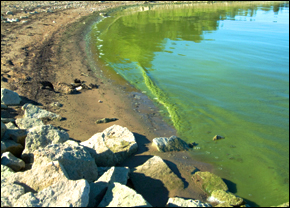
    Algae BloomThe U.S. Environmental Protection Agency has laid out the details of a five-year blueprint that will clean and protect the world’s largest freshwater source from its “150 years of abuse.”

    EPA Administrator Lisa P. Jackson unveiled the plan Sunday at a meeting with Great Lakes politicians including Wisconsin Gov. Jim Doyle and Ohio Gov. Ted Strickland—co-chairs of the Council of Great Lakes Governors.

    “This action plan outlines our strategy to protect the environmental, human health, and economic interests of the millions of people who rely on the Great Lakes,” Jackson said.

    Specific goals of the Great Lakes Restoration Initiative Action Plan include:

    • Collecting or preventing the release of 45 million pounds electronic waste, 45 million pills of unwanted medicines, and 4.5 million pounds of household hazardous waste;
    • Cleaning up 9.4 million cubic yards of toxic sediment;
    • Cutting runoff from cities and farms and improving habitat in lake watersheds;
    • Reducing algae blooms at Great Lakes beaches to reduce the number of beach closures; and
    • Performing a comprehensive assessment of the Great Lakes’ entire 530,000 acres of coastal wetland, including 10,000 miles of shoreline.

    Congress has authorized $475 million for improving the Great Lakes ecosystem this year, $60 million of which would go to the fight against the invasive Asian carp. Earlier this month, President Barack Obama proposed to direct $300 million of his 2011 budget request to the plan. The Great Lakes Restoration Initiative assumes similar funding allocations in each of the plan’s subsequent years.

    While most environmental groups have praised the plan, one group leader questioned the amount of attention being given to Asian carp to the detriment of broader lake protection efforts.

    Jeff Skelding, campaign director of the Healing Our Waters-Great Lakes Coalition, warns that too much funding is being diverted to the fight against the carp, The Associated Press reported. He also called on President Obama to match Congress’ 2010 funding level of $475 million in his 2011 budget request.

    Mich. Sen. Patty Birkholz, R-Saugatuck Township, said she supports efforts to block invasive species but does not want to see large portions of the Great Lakes Restoration Initiative diverted towards the effort, The Grand Rapids Press reported. Birkholz, who’s district includes 25 miles of Lake Michigan Shoreline and the popular harbor village of Saugatuck, said she’d rather see other funding used for that effort.

    Sources: Great Lakes Restoration Initiative Action Plan (PDF), EPA news release, The Associated Press, Grand Rapids Press

  • EPA Gets an Earful Over Asian Carp Plans

    A public meeting on Friday drew a large crowd that was divided over solutions to keeping the invasive fish out of the Great Lakes.

    Great Lakes EPA

    By Steve Kellman
    Circle of Blue

    Federal officials who are protecting the Great Lakes against Asian carp unveiled their multi-pronged plan during a public hearing in Chicago on Friday.

    The representatives planned on using the forum to get immediate feedback on their proposed solution.

    What they got was a sharply divided range of opinions and raw emotions from the standing-room only crowd. Dozens of Chicago-area business owners and boat captains made emotional comments in anger over the mere possibility of closing the locks on a part-time basis. Meanwhile, other people in attendance called for the locks to be closed immediately, rather than wait several months to conduct a study called for by the plan.

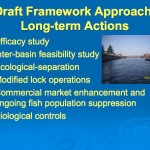
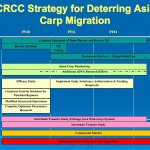
    While the Asian Carp Control Strategy Framework consists of 24 different short-term and long-term recommendations—including increased monitoring of the waters around the Chicago locks for carp, installation of a new electric barrier and other impediments, and chemical treatments of the waterways during barrier maintenance and operations—the plan’s consideration of partial lock closures had area businesspeople up in arms.

    “Any closures at all of the Chicago River lock would devastate our family,” said Ragna Russo, who works as a boat captain along with her husband for Wendella Boats. Russo asked that lock closures be taken off the table until all other options are explored.

    Several speakers questioned the science behind environmental DNA tests conducted by University of Notre Dame researcher David Lodge, who found evidence that the carp have gotten past the electric barriers. The criticism counters the Environmental Protection Agency’s “high degree of confidence” in Lodge’s cutting-edge research and his results.

    Lodge defended his team’s findings. He said that while something other than live fish could have left traces of DNA in the waters, that does not explain his team’s observations.

    “It’s not plausible that those mechanisms, like a dead fish here or there, or a seagull dropping a fish… are sufficient to produce the pattern, the repeated pattern, of results that we have in the Chicago waterway,” he said. “We go back to the same places time and again, and we get the same result.”

    Supporters of the lock closures also made their case.

    Traci Barkley of the Prairie Rivers Network, an Illinois affiliate of the National Wildlife Federation, noted that she helped conduct a field assessment of the original electrical barrier in 2006.

    “I want to remind everyone that the electrical barrier was first designed for the round goby,” Barkley said. But by the time the barrier was up and running, the invasive fish, which got into the Great Lakes via ship ballast water, had already passed through the waterways and into the Illinois River. The goby are now heading south to the Mississippi.

    “I think we need to get out of this defensive position looking at the next threat, because there are more and more behind what we’re facing right now,” Barkley said. “Permanent separation of the Great Lakes is the only viable long-term solution.”

    Department of Natural Resources representatives from Ohio, Wisconsin and Indiana also spoke to urge quick, decisive action.

    “We think that the only really solid guaranteed solution is a permanent ecological separation,” said Sean Logan, director of Ohio’s DNR. “It’s not just about reducing the risk, it’s about preventing it from happening.”

    Todd Ambs, water division administrator for Wisconsin’s DNR, shared Logan’s concerns.

    “As significant as the potential economic impact is here in Chicago,” Ambs said, “we have a multi-billion dollar sportfishing industry that is at risk.”

    Dueling statements from U.S. congressional representatives surrounding the Great Lakes were also read into the record.

    Louise Slaughter, a Democratic congresswoman from New York’s 28th district, which borders Lake Ontario, serves as co-chair of the Great Lakes Task Force. She noted in her statement that she had joined with 49 other members of Congress to urge that federal agencies “take immediate steps to protect the Great Lakes… including closing the locks if there’s a reasonable likelihood that Asian carp are above the electric barrier…. (and) creating a permanent hydrological separation between the Great Lakes and the canal.”

    Rep. Slaughter also urged that the installation of new barriers be accelerated beyond the time frame posed by the Asian Carp Control Strategy Framework. “Are we going to look back a year or two from now and say to ourselves ‘If only we had closed the locks temporarily we could have averted disaster?’” Slaughter asked.

    Judy Biggert, a Republican congresswoman who represents part of Chicago’s suburbs, criticized recent efforts to “litigate and legislate Chicago-area lock closures,” saying “the ‘act now, think later’ mentality that they represent are so misguided that they can only suggest that politics, and not sound science and policy, are ruling the day.”

    Rep. Biggert’s questioned the DNA evidence. She warned of “massive flooding” that could wash carp into the lake if the locks are closed, and charged that such closures would have an “absolutely devastating impact” on the local and national economy.

    “Of course we are all working to protect the Great Lakes ecosystem,” she said. “The right way is not a knee-jerk legislative or legal action that ignores people’s lives or livelihoods for what sounds simple and yet is an alarmingly ineffective solution…. I will now allow those who harbor an act-now, think later approach to solve this problem flood our basements and kill our jobs for a quick fix that won’t work.”

    One of the last speakers was Leia Montgomery of Wisconsin, who said she and her husband had driven four hours to attend Friday’s meeting. She noted that the original construction of the Chicago Sanitary and Ship Canal project in 1900 cost $31 million, and was as controversial back then as it is becoming now.

    “This isn’t about being mad at Chicago, and it’s not about jobs,” she said. “Chicago does big things…. And now you’ve got to think really big again because this is bigger than all of us. This is Lake Michigan we’re talking about; this is the Great Lakes. This is 20 percent of the world’s fresh water supply…. It’s our children’s future.”

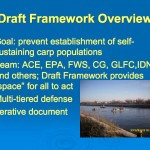
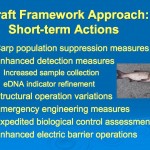
    Asian Carp Control Strategy Draft Framework (EPA)

    Page 1
    Page 2 Overview
    Page 3 Approach
    Page 4 Approach
    Page 5 Deterring Migration

  • Congress Holds Hearing to Debate Closing Chicago-Area Locks

    Water expert warns that closing the locks is the only way to keep Asian carp and other invasive species out.

    A Great Lakes expert warned members of a U.S. House subcommittee Tuesday that closing off the canals that link Chicago to the freshwater bodies is the only way to keep invasive species like Asian carp from migrating in and out.

    “This is not just about Asian carp,” David Lodge, director of the University of Notre Dame’s Center for Aquatic Conservation, told members of a House Transportation and Infrastructure subcommittee, the Detroit Free Press reported. Lodge noted that other invasive species including zebra and quagga mussels and round gobies, an invasive bottom-dwelling fish, have already migrated out of the Great Lakes via the Chicago Sanitary and Ship Canal.

    Michigan and several other states are pushing for immediate closure of the canals to prevent Asian carp from devastating the region’s $7 billion sportfishing industry. The Obama administration has pledged $78.5 million to the Asian carp fight, but does not support an immediate closure, while Illinois officials oppose closing the locks because of the potential economic damage to the Chicago area.

    Michigan and Wisconsin officials who spoke at the subcommittee hearing repeated their calls to close two navigation locks in the Chicago area as part of the effort to keep the carp from the lakes, the Milwaukee Journal Sentinel reported. They also argued for a permanent separation of the Great Lakes from the Mississippi River basin.

    Attendees at Tuesday’s subcommittee hearing included two Asian carp, shipped from Illinois by cooler to help illustrate the danger that the fish pose to the world’s largest freshwater source.

    Sources: Chicago Tribune, Detroit Free Press, Milwaukee Journal Sentinel

  • Liquid Assets: Tide Turns Against Privatization of City Water Systems

    By Steve Kellman
    Circle of Blue

    There’s nothing like a fiscal deficit to prompt municipal leaders to think hard about how to save money. Everything is on the table and no city service or asset is untouchable. So last November when the mayor of Carbondale, Illinois made several suggestions for bailing out the cash-strapped city, the idea of selling the municipal water and sewer system gained serious traction.

    Carbondale Water Plant

    Water plant, Carbondale, Illinois.

    According to Mayor Brad Cole, the $42 million sale would supply enough cash to erase the budget deficit, pay off pension fund obligations, repeal a two-year-old sales tax, and build long delayed police and fire stations, the Southern Illinoisan of Carbondale reported.

    That may sound good in Carbondale but the newspaper also noted, that officials in other cities around Illinois are regretting decisions to privatize water systems in the face of steep water rate hikes and loss of control over when and where to install water mains.

    More than 75 Carbondale residents turned out for a meeting at a local coffeehouse in late November to discuss their opposition to water privatization. Standing-room-only crowds peppered the city council with questions and concerns in two December council meetings, even as council members repeatedly said, and they weren’t joking, that the proposal was dead in the water.

    “I understand the community being very concerned about it; it’s not going to move forward anywhere,” Councilwoman Corene McDaniel assured the local newspaper. “The community is passionate about the water and I understand wholeheartedly; you don’t know what you’d be getting if you went to a private organization.”

    Mayor-Brad-Cole

    Brad Cole, Mayor of Carbondale.

    What convinces a city to consider giving up control of its water in the first place?

    Some officials believe the private sector can do a better job maintaining and upgrading a leaky and inefficient water system. Others see an opportunity to leverage a successful water system and its guaranteed cash flow from its customers — city residents — to win a large up-front payment from a private firm. That money can then be used to plug budget shortfalls in other departments.

    Experts who have watched failed experiments in the privatization of municipal water systems say both beliefs are wrong.

    John Keesecker, a senior organizer for the non-profit consumer organization Food & Water Watch, works with community groups across the United States to prevent the privatization of public water resources.

    “Our number one concern with systems that are privatized is that service goes down and there’s poor water quality,” Keesecker said. “There’s also less accountability and transparency, because at the end of the day these companies are beholden to shareholders and their concern is primarily with making a return and not with providing a good service.”

    “When it’s publicly managed, council members or aldermen can be voted out if it’s not being managed well but that’s not the case when it’s been privatized. Voting them out won’t necessarily change the way the water system operates.”

    In the United States, the big commercial players in the field of water privatization include:

    • Veolia Water North America, a subsidiary of France’s Veolia Environment. According to the organization’s Web site, the North American division serves more than 14 million people in 650 communities “through public-private partnerships with municipalities or governments,” and is involved in the nation’s largest public-private water services partnership in Indianapolis;
    • United Water, a subsidiary of France’s Suez Environnement, which serves more than seven million people in 24 states and operates 240 municipal water systems, including three of the nation’s largest contract services operations;
    • American Water Works Company, Inc., which was owned by German conglomerate RWE until last November and currently serves 15 million people in 32 states as well as Ontario, Canada; and
    • Aqua America, which provides water and wastewater services to approximately three million people in 13 states.

    In the U.S., the privatizing trend began in the 1980s, Keesecker said. Initially, most of the deals involved cities paying companies to manage systems for several years.

    Over the past several years, however, there’s been a backlash against privatization, Keesecker told Circle of Blue.

    “When these giant multinationals first hopped into the market around 2000, they were going for large cities like St. Louis, Atlanta and Stockton,” he said. “And they found in many of these cases either that the deals couldn’t be struck or they failed.”

    Atlanta, for example, struck a $400 million, 20-year deal with United Water in 1998. Five years later, the city canceled the agreement because it was dissatisfied with United’s management. The city’s major complaints included a 50 percent cut in staff size that caused a backlog in work orders, and $36,000 in bills to the city for work that was never performed, Keesecker said.

    In Fort Wayne, Indiana parts of the city get water from a municipal system while other areas use Aqua Indiana: an Aqua America subsidiary. Complaints from Aqua Indiana customers have spurred the city to begin buying back portions of the Aqua Indiana system and folding them into the city’s service, Keesecker added.

    Another setback with privatization are the increased costs.

    “The private water companies in the U.S. cost, on average, 80 percent more than public water utilities in providing water,” Keesecker said. “And although private municipal water systems are regulated at the state level, the public service commissions at the state level often rubber-stamp rate increases, and allow companies to make profits, which require dramatic rate increases.”

    For example in Indianapolis, which Veolia Water North America cites as a successful partnership, residents are furious over a requested 35-percent rate hike earlier this year. The request comes just three months after the water department won permission to charge a 10.8 percent emergency rate increase.

    Veolia officials say they need to make $111 million in improvements over the next two years to maintain the system and meet federal mandates, The Indianapolis Star reported. The company also attributes part of the problem to variable-rate bonds which have seen their rates shoot up during the economic meltdown, and the need for millions in additional debt to get out of it, the paper reported.

    With lease deals not as popular as they once were, Keesecker has seen the companies adopt another strategy in recent months.

    “The trend that we’ve seen in the Midwest in the last year and a half is more of these water companies are courting cities to buy or lease their water systems, and that’s because the cities are really cash strapped and they could use the influx of money,” he said. ““It’s been spurred largely by the economic crisis…. State budgets are hurting and cities like Milwaukee, for instance, are getting less support from the state, and they have this tremendous asset, which is a wildly successful drinking water system.”

    In Milwaukee last spring, the city comptroller floated the idea of leasing the Milwaukee Water Works to a private operator for up to 99 years in exchange for a one-time payment of up to $600 million. The comptroller argued that the payment could be used to create an endowment that would generate $30 million a year, letting the city avoid annual debates over cutting city services or raising taxes.

    Milwaukee’s 60- to 99-year lease would have been the first in the country for a system that large. Milwaukee Water Works, which was established in 1871, provides drinking water to the city and 15 other communities in the region.

    While city leaders initially authorized the comptroller to explore the possibility, a wave of protest from public employee unions and environmental groups forced the city to back away from the proposal in May.

    One of the leaders of that fight was Melissa Scanlan, the founder and senior counsel of Midwest Environmental Advocates. She and others helped organize KPOW (Keep Public Our Water) to fight the proposal.

    “People just threw themselves into this issue because water is such a fundamental core of human life, and it really struck a chord in the community,” Scanlan said. “They did back down pretty quickly but there’s always the possibility that this will surface again and be put back on the table.”

    Scanlan also argues that water privatization runs counter to the goals of water conservation, since the profit-based motivation of a private company encourages it to sell as much water as it can to create profit for its owners and shareholders rather than preserve the resource. This is a big issue in Great Lakes states like Wisconsin that are subject to the Great Lakes Compact, she said, which requires its member states to adopt water conservation measures.

    KPOW is now seeking city passage of a resolution blocking the lease or sale of the Water Works on the grounds that doing so would violate the public trust doctrine, which holds that all waters of the state are held in trust by the government for the use of the public. Milwaukee Alderman Nik Kovak filed a resolution expressing support for the city’s continuing ownership and operation of the Water Works in September; the bill, which has won three co-sponsors since its introduction, is still in committee.

    The fight has also reached the Wisconsin statehouse. In October, Rep. Fred Kessler (D-Milwaukee) introduced legislation to ban the sale or lease of Milwaukee Water Works. The bill has been referred to the Assembly Energy and Utilities Committee, which is chaired by Rep. Jim Soletski (D-Green Bay). State Senator Jim Sullivan (D-Wauwatosa) introduced a similar bill in November that would require senate approval of a water lease like the one proposed in Milwaukee.

    “In these times of economic crisis, it is important for cities to examine ways to raise revenue, but we must proceed with extreme caution when it comes to natural resources like water,” Sullivan told Food & Water Watch. “Milwaukee should not fall prey to the empty promises of privatization. Water is life, not a commodity to (be) auctioned off to the highest bidder.”

    Steve Kellman is a reporter for Circle of Blue. Reach Steve at [email protected]

    Sources: The Atlanta Business Chronicle, New York Times, Indianapolis Star, Fort Wayne Journal Gazette, Southern Illinoisan
  • Obama Administration Pledges $78.5 Million To Fight Asian Carp; Great Lakes Governors Want More Than Cash

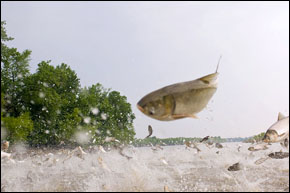
    A $78.5 million pledge from the Obama administration and a plan for part-time closure of Chicago-area locks isn’t enough to protect the Great Lakes from Asian carp, Michigan’s governor declared Monday.

    Jumping Asian Carp

    Photo © Jason Lindsey

    Following a Monday “carp summit” at the White House with Obama administration officials, Governor Jennifer Granholm said in a statement that she was “very disappointed” with the administration’s plans.

    “While we did have some areas of agreement with the White House, we believe that the plan does not adequately address the concerns we have been voicing about the imminent threat Asian carp pose to the Great Lakes,” Granholm said. “I believe the proposal’s primary objectives are not sustainable, and that this is a plan to limit damages — not solve the problem.”

    Michigan officials and several representatives from other states in the region have called for immediate closure of the Chicago locks. They hope to prevent the invasive fish species from decimating the Great Lakes’ $7 billion sportfishing industry. 

    But the Obama administration and the state of Illinois have opposed the move. Under the administration’s proposal, the locks may be closed more often, while the water around them would be treated with poison to kill nearby Asian carp before they enter Lake Michigan.

    The administration’s proposal, known as the Asian Carp Control Strategy Framework, would also involve increased DNA sampling of the waters, a third electric barrier in Chicago-area waterways to drive the invasive species away from the lake, and land barriers to keep carp from getting past the electric blockades during floods. 

    The plan includes funding for chemical treatments if the barriers fail, and for further research on controlling the carp.

    Sources: Michigan Governor Jennifer Granholm, Detroit News, Washington Post

  • Asian Carp Threat Prompts Protest Near Lake Michigan Shore

    Fishing enthusiasts and state representatives rallied on the banks of Traverse City’s Boardman River Saturday against Illinois’ opposition to the closure of Chicago-area locks.

    Michigan Carp Protests

    Photo © Steve Kellman
    Michigan representatives Gary McDowell (D-Rudyard), Andy Neumann (D-Alpena) and Dan Scripps (D-Leelanau), from left to right, and Wayne Schmidt (R-Traverse City), not pictured, take turns speaking to a crowd of 100 people gathered in Traverse City, Mich., Saturday to protest inaction by Illinois and federal officials on the threat that Asian carp pose to the Great Lakes. The rally followed a similar one held in Michigan’s Upper Peninsula Friday. Michigan House Democrats have launched a website in connection with the rallies—noasiancarp.com—to collect signatures urging the immediate closure of Chicago-area waterways that could let the carp into Lake Michigan. A similar website—stopasiancarp.com—is being promoted by Mike Cox, Michigan’s attorney general and a Republican gubernatorial candidate.

    By Steve Kellman
    Circle of Blue

    As owner of a Traverse City-based charter fishing company and captain for another local charter outfit, Steve Huston fears Asian carp invading Lake Michigan.

    Huston spent the past 33 years working in the charter and tournament fishing industry around northern Michigan. If the fish that have infested Chicago-area waterways get into the lake, he says he and his fellow charter captains will lose their jobs.

    “If they do replace the sportfish, the salmon and the trout, we can’t make a living,” Huston said. “If they displace the small fish, the feeder fish, it’ll end sportfishing in Lake Michigan.”

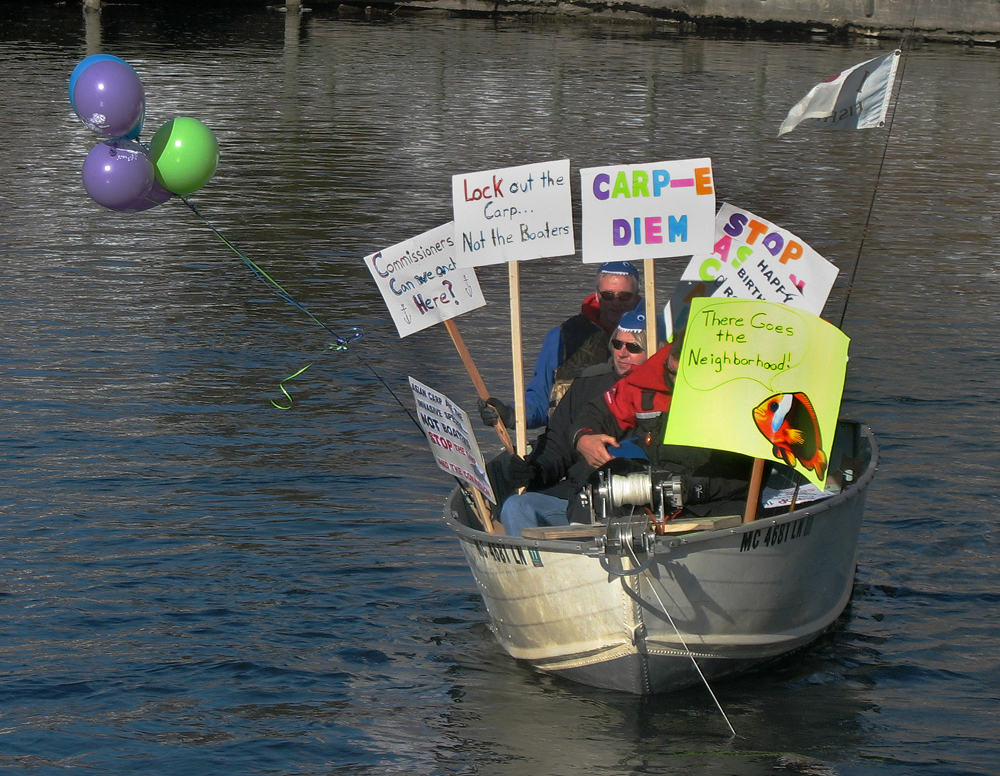
    Fears about the invasive species lurking on the lake’s threshold—and anger over the failure of state and federal officials to stop the carp in their tracks—prompted Huston and a hundred other people to brave 20-degree temperatures for a Saturday morning rally on the banks of the Boardman River. Several carried signs bearing slogans like “Close Chicago Lock,” “Cap the Carp” and “Lock out the Carp… Not the Boaters.”

    Also in attendance were Michigan representatives Dan Scripps (D-Leelanau), Wayne Schmidt (R-Traverse City), Andy Neumann (D-Alpena) and Gary McDowell (D-Rudyard), who threatened the possibility of economic sanctions and a boycott of Chicago businesses if protective action isn’t taken soon.

    The rally came two days before Great Lakes governors, including Michigan Governor Jennifer Granholm, are scheduled to be in Washington on Monday to talk to White House officials about the carp invasion and the threat to the regions fisheries and environment.

    The International Joint Commission, the bilateral agency overseeing Great Lakes policy, also is scheduled to convene its second public meeting on Asian Carp in Ypsilanti, Michigan on February 17.

    Rep. Schmidt, who said he learned to fish on the Boardman River, noted that the pressure to close the locks is bipartisan and spans both state and national boundaries. Indiana, Minnesota, New York, Ohio, Pennsylvania and Wisconsin, along with Ontario, Canada, have all announced their support of a legal effort by Mike Cox, Michigan’s attorney general, to seal off the Great Lakes from the invasive species. The fish have already overrun portions of the Mississippi and Illinois rivers, driving out game fish and upending ecosystems. They were originally imported to clean southern fish farms in the 1970s, but escaped into the rivers. The bighead variety of the fish can grow up to four feet long and weigh 100 pounds. Meanwhile the silver carp variety is known for jumping out of the water at the sound of boat motors, knocking people out of their boats and causing serious injuries.

    Saturday’s protest comes three weeks after the U.S. Supreme Court rejected Cox’s motion to order an immediate closure of the locks that connect Lake Michigan with the carp-infested waters of the Chicago Waterway System. Cox filed a new Supreme Court motion to close the locks Thursday, citing new evidence that carp may already have entered the lake as well as a study that has found Illinois’ estimates of economic damages from closing the locks to be “seriously exaggerated.” Cox, a Republican, is also running for governor.

    carp2-290

    Photo © Steve Kellman
    Charter captain Jack Nowland, back, and friends arrive by boat for a Saturday morning rally on the shore of the Boardman River in Traverse City, Mich. Rally organizers including Michigan anglers and legislators are pressing Illinois officials to take immediate action to block the Asian carp that have infested Chicago-area waterways from entering the Great Lakes, where they could decimate the region’s $7 billion sportfishing industry and a recreational boating industry valued at $9 billion.

    Wearing a Big Kahuna Charters baseball cap and carrying a handmade placard that read “No Carp!”, Huston said Saturday that he worries the effect of an Asian carp invasion will not be limited to sportfishing.

    “You think alewives are a problem?” he said, referring to the small fish that die by the millions each summer and foul Great Lakes beaches with their carcasses. “Just wait until the Asian carp start dying off when they run out of food.”

    Ryan Matuzak, captain of his own charter boat and guide service and president of the Grand Traverse Area Sport Fishing Association (GTASFA), took a break from ice fishing Saturday to attend the rally. He planned to head back out on the ice after the rally was over.

    Fishing is “everything to me,” Matuzak said. “I’ve fished the entire state, all of its waters, all the way from Lake Superior down to Lake Erie and both sides.”

    GTASFA helped sponsor Saturday’s rally, Matuzak said, and urged Michigan’s attorney general to take legal action over the locks.

    “We’ve been involved in the push for this lawsuit probably since the first of November,” he said. “We need to make sure our voices are heard.”

    Rep. Scripps, an environmental attorney, told Circle of Blue that he knows the sportfishing industry firsthand, having fished Lake Michigan with charter captains from Leelanau County’s century-old Fishtown village. Scripps said that while on the campaign trail before his 2008 election, he often kept a fly rod and a set of waders in the back of his truck.

    “After a long day of door knocking, there’s nothing better than jumping in a stream and throwing a couple of lines in and hoping to find something coming back at you,” he said.

    Scripps added that the carp pose a threat to the region’s entire recreational boating industry, not just the sportfishing industry.

    “If you go to some of these rivers where the Asian carp already are, you just don’t see boat traffic anymore… These are just silent rivers at this point because it’s too dangerous to boat on them,” he said. “And to know that that could happen here unless we take action shows why we need to act.”

    Scripps also agreed with Rep. McDowell’s calls for more drastic action if Illinois officials don’t act now.

    “If we need to ratchet up the pressure to get their attention, then we need to ratchet up the pressure,” he said. “I hope it doesn’t go that far, but we’re talking about a tourism industry that it’s hard to put a price tag on, a $9 billion boating industry, and $7 billion sportfishing industry… That’s real money and real jobs.”

    Rally organizers took the occasion of Saturday’s event to announce the launch of a new Web site, No Asian Carp, where concerned residents can sign a petition urging Gov. Pat Quinn and other Illinois officials to close the locks. The site, which is being promoted by Michigan House Democrats, joins Stop Asian Carp – Protect Our Great Lakes, a project of Attorney General Mike Cox, as a forum for concerned residents to sign a petition calling for immediate action to stop the carp’s spread.

    “I don’t care what petition you sign, frankly,” Scripps told the crowd at Saturday’s rally. “We need action, and we need it now.”

    Steve Kellman is a reporter for Circle of Blue. Reach Steve at [email protected]

    See previous Circle of Blue coverage: Asian Carp Knocking at the Great Lakes’ Door; Michigan Attorney General Seeks To Slam It Shut, Michigan Takes Asian Carp Fight Back To the Supreme Court

    Read more: No Asian Carp, Stop Asian Carp – Protect Our Great Lakes, Northern Michigan Legislators Tell Illinois: Keep Your Carp!

  • Michigan Takes Asian Carp Fight Back To the Supreme Court

    Michigan’s Attorney General Mike Cox has filed a new Supreme Court motion to sever the connection between the carp and the Great Lakes, saying that claims by Illinois of $190 million in annual damages from lock closures are “seriously exaggerated.”

    By Steve Kellman
    Circle of Blue

    Michigan Attorney General Mike Cox filed a new brief with the U.S. Supreme Court Thursday in his effort to sever the ties between carp-invested canals around Chicago and Lake Michigan, following the high court’s rejection of his initial motion.

    The legal maneuver comes amid a flurry of activity over the threat that Asian carp pose to the world’s largest freshwater system.

    Three Great Lakes governors—Michigan’s Jennifer Granholm, Wisconsin’s Jim Doyle, and Illinois’ Patt Quinn—plan to meet with Obama administration officials Monday to discuss how to combat the spread of the invasive species. The U.S. House of Representatives scheduled an emergency hearing on the carp crisis for Tuesday in response to calls from Michigan’s congressional delegation. The hearing will be held by the Transportation and Infrastructure Subcommittee on Water Resources and Environment.

    Joel Brammeier, president of the 40-year-old non-profit, the Alliance for the Great Lakes, plans to testify at the hearing on behalf of closing the locks. In 2008, the Alliance conducted a study for the Great Lakes Fisheries Commission on the feasibility of separating the carp-invested river from the Great Lakes.

    “Next week will probably be the biggest spotlight on carp management in months, if not years,” Brammeier told Circle of Blue. “I’ve never seen this level of engagement.”

    “What hasn’t been apparent yet is if the agencies are willing to go to the mat and make stopping Asian carp priority one in both word and deed, and I’m very hopeful we’ll see that level of engagement next week.”

    While Cox acknowledged the impending White House summit in a statement about the new legal brief, he said immediate legal action is still needed.

    “We think the Court should take another look at our request to hit the pause button on the locks until the entire Great Lakes region is comfortable that an effective plan is in place to stop Asian carp,” Cox said. “While we would like to see significant and immediate action as a result of next week’s meeting between the governors and administration, that is an unknown at this time, so our battle to protect the Lakes will continue.”

    Meanwhile Asian carp, which can grow up to 100 pounds and four feet long, have displaced native fish along the Illinois and Mississippi rivers.

    Michigan officials are pressing for an immediate closure of the waterways that connect the carp-infested Illinois River with Lake Michigan, fearing that the invasive species will destroy the lakes’ ecosystem and devastate its $7 billion sportfishing industry. Their efforts have drawn legal support from the Indiana, Minnesota, New York, Ohio, Pennsylvania and Wisconsin, as well as from Ontario, Canada.

    Illinois state officials have opposed the move, saying the closure could damage the Chicago region’s shipping industry, which uses the system of canals and locks to transport millions of dollars worth of goods and commodities annually. And the American Waterways Operators, a national trade association representing the U.S. tugboat, towboat and barge industry, has warned that closing the locks could raise transportation prices and cost hundreds of people in the barge transportation industry their jobs.

    In his latest Supreme Court motion, Cox cited new information that became known after the court’s Jan. 19 denial of his original motion–the discovery of Asian carp DNA in Lake Michigan, which suggests that efforts by the U.S. Army Corps of Engineers to contain the carp are not working. In a statement on his state Web site, Cox pointedly noted that the DNA evidence “was available three days before the Court made its decision but not provided by the U.S. Army Corps of Engineers until afterward.”

    The new motion also includes the results of a transportation study that challenges Illinois estimates of the economic damage from closing the locks. The study, by Wayne State University transportation expert John Taylor, determined that statistics previously submitted to the Supreme Court by Illinois and the federal government on the potential economic costs of lock closure are “seriously exaggerated.”

    While Illinois and the federal government claimed that lock closures could cost the region $190 million a year, the new study places the annual costs at less than $70 million. The study also estimated that the number of jobs overall would increase due to the need for new modes of transposition like trucking.

    Sources: Michigan Attorney General Mike Cox, Detroit Free Press, Milwaukee Journal Sentinel

    See previous Circle of Blue coverage: Asian Carp Knocking at the Great Lakes’ Door; Michigan Attorney General Seeks To Slam It Shut

  • U.S. Water Managers Gather at Global Conference To Brace for Climate Change

    World water leaders come together to exchange ideas and propel action against climate change.

    Climate Change Impact on Water

    By Steve Kellman
    Circle of Blue

    The people responsible for some of the largest water utilities in the U.S. gathered in Washington, D.C. last week to exchange climate change coping strategies with overseas counterparts.

    The two-day meeting, Climate Change Impacts on Water: An International Adaptation Forum, brought together more than 200 water system executives, policy and climate officials, and scientists from around the world.

    As U.S. cities from Atlanta to Las Vegas already suffer severe water shortages, and others struggle with rising sea levels, hurricanes and floods, the forum was designed to help authorities develop successful responses to climate-related challenges.

    Diane VanDe Hei, executive director of the Association of Metropolitan Water Agencies (AMWA) told Circle of Blue that forum speakers were from regions grappling with a water surplus as well as with drought.

    For example, Paula Verhoeven, climate office director for the city of Rotterdam, described how her South Holland city is coping with rising oceans and heavy rains — a particular challenge given that much of the city sits below sea level. The port of Rotterdam is the largest in Europe and for decades was the busiest in the world. City planners have gotten creative with a series of dikes and levees with built-in remote sensors to hold the water back and warn engineers when a dike is in danger of failing.

    “They’ve got different types of levees, different types of sensors, even homes that float on water,” VanDe Hei said. “They’ve created levees that are broader, and actually have a park on top of them… As the speaker said, rather than trying to keep the water out, they’re looking at how to use the water.”

    Several speakers from Australia discussed how they are coping with the worst drought in the country’s history, and how climate change research can provide water managers with better information for the future.

    “They discovered that they needed to go out into the community first to discover what their priorities are in terms of water,” VanDe Hei said.

    “We held the forum in Washington, D.C. because we wanted to raise the profile of water to policy makers, and I think we did that,” VanDe Hei said. She noted that federal officials attending the forum included those from the Environmental Protection Agency, Interior Department and National Oceanographic and Atmospheric Administration (NOAA), with NOAA Administrator Jane Lubchenco delivering a keynote address. Dr. Lubchenco is pushing to create a National Climate Service that would act as an authoritative source of policy-relevant climate information.

    “We definitely need better models and better predictors,” VanDe Hei said. “The past doesn’t tell us what the future’s going to look like and water utilities need to predict far ahead and they need to predict for worst cases… We need scientists and the federal government to support the development of the tools needed to make those kinds of decisions.”

    Now that the forum has concluded, organizers are drafting principles that will help water departments strategize how to cope with climate change, VanDe Hei said.

    Presentation materials from the forum’s speakers will also be posted on the forum Web site at waterclimateforum.org.

  • Wisconsin City Makes Its Case for Diversion of Great Lakes Water

    Waukesha needs approval from the state’s Department of Natural Resources and all eight Great Lakes states’ governors before moving forward with its request.

    Wisconsin City Makes Its Case for Diversion of Great Lakes WaterCity officials in Waukesha, Wisconsin spelled out why they need Great Lakes water to replace their radium-contaminated city water wells Thursday, and why tapping into the world’s largest freshwater supply makes more sense than drilling more wells.

    But several more hurdles remain before the city can become the first outside the Great Lakes basin to tap into the lakes since adoption of a landmark protection agreement in 2008.

    Under terms of the Great Lakes Compact, cities outside the basin must win approval of the governors from all eight Great Lakes states before diverting water from the lakes. Wisconsin’s Department of Natural Resources (DNR) also needs to sign off on Waukesha’s plan.

    Waukesha Mayor Larry Nelson called the city’s efforts to secure a radium-free water supply “a critical public health issue,” the Milwaukee Journal Sentinel reported Thursday. For years, the city has been figuring how to replace city water from deep wells contaminated with naturally occurring radium and salt. The city needs to comply with federal radium-safe water standards by 2018 under a state order.

    The city made its case for Lake Michigan water in a draft application released Thursday. The application notes that the city has already made great strides toward reducing its water use through conservation measures, but it maintains that conservation alone will not serve the city’s water needs.

    Between 1988 and 2008, the city managed to decrease water use by 31 percent despite an 18-percent increase in population, according to the application. Recent efforts to encourage consumption, including a ban on daytime water sprinkling, water rates that promote conservation, a high-efficiency toilet rebate program, and public education, have resulted in an 11-percent decrease in use in the past three years.

    Waukesha currently uses an average of 6.8 million gallons of water a day and will need an average of 10.9 million gallons a day when the city is fully developed, according to the Southeastern Wisconsin Regional Planning Commission (SEWRPC). The city and SEWRPC evaluated numerous water supply alternatives to meet those needs before settling on the three most feasible: using a mix of deep and shallow wells, switching to shallow wells alone, or switching to water pumped from Lake Michigan.

    Besides the contamination issues with deep wells, the application notes that the deep water aquifer that those wells draw from is already depleted, and not reliable in the future. Switching from the deep wells to shallow wells exclusively would avoid the radium contamination but leave the city’s water supply vulnerable to other contamination sources, while reducing the volume of groundwater feeding wetlands, streams and lakes.

    Given that, the city has concluded that using Lake Michigan for its water supply “has the least environmental impact and provides the greatest protection of public health.”

    Any change to the city’s current water sources will be expensive.

    Engineering and construction of pipelines to pump Lake Michigan water to the city and then return the treated wastewater to the lake via one of its tributaries, as required by the Great Lakes Compact, will cost about $164 million. Annual operating and maintenance costs for the pipelines are estimated at $6.2 million.

    Switching to a series of shallow wells to supply the city would cost $174 million for construction, engineering, administrative, legal and other expenses, followed by an estimated $7.4 million a year to run and maintain the wells.

    While the Great Lakes Compact prohibits water diversions outside of the lakes’ drainage basin, exceptions may be granted to communities in counties that fall at least partly within the basin such as Waukesha County.

    The Wisconsin DNR will work with the city on a comprehensive environmental impact study for the project, the Journal Sentinel reported. The DNR will also invite the public to comment on issues that should be included in the study.

    Sources: City of Waukesha, Wisconsin, Milwaukee Journal Sentinel

    See previous Circle of Blue coverage: Waukesha’s Water Woes Herald Test of Great Lakes Compact

  • New Plan Approved To Protect Chicagoland Water

    Plan includes recommendations for new water conservation and protection measures, along with better measurement of the region’s water supplies.

    Sangamon River, Illinois

    Photo courtesy Dual Freq

    By Steve Kellman
    Circle of Blue

    A three-year effort to develop a landmark water plan for the greater Chicago region was unanimously approved by political and environmental stakeholders Tuesday.

    Now comes the hard part.

    The Northeastern Illinois Regional Water Supply/Demand Plan is designed to help the 11-county region continue meeting the water needs of its surging population. Over the next 40 years, the region’s population is expected to grow from 8.4 to 12.1 million residents.

    The plan was developed by the Regional Water Supply Planning Group of the Chicago Metropolitan Agency for Planning, or CMAP, and was commissioned by the Illinois Department of Natural Resources. It recommends hundreds of ways for local governments, businesses and residents to conserve and protect the region’s existing water supplies, including Lake Michigan, local rivers like the Fox and Kankakee, as well as groundwater.

    “This is a pilot, part of a statewide program that we hope will move forward to other parts of the state,” Randy Blankenhorn, CMAP’s executive director, told Circle of Blue. “Those other parts of Illinois and other areas in the Midwest obviously are watching what’s happening here and how we were able to take a plan like ours and move towards implementation.”

    “You can’t manage what you don’t measure.”

    -Tim Loftus

    One key goal of the plan is to do a better job of measuring the region’s surface and groundwater, said Tim Loftus, project director for the planning group.

    “You can’t manage what you don’t measure,” he said.

    To that end, the plan asks that the state provide the Illinois Department of Natural Resources with enough funding to conduct impact analysis of new withdrawals on groundwater supplies that will support the Illinois Water Inventory Program, which determines how much water is used in the state. Another recommendation encourages greater cooperation between the government and CMAP to foster better regional data collection in order “to help the region understand the trends and where water’s being used and where opportunities are to achieve greater savings,” Loftus said.

    Another key goal is to protect the quality of the region’s surface and groundwater supplies. Loftus noted that the plan contains several suggested measures in that regard that are directed at municipal governments, wastewater treatment plants and agricultural users.

    potential water savings chart

    “Those are the sources that are largely responsible for both point and non-point pollution, so we have made recommendations in there to mitigate existing impairments as well as protect the resource from future impairments,” he said.

    The recommendations include reducing the use of road salt on the region’s highways through the adoption of “sensible salting” practices that have been recommended by the Salt Institute, a non-profit salt industry trade association. This would help address “the emerging issue of contamination by road salts,” Loftus said.

    “Of course we’re also protecting groundwater by just becoming more conservative and efficient with its use, so that there’s adequate groundwater available to sustain the aquatic ecosystems like wetlands and streams that require shallow groundwater,” he said.

    Bonnie Thomson Carter, who chaired the planning group, also serves as a Lake County Board member and president of the Lake County Forest Preserves. She told Circle of Blue that the plan had input from an “extremely diverse” group. The next step will be to encourage local governments to adopt the plan at the local level, Carter said.

    “Being an elected official outside of this role, I think the intention of many elected officials and the stakeholder groups is to talk the plan up, to integrate it into our zoning and our comprehensive plans and our watershed plans, and to move the effort into getting groups together to address theses water-related issues outside of our boundaries,” she said.

    Underlying the discussions was the concept of water as a public trust, a legal principle that dates back to ancient Roman times. The public trust doctrine states that certain resources, like water, are preserved for public use, and that the government must maintain them for that use.

    “I wouldn’t say it was an explicit point of discussion,” Loftus said, “but I think implied in the executive order and the planning process and the plan itself is that it is a public trust, and that all of us that have some role in managing the resource need to step up and increase our stewardship of that resource.”

    See previous Circle of Blue coverage: Protecting the Future of Chicagoland’s Drinking Water

    Read More: CMAP Regional Water Supply Study

  • Legal Battle Over Asian Carp in the Great Lakes Heats Up

    The White House responds to calls for a Great Lakes summit to protect the lakes and their $7 billion sportfishing industry from the invasive species.

    Asian Carp

    Photo Copyright Jason Lindsey

    Last week’s U.S. Supreme Court rejection of Michigan’s request to immediately sever the connections between the Illinois River and Lake Michigan continues to reverberate, from the White House to the U.S. Congress and across the border in Ontario.

    Michigan Attorney General Mike Cox sought the request as part of a larger effort to permanently cut off the carp-infested Illinois River from the Great Lakes and protect the lakes’ $7 billion sportfishing industry from irreparable harm. Asian carp, which can grow to 100 pounds and four feet long, have displaced native fish along the Illinois and Mississippi rivers. The carp were imported decades ago for use in Southern states to clean the ponds of catfish farmers, but subsequently escaped into the Mississippi and began migrating north.

    Since Cox filed his suit, the states of Indiana, Minnesota, New York, Ohio, Pennsylvania and Wisconsin, along with Ontario, Canada, have announced their support to seal off the Great Lakes from the invasive species. Illinois opposes the effort, as does the American Waterways Operators, a national trade association representing the U.S. tugboat, towboat and barge industry. Because the Chicago-area canals are used to transport millions of dollars worth of goods and commodities each year, the trade organization warns that closing them could increase transportation prices and cost hundreds of people in the barge transportation industry their jobs.

    Immediately after the Supreme Court decision, Michigan Gov. Jennifer Granholm and Wisconsin Gov. Jim Doyle called for a summit with White House officials to discuss the brewing controversy. The Obama administration, which initially sided with Illinois, responded positively to the call for an Asian carp summit Wednesday, ABC News reported. The White House Council on Environmental Quality has proposed holding a meeting the first week of February with governors from the Great Lakes states.

    Also on Wednesday, U.S. Rep. Dave Camp (R-Mich.) brought the fight to Congress when he submitted a bill dubbed the CARP ACT — Close All Routes and Prevent Asian Carp Today — which directs the U.S. Army Corps of Engineers to take action to prevent the entry of the fish into the Great Lakes. The bill calls for immediate closure of two Chicago-area locks until a controlled lock operations strategy is developed, installation of interim barriers in several Chicago-area channels into Lake Michigan, and enhancement of existing barriers and monitoring systems.

    Senator Debbie Stabenow (D-Mich.) joined Camp’s effort Friday, introducing the legislation in the U.S. Senate. That same day, all 17 Michigan members of Congress called for federal agencies to give them a comprehensive plan on how to keep Asian carp from taking over the Great Lakes by the first week of February. The call came in a joint letter to the Environmental Protection Agency, Army Corps of Engineers, Coast Guard and Fish and Wildlife Service.

    Across the U.S.-Canada border, Ontario’s attorney general filed a U.S. Supreme Court motion Thursday in support of Cox’s lawsuit, CTV.ca News reported. Ontario is the only Canadian province that borders the Great Lakes.

    Ontario Natural Resources Minister Donna Cansfield told CTV.ca News that an Asian carp invasion would devastate the fishing industry on Ontario’s Lake Erie shore — home to one of the world’s largest freshwater commercial perch and bass fisheries.

    “It’s a huge impact in terms of the billions of dollars for Ontario,” Cansfield said, estimating that sportfishing alone is worth about $1 billion to the province. “You’re talking the drinking water and the source of recreation. We want to protect our water too. We’re going to support the efforts of the states that are involved.”

    Sources: ABC News, Chicago Tribune, Detroit Free Press, CTV.ca News, U.S. Rep. Dave Camp

  • Supreme Court Declines To Wade Into Asian Carp Fight, Worrying Great Lakes Governors

    DNA tests indicate the invasive species may already have entered Lake Michigan.

    The battle over Asian carp intensified Tuesday as the U.S. Supreme Court declined to order an immediate closure of Chicago-area locks that could let the invasive fish enter the Great Lakes.

    The one-sentence decision prompted calls for a White House summit from Michigan Governor Jennifer Granholm and Wisconsin Governor Jim Doyle. Granholm and Doyle fear the fish will decimate the region’s $7 billion sportfishing industry by driving out native species, as they have along the Mississippi and Illinois rivers.

    “Asian Carp threaten the well-being of our Great Lakes, and ultimately, the well-being of Michigan,” Granholm said in a statement. “It is disappointing that the Supreme Court declined to aid in our fight against these aquatic invaders, so we now ask the White House to work with us in finding a solution before it is too late.”

    Mike Cox, Michigan’s Attorney General, said he was “extremely disappointed the Supreme Court did not push the pause button on this crisis until an effective plan is in place.” In his statement Tuesday, Cox also called for President Obama to immediately order the locks closed, at least temporarily.

    “President Obama said he would not tolerate new threats to the Great Lakes, yet he has left the front door to Lake Michigan wide open,” Cox said. “Billions in economic activity and 800,000 Michigan jobs connected with the health of the Lakes are at risk.”

    Cox filed the original lawsuit at the heart of the case in December, asking the Supreme Court to reopen a 1922 case concerning the turn-of-the-century diversion of the Chicago River from Lake Michigan into the Illinois and Mississippi rivers. The ongoing diversion, and the canals and locks that are part of it, have allowed a series of invasive species to cross between the Great Lakes and the rivers, including zebra mussels and the round goby.

    Cox also requested a preliminary injunction to force the immediate closure of the locks while the lawsuit is being argued; though the Supreme Court rejected the injunction request, the larger lawsuit remains.

    “While the injunction would have been an extraordinary step by the court, Michigan and the other Great Lakes states are facing an extraordinary crisis that could forever alter the Lakes, permanently killing thousands of jobs at a time when families can least afford it,” Cox said.

    In more ominous news for the Great Lakes, the U.S. Army Corps of Engineers announced Tuesday that Asian carp DNA had been detected north of the O’Brien Lock, the last barrier between the carp-infested rivers and Lake Michigan (http://www.lrc.usace.army.mil/pao/Release_eDNA_19Jan2010.pdf). While the results suggest that at least some fish have crossed into the lake, that does not mean that a breeding population has been established in the lake, the Milwaukee Journal Sentinel reported.

    Sources: Detroit Free Press, Milwaukee Journal Sentinel, Michigan Governor Jennifer Granholm, Michigan Attorney General Mike Cox, U.S. Army Corps of Engineers (PDF)