
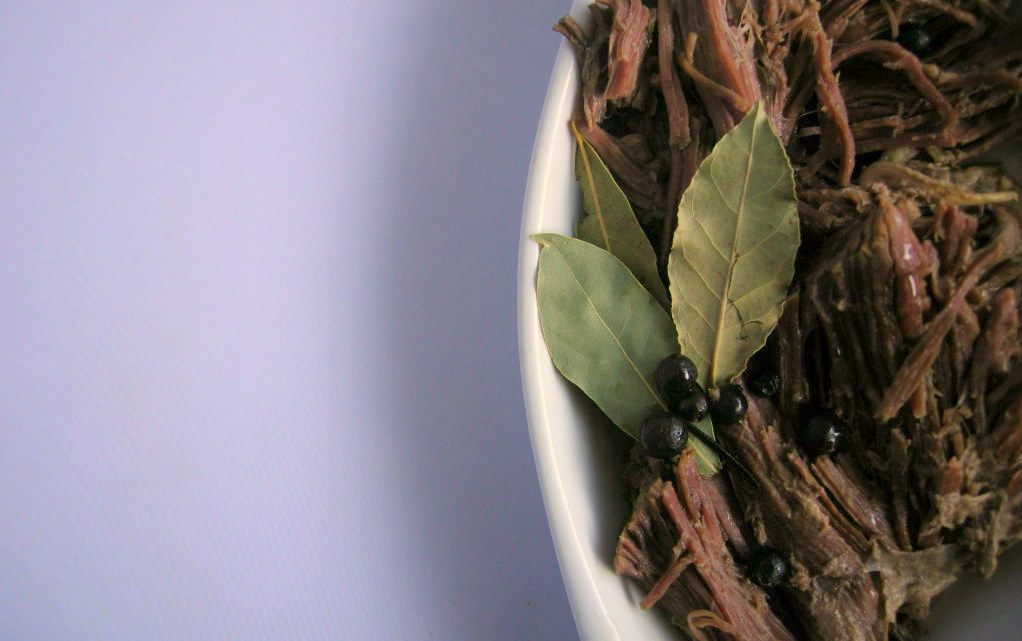
Home-cured corned beef. It seems daunting, doesn’t it? Curing meat at home is much easier than you’d expect, and there’s a growing community of home cooks who are beginning to revive traditional methods of food preservation and charcuterie. Preparing corned beef at home is a simple entrance into this lost art; moreover, the flavor is richer, less salty and more deeply spiced than the pre-packaged corned beef you find in the supermarket in the weeks before St. Patrick’s Day.
Pairing corned beef wih cabbage on St. Patrick’s Day is decidedly more of an Irish-american tradition than it is a strictly Irish tradition. The combination became popular in Irish-american homes during the 19th century as Irish immigrants began to settle down in American cities, they lacked easy access to their native foods – namely joints of cured pork which they customarily paired with cabbage – and thus began to use the more widely available cured beef.
While the combination of corned beef and cabbage may be more American than Irish, that’s not to say that cured beef lacks its own heritage. Curing meat with salt and brine, much like fermenting vegetables for sauerkraut or kimchi, has long been practiced. It was born out of practicality more than culinary preference as, prior to the days of refrigeration, people needed a way to preserve meat that could not be immediately consumed after harvest.
Traditionally, cooks would use saltpeter (a nitrate) to aid in curing their meat. Saltpeter would help to preserve the meat’s pinkish color which, otherwise, would turn a dingy grey. The substance was also to prevent contamination by pathogens. While one could certainly use nitrates or nitrites for preparing home-cured corned beef, both nitrites and nitrates are not with out their own host problems – having been linked to cancer. Surely, only a small amount is used.
In this recipe for home-cured corned beef, I skipped the inclusion of saltpeter and resolved instead to focus on fresh whey (a source of lactic acid) as well as celery juice, which are used to prepare nitrate- and nitrite-free cured meats. While the exclusion of nitrates and nitrites failed to produce a brilliantly pink piece of meat, it did produce a meat with a charming dusty rose hue.
As always, it is critical to choose grass-finished beef for home-curing as for any recipes here at Nourished Kitchen, it is a rich source of the wholesome fat conjugated linoleic acid which research indicates shows promise in the fight against cancer; moreover, violent strains of e. coli bacteria are greatly reduced in grass-fed beef.
Recipe for Home-cured Corned Beef
Prepared without nitrate or nitrate salts, this recipe for home-cured beef is quite simple to prepare, requiring little preparation – just good, wholesome ingredients. We serve it with boiled cabbage and new potatoes seasoned with a sizable sprinkling of fresh parsley. If you like to celebrate St. Patrick’s day with corned beef, cabbage and soda bread in the best of Irish-american tradition, you can begin brining the beef up to ten days prior to the date you plan to serve it. Want to see more photos of the curing process, view the full set on flickr.
(…)
Read the rest of Home-cured Corned Beef (510 words)
Wondering where your full feed went? Click here to learn why The Nourished Kitchenmoved to summary feeds. Don’t forget to find Nourished Kitchen on Facebook, Twitter, Flickr and
© Jenny for The Nourished Kitchen, 2010. |
Permalink |
Post tags: