A web search for the phrase “Men don’t listen” turns up lots of pop-psychology books and articles. There’s Allan and Barbara Pease’s relationship self-help book Why Men Don’t Listen and Women Can’t Read Maps; an online chapter from the book Be Your Own Therapist with the title “Men Don’t Listen; Men Don’t Communicate”; another self-help book, by Wayne Misner, that’s called just plain Men Don’t Listen; an MSNBC Today article “Honey, did you hear me? Why men don’t listen”; a BBC News Health article from 2000, “Why men don’t listen?“. And that’s just on the first page.
Most of these books and articles propose a biological basis for the phenomenon.
Thus Rick Ryckeley in The [Peachtree City] Citizen, March 18, 2010, explains :
Spending the better part of my adult life trying to understand the opposite sex, I’ve realized one thing.
It’s a daunting task — a task that I’m incredibly ill-equipped for. Okay, so that’s two things, but they don’t change the fact that when it comes to women, I’m in over my head.
And whether you realize it or not, the rest of you Neanderthals out there are in the same boat. You would be aware of it, if you’d only listen.
Therein lies the root of the problem for most relationships. Women listen to what men say, but men don’t listen to what women say. Or at least that’s what The Wife told me last weekend. Come to find out she had told me the same thing two weeks ago. Apparently, I wasn’t listening. […]
Other than my being a Neanderthal, The Wife has come up with a plausible answer as to why I don’t listen.
Hair.
Yes, hair.
It seems for some reason the older I get, the more hair falls out of my head and lands in my ears. Once there it takes root, grows like a weed, and blocks sound waves from entering.
This is a joke, obviously, and so Rick’s column has no footnotes citing the extensive scientific literature on sex differences in ear-canal hair. (Yes, there really are some, though Rick’s not going to get off the hook by citing them.) But most of the other references are serious in their attribution of male acoustic inattention to biological sex differences.
One common trope is that males’ hearing is simply less sensitive than females’ hearing is. I discussed one instance of this idea — coming mainly from Dr. Leonard Sax — in an earlier post and some links therein. Summarizing the (non-)evidence: there is no functionally significant difference between human males and females in auditory sensitivity.
But the “Men don’t listen” idea is a powerful one, and there are plenty of other confidently-asserted biological explanations besides ear-canal hair and hearing-threshold differences. In particular, there are some fine specimens in Louann Brizendine’s new book The Male Brain. The relevant section is on pp. 40-41, under the heading Tuning Out. (I’ve added numbers in square brackets to link to the endnotes, which in the book are on p. 150.)
The teen male not only sees faces differently than he did as a boy; he also begins to perceive voices and other sounds differently than he did before adolescence[1]. And his changing hormones can make him hear things differently than girls his age. In Portugal, researchers found that during puberty, estrogen surges in females and testosterone surges in males increase the hearing differences between girls’ and boys’ brains[2], but the main difference is that some simple sounds, like white noise, are processed differently in the male brain. Liesbet Ruytjens and colleagues in the Netherlands compared the brain activity of seventeen- to twenty-five-year-old males and females as they processed the sound of white noise and as they processed the sound of music[3]. The female brains intensely activated to both the white noise and the music. The male brains, too, activated to the music, but they deactivated to the white noise. It was as if they didn’t even hear it. The screening system in their male brains was automatically turning off white noise. Scientists have learned that during male fetal brain development, testosterone affects the formation of the auditory system and the connections within the brain, making it inhibit unwanted “noise” and repetitious acoustic stimuli more than the female brain does[4]. I tease my husband that his brain’s acoustic system seems to automatically shut down when I start repeating myself — it’s registering in his brain as white noise.
Likewise, when Zoe and her friends talked endlessly about movies, fashion, and other girls, their combined voices just sounded like humming and buzzing to Jake’s ears. For him and the other guys, following the girls’ rapid musical banter was practically impossible[5]. The best they could do was nod their heads and pretend to be listening.
Note [1], explaining the assertion that “The teen male … begins to perceive voices and other sounds differently than he did before adolescence“, cashes out to Krystyna Rymarczyk and Anna Grabowska, “Sex differences in brain control of prosody“, Neuropsychologia 45(5):921-930, 2007.
There are two really weird things about this reference. First, it’s got nothing to do with changes in teens, male or otherwise — it documents a study whose subjects were all in their late 50s to mid 60s, two thirds of whom had suffered serious strokes of various sorts:
Fifty-two individuals (28 men and 24 women) with unilateral infarction involving the right cerebral hemisphere and 26 (11 men and 15 women) neurologically intact controls (C) participated in this study.
Second, the study found no sex differences of any kind in the intact control subjects. The only differences had to do with interactions between sex and various areas of brain injury:
Post hoc analysis of the group × sex interaction demonstrated that women with frontal damage performed worse in both the linguistic and affective prosody tests than men with frontal damage (p < 0.002), whereas subcortical lesions produced greater impairment in men (p < 0.001) (Fig. 2). No other sex differences reached statistical significance.
Most of you (if you’re still with me) will probably want to peel off at this point — or skip ahead to the discussion at the end of the post — satisfied that Dr. Brizendine’s new book is more of the same sort of “psychoneuroindoctrinology” found in her first book, in which the pages and pages of endnotes and references are a sort of Potemkin Village of scientific pretense laid out in support of banal gender stereotypes. But in fairness to Brizendine — and to her readers — I feel compelled to go on with the note-checking to the end of this passage, and perhaps a few of you will want to come along for the ride.
There’s some interesting science along the way.
Note [2], backing up the assertions that “In Portugal, researchers found that during puberty, estrogen surges in females and testosterone surges in males increase the hearing differences between girls’ and boys’ brains“, reads:
Rymarczyk 2007 found a sex difference in the brain’s processing of tone of voice. For more on sex differences in brain chemistry and the sex-determining gene located on the Y chromosome, see Wu 2009 and Pau 2009.
A third weird thing: none of the notes relating to these paragraphs seem to reference any work done in Portugal. Either the author neglected to include a reference, or there’s a reference somewhere earlier that I’ve missed, or there was some other lapse on her part or on mine.
Rymarczyk 2007 is the the same paper just discussed, and again, there’s nothing in it about hormone surges in teens. Its conclusion, again, is that (in 60-ish subjects)
We examined the possibility that the effectiveness of prosody processing may differ between the sexes. Contrary to our expectations, we did not find any significant differences in the ability of healthy men and women to comprehend emotional intonation.
Furthermore, the paper’s authors are based at the Department of Neurophysiology, Nencki Institute of Experimental Biology, Warsaw, Poland. Which starts with the same letter as Portugal, but still…
Wu 2009 cashes out as M.V. Wu et al., “Estrogen masculinizes neural pathways and sex-specific behaviors“, Cell 139(1):61-72, 2009, which is about “activating male-specific aggression and urine marking” in mice, and concludes that “aromatization of testosterone into estrogen is important for the development and activation of neural circuits that control male territorial behaviors”. There’s nothing in it about hearing, auditory attention, or humans. Its authors are all at UCSF or in Japan.
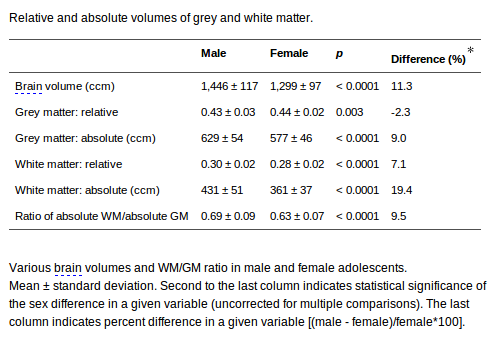
Pau 2009 apparently cashes out as T.I. Paus et al., “Sexual dimorphism in the adolescent brain: Role of testosterone and androgen receptor in global and local volumes of grey and white matter“, Hormones and Behavior 57(1) 2010. (It was published online during 2009.) This study comes to some general conclusions about sex differences in brain anatomy, as summarized in this table:
And it relates this differences to testosterone levels among adolescents, as summarized in this graph:
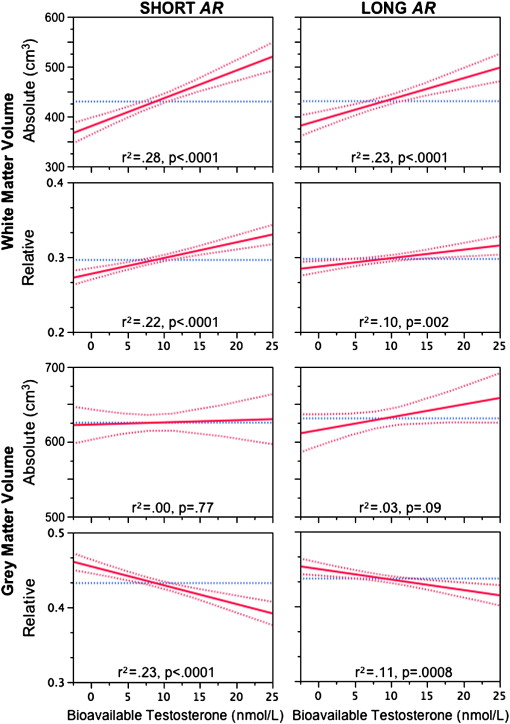
Absolute and relative volumes of white matter (top half) and grey matter (bottom half) plotted as a function of bioavailable testosterone (in nmol/L) in male adolescents with the short (left column) and long (right column) variant of the androgen-receptor gene. The lines represent the regression equation with 95% confidence intervals. R2 indicate the amount of variance in the respective volume explained by testosterone and p-values indicate statistical significance of a given correlation.
This is extremely interesting, but there’s nothing about effects on hearing. And the authors are based in Nottingham, Quebec, and Penn State, none of which are in Portugal.
Note [3] backs up the assertion that in a study in the Netherlands, “female brains intensely activated to both the white noise and the music. The male brains, too, activated to the music, but they deactivated to the white noise. It was as if they didn’t even hear it. The screening system in their male brains was automatically turning off white noise“.
The note reads
Ruytjens 2007 found the male brain screened out white noise better than the female brain. For more on gender differences in auditory processing, see Voyer 2001 and Ikezawa 2008.
That first reference cashes out to L. Ruytjens et al., “Functional sex differences in human primary auditory cortex“, Eur J Nucl Med Mol Imaging 34(12):2073-81, 2007. The abstract:
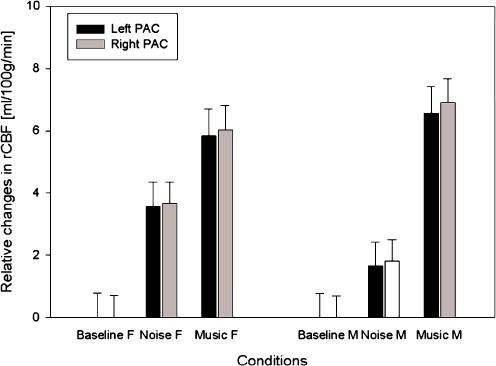
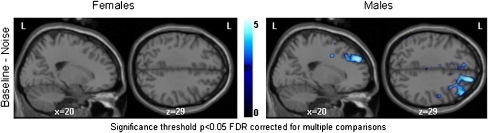
We found a sex difference in activation of the left and right PAC [“primary auditory cortex”] when comparing music to noise. The PAC was more activated by music than by noise in both men and women. But this difference between the two stimuli was significantly higher in men than in women. To investigate whether this difference could be attributed to either music or noise, we compared both stimuli with the baseline and revealed that noise gave a significantly higher activation in the female PAC than in the male PAC. Moreover, the male group showed a deactivation in the right prefrontal cortex when comparing noise to the baseline, which was not present in the female group. Interestingly, the auditory and prefrontal regions are anatomically and functionally linked and the prefrontal cortex is known to be engaged in auditory tasks that involve sustained or selective auditory attention. Thus we hypothesize that differences in attention result in a different deactivation of the right prefrontal cortex, which in turn modulates the activation of the PAC and thus explains the sex differences found in the activation of the PAC.
Finally something relevant to hearing and attention! But the male “deactivation” (relative to baseline) was just in the right prefrontal cortex, not in the brain as a whole. And the difference in PAC responses was only found to be significant in an ROI (“region of interest”) analysis, not in an overall SPM (“statistical parametric modeling”) analysis, because “The ROI analysis pools the data of all voxels in the PAC and gives a reduced standard error, resulting in a higher t-value and hence more power”.
Here are their figures showing the ROI differences in the PAC:
And the pretty blue prefrontal region of decreased activation:
What’s not clear to me about this was whether it’s a reproducible fact about men vs. women, or a fact about these particular 10 men and 10 women and their responses to this particular experiment. Specifically, did the men “tune out” the white noise (to a degree) because that’s the way their brains are built, or because that’s how (some of them) felt about this experiment?
That’s not an idle question. In an earlier post, I documented a study where a simple change in the instructions to subjects — whether or not to pay attention to the content of a broadcast — completely reversed the sex difference in “most comfortable listening level”. Without the instruction to pay attention, the females’ MCL was 10.8 dB lower than the males’ — but with the instruction, it was 9.7 dB higher:
| WITH | WITHOUT | |
| Male | 47.9 (10.1) | 50.4 (13.1) |
| Female | 57.6 (12.5) | 41.2 (9.4) |
That kind of attentional effect would almost certainly show up in PET scans, but it might very well be a cultural difference, or at least one having more to do with assiduousness in following experimenters’ instructions.
Brizendine’s additional references “Voyer 2001 and Ikezawa 2008” are D. Voyer and J. Flight, “Gender differences in laterality on a dichotic task: The influence of report strategies“, Cortex 37(3):345-62; and S. Ikezawa et al., “Gender differences in lateralization of mismatch negativity in dichotic listening tasks“, International Journal of Psychophysiology 68(1)41-50, 2008.
The first of these papers (whose authors are based in New Brunswick, Canada) emphasizes the just-noted effect of instructions, in four different versions of encounters with the same stimuli:
It was hypothesized that improved control of report strategies would increase the likelihood of detecting significant gender differences in laterality. This was confirmed when results showed no significant gender differences in laterality for the free recall and order of report control conditions, whereas focused attention produced marginal gender differences and clearly significant differences were obtained in the ABX discrimination condition.
The second paper (whose authors are based in Japan) found that “mismatch negativity” (an ERP indication of the pre-attentive detection of “oddball” acoustic stimuli) is not lateralized for tones in either sex, but is lateralized to a much greater extent for males than for females in the case of phonetic stimuli.
Neither paper tells us anything relevant about brain structures or mechanisms that would explain an increased male propensity or ability to “tune out” uninteresting sounds, or a testosterone-driven inability to focus on female voices.
Note [4], backing up the assertion that “Scientists have learned that during male fetal brain development, testosterone affects the formation of the auditory system and the connections within the brain, making it inhibit unwanted “noise” and repetitious acoustic stimuli more than the female brain does“, is again Ruytjens 2007. The note adds:
For more on fetal brain development and the effects of testosterone on hearing, see Beech 2006 and Cohen-Bendahan 2004.
That’s J.R. Beech and M.W. Beauvois, “Early experience of sex hormones as a predictor of reading, phonology, and auditory perception“, Brain and Language 96(1):49-58; and C.C. Cohen-Bendahan et al., “Prenatal exposure to testosterone and functional cerebral lateralization: A study in same-sex and opposite-sex girl twins“, Psychoneuroendocrinology 29(7):911-16.
The Beech and Beauvois paper (whose authors are based in Leicester) examines the relation of finger-length ratios (which are believed in turn to correlate with fetal testosterone) to performance on various auditory and linguistic tasks. In some cases there are significant effects, and in others cases not. The key hypothesis (which remains somewhat controversial) relates to “possible effects of androgens on early brain development impairing aspects of the temporal processing of sounds by the left hemisphere”, which is a reference to Paula Tallal’s theory that the left hemisphere of the brain is specialized for processing more rapidly-changing sounds. There’s nothing relevant to male “tuning out”.
The Cohen-Bendahan et al. paper (whose authors are based in the Netherlands and the UK) uses dichotic lateralization as a way to argue for the effects of prenatal testosterone:
An auditory–verbal dichotic listening task (DLT) was used as an indirect method to study hemispheric specialization. Firstly, we established a sex difference on the DLT. Compared with SS girls, OS twin boys showed a more lateralized pattern of processing verbal stimuli. Secondly, as predicted OS girls had a more masculine pattern of cerebral lateralization, than SS girls. These findings support the notion of an influence of prenatal T on early brain organization in girls.
Their Figure 1:
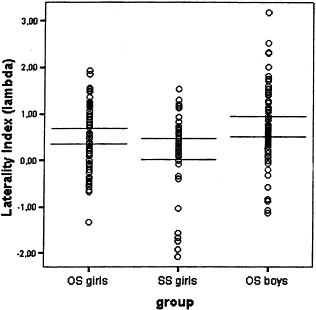
Scattergram of the Laterality Index (LI; Lambda) as measured with the Dichotic Listening Task (DLT) for the Opposite-sex (OS) girls, Same-sex (SS) girls, and OS boys. The error bar represents the 95% mean confidence interval LI for each group.
As you can see, the effect is persuasive, but not nearly categorical enough to motivate generic-plural statements about “male brains” and “female brains”.
Note [5] backs up the assertion that “when Zoe and her friends talked endlessly about movies, fashion, and other girls, their combined voices just sounded like humming and buzzing to Jake’s ears. For him and the other guys, following the girls’ rapid musical banter was practically impossible.“
The note reads:
Schirmer 2002 studied sex differences in neural processing of emotional words, and found the tone and meaning of emotional words were processed faster in females than in males.
That’s A. Schirmer et al., “Sex differentiates the role of emotional prosody during word processing“, Cognitive Brain Research 14(2):228-33.
At this point, you probably won’t be surprised to learn that there’s nothing whatever in that paper (whose authors are based in Leipzig) to support the notion that girls’ “combined voices just [sound] like humming and buzzing” to teen male ears. Nor does the research even support the weaker position that “the tone and meaning of emotional words were processed faster in females than in males”.
In this study, lexical decision time (how long it takes to determine whether a stimulus is a word or not) was the dependent variable. The independent variables included whether words have a semantically “positive” or “negative” meaning (i.e. have happy or unhappy associations); whether they were preceded by an irrelevant (and semantically neutral) “priming” sentence produced with a “happy” or “sad” intonation; and whether the priming sentence was 0.2 seconds before the target word, or 0.75 seconds before it.
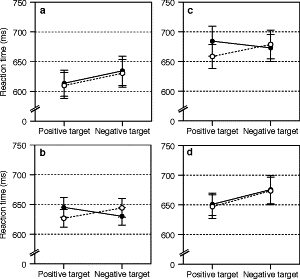
Mean reaction times (±1 S.E.M.) for lexical decisions plotted as a function of target valence. Open circles together with dotted lines indicate a positive prime prosody, closed circles together with solid lines indicate a negative prime prosody. Experiment 1 (ISI 200 ms) is presented in (a), male subjects and (b), female subjects. Experiment 2 (ISI 750 ms) is presented in (c), male subjects and (d), female subjects.
The sex differences were fairly small in all conditions — all the differences appear to be within a standard error, which since there were 16 subjects of each sex means that the biggest sex differences were about a quarter of standard deviation.
The simplest way to describe the differences would be this. At the short (200 msec) inter-stimulus interval, the responses of the male subjects were (taken as a whole) unaffected by the (happy or sad) prosody of the priming sentences. The only effect for the male subjects (in the short-ISI condition) was that positive-meaning target words were slightly slower than negative-meaning words. The female subjects (in the short-ISI condition) behaved roughly like the males (though they reacted a little more slower) for the positive-prime prosody words, but for the words primed with a negative-prosody sentence, the positive-meaning words were on average a bit slower than the negative-meaning words.
At the long (750 msec) ISI, the patterns of the male and female subjects were roughly reversed.
The authors interpret this to suggest that the effect of the “happy” or “sad” intonation of the priming sentence was taking a few tenths of a second longer to affect the behavior of the males than the females. This is plausible, though other explanations also come to mind.
But in any case, it’s not true that “the tone and meaning of emotional words were processed faster in females” — in the short ISI experiment, the word meanings seem to be processed faster by the males, though it’s plausible that the intonational priming is taking longer to have an effect.
And there’s certainly nothing about this at all that provides any support whatever for the view that teen boys can only perceive teen girls’ speech as meaningless “humming and buzzing”.
Discussion
Q: So is it true that men tend to “tune out” what women say, more than women tend to “tune out” what men say?
A: I’m not sure. This is certainly something that many people believe. Of course, many people believe that Blacks are lazy, Jews are greedy, Irish are drunks, Poles are stupid, and so on.
Q: If it’s true, is it because men have less sensitive hearing, or because they simply can’t process women’s voices very well, at least after puberty?
A: No, both of those ideas are complete nonsense, as far as I can tell.
Q: Could it be because men are generally better than women are at focusing their attention so as to ignore auditory stimuli that they find uninteresting or obnoxious?
A: Maybe — but the evidence for this is meager at best. In particular, I don’t know of any direct tests of the hypothesis. The only relevant evidence that Brizendine cites comes from a study where a small number of subjects were made to listen to music and to white noise, without being given any particular reasons or motivations to attend closely to any of the stimuli. (“Subjects were instructed to close their eyes, not to move during the scans, and to listen to the auditory stimuli”, but there was no task that tested whether they attended or not.) PET scans suggested that the males tended to tune out the white noise more than the females did. The subjects were 10 male and female Dutch university students (whose backgrounds are not clear — perhaps the males were mostly drawn from a different subject area than the females?), in the context of an experiment run by women; so the universality of the results is open to question, as usual in sex-difference experiments done by psychologists.
Q: Are there any other biological explanations still in the running?
A: The effect of sex differences in ear-canal hair has never actually been tested, as far as I know. Really, old guys do tend to get hair in their ears. Must be there for something.
Q: Is there any plausible reason to expect the biology to work according to this stereotype?
A: Some have suggested that maybe there was an evolutionary advantage for (putatively male) hunters to be able to “tune out” irrelevant stimuli so as to keep their attention focused on potential prey animals. As with most other such plausible stories, there’s no evidence for this, as far as I know. And I suppose that you could make an equally plausible argument about how our female ancestors needed to be able to ignore distracting stimuli while engaged in delicate (putatively female) tasks like spinning, weaving and sewing.
Q: MIght there be historical or cultural reasons for the stereotype of male inattention to female speech?
A: You tell me…
Well, in the unlikely event that you’re still reading, you’ve wasted another perfectly good hour on yet another application of explanatory neurophilia to gender stereotypes. Of course, wonky biological explanations are often cited in other areas as well:
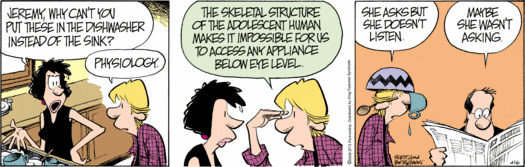
Note that in this case, it’s the mom who “doesn’t listen”. Maybe she was exposed to too much of her son’s fetal testosterone.