Author: Mark Liberman

  • Proud of insinuating involvement?

    From Kenneth P. Vogel, “GOP operatives crash the tea party“, Politico 4/14/2010:

    As for the bus tours, [Sal] Russo said “they work for us. It’s a great vehicle to go to a lot of places and get a lot of people involved and engaged. I am proud of what we do. Who else goes out there and motivates people and insinuates involvement and activity and actually is making a difference in what is going on?”

    It surprised me to see Mr. Russo taking credit for insinuating something.

    The relevant OED gloss for insinuate is “To introduce tortuously, sinuously, indirectly, or by devious methods; to introduce by imperceptible degrees or subtle means”.

    The American Heritage Dictionary has “To introduce or otherwise convey (a thought, for example) gradually and insidiously”.

    Merriam-Webster online has glosses of

    1 a : to introduce (as an idea) gradually or in a subtle, indirect, or covert way <insinuate doubts into a trusting mind> b : to impart or suggest in an artful or indirect way : imply <I resent what you’re insinuating>
    2 : to introduce (as oneself) by stealthy, smooth, or artful means

    Encarta has “to hint at something unpleasant or suggest it indirectly and gradually” or “to introduce yourself gradually and cunningly into a position, especially a place of confidence or favor”.

    I doubt that Mr. Russo would characterize his actions as “devious”, “insidious”, or “covert”. Instead, he seems to have used insinuate to mean simply initiate. I looked around for other evidence of an insinuate=initiate trend, but didn’t find anything much, except for a completely different malapropism insinuate=intimate (“H20 soluble liniment enhances a comfort as well as ease of insinuate activity…”).

    [The political issue under discussion is the role of Russo, Marsh, and Associates in the Tea Party Express bus tours and various other “Tea Party” branded activities.  And as usual, we need to note that the word-substitution might have been the reporter’s (or a spelling-corrector’s) rather than the source’s.]

    [Update — I’m persuaded by Mr. Fnorter’s suggestion in the comments that the intended word might have been  instigate — note that there was a flap last year when Maxine Waters apparently said that Castro “insinuated revolution to kick out the wealthy”, which seems to be a similar malapropism.]

  • Peeving enfeebled?

    A few days ago at the Guardian, David Marsh brought out the stuffed body of George Orwell and propped it up in the pulpit (“Election 2010 – vote for the cliche you hate the most“, 4/9/2010):

    George Orwell, in his brilliant 1946 essay Politics and the English Language, wrote: “When one watches some tired [political] hack on the platform mechanically repeating the familiar phrases … one often has a curious feeling that one is not watching a live human being but some kind of dummy.” He memorably argued that “if thought corrupts language, language can often corrupt thought” and proposed six rules of good writing:

    • Never use a metaphor, simile or other figure of speech which you are used to seeing in print.
    • Never use a long word where a short one will do.
    • If it is possible to cut a word out, always cut it out.
    • Never use the passive where you can use the active.
    • Never use a foreign phrase, a scientific word, or a jargon word if you can think of an everyday English equivalent.
    • Break any of these rules sooner than say anything outright barbarous.

    The result was shocking.

    Four days later, there are only 83 comments. I’m used to seeing hundreds or thousands of comments in response to invitations of this kind.  And none of the comments called for cutting off tongues or fingers.

    Perhaps this is because current political rhetoric in Britain is too derivative and impoverished, even in its clichés, to arouse much feeling. Or perhaps, the springs of British linguistic peeving might be drying up. In fact, several of the 83 comments questioned Orwell’s rules.

    But it seems that 83 is actually a large number of comments in the Guardian’s current blog ecology, where yesterday’s blog posts have so far gotten 1, 14, 0, 43, 0, 0, 0, 6, 2, 71, 1, … responses.

    As for those rules, here are some past LL posts about aspects of Politics and the English Language:

    Orwell’s Liar“, 1/10/2009
    A load of old Orwellian cobblers from Fisk“, 8/31/2008
    Dong!“, 8/9/2006
    When men were men, and verbs were passive“, 8/4/2006
    Passive aggression“, 7/18/2006
    Fed up with ‘fed up’?“, 3/4/2004
    Clichés, stereotypes and other obsolete metaphors“, 3/15/2004

  • Coordination parsing challenge

    Dan Bilefsky, “Hungarian Right, Center and Far, Make Gains“, New York Times 4/11/2010:

    Hungary’s center-right opposition party won first-round parliamentary elections here on Sunday, while a far-right party, whose black-clad paramilitary extremists evoke the Nazi era, made significant gains.

    It’s true that “center right” and “far right” are common collocations — but I wonder how many parsers can get that headline right.

    Parsing is not the only way to fail in this case. Google Translate (which is phrase-based, as far as I know, and doesn’t try to parse the input) renders the headline as “derecho de Hungría, el centro y la fecha, obtengan beneficios”.

    At first I was puzzled about how far could be translated as “la fecha” (= “the date”), but then I realized that it’s probably from associating the English phrase “so far” with the typical Spanish translation “hasta la fecha”.

    [Hat tip to Evan Harper.]

  • Annals of scope

    According to Andreas Ulrich and Alfred Weinzierl, “German Trainers Describe Pitiful State of Afghan Police“, Der Spiegel, 4/7/2010:

    A functioning police force is seen as a prerequisite for a Western withdrawal from Afghanistan. German trainers, however, paint a disastrous picture of the quality of Afghan security forces. Too many police, they say, can’t read or write, can’t shoot straight or take bribes.

    Reader SK writes:

    Good lord! Do we have to teach these guys how to do EVERYTHING? Can’t read, can’t write, can’t shoot straight — don’t even know how to take BRIBES! You put your left hand out, and you shake it all about. I ask you, what’s this world coming to?

  • A book written within and on the backside

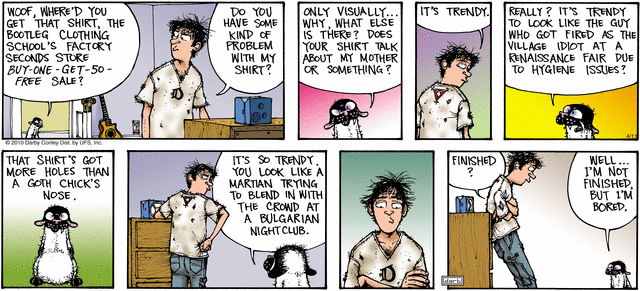
    This morning’s Get Fuzzy featured a Bulgarian stereotype that seemed slightly, well, random:

    Bucky Katt’s assumption seems to be that the dress code at a Bulgarian nightclub would be ragged and strange, thus (at least partly) explaining Rob Wilco’s pre-torn and pre-soiled shirt.

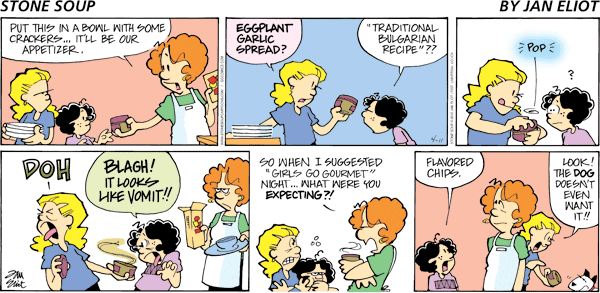
    As it happens, this morning’s Stone Soup featured a more familiar Bulgarian stereotype, based on the history that resulted in the name Lactobacillus bulgaricus:

    So I thought I would see what other Bulgarian stereotypes might be floating around out there, and as a result, I stumbled on a relevant story from last fall that I somehow missed at the time — “Aliens ‘already exist on earth’, Bulgarian scientists claim“, The Telegraph, 11/26/2009.

    Aliens from outer space are already among us on earth, say Bulgarian government scientists who claim they are already in contact with extraterrestrial life.

    Work on deciphering a complex set of symbols sent to them is underway, scientists from the country’s Space Research Institute said.

    They claim aliens are currently answering 30 questions posed to them.

    Lachezar Filipov, deputy director of the Space Research Institute of the Bulgarian Academy of Sciences, confirmed the research.

    He said the centre’s researchers were analysing 150 crop circles from around the world, which they believe answer the questions.

    “Aliens are currently all around us, and are watching us all the time,” Mr Filipov told Bulgarian media.

    “They are not hostile towards us, rather, they want to help us but we have not grown enough in order to establish direct contact with them.”

    A few days later, “badmoviefan” at the site abovetopsecret posted a letter said to be from Filipov himself:

    This year, I had the opportunity of putting together a team of experts representing various scientific fields and walks of life. We worked together on a project based on the original work on our own Mrs M.Vezneva, a former architect and correspondence member of IAI. Mrs. Vezneva has two published books containing dictionaries of universal symbols language via which she states that pictograms may be interpreted. In her books, she engages in a dialogue regarding global issues with the crop circles “creators”. It is based on the universal symbols language, I.e. Pcychometry and telepathy.

    The aim of the “Dialogue 2009” experiment is to carry out a similar dialogue regarding the use of the crop circles but using different participants. We believe that the crop circles are real existing formations from unexplained nature, and that they carry information from alien to us sources. We have already 36 participant replies which we are currently analyzing. Currently, there are facts confirming our initial hypothesis, mentioned above, however we will publish our final thoughts after careful consideration by all team members.

    More information about Ms. Vezneva’s pictogramology is available on a special website, including a dictionary in which my favorite item is the remarkable entry

    “A book written within and on the backside” – the human consciousness and sub-consciousness, the human memory from his past lives; the human brain, “sealed by seven seals”.

    Inexplicably, Cybertronian has not yet been added to the ancient writings in Ms. Vezneva’s collection.

    As a topical hook, Reuters/Ipsos has just released a poll showing that “One in Five (20%) Global Citizens Believe That Alien Beings Have Come” (4/8/2010). National alien belief rates are reported to range from a high of 45% in India to a low of 8% in the Netherlands, with the U.S. (24%) in the middle. Bulgaria isn’t listed, but Italy (25%), Russia (21%), Poland (19%), Czech Republic (18%) and Hungary (14%) are.

    Overall,

    Those who believe that “alien beings have come to earth and walk amongst us in our communities disguised as us” (20%) are more likely to be men (22%) compared to women (17%), under the age of 35 (25%) compared to those aged 35-54 (16%) and those over the age of 55 (11%) and those more likely to be higher educated (22%) compared to those who are lower or middle educated (19%).

    The poll didn’t break out national Academy of Science members as a separate category, but perhaps in that case the effects of age neutralize those of sex and education.

    [And for langiappe, this is real science: “Two new alien species of Bidens have been recorded in Bulgaria“. The alien Bidens really were found in the Varna railway station, but they turn out not to be among those that Mr. Filipov’s group believes are already observing among us on earth.]

    [Finally, we need to revisit Roman Jakobson’s language-learning method, in which Bulgarian plays a central role.]

  • The worst science journalism ever?

    Here at Language Log, we’ve been known to complain from time to time about language-related reporting in the popular press.  But a couple of days ago, when I clicked on a link in the science section of Google News and hit John Brandon’s “Freaky Physics Proves Parallel Universes Exist“, Fox News, 4/5/2010, I was reminded that things could be worse.

    Look past the details of a wonky discovery by a group of California scientists — that a quantum state is now observable with the human eye — and consider its implications: Time travel may be feasible. Doc Brown would be proud.

    The strange discovery by quantum physicists at the University of California Santa Barbara means that an object you can see in front of you may exist simultaneously in a parallel universe — a multi-state condition that has scientists theorizing that traveling through time may be much more than just the plaything of science fiction writers.

    A bit of web search turned up Matt Springer’s blog post “The Worst Physics Article Ever“, which confirmed my reaction:

    Every word in the title is wrong but “physics”. It’s not freaky, doesn’t prove anything we didn’t already know, and has nothing to do with parallel universes nor does it shed any light [on] the question of their possible existence. […]

    I know complaining about science journalism is a staple around ScienceBlogs, but really this is just astonishing malpractice. This would be an embarrassment in a Star Trek episode. For it to appear in a news story is beyond words.

  • Sarah Palin’s distal demonstratives

    I’m going to venture to disagree with my colleague and friend John McWhorter’s diagnosis of “What does Palinspeak mean?” (TNR, 4/6/2010).

    Of course, I don’t disagree with John’s observation that Sarah Palin’s speech style is folksy and informal. As for his comment that “part of why Palin speaks the way she does is that she has grown up squarely within a period of American history when the old-fashioned sense of a speech as a carefully planned recitation, and public pronouncements as performative oratory, has been quite obsolete”, we could quibble over details — how much of the difference is in what public figures say, as opposed to what gets transmitted and reported? — but let’s grant that John is right about this as well.

    Where I think that John may go wrong is in his analysis of that and there.

    Now, there’s no doubt that Sarah Palin tends to use certain demonstratives more often than most other public figures, and also tends to use them in a different way. In “Affective demonstratives“, 10/5/2008, I noted differences as great as 15-to-1 between her and Joe Biden in the 10/4/2008 vice-presidential debate. Her  demonstratives often seemed qualitatively as well as quantitatively different, in characteristic examples like “Americans are craving that straight talk”. Straight talk was John McCain’s slogan, but “craving that straight talk” was pure Palin.

    Here’s John McWharter’s diagnosis:

    What truly distinguishes Palin’s speech is its utter subjectivity: that is, she speaks very much from the inside of her head, as someone watching the issues from a considerable distance. The there fetish, for instance — Palin frequently displaces statements with an appended “there,” as in “We realize that more and more Americans are starting to see the light there…” But where? Why the distancing gesture? At another time, she referred to Condoleezza Rice trying to “forge that peace.” That peace? You mean that peace way over there — as opposed to the peace that you as Vice-President would have been responsible for forging? She’s far, far away from that peace.

    All of us use there and that in this way in casual speech — it’s a way of placing topics as separate from us on a kind of abstract “desktop” that the conversation encompasses. “The people in accounting down there think they can just ….” But Palin, doing this even when speaking to the whole nation, is no further outside of her head than we are when talking about what’s going on at work over a beer. The issues, American people, you name it, are “there” — in other words, not in her head 24/7. She hasn’t given them much thought before; they are not her. They’re that, over there.

    But there’s another set of reasons for using that and there — not to signal distance from the referent, but to establish fellowship with the audience. The OED’s entry for that as a “demonstrative adjective” sketches the cause and the effect:

    1. a. The simple demonstrative used (as adjective in concord with a n.), to indicate a thing or person either as being actually pointed out or present, or as having just been mentioned and being thus mentally pointed out. […]

    b. Indicating a person or thing assumed to be known, or to be known to be such as is stated. Often (esp. before a person’s name: cf. L. iste) implying censure, dislike, or scorn; but sometimes commendation or admiration.

    Similarly in the entry for there:

    3.b. Pointing out a person or object with approval or commendation, or the contrary. Also in anticipatory commendation of the person addressed; cf. THAT dem. pron. B. I. 1b.

    When Frank Sinatra sings about “that old black magic”, or about “Chicago, that toddlin’ town”, it’s not because the magic and the city are “that, over there“, things that he “hasn’t given … much thought [to] before”. On the contrary, they’re a familiar part of his mental life, and by treating them as “assumed to be known” to the audience, he draws in us as well. Similarly, Billie Holiday’s reference to “them there eyes” is a form of endearment, not a distancing mechanism.

    Of course, as the OED’s entries indicate, familiarity can also signal contempt, as in the case of Ronald Reagan’s famous line “There you go again“.

    John’s reaction shows that he gets the implication of shared familiarity:

    This reminds me of toddlers who speak from inside their own experience in a related way: they will come up to you and comment about something said by a neighbor you’ve never met, or recount to you the plot of an episode of a TV show they have no way of knowing you’ve ever heard of.

    But using distal demonstratives as a rhetorical device to imply familiarity is an entirely grown-up trick. The phrasal lexicon of adult discourse is full of collocations like “that good old American ___“.

    In the vice-presidential debate of October 2008, Sarah Palin’s first turn included this passage (emphasis added):

    The barometer there, I think, is going to be resounding that our economy is hurting and the federal government has not provided the sound oversight that we need and that we deserve, and we need reform to that end.

    I doubt that any other prominent American politician would have thrown in that semantically superfluous there. But its force is not to distance Palin from her resounding barometer, prudent though it might have been to do so. Rather, this verbal tic is an attempt to draw us all in to her metaphor. The barometer, you know, the one we’re all familiar with, that good old barometer there.

    She goes on:

    Now, John McCain thankfully has been one representing reform. Two years ago, remember, it was John McCain who pushed so hard with the Fannie Mae and Freddie Mac reform measures. He sounded that warning bell.

    We all know the warning bell she’s talking about, right? That one over there, always in the back of our shared experience.

    People in the Senate with him, his colleagues, didn’t want to listen to him and wouldn’t go towards that reform that was needed then. I think that the alarm has been heard, though, and there will be that greater oversight, again thanks to John McCain’s bipartisan efforts that he was so instrumental in bringing folks together over this past week, even suspending his own campaign to make sure he was putting excessive politics aside and putting the country first.

    So yes, Sarah Palin uses distal demonstratives more than other public figures do, and she often uses them in different ways. This is partly a folksy regionalism, and partly a personal quirk, but contrary to John’s analysis, it’s not because

    The issues, American people, you name it, are “there” — in other words, not in her head 24/7. She hasn’t given them much thought before; they are not her. They’re that, over there.

    On the contrary, it’s because she’s welcoming all of us into the familiar space of that good old American experience there.

  • This digitized life

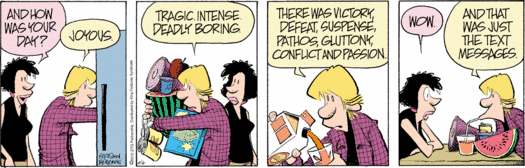
    Yesterday’s Zits:

    Then there was the whole Facebook wall rape episode, and…

    (Alas, most academic social scientists are sleeping right through the opportunities for in silico ethnography, virtual conversational analysis, psychodynamic data mining, etc.)

  • Evolutionary Psychology Bingo

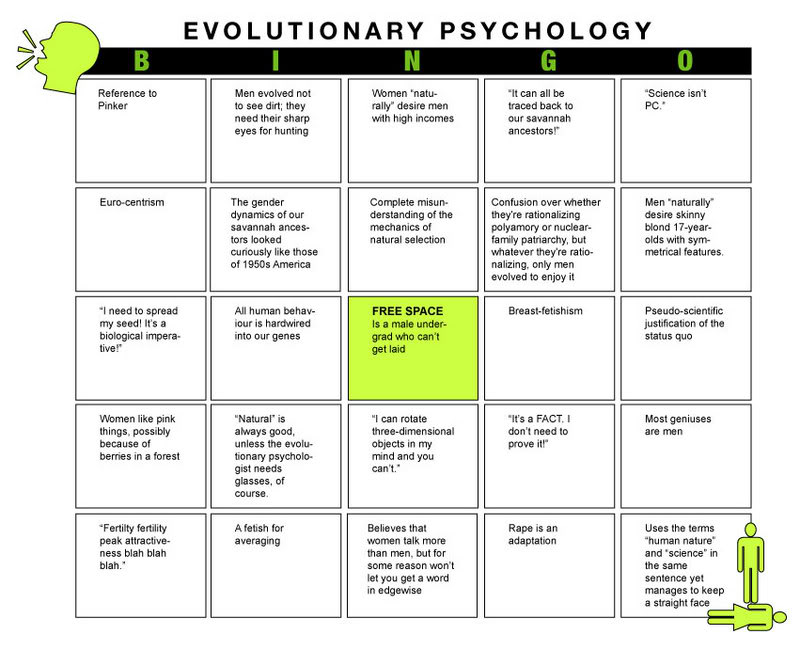
    David Craig put a link to this on my facebook wall:


    It’s funny, but we shouldn’t forget the parallel set of male-disparaging labels: we’re uncommunicative, we’re hard of hearing, we’re unempathetic, we’re emotionally immature, we pretty much can’t see things unless they’re moving, in fact we’re practically vegetables from the neck up.

    You could make up another bingo card with labels of that sort.

  • Explanatory Neurophilia ≅ Physics Envy?

    Jonathan Weinberg wrote to suggest that perhaps “explanatory neurophilia” (the fact that people tend to be impressed and persuaded by neuroscientific details even if they provide no explanatory value) is part of a larger phenomenon that also includes “physics envy” (the desire to achieve in other sciences the success of mathematical reasoning from first principles that Newton brought to physics).

    The cited post by DougJ at Balloon Juice suggests the relationship explicitly:

    There’s a more general science envy in the nexus of finance, social science, and media. In a few weeks, Bobo Brooks will come out with a book purporting to be about neuroscience which will in fact be a bunch of pop psychology about how conservatives are right about everything.

    This has certainly been a recurring theme in David Brooks’ columns over the past few years (see “David Brooks, Cognitive Neuroscientist“, 6/12/2006; “David Brooks, Neuroendocrinologist“, 9/17/2006; “David Brooks, Social Psychologist“, 8/13/2008; “An inquiry concerning the principles of morals”, 4/7/2009), but if he’s got a book on this topic coming out, you can’t pre-order it on amazon yet…

    Getting back to the “explanatory neurophilia ≅ physics envy” idea, it seems to me that there are some analogies but also some striking differences. The research of Weisberg et al. on “The Seductive Allure of Neuroscience Explanations” suggests that logically irrelevant neuroscience impresses novices and outsiders, but not experts. In contrast, Lo and Mueller argue that the seductive allure of irrelevant but interesting mathematics has distorted the judgment of the most highly-regarded economists and financial analysts.

    For those who are interested in the sociology of economics (about which I obviously know very little), I recommend Deirdre McCloskey’s The Secret Sins of Economics (summary and discussion here).

    And in any area of rational inquiry, the best advice comes from Dick Hamming: “Beware of finding what you’re looking for”.

  • Why men don’t listen

    A web search for the phrase “Men don’t listen” turns up lots of pop-psychology books and articles. There’s Allan and Barbara Pease’s relationship self-help book Why Men Don’t Listen and Women Can’t Read Maps;  an online chapter from the book Be Your Own Therapist with the title “Men Don’t Listen; Men Don’t Communicate”; another self-help book, by Wayne Misner, that’s called just plain Men Don’t Listen; an MSNBC Today article “Honey, did you hear me? Why men don’t listen”; a BBC News Health article from 2000, “Why men don’t listen?“. And that’s just on the first page.

    Most of these books and articles propose a biological basis for the phenomenon.

    Thus Rick Ryckeley in The [Peachtree City] Citizen, March 18, 2010, explains :

    Spending the better part of my adult life trying to understand the opposite sex, I’ve realized one thing.

    It’s a daunting task — a task that I’m incredibly ill-equipped for. Okay, so that’s two things, but they don’t change the fact that when it comes to women, I’m in over my head.

    And whether you realize it or not, the rest of you Neanderthals out there are in the same boat. You would be aware of it, if you’d only listen.

    Therein lies the root of the problem for most relationships. Women listen to what men say, but men don’t listen to what women say. Or at least that’s what The Wife told me last weekend. Come to find out she had told me the same thing two weeks ago. Apparently, I wasn’t listening. […]

    Other than my being a Neanderthal, The Wife has come up with a plausible answer as to why I don’t listen.

    Hair.

    Yes, hair.

    It seems for some reason the older I get, the more hair falls out of my head and lands in my ears. Once there it takes root, grows like a weed, and blocks sound waves from entering.

    This is a joke, obviously, and so Rick’s column has no footnotes citing the extensive scientific literature on sex differences in ear-canal hair.  (Yes, there really are some, though Rick’s not going to get off the hook by citing them.)  But most of the other references are serious in their attribution of male acoustic inattention to biological sex differences.

    One common trope is that males’ hearing is simply less sensitive than females’ hearing is. I discussed one instance of this idea — coming mainly from Dr. Leonard Sax — in an earlier post and some links therein. Summarizing the (non-)evidence: there is no functionally significant difference between human males and females in auditory sensitivity.

    But the “Men don’t listen” idea is a powerful one, and there are plenty of other confidently-asserted biological explanations besides ear-canal hair and hearing-threshold differences. In particular, there are some fine specimens in Louann Brizendine’s new book The Male Brain. The relevant section is on pp. 40-41, under the heading Tuning Out. (I’ve added numbers in square brackets to link to the endnotes, which in the book are on p. 150.)

    The teen male not only sees faces differently than he did as a boy; he also begins to perceive voices and other sounds differently than he did before adolescence[1]. And his changing hormones can make him hear things differently than girls his age. In Portugal, researchers found that during puberty, estrogen surges in females and testosterone surges in males increase the hearing differences between girls’ and boys’ brains[2], but the main difference is that some simple sounds, like white noise, are processed differently in the male brain. Liesbet Ruytjens and colleagues in the Netherlands compared the brain activity of seventeen- to twenty-five-year-old males and females as they processed the sound of white noise and as they processed the sound of music[3]. The female brains intensely activated to both the white noise and the music. The male brains, too, activated to the music, but they deactivated to the white noise. It was as if they didn’t even hear it. The screening system in their male brains was automatically turning off white noise. Scientists have learned that during male fetal brain development, testosterone affects the formation of the auditory system and the connections within the brain, making it inhibit unwanted “noise” and repetitious acoustic stimuli more than the female brain does[4]. I tease my husband that his brain’s acoustic system seems to automatically shut down when I start repeating myself — it’s registering in his brain as white noise.

    Likewise, when Zoe and her friends talked endlessly about movies, fashion, and other girls, their combined voices just sounded like humming and buzzing to Jake’s ears. For him and the other guys, following the girls’ rapid musical banter was practically impossible[5]. The best they could do was nod their heads and pretend to be listening.


    Note [1], explaining the assertion that “The teen male … begins to perceive voices and other sounds differently than he did before adolescence“, cashes out to Krystyna Rymarczyk and Anna Grabowska, “Sex differences in brain control of prosody“, Neuropsychologia 45(5):921-930, 2007.

    There are two really weird things about this reference. First, it’s got nothing to do with changes in teens, male or otherwise — it documents a study whose subjects were all in their late 50s to mid 60s, two thirds of whom had suffered serious strokes of various sorts:

    Fifty-two individuals (28 men and 24 women) with unilateral infarction involving the right cerebral hemisphere and 26 (11 men and 15 women) neurologically intact controls (C) participated in this study.

    Second, the study found no sex differences of any kind in the intact control subjects. The only differences had to do with interactions between sex and various areas of brain injury:

    Post hoc analysis of the group × sex interaction demonstrated that women with frontal damage performed worse in both the linguistic and affective prosody tests than men with frontal damage (p < 0.002), whereas subcortical lesions produced greater impairment in men (p < 0.001) (Fig. 2). No other sex differences reached statistical significance.

    Most of you (if you’re still with me) will probably want to peel off at this point — or skip ahead to the discussion at the end of the post — satisfied that Dr. Brizendine’s new book is more of the same sort of “psychoneuroindoctrinology” found in her first book, in which the  pages and pages of endnotes and references are a sort of Potemkin Village of scientific pretense laid out in support of banal gender stereotypes. But in fairness to Brizendine — and to her readers — I feel compelled to go on with the note-checking to the end of this passage, and perhaps a few of you will want to come along for the ride.

    There’s some interesting science along the way.


    Note [2], backing up the assertions that “In Portugal, researchers found that during puberty, estrogen surges in females and testosterone surges in males increase the hearing differences between girls’ and boys’ brains“, reads:

    Rymarczyk 2007 found a sex difference in the brain’s processing of tone of voice. For more on sex differences in brain chemistry and the sex-determining gene located on the Y chromosome, see Wu 2009 and Pau 2009.

    A third weird thing: none of the notes relating to these paragraphs seem to reference any work done in Portugal. Either the author neglected to include a reference, or there’s a reference somewhere earlier that I’ve missed, or there was some other lapse on her part or on mine.

    Rymarczyk 2007 is the the same paper just discussed, and again, there’s nothing in it about hormone surges in teens. Its conclusion, again,  is that (in 60-ish subjects)

    We examined the possibility that the effectiveness of prosody processing may differ between the sexes. Contrary to our expectations, we did not find any significant differences in the ability of healthy men and women to comprehend emotional intonation.

    Furthermore, the paper’s authors are based at the Department of Neurophysiology, Nencki Institute of Experimental Biology, Warsaw, Poland. Which starts with the same letter as Portugal, but still…

    Wu 2009 cashes out as M.V. Wu et al., “Estrogen masculinizes neural pathways and sex-specific behaviors“, Cell 139(1):61-72, 2009, which is about “activating male-specific aggression and urine marking” in mice, and concludes that “aromatization of testosterone into estrogen is important for the development and activation of neural circuits that control male territorial behaviors”. There’s nothing in it about hearing, auditory attention, or humans. Its authors are all at UCSF or in Japan.

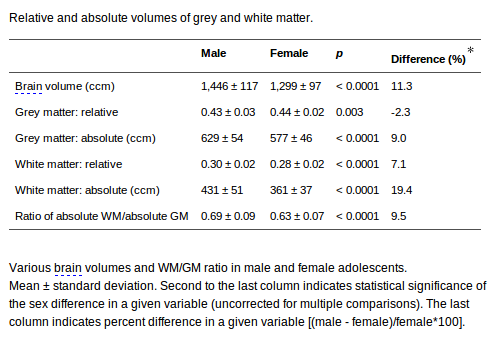
    Pau 2009 apparently cashes out as T.I. Paus et al., “Sexual dimorphism in the adolescent brain: Role of testosterone and androgen receptor in global and local volumes of grey and white matter“, Hormones and Behavior 57(1) 2010. (It was published online during 2009.) This study comes to some general conclusions about sex differences in brain anatomy, as summarized in this table:
    And it relates this differences to testosterone levels among adolescents, as summarized in this graph:
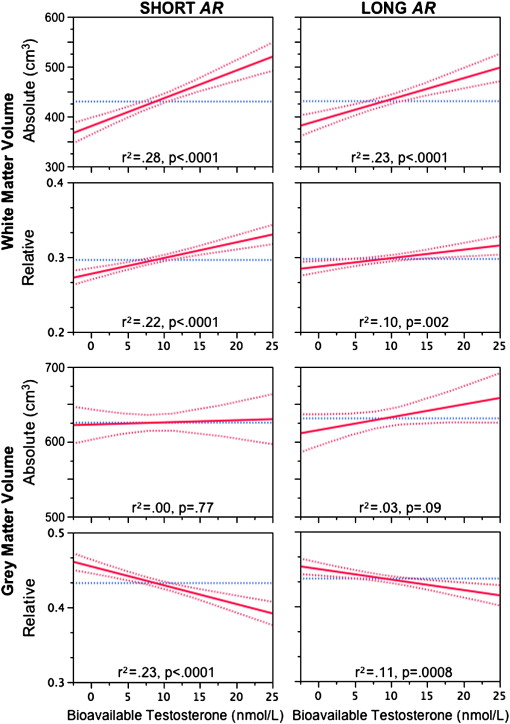
    Absolute and relative volumes of white matter (top half) and grey matter (bottom half) plotted as a function of bioavailable testosterone (in nmol/L) in male adolescents with the short (left column) and long (right column) variant of the androgen-receptor gene. The lines represent the regression equation with 95% confidence intervals. R2 indicate the amount of variance in the respective volume explained by testosterone and p-values indicate statistical significance of a given correlation.

    This is extremely interesting, but there’s nothing about effects on hearing. And the authors are based in Nottingham, Quebec, and Penn State, none of which are in Portugal.


    Note [3] backs up the assertion that in a study in the Netherlands, “female brains intensely activated to both the white noise and the music. The male brains, too, activated to the music, but they deactivated to the white noise. It was as if they didn’t even hear it. The screening system in their male brains was automatically turning off white noise“.

    The note reads

    Ruytjens 2007 found the male brain screened out white noise better than the female brain. For more on gender differences in auditory processing, see Voyer 2001 and Ikezawa 2008.

    That first reference cashes out to L. Ruytjens et al., “Functional sex differences in human primary auditory cortex“, Eur J Nucl Med Mol Imaging 34(12):2073-81, 2007. The abstract:

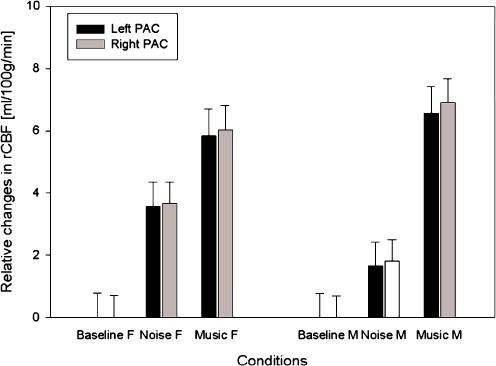
    We found a sex difference in activation of the left and right PAC [“primary auditory cortex”] when comparing music to noise. The PAC was more activated by music than by noise in both men and women. But this difference between the two stimuli was significantly higher in men than in women. To investigate whether this difference could be attributed to either music or noise, we compared both stimuli with the baseline and revealed that noise gave a significantly higher activation in the female PAC than in the male PAC. Moreover, the male group showed a deactivation in the right prefrontal cortex when comparing noise to the baseline, which was not present in the female group. Interestingly, the auditory and prefrontal regions are anatomically and functionally linked and the prefrontal cortex is known to be engaged in auditory tasks that involve sustained or selective auditory attention. Thus we hypothesize that differences in attention result in a different deactivation of the right prefrontal cortex, which in turn modulates the activation of the PAC and thus explains the sex differences found in the activation of the PAC.

    Finally something relevant to hearing and attention! But the male “deactivation” (relative to baseline) was just in the right prefrontal cortex, not in the brain as a whole. And the difference in PAC responses was only found  to be significant in an ROI (“region of interest”) analysis, not in an overall SPM (“statistical parametric modeling”) analysis, because “The ROI analysis pools the data of all voxels in the PAC and gives a reduced standard error, resulting in a higher t-value and hence more power”.

    Here are their figures showing the ROI differences in the PAC:
    And the pretty blue prefrontal region of decreased activation:
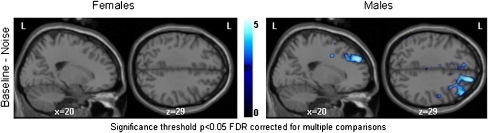
    What’s not clear to me about this was whether it’s a reproducible fact about men vs. women, or a fact about these particular 10 men and 10 women and their responses to this particular experiment. Specifically, did the men “tune out” the white noise (to a degree) because that’s the way their brains are built, or because that’s how (some of them) felt about this experiment?

    That’s not an idle question. In an earlier post, I documented a study where a simple change in the instructions to subjects — whether or not to pay attention to the content of a broadcast — completely reversed the sex difference in “most comfortable listening level”. Without the instruction to pay attention, the females’ MCL was 10.8 dB lower than the males’ — but with the instruction, it was 9.7 dB higher:

    WITH WITHOUT
    Male 47.9 (10.1) 50.4 (13.1)
    Female 57.6 (12.5) 41.2 (9.4)

    That kind of attentional effect would almost certainly show up in PET scans, but it might very well be a cultural difference, or at least one having more to do with assiduousness in following experimenters’ instructions.

    Brizendine’s additional references “Voyer 2001 and Ikezawa 2008” are D. Voyer and J. Flight, “Gender differences in laterality on a dichotic task: The influence of report strategies“, Cortex 37(3):345-62; and S. Ikezawa et al., “Gender differences in lateralization of mismatch negativity in dichotic listening tasks“, International Journal of Psychophysiology 68(1)41-50, 2008.

    The first of these papers (whose authors are based in New Brunswick, Canada) emphasizes the just-noted effect of instructions, in four different versions of encounters with the same stimuli:

    It was hypothesized that improved control of report strategies would increase the likelihood of detecting significant gender differences in laterality. This was confirmed when results showed no significant gender differences in laterality for the free recall and order of report control conditions, whereas focused attention produced marginal gender differences and clearly significant differences were obtained in the ABX discrimination condition.

    The second paper (whose authors are based in Japan) found that “mismatch negativity” (an ERP indication of the pre-attentive detection of “oddball” acoustic stimuli) is not lateralized for tones in either sex, but is lateralized to a much greater extent for males than for females in the case of phonetic stimuli.

    Neither paper tells us anything relevant about brain structures or mechanisms that would explain an increased male propensity or ability to “tune out” uninteresting sounds, or a testosterone-driven inability to focus on female voices.


    Note [4], backing up the assertion that “Scientists have learned that during male fetal brain development, testosterone affects the formation of the auditory system and the connections within the brain, making it inhibit unwanted “noise” and repetitious acoustic stimuli more than the female brain does“, is again Ruytjens 2007. The note adds:

    For more on fetal brain development and the effects of testosterone on hearing, see Beech 2006 and Cohen-Bendahan 2004.

    That’s J.R. Beech and M.W. Beauvois, “Early experience of sex hormones as a predictor of reading, phonology, and auditory perception“, Brain and Language 96(1):49-58; and C.C. Cohen-Bendahan et al., “Prenatal exposure to testosterone and functional cerebral lateralization: A study in same-sex and opposite-sex girl twins“, Psychoneuroendocrinology 29(7):911-16.

    The Beech and Beauvois paper (whose authors are based in Leicester) examines the relation of finger-length ratios (which are believed in turn to correlate with fetal testosterone) to performance on various auditory and linguistic tasks. In some cases there are significant effects, and in others cases not. The key hypothesis (which remains somewhat controversial) relates to “possible effects of androgens on early brain development impairing aspects of the temporal processing of sounds by the left hemisphere”, which is a reference to Paula Tallal’s theory that the left hemisphere of the brain is specialized for processing more rapidly-changing sounds. There’s nothing relevant to male “tuning out”.

    The Cohen-Bendahan et al. paper (whose authors are based in the Netherlands and the UK) uses dichotic lateralization as a way to argue for the effects of prenatal testosterone:

    An auditory–verbal dichotic listening task (DLT) was used as an indirect method to study hemispheric specialization. Firstly, we established a sex difference on the DLT. Compared with SS girls, OS twin boys showed a more lateralized pattern of processing verbal stimuli. Secondly, as predicted OS girls had a more masculine pattern of cerebral lateralization, than SS girls. These findings support the notion of an influence of prenatal T on early brain organization in girls.

    Their Figure 1:
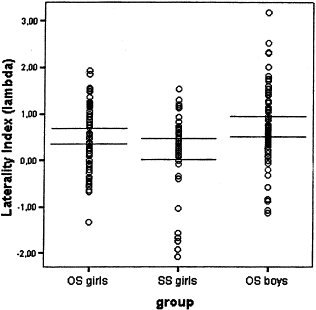
    Scattergram of the Laterality Index (LI; Lambda) as measured with the Dichotic Listening Task (DLT) for the Opposite-sex (OS) girls, Same-sex (SS) girls, and OS boys. The error bar represents the 95% mean confidence interval LI for each group.

    As you can see, the effect is persuasive, but not nearly categorical enough to motivate generic-plural statements about “male brains” and “female brains”.


    Note [5] backs up the assertion that “when Zoe and her friends talked endlessly about movies, fashion, and other girls, their combined voices just sounded like humming and buzzing to Jake’s ears. For him and the other guys, following the girls’ rapid musical banter was practically impossible.

    The note reads:

    Schirmer 2002 studied sex differences in neural processing of emotional words, and found the tone and meaning of emotional words were processed faster in females than in males.

    That’s A. Schirmer et al., “Sex differentiates the role of emotional prosody during word processing“, Cognitive Brain Research 14(2):228-33.

    At this point, you probably won’t be surprised to learn that there’s nothing whatever in that paper (whose authors are based in Leipzig) to support the notion that girls’ “combined voices just [sound] like humming and buzzing” to teen male ears. Nor does the research even support the weaker position that “the tone and meaning of emotional words were processed faster in females than in males”.

    In this study, lexical decision time (how long it takes to determine whether a stimulus is a word or not) was the dependent variable. The independent variables included whether words have a semantically “positive” or “negative” meaning (i.e. have happy or unhappy associations); whether they were preceded by an irrelevant (and semantically neutral) “priming” sentence produced with  a “happy” or “sad” intonation; and whether the priming sentence was 0.2 seconds before the target word, or 0.75 seconds before it.
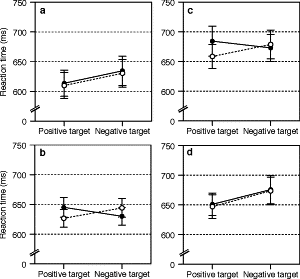
    Mean reaction times (±1 S.E.M.) for lexical decisions plotted as a function of target valence. Open circles together with dotted lines indicate a positive prime prosody, closed circles together with solid lines indicate a negative prime prosody. Experiment 1 (ISI 200 ms) is presented in (a), male subjects and (b), female subjects. Experiment 2 (ISI 750 ms) is presented in (c), male subjects and (d), female subjects.

    The sex differences were fairly small in all conditions — all the differences appear to be within a standard error, which since there were 16 subjects of each sex means that the biggest sex differences were about a quarter of standard deviation.

    The simplest way to describe the differences would be this. At the short (200 msec) inter-stimulus interval, the responses of the male subjects were (taken as a whole)  unaffected by the (happy or sad) prosody of the priming sentences. The only effect for the male subjects (in the short-ISI condition) was that positive-meaning target words were slightly slower than negative-meaning words. The female subjects (in the short-ISI condition) behaved roughly like the males (though  they reacted a little more slower) for the positive-prime prosody words, but for the words primed with a negative-prosody sentence, the positive-meaning words were on average a bit slower than the negative-meaning words.

    At the long (750 msec) ISI, the patterns of the male and female subjects were roughly reversed.

    The authors interpret this to suggest that the effect of the “happy” or “sad” intonation of the priming sentence was taking a few tenths of a second longer to affect the behavior of the males than the females. This is plausible, though other explanations also come to mind.

    But in any case, it’s not true that “the tone and meaning of emotional words were processed faster in females” — in the short ISI experiment, the word meanings seem to be processed faster by the males, though it’s plausible that the intonational priming is taking longer to have an effect.

    And there’s certainly nothing about this at all that provides any support whatever for the view that teen boys can only perceive teen girls’ speech as meaningless “humming and buzzing”.


    Discussion

    Q: So is it true that men tend to “tune out” what women say, more than women tend to “tune out” what men say?

    A: I’m not sure. This is certainly something that many people believe. Of course, many people believe that Blacks are lazy, Jews are greedy, Irish are drunks, Poles are stupid, and so on.

    Q: If it’s true, is it because men have less sensitive hearing, or because they simply can’t process women’s voices very well, at least after puberty?

    A: No, both of those ideas are complete nonsense, as far as I can tell.

    Q: Could it be because men are generally better than women are at focusing their attention so as to ignore auditory stimuli that they find uninteresting or obnoxious?

    A: Maybe — but the evidence for this is meager at best. In particular, I don’t know of any direct tests of the hypothesis. The only relevant evidence that Brizendine cites comes from a study where a small number of subjects were made to listen to music and to white noise, without being given any particular reasons or motivations to attend closely to any of the stimuli. (“Subjects were instructed to close their eyes, not to move during the scans, and to listen to the auditory stimuli”, but there was no task that tested whether they attended or not.)  PET scans suggested that the males tended to tune out the white noise more than the females did. The subjects were 10 male and female Dutch university students (whose backgrounds are not clear — perhaps the males were mostly drawn from a different subject area than the females?), in the context of an experiment run by women; so the universality of the results is open to question, as usual in sex-difference experiments done by psychologists.

    Q: Are there any other biological explanations still in the running?

    A: The effect of sex differences in ear-canal hair has never actually been tested, as far as I know. Really, old guys do tend to get hair in their ears. Must be there for something.

    Q: Is there any plausible reason to expect the biology to work according to this stereotype?

    A: Some have suggested that maybe there was an evolutionary advantage for (putatively male) hunters to be able to “tune out” irrelevant stimuli so as to keep their attention focused on potential prey animals. As with most other such plausible stories, there’s no evidence for this, as far as I know. And I suppose that you could make an equally plausible argument about how our female ancestors needed to be able to ignore distracting stimuli while engaged in delicate (putatively female) tasks like spinning, weaving and sewing.

    Q: MIght there be historical or cultural reasons for the stereotype of male inattention to female speech?

    A: You tell me…


    Well, in the unlikely event that you’re still reading, you’ve wasted another perfectly good hour on yet another application of explanatory neurophilia to gender stereotypes. Of course, wonky biological explanations are often cited in other areas as well:
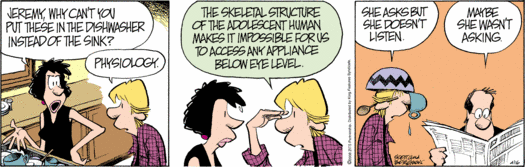
    Note that in this case, it’s the mom who “doesn’t listen”. Maybe she was exposed to too much of her son’s fetal testosterone.
  • Winners in 2010 NACLO competition

    The winners in the Fourth Annual North American Computational Linguistics Competition have been announced. The top eight scorers were:

    1st- Ben Sklaroff, Palo Alto, CA, Palo Alto High School
    2nd- Brian Kong, Milton, MA, Milton Academy
    3rd- Allen Yuan, Farmington Hills, MI, Detroit Country Day School
    4th- Daniel Li, Fairfax, VA, Thomas Jefferson High School for Science and Technology
    5th- Alan Chang, San Jose, CA
    6th- Alexander Iriza, Astoria, NY, The Dalton School
    7th- In-Sung Na, Old Tappan, NJ, Northern Valley Regional HIgh School at Old Tappan
    8th- Tian-Yi Damien Jiang, Raleigh, NC, North Carolina School of Science & Mathematics (Durham)

    1,118 students participated in the first round of the competition, held on February 4, and the top 100 scorers took part in a second round on March 10.  Squads formed from the best-scoring participants will be eligible to go on to the Eighth International Linguistics Olympiad, to be held in Sweden in July.  NACLO winners have done very well in previous Olympiads.

    According to the press release,

    Students compete in the Computational Linguistics Olympiad by solving challenging problems using data from a variety of languages and formal systems.  There is no pre-requisite knowledge.  Students discover facts about languages and formal systems in the course of solving the puzzles.  This year students solved a total of 16 problems, including deciphering the rules for a Pig-Latin-like play language in Minangkabau, the writing systems of Plains Cree, and the Vietnamese classic Tale of Kieu written in Chinese characters.    Computational problems dealt with text compression and automatic expansion of abbreviated words.

    For those interested in more detail, the NACLO website gives the problems from previous years. For example, the first problem in the invitational round of the 2009 competition involved figuring out a shift-reduce parser for the button presses in P-Little’s Triple-I XTreem Hyp()th3tica7 Sk8boarding Game;  the second one involves decoding Linear B; and the third one requires you to figure out some aspects of Bulgarian morphology.

    The NACLO website also explains the history:

    The idea of holding academic Challenges in linguistics stems from a long tradition of linguistics and mathematics competitions, which began in Moscow in the 1960s. In 1984, Bulgaria began holding similar competitions, and contests were first held in the United States at the University of Oregon starting in 1998. Bulgaria hosted the First International Olympiad in Linguistics in Borovetz in September of 2003, and subsequent International Olympiads have been held in Moscow, Russia in 2004, Leiden, The Netherlands in 2005, and in Tartu, Estonia in 2006. More recently, universities in Estonia, Finland, Netherlands, the United States, and other countries have begun sponsoring such outreach activities aimed at high school students. Participating as individuals and in country teams, students are given challenging sets of language data and language puzzles to solve, with the chance to win prizes and international recognition. Students learn about the richness, diversity and systematicity of language, while exercising natural logic and reasoning skills. No prior knowledge of languages or linguistics is necessary, but the competitions have proven very successful in attracting top students to study in the field of linguistics and computational linguistics.

    The North American Computational Linguistics Olympiad picks up on this long tradition, with a focus on computational thinking as it relates to solving linguistics problems. In addition to the traditional linguistics problems, NAMCLO endeavors to introduce students to computational problem solving as it relates specifically to natural language data.

    The people mainly responsible for creating this excellent institution are Lori Levin and Drago Radev.

  • Uh accommodation?

    In the course of an enjoyable conversation over lunch yesterday, Michael Chorost asked whether disfluency is contagious, in the sense (for example) that talking with someone who uses “uh” a lot would tend to lead you to behave similarly.  This seems plausible, since such effects can be found in most other variable aspects of speech and language use, so I promised to check — with a warning that causation is especially difficult to infer from correlation in such cases.

    As data, I used the transcripts of the Fisher English conversational speech corpus, recorded in 2003 and published by the LDC in 2004 and 2005. There are 11,699 conversations in all, or 23,398 conversational sides. As transcribed, the average number of words per conversational side is 960.

    The median rate of uh usage was about 2.6 per thousand words. But 8,494 of the 23,398 conversational sides (36%) had no instances of uh at all, at least as transcribed; and some had a lot — one conversational side had 80 uhs in 592 total words, for a rate of 135 per thousand.

    The correlation between the rates of uh usage on the two sides of a conversation was r= 0.383.  This is not especially high — it means that only about 15% of the variance in overall rate of uh usage is explained by knowing the interlocutor’s rate. Still, it’s certainly statistically significant.

    And some ways of looking at the relationship are more striking. Thus of the 4,235 conversations in which the A side never used uh, in 3,507 cases (83%) the B side also never used uh. In contrast, in the 7,464 conversations in which the A side used uh at least once, there were only 752 (10%) in where the B side failed to use uh.

    One graphical way to look at the relationship would be to compare the distribution of uh-usage rates for conversations where the partner’s uh-usage was greater than the median, to the distribution of rates in conversations where the partner’s uh-usage was less than the median. Here’s a “bean plot” that does this:

    I’ve plotted the square root of the rate of uh usage, just to spread out the distributions a bit. If we leave out the zero-rate cases, a comparison of the log of the uh-rate distributions is suggestive:

    A number of trivial explanations for this pattern come to mind. For example, transcribers sometimes edit out disfluencies (though the transcribers were instructed not to do so in this case), and so it’s conceivable that this correlation reflects variation in the behavior of the transcribers rather than variation in the behavior of the speakers.

    Assuming that the correlation is really a fact about the behavior of speakers, “accommodation” of filled-pause usage is not the only possible explanation for the correlation. There might well be shared factors (complexity of the subject-matter, for example) that would influence both participants at once.

    Finally, we know that rates of uh usage vary with age and sex. There’s no guarantee that this set of conversations is balanced for pairings of ages and sexes — in fact, the distribution of topics might well lead to sex or age correlations among speakers. So it would be helpful to use multiple regression to see if the interlocutor’s rate of uh-usage still had an effect, when sex and age were also included in the model.

    Still, I’ll take these results as tending to confirm Michael’s conjecture.

    (For the purposes of this little experiment, I didn’t check on uses of um or ah, and I should have included them as well.)

  • Pictish writing?

    According to Jennifer Viegas, “New Written Language of Ancient Scotland Discovered“, Discovery News, 3/31/2010:

    Once thought to be rock art, carved depictions of soldiers, horses and other figures are in fact part of a written language dating back to the Iron Age.

    The ancestors of modern Scottish people left behind mysterious, carved stones that new research has just determined contain the written language of the Picts, an Iron Age society that existed in Scotland from 300 to 843.

    The “new research” is described in Rob Lee, Philip Jonathan, and Pauline Ziman, “Pictish symbols revealed as a written language through application of Shannon entropy“, Proceedings of the Royal Society A, in press.

    The authors use an argument of the same general shape as the one used by Rao et al. in arguing for linguistic structure in inscriptions from the Indus Valley civilization (“Conditional entropy and the Indus Script“, 4/26/2009). They calculate certain statistical measures for some known writing systems, for things that are clearly not writing, and for the inscriptions in question, and they find that in terms of these measures, the inscriptions look more like the writing sytems than like the non-writing sets.

    The trouble with this form of argument is that it’s heavily dependent on the particular combination of statistical measure and comparison sets that we choose. And the argument is particularly unconvincing when there’s an obvious alternative choice of comparison set — generated by a simple random process — that would fall squarely on the side of the line that allegedly identifies “written language”.

    That’s what Cosma Shalizi, Richard Sproat and I (independently) argued in the case of the Rao et al. article (see here for details). And it looks to me as if the Lee et al. article on Pictish has got similar problems.

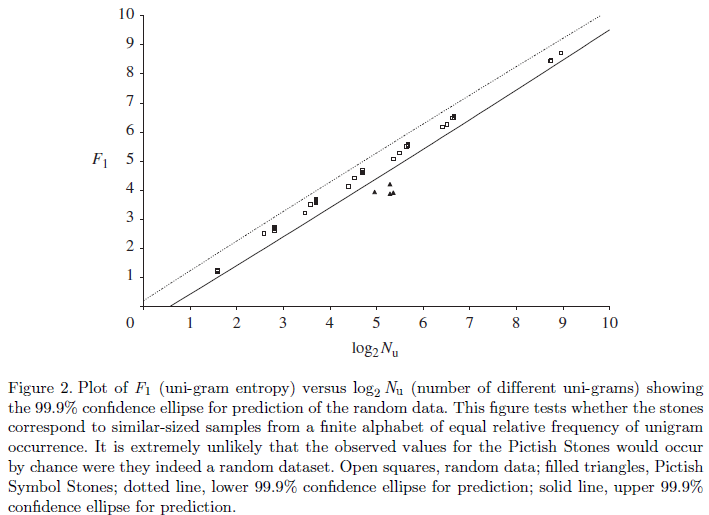
    Let’s take the first part of their argument, summarized in their Figure 2:

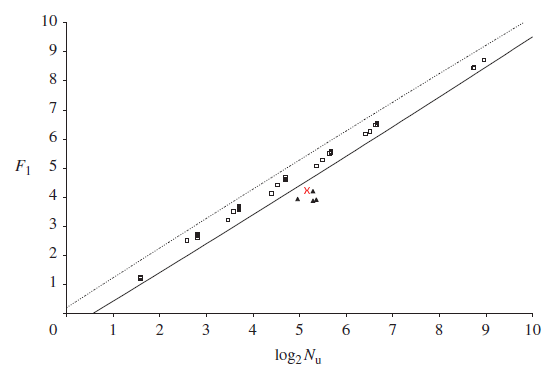
    This shows convincingly that the Pictish petroglyph symbols are not drawn randomly from a uniform distribution. But symbols in writing systems are hardly the only phenomena whose statistical distribution is non-uniform. For example, if we plot the outcome of rolling 7 6-sided dice on the same graph, we get the red x shown below:

    There are 36 possible outcomes (sums from 7 to 42), so that the x-axis value for the dice will be log2(36), or about 5.17. And these outcomes are not equally likely, since there’s only one way to roll 7, but 7 ways to roll 8, 28 ways to roll 9, etc. — so if we calculate the entropy of the 36 probabilities, we get about 4.22.

    I certainly don’t mean to suggest that the ancient Picts generated their petroglyphs using throws of 7d6. The point is just that any process that is (in effect) sampling from a distribution with the right number of alternative outcomes (about 35 to 40) and the right amount of non-uniformity (around 20% relative redundancy for unigrams) will look similar on this measure. And we don’t need to look very far to find a (non-writing-related) random process with these characteristics.

    Lee et al. go on to repeat the same form of argument using a number of more sophisticated measures. I haven’t evaluated these in detail. But the way that they present Fig. 2 is not a good sign, in my opinion.

  • Frontiers of animal communication research

    Google translate for animals:


    I need to point out that this is not an entirely new development. Hearsay, CMU’s early-1970s speech recognition system, was built using the best Artificial-Intelligence theories of the time:

    The system consists of a set of cooperating independent processes, each representing a source of Knowledge. The knowledge is used either to predict what may appear in a given context or to verify hypotheses resulting from a prediction. The structure of the system is illustrated by considering its Operation in a particular task situation: Voice-Chess. The representation and use of various sources of knowledge are outlined. Preliminary results of the reduction in search resulting from the use of various sources of knowledge are given.

    One of the “sources of Knowledge” was the state of the chess board and the list of currently-valid moves, arranged in rough order of plausibility. And the “source of Knowledge” representing the analysis of the acoustic input was somewhat, shall we say, open-textured. As a result, it was possible to play a decent game of chess against the machine by barking at it.

    A similarly Bayesian approach to pattern recognition is clearly built into this new animal-communication app.  A cough played to the cat-to-English translator produces the output “Might go out on the town tonight, don’t wait up!” The same sound, input to the dog-to-English engine, produces the output “Seriously, what’s with the stick thing? It’s getting old.”

    Some other prior art:

    The dogs of speech technology” (3/1/2005)
    It’s a dog’s life — 0.3 bits at a time” (1/19/2008)
    Dog language mailbag” (1/21/2008)
    Not Professor Milton, but Professor Schwartzman” (1/21/2008)

    Those looking for a niche not yet occupied might consider the possibility of incorporating chemical sensors into cell phones, allowing them to deal with the sorts of animal communication involved in an interesting recent paper by Fiona Berry and Thomas Breithaupt (“To signal or not to signal? Chemical communication by urine-borne signals mirrors sexual conflict in crayfish“, BMC Biology 8:25, 2010):

    Sexual selection theory predicts that females, being the limiting sex, invest less in courtship signals than males. However, when chemical signals are involved it is often the female that initiates mating by producing stimuli that inform about sex and/or receptivity. This apparent contradiction has been discussed in the literature as ‘the female pheromone fallacy’. Because the release of chemical stimuli may not have evolved to elicit the male’s courtship response, whether these female stimuli represent signals remains an open question. […]

    Urine-blocking experiments demonstrate that female urine contains sex-specific components that elicit male mating behaviour. The coincidence of chemical signalling and aggressive behaviour in both females and males suggests that urine release has evolved as an aggressive signal in both sexes of crayfish. By limiting urine release to aggressive behaviours in reproductive interactions females challenge their potential mating partners at the same time as they trigger a sexual response. These double messages should favour stronger males that are able to overcome the resistance of the female. We conclude that the difference between the sexes in disclosing urine-borne information reflects their conflicting interests in reproduction. Males discontinue aggressive urine signalling in order to increase their chances of mating. Females resume urine signalling in connection with aggressive behaviour, potentially repelling low quality or sexually inactive males while favouring reproduction with high quality males.

    This strikes me as a worthy continuation of D. Barry’s seminal work on gendered communication in herring.

  • Debogotification of English libel law?

    The England and Wales Court of Appeals delivered its judgment this morning in Simon Singh’s appeal of last year’s libel verdict against him.  This all began on April 19, 2008, when Singh wrote an opinion piece in the Guardian containing these sentences:

    The British Chiropractic Association claims that their members can help treat children with colic, sleeping and feeding problems, frequent ear infections, asthma and prolonged crying, even though there is not a jot of evidence. This organisation is the respectable face of the chiropractic profession and yet it happily promotes bogus treatments.

    The BCA sued for libel, and won an initial victory in May of 2009, when Sir David Eady, the presiding judge in the English High Court, decided that Singh’s piece involved assertions of fact rather than opinion, and that the word bogus in effect meant “fraudulent” and not just “ineffective”. This decision meant that in order to defend himself successfully, Singh would have to prove that the BCA was deliberately and knowingly dishonest in promoting treatments that it knew did not work.

    Although the Guardian withdrew the article, Singh chose to appeal Eady’s judgment, and attracted considerable support for his goal of keeping libel laws out of scientific debate.

    The Court of Appeals had this to say about the question of fact vs. opinion:

    One error which in Ms Page’s submission affects Eady J’s decision on meaning is that in §14, quoted above, he treats “verifiable fact” as antithetical to comment, so that any assertion which ranks as the former cannot qualify as the latter. This, it is submitted, is a false dichotomy. It led the judge to postulate the resultant issue as “whether those responsible for the claims put out by the BCA were well aware at the time that there was simply no evidence to support them”. This, he held, was “a matter of verifiable fact”.

    It seems to us that there is force in Ms Page’s critique – not necessarily because fact and comment are not readily divisible (that is a philosophical question which we do not have to decide), but because the subject-matter of Dr Singh’s article was an area of epidemiology in which the relationship of primary fact to secondary fact, and of both to permissible inference, is heavily and legitimately contested. The issue posed by the judge is in reality two distinct issues: first, was there any evidence to support the material claims? and secondly, if there was not, did the BCA’s personnel know this? If, as Dr Singh has contended throughout, the first issue is one of opinion and not of fact, the second issue ceases to matter.

    In our judgment Eady J, notwithstanding his very great experience, has erred both in conflating these two elements of the claim and, more particularly, in treating the first of them as an issue of verifiable fact.

    With respect to the question of deliberate dishonesty vs. careless disregard for evidentiary status, the court wrote:

    Once the allegation that there is “not a jot of evidence” to support the claims is properly characterised as a value judgment, the word “happily”, even if synonymous with “knowingly”, loses its sting. But we respectfully doubt whether the judge was justified in any event in attributing to the word any significance beyond, say, “blithely”. The natural meaning of the passage, in other words, was not that the BCA was promoting what it knew to be bogus treatments but that it was promoting what Dr Singh contended were bogus treatments without regard to the want of reliable evidence of their efficacy – a meaning which takes one back to the assertion that there was not a jot of evidence for the BCA’s claims.

    Milton is quoted, and not in a good way for the BCA:

    … the material words, however one represents or paraphrases their meaning, are in our judgment expressions of opinion. The opinion may be mistaken, but to allow the party which has been denounced on the basis of it to compel its author to prove in court what he has asserted by way of argument is to invite the court to become an Orwellian ministry of truth. Milton, recalling in the Areopagitica his visit to Italy in 1638-9, wrote:

    “I have sat among their learned men, for that honour I had, and been counted happy to be born in such a place of philosophic freedom, as they supposed England was, while themselves did nothing but bemoan the servile condition into which learning among them was brought; …. that nothing had been there written now these many years but flattery and fustian. There it was that I found and visited the famous Galileo, grown old a prisoner of the Inquisition, for thinking in astronomy otherwise than the Franciscan and Dominican licensers thought.”

    That is a pass to which we ought not to come again.

    The court’s conclusions could not, as far as I can understand them, be more favorable to Singh.  And the opinion further suggests that he may be succeeding in his quest to reform English libel law more broadly:

    It may be said that the agreed pair of questions which the judge was asked to answer … was based on a premise, inherent in our libel law, that a comment is as capable as an assertion of fact of being defamatory, and that what differ are the available defences; so that the first question has to be whether the words are defamatory even if they amount to no more than comment. This case suggests that this may not always be the best approach, because the answer to the first question may stifle the answer to the second.

    Towards the end of the judgment, the court cites “[r]ecent legislation in a number of common law jurisdictions – New Zealand, Australia, and the Republic of Ireland”, and quotes from the opinion of an American judge:

    We would respectfully adopt what Judge Easterbrook, now Chief Judge of the US Seventh Circuit Court of Appeals, said in a libel action over a scientific controversy, Underwager v Salter 22 Fed. 3d 730 (1994):

    “[Plaintiffs] cannot, by simply filing suit and crying ‘character assassination!’, silence those who hold divergent views, no matter how adverse those views may be to plaintiffs’ interests. Scientific controversies must be settled by the methods of science rather than by the methods of litigation. … More papers, more discussion, better data, and more satisfactory models – not larger awards of damages – mark the path towards superior understanding of the world around us.”

    I suspect that this sort of attention to legislation and legal opinion in other countries is not a normal part of English appeals-court judgments, and represents an implicit (and well-deserved) rebuke to the current state of the law of defamation in England and Wales.

    A response from the BCA is here.

    [Update — Commentary at libelreform.org; at senseaboutscience.org; by Jack of Kent; at the Guardian; at BBC News.]

    [Hat tip to Ian Preston.]

  • Debogosification of English libel law?

    The England and Wales Court of Appeals delivered its judgment this morning in Simon Singh’s appeal of last year’s libel verdict against him.  This all began on April 19, 2008, when Singh wrote an opinion piece in the Guardian containing these sentences:

    The British Chiropractic Association claims that their members can help treat children with colic, sleeping and feeding problems, frequent ear infections, asthma and prolonged crying, even though there is not a jot of evidence. This organisation is the respectable face of the chiropractic profession and yet it happily promotes bogus treatments.

    The BCA sued for libel, and won an initial victory in May of 2009, when Sir David Eady, the presiding judge in the English High Court, decided that Singh’s piece involved assertions of fact rather than opinion, and that the word bogus in effect meant “fraudulent” and not just “ineffective”. This decision meant that in order to defend himself successfully, Singh would have to prove that the BCA was deliberately and knowingly dishonest in promoting treatments that it knew did not work.

    Although the Guardian withdrew the article, Singh chose to appeal Eady’s judgment, and attracted considerable support for his goal of keeping libel laws out of scientific debate.

    The Court of Appeals had this to say about the question of fact vs. opinion:

    One error which in Ms Page’s submission affects Eady J’s decision on meaning is that in §14, quoted above, he treats “verifiable fact” as antithetical to comment, so that any assertion which ranks as the former cannot qualify as the latter. This, it is submitted, is a false dichotomy. It led the judge to postulate the resultant issue as “whether those responsible for the claims put out by the BCA were well aware at the time that there was simply no evidence to support them”. This, he held, was “a matter of verifiable fact”.

    It seems to us that there is force in Ms Page’s critique – not necessarily because fact and comment are not readily divisible (that is a philosophical question which we do not have to decide), but because the subject-matter of Dr Singh’s article was an area of epidemiology in which the relationship of primary fact to secondary fact, and of both to permissible inference, is heavily and legitimately contested. The issue posed by the judge is in reality two distinct issues: first, was there any evidence to support the material claims? and secondly, if there was not, did the BCA’s personnel know this? If, as Dr Singh has contended throughout, the first issue is one of opinion and not of fact, the second issue ceases to matter.

    In our judgment Eady J, notwithstanding his very great experience, has erred both in conflating these two elements of the claim and, more particularly, in treating the first of them as an issue of verifiable fact.

    With respect to the question of deliberate dishonesty vs. careless disregard for evidentiary status, the court wrote:

    Once the allegation that there is “not a jot of evidence” to support the claims is properly characterised as a value judgment, the word “happily”, even if synonymous with “knowingly”, loses its sting. But we respectfully doubt whether the judge was justified in any event in attributing to the word any significance beyond, say, “blithely”. The natural meaning of the passage, in other words, was not that the BCA was promoting what it knew to be bogus treatments but that it was promoting what Dr Singh contended were bogus treatments without regard to the want of reliable evidence of their efficacy – a meaning which takes one back to the assertion that there was not a jot of evidence for the BCA’s claims.

    Milton is quoted, and not in a good way for the BCA:

    … the material words, however one represents or paraphrases their meaning, are in our judgment expressions of opinion. The opinion may be mistaken, but to allow the party which has been denounced on the basis of it to compel its author to prove in court what he has asserted by way of argument is to invite the court to become an Orwellian ministry of truth. Milton, recalling in the Areopagitica his visit to Italy in 1638-9, wrote:

    “I have sat among their learned men, for that honour I had, and been counted happy to be born in such a place of philosophic freedom, as they supposed England was, while themselves did nothing but bemoan the servile condition into which learning among them was brought; …. that nothing had been there written now these many years but flattery and fustian. There it was that I found and visited the famous Galileo, grown old a prisoner of the Inquisition, for thinking in astronomy otherwise than the Franciscan and Dominican licensers thought.”

    That is a pass to which we ought not to come again.

    The court’s conclusions could not, as far as I can understand them, be more favorable to Singh.  And the opinion further suggests that he may be succeeding in his quest to reform English libel law more broadly:

    It may be said that the agreed pair of questions which the judge was asked to answer … was based on a premise, inherent in our libel law, that a comment is as capable as an assertion of fact of being defamatory, and that what differ are the available defences; so that the first question has to be whether the words are defamatory even if they amount to no more than comment. This case suggests that this may not always be the best approach, because the answer to the first question may stifle the answer to the second.

    Towards the end of the judgment, the court cites “[r]ecent legislation in a number of common law jurisdictions – New Zealand, Australia, and the Republic of Ireland”, and quotes from the opinion of an American judge:

    We would respectfully adopt what Judge Easterbrook, now Chief Judge of the US Seventh Circuit Court of Appeals, said in a libel action over a scientific controversy, Underwager v Salter 22 Fed. 3d 730 (1994):

    “[Plaintiffs] cannot, by simply filing suit and crying ‘character assassination!’, silence those who hold divergent views, no matter how adverse those views may be to plaintiffs’ interests. Scientific controversies must be settled by the methods of science rather than by the methods of litigation. … More papers, more discussion, better data, and more satisfactory models – not larger awards of damages – mark the path towards superior understanding of the world around us.”

    I suspect that this sort of attention to legislation and legal opinion in other countries is not a normal part of English appeals-court judgments, and represents an implicit (and well-deserved) rebuke to the current state of the law of defamation in England and Wales.

    A response from the BCA is here.

    [Hat tip to Ian Preston.]

  • Proper Topeka usage

    According to Eric Schmidt, “A different kind of company name“, The Official Google Blog 4/01/2010:

    Early last month the mayor of Topeka, Kansas stunned the world by announcing that his city was changing its name to Google. We’ve been wondering ever since how best to honor that moving gesture. Today we are pleased to announce that as of 1AM (Central Daylight Time) April 1st, Google has officially changed our name to Topeka.

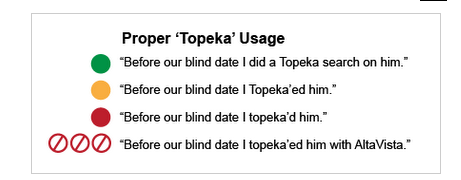
    Schmidt’s post includes some instructions on the proper use of the company’s new trademark:

    I was pleased to see that the instructions were graded as to degree of violation, rather than being an all-or-nothing matter.

    The new name is going to take some getting used to –

    Although we hate to see that jaunty Google logo going unused on the internet, an early-morning board meeting at Language Log Plaza decided that it would be inappropriate to dilute our brand equity by picking it up:

  • Teabonics?

    Pictures here.

    Including some nice examples of Muphry’s Law in action: