I don’t like dark rooms –it’s probably because I’ve lived in California most of my life so I’ve gotten used to having lots of ambient daylight. My heart sinks when I walk into a room in the middle of the day and it’s darker than a cavern. The guys in the office always know when I’m in the building because I flip the light switches as I walk through the building. Now let me make this clear… I don’t turn on the lights when there’s plenty of sunlight and I always turn the lights off when I leave the room (that is if I’m the last one leaving the room).
Anyway, the lighting fixture in our living room can fit three 100W lights and over the weekend one of the light bulbs unceremoniously fizzed out. Not a big problem because normally all I have to do is go to my trusty supply cabinet in the kitchen, find the right light bulb and replace the dead one. Unfortunately, we didn’t have any 100W light bulbs anywhere in the house– I had conveniently forgotten that the European Union had put a ban on the manufacture and import of them. You can’t find any of these contraband lights (including the 75W ones) in the shops although you can still buy them online (at least until the supplies run out).
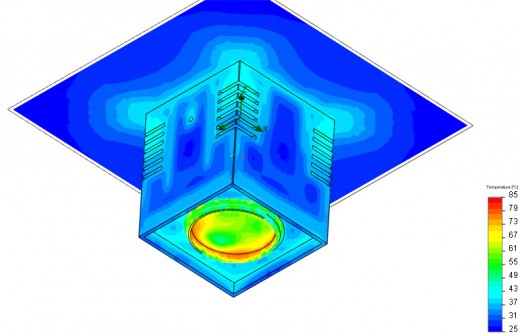
CFD analysis results on an LED light. Image courtesy of Voxdale.
I understand why the EU is pushing consumers towards more energy efficient alternatives.These light bulbs which have been lighting our homes for 100 odd years aren’t the most energy efficient. But I’m not a huge fan of those fluorescent low-energy lights (the light just doesn’t look right and they flicker). So it’s a good thing that there are other alternatives – among them LED lights. The useful life for an LED can range from 6,000 hours to more than 50,000 hours. To put that in perspective, good ol’ incandescent bulbs have a life of 2,000 hours. But LEDs run pretty hot; therefore, thermal issues need to be considered and dealt with during the design process. If I understand it correctly, 75% to 85% of the energy used to drive LEDs is converted to heat and therefore must be conducted from the LED die. As the leaders in thermal simulation, we have many customers who use simulation in their LED design efforts. Among them is a Belgian engineering consulting firm named Voxdale. The team at Voxdale have designed several LED lights for their customers and have gotten the design process down to an art-form — they solve power LED thermal management problems in just one day!
In a conversation with the president of Voxdale, Koen Beyers, he mentioned that one of their customers, a lighting system manufacturer, built a prototype of a new design and discovered that the temperature of the LED rose above its maximum operating temperature rather quickly. Because the manufacturer wanted to get their product to market quickly, they didn’t have the time to optimize the thermal design the traditional way (modify and test the prototype multiple times). So the team at Voxdale solved their problem in under one day. Considering how quickly the LED market moves, any time saved in the product design process is an advantage. Anyway, if you’d like to read more about how Mr. Beyers’ team solved this LED thermal problem, please click here.
And if you’d like to learn more about solving thermal issues of LEDs, please download a copy of this whitepaper: Solving the System-Level Thermal Management Challenges of LEDs This white paper describes the use of CFD for LED lighting products. CFD simulation helps manufacturers optimize the design of heat sinks and other parts of the luminaire to produce low-cost, high performance products. Happy reading!
Until next time,
Nazita