Let’s see a show of hands. How many of you know what I’m talking about? Yes, this was the call to action for Speedy Gonzales, the fastest cartoon mouse (and before the lawyers get involved, Speedy Gonzales and Looney Tunes are trademarks and or trade names of Warner Brothers. All rights reserved). A direct translation of it means: Up! Up! Go on! Go on! And he’d usually yell it out before speeding off to his next adventure. I can still hear myself reciting it when I drove my very first sports car on the freeway during the early morning hours oh so many moons ago.
Now I chant it under my breath when I see Concurrent CFD in action. This type of simulation software is named Concurrent because CFD is fully embedded in CAD; as a result, you can conduct fluid flow and heat transfer analysis throughout a product’s design process. When you’re ready to analyze your new model, you simply prepare it for analysis right there and then inside CAD without transferring your data to another software or person. There’s been a fair amount of press on it lately so I won’t go into too much detail here. But the reason why Concurrent CFD reminds me of Speedy is that Concurrent CFD can reduce simulation time by as much as 65 to 75 percent in compare to traditional CFD tools. ¡Ándale! ¡Ándale!
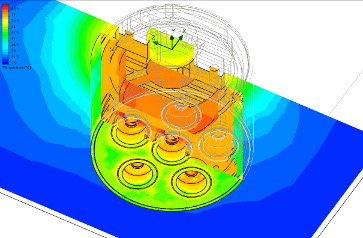
Analysis results on an LED light. Image courtesy of Voxdale.
While all markets and products are time sensitive to a certain degree, the electronics market seems to be an extremely fast moving one. Every day we are bombarded by ads showcasing the latest/newest/shiniest mobile phone. TVs are getting bigger and thinner by the hour. In short, time is of essence for companies developing any electronic product. So it would be helpful to do thermal validation and optimize airflow as quickly as possible. If you’re involved in electronics design and are interested in how Concurrent CFD can help, then I’d like to invite you to the Concurrent CFD for Electronics Cooling Applications online presentation. During this 45-minute presentation Travis Mikajaniec will give you a bit more background information on Concurrent CFD and show you how to take advantage of it to make your life a whole lot easier. Hope to see you there.
Until next time,
Nazita