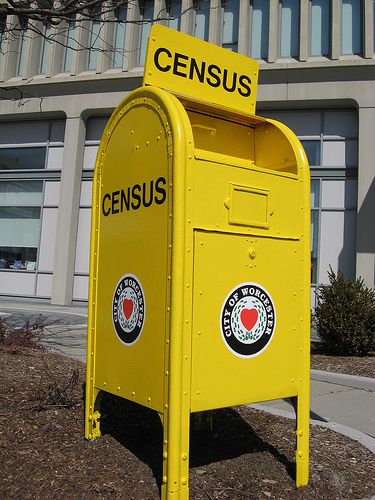
 The 2010 U.S. Census is about to hit full swing, and it’s critical that we commit to counting everyone.
The most directly pertinent census issue to the criminal justice system is the colossal mistake of counting prisoners where they’re incarcerated instead of where they’re from.
As Elena Lavarreda wrote recently in an excellent piece on change.org, counting prisoners in rural districts gives undue political influence to farmlands while robbing power from poor inner-city populations. This is a critical issue and it needs to be addressed.
But there’s a broader issue, too. Not only will poor urban communities be counted without their prisoners, they’ll also be missing more than a million people the census classifies as Hard to Count. This includes people with no fixed address, or people who stay in a public housing unit but aren’t on the lease. These are people who might not be around on the day the count happens, or might be suspicious of a guy from the government coming to count them. Every person the census misses means lost services for the community and exacerbates the cycle of poverty.
When urban populations are undercounted, they are denied critical government support. Funds that would improve inner-city schools or police cars are instead diverted elsewhere. The last census, in 2000, missed 1 million people color, according to the NAACP’s Legal Defense Fund. More than 600,000 of them were African-American.
Some states are hit harder than others. The Census Bureau classifies 30 percent of California’s population as Hard to Count, and a Brookings Institute study found that for each person missed by the national count the state — and potentially the district — loses $1,600 in federal assistance.
This is the vicious cycle of the census. When inner-city schools and services are shortchanged, the quality of education suffers. And when educations suffers, the dropout rate soars. And then? More young men go to prison. Once they’re locked up, they’ll be counted everyday — but in the wrong place.
Fixing the prisoner miscount loophole is an important step in the process of ensuring fair representation for inner-city populations. But the bigger step for census justice comes in committing to count every last person, whether it’s through aggressive outreach or even data sampling.
Photo: Mike Benedetti