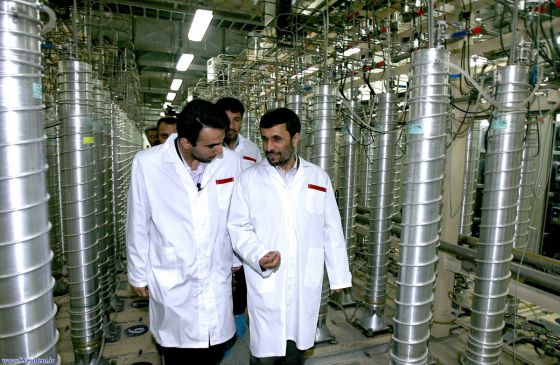
Note: Two previously overlooked estimates have been added to the data table, and the “observations” section updated accordingly.
Last week, at an event sponsored by AAAS (depicted above*), I had the privilege of giving a presentation on “Expert Opinion on Iran’s IR-1 Centrifuge.” The session was off the record, but I can share with you, Dear Reader, a data table assembled for the occasion, along with a few observations.
This table is an amended version of the data previously assembled by the Federation of American Scientists (see Table 1 in this report). I’ve tinkered with this dataset before (see: Estimating SWU with Expert Opinion, December 6, 2009). The amended table covers every published estimate of the separative power of the IR-1 centrifuge that I could find, running from March 2003 to December 2009. Explicit repetitions of previous estimates [or estimates explictly derived from earlier estimates] are not included.
(N.B. “Actual” indicates the mean performance of actual devices. “Nominal” indicates the maximum power of the device on paper. Despite some ambiguities, it’s usually apparent from context which type of estimate is intended, when not stated directly. For example, I’ve tagged as “nominal” those estimates that relate to the machines believed by different experts at various points to be ancestors of the IR-1.)
There are 29 31 estimates, although some of the “nominal” estimates from ISIS appear to be repetitions. (More on this point in a few moments.) Here it is: the whole megillah.
Note: Thanks to Scott Kemp for the clarification on his 5/27/08 estimate, which was actually two estimates. Thanks also to Andreas Persbo for the similar observation about his estimate of 2/27/09. I’ve corrected the table to reflect both of these inputs. I’ve also corrected a few minor errors and inconsistencies.
| Author(s) | Data source(s) | kg SWU/yr | Estimate of | Date |
|---|---|---|---|---|
| Hibbs | Official sources | 7 to 15 | Actual | 3/13/03 |
| Hibbs | IAEA sources | 12 to 14 | Actual | 5/12/03 |
| Hibbs | AEOI data | 6 to 7 | Actual | 5/12/03 |
| Albright & Hinderstein (ISIS) | Senior Western officials | 2 | Actual | 9/1/03 |
| Albright & Hinderstein (ISIS) | Senior IAEA officials (stated subsequently) | 3 | Nominal (based on 4M) | 3/1/04 |
| Gilinsky, Miller, & Hubbard | Unclassified sources (and educated guesses) | 1 to 3 | Actual | 10/22/04 |
| Hibbs | IAEA and Western governments | 2 | Nominal (based on SNOR & CNOR) | 1/31/05 |
| Glaser | (not stated) | 2 | Nominal (estimate of P-1) | 6/14/05 |
| Lewis | Rademaker (USDOS) statement | 2 < and < 3, closer to 2 | Actual | 4/15/06 |
| Lewis | Aghazadeh (AEOI) statement | 2.3 | Actual | 4/18/06 |
| “Feynman” via Lewis | Aghazadeh (AEOI) statement | 1.46 | Actual | 5/12/06 |
| “Feynman” via Lewis | Aghazadeh (AEOI) statement | 2.3 | Nominal | 5/12/06 |
| Albright (ISIS) | Aghazadeh (AEOI) statement | 1.4 to 2.7 | Actual | 5/17/06 |
| Albright (ISIS) | (not stated) | 2.5 to 3 | “the high end of the possible” | 7/1/06 |
| Albright & Shire (ISIS) | Level Pakistan is said to have achieved | 2 | Actual of P-1 | 11/1/07 |
| Garwin | Aghazadeh (AEOI) statement | 1.362 | Actual | 1/17/08 |
| Glaser | (not stated) | 2.5 | Nominal (hypothetical max. of P-1) | 4/16/08 |
| Kemp via Lewis | Observed efficiency of 42% | 1 | Actual | 5/27/08 |
| Kemp via Lewis | (not stated) | 2.5 | Nominal | 5/27/08 |
| ISIS NuclearIran FAQ | (not stated) | 1 to 2 | Actual | ~9/1/08 (n.d.) |
| ISIS NuclearIran FAQ | (not stated) | 3 | Nominal | ~9/1/08 (n.d.) |
| Persbo | Cascades operating between 27 and 36% of total capacity | 0.59 to 0.79 | Actual | 2/27/09 |
| Persbo | (not stated) | 2.2 | Nominal (based on SNOR) | 2/27/09 |
| Salehi (AEOI) | (not stated) | 2.1 | Unclear; nominal? | 9/22/09 |
| Oelrich & Barzashka (FAS) | IAEA reports | 0.5 | Actual | 9/25/09; see also 11/23/09 |
| Wisconsin Project | IAEA reports | 0.5 | Actual | 11/16/09 |
| Albright & Brannan (ISIS) | IAEA reports | 1.0 to 1.5 | Actual | 11/30/09 |
| Albright & Brannan (ISIS) | (not stated) | 3 | Nominal | 11/30/09 |
| Oelrich & Barzashka (FAS) | IAEA reports | 0.44 to 0.88 (0.88 is highly unlikely) | Actual | 12/1/09 |
| Kemp | IAEA reports | 0.6 to 0.9 | Actual | 12/1/09 |
| Wood via Kemp | Max. of P-1 based on validated hydrodynamic codes from the U.S. program | 2.1 to 2.2 | Nominal (max. of P-1) | 12/1/09 |
Four Observations
First, as noted previously, the trend of the estimates declines with time. This effect only becomes more pronounced with the inclusion of the estimates reported by Mark Hibbs in NuclearFuel and Nucleonics Week in early 2003: now the trend of the decline is follows an exponential curve. These reports appeared when IAEA inspectors had just put eyes on the IR-1 (then called the P-1 in IAEA reports) for the first time. Their initial frame of reference presumably involved more up-to-date machines, rather than centrifuges whose design heritage extends back to the 1960s.
[Update | 22:54. See Mark Hibbs’ account in the comments below.]
Second, the decline comes in bursts, coinciding with the availability of new information. This effect is loosely similar to the influence of news on stock prices, as documented in event studies. The effect tends to be prompt in finance; a bit less so here.
- From mid-2003 into 2005, which covers the first period of centrifuge operations at PFEP in Natanz, we see the gradual sorting-out of the design heritage of the IR-1.
- The next wave comes in mid-2006, right after AEOI chief Gholamreza Aghazadeh gave some detailed figures during an interview with Iranian TV. Here we start to see some divergence between “actual” and “nominal” estimates, with “actual” figures falling below 2 kg SWU/yr.
- Next come the estimates of late 2007 to
early 20092008, after the commencement of enrichment work at the FEP in Natanz, whose results were periodically documented in IAEA reports.
- A final burst of estimates, explicitly derived from the ever-accumulating IAEA reports, takes place in
late2009. Here, “actual” estimates fall below 1 kg SWU/yr.
Third, in most cases, a “new entrant” tends to lead the way in pushing “actual” estimates down. That is, someone who wasn’t previously in the game seems to take hold of the new information and bring it to light, with the rest shortly catching up. In 2003 and 2004, it was David Albright and Corey Hinderstein of ISIS. In 2006, it was Jeffrey Lewis and a pseudonymous correspondent here at ACW. In 2009, it was Ivan Oelrich and Ivanka Barzashka of FAS.
[Update | 23:51. In hindsight, Andreas Persbo was the first to present an “actual” estimate below 1, using recent IAEA reports. This contribution may have been overlooked because it was couched as a range of percentages of a nominal figure.]
Fourth, there are lingering differences between experts in both “actual” and “nominal” figures. Much of the basis of the “actual” differences was laid bare in the FAS–ISIS debate of late 2009. The “nominal” differences seem to originate with early reports about the design heritage of the IR-1. In March 2004, ISIS related that the IR-1 was copied from URENCO’s 4M centrifuge; both designs have four aluminum tube rotor segments. In January 2005, Hibbs reported that the IR-1 was derived from URENCO’s SNOR and CNOR machines.
Both 4M and CNOR are said to have been capable of about 3 kg SWU/yr. The CNOR had six segments, each responsible for about 0.5 kg SWU/yr, according to Hibbs. Since the Pakistani P-1 and the Iranian IR-1 have four segments, their nominal output, if they are understood to be CNOR derivatives, is about 2 — or, according to some recent figures, 2.1 or 2.2. Most experts seem to agree with Hibbs, or wind up close to his figure. But Albright and colleagues persist in viewing 3 as the real ceiling.
Should you, Dear Reader, notice any other subtle patterns in the data, well, that’s what the comments feature is for!
*Actually, the picture at the top of this post does not show me giving a presentation.