Alexander Graham Bell patented the telephone in 1876. In 1880, Mark Twain wrote a comic sketch about how strange it is to overhear one end of a telephone conversation. A century and a quarter later, people have gotten used to the experience with landlines — or at least stopped complaining about it — but we still tend to perceive overheard cell phone conversations in public places as more distracting and annoying than real-life conversations, even when the real-life conversations are just as loud or even louder.
Now there’s increasing experimental evidence that phone conversations are not only cognitively more troublesome than in-person conversations for outsiders, they’re more difficult for participants as well. One recent study interviewed pedestrians who had just walked along a 375-foot path across an open plaza where a clown on a unicycle was riding around. Only 2 out of 24 cell phone users reported seeing the clown. In comparison, the unicycling clown was reported by 12 out of 21 people involved in real-life conversations as they walked the same path.
The abstract of Ira Hyman et al., “Did You See the Unicycling Clown? Inattentional Blindness while Walking and Talking on a Cell Phone“, Applied Cognitive Psychology 2009:
We investigated the effects of divided attention during walking. Individuals were classified based on whether they were walking while talking on a cell phone, listening to an MP3 player, walking without any electronics or walking in a pair. In the first study, we found that cell phone users walked more slowly, changed directions more frequently, and were less likely to acknowledge other people than individuals in the other conditions. In the second study, we found that cell phone users were less likely to notice an unusual activity along their walking route (a unicycling clown). Cell phone usage may cause inattentional blindness even during a simple activity that should require few cognitive resources.
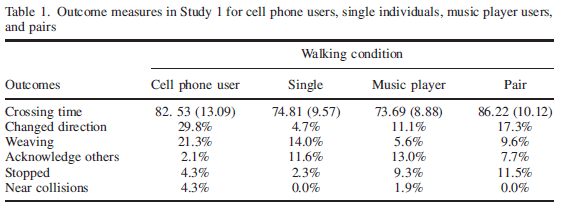
Actually, the conversational pairs in their Experiment 1 seem to have taken longer to cross the square than the cell phone users, and to have stopped more often, though they did less weaving and direction changing:
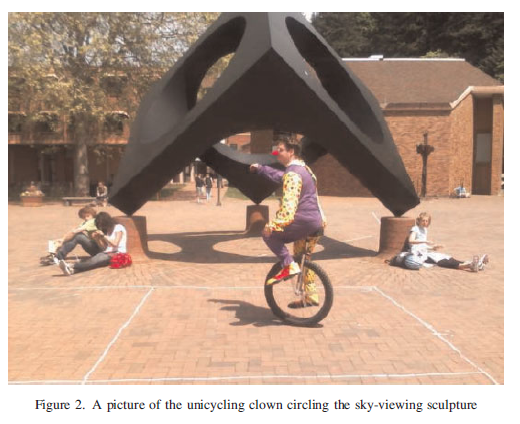
Here’s the clown from Experiment 2:
A description of the method and the numbers of subjects in each category:
Observations were collected of individuals walking along the same diagonal path used in Experiment 1. Observers were positioned at both ends of this path and attempted to interview all individuals who exited Red Square classifiable under any of the same four conditions. We interviewed 151 individuals (67 classified as males, 84 as females; 139 classified as college-age, 10 as older and 2 as unsure). Of these individuals, 78 were single individuals without electronics, 24 were cell phone users, 28 were music player users and 21 were part of a pair (for pairs, observers interviewed the closest individual).
And here’s the table of results:
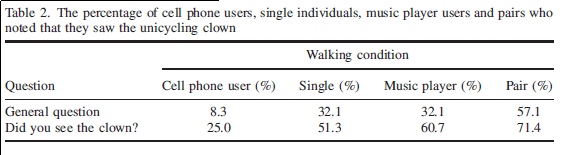
The real-life conversational pairs in fact noticed the clown more often than the unoccupied single pedestrians, perhaps because they walked more slowly and stopped more often, and perhaps because if one participant noticed the clown, he or she pointed it out to the other.
(The overall rates of clown-noticing were fairly low, apparently not because unicycling clowns are routine on the campus of Western Washington University, nor because WWU students are unusually inattentive, but rather because the clown was a bit off to the side of the diagonal path across the plaza where the experiment was conducted.)
As the study’s authors observe, there are quite a few alternative explanations for the effect, and more than one of them may be true:
One possible explanation for the effect of cell phone conversations is that they cause a particular drain on attentional resources and thus lead to inattentional blindness. Fougnie and Marois (2007) argued that divided attention tasks that drain central executive processing capacity are more likely to produce inattentional blindness. Similarly, Strayer and Johnston (2001) found that cell phone conversations were particularly disruptive in comparison to listening to books on tape, a radio broadcast, or shadowing using a cell phone. Something about the conversation seems to limit attentional capacity. We, like other researchers, found that having a conversation with a person next to you did not increase inattentional blindness (Crudell et al., 2005; Hunton & Rose, 2005; Strayer & Drews, 2007). Similarly, Klauer et al. (2006) reported that a passenger in the adjacent seat decreased accident rates whereas a cell phone conversation increased accident rates. Strayer and Drews (2007) suggested that in-vehicle conversations are less problematic because the driver and the passenger can more easily coordinate the conversation with the driving demands. Klauer et al. (2006) suggested that two observers increases the odds of noticing important aspects of the driving environment and our finding that pairs were more likely to see the clown is consistent with this point. Of course there are other differences between conversing with someone who is present and someone via a cell phone that may contribute to inattentional blindness. For example, the degraded sound quality of cell phone conversations may require more attentional resources to process both the content and the precise timing of turn-taking. In addition, an absent partner may cause an individual to engage visual processing to imagine the other person. This additional visual interference may increase inattentional blindness.
[And yes, people are quite capable of extraordinary levels of inattentional blindness even when no conversations of any sort are involved.]
[Update — I should add, since I’ve made this point in other cases, that this is a relatively small study, carried out in a specific social setting, involving a limited sample of subjects. And the fact that the results are consistent with expectations (including mine) is perhaps a reason to be more skeptical, not less. (As Dick Hamming used to say, we should always beware of finding what we’re looking for.) Still, I’ll take this study as increasing the plausibility of the view that cell phone conversation tends to soak up attentional resources in a way that face-to-face conversation doesn’t.]