 In a twist of affairs, one of the most egregious juvenile court scandals in recent memory could actually mean more future openness in Pennsylvania’s courts.
Former Luzerne County judges Mark A. Ciavarella Jr. and Michael T. Conahan, who allegedly took $2.6 million in bribes from a private prison operator in exchange for sentencing kids to company facilities, are awaiting trial on racketeering charges. In the meantime, the state has kicked off hearings on how it might prevent such a nightmare in the future.
As one witness, Robert G. Schwartz, executive director of the Juvenile Law Center, told the commission on Thursday, what happened in Luzerne County “was a toxic combination of for-profit facilities, corrupt judges, and professional indifference.” Accordingly, juvenile justice experts recommended to the commission that the state open up juvenile courts to the public, and ensure that juveniles consult with lawyers before hearings.
Most juveniles on the conveyor belt before allegedly corrupt judges Ciavarella and Conahan waived their rights to see a lawyer — Ciavarella even had a table set up for juveniles to fill out forms, expediting the process. This was, plainly, a system ripe for abuse.
Many juvenile courtrooms across the country are not fully open to the public, in an effort to protect the privacy of sensitive juvenile defendants. While a valid purpose, anything can happen in a closed courtroom, and there are ways to ensure privacy in special cases while letting a little sunlight into the room.
The commission will hold several more hearings and deliver a report recommending juvenile justice reforms by May 31.
But, as an editorial in Saturday’s Phildelphia Inquirer points out, problems with the juvenile justice system extend far beyond the case of two judges sending kids to jail for cash. After all, conditions in public and private juvenile facilities across the country aren’t pretty, either. A recent report found that 12% of incarcerated juveniles in the U.S. report being sexually assaulted, often by facility staff — — findings which Pennsylvania officials were “reluctant” to accept, says the Inquirer.
For now, while the commission is hearing some good recommendations on how to protect juveniles inside the courtroom, considering the conditions youth face once they’re behind bars, that’s just a start.
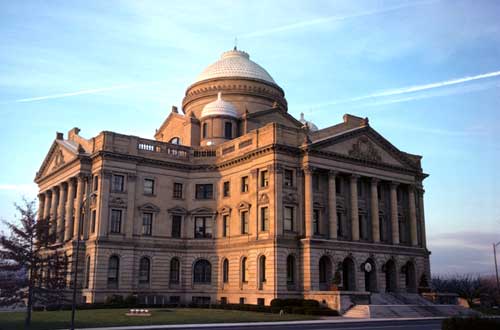
Photo Credit: Luzerne County Courthouse