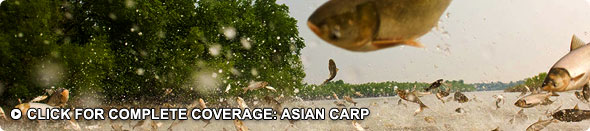
Circle of Blue talks with U.S. Rep. Dave Camp (R-Mich.) about fighting the Asian carp battle on the federal front.

By Steve Kellman
Circle of Blue
U.S. House Representative Dave Camp represents a legislative district that covers a huge swath of Michigan’s lower peninsula including the Leelanau Peninsula that juts into Lake Michigan. In January, the Michigan Republican introduced the Close All Routes and Prevent Asian Carp Today bill, also known as the CARP ACT, to the House.The proposal seeks to make actionable the legal motion filed by Michigan Attorney General Mike Cox to the U.S. Supreme Court in December. The Court rejected the motion to close canals and locks to the Great Lakes a month later.
In announcing his proposal, Rep. Camp noted that recent environmental DNA tests suggest that at least some Asian carp have already gotten into Lake Michigan.
Circle of Blue caught up with Rep. Camp earlier this month in Traverse City where he appeared with Attorney General Cox and other state officials during a rally to block the carp from entering the Great Lakes. Camp discussed his legislative efforts to stop the potential Asian carp threat from becoming a reality.
Can you describe the goals of your legislation?
What we want to try to do is keep the Asian carp out, and we believe that closing the canals and the locks is the first thing to do. Then we can address how to continue to operate barge traffic and recreation and other things. The concern is that the eDNA sampling results show that it may be too late. It’s important that we act and we act now, and we act decisively.
Your legislation, the CARP ACT, does have study and mitigation aspects?
It does. It’s about trying to find solutions to the concerns that the Chicago-and northern Indiana-area has raised. The main one we’ve [Michigan] raised is flooding. We want to make sure there are proper procedures in place so that homes and businesses don’t flood. [Closing the locks] is not a win-win for anybody, but I think it’s important that we do that.
Obviously they’re also concerned about any economic impact, but I think it’s important to get the information out about what the alternatives are. What actually is the level of barge traffic? What are the economic needs? How many jobs would be lost and what is the tradeoff? How does that compare to the potential job loss and economic damage if Asian carp were to get into the lakes?
We need to do some education. We need to make sure people understand what their choices are. We’ve gotten some attention with the new federal dollars we got from the appropriations process last year and from the president’s announcement recently. But it’s not just about dollars, we need some action. This is an issue that’s been out there for quit a while.
How long have you been working on this issue?
I really got involved in 2006 to try to get funding for the first electronic barrier and then we found out how inadequate that was and obviously there were some succeeding appropriations for other barriers. What really has been most troubling is it’s been a stop-gap approach, with no comprehensive solution or addressing of the concern. So while an electronic barrier is like sticking your finger in the dike, we really need to figure out how to design the berms, the locks, any sluice gates and any barriers. How do you look at the entire area and issue so that we can prevent Asian carp from getting into Lake Michigan?
There are two petition sites up now. Attorney General Mike Cox is behind one, and Michigan House Democrats have put up another one. Do you worry that the issue might become overly politicized?
I don’t think it is. I agree with Governor Granholm 100 percent on this issue. She’s called for closing the locks, so have I and so has Sen. Stabenow (D-Mich). Legislation is moving through Congress by a Republican in the House, a Democrat in the Senate, and with bipartisan co-sponsorship. I’m not too worried about Web sites and resolutions, although those are helpful. If we can reach people that check our Web sites, that can only help our issue. I haven’t seen their site, but I think the result is probably very similar to the result we’d like.
What’s your opinion of the Asian Carp Control Strategy Framework in general?
So far I think it’s been inadequate. There are several agencies involved and obviously there has to be coordination with state environmental offices as well. I don’t think the coordination has been good enough. I don’t think the agencies have really tried to, in a comprehensive way, address the problem. There’s been some good people working on it and they’ve taken it seriously, but we really need some direction from the top.
We just had a meeting, House and Senate members from the Great Lakes region, with the secretary of the Army Corps of Engineers where she was mispronouncing the names of the rivers. I asked if she’d been there and she said ‘no.’
I told her that’s part of the problem–we really don’t have people at the top levels taking this seriously, and making this a priority for federal agencies. We’re starting to get that attention, but we need to continue to push for it.
Steve Kellman is a reporter for Circle of Blue. Contact Kellman at [email protected] and read more of our carp coverage here.