One of the things that has always stuck in my mind from my childhood addition to science fiction was Robert Heinlein’s explanation of rocket guidance, where a special “cam” was machined to control the trajectory of a rocket every time it took off. The cam would be rotated with a constant speed and its radius at any given point would determine the average direction of the thrust. It turns out that exactly the same method is used in SCUD’s. (I’m not surprised, really. The reason I loved Heinlein’s books was the fact that he was a “hard core” science fiction writer who obviously calculated interplanetary trajectories to make sure his stories had the ring of truth in them.) In the case of the SCUD, a constant rate step motor turns an odd shaped cam that, in turn, adjusts a potentiometer. At that point, the potentiometer changes the average setting of the jet vanes that control the direction of the SCUD’s thrust. Of course, on top of this average motion, the guidance system—the various gyros and accelerometers—determine small displacements from the average in order to keep the wind and other disturbances from effecting the trajectory.
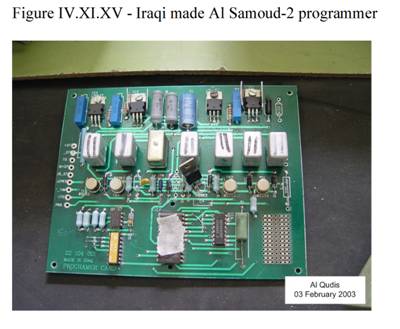
The SCUD is optimized for operating in the field and I can imagine that its Russian engineers first selected a mechanical “computer” for its ruggedness. However, it also might have had other advantages over more general purpose digital computers. It’s hard to imagine weight being one of those advantages given today’s computers but it might for a country just starting out designing a missile’s guidance system if you include all the adjunct equipment that would be needed such as digital-to-analog converts with enough power to control the jet vane actuators. Be that as it may, Iraq as late as 2002 was using an analog computer (electrical this time, not electro-mechanical as was the SCUD pitch controller) to control the pitch. This image of the Al Samoud II pitch “programmer” is from the UNMOVIC compendium:
I think this establishes, if it doesn’t quite explain why, a tendency for countries just starting out in developing their own missiles to use analog computers their guidance systems. Perhaps the reason is simply that analog computers are a logical next step from the systems—i.e. SCUDs—that they are used to. Of course, it doesn’t prove that a country, such as Iran, would use an analog computer but I find it suggestive. Let us, for the moment, assume that is the case. That might explain why Iranian documents suggest that the Safir uses radio guidance during its flight into orbit. Another possibility, one that I’m still working on, considers the impact of a long period of a pure gravity turn, where the average thrust is directly exactly opposite the vehicles velocity vector. (SCUDs and the Al Samoud II use a pitch program that approximates a pure gravity turn—after a substantial “kick” to get it moving in the right direction—by constantly changing the angle the thrust makes with the horizontal.) A trajectory based on a pure gravity turn appears to be very sensitive to the exact attitude of the missile when the “kick” is turned off. The long burn time associated with rockets like the Safir (which, according to some estimates, has a burn time of over 400 seconds) could allow those errors to accumulate and possibly prevent it from inserting its satellite into orbit. Ground-based radio guidance could provide an easy—and possibly quickly achieved—solution, especially if the Safir’s position is determined by GPS as was hinted at in the memos. That brings us back to the Safir and this image of a radio or radar dish displayed at the recent Space Days in Tehran:
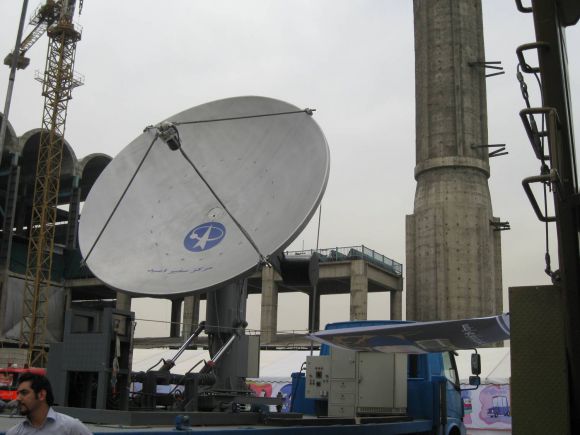
This could be used for any number of signals associated with Safir (or, to be complete, it could have nothing to do with the Safir). It is, however, very unlikely to be associated with telemetry from the Omid satellites. That is, as I showed in an earlier post, handled by a different antenna. So this dish could be used simply for telemetry from the rocket during boost. Or also for sending back to the missile guidance commands. Unfortunately, we cannot see the attachment of the dish to the support column so we cannot determine if it can be slewed fast enough to follow the flight of the missile.
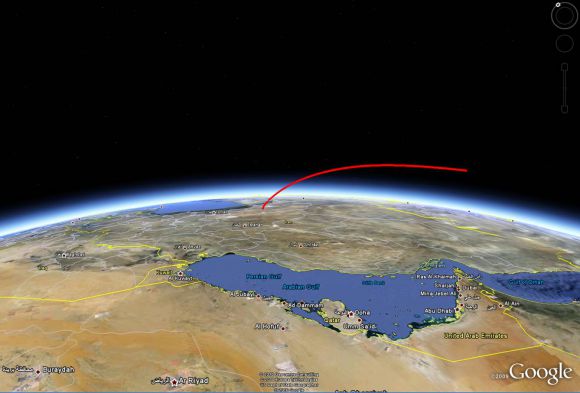
If it does follow the trajectory of the Safir, it does not need to be positioned very far down range to see the entire powered flight of the space launch. In fact, burnout of the Safir—which occurs about 920 km down range—is still visible at the launch pad with an elevation of 10 degrees. To complete the argument, there is an antenna mounted on the Safir airframe (and which all the photos of the Safir that I have seen have managed to minimize) that would suit this purpose very well. It is mounted over Fin I, which is aligned with the trajectory so that it is always pointed down toward the Earth during powered flight. This facilitates its visibility to such a ground station.
If this chain of argument, which heavily relies on the information found in the Iranian documents, implies that Iran has not assimilated guidance and control (G and C) technology enough to fabricate its own system suitable for use in space launch. It also shows, however, that Iran wants to solve this problem itself as much as possible and not rely on importing complete G and C systems.
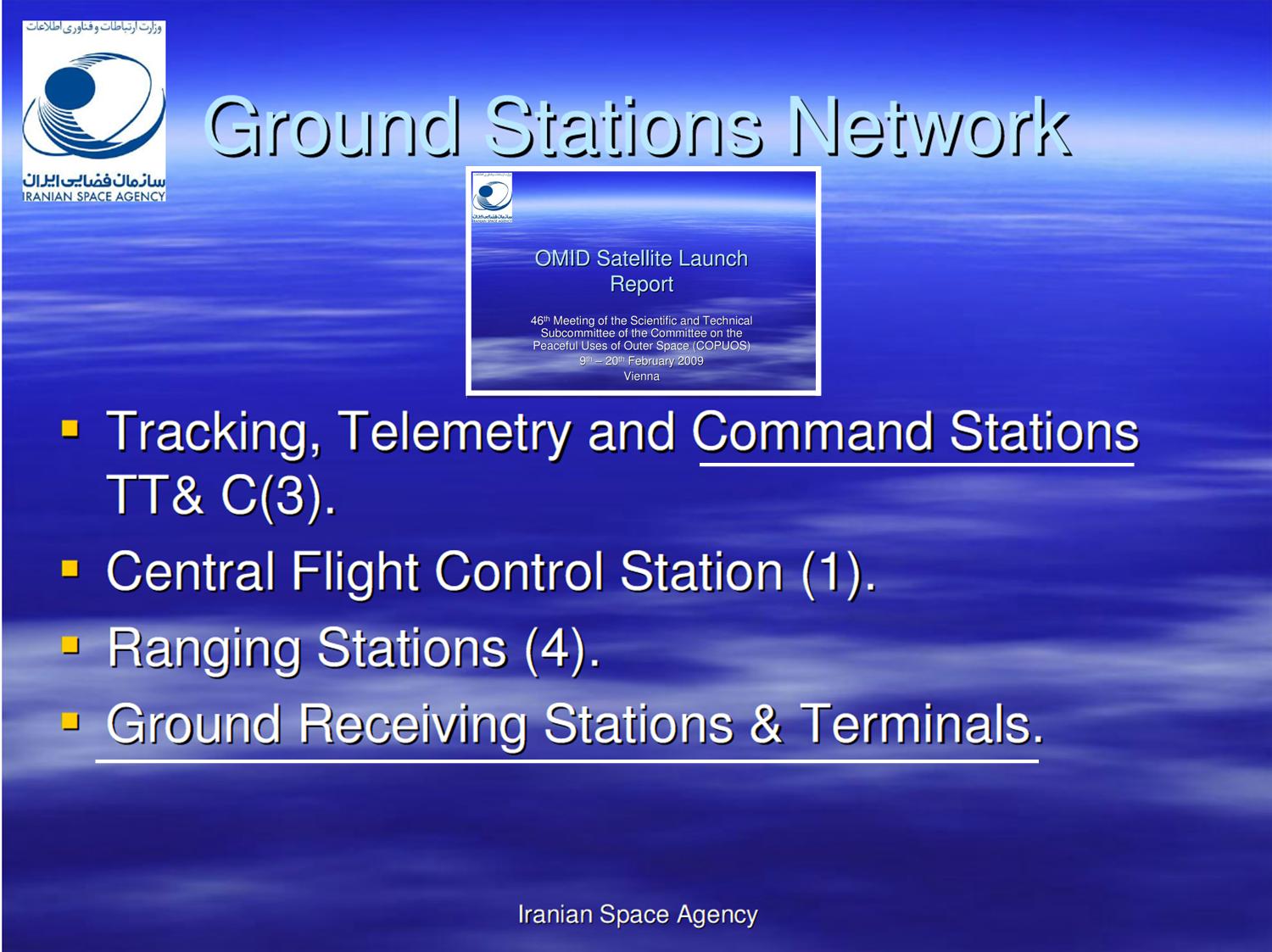
UPDATE (4 March 2010): I was going over some Iranian presentations and came across (once again) this presentation by the Iranians to the Feb. 2009 meeting of the UN Committee of the Peaceful Uses of Outer Space. This page clearly indicates a difference between satellite ground stations and ground facilities devoted to the powered phase of the Safir. Note that it says “Tracking, Telemetry, and Command Stations.” I have added the underlining in this image to highlight what I consider are important points.