Author: geoffrey_forden

  • “Unveiling” Iran’s New Centrifuge

    click on the image for a larger version

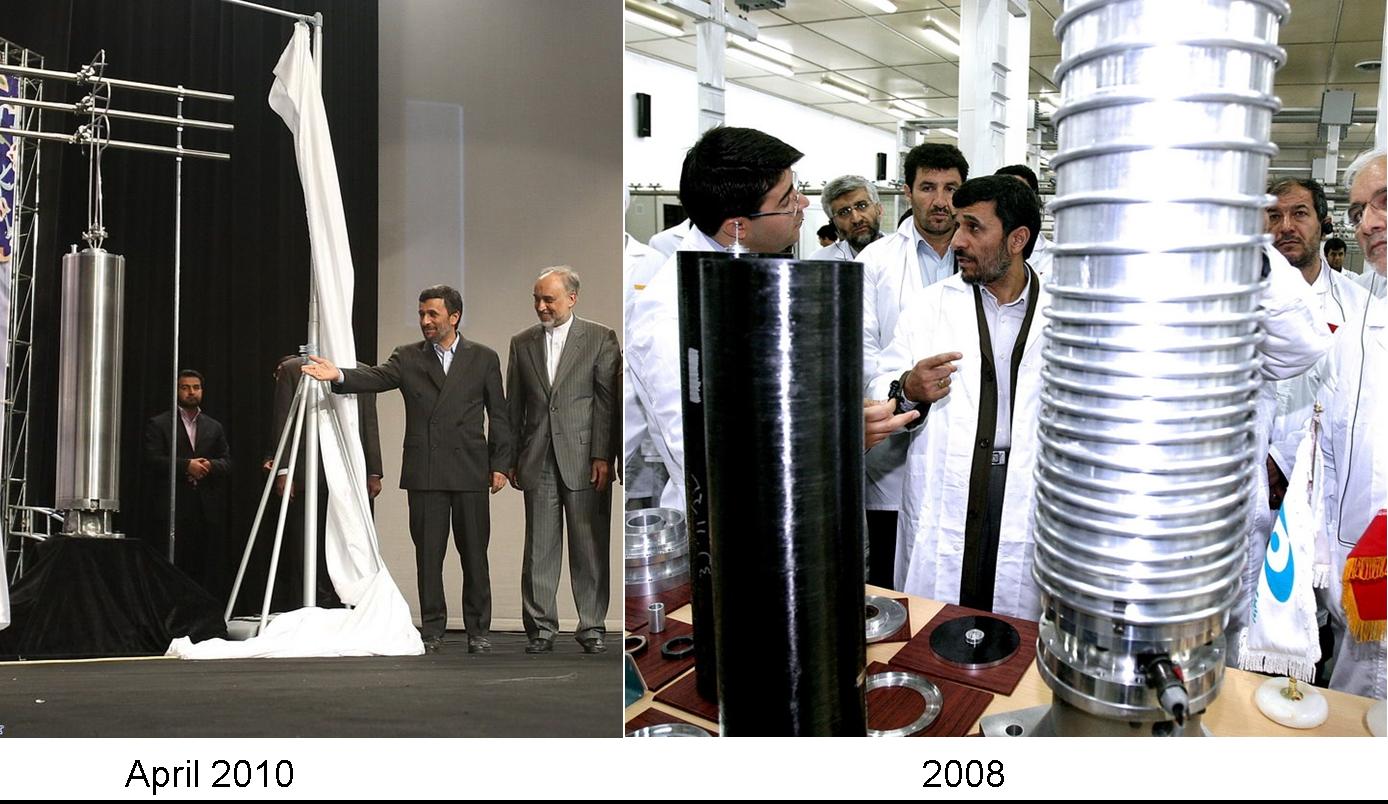
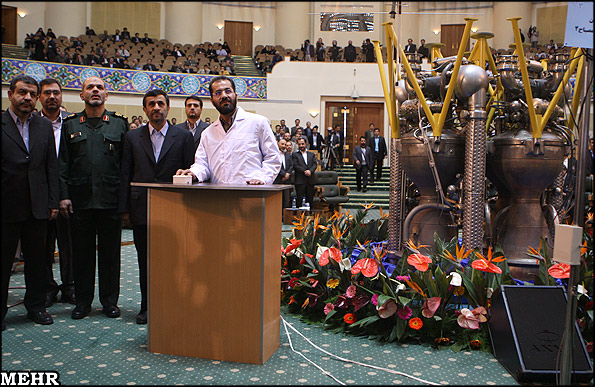
    Iranian president Ahmadinejad unveiled the new IR-2 centrifuge on 11 April 2010 after having viewed it during its development stage in 2008.

    Unveiling is in quotes because we have, of course, seen these centrifuges before: President Ahmadinejad viewed them in April 2008; during the 2nd Nuclear Festival Day. These were the IR-2 centrifuges and an initial test batch was installed at the Pilot Fuel Enrichment Facility at Natanz in January 2008. At that time, there were 11 such machines undergoing testing. Ten were arranged in a cascade and one was operating on its own.

    The IR-2 is said to be based on the second generation Pakistani machine, the P-2, but with a carbon fiber rotor instead of the maraging rotor Pakistan used. As we have discussed before, Iran does have considerable academic and practical experience with carbon fiber forms. I won’t even begin to try to guess the enrichment capacity of this machine; we have had so many discussions on the capacity of the IR-1 and arrived at so many different numbers that it hardly seems worthwhile. For all you fellow timeline addicts, I would say that this announcement does seem to set an upper limit for how long it takes Iran to run the final development tests at about 27 months. It’s not clear if that includes production run tests or not but I would guess that it does. Of course, it’s very likely that these tests were finished before this and that the Iranian president waited until the Fourth Nuclear Festival Day to announce them. But that’s why 27 months is an upper limit!

    It is also important to keep in mind that these machines were tested at Natanz. That is where Iran’s experts at setting up centrifuges work. When and if we see new centrifuge designs being developed at other sites—such as the facility near Qom—we will know that Iran has reproduced its centrifuge operational expertise at other facilities. That will be an important proliferation milestone!

  • Don’t Let Your Rocket Chuff You [4]

    click on the image for a larger version

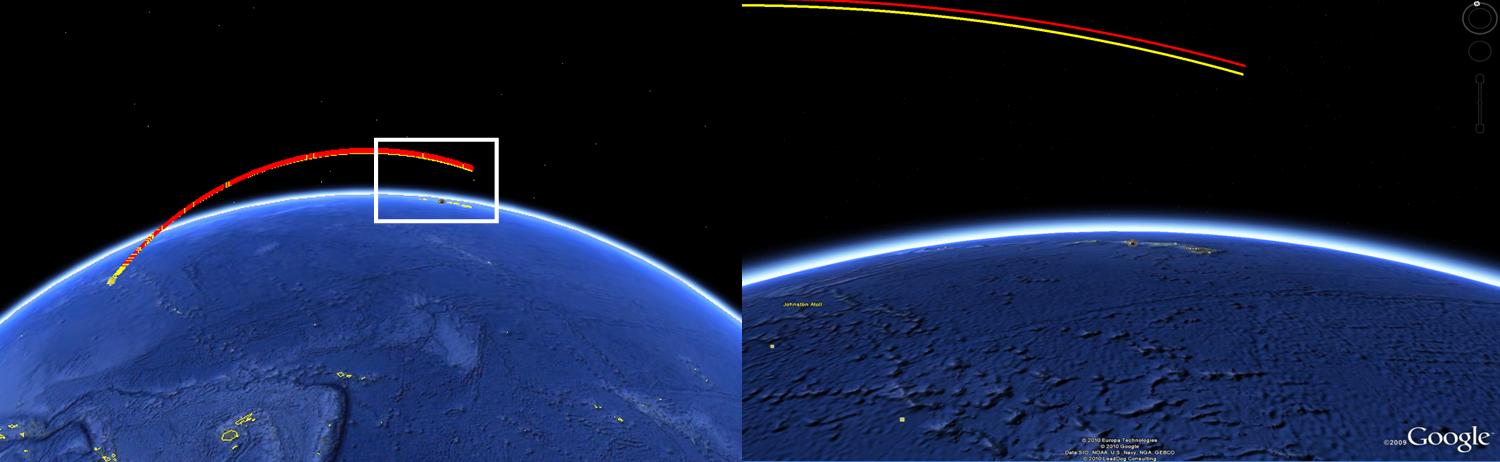
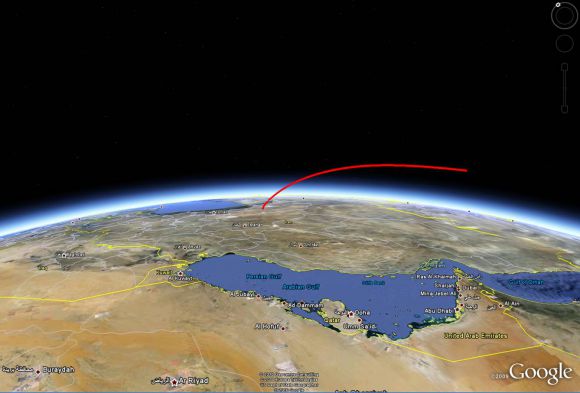
    The trajectories for the bus/warhead/decoy complex (in red) and a cloud of chuff released just before burnou (in yellow)t.

    (With apologies to Langston Hughes.) The Missile Defense Agency (MDA) might paraphrase Langston Hughes to say to potential adversaries “Chuff your rocket like you ought to do but [please] don’t let your rocket chuff [us].” It turns out that the MDA requires any potential incoming missile to behave extraordinarily well. Any deviation from absolutely perfect behavior could throw the missile defense into a dizzy. The latest example of this is the 31 January 2010 failure of the Ground-Based NMD interceptor to hit its target. One of two contributing reasons for the failure was a “chuffing” of the LV-2’s solid propellant stages, which apparently changed what the Sea-Base X-band radar enough to prevent it from adequately assisting the interceptor close with the target. (Or, perhaps, help it discriminate between the simulated warhead and the officially sanctioned decoys.)

    That, of course, needs some explanation. Chuffing is pretty much what it sounds like; a type of puffing. Solid propellant motors (like liquid propellant engines) can suffer from instabilities in the combustion of their fuel and oxidizer. Chuffing involves a sudden extinguishing of the flame burning inside the rocket with a consequent loss of pressure, perhaps down to a vacuum if this happens at high altitudes. Gases released from the heated inner surfaces then spontaneously catch fire and the process of burning and snuffing out starts all over again. This can happen as much as one hundred times a second and it doesn’t take much imagination to believe that there is a lot of variation the amount of aluminum particles coming out the end during this process (aluminum is added to many types of solid-propellant rocket motors to increase the burn temperature and hence thrust).

    Here is my guess on how chuffing completely changes what the SBX sees: The LV-2 target vehicles consists of the first two stages of a Trident C-4 missile a bus with the simulated warhead and the officially approved decoys. In my hypothesis, the second stage experiences chuffing near the end of its burn time, releasing excessive amounts of aluminum (in unburned chunks of propellant that broke off during the trauma of cyclic pressure drops). This cloud propellant chunks containing aluminum is, naturally, released with a lower velocity than the warhead and decoy bus because the bus/warhead/decoy complex continues to be accelerated. This difference in velocity, however, does not need to be very large if the chuffing lasted all the way up to burnout.

    It turns out, however, that the cloud, traveling on its lower trajectory, actually appears to move ahead of the warhead because it is also on a lower trajectory. I have simulated this as shown in the diagram at the top of this post and, assuming that the SBX is some 1000 km West of Vandenberg, it could actually shield the warhead/decoy complex during the important period when the bus released the various bits and pieces.

    click on the image for a larger version

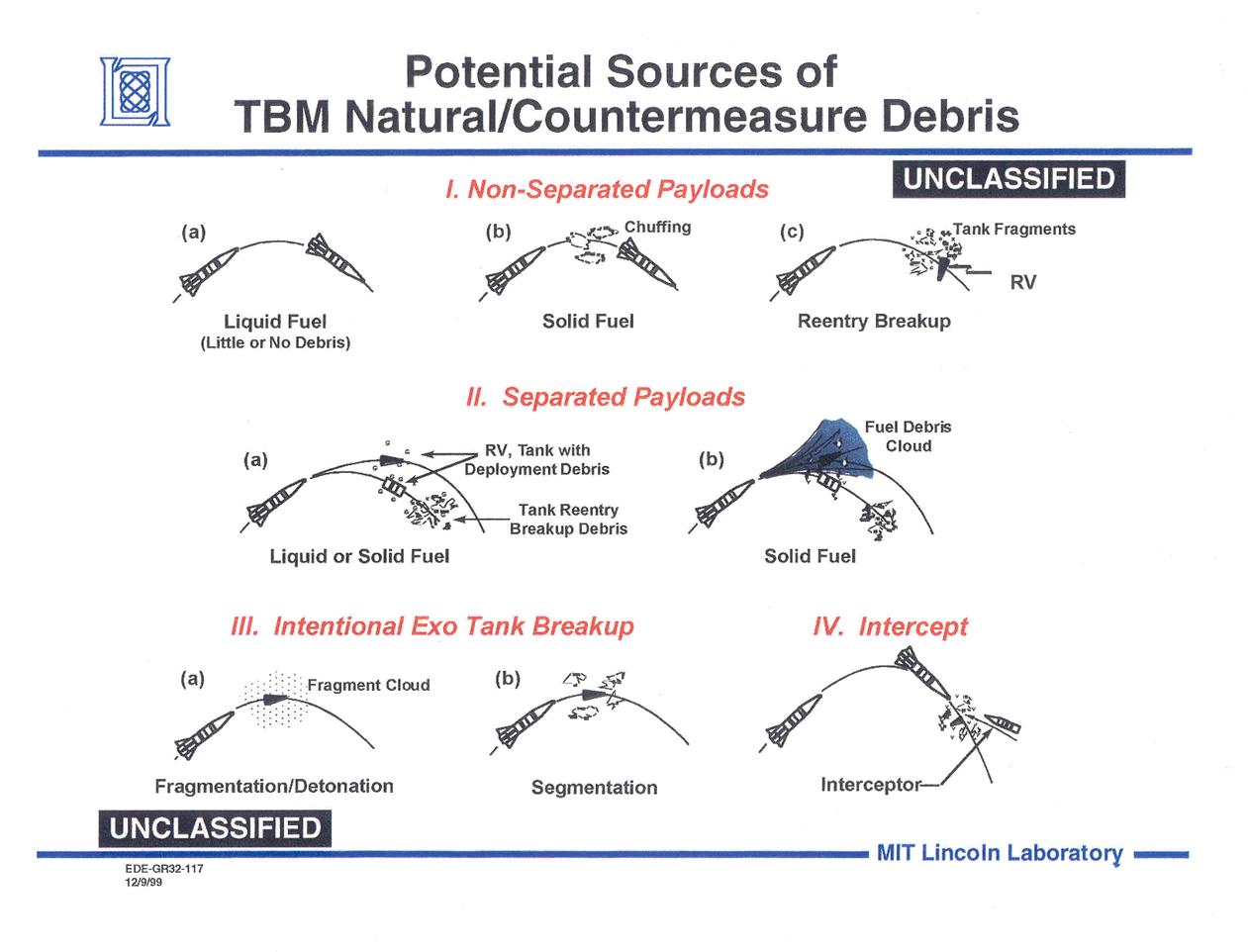
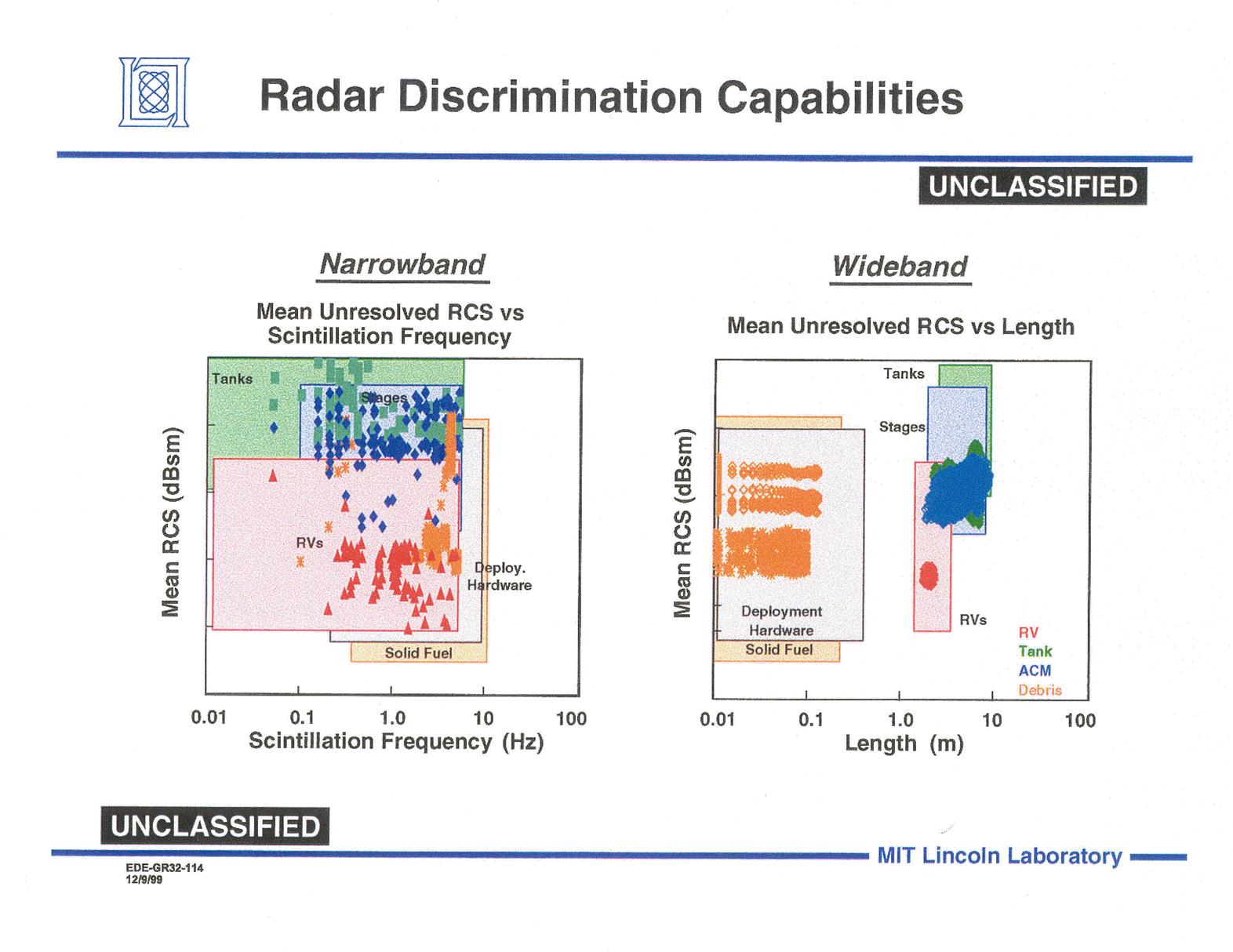
    You would think that an X-band radar could discriminate between chunks of aluminum and a warhead. That is certainly what Lincoln Labs thought in 1999 when they gave a briefing on just this issue. ( Here is their graph showing all potential sources of confusion, both “natural”, meaning stuff unavoidably produced during target vehicle flight, intentional countermeasures. Note II.b, the right diagram in the middle row, which shows fuel debris cloud as an important factor.) A little later in the briefing, they show a graph of measured “length” of the objects and their mean radar cross section (the right most diagram). The box, almost totally obscured by the “deployment hardware” square, shows that they expect the debris from chuffing to have very low length while the RV (and empty stages trailing along behind) have very large lengths. The battle management computers and filters on the individual sensors—including the SBX—would use these differences to discriminate between targets and decoys (and chunks of unburnt fuel). In this flight test, however, they weren’t able to.

    Whether or not this is going to be a fundamental flaw in the whole missile defense development program remains to be seen. But remember that this is just a result of a fully functional target vehicle behaving in an “acceptable” manner. Based on MDA’s history, we might expect them to put increased attention to making sure the target booster does not chuff. And if they do attempt to solve the more general problem of discriminating between the nuclear tipped warhead and small bits of unburnt rocket fuel, the chances are they will come up with a new algorithm that is good only for chuffing from Trident C-4 stages.

    We haven’t even started to think about what an aggressor might do to make life difficult for a missile defense system. Ted Postol has been working on similar issues and will be discussing his results in a forthcoming issue of Arms Control Today. From what I’ve seen of his article, it’s going to prove very interesting. As for today, I think we have a pretty good idea of why chuffing contributed to the failure of the January 2010 NMD flight test.

  • 1-year Anniversary of U’nha-2 Launch

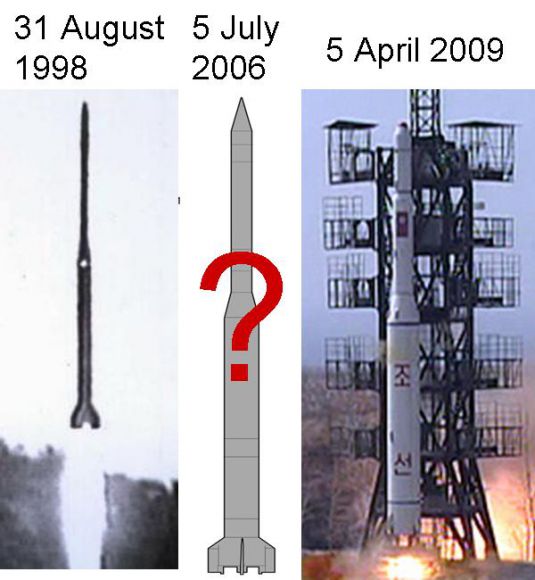
    Today is April 5, 2010, the one year anniversary of North Korea’s failed attempt to launch a satellite into orbit. Depending on how you count them, this was either the DPRK’s second or third attempt to launch a satellite. (I favor calling it the third satellite attempt but, as fellow-wonk contributor Josh Pollack points out, North Korea only claimed it was a missile launch.) We have had numerous discussions of the U’nha-2 launch and, I am sure since I have more to say, we will have many more. What I am most interested, however, is the July 4th 2006 launch. I would love to know what that missile looked like. Apparently, the US government knows, presumably because they photographed it on its launch pad. I don’t suppose I can convince them to publish an image of that missile. If they did, we could learn a great deal about how the DPRK is developing their missiles. But perhaps some privately owned hi-res satellite took an image of it, much like they did with the U’nha-2. If they did, please, please, please publish it. (I will have more to say about the implications of knowing what the 2006 “Tae’podong-2” looked like later.)

  • The Green Zone: an ACW Movie Review [18]

    “ ‘Where did this intel come from? Did we get it from the UN?’ ‘No, it’s been vetted by the US Government.’ ” Or words to that effect, I don’t have a transcript for the movie The Green Zone. I’m just your humble ACW movie reviewer.

    I’m not sure what the connotation of that bit of dialog was supposed to be. Was the Matt Damon character blaming the lack of good intelligence on the UN? Or was he wanting to know if it had a reasonable pedigree? I sort of suspect the former, since that was the feeling at the time, at least in the US Government. After all, I remember leaving the UN Headquarters late at night after sitting all day on the meeting of the independent panel of international experts reviewing our conclusions about the Iraqi missile program when some lady standing outside the fence started yelling “Boo UN! Boo!” Later in the movie, however, I could feel a bit of pride when the chubby guy from the CIA, referring to a Priority 1 site, said, “There’s nothing there, that place was hit by the UN two months ago.” This feeling of satisfaction was, unfortunately, soon followed by a sinking feeling when the person I watched the movie asked as we walked out, “Is that how the real Al Rawi died?”

    Movies have a license to simplify complex problems or make the audience feel a certain way all within 120 minutes. In ‘The Green Zone,’ the writers simplified the bureaucratic dynamics of the Intelligence Community, the Secretary of Defense, and the White House by essentially blaming the war on one guy lying about Iraqi WMD when he had just been told differently by an Iraqi general. It’s possible to learn to hate a person in a short amount of time if he is a liar and tries to have Matt Damon killed. It’s very hard, however, to hate the interplay between high ranking policy makers who kept on sending intel analyses back because they just don’t believe them. The true point that the film makers were making—and it is in there—is that the Bush Administration wanted intelligence reports that said there was WMD in Iraq.

    A Trip to Amman

    In the movie, Poundstone falsifies a raw intel report about a meeting he had with him in Amman, Jordan. The Poundstone character promises him, probably as an inducement to reveal the WMD locations, that he would play an important role in the “new Iraq.” Instead, Al Rawi assures him that there are no weapons of mass destruction in Iraq. Does Poundstone believe him? The movie is not clear on this since the meeting supposedly predates the time it covers. It would, of course, have been very foolish to believe a single source about such an important issue. While there are examples of single intel sources being used extensively in the lead up to the Iraq invasion—Curveball is a prime example—there were other sources to back them up. Unfortunately, there were at least as many sources that refuted them. That is both why it is necessary for an unbiased analysis and why it was possible for “higher ups” to insist the analysis be redone. Their intuition told them to believe the WMD “myth.” (Not that there wasn’t WMD in Iraq after the First Gulf War and that the Iraqi Government lied about it. They apparently used all the left over chemical weapons on the Shia and the Kurds to suppress the rebellion that the war ignited.)

    General Al Rawi is an interesting (fictional) character. Did he go to Amman to try to wave off the invasion? Or did he go there for personal gain, to secure a position in the new Iraqi Government? One could interpret the movie to say that he was a true Iraqi patriot and had gone to try to avert the coming war. When that failed, the movie seems to say, he was willing to try to reduce the suffering of his country by using his influence over the Iraqi Army to bring about a new stability. Since Al Rawi never existed, he is just a convenient technique to simply the problems of de-Ba’athification. At that, I think he succeeds wonderfully.

    Secret Initiatives

    But what is most interesting about him is that there were secret Iraqi diplomatic missions sent out to try to avert the war. I know from my personal experience at UNMOVIC that, by February 2003, Iraq was desperate to forestall the invasion. At the beginning of the final crisis, which I place at the time of Pres. Bush’s September 2002 speech to the UN General Assembly, Iraq was defiant and committed to stonewalling the international community’s just demands that they either disarm or prove that they had already disarmed their WMD. Iraq responded to that speech by supplying UNMOVIC with the backlog of their semiannual reports. These reports were intended to keep the UN informed on the status of industrial sites that had WMD-potential. They make pretty dry reading, consisting mostly of lists of chemicals or equipment located at each site.

    Iraq had stopped supplying the United Nations with these reports when the UNSCOM inspectors left in 1998. We therefore got four years worth of reports on hundreds of potential WMD sites. But there was a clear message if you read between the lines—and I mean that quite literally. Iraq was once again poking a finger in the UN’s eye. For instance, where they were supposed to list newly purchased equipment (equipment that we inspectors would certainly check up on once we got back into the country) they said they were purchased “on the local market.” That was, of course, impossible in the most literal sense of the phrase. These pieces of equipment were manufactured in the West, most after the inspectors left in 1998. A more honest answer would have been “they were smuggled in and we are not about to tell you about that!” Oh, yes; about my “between the lines” comment. Every windows file has a tag associated with it that lets the files originator write a short memo that follows the file around. Many of those late reports had “Did you really believe you would ever see these reports?” as their message, written in English. (Many had something written in Arabic, but I never got those translated.)

    A Frenetic Last Month

    By February of 2003, a month or less before the war started, Iraq had undergone a dramatic transformation. They were clearly desperate to cooperate with the UN and avert the war, something they obviously considered would be a tragedy for their country. By mid-February, they were swamping us with new initiatives to try to resolve the remaining WMD questions. Many of these were impractical or technically impossible but their shear number symbolized Iraq’s mental state. Of these dozens and dozens of new initiatives they sent us that month, there were two that stick in my memory. Both proposed to use a sampling method to “verify” that the amount of VX, in one proposal, and anthrax, in the other, dumped in the desert accounted for all the poisonous material they had produced. There were significant technical flaws with this proposal which even their own write-up showed. For instance, it would be impossible to simply count the number of anthrax spores in a hundred or so core samples and infer the total amount of anthrax dumped at the site, which is a brief summary of one of their proposals. Even if we were willing to count them, it would have been impossible to take that number and infer the total originally involved. Spores die—even hardy anthrax spores—or migrate away as the wind or underground water moves them. Iraq’s own control region samples, outside the declared dump site, showed a significant amount of contamination. Similar problems existed in the VX proposal. (It turns out that, after the war, Iraqi bioweaponeers admitted dumping the rest of the anthrax at a different site, one too close to one of Saddam’s palaces for them to admit.) However, even admitting the flaws in the initiatives—flaws that might very well have been intentional—these initiatives showed a significant change in Iraq’s desire to cooperate. Unfortunately, as we believed at the time and have been confirmed since then, they also did show a willingness to reveal the truth about Iraq’s WMD.

    Dr. Hans Blix, as the Executive Chairman of UNMOVIC, was brilliant at judging Iraq’s level of cooperation in near real time. This function, which he was mandated to perform by the UN Security Council’s resolution creating UNMOVIC, was both vitally important and very difficult to assess. It was important because it seems unlikely to me that the United Kingdom, for one, would have joined the coalition if Dr. Blix had been able to unambiguously state that Iraq was fully cooperating with the inspections. Could the war have been averted if such a level of cooperation was present? I think it could have. But we needed that full cooperation to finally resolve the remaining issues and it is clear that Iraq was holding out on giving that.

    Now, let me return to General Al Rawi. As I said, he—perhaps by accident—does represent a(nother) real Iraqi initiative. In that last month, the same thirty days during which we were being swamped by Iraqi disarmament initiatives, Iraqi diplomats were desperately reaching out to the Bush Administration to try to avert the war. But instead of Amman, these meetings took place in London and instead of a “Pentagon Special Intelligence” officer (Poundstone), the Iraqis were reaching out to Richard Perle. And instead of an Iraqi general, the Iraqis were using a Lebanese-American businessman. They are reported to have offered to let 2,000 FBI agents into Iraq to search for WMD. (Here, too, I feel a certain amount of pride. It’s clear to me that the Iraqis realized that 2,000 FBI agents would be less effective than the 300 UN weapons inspectors. One needs only consider the Anthrax terrorism investigation to see why.) What would have happened if UNMOVIC had known about those secret diplomatic initiatives? I know I would have been convinced that Iraq had made a strategic decision to cooperate with the inspections. It might still have been a hard slog to get the truth, but I am confident we could have verified the disarmament of Iraq by inspections alone.

    By the way, I loved this movie! It kept me on the edge of my seat the entire time.

  • Dialing for Proliferation Dollars [16]

    Proliferation for profit is in the air. You can hardly turn on your TV or radio without seeing David Albright talking about his excellent new book, “Peddling Peril.” I have long advocated thinking about proliferation as a business and applying the results of research on the diffusion of technology to understanding how countries get the infrastructure and know-how for making WMD and the means to deliver them. As such, it would be nice to understand the amount of profit a proliferation profiteer like A. Q. Khan or North Korea makes on selling various technologies the world would rather see end. If we could understand the amount of profit to various forms of proliferation, say selling missiles vs. missile factories, we might be able to understand how the nature of proliferation is changing.

    Unfortunately, it is very hard know the profits associated with any given sale or even industry. It is even hard to get firm numbers of the gross transaction much less the profit made. I have tried to assemble a collection of prices for various missile component, system, and production plants that can be used to give a feeling for the order of magnitude of the problem. The ones I feel relatively confident in are shown in the table below. Prices have been adjusted to be in 2010 dollars.

    Missile Component/System/Plant Price (in 2010 Dollars)
    1 Iraqi Badr-2000 missile $9,900,000
    1 SCUD-B plus TEL $220,000
    SA-2 Sustainer Engine $14,000
    Badr-2000 Factory $185,000,000

    The Badr-2000 was a virtual missile sold to Iraq in 1984 by a consortium of countries that were hoping to use Iraqi financing to develop a missile that was being sold by as “equivalent to the Pershing II.” Since the Badr-2000 was never actually built, it is possible that these numbers are unrealistic, though you could make an argument either way as to whether the actual price would be more or less expensive. It does establish a ball park number for a sophisticated, long-range missile production facility. The number I am using for the SCUD-B comes from reports on what a “collector” in the US is reported to have paid for a fully militarized missile and it’s TEL. It is hard to imagine this collector paying less than the price of such a deal would be on the “open” market. Nevertheless, I would love to have other examples of SCUDs being sold to check this. (Hopefully without the TEL. Of course, any well documented numbers for missile prices in the developing world would also be greatly appreciated.)

    Let’s try using this table on a media report from 1992. Bill Gertz reported on March 10th of that year, that North Korea shipped a complete ‘SCUD’ factory to Syria for a reported $300 million. (Again, this is in today’s dollars.) Of course, this was about the time that North Korea was shipping Nodong factories to Syria, Iran, and Pakistan so it seems quite possible that this was actually a Nodong factory. The “misidentification” is, of course, quite reasonable since Nodongs hadn’t become as well known as they are now. Also, they are, after all, derived from SCUD technology. But the point I want to talk about is: how believable is this price? Comparing it to the Badr-2000 factory complex, it seems too high. After all, the Badr-2000 was supposed to be a very sophisticated missile with both solid- and liquid-fueled stages.

    I am, however, inclined to believe it as a ballpark figure though not enough to include it in my table. If true, it would seem that today’s market is willing to pay a premium for the know-how to build a larger, more powerful missile. If we consider the costs to North Korea in developing the production line to be sunk costs, then this know-how is pure profit. This might explain why North Korea is willing to sell factories to proliferators as opposed to insisting on selling missiles. Of course, there are a number of other reasons for selling factories (with a “small” number of example missiles). For instance, it is possible that North Korea is doing exactly what Iraq’s Badr-2000 suppliers tried to do: get other countries to pay for the missile’s development.

    Note Added:
    “Know-how” is a technical trade term that refers to a written description of the product and process for its manufacture. Wikipedia has an article on it though they seem to also include the tacit knowledge needed to operate the machines. I disagree with that somewhat since all the contracts that I have seen have made a distinction between know-how and training.

  • New, Large Simorgh Launch Complex [10]

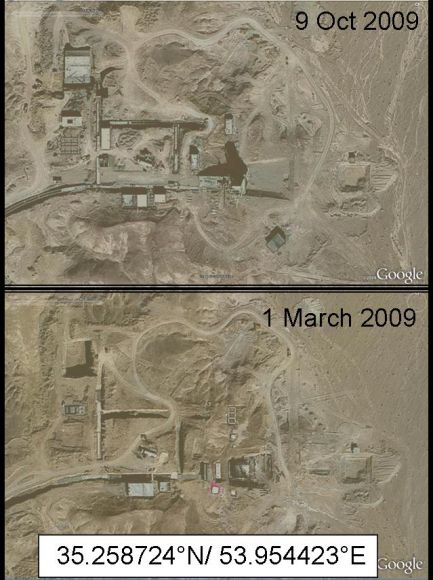
    Jane’s Information Group, and a whole bunch of other sites, have “found” a new, large launch complex in Iran that is close to the rather spartan launch pad for the Safir. What is irksome (at least to me) is that the new launch complex is visible in Google Earth images dating back a year ago. This allows some interesting estimates for when the Simorgh project started, how much importance Iran assigns it, and when the new rocket might be launched (a lot sooner than some of us suspected). Here are two Google Earth images dating from 1 March 20010 2009 (typo!) and 9 October 2009. Nothing is visible at the site on 25 February 2005 so all this work is relatively recently. Iran is so active!

  • Telemetry or Guidance? [8]

    One of the things that has always stuck in my mind from my childhood addition to science fiction was Robert Heinlein’s explanation of rocket guidance, where a special “cam” was machined to control the trajectory of a rocket every time it took off. The cam would be rotated with a constant speed and its radius at any given point would determine the average direction of the thrust. It turns out that exactly the same method is used in SCUD’s. (I’m not surprised, really. The reason I loved Heinlein’s books was the fact that he was a “hard core” science fiction writer who obviously calculated interplanetary trajectories to make sure his stories had the ring of truth in them.) In the case of the SCUD, a constant rate step motor turns an odd shaped cam that, in turn, adjusts a potentiometer. At that point, the potentiometer changes the average setting of the jet vanes that control the direction of the SCUD’s thrust. Of course, on top of this average motion, the guidance system—the various gyros and accelerometers—determine small displacements from the average in order to keep the wind and other disturbances from effecting the trajectory.

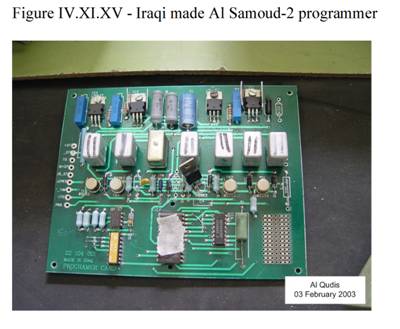
    The SCUD is optimized for operating in the field and I can imagine that its Russian engineers first selected a mechanical “computer” for its ruggedness. However, it also might have had other advantages over more general purpose digital computers. It’s hard to imagine weight being one of those advantages given today’s computers but it might for a country just starting out designing a missile’s guidance system if you include all the adjunct equipment that would be needed such as digital-to-analog converts with enough power to control the jet vane actuators. Be that as it may, Iraq as late as 2002 was using an analog computer (electrical this time, not electro-mechanical as was the SCUD pitch controller) to control the pitch. This image of the Al Samoud II pitch “programmer” is from the UNMOVIC compendium:

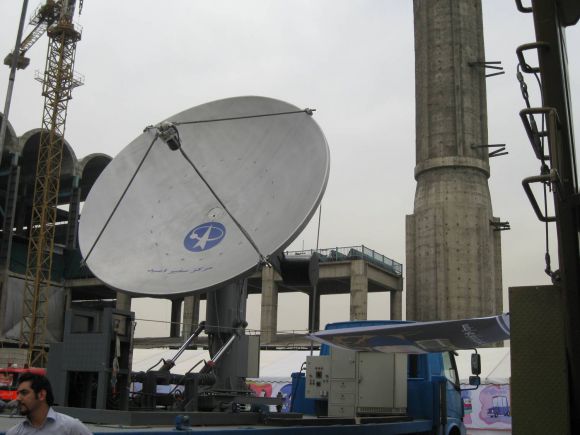
    I think this establishes, if it doesn’t quite explain why, a tendency for countries just starting out in developing their own missiles to use analog computers their guidance systems. Perhaps the reason is simply that analog computers are a logical next step from the systems—i.e. SCUDs—that they are used to. Of course, it doesn’t prove that a country, such as Iran, would use an analog computer but I find it suggestive. Let us, for the moment, assume that is the case. That might explain why Iranian documents suggest that the Safir uses radio guidance during its flight into orbit. Another possibility, one that I’m still working on, considers the impact of a long period of a pure gravity turn, where the average thrust is directly exactly opposite the vehicles velocity vector. (SCUDs and the Al Samoud II use a pitch program that approximates a pure gravity turn—after a substantial “kick” to get it moving in the right direction—by constantly changing the angle the thrust makes with the horizontal.) A trajectory based on a pure gravity turn appears to be very sensitive to the exact attitude of the missile when the “kick” is turned off. The long burn time associated with rockets like the Safir (which, according to some estimates, has a burn time of over 400 seconds) could allow those errors to accumulate and possibly prevent it from inserting its satellite into orbit. Ground-based radio guidance could provide an easy—and possibly quickly achieved—solution, especially if the Safir’s position is determined by GPS as was hinted at in the memos. That brings us back to the Safir and this image of a radio or radar dish displayed at the recent Space Days in Tehran:

    This could be used for any number of signals associated with Safir (or, to be complete, it could have nothing to do with the Safir). It is, however, very unlikely to be associated with telemetry from the Omid satellites. That is, as I showed in an earlier post, handled by a different antenna. So this dish could be used simply for telemetry from the rocket during boost. Or also for sending back to the missile guidance commands. Unfortunately, we cannot see the attachment of the dish to the support column so we cannot determine if it can be slewed fast enough to follow the flight of the missile.

    If it does follow the trajectory of the Safir, it does not need to be positioned very far down range to see the entire powered flight of the space launch. In fact, burnout of the Safir—which occurs about 920 km down range—is still visible at the launch pad with an elevation of 10 degrees. To complete the argument, there is an antenna mounted on the Safir airframe (and which all the photos of the Safir that I have seen have managed to minimize) that would suit this purpose very well. It is mounted over Fin I, which is aligned with the trajectory so that it is always pointed down toward the Earth during powered flight. This facilitates its visibility to such a ground station.

    If this chain of argument, which heavily relies on the information found in the Iranian documents, implies that Iran has not assimilated guidance and control (G and C) technology enough to fabricate its own system suitable for use in space launch. It also shows, however, that Iran wants to solve this problem itself as much as possible and not rely on importing complete G and C systems.

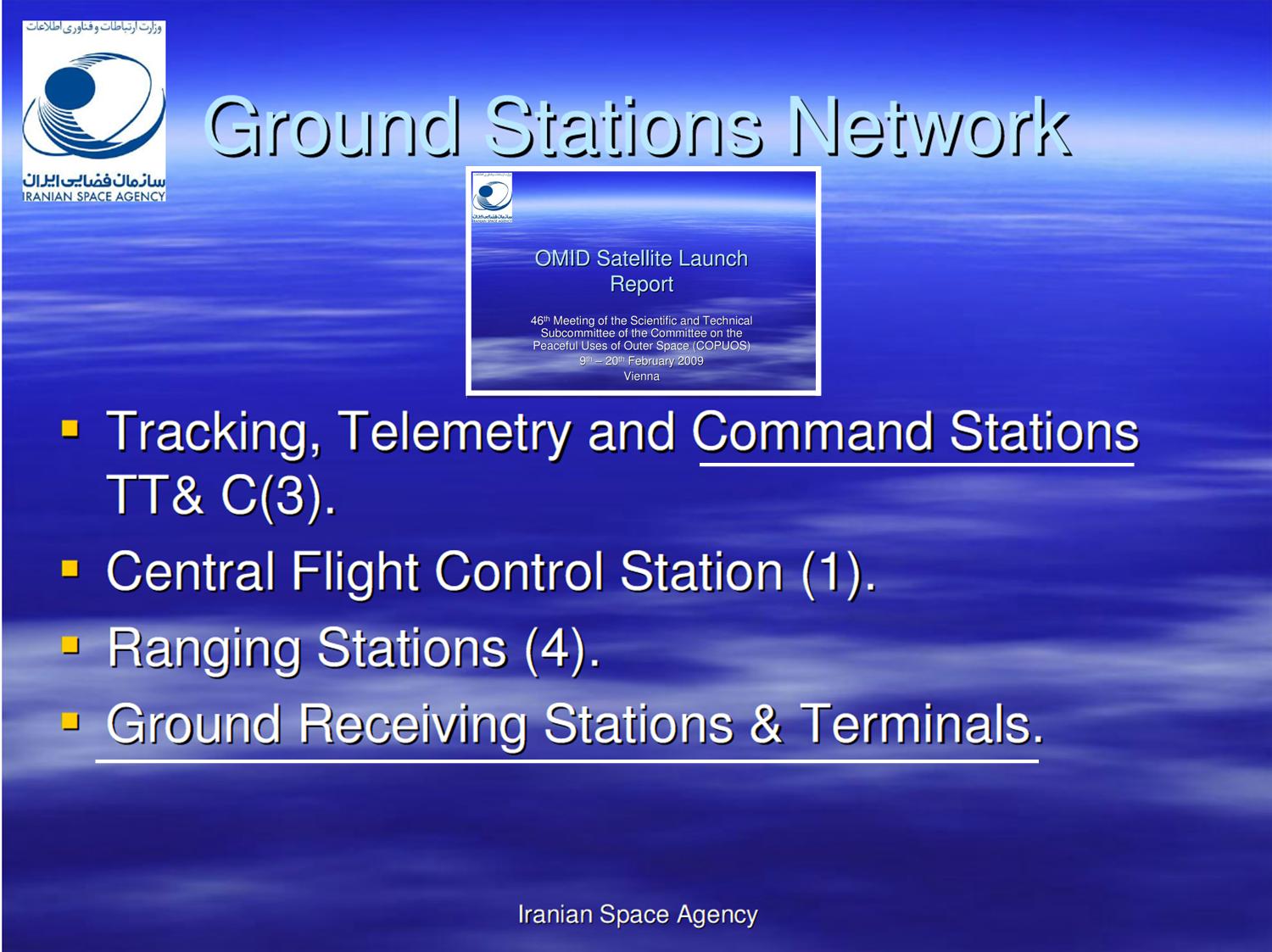
    UPDATE (4 March 2010): I was going over some Iranian presentations and came across (once again) this presentation by the Iranians to the Feb. 2009 meeting of the UN Committee of the Peaceful Uses of Outer Space. This page clearly indicates a difference between satellite ground stations and ground facilities devoted to the powered phase of the Safir. Note that it says “Tracking, Telemetry, and Command Stations.” I have added the underlining in this image to highlight what I consider are important points.

  • Shocking Good Fun [26]

    click on the image for a larger version

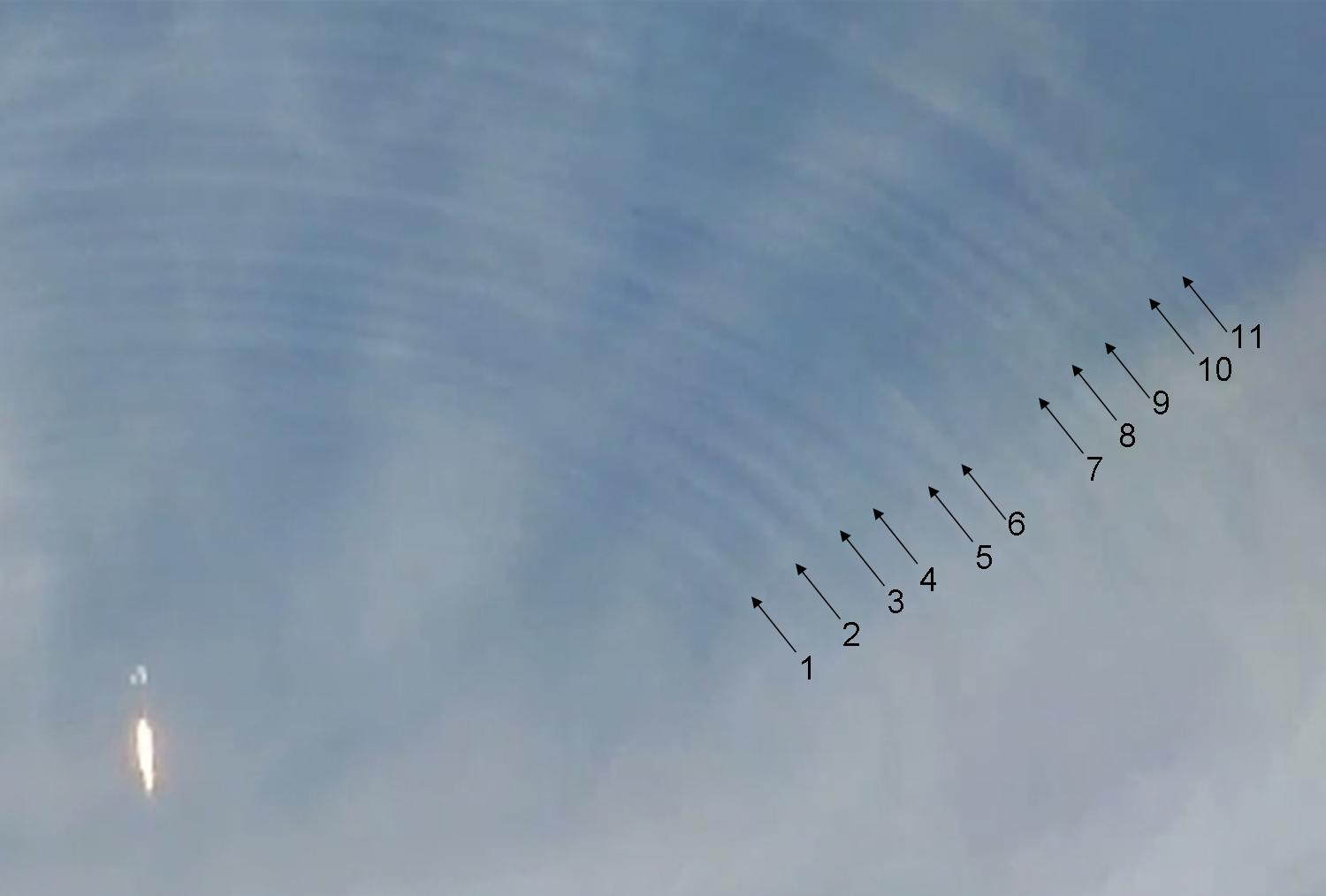
    The Atlas V that carried the Solar Dynamics Observatory into orbit on 11 Feb. 2010 created shockwaves that rippled through a cloud layer. I’ve counted 11 distinct shockwaves, marked by arrows in this image.

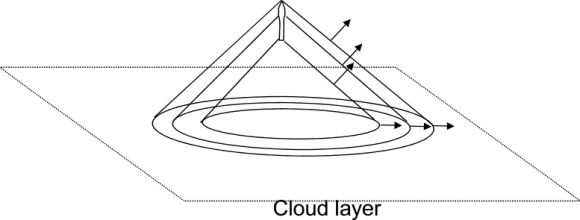
    Ok, this has little if anything to do with security or arms control (well, perhaps a little) but it is such fun that I couldn’t resist writing about it. And it is certainly very educational. There is a very fun video of the Solar Dynamics Observatory launched on February 11, 2010. In that video (and in the image above) you see the SDO’s Atlas V launch vehicle passing through a cloud layer, with shockwaves radiating out. Of course, the shockwaves are generated by the missile and the cloud layer is only providing a way of seeing them. In fact, what is visible is not a single shockwave radiating through the cloud layer but rather multiple shockwaves passing through the layer. As these shockwaves “follow” the missile, each point of intersection with the cloud layer moves outward. I’ve tried to indicate this with the cartoon below:

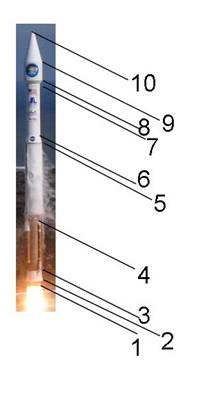
    Shockwaves are formed at “discontinuities” along a rocket’s airframe. They radiate energy away from the point on the missile where they are created. As the missile moves along, this constant creation of shocks form what appears to be a continuous “cone” that trails along the rocket. The angle the cone makes with the rocket is therefore related to the rocket’s speed. Of course, the more discontinuities there are on the airframe, the more shockwaves are formed and the more energy is radiated away. That, by the way, explains why the “baby-bottle nose cone” of the Ghadr (also sometimes know as Shahab-3B and various other names, I wish we could all agree on names) has a higher drag coefficient than the simple cone on a Nodong or Shahab-3. Of course, as my friend and fellow former UNMOVIC inspector, Mike Elleman points out, the baby bottle shape allows the weight to cross sectional area of the detached warhead to be increased. This ratio is also know as the ballistic coefficient or Beta of the warhead and allows both a faster reentry and a more stable trajectory.

    I’ve been able to make a rough correspondence between the number of discontinuities on the Atlas V and the number of shockwaves visible in the cloud layer. (See the image at the top of this post as well as the images to the left.) Of course, not all discontinuities make shockwaves that are visible around the entire vehicle. For instance, the vehicle’s airframe shields a whole hemisphere from a shockwave caused by a pipe sticking out on one side. But this correspondence is close enough to really illustrate this physical process.

    .

    .

    .

    .

  • ALTB: The Long and Short [21]


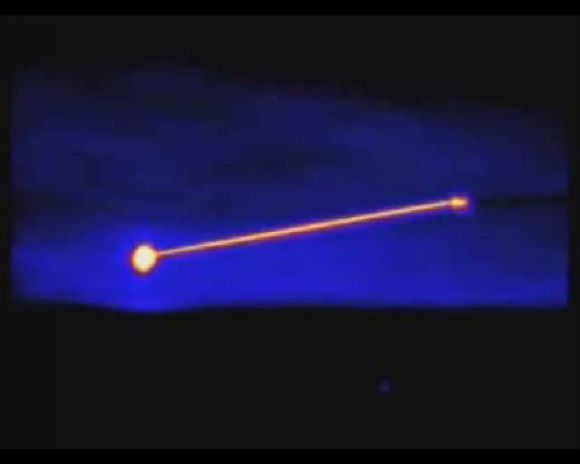
    The February 11, 2010 test of the ALTB (the small, slightly horizontal blip on the right) against a target missile, the larger blip on the left. The target blip size is dominated by the exhaust plume.)

    On February 11th, 2010, the Air Force successfully tested its Airborne Laser Test Bed (the new name for what was developed as the Airborne Laser or ABL). Since the ABL was how I got into this business, I feel a certain interest in its continued development. Others, especially Jan Stupl who is a Science Fellow at Stanford’s CISAC, have done a more complete analysis since I did my study (also as a CISAC Science Fellow ) on the ABL. Jan’s thesis at Hamburg University involved authenticating a finite element simulation of a laser heating up a rocket’s airframe by actually comparing it with experiments he did. I consider his study to represent the current state-of-the-art knowledge in the nongovernmental community. (While at CISAC, Jan has extended that study with a very important analysis of using lasers as anti-satellite weapons.)

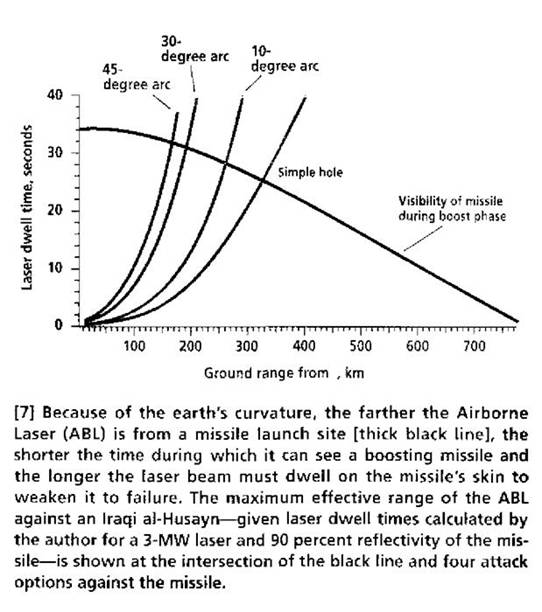
    I think my most important contribution to the ABL discussion was in presenting a way of thinking about laser missile defense engagements. This is summarized by this graph, which shows the two important curves for determining a laser’s effectiveness, which can be characterized by the length of time it takes the laser to heat up the rocket’s skin enough for internal stresses to break the missile apart. (See Jan Stupl’s work for more accurate time estimates.)


    An example of how to think about laser engagements. It depends on the nature of the target missile as well as the laser’s energy; both of which are uncertain.

    One graph, the “visibility” curve, shows how long the missile is visible to the ABL while it is under power. (The ABL’s kill mechanism requires that there be a large axial load on the airframe that is only there while under power.) As the ABL gets farther away, the Earth’s curve hides more and more of the powered flight either behind the Earth’s limb or, perhaps more likely, behind a large barrier of atmosphere that disrupts the laser beam. On the other hand, the farther away the laser is, the long it takes to deposit enough energy to cause a failure. That is represented by the graphs that are increasing dramatically with distance. The distance at which these two types of curves cross is the maximum range of ABL.

    Videos of the February 11th test have been altered to mask the time of the actual engagement. (That is what they say at the start of each video segment.) My guess, based on how fast pieces seem to fall away, is that they have been sped up. Which, of course, makes the laser seem more effective. Another apparent feature of the videos is how close the target and the ALTB are. This has two effects. Most importantly, the engagement is much farther down the “time required” curves. But it also means a given change in the missile’s position, as it accelerates along its trajectory, will produce a bigger angular displacement as viewed from the ALTB. That should mean it is easier for the onboard targeting systems to follow the target. It also appears that the ALTB is pointing down when it fires. This could, of course, be an artifact of the position of the camera. However, if it is true, it means both that the laser is firing through more atmospheric turbulence (an impressive achievement) and that the rocket is moving slower than it would if it was allowed to gain altitude. The later means, of course, that it is easier to shoot down.

  • Yaogan 1 Erupts [6]

    click on the image for a larger version

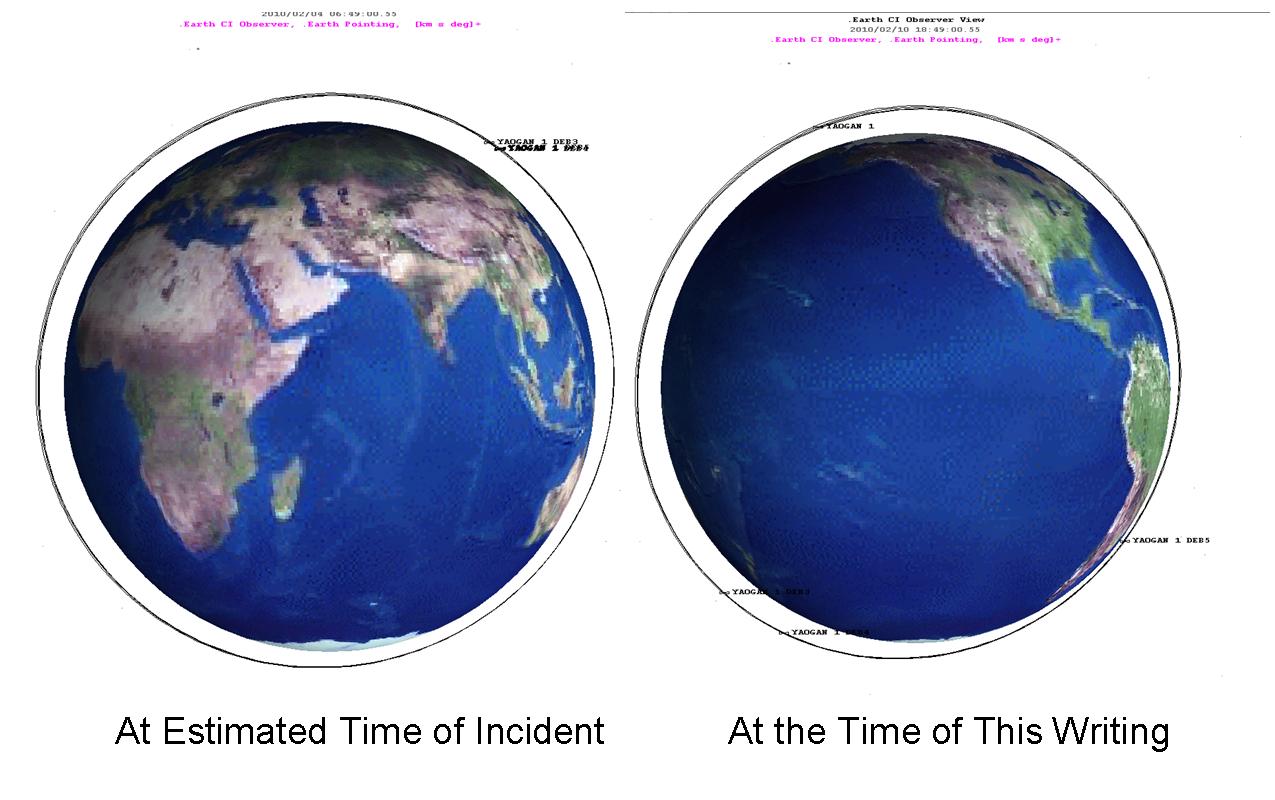
    The first three pieces of debris cataloged from the Yaogan 1 breakup are shown. The approximate time of the incident (2/4/10 at 6:49 UTC) was determined by “backtracking” the pieces. The fact that the debris and the remainder of the satellite do not exactly “match up” indicates errors associated with the orbital measurements.

    Yaogan 1, a Chinese Earth Observation Satellite, erupted into multiple pieces last week. By back-tracking the pieces, I believe the date and time of the incident was February 4, 2010 at about 6:49 UTC. It is interesting to note that the maximum difference in orbital speeds is about 22 m/s. That can be compared with the hundreds of meters per second typical in a collision. Judging by past experience, a few more pieces of debris will be cataloged in the days to come. Yaogan 1 would have been four years old this April (launch date: 27 April 2006).

    Just to be complete, there is no indication that this was anything other than an internal explosion. While the original satellite might appear in this particular view to be over China at the time of the incident, it is actually well over the Ocean.

  • Iran’s Missile (Development) Trajectory [75]

    Iran’s aerospace program has been so active in the last few years it should be possible to say something about their development philosophy: the technological arc or trajectory they are following. For instance, why did they “jump” from SCUD-type missiles to the Shahab-3-type? Why didn’t they put a higher priority on clustering engines in order to achieve greater ranges before moving on to the Shahab-3? Many of my friends believe they should have. A large portion of their argument is centered on the fact that they believe Iran would have established a missile capable of hitting Israel much sooner if they had done that, perhaps as early as the mid-1990s. Of course, such arguments place an extraordinary amount of emphasis on such a military objective, especially when Iran’s nuclear program was much, much less advanced.

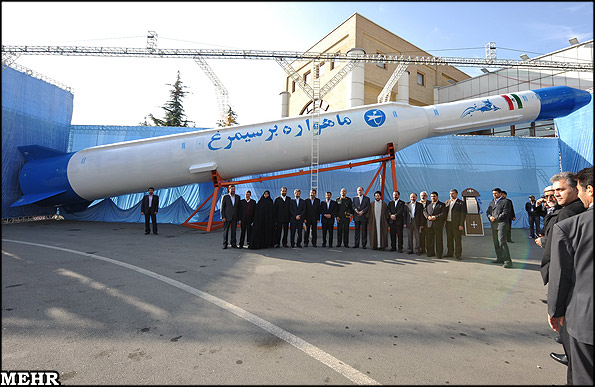
    I’ve always thought, however, that Iran did make a strategic decision about the direction its missile development program was going in. But it was not a military-strategic decision but an industrial-strategic decision even if there were military advantages to be had further down the road. I believe Iran decided they needed to assimilate the technology for producing large engines indigenously and that this was a much higher priority for them than early production of a longer range missile. New images released at the same time as the “Kavoshgar-3” sounding rocket (with its animal passengers) was launched. Two amazingly important images were released:


    A new, large, two-stage rocket with the Iranian space agency logos on it. The second stage appears to be the same stage (and nose fairing) as the Safir’s second stage.

    Assuming that the smaller diameter second stage is the same as the Safir’s second stage (with a diameter of 1.25 meters), then the much larger first stage is consistent with a diameter of 1.95 meters. That is, of course, considerably smaller than twice the Shahab-3’s diameter of 2 times 1.25 (or 2.5) meters. So it is fair to ask “What can you put in there?” I think the answer is a cluster of four “Nodong engines.” And, voila, the Iranians show a new rocket power plant with a cluster of four Nodong engines at the same gathering where Pres. Ahmadinejad watched the Kavoshgar-3 launch:


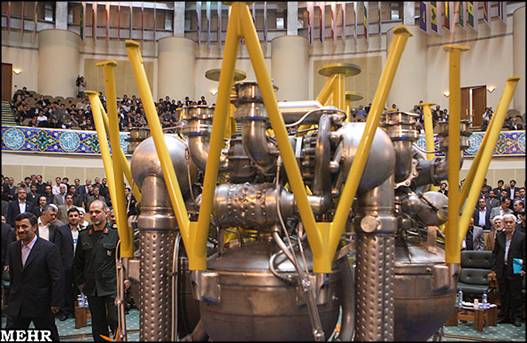
    An Iranian rocket scientist unveils the new cluster of four Nodong engines, known as the Phoenix (if Google translate is working properly). The yellow struts above the engines are for transmitting the thrust to the rocket’s airframe. Their presence implies that the first stage will use jet vanes for thrust vector control.

    Phoenix, the name of the new power plant, is an interesting name. I’m not sure what the Iranian mythological implications are but as a Westerner, to me it means rebirth in fire. Perhaps they are implying the rebirth of this engine design in a new form. Of course, it is always dangerous to use one cultural point of view to analyze another culture’s literary allusions.

    The yellow struts rising above the engine cluster (and their multiple turbopumps, perhaps four? one for each engine?) are for fastening the power plant to the rocket body and for transmitting the thrust they develop. They are angled slightly outward for increased structural strength. Pads at the top of the struts are the connections with corresponding strong points inside the first stage. But is the first stage wide enough to accommodate this cluster?

    To answer that question, I have had to go through a chain of photo-interpretation; each of which undoubtedly contributes a certain amount of uncertainty or error to the final answer. First, I had to determine the diameter of the Nodong engine. (I know these are Shahab-3 engines, but I am so used to calling them Nodongs, it would be too painful to switch. Let it be known that I think these engines are indigenously produced in Iran, though Iran probably bought or licensed the production line for them from North Korea.) I get a diameter for the combustion chamber, just below the strong points for the struts, of 0.57 m.

    Then, transfer this diameter to the image of the Phoenix power plant:


    The top of the Phoenix power plant, showing the combustion chambers and the full diameter of the struts. Calculations by the author indicate that this cluster of four engines would certainly fit inside the large rocket body shown above.

    Using this combustion chamber diameter as a reference point on length, I get a total separation between opposite pads at the top of the struts of 1.87 meters. Of course, a rather long chain of analyses was needed to estimate this length. And even the assumption that the farthest right strut pad and the farthest left strut pad represent the full diameter of the support system introduces a certain amount of uncertainty (though that is reduced by a cosine theta effect). Nevertheless, this is remarkably close to my estimate for the diameter of the new rocket’s first stage. Close enough to convince me that this is the new first stage’s power plant.

    Note that there are at least superficial differences between this rocket’s first stage and the DPRK’s U’nha-2’s first stage. If nothing else, Iran has designed the airframe itself. (I am being extra cautious about this, my own feeling is that Iran has designed the entire first stage itself. But that is such a key step in my understanding of Iran’s missile development trajectory, that I am hesitant to state it as a conclusion.)

    So what do I think has happened? First, Iran purchased a production line for Nodong engines (and the other components of the Shahab-3 missile) from North Korea. However, though the years of producing them, flight testing Shahabs, and modifying them with the design and production of the Safir and other rockets, Iran has fully assimilated this technology and they are moving on to the next stage of development—clustering large engines (they obviously gained some highly important experience with the cluster of two engines on the Safir’s second stage)— and they are probably doing this largely on their own.

    Note: a future post will estimate the range of this missile using the “hypothesis” developed here.