So I was reading a major book review of Ian McEwan’s new satiric novel on climate and energy, Solar, this week and came across this jaw-dropper:
Whether or not carbon dioxide is accumulating in the atmosphere, there’s no denying that novelists are warming up to the subject. From Michael Crichton’s “State of Fear,” which claimed that we’re being hoodwinked by faulty data, to Kim Stanley Robinson’s “Fifty Degrees Below,” which imagined Washington encased in ice, popular fiction about climate change has been as nuanced and illuminating as a shouting match on Fox News.
Now I don’t know what’s sadder about this paragraph. Is it that Ron Charles, the fiction editor for the ever-shrinking “Book World” section of the Washington Post, is simply unaware of the single most established fact in the entire arena of climate science?
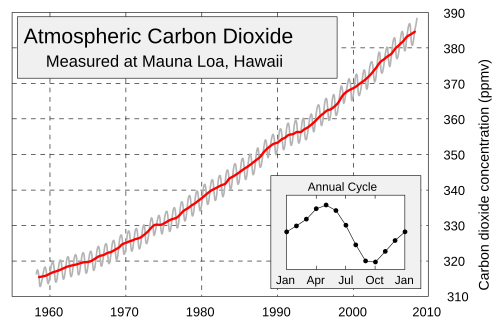
Or that not a single person associated with putting together the final product of the Washington Post print piece edition apparently knew this most basic of climate facts.
And it’s not just the Charles wrote this howler in a major review of a novel on global warming in a newspaper that recently editorialized: “If current trends persist, it’s likely that in coming decades the globe’s climate will change with potentially devastating effects for billions of people.”
He was apparently so comfortable in his ignorance that he made this mistake in a paragraph devoted to mocking novelists for writing about climate change in a fashion as unilluminating as Fox News. Indeed, Charles and everyone else who looked at this piece before publication were apparently so comfortable in their ignorance they didn’t even bother to spend 10 seconds running some variant of the phrase “carbon dioxide is accumulating in the atmosphere” through Google.
For the record, carbon dioxide has been accumulating in the atmosphere for a very long time now thanks to human activity. The direct measurement of that CO2 rise led to the single most famous chart of observational data in the entire climate arena, the Keeling Curve of Atmospheric concentrations of carbon dioxide (CO2).
It is an unequivocal fact.
It is true that the media itself has worked hard to confuse people on this undisputed issue (see “Yes, the atmospheric CO2 fraction has risen at a dangerously fast rate in the past 160 years, reaching levels not seen in millions of years“). And I spend a lot of time here documenting the poor understanding of climate science even by the reporters who regularly cover the issue (see “media” category).
And this leads to two conclusions.
First, this is a reminder to all of us who try to communicate climate science to the general public — or even to the media elite and other opinion makers erroneously labeled the “cognoscenti” — not to take the most basic fact of climate science for granted.
Second, the knowledge that the media itself is constantly making mistakes on the most basic of climate science issues means journalists need to start going to primary sources for every science-related fact they are reporting. Otherwise media coverage will become permanently indistinguishable from the children’s game of Telephone.


Related Post:
- Memo to Wall Street Journal: You can do better than “greenhouse gases, which are believed to contribute to climate change”
- How well have journalists covered climate change?
- Science Times stunner: “… a majority of the section’s editorial staff doubts that human-induced global warming represents a serious threat to humanity.”
- Boykoff on “Exaggerating Denialism: Media Representations of Outlier Views on Climate Change”