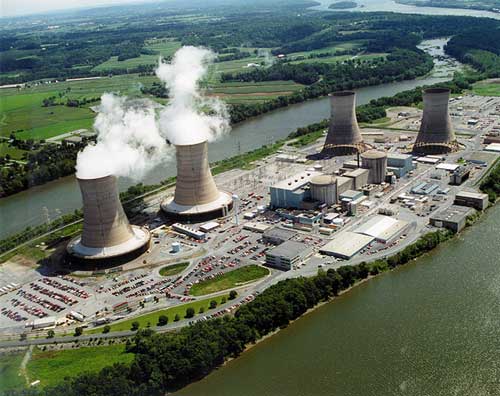
Photo- Nuclear Power Plant in Three-Mile Island in USA
ISTANBUL – Hurriyet Daily News with wires, Monday, April 19, 2010
Turkey’s energy minister urges activities in nuclear energy as well as renewables during his speech at a panel at the Istanbul-based Okan University. Calling Turkey as a ‘solar heaven,’ the minister expresses a plan to focus on the issue in the Renewable Energy Law to be submitted to the Parliament’s General Assembly within two months
Turkey should be determined to launch nuclear power plants, said the Turkish energy minister, also calling for an assessment of the country’s potential in solar energy.
Speaking on Saturday at a panel on clean energy held at Okan University, Energy Minister Taner Yıldız said, “We should start nuclear power plants. We should display this determination. The more solid a fuel is, the more negative it is for the world, and the more liquefied it becomes, the less it pollutes the world.”
The minister’s speech focused on the latest situation in the sector both in Turkey and worldwide, financial aspects, its reflections on practical life and global interaction. “The energy issue is a significant concept that cannot be cleared from international relations,” he said.
Commenting on solar energy as an important renewable resource, Yıldız said, “Turkey is a solar heaven. It is a proper thought when we propose using it, and we will bring this up in the Renewable Energy Law and designate its price.” The law will be submitted to the Turkish Parliament’s General Assembly within two months.
Also talking about the debate on mine licenses, Yıldız said all licenses in Turkey cover only 0.8 percent of forest areas. The minister also expressed the need for clarification on hydroelectric power plants. “This will pave the way for real investors and close the way for speculative investors.”
Yıldız noted that Turkey’s energy goals may not always match up with those of the rest of the world. “The use of energy resources in the world is around 16 percent. Our goal is to raise this to 30 percent by 2030.”
Focus on domestic resources
Yıldız said the aim is to activate all of Turkey’s domestic resources by 2023. A decision supporting nuclear energy power plants would also indirectly support domestic and renewable resources, according to the minister.
The cost of clean energy is high but Turkey fulfills its responsibilities, said Yıldız.
Production of wind energy in Turkey will total 76,000 megawatts, said Yıldız, adding that 13,000 megawatts of this amount will be activated by 2015, and 20,000 megawatts by 2020. The private sector will undertake these investments in wind energy, he said, expressing an optimistic outlook in this field.
Responding to a reporter’s question, Yıldız said Turkey does not face a problem in terms of supplying security, but there is no time to waste in terms of investments, reported the Anatolia news agency.
When asked about the framework of the solar energy law, Yıldız said there will not be high prices for solar energy. “Turkey’s people should benefit from the advantages of Turkey’s sun. International investors should not benefit from the advantages of Turkey’s sun. They should benefit from the money brought through technology transfer.”
At the panel, Bekir Okan, chairman of the board of trustees of the university, expressed the importance of being a tool for the production of studies, opinions and projects on energy awareness and use, as well as the implementation of projects in this field.
Okan University Rector Sadık Kırbaş stressed the resource problems in fossil fuels. “The world’s fossil fuels are being exhausted. Their prices are rising, and this situation is likely to result in significant conflicts. Clean energy is the energy of the future and more investment is necessary.”
The panel took place under the chair of R. Nejat Tuncay, dean of the Faculty of Engineering and Architecture. The participant panelists included Mustafa Tırıs, energy institute manager at the Marmara Research Center of the Scientific and Technological Research Council of Turkey, or TÜBİTAK MAM; Vedat Gün, Vice President of the Energy Market Regulatory Authority, or EMRA; Gökmen Topuz, deputy managing director at Zorlu Energy; Mürsel Meral of Cansu Elektrik; Cemil Kazancı of AKSA Natural Gas; and Levent Gülbahar, chair of the Turkish Photovoltaic Industry Association, or GENSED.
The panel discussion followed the official opening of the building of the university’s faculty of engineering and architecture.
