Author: yuvakuran

  • Sinop Gerze YAYKIL information note on new thermal power plant investment

    Dear Colleagues, Dear Energy Professional,

    As Energy Working Group of Chamber of Mechanical Engineers, we visited Gerze town on 22nd May 2010 Saturday afternoon. We got information about investment for a new imported coal firing thermal power plant. A hardcopy of EIA application report is received. We have reviewed the possible site which is considered for building the new plant at Sinop Gerze YAYKIL village.

    On a narrow coastal sea shore of about 200 meters, approximately 400 acres of farmland extended backwards is considered for this new investment. At the edges of the selected agricultural / forest land, 108 acres of land is covered by forest.

    Samsun-Sinop highway is on the west backend and 154 kV electricity transmission line is also very close. In the north, a small river reaches the Black Sea coast line.

    Samsun Gerze double road is under construction. The road is in a mess as of last week. There are infrastructure bridge constructions and ongoing works for asphalt road surface coating. We passed 100 km in two hours at very low speed.

    There is a new Airport at Sinop. There is scheduled THY flights to Istanbul every day.

    Here is my observations and comments on new Gerze imported coal firing thermal power plant as follows,

    1. Although the locals express that they did not sell their land to the investor, that is not important. If the investor obtains EIA certification and EMRA license, then upon investors request, public authorities can initiate the expropriation of the required land for the new thermal power plant in accordance with new temporary clauses of Nuclear Law. Legal advise is necessary.

    2. I have read the available application to EIA report three times. Other than the birds insects flowers section, it is very premature, very simple, lack of technical details, very rouge and careless as if it is saying in comfort that “We know this business, we do not want to specify the details, you are illiterate, you do not know these issues, in any case we shall complete this investment despite of your objections, and you have no ability no power to stop us”.

    3. After a very narrow coastal sea shore of about 200 meters, there is an extending land in S- shaped backwards already in agricultural works in the new thermal power plant proposed site. This 400 acres of agricultural land is not enough for the new thermal power plant in the long run. There is small space for Coal stocks in small lanes in the draft project layout, similarly a small ask disposal pit just for 1-month storage. There is not space for ash dam. A small land of 400 acres is not enough for the new thermal plant for sure . A similar imported coal plant in Sugozu Isken has site for more than 1000 acres at Iskenderun bay on the Mediterranean coast. Therefore future expropriation and more land purchase is inevitable.

    4. We chamber of mechanical engineers support thermal power plant constructions as long as they do not interfere the ongoing agricultural activities, and they do not pollute nearby air, sea and land environment. We have a clear attitude that new thermal power plant should not harm the environment, it should not interfere the interest of the local people. Coal intake facilities, seaport, coal storage facilities, ash disposal facilities, stack flue gas emissions, deep sea disposal facilities should not harm the existing neighborhood, and should be extremely environmentally friendly. In our country that is too difficult, since in case of any violation, the penalties are not deterrent, and the plants continue to pollute the environment in the long run as we notice in the past similar references. There is no plant closure since we have chronic ever growing energy demand of the country as a whole.

    5. A thermal power plant investment can not be realized despite of the growing reaction of the local people. Future developments can be unpleasant. Thermal power plants around the potential future value of agricultural land loss is a very well known fact.

    6. It is reported that the investor consultants (especially the academician) constantly insulted the local people. The academician can be a competent science person but her competence is in fluid bed firing technology whereby this plant will have pulverized coal firing equipment of the imported coal and that is not within her field of specialty.

    7. It is our sincere feeling that the investor has not effective public relations activity for the new plant. You can not handle all PR through a fancy internet page. That is necessary for sure but not enough. A presentation to a limited number of people in a relatively expensive hotel restaurant on a dinner table does not work. Gerze residents may not be engineers in profession but they are educated people with many different professions, and eager to defend their civil rights, and they have all access to legal platforms at all times.

    8. On May 3rd 2010, a small summer vacation/ farm community with 6800 population gathered more than 10,000 people and expressed their reaction to the thermal power plant and this appeal is a serious situation. You have to consider your investment decision once again if you receive so high opposition. If you do not care, the consequence can be so harsh and there will be no winner.

    9. There is incoming natural gas BlueStream pipeline in Samsun region. It is obvious that we shall have new combined cycle power plants in the region to utilize that huge incoming gas by maximized used of local engineering, local manpower, local fabrication. We chamber of mechanical engineers are too pleased to have more job more business more contract opportunities for our members, employment for the local people more business in our facilities as long as other colleagues have favorable opinion.

    10. However, the objections of the local people has surpassing decision on our expectations, since it is high risk investment on neighboring environment for air, sea, and land/ soil environment. Therefore we would recommend the investor to evaluate the other land options especially on the Mediterranean coast in Iskenderun Bay since Russian coal is also not so cheap any more compared to international market prices of the imported coal.

    Respectfully submitted for your evaluation and further comments.


    Haluk Direskeneli, Ankara based Energy Analyst,

  • How to get Environmental Impact Assessment

    Dear Energy Professional, Dear Colleagues,

    Do you know how to get your Environmental Impact assessment certification for your new thermal power plant investment? Let me explain.

    Any new thermal power plant project with output capacity more than 100 MW thermal, needs EIA certification for initiation of the investment in our local market.

    It is certified under the scrutiny and supervision of the EIA general Directorate of Ministry of Environment and Forestry. There is a public regulation for that process. You should first find a competent environmental engineering company, preferably based in Ankara, with good relations in the respective Ministries, and Public workers, close to the current administration, with many similar references in the past. Those companies are all well known by the sector. You can reach them by simple goggle search.

    That engineering company normally has sample master EIA document with 200-300 pages in Turkish, created with copy/ paste method, from various similar sources. They use “replace” mode in world and create a new version for your new thermal power plant investment. In this report, you read local insects, birds and flowers of the subject environment. Then the document starts to describe the thermal power plant in loose format, with general explanations of the technical details with no commitment no binding to any technology now to any supplier. Graphs, drawings, charts are all in primitive format, too childish in appearence, within capability of secondary school education.

    These explanations are so simple and funny that you laugh a lot while reading. Those are written usually by non- technical translators, from non-related Internet sources. Many technical terms are false. Investor does not have any commitment to any supplier nor to any technology, all loose information. There is plenty of talk about local employment opportunities. In project execution, the investor places the order to the lowest price supplier, mostly to the Fareast company with one third of the world prices as if it is a virtue, then the plant will be constructed by 2000+ Chinese leaving no employment opportunities to the job hungry locals, whereby it is worse to see that the same plant will be operated by 500+ foreign workers of the same foreign contractor for the next years.

    EIA reports declare that you will create employment to the local people. In the end, the investor creates employment to the foreign workers with the lowest ridicules price declaring Fareast company. The cheap price will certainly have lower life time in operation just to pass the guaranteed period of 2-3 years.

    All these documents are collected, and shall be submitted to the public authorities. The technical details are not important, so are the company’s financial status, or experience, or past references. The important thing is creating the required documents in full compliance to the regulations. If there is a certified commercial company in application, then it is enough to have certification for competence. The authority reads and evaluates the EIA report in a certain period of time. Normally they do not read the same wording on birds, insects, and flowers since they had enough exposure to that rubbish wording so many times in the past. The important thing is to satisfy a higher authority.

    Then “Public information Meeting” is scheduled in the nearest settlement town or village close to the thermal power plant site, serving tea, coffee, and cakes and empty wording, and explanations how wonderful and friendly would be the thermal power plant. The EIA report is released in the Internet with the possible short period of time, without awakening the local NGOs nor the chambers of engineers, nor environmental organisations.

    If those environmental organisations, Chambers of Engineers somehow learn and attend the meeting, and if they declare their objections on the EIA, lack of necessary filtration, lack of enough space for ash dam, inability to conform with deep sea water discharge, danger to underground water for the nearby agricultural activities in Antalya, danger to the air traffic in the nearby airport landing corridor in Denizli. These objections will be noted with care and said to be evaluated. As in Gerze, “Public right not to get informed” is noted, or in Terme “the meeting will be on hold”, enters into the public record.

    Then that EIA report is approved, and certified, so EMRA license is released based on that EIA certification together with many other registration forms already filled in full compliance with the regulation without sound scrutiny of financial status, nor capability, experience or similar references in the past. Public disapproval to the application is so rare.

    Investors’ consultants will then go to the market for shopping for the cheapest price without caring the quality, appropriate technology. They can not monitor or evaluate the technology since all technical drawings are in the original language of the cheap Far East contractor, only a few English wording appears on the title block of the technical drawings. There is limited, or mostly no access to the technical manuals since they are all in the foreign language of the Foreign Far East company with no intention to make English translations.

    These cheap FarEast originated plants operate for neat 2-3 years just to past the guaranteed period under the full operation f the foreign crew of 500+ foreign contractor team. Then the failures start in the dust filters, in the safety valves, in the fuel injection burners, then in the coal mills, in the ash disposal systems. Most of the time the plant has no spares since there is no emergency spare-part policy of the contractor. The investor does not request one because they do not know that they will need spare parts in the long run. These are all new for the investor, and spare part list is an unnecessary cost item in the initial cost of the plant in early comparison.

    Plant starts to pollute the nearby environment, local people reacts in desperation, in the mean time, the investor generates electricity and sells in the local market with high market price while polluting the air, sea and the land. Penalties are not deterrent, the plant is never closed due to ever increasing electricity demand f the local market. Plant shut down is temporary. It is normally re-opened in a short period of time after paying the ridiculous penalties.

    Coal power plant is operated with a staff of approximately 500 employees, similarly a combined cycle power plant works with 50 qualified staff. Local people can work at the door and just outside of the fence as security personnel.

    For how long? Until the time comes for a new political formation which protects the local employment, which restricts the employment of foreign workers, cares the expectations of the local community and responds to the local voters.

    In KaraBiga, there is a cheap 2x 135 MWe CFB design thermal power plants with lots of operational problems. Now the same investor placed a new order for construction of new 2x 600 MWe pulverised imported coal firing new thermal power plant. All technical drawings are in Chinese. Foundation works of the first unit is ongoing. You can not visit the plant but you can visualise via Goggle earth and can see the deep sea water discharge pollution.

    There is an ongoing construction work in Catalagzı for 2x 600 MWe Pulverized imported coal, cheap Chinese power plant. Construction will be completed by the end of the year. All technical drawings are in Chinese so there is possibility of local workers to operate the plant.

    We Mechanical Engineers, are not against the construction of thermal power plants. We are educated to make construction of the thermal power plant in compliance with the technical quality of our local coal. We would like to use the maximum local engineering, local design, local resources, local fabrication and local manpower, in compliance with environmental regulation with the least harm to the nearby environment. The try to design the environmental friendly equipment to collect maximum amount of dust, ash, NOx, SOx, reduce the noise to lowest level, appropriate and clean deep sea water discharge, collect all ash and bottom ash in ash dams, keep the air clean, stack clean, coal stock area non-polluting.

    EIA approvals, environmental controls are too important and should not be left only to the care and regulations of the government agencies. Turkey’s energy policy, should not be “more energy and electricity generation no matter what the cost to the nearby environment” as the public institutions have now been implementing.

    Our energy policy should be, “to generate energy and electricity in respectful to the environment, with maximised use of local fuel, with best local design engineering, fabricated with maximised local portion, installed by the local contractors, with local labour, built at environmentally appropriate areas.

    Engineers can not be against to the thermal power plants. On the contrary it is engineers’ job to design with best engineering capability to meet the firing maximised local coal, to inform and enlighten the society how to reach to that target.

    Pulverised coal-fired thermal power plant coal combustion technologies should be abandoned, new clean coal technologies, CFB, IGCC, Oxy-firing, underground gasification systems must be applied. Combined cycle power plants should be designed to have sea water plant cooling system, with minimum damage to marine life with deep sea discharge properly designed, to the sea water temperature, dust, ash, NOx, SOx emissions should be kept under control, and the plant should not be placed in the forest land.

    Without Energy, and electricity production, a society can not develop, can not raise the level of prosperity. You can not live conformable life. You can not watch opera, cinema, TV, without electricity. You can drive on the freeway without traffic lights, live warm, comfortable environment in your home at night. Newspapers can not be printed, Planes cannot fly nor land.

    More energy production is essential, increase in power production is required. Everybody wants electricity, want more power, but no one wants the thermal power plant in their own backyard, even wind power plants since they make too much noise. How shall we fix this dilemma?

    This dilemma will be fixed. Investors will make investments on appropriate design plants in correct place, environmental friendly, employ more local people, with sufficiently big dust filters in operation, designed to deep sea discharge properly. They will not cheat the local people. Plant will not be in the forest land, nor in agricultural neighbourhood. All depreciation of the nearby land value will be repaid. A new thermal power plant can be constructed next to an old thermal power plant since the local plant around an old plant is used to the presence of a thermal power plant. They worked there for many years. They accept the investment much faster.

    Investors are to pay attention to the environmental issues, care to respond to local engineering and local employment expectations, if they wish to have minimum problem with the locals in the long term operation of the plant. We engineers want all parties to earn money. If the local people can not earn money, while only investor earns money, this is not fair. This one-way happiness can not continue forever. We engineers want all parties to earn money, and the thermal power plant investment should bring wealth to the community and o the investor both. Local NGOs and chambers of engineers should have regulatory and supervisory role for the project at all times.

    What happens next after all?

    If the local people are mostly comprised of highly educated retiree/ pensioner population with sufficient environmental organisations, fully informed of the details of the new investment project, they apply to local courts for cancellation of the investment certificate. Since the EIA report is not so complete, it is weak in content, ill-prepared, with many deficiencies in technology, courts declare cancellation of execution.

    However the construction is not ceased. Investor and the constructor continue the site activities. The investor completes the deficiencies and applies to the administration for renewal of the certification and the license. The public office re- issues the certification in time. The investor spends a little more money, without any change in design and details of the equipment at site.

    The investor with no care in public relations, continues to make mistakes with applications to courts for compensation of the extra costs. It is funny but a reality. It there any other similar court case in the world that an investor goes to court to sue a local person who goes to the court to ask real value to the land which is expropriated??

    That is poor practise public relations, too absurd, and the initiator pays back unnecessary consequences in the long term at all times, since be sure that nobody gets intimidated.

    We engineers do not ride trains if we were scared of the iron, we do not go to mines if we were scared to get dirty, we do not work on off-shore platforms if we were scared from water. (a local saying created in recent years)


    Haluk Direskeneli

  • Karadon Zonguldak

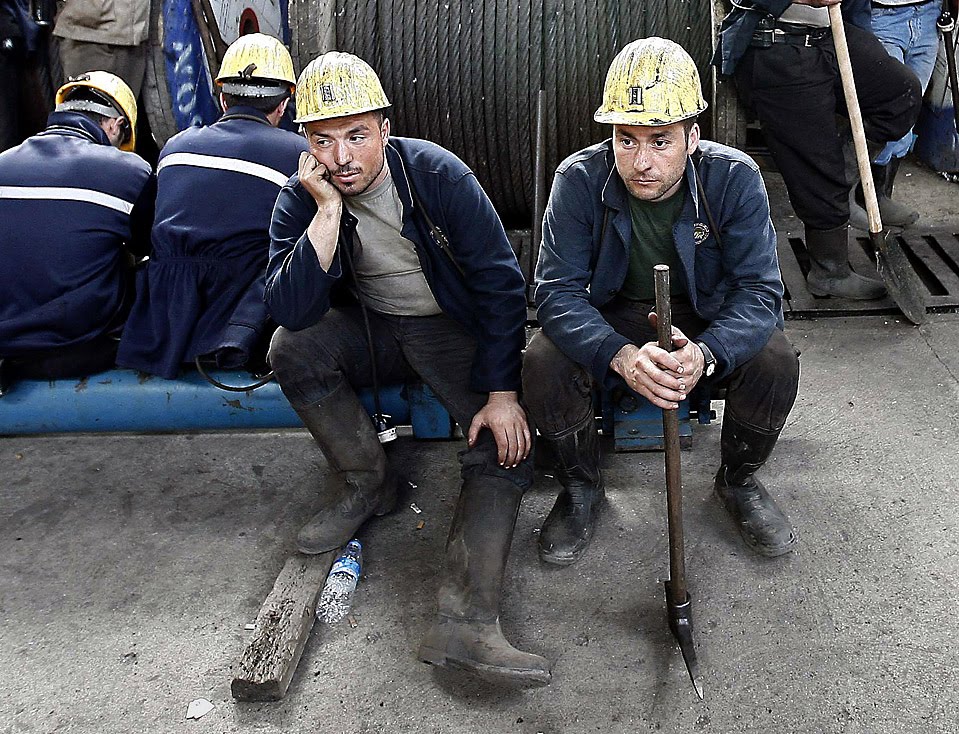
    Turkey prays for miners trapped underground
    Turkey is focused on the fate of 30 workers trapped deep underground in a mine in Zonguldak following a methane gas explosion.

    The explosion that buried the workers 540 meters underground at the state-run Turkish Hard Coal Enterprises (TTK) Karadon mine on Monday drew the entire country’s attention to this northwestern province. However, despite all efforts, the miners had not been rescued by the time Today’s Zaman went to print. Energy and Natural Resources Minister Taner Yıldız said fallen rock was hampering rescue efforts but that the teams were doing their best to reach the trapped miners.

    Five separate rescue teams made up of 400 men were deployed to the mine hours after the incident occurred on Monday. They started working in shifts under difficult circumstances to extract the victims. They dug a passage early yesterday but it collapsed, and they were then forced to approach the miners from a different route, more than 2,000 meters away from the site of the explosion. A member of the rescue team collapsed due to a lack of oxygen while working underground. He was treated in one of the ambulances standing by to take the miners to hospitals if they are successfully rescued.

    Labor Minister Ömer Dinçer said there were reports suggesting that the methane gas concentration was not very high in some parts of the collapsed mine and that the trapped workers might still be alive if they were in one of these sections of the mine.

    “We are keeping our hopes alive. We hope that our fears will not be realized,” Dinçer said, adding later in the day that as time passed their hopes were decreasing. He also said there was no visible violation of safety rules but that the reason behind the explosion has not yet been ascertained. Dinçer noted that their primary focus was not on looking for who was responsible for the explosion but on rescuing those trapped.

    Turkish Red Crescent (Kızılay) President Tekin Küçükali said their teams were working without stop to help the people waiting near the mine for news on the rescue efforts. “Our state and the government have put all their resources to use to rescue those workers. Three ministers are dealing with the matter personally. Our teams are on 24-hour duty,” said Küçükali, adding that they provided soup on Monday night and meals yesterday while also affording professional psychological counseling for relatives waiting for their loved ones to be rescued.

    Civil Servants’ Trade Union (Memur-Sen) issued a written statement following the blast yesterday and said the incident has led to immense sorrow across Turkey. “We expect those 30 workers trapped to be safely rescued and good news to be delivered to their families, friends and the entire nation as soon as possible,” the statement read, adding that “it is our the most natural right to expect all those accidents that happened because the required safety measures were not met or because of inspection deficiencies and negligence to come to an end. Although the state having the means to rescue them is pleasing, the best work to do is to prevent similar accidents from happening again.”

    Deadly mine blasts have been a common occurrence in Turkey. The explosion at the mine in Zonguldak was the third mine explosion in the country in the past six months. In February, a methane gas explosion collapsed an underground chamber in a coal mine in the northwestern province of Balıkesir, killing 13 workers. Nineteen miners were killed in Bursa in December of last year in a similar accident. Both accidents led to national grief when images of the workers’ families weeping helplessly hit television screens. However, little has been done to take necessary measures to prevent another such tragedy from happening. In country’s worst mining disaster, a gas explosion killed 270 miners near Zonguldak in 1992.

    Victims’ families in desperate wait

    In the meantime, victims’ families waited tirelessly all day near the mine’s entrance. Some have more than one relative trapped deep in the mine. Ayşe Aklin’s son, son-in-law and nephew are trapped underground. “I told my son not to go and work in the mine and that I would take care of him by selling milk, but he took this job,” she said, with her eyes full of tears. Gülşen Karabektaşoğlu, with her 6-year-old daughter Ebrar, was waiting for her husband to be rescued. “My husband faced danger when he passed out a month ago after being poisoned by gas. However, he could not quit the job because we are renting our house. He, in fact, is a cook but started working there almost five years ago due to financial difficulties,” she said.

    19.05.2010, News, TODAY’S ZAMAN WITH WIRES

  • Opera at Italy’s La Scala live on Turkish movie screens

    DENİZ İNCEOĞLU, Hürriyet , Wednesday, April 21, 2010

    Turkish art lovers will have a chance to see a live opera at the famous Italian La Scala Theater. On April 29 legendary Spanish tenor Placido Domingo will be live on screen at Cinebonus movie theaters in Istanbul, Ankara and İzmir with one of Verdi’s most important operas, ’Simon Boccanegra’

    Cinebonus movie theaters in Istanbul, Ankara and İzmir will show a live opera from Italy’s famous La Scala Theater on April 29. One of Verdi’s most important operas, “Simon Boccanegra,” which features politics and love, will appear on stage.

    The opera, starring the legendary Spanish tenor Placido Domingo and one of the world’s best known opera artists, Italian Ferruccio Furlanetto, will be led by the world-renowned conductor Daniel Barenboim, who was presented the Lifetime Achievement Award by the Istanbul Foundation for Culture and Arts, or İKSV, last year.

    Jose Placido Domingo Embil, better known as Placido Domingo, who is known for his strong and dramatic tenor voice, will play baritone Simon in the opera.

    Domingo, who turns 69 this year, debuted on stage March 28, 2008, for the 128th time, giving him more roles than any other tenor. He has since extended his hold on the record. Domingo is also an orchestra conductor and spoke about Verdi and La Scala.

    ‘Artists should know La Scala’s history’

    He has seen many opera buildings throughout his career, and when asked about the difference between La Scala and these buildings, Domingo said each opera artist who performs at La Scala should know about its history. “The premiers of all Italian composers and other foreigners have been made at La Scala over the last 200 years, and hundreds of master opera artists, dancers and chefs worked there. The significance of the history of this stage can intimidate a person but inspire at the same time. You want to do your very best performance there,” he said.

    Domingo said Verdi holds a special place in his heart and repertoire, adding that he was the best past composer. He said he had so far performed almost all tenor roles in Verdi’s operas. “I also performed some parts of the lead tenor Gabriele Adorno in the opera ‘Simon Boccanegra,’ but the leading hero of this opera is baritone Simon. This role is one of the most important ones of Verdi’s repertoire. I have dreamed of performing this role for years although he is a baritone. Now I am on stage to play this role.”

    Speaking about the difficulties of performing an aria as a baritone, Domingo said there were some difficulties but all of Verdi’s leading roles have difficulties that need to be overcome. “Simon is a very complicated character in terms of psychology. The person who plays this role should understand what kind of a man he is,” he said.

    Domingo has so far performed many roles, and there are also many other roles he wants to play. “But they are far from me,” he said.

    This year Domingo will perform in “Simon Boccanegra” in the United Kingdom and Madrid and will also perform Sigmund in “The Valkyrie” in Los Angeles. Domingo offered his thanks to the cinema project in Turkey, adding that thousands of people who have not had a chance to come to La Scala would be able to see him on stage, which makes him very excited.

    Tickets for live opera

    Ticket prices for the live opera are 45 Turkish liras at Cinebonus movie theaters in Istanbul and 35 liras in Ankara and İzmir. Tickets are available through www.cinebonus.com.tr and Cinebonus box offices.

    The Cinebonus movie theaters that will screen the live opera will be: Kanyon in Levent, Nautilus in Kadıköy, Capacity in Bakırköy, Gmall in Maçka, Palladium in Kozyatağı, Panora in Ankara and Kipa in İzmir.

    Simon Boccanegra

    Simon Boccanegra is an opera with a prologue and three acts by Giuseppe Verdi and an Italian libretto by Francesco Maria Piave. It is based on a play with the same name by Antonio García Gutiérrez in 1843 and was first performed at Teatro La Fenice, Venice on March 12, 1857. The opera is set in Genoa, Italy, in the 14th century. In the play, the leaders of the plebeians are conspiring to name the former pirate Simon Boccanegra as “doge” (chief magistrate). He accepts because he hopes to marry a woman named Maria. However, she has died, and the illegitimate child she and Boccanegra had has disappeared.

  • On Thermal Power Plants

    Dear Energy Professional, Dear Colleagues,

    There were important issues related to thermal power plants, so on this Sunday morning, I would like to share with you here-in this blog page.

    I worked all my professional life in thermal power plant construction, design, marketing, sales, project management, and in proper operation since my graduation as a mechanical engineer in year 1973.

    Like myself and many other ME graduates in the energy sector, we received training in mechanical engineering for years, it should not be expected us to be against to thermal power plant operations for electricity generation and creation of more power for the society.

    We construct power plants, make basic and detail designs, try to build properly, without damaging the nearby environment, operate smoothly and friendly with the environment. Our nation paid us to get trained for this purpose, allocated limited resources to educate us to work as engineers to contribute to our society, and we do our best for our nation to create more energy, more power, and better environmental conditions.

    It is my sincere feeling that it is funny to be against thermal power plants, or meaningless, even it is an absurd situation. For those who do not understand the energy business, say hoteliers, environmentalists, or medical doctors, you still need electricity, since hoteliers will need for your hotel air conditioners, to run the filter circulation in your pool, if you are a doctor / or surgeon, you would need electricity for the operation table devices, for the lamps to illuminate, for the sterilization of the equipment, at least for the lamp, for heating, for your computer to work.

    We must design better thermal power plants, with least harm to the environment, at the most appropriate place; make all the filters big enough to collect almost all outgoing dust and sulphur, NOx etc. in the works. Solar power plants do not operate at night, wind power plants do not operate if there is no wind. Solar and wind power plants do not work, without engaged in the equivalent capacity of thermal power plants which would be kept warm stand-by.

    “The wind and the sun are enough for us” is a ridiculous expression, and it is pronounced by those who do not know the energy technology. Not only the solar and the wind, we need thermal, hydraulic, nuclear plants each with appropriate proportion, with the best available design, in environmentally least damaging, and with the local engineering staff to construct and operate.

    A society can not develop without energy generation, without electricity production, and we can not raise the level of prosperity. It is necessary for our own household comfort and cultural activities, we can not watch opera, cinema, TV, nor access to PC without electricity, we can not drive on the freeway without traffic lights, we can not live in warm, properly illuminated and comfortable environment in our home at night.

    Energy production is essential, it is mandatory to increase electricity generation for everyone. Everybody wants more electricity, but no one wants power plants in his/her backyard, even wind power plants since they create a lot of noise. How do we solve this dilemma?

    It will be solved for sure. Investors will install the power plants in the proper place, with the best friendly design with the environment, give confidence to the nearby local people, with big filters to work properly, with appropriate deep sea discharge, and control air pollution, and they will not deceive people,

    “I’ve written the EIA report, it is here in my office, if you wish to read and review, come over here” – is funny statement as advised by our local investors. You create an internet web page, you put your EIA reports there in pdf format, we all read, and write our objections if any.

    From economically bankrupt country (Greece), a relatively small contracting firm (Metka) comes to Turkey, and investor RWE from Germany places the contract to construct a turn-key 770 MWe combined cycle power plant in Denizli province Honaz county Kaklık village, at an inappropriate location on the airport landing corridor.

    Yet the same company gets another turn key contract in Samsun province Terme county Kozluk village, from an Austrian investor OMV to construct new 870 MWe capacity combined cycle power plan.

    These are absurd cases. Risk assessment of the investors is not correct. It is not so easy to finalize these contracts without local reaction, without heavy headache, and loss.

    Our companies have engineering capability to construct natural gas fired combined cycle power plants turnkey basis, complete with basic and detail engineering design, equipment sourcing, mechanical fabrication, site construction, start up, commissioning, and full operation. It is our natural right to defend our local employment rights at any legal platform, and protect our engineering jobs.

    We have another absurd case in Amasra. There is only a simple, immature, somewhat funny EIA report. Some MPs say “Whatever’s necessary for Bartin will be done”. It is an incomprehensible expression for hiding behind. My former auto mechanic was saying the same when I asked more details of the car repair, and I quickly found another mechanic to explain me better.

    In internet environment, a local group created a new web page named BartınPlatformu.org as emerged to voice the local reaction. We would like to congratulate them. Investor does not have a web site, but people of Amasra BARTIN have. It is very nice web page currently in initial stages but later in the day, we are sure it would be better. There are certain things getting incorrect, so we have to fix them in advance not to leave them to next future generations to solve.

    For Yalova 100 MWe imported coal firing thermal power plant investment, both the investor and the local people have web pages. Investors are to convince the local highly educated retiree population that they will construct the power plant with least harm to the nearby environment; they should restore confidence not to repeat the old ignorant rouge practice of the past, install big filters in the best and non-stop operation to run, with proper deep sea discharge, all with maximized local engineering.

    We are the engineers of this country, we are the people of this country to serve our society to upgrade the well being of our nation, not to match with foreign companies, we do not finish our job and escape, and we are here to serve all our lives.

    In Gerze county YAYKIL village for 1200 MWe capacity imported coal firing thermal power plant investment project, the investment advisor said, “We shall construct the best thermal power plant, if we do not- then, if the State will make the necessary controls and the plant will be closed,” This is an incorrect expression. This statement is the inauspicious expression of academic isolation in the ivory tower.

    The Public authority can not close a power plant, even it is deemed necessary, due to ever growing energy demand in the local market. The Authority issues a small fine and that pollutant plant goes on running with huge pollution to nearby environment, as it is the case in Afsin-Elbistan-A plant, in TunçBilek Plant, in Yatağan Plant.

    The environment is an important issue not to be left alone to the respective ministry only. We are all responsible. Local civil societies, local NGOs as well as Chambers of Engineers, are all responsible for proper design, proper site selection, proper construction and operation of the thermal power plant, in regulatory, supervisory and corrective actions.

    Afsin Elbistan-A unit is operated almost without proper dust collectors for many years. It is beyond the limits of comprehension. In order to describe the existing situation, one can not find the words to say. MENR, EMRA, Ministry of Environment, SPO, the Treasury were unable to stop that men-made disaster for many years. The latest WB credit of 280 million Euros with extraordinary repayment conditions were returned to the creditor since the authority could not make the proper tendering to WB norms. In Afsin-Elbistan B power plant, the ash dam is still missing, the ashes are kept in next to the plant in open area, when the wind blew the whole mess is all around. This investment is not completed for many years, it is a great mistake. People lost their faith to thermal power plants as well as to public initiatives to similar investments.

    Rehabilitation plans of the old aging plants are still pending. The “OEM expert company award procedure” is unfair and very expensive. It is award without competition. If there is no competition in public tendering then corruption is unavoidable. The foreign OEM companies repeat their old mistakes over and over. The most of the thermal power plant rehab programs are almost 10 years old, and not completed yet, and the plants are almost idle. This work should be finalized quickly and properly, or privatized and to be given to new private owners to handle the rehabilitation job soon.

    To be against the thermal power plants is a sort of advising people “not to make babies” in order to avoid “child diseases”. It is similarly absurd to suggest both cases.

    Economic development of the society is directly related with more generation of energy and electricity. So that is not only the work of engineers, and cultural and social well being of our nation is work and responsibility of all citizens.

    With my deepest respect

    Haluk Direskeneli

  • Macbeth in Ankara Opera House

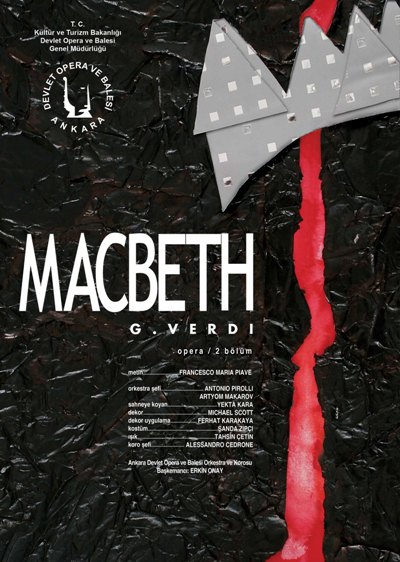
    ‘Macbeth’ returns to Ankara opera stage after 48 years

    Hurriyet Daily News with wires, Monday, April 26, 2010

    William Shakespeare’s tragedy ’Macbeth’ will appear on stage in Ankara on Wednesday after 48 years with a performance by the Ankara State Opera and Ballet. The director of the play, Yekta Kara, says almost half a century has passed since it was last staged and it is a very long time for a masterpiece like ’Macbeth’
    One of the most important tragedies of William Shakespeare, “Macbeth,” which has been adapted to opera stage with Guiseppe Verdi’s melodies, will meet the audience of Ankara after 48 years. The opera will premiere on Wednesday.

    The opera, which Shakespeare wrote in 1606, is one of the most significant works of the Ankara State Opera and Ballet this season. The stage director is Yekta Kara, who staged the work at the Istanbul State Opera and Ballet in 2006.

    “Macbeth,” which is one of the shortest but the most important among Shakespeare’s tragedies, has so far met audiences on the world’s most important theater and opera stages. Speaking about the opera, Kara said that he last time staged the opera “Zahide” in Ankara and would meet the audience of the capital after 19 years.

    He said the Ankara people viewed “Macbeth” in 1962 for the last time. “Almost half a century has passed. This is a very long time for a masterpiece like Macbeth.”

    Kara said like in all plays of Shakespeare, “Macbeth” featured human, and that he knew human nature and human feelings very well and adopted it to the stage very successfully. He said Verdi had a great admiration for Shakespeare, adding that he had composed three different Shakespeare plays in his life.

    “The first one was ‘Macbeth’,” Kara said. “Verdi played with ‘Macbeth’ for a long time. He composed it first, it was staged and revised in the direction of critics. Later on, it met the audience in Paris with its new version.”

    Today after 10 centuries

    Kara said since it featured human, “Macbeth” would always be a popular play. “There is love in most of operas. People die, cry or have problems for the sake of love. And death is always in question. There is no love in ‘Macbeth,’ we don’t see any love scene between Macbeth and Lady Macbeth. But there is a great will to power,” he said, talking about the theme of the play.

    “The thing that brings together a man and a woman, namely Macbeth and Lady Macbeth, and caused them to collaborate is an unbelievable will to power. They commit crime for power. Many things are still the same in human nature”, Kara said.

    “Macbeth takes place in 11th-century Scotland. We stage it in the 21st century in Ankara, after 10 centuries. People’s wills never end, regardless of their position. And many bitter events happen because of these wills. They shed blood, fight and kill each other for their will. It means that nothing has changed in human nature since then. But thanks to education and culture, we learn to suppress primitive feelings and the will to power. Those who fail to do it continue committing crime just as in ‘Macbeth.’”

    True story of a Scottish king

    “Macbeth” is the last of Shakespeare’s four great tragedies, the others being “Hamlet,” “King Lear” and “Othello.” It is based on a true story of a Scottish king who rose to power through bloody ambition. The play opens as Macbeth has just vanquished an usurper to the current king’s throne. He and his comrade Banquo come across three witches who prophesy that Macbeth will be made thane of Cawdor and will eventually become king. When he reaches the king’s court, Macbeth is made thane of Cawdor as a reward for his bravery and loyalty. Now the witches’ greater prediction begins to occupy the minds of both him and his wife. It is Lady Macbeth who plots the murder of King Duncan and the ascension of her husband to the throne. Macbeth initially resists her prodding, but finally agrees to commit the regicide. While the plot is successful and Macbeth rises to the throne, many suspect him of the murder. His reign is marked by the murders of his opponents, both real and imagined, and by the visitation of spirits. Both Macbeth and his wife suffer greatly from their guilt, until the dramatic conclusion that ends his bitter rule.

  • Pazar sabahı Termik santraller üstüne öylesine

    Değerli Arkadaslarım,

    Aklimda bu haftasonu termik santrallerle ilgili önemli konular vardı, Pazar sabahı onları burda- bu blog sayfasında sizlerle paylaşayım istedim

    Ben termik santral yapımı, tasarimi, pazarlanması, satışı, proje yönetimi, işletimi konusunda mezuniyetinden itibaren (1973) çalışmış bir makina mühendisiyim.

    Benim ve benim gibi makina muhendisliği konusunda eğitim almış bu konuda yıllarca çalışmış kişilerin doğrudan termik santral karşıtı olması herhalde beklenmez. Biz termik santral yapmak , tasarımını gerçekleştirmek, inşaa etmek, ve düzgün çevreye zarar vermeden işletmek için eğitim aldık. Toplum bizi bu amaç için eğitti, yetiştirdi, kaynaklarını seferber etti, biz de en iyisini yapmak, topluma daha çok enerji, daha çok elektrik, daha iyi çevre şartlarına uyumlu santral kurmak için çalıştık, bugünlere geldik

    Doğrudan termik santrallere karşı olmak bence komik, anlamsız hatta absürt bir durumdur. Konudan anlamasanız, diyelimki otelci, cevreci, veya TIP doktoru olsanız, yine elektrige ihtiyacınız var, otelci iseniz yazın otelinizde klimalar çalışacak, havuz filtresi sirküle olacak, Doktor/ Cerrah için ameliyat masasında cihazlar çalışacak, lambalar yanacak, sterilizasyon yapılacak, en azından lambanız, kaloriferiniz, bilgisayarınız çalışacak,

    Termik santralleri doğru tasarımla, çevreye en az zarar verecek şekilde, en uygun yerde, tüm filtreleri yapılmiş çalışır şekilde inşaa etmek gerekir. Güneş santralleri geceleri çaışmaz, rüzgar santralleri rüzgar esmezse çalışmaz, güneş ve ruzgar santralleri çalışmadığı sürelerde devreye girecek eşdeğer kapasitede termik santrali sıcak hazir beklemede tutmak zorundasınız. “Rüzgar, güneş bize yeter” demek, bu konuyu hiç bilmeyenlerin ifadesidir, sadece gunes ruzgar degil, termik, hidrolik, nukleer her tür santrali uygun oranda, düzgün tasarımlarla, çevreye en az zarar verecek şekilde ve yerli kadrolarla yapmak gerekir

    Enerji, elektrik üretimi olmadan toplum gelişemez, refah seviyesini yükseltemez. Toplum kültürel, sosyal olarak ta ilerlemeli, ama elektrik olmadan opera seyredemezsiniz, trafik ışıkları olmadan karayolunda gidemezsiniz, aksamları evinizde rahat aydınlık sıcak ortamda oturamazsınız

    Enerji üretimi şarttır, elektrik üretimini artırmak zorunludur. Herkes elektrik ister, ancak kimse kendi arka bahçesinde istemez. Bu açmaz nasıl düzelecek?

    Düzelecek, yatırımcı düzgün yerde, çevre ile barişık, yerli insanla barişık santral yapacak, filtreler çalışacak, derin deniz deşarji doğru düzgün olacak, ortam hava su kirlenmeyecek, insanlar aldatılmayacak,

    “Ben CED raporu yazdım, işte burda gel bak oku incele”- demek komiktir, CED raporunu pdf yapar internet sayfası açar koyarsın, hepimiz okuruz, varsa itirazımız yazarız

    Ekonomisi batmiş (Yunanistan) bir ülkenin müteahhitlik firmasına (Metka) Türkiye’de 770 MWe Denizli Kaklık köyünde hemde Çardak havaalanı uçak iniş koridoru üstünde kombine çevrim santrali inşaatı işini vermek, aynı firmaya Samsun Terme Kozluy da 870 MWE başka bir kombine çevrim santrali işini vermek başka bir absürt durumdur. Bizim firmalarımız bu artık basit santral tasarımını, inşaasını, montajını, işletmesini yaparlar, bu tip yabancı firmalarin yurtiçi santral yapımına kanuni olarak karsi çıkmak en doğal hakkımızdır- Kendi yerli mühendislik istihdam hakkımızı sonuna kadar savunmak şarttır

    Aynı şekilde Amasra’da olanlar başka bir absürt / anlaşılmaz durumdur. Ortada anlaşılmaz, uyduruk hatta yer yer komik bir CED raporu vardir, bazı milletvekilleri “Bartin için en iyisi neyse yapılacaktir” seklinde anlaşılmaz bir ifadenin arkasına saklaniyorlar. Benim eski oto tamirci ustamda detaydan kacmak isteyince oyle diyordu, hemen baska bir usta buldum, internet ortamında BartınPlatformu olarak ortaya çıkan yerel gurubu tebrik ediyorum. Yatırımcının kendini anlattığı bir internet sayfası yok, ama BARTIN halkının var, çok güzel, internet sayfası henüz baslangıç aşamasında ancak ilerleyen günlerde cok daha iyi olacak eminim. Ortada yanlış işler var, bunları gelecek nesillere birakmadan şimdiden çözmek zorundayız

    Yalova’daki 100 MWe ithal kömür santrali için yatırımcının ve yerel halkın ayrı ayrı tanıtım internet sayfaları var, yatırımci yerli halkı, çevredeki eğitimli emeklileri ikna edecek, güven tazeleyecek, eski yanlışlarını tekrarlamayacak, külü tutacek, filtreleri en iyi şekilde çalıştıracak, derin deniz deşarjını düzgün yapacak, bütün bu işler için yerli mühendisliği sonuna kadar kullanacak. Biz mühendisler bu yurdun insanlarıyız, yabancı firmaların yaptığı gibi işi bitirip kaçmak bizde yok,

    Gerze’de olduğu gibi “Biz en iyi termik santrali yapacagiz, zaten yapmaz isek devlet kontrol eder ve santrali kapatır” demek yanlış bir ifadedir, çevre konusu sadece kamu kurumlarına, Çevre bakanlığına bırakılmayacak kadar önemli bir konudur. Çevreye ne kadar zarar verdiği herkesce bilinen, Afsin-Elbistan-A, Yatağan santralleri örnekleri varken bunları söyleyebilmek, yurt gerçeklerinden uzak olmak, akademik izole kulede yaşamak anlamındadır.

    Yerel Sivil toplum örgütlerinin, TMMOB, EMO, MMO’nun düzenleyici, denetleyici ve yönlendirici olarak mutlaka devrede olmaları şarttır.

    Afsin Elbistan -A unitesinde filtreler devrede olmadan çalışmak anlaşılır değildir. Durumu anlatacak, söyleyecek söz bulamıyorum. ETKB, EPDK, Cevre, DPT, Hazine bu durumu önlemek için yıllardır birşey yapmıyor. 280 milyon Euro uygun krediyi kullanamadan iade etmek hiç anlaşılır değildir, bu yapilanlar anlama sınırları ötesindedir. Afsin Elbistan-B santralinde kül barajı hala yoktur, kül tutulmakta ancak yanda stoklanmaktadır, rüzgar esince ortalık kül içinde kalmaktadır. Bu yatırımın da bitirilmemesi anlamanın ötesinde bir büyük hatadır.

    Rehabilitasyonları yapılmamış, amili- mutehassıs usuluyle cok pahalıya yabancılara ihale edilerek yapılmış termik santrallerin varlığı ayrı bir hatadır, 10 senedir rehabilitasyon ihalesi yapılamamış eski kullanılmaz halde termik santraller vardır, kamu bu işleri çabuk ve düzgün ihale etmek zorundadır.

    Termik santrallere karşı olmak “Cocuk hastalıkları olmasın”- diyerek “çocuk yapmayalım”- çözümünü söylemek gibi absürt birşeydir.
    Daha çok elektrik üretimi maddi gelişmişlik için şart, bunlara kafa yormak sadece biz mühendislerin işi değil,
    Ayrıca toplum için sosyal, zihinsel, entellektüel, kültürel gelişmişlik lazım ve bunlar zaten herkezin işi.

    En derin saygilarimla

    Haluk Direskeneli
    ODTU ME’1973, MMO Ankara 6606

  • Thermal Power Plant Design Software training and FreeTrial Demo CD.

    Dear Energy Professional, Dear Power Plant Designer,

    Thermal Power plant design software company offers a variety of training programs to suit your needs. Course content, schedules and registration forms are available on the linked pages. Scheduled week-long sessions covering all programs. Sessions are held at various locations around the world during the course of the year. Content designed to give attendees the necessary understanding to effectively use Thermoflow software in business activities. This course has been given over 150 times to more than 1000 attendees since the early 1990’s.

    For more detailed information and registration please visit the web site at “Training Standard Schedule”

    For demo CD and catalogue, please visit the FreeTrialRequest link.

    Free trial package comes with working versions of all of our software with restrictions on only a few of the thousands of program inputs. If after reviewing the free trial, you want to analyze the software in even more detail, contact Thermoflow for a provisional trial license of the fully functional software suite. We have one trial CD and it includes all of our programs. You only need to submit one copy of this form, regardless of which program(s) you want to try.

    In-house training and tailor-made courses can also be arranged at your company location, please ask for more information.

    Best Regards


    Haluk Direskeneli

  • To Barack Obama with my deepest respect

    Ankara, April 16, 2010

    His Excellency
    Barack Obama
    President of the United States of America
    Washington D.C.
    USA

    Dear Mr. President,

    It wouldn’t be an exaggerated statement if I say that your exceptionally impressive speech to the Turkish Grand National Assembly on April 6, 2009, captured the hearts and the minds of the Turkish people. This speech and the other statements you made during your visit left a deep imprint on the Turkish public opinion conveying the belief that you look at the world and Turkey with good will and without adverse prejudices.

    Unfortunately, the subsequent statement that you made on April 24th regarding the events of 1915 in Eastern Anatolia seriously disappointed the Turkish people and cast a shadow on the positive impression formed during your visit for the following reason: Although your statement omitted the highly charged word “genocide”, you twice employed the expression “metz yeghern” which is the exact translation of “genocide” in the Armenian language. Furthermore, the statement said, “Each year, we pause to remember the 1.5 million Armenians who were subsequently massacred or marched to death in the final days of the Ottoman Empire”, and thereby, in effect, reprised the expression “Armenian genocide” that you used frequently during your election campaign.

    Mr. President,

    In addition to being a world statesman of the first rank, you are also justifiably regarded as a distinguished scholar of law, having graduated from the world renown Harvard Law School and having instructed law as a senior lecturer at a prominent university. In light of these qualifications, we are particularly perplexed by your characterizations of historically controversial events that took place 95 years ago in terms that are incompatible with the universal principles of law as well as provisions of the U.S. Constitution and U.S. national law.

    “Genocide” is an international crime codified in an international legal instrument, the “Convention for the Prevention and Punishment of the Crime of Genocide”. This was adopted by unanimity by the United Nations General Assembly in 1948 and subsequently became the supreme law of the U.S., as stipulated by Article VI of the Constitution pursuant to its ratification by the U.S. Senate. Article II of the Genocide Convention delineates the crime of “genocide” and prescribes the objective/material and subjective/mental elements which should be proven for the existence of the crime. To incriminate a person with the crime of “genocide” or for state responsibility to arise, together with the existence of these two elements of the crime, the fact that the crime has been committed with specific intent must be proven and a competent court must ascertain that the crime has been perpetrated. The Convention’s Article VI specifies that the competent judicial authority is the competent court of the state in the territory of which the alleged act was committed, or an international penal tribunal, the jurisdiction of which has been accepted by the parties. Article IX of the Convention provides that the states can take disputes on matters relating to “genocide” which arise between them to the International Court of Justice.

    Mr. President,

    Consequently, unless the existence of the material and mental elements of the crime as well as its execution with the specific intent have been proven, and unless the perpetration of the crime has been determined by a competent court, a charge of “genocide” leveled against a person or a state has no legal value and only constitutes a defamation.

    Until today no accused has ever been incriminated with the crime of “genocide” or with the “crime against humanity”, which is a crime as odious as “genocide”, without a decision of a competent international criminal court. Indeed, the Nuremberg International Penal Military Tribunal, after a long trial process, found guilty the leaders of the German Nazis accused of “crimes against humanity” and sentenced 22 of them to death. Furthermore, those incriminated of “genocide” for the events which occurred during the Rwanda and Yugoslavia conflicts have been tried and convicted by the Rwanda and Yugoslavia international penal tribunals. As is known, both tribunals are ad hoc courts which had been set up by decisions of the UN Security Council. Saddam Hussein, who was charged with crimes against humanity, was tried and convicted in an Iraqi Special Court which was established in line with the principle of due process of law. Recently, the legal action brought by Bosnia-Herzegovina against Serbia was heard by the International Court of Justice. In its decision in February 2007 the Court has reaffirmed that at Srebrenica genocide was committed, but has not convicted the state of Serbia of having committed genocide.

    Mr. President,

    I am certain that you hold dear the concept of the presumption of innocence whose roots go back to Magna Carta. Article 11 of the Universal Declaration of Human Rights which was adopted in 1948 by the United Nations General Assembly by unanimity, describes the principle of presumption of innocence as follows:

    “(1) Everyone charged with a penal offence has the right to be presumed innocent until proven guilty according to law in a public trial at which he has had all the guarantees necessary for his defence.

    “(2) No one shall be held guilty of any penal offence on account of any act or omission which did not constitute a penal offence, under national or international law, at the time when it was committed. Nor shall a heavier penalty be imposed than the one that was applicable at the time the penal offence was committed.”

    This principle is set forth in the European Human Rights Convention, Article 6 paragraph 2:

    “Everyone charged with a criminal offence shall be presumed innocent until proven guilty according to law.”

    The principle of presumption of innocence is also guaranteed by the Fifth Amendment of the U.S. Constitution which prescribes that “No person shall be held to answer for a capital, or otherwise infamous crime” unless tried fairly and indicted by a court.

    Therefore, Mr. President, wouldn’t it be a gross injustice and a grave violation of the principle of the presumption of innocence to heap accusations on Turkey for disputed events of the past?

    Mr. President,

    As you would agree, the principle of legality, which is as old as the concept of law itself, is a basic concept in both international and national justice. According to this principle, an act is not recognized as a crime unless it is legally defined before the act was committed. “Genocide”, as a word, as a concept, and as a codified international crime, did not exist in 1915. After being defined for the first time by the U.N. General Assembly document 96 (I) on 11 December 1946, it was codified by the U.N. Genocide Convention on December 9, 1948.

    Consequently Mr. President, by leveling accusations of the crime of “genocide” (directly during your campaign speeches and indirectly in your 2009 remembrance day statement) haven’t you contravened the two dimensions of this principle expressed by the maxims: nullum crimen sine lege, and nulla poena sine lege – there is no crime without a law, and no punishment without a law?

    Mr. President,

    The judgments made in your statement appear to us to violate the spirit of the U.S. Constitution which espouses the principle of legality in its Article I, Section 9 by forbidding the passage of ex post facto criminal laws and bans retrospective criminal sanction. We also must note that President Thomas Jefferson, in his August 13, 1821, letter to Isaac McPherson, asserted that “ex post facto laws are against natural right”. This shows that an abhorrence of retroactive application of laws in criminal justice has a deep-rooted legal history in the U.S.

    Moreover, the principle of legality is equally prescribed by Article 28 of the 1969 Vienna Convention of the Law of Treaties under the heading, “Non Retroactivity of the Treaties”.

    Mr. President,

    In light of the foregoing irrefutable points, certain concerns and questions inescapably arise.

    What are we to infer from the statement you might make this year regarding the disputed events of 1915, if this statement includes the word “genocide” or, echoing your 2009 statement, employs the word’s exact Armenian translation “metz yeghern” and alleges the massacre of the 1.5 million Armenians?

    Wouldn’t such a statement flagrantly violate and flout universal principles of law, international law and the U.S. Constitution? And, to what possible worthy end?

    Wouldn’t it constitute for the Turkish people and their forebears a judgment without trial?

    Wouldn’t the Turkish people consider this gross injustice inflicted on them as the outcome of narrow domestic political calculus, heedless of basic fairness and shared U.S. – Turkish interests ?

    Wouldn’t the imputation of historical guilt upon the people of Turkey and upon their forebears, who themselves suffered enormous losses and were exposed to unbearable pains during those tragic times, be at utter odds with your stated proposal before our Parliament to build a model partnership between the United States and Turkey?

    Mr. President,

    Historian Arthur Ponsonby penetratingly discusses the terrible and enduring effects of war propaganda that persist for generations in “Falsehood in Wartime”:

    “The injection of the poison of hatred into men’s minds by means of falsehood is a greater evil in wartime than the actual loss of life. The defilement of the human soul is worse than the destruction of the human body.”

    I think that Arthur Ponsonby’s cogent words are valid now and will remain valid in the future. What we need today, more than ever, is an international environment that we can hand over to our children and future generations – a world where peace, security, tolerance, friendship and good will reign, instead of prejudices, hatred and passions for revenge.

    For this reason, Mr. President, I must urge you to avoid being influenced by superficial stereotypes regarding the events of 1915 that are rooted in large part in the deliberate wartime propaganda efforts of the World War I Allies. I ask that you foster impartiality and avoid contributing to a deepening of the wounds suffered by the Turkish and Armenian nations in this enormous human tragedy.

    In this context, the best course for the U.S. should be, in line with an ethical and evenhanded approach, to encourage the parties to bring to light and to clarify the obscure and ambiguous aspects of the conflict between the Ottoman State and the Armenians. This would best be accomplished by employing a common, scientifically disciplined research effort by Turks and Armenians regarding their mutual history and by completely opening their archives to examination.

    I am submitting these views to your consideration trusting that you will examine them with objectivity and fairness.

    With my deepest respect,

    Dr. Şükrü M. Elekdağ
    Member the Grand National Assembly of the Republic of Turkey
    Peoples Republican Party
    Deputy from Istanbul
    (Former Ambassador to the USA)

  • Eroglu Victory in Northern Cyprus: What Should Be The Negotiation Dynamics?

    by Fatma Yilmaz Elmas, Tuesday, 20 April 2010

    Elections in Northern Cyprus, turning into a quasi-race between supporters of the negotiation process and those who are against either the process itself or the course of process, resulted at the first round on April, 18. Dervis Eroglu won the presidential elections with just over 50% of the total vote whereas Mehmet Ali Talat was defeated by taking 42.84% of the vote in contrast to his previous victory in 2005 with an average 55%.

    The issue putting its mark on the choice of the electorate and related to the following process is about in what way the negotiations will proceed. It seems that there will be no deviation from the existing will to continue the negotiations, according to Eroglu’s several speeches, previous party program and election declaration for presidency. This view was clear enough in victory speech of Eroglu after the declaration of ultimate results. In his speech, Eroglu expressed that he will not be the one who leave the negotiation table and noted that the negotiations will continue in cooperation with Turkey. However, Eroglu’s attitude is so obvious that the negotiation process will be conducted with a different perspective. Eroglu’s style seems to differ from that of Talat in terms of both way of conducting negotiations and parameters on which negotiations are based. Complaining about an opaque negotiation process during Talat era, Eroglu envisages some steps to make negotiations more transparent and open. The primary one is to form a structure similar to “National Council” in Southern Cyprus. Accordingly, it will incorporate also the government in the process and it will therefore give way to teamwork during the negotiation process instead of one-man domination.

    In contrast to Talat’s vision based on bi-communal and bi-zonal federation, the basic parameter of a possible solution for Eroglu is a new partnership based on the equal political status of founding states. From this viewpoint, the foreseen federation could only be attained by evolutionary term stating with a confederational structure founded by two independent and sovereign states on the island. Therefore, it is expectable that the divergent view of Eroglu from that of Talat could force Greek leader Christofias further.

    Nevertheless, the main issue on Cyprus negotiations is how the Greek side will make use of the change in Turkish presidency rather than divergent attitudes of Talat and Eroglu in respect of solution parameters. The Greek propaganda, trying to show Eroglu as if he is against any solution and to direct and convince both national and international public opinion in this way, has paid well. The news about the elections in foreign press that Eroglu is unwilling for a solution, despite his counter-speeches, shows that the Greek propaganda has been relatively successful. It will not be wrong to wait for the Greek side to try its best to strengthen this perception more in the international arena. Any future deadlocks in negotiation process could be a good tool to utilize for the Greek side in order to change its uncompromising image sticking on it after Annan Plan referenda. At this point, importance of the external dynamics comes on the scene. Without any pressure on Christofias coming from the international public opinion in favor of a possible solution, it seems so difficult to make any progress in negotiations. The process have been damaged anyhow even in Talat-Christofias period because of the inconsistencies of both rhetoric and action. Apart from the accusations of parties against one another, incompatible judicial steps of both sides about the guarantorship also harmed the process primarily. Revitalization of the process once again in real term mostly depends on the European Union which is, to a great extent, the main responsible actor for the imbalance especially in negotiation process. Needless to say, the Greek side has the EU membership card in its hand on behalf of the whole island. What more, it is about to manage to convince the international public opinion about Eroglu’s uncompromising stance on a possible solution. In such situation, it is hard to expect from the Greeks to take constructive steps without any forcible reason.

    There is also another dimension on this issue, which is internal dynamics. Eroglu’s commitment to stay on the negotiation table is not enough alone to set the course of ongoing negotiations. In addition to the contribution of external dynamics, it is essential to add internal dynamics to this process. The necessity of synchronous and multi-dimensional policies including social, political, economic and judicial initiatives has been the neglected part of a possible solution for a long time. As the possible solution is only locked onto the negotiation process, the necessary reforms in order to eliminate the socio-economic asymmetry in the island in favor of the Turkish side is the most important part of such neglected point. During the presidential elections, any approaches about the internal dynamics either were not mentioned or were so weak. CTP’s (Republican Turkish Party) belief on internal dynamics of the solution and its emphasis on the need for reform in several state regulations could not be realized. Except the several sentences in CTP party program during April 2009 elections, the concept of internal dynamics has mainly remained out of the issue. However, internal dynamics is not only an element which will strengthen the hand of Turkish side on negotiation table against the Greek side, it is also a crucial concept for making projections about future as “B Plan” for Northern Cyprus in case of a possibility of cessation of the ongoing negotiations.

    Important to note that, a possible deadlock in negotiation process since it turns into a race to stay just at the table seems not logical till the end. Thus, what should be done in long-term is to make strategic planning from the best to the worst case scenarios in regard to negotiations. However, this situation should not be interpreted that the negotiations have to be conducted in an insincere way. This is just an effort to transform the process, which has proceeded as a derivative just of the external dynamics for long years, into a viable solution

    Fatma Yilmaz-Elmas (Mrs.)
    USAK Centre for EU Studies
    http://www.turkishweekly.net

  • Minister calls for determination in nuclear energy


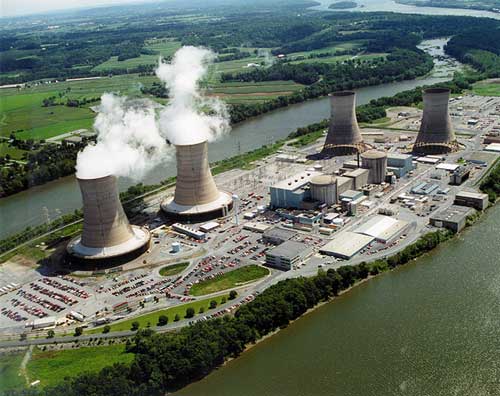
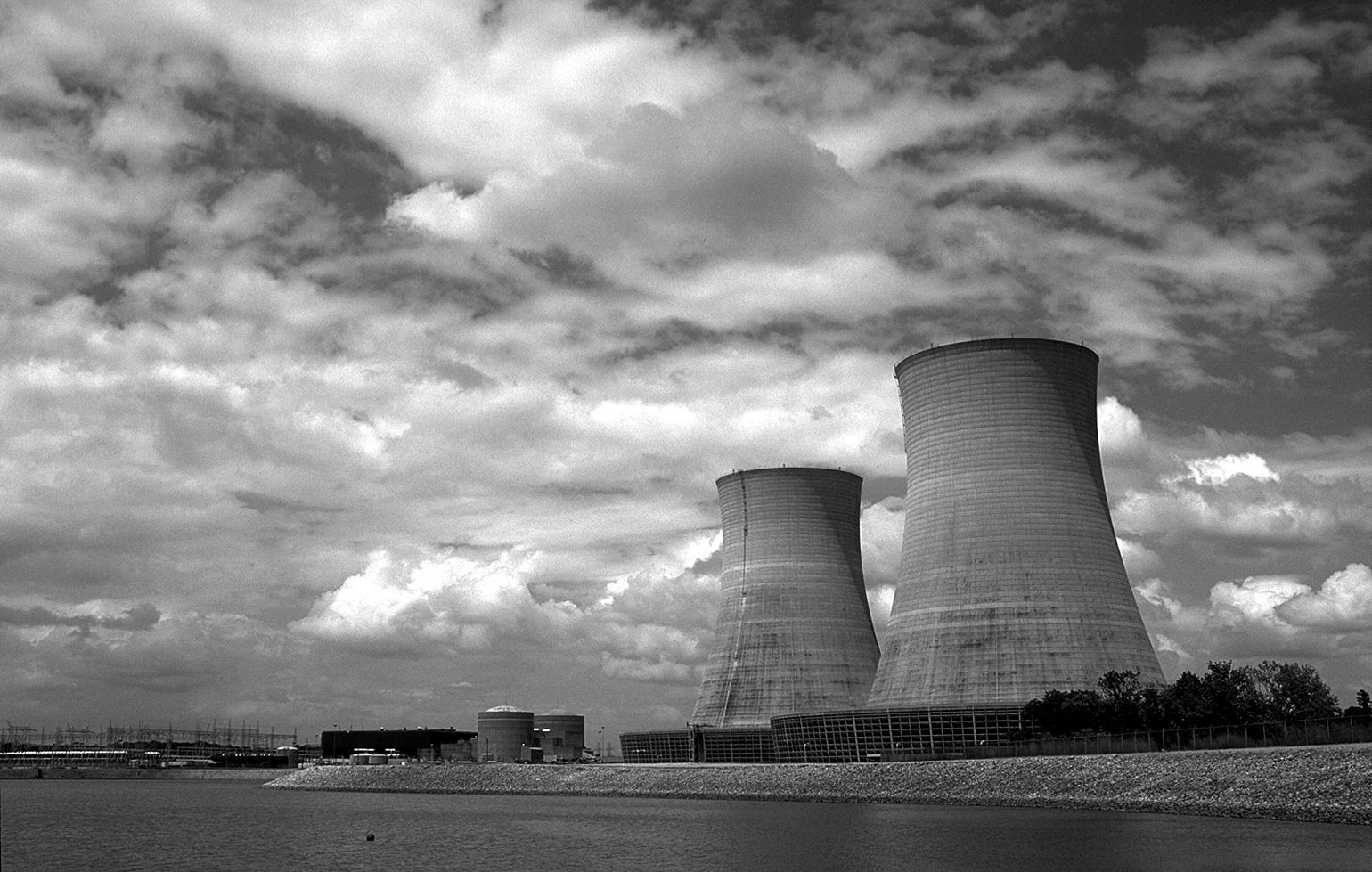
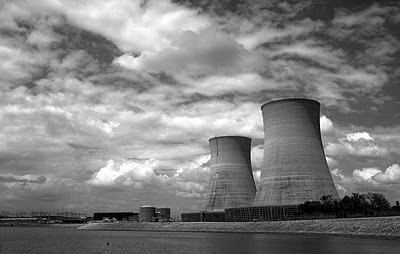
    Photo- Nuclear Power Plant in Three-Mile Island in USA

    ISTANBUL – Hurriyet Daily News with wires, Monday, April 19, 2010

    Turkey’s energy minister urges activities in nuclear energy as well as renewables during his speech at a panel at the Istanbul-based Okan University. Calling Turkey as a ‘solar heaven,’ the minister expresses a plan to focus on the issue in the Renewable Energy Law to be submitted to the Parliament’s General Assembly within two months
    Turkey should be determined to launch nuclear power plants, said the Turkish energy minister, also calling for an assessment of the country’s potential in solar energy.

    Speaking on Saturday at a panel on clean energy held at Okan University, Energy Minister Taner Yıldız said, “We should start nuclear power plants. We should display this determination. The more solid a fuel is, the more negative it is for the world, and the more liquefied it becomes, the less it pollutes the world.”

    The minister’s speech focused on the latest situation in the sector both in Turkey and worldwide, financial aspects, its reflections on practical life and global interaction. “The energy issue is a significant concept that cannot be cleared from international relations,” he said.

    Commenting on solar energy as an important renewable resource, Yıldız said, “Turkey is a solar heaven. It is a proper thought when we propose using it, and we will bring this up in the Renewable Energy Law and designate its price.” The law will be submitted to the Turkish Parliament’s General Assembly within two months.

    Also talking about the debate on mine licenses, Yıldız said all licenses in Turkey cover only 0.8 percent of forest areas. The minister also expressed the need for clarification on hydroelectric power plants. “This will pave the way for real investors and close the way for speculative investors.”

    Yıldız noted that Turkey’s energy goals may not always match up with those of the rest of the world. “The use of energy resources in the world is around 16 percent. Our goal is to raise this to 30 percent by 2030.”

    Focus on domestic resources

    Yıldız said the aim is to activate all of Turkey’s domestic resources by 2023. A decision supporting nuclear energy power plants would also indirectly support domestic and renewable resources, according to the minister.

    The cost of clean energy is high but Turkey fulfills its responsibilities, said Yıldız.

    Production of wind energy in Turkey will total 76,000 megawatts, said Yıldız, adding that 13,000 megawatts of this amount will be activated by 2015, and 20,000 megawatts by 2020. The private sector will undertake these investments in wind energy, he said, expressing an optimistic outlook in this field.

    Responding to a reporter’s question, Yıldız said Turkey does not face a problem in terms of supplying security, but there is no time to waste in terms of investments, reported the Anatolia news agency.

    When asked about the framework of the solar energy law, Yıldız said there will not be high prices for solar energy. “Turkey’s people should benefit from the advantages of Turkey’s sun. International investors should not benefit from the advantages of Turkey’s sun. They should benefit from the money brought through technology transfer.”

    At the panel, Bekir Okan, chairman of the board of trustees of the university, expressed the importance of being a tool for the production of studies, opinions and projects on energy awareness and use, as well as the implementation of projects in this field.

    Okan University Rector Sadık Kırbaş stressed the resource problems in fossil fuels. “The world’s fossil fuels are being exhausted. Their prices are rising, and this situation is likely to result in significant conflicts. Clean energy is the energy of the future and more investment is necessary.”

    The panel took place under the chair of R. Nejat Tuncay, dean of the Faculty of Engineering and Architecture. The participant panelists included Mustafa Tırıs, energy institute manager at the Marmara Research Center of the Scientific and Technological Research Council of Turkey, or TÜBİTAK MAM; Vedat Gün, Vice President of the Energy Market Regulatory Authority, or EMRA; Gökmen Topuz, deputy managing director at Zorlu Energy; Mürsel Meral of Cansu Elektrik; Cemil Kazancı of AKSA Natural Gas; and Levent Gülbahar, chair of the Turkish Photovoltaic Industry Association, or GENSED.

    The panel discussion followed the official opening of the building of the university’s faculty of engineering and architecture.

  • On new thermal power plant investment in Amasra


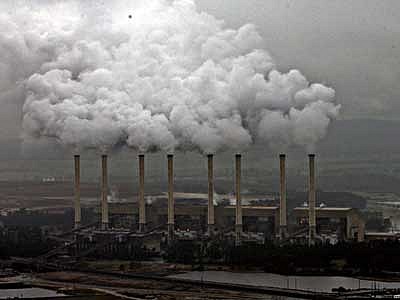
    Hazelwood, in Victoria, is Australia’s most greenhouse polluting power station, producing about the same greenhouse emissions as 3.95 million cars per year.

    Dear Colleagues

    If you wish to review the investment in Denizli province as planned by RWE of Germany for 870 MWE Combined cycle power plant, then all you have to do is open google, write “RWE, Denizli” then you get the all reports for EIA, http://www.rweturcasdenizlienerjisantrali.com/

    Then if you wish to know details of AKSA 100 MWe imported coal firing new thermal power plant in Yalova, similarly you search for “AKSA, Yalova, Enerji” in google, and you immediately reach to the respective presentation link, http://www.yalovaenerjiyatirimi.com/

    If you need information on 1200 MWe imported coal firing new Gerze Thermal Power plant investment, it is in http://www.gerzeenerjisantrali.com/

    It is so surprising that they put so much details into those reports. You can read and write your critics, and they answer to you,

    On the other case, where are the investment reports for Amasra 2640 MWe (or 1200MWe) thermal power plant investment? It is only lip service, daily emails to newspapers, media writers, who are unable to interpret those empty wording.

    When you review internet page of their UK partner, you come up with many thermal power plants but almost all of them are combined cycle. They have only three major coal firing thermal power plants in UK, Portugal and Indonesia plus very old two plants in Australia which are Hazelwood (photo) and Loy Yang B plants. However they purchased all these coal plants after construction and many years of service by the first investors. So they know how to operate the coal firing thermal power plant but they do not have any experience on their construction. Moreover most of their existing coal based thermal power plants need upgrading in ESP, FGD and ash disposal systems, due to new local requirements to stop global warming.

    All and all, we have sincere doubts on the technical qualifications of Amasra thermal power plant investment. We need to know the details, coal mine investigations, an appropriate EIA internet page with sufficient evidence, meteorology facts.

    Meteorological studies show that Amasra is in “advection inversion” that is
    a temperature inversion caused by advection as warm air passes over a cool surface, which makes impossible to construct a thermal power plant. Who cares??

    Therefore we feel that PR activities of the investors are not sufficient at this point in time, and we would sincerely advise the locals not to care about that service.

    Thank you and best regards


    Haluk Direskeneli, Ankara based Energy Analyst

  • Amasra new thermal power plant investment

    Dear Energy Professional, Dear Colleagues,

    An international energy/ power investor company is partner of 480 Mwe combined cycle power plant on Tekirdag sea coast in Thrace part of Turkey for last 10 years. The Company advanced the most in two weeks in London trading after the Independent newspaper reported GDF Suez SA is considering raising its bid to purchase for the utility.

    The Foreign Company is now considering partnering with another local investment group to build a new local bituminous coal firing thermal power plant in Amasra county, BARTIN Province of Turkey to generate 1200 MWe (or 2640 MWe) electricity output for the national grid. The new TPP investment project may be considered to increase the investment portfolio in order to have price raise in negotiation with GDF Suez SA.

    The local partner investor group has received 49-years of coal production concession right. Both parties are now negotiating on the final MoU draft, and hoping to sign the MoU document in next few weeks time.

    Earlier the local investment group has prepared an Environmental Impact Assessment (EIA) report to get permission from the Ministry of Environment, which is needed to get power plant investment licensing from the energy markets regulatory board.

    Earlier the investment capacity was presumed to be 2640 Mwe comprising 4x 660 MWe units, firing approximately total 1000 tons of coal per hour, where the local coal has 3500 local/kg LHV as received, 5800 kcal/kg LHV after water washing enrichment.

    Your writer had spent a few nights to read the preliminary so-called EIA report, in the end he was displeased with the technical quality of the report, other than flora and fauna and all unnecessary details, concluded that the report was not so professional, very simple, even somewhat misleading, even quite far from truth in certain chapters.

    Our calculation relieves 1300 tons per hour coal with 5800 kcal/kg LHV after water washing enrichment of as received bituminous. With 7000 hours of estimated annual operation, the plant should consume 7 million tons of enriched coal or 10 million tons per year as received.

    Overall local bituminous coal production was 1.2 million per year in year 2008, which is corrected to 2 million tons in year 2009. Therefore the plant will consume 5 times of the current production of the local coal reserves. How will this happen? Isn’t it misleading?

    Now the new foreign company is in the picture with the local investor with half the earlier output generation not 2640 MWe but for 1200 MWe, in 2 units of 600 each.

    We understand that the foreign investor company has 3 similar coal firing references in the world, 1000 MWe Rugeley Power plant in England, Pego 2×300 MWe in Portugal and 2×615 MWe Paiton Indonesia (+800 MWe new) all burning high LHV bituminous coal.

    At this time of global warming, world uprising climate change, there is no excuse, no luxury for Operators not having sufficient E/Ps, not installing FGDs whatever local emission regulations. All these reference plants are not constructed by the Company but purchased after construction in privatization, and all of them have same common environmental sensitivity weaknesses.

    Their plants are seriously lacking environmental equipment, ESPs are not sufficient to collect all outgoing fly-ash, and first two references do not have FGD systems at this point. First two plants’ FGD systems are added nowadays after so many years of operation and air pollution, due to local or international public pressure.

    The Foreign Partner has to have more environmental sensitivity in their own plants. They have small E/Ps and lack of FGDs in their coal plants. That means they can not collect dust properly, they can not collect sulphur but pour all to atmosphere.

    Should we interpret this situation as opportunism, or greed, or ignorance to public health and safety?

    Which state of art technology will be employed in the plant design? And what employment opportunities are waiting for the local people??

    How should we interpret? Is that they presume all local people ignorant, illiterate, unable to make calculation, unable to read technology?

    They have money to invest in poor technology with no care to beautiful environment of the Black Sea coast, we need electricity generation and we comply with all that information rubbish. Is this what is expected?

    We understand that the partners will finance the project 30% from their own sources and the remaining 70% through project financing.

    That means they will need serious bankable feasibility and EIA reports with full compliance to European standards and norms to emission limitations.

    They will need serious plant design, to run smoothly for many years. They will need full compliance to local and EU laws and regulations and local expectations for maximized local employment.

    We only get pleased to read such news on new energy investments in our local energy market, provided that

    They are designed environmentally friendly, to enable low CO2 emissions, even employ CCS technology,
    They consume maximized amount of local coal,
    They have E/Ps, FGD, CCS fully installed and operated, and they meet EU emission standards,
    They have completed all obligations for Environmental Impact Assessment Reports,
    They receive their license from the Local Regulatory Board,
    They are designed by local engineering companies or in-house engineering as much as possible,
    They are fabricated in the local fabrication plants as much as possible,
    They are installed by our local contractors,
    They are commissioned and supervised by our local engineering power,
    They are operated by our own local staff, and
    Regularly checked by our own Labor force in programmed maintenance.

    We only get pleased to read investment, and sincerely feel that energy investors deserve all our support to complete those power plant investments.

    On the other hand, there is great risk in project finance of such investments due to public response.

    Partners should make the risk assessment for coal supply and electricity sales.

    Those companies, who are ignorant of local workforce employment expectations, and neglecting local engineering contribution, neglecting world class environmental limitations, will surely deserve the highest level of local resistance in legal platforms.

    They may have too much of a headache during project execution; therefore, the project finance institutions should make their risk assessments carefully.

    We would like to warn them not to make any technical mistakes in their power plant design, avoid incorrect selection of the necessary basic equipment, as well as environmental requirements, and wish them to operate the plant for many years, to generate electricity which will push our economic prosperity.

    The investors should feel comfortable that we shall be warning them for proper design, sourcing fabrication, site installation, logistics, and public approvals. We all expect that these energy investments will bring prosperity, employment and peace to the site and the nearby community.

    Maximized local manpower, as well as maximized local engineering/ fabrication/ site installation capabilities should be employed.

    May God bless them with wisdom for all those who need. May God save you and forgive you for making any mistakes in your risk assessment.

    God bless you all.


    Haluk Direskeneli, Hamburg based Energy Analyst,

  • OMV Austria in Samsun for 870 MWe CCPP

    Dear Colleagues, Dear Energy Professional,

    We have been informed through various wires that Austria-based power company OMV will invest EUR 600 million in a natural gas-powered combined cycle power plant in the city of Samsun, on Black Sea coast of Turkey. OMV acquired the stakes of Met Group and Lehman Brothers in local electricity generation company Borasco Elektrik, which will undertake the power plant investment. CEO of OMV, Wolfgang Ruttenstorfer details that construction works for the power plant with an installed capacity of 870 MW will start this month and the plant will become operational in 2012.

    Borasco Elektrik, with headquarter in Istanbul, Turkey, was founded in October, 2007 as a joint venture / project company of OMV, MET-CAP and Lehman Brothers with the purpose of constructing a gas-fired power plant in Samsun Province, Terme County. In 2008 OMV Power International GmbH (OMV Gas & Power GmbH) acquired 60 % of the shares, taking over the rest % 100 shares in 2009.

    In April 2008 Borasco was granted a 49 years generation license from the Turkish Energy Market Regulatory Authority to produce and trade energy in Turkey.

    The respective Power Plant in Samsun is planned with a capacity of 870 MW electricity, investment will be around EUR 600 million and the life-time of the thermal power plant is expected for 30 years. Borasco aims to fulfill demand in the highly growing but still undersupplied Turkish energy market.

    Due to its strategic location next to the Blue Stream Pipeline the power plant will be able to enhance the security of supply for electrical power for the Turkish energy market.

    Borasco, a subsidiary of Austrian power giant OMV, and Greek energy firm Metka announced plans to build a power plant in Samsun, on Turkey’s Black Sea coast. The agreement includes construction work as well as supplying most of the equipment for the 870-megawatt power plant.

    Metka quotes some 199.9 million euros and an option of US$172.3 million in the project, while its subsidiary in Turkey, Power Projects, quotes 142.4 million Euros with an option for US$10.8 million. Metka and Power Projects, the project contractors, aim to have the power plant up and running by the summer of 2012.

    The contract covers the supply of the majority of equipment and construction work for an 870-megawatt natural-gas-fueled power plant, consisting of two single shaft GE-Frame-FB units with vertical gas pass HRSG and STs provided by General Electric.

    The news follows Metka’s announcement in October 2009 of another power plant in Turkey. Along with German power giant RWE and Turcas, the Greek firm agreed to construct a similar thermal power plant near Denizli, in southwest Turkey. The budget for the project stands at 450 million Euros and an option of 40 million Euros.

    We only get pleased to read investment, and sincerely feel that energy investors deserve all our support to complete those power plant investments. On the other hand, there is great risk in project finance of such investments due to public response. Those companies, who are ignorant of local workforce employment expectations, and neglecting local engineering contribution, neglecting world class environmental limitations, will surely deserve the highest level of local resistance in legal platforms. They may have too much of a headache during project execution; therefore, the project finance institutions should make their risk assessments carefully. We all expect that these energy investments will bring prosperity, employment and peace to the site. Maximized local manpower, as well as maximized local engineering/ fabrication/ site installation capabilities should be employed.

    May God bless them with wisdom for all those who need. May God save you and forgive you for making any mistakes in your risk assessment. God bless you all.

    Haluk Direskeneli, Ankara based Energy Analyst

  • Turkey proud to keep current tax rates

    By Delphine Strauss in Istanbul, FT, Published: April 14 2010

    Turkey can afford to keep tax rates unchanged “for the foreseeable future” while other European governments struggle to repair the damage done by the financial crisis, Ali Babacan, economy minister, said on Wednesday.

    His comments reflect Turkey’s pride in weathering last year’s turmoil without bailing out any banks or seeking help from the International Monetary Fund. In contrast with much of the European Union it aspires to join, Turkey won recent upgrades to ratings of its sovereign debt after setting medium term fiscal targets it is likely to beat in 2010.

    “We see no reason to raise corporate tax for years to come. We don’t need to raise VAT . . . We don’t have the problems some countries [have] on debt and deficits,” Mr Babacan said. He was critical of the EU’s failure to enforce fiscal rules, saying rescue plans for Greece were “extinguishing the fire” and “not a strategic solution”.

    Stable tax rates may not be enough to draw foreign companies to Turkey, as Mr Babacan hopes. Christian Keller, economist at Barclays Capital, said labour taxes, which foreign employers often pay more punctiliously than locals, remained high. Tim Ash, at the Royal Bank of Scotland, said Turkey needed to broaden the tax base and improve collection.

    But analysts agree Turkey’s public debt, around 45 per cent of GDP at the end of 2009, compares well with that of Greece, its historical rival, and with European averages. The treasury has had little trouble rolling over debt and lengthening its maturity. “Eurozone membership doesn’t mean much any more . . . people look much more at countries’ individual fiscal strength,” Mr Keller said.

    Tax revenues will receive a further boost if economic growth outstrips the official 2010 forecast of 3.5 per cent, as most expect it will. But some fear any gains will be offset by a spending spree before elections in 2011.

    “We have to be more careful on the expenditure side,” Mr Babacan said, but he added the main reason Turkey had rejected IMF funding was that it wanted greater freedom to spend or save any extra revenues.

    Separately, Turkey’s central bank on Wednesday sought to calm investors’ worries over rising inflationary pressures, by outlining an “exit strategy” under which it will gradually reduce its role in supporting liquidity in money markets. However, it gave no time scale for technical measures such as raising requirements for foreign exchange reserves to pre-crisis levels.

    The announcement followed Tuesday’s decision to hold interest rates at a historic low, with policymakers saying they were unlikely to change “for some time”. Tevfik Aksoy, Morgan Stanley economist, said on Wednesday’s measures were a “first step” to remove excess liquidity, signal higher rates ahead and show an intention to act “as and when necessary”.

  • Electrifying Turkey

    24 – 02 – 2010

    A concerted effort to both increase the country’s generating capacity and increase the proportion of capacity in private hands makes Turkey’s power sector an area few would want to miss out on. Opportunities abound in 2010 and beyond. By Mark Kolmar.

    Turkey only escaped the inconvenience and ignominy of electricity shortages in 2009 due to lower demand amid lower economic activity. Demand is expected to return to growth in 2010, at rate of between 4% and 6%, and continue at 6%−8% per year between now and 2017. The Ministry of Energy and Natural Resources (MENR) has estimated that the country will need between 40GW and 56GW of additional power on top of its existing 41GW by 2020 − at a cost of US$100bn.

    Average per capita consumption is very low in Turkey compared with many of its Western neighbours, suggesting room for demand to grow that urbanisation and a young, growing population will fill. Electricity consumption in the country grew by 92% between the mid-1990s and mid-200s – a rate that only China and South Korea exceeded.

    The prevailing conditions of demand growth mean that not only is the dampening effect of the economic downturn temporary, but it is minimal. One local banker estimates when the economy drops by 5% or 6%, electricity demand drops perhaps 1% – when the economy is rising again, demand growth will outpace it.

    Inevitably, the result of this predicament is greenfield investments. With the demand so clear, banks are very interested. The quantity of new capacity required in the short to medium-term also means that thermal, typically coal-fired, plants will be providing the bulk of the additional generation in the foreseeable future. Many thermal plants postponed in recent years are returning to the market.

    Evonik Steag, Germany’s fifth largest power firm, and Oyak, Turkey’s armed forces pension fund (and both the country’s first and still-largest privately-owned pension fund) are developing a new 625MW plant to go alongside their existing project, the 1,320MW hard coal-fired Isken power plant at Iskenderun bay in the south-east of Turkey. Royal Bank of Scotland is financial adviser.

    The new Ayas project will cost US$1.35bn, financed through a combination of equity, ECA-covered debt and commercial debt. Sinosure is covering, backing China National Machinery and Equipment Import and Export Corporation’s (CMEC’s) involvement as EPC contractor on a turn-key, fixed-price deal. Bank of China, China Construction Bank and ICBC have been mandated on the Sinosure facility. Turkish and international banks are poring over details of the commercial facility.

    The new plant will be split between Evonik and Oyak on the same 51/49 basis as the Isken plant, which has been operating since 2003. A critical difference is in the off-take, however. Where Isken, one of the original build and operate (BO) schemes tendered in 1997, is backed by a Treasury-guaranteed 20-year power purchase agreement (PPA) with state utility TEAS for 85% of the power, Ayas will sell on a merchant basis. Even given the agreed need for additional power in coming years, market-risk will be an important consideration for lenders.

    The merchant route is expected to become increasingly common for plants. A number of the existing BOTs have price guarantees, but those are all coming to an end over the course of the next decade. Evonik and Oyas are aiming for a Q2 financial close for Ayas.

    RWE and Turcas are developing a 775MW plant in Denizli, in Western Turkey. RWE is the majority shareholder on the combined cycle gas turbine plant with a 70% stake. Greek firm Metka has the EPC; Siemens will supply major components. Projected cost is €450m, and commissioning is scheduled for 2012.

    Also on the way is a 900MW gas-fired plant being planned by Akenerji. Akenerji bought a 98.99% stake in Egemer Elektrik Uretim in March 2009, giving it control of Egemer’s licence for a 900MW natural gas-fired plant in Hatay. ING is advising on the plant financing, which is scheduled for operations in Q4 2012.

    The financing is likely to be heavily backed by export credit agencies (ECAs). Akenerji is 37.5% owned by Czech utility CEZ, and co-owned by Akkok Group, as well as being quoted on the Turkish stock exchange. It is looking to double its 358MW power output over the next two years, and to be generating 3GW within six years.

    Others with more embryonic plans include Anadolu Group, which is planning a 1,200MW coal-fired plant in the north, as part of a €2bn investment in energy projects to boost its generating capacity to more than 2GW. It is in talks with equity partners for a number of initiatives. Park Teknik has applied to build an 864MW natural gas power plant in Mersin, and Suez-Guney Elektrik (owned by Tractebel, Mimag and Samko) plans to build a 1,320MW coal-fired plant in Adana.

    The difficulties that coal plants, particularly lignite-fired examples, present in meeting carbon obligations and EU entry requirements on clean energy, combined with high gas prices, give renewables a great boost in attractiveness. A draft renewables law is on its way to shape the environment for new green power, determining feed-in tariffs for wind, hydro, solar, although much investment will inevitably be delayed until this is in place.

    Doğan, Doğuş and Unit signed a US$750m loan with four local banks for the US$1bn 513MW Boyabat hydropower project last month (PFI 426). Due to the 65.4km2 reservoir being above eligible size, the project will not benefit from the offtake price guarantee, which typically provides a 5.5 euro cents per kWh price for the first 10 years of production.

    New hydro generation totalling 60TWh−100TWh is targeted by 2023, but developing can be expensive due to taxes, including a tax of up to US$0.047/kWh to State Hydraulic Works (DSI) for water use. Accordingly, wind generation is also an attractive option.

    Since 2007’s energy efficiency law, installed wind capacity has grown from 50MW to more than 800MW. The Ministry of Energy and Natural Resources estimates that the country has potential for 48GW, and wants windfarms’ contribution to total energy production to grow from 15% to 34% by 2020.

    The contribution nuclear power can make to Turkey’s energy mix is less clear. Tetas cancelled the tender for a 3GW–5GW nuclear power plant in December, after a court ruled the tender invalid due to disputes over pricing the electricity. An Inter RAO/Atomstroyexport/Park Teknik consortium had been awarded the contract in September 2008, after a three-month tender process in which it was the only group to submit a bid.

    As well as new generation capacity, the country is pushing to reform the wider electricity sector. In June, the World Bank approved a 23.5-year, €548.4m loan aimed at supporting policies of improving sustainable electricity supply security, ensuring financial viability of the electricity sector, improving operational efficiency and the conditions for attracting enhanced private investments, and improving energy efficiency in supply and consumption. Key to improving operational efficiency and conditions for private investment are the privatisation plans for both distribution companies and generation plants.

    Last week, four televised auctions saw the Vangolu, Firat, Camblibel and Uludag power distribution grids privatised. Limak won the largest on offer, the Uludag grid, with a US$940m bid. Uludag is the country’s fifth largest grid with a 10,940GW capacity.

    Aksa Elektrik won the smallest, Vangolu, as well as Firat, with bids of US$100.1m and US$230.25m respectively. Kolin Insaat Elektrik’s US$258.5m bid was the highest for the Camlibel grid. The Firat and Camlibel grids each have about 700,000 customers and a 2,100GW capacity.

    The auctioned grids highlight the wildly varying efficiency of the network – the Vangolu grid has the second highest rate of loss in the country, suffering a 55.9% lost or stolen rate in 2008. Firat, Camlibel and Uludag have comparatively low corresponding figures of 10.5%, 8.8% and 6%.

    The sales follow three previous auctions in November, in which Eti Gumus was highest bidder at US$485m for the Osmangazi grid (which consumed 5,042GWh in 2008), Calik Enerji bid US$441.5m for the Yesilirmak grid (4,063GWh) and Aksa Elektrik bid US$227m for the Coruh grid (2,268GWh). The sales will fund investment in the grid. The pace is intended to increase in 2010, with receipts totalling US$7bn targeted after poor market conditions last year inhibited activity.

    As well as distribution grids, generating plants are also to be sold. Most of the country’s generating capacity is privately owned, and it is hoped that sell-offs will not only raise funds, but increase efficiency, competitiveness and encourage foreign direct investment.

    Plants totalling 16GW are to be privatised within the next three years, at a cost of between US$16bn and US$20bn. It is hoped that 3GW−4GW of that will be sold this year, at a cost of US$6bn, although the chunkier portions of this will be towards the end of the year. Citigroup, Oyak, Master and SOCOIN won the advisory mandate for the sale of EUAS’s power assets in September.
    Plants are being divided into portfolios according to capacity for the sales, with the smallest, plants of less than 10MW, coming first. The first phase is made up of small run-of-the-river hydros. The total capacity involved in this market-testing first round is 142MW, split between 19 groups of assets each containing one or more hydros each.

    Bids came in on February 19. Although small, the package will be a test-case of market appetite for the larger packages coming later in the year and beyond. The first phase auction is expected to last about six months. Approximate prices of US$1.0−$1.5 per MW are expected.

    Power plants being lined up for the first of the larger portfolios are expected to include the 1,120MW gas-fired Hamitabat scheme, the 1,034MW Soma coal-fired scheme, the 600MW Seyitomer coal-fired scheme and the 320MW Can thermal project. NRG was near to buying the Seyitomer plant in 1999 under a previous privatisation drive.
    A great number of players are eagerly awaiting the arrival of these larger plants on the market. Gama Energy is planning an IPO this year for 30%−35% of the company in order to provide funds for new projects and to take part in the power privatisations.

    www.hbc.com.tr/index-4_PFI_ElectrifyingTurkey.html

  • New Imported Coal firing Thermal Power Plant in Yalova, Turkey

    Dear Energy Professional, Dear Colleagues,

    Local investor company has recently announced that they have signed an agreement to build a new 100 -megawatt (plus 350 tph steam) generating imported coal firing new thermal power plant in Yalova, a beautiful summer resort close to Istanbul.

    Financial details were not released yet by the investors. We have further reviewed and evaluated the EIA reports in their web site,

    The budget for this project is about 135 million US Dollars. Available details are as follows

    Plant will employ pulverized coal firing system. The first unit is purchased from Poland; the second stand-by unit is supplied from South Africa which is designed to BS standards. Both units are certified to TUV Germany standards. They will have sufficient capacity dust collection ESPs, and flue gas desulphurization systems.

    Slug discharge system will not use ash dam, but investor prefers to move the bottom ash disposal system via trucks to nearby cement factories. That is to be carefully monitored. Any deep sea discharge should be avoided. Otherwise it becomes an environmental disaster.

    It is declared that plant cooling system will use seawater. Seawater cooling cycle should not exceed environmentally safe limitations otherwise we face nearby sea life endangered. Fish population should be carefully monitored and kept unharmed.

    Imported coal supply will be handled with large body ocean ships, which will need large seaport at plant’s seaside, which is quite shallow, at Izmit Bay entrance. That will need special and expensive design. Periodical coal ship unloading may create sea traffic congestion, plus more sea traffic in Turkish Channels. These risks should also be taken into consideration by the regulatory board.

    Your writer feels happy to get such news on new energy investments in our local energy market, provided that they are environmentally friendly, they have completed all obligations for Environmental Impact Assessment Reports, they receive their updated license from the Local Regulatory Board, design by local engineering companies as much as possible, fabricate in the local fabrication plants as much as possible, install by our local contractors, commissioned and supervised by our local engineering power, operated by our own staff, and regularly checked by our own Labor force in programmed maintenance.

    Your writer sincerely feels that energy investors deserve all our support to complete those power plant investments. They deserve since they risk their own property in order to get proper “Corporate Financing” at reasonable interest rates, and payment terms.

    Hence your writer also tries to avoid them to make any technical mistakes in their power plant design, furthermore to avoid incorrect selection of the necessary equipment, wishes them to operate the plant for many years, to generate electricity which will push our economic prosperity.

    There are not much project details; only already known details are disclosed. We learn that the output capacity is 100 –megawatt, pulverized coal firing steam generators, with sufficient capacity ESP and FGD systems.

    Local investor should feel comfortable that we shall be warning them in proper design, sourcing fabrication, site installation, logistics, and all and all public approvals.

    We all expect that these energy investments should bring prosperity, employment and peace to the site. Maximized local manpower, maximized local engineering/ fabrication/ site installation capabilities should be employed.

    After brief review of the project, we feel that the investor group should need answers to the following questions as a stress test of the investment project;

    We need to learn the origins of the basic equipment, steam turbine, steam generator, condenser, cooling system, sea water circulation, ash handling, ESP dust collecting details.

    In EIA certification and Local regulatory board for license updating, there should not be any deviation of the information they will be declaring in the local information meeting and the information they will be furnishing to the public administrations.

    Their high stacks should not interfere with the airplane landing route of the nearby air force airport which is used for training of the young cadets in summer time. Red lights on the high stacks may not be sufficient for the ongoing air traffic of the air force trainees. Foreseeable Risks are to be clearly defined at this point.

    We need to know who will be the site constructor? They should be local companies. Local labors will be needed at the site for smooth and fast execution of the construction.

    We need to know the estimated project period, the importance milestones; we expect that 38-40 months could be a reasonable period.

    Do they have long term imported coal purchase agreement with respective vendors?

    Do they/ investors consider any capacity extension in the long term in 10-20 years time? Do they have enough space/ land for that extension??

    We will be too pleased to learn if the local party will be considering to create local in-house engineering department to carry out necessary basic engineering in the long term.

    Yalova is a beautiful resort region, close to Istanbul. There are summer houses which were constructed over a long period of time. Highly educated old age retirees spend almost 6-months in those summer houses. They fear that their summer time will be disturbed by the new investment, air and sea pollution. They need confidence. The past environmental sensitivity record of the plant is not so comfortable, at least people feel so.

    We only get pleased to read investment, and sincerely feel that energy investors deserve all our support to complete those power plant investments. On the other hand, there is great risk in project finance of such investments due to public response.

    Those companies, who are ignorant of local people’s environmental sensitivity, neglecting local engineering contribution, neglecting world class environmental limitations, will surely deserve the highest level of local resistance in legal platforms.

    They may have too much of a headache during project execution; therefore, the project finance institutions should make their risk assessments carefully.

    We would like to warn them not to make any technical mistakes in their power plant design, avoid incorrect selection of the necessary basic equipment, as well as environmental requirements, and wish them to operate the plant for many years, to generate electricity which will push our economic prosperity.

    The investors should feel comfortable that we shall be warning them for proper design, sourcing fabrication, site installation, logistics, and public approvals.

    We all expect that these energy investments will bring prosperity, employment and peace to the site. Maximized environmental sensitivity, maximized air and sea pollution control, maximized local engineering/ fabrication/ site installation capabilities should be employed.

    May God bless them with wisdom for all those who need. May God save you and forgive you for making any mistakes in your risk assessment.

    God bless you all.


    Haluk Direskeneli, Ankara based Energy Analyst

  • PowerGen Europe 2010 Amsterdam


    Dear Energy Professional, Dear Colleagues,

    On 8-9-10 June 2010, the main European energy event is in Amsterdam, The Netherlands for Powergen Europe 2010 exhibition and conference. The Powergen conferences are very important in energy sector.

    If you plan to participate to Powergen Europe Conference, you have to purchase an international ticket to fly to an European city- Amsterdam The Netherlands this year, Milan Italy in 2011, Koln Germany in 2012, you should make hotel reservation and handle your living and traveling expenses.

    You have to spend almost one week. That means you are away from your daily work load and your ongoing projects, customers. That is a real dedication. That needs time, money, effort.

    But on the other hand, you meet with the key players of the international market. Only real players, only serious organizations, and individuals can do/ participate to the fair. So let us see who these real serious players of our energy sector are.

    Here are the Turkish participants and major key players of our energy market in the PowerGen Europe conference in the past years,

    Aalborg Engineering Istanbul/Aalborg
    ABB Elektrik Sanayi AS Istanbul
    AkEnerji, Istanbul
    Alstom, France/ Turkey
    AnsaldoBreda Istanbul
    Armagan Muhendislik Istanbul
    ASKO Limited, Istanbul/ London
    Austrian Energy & Environment, Ankara/ Vienna
    BGM Engineering, Istanbul
    Babcock& Wilcox, Ankara, USA
    Babcock- Hitachi, Istanbul, UK
    BGM Engineering, Istanbul
    Bis Enerji, Bursa
    Black & Veatch USA/ Turkey
    Borusan Enerji, Istanbul
    Calik Enerji Ankara
    CMI- Belgium/ Turkey
    DoğaEnerji, Istanbul
    EnkaPower, Istanbul
    EPDK, EUAS, TEIAS, ETKB, Ankara
    EnerjiSA, Sabanci, Istanbul
    Enpro Engineering, Ankara
    ENPRODE Engineering & Consulting, Istanbul
    EntekElektrik, Koç Holding, Istanbul
    Foster Wheeler, Ankara/ Istanbul
    Gama Power Systems, Ankara
    GE Energy, USA / UK/ Turkey
    GSD Istanbul
    International Power Plc, Istanbul, UK
    Innovative Steam Technologies, Canada/Turkey
    Koc Holding/ Entek, Istanbul
    Lotus Enerji, Ankara
    MEGA Enerji, Istanbul
    Mitsubishi, Ankara, Japan
    NaturGaz/ Kolin, Ankara
    NEM, Holland/ Turkey
    Nooter/ Ericson USA/ Turkey
    Nurol Enerji Ankara
    Pratt Whitney USA / Turkey
    Park Enerji, Ankara
    SEGU Engineering & Contracting, Izmir
    SETAS Enerji, Ankara
    Siemens, Germany/ Turkey
    Steag/ Evonik Germany
    STORK Thermeq – Ankara, The Netherlands
    Teknotes, Ankara
    Thermoflow Thermal Power Plants Design Software USA/ Turkey
    TUBITAK MAM, Marmara Research Center, Gebze
    TurboMach, Istanbul/ Switzerland
    VA-Tech, Austria/ Ankara
    VESTAS Wind Energy Istanbul/ Denmark
    Vogt Power Systems, USA/ Turkey
    Wartsila Engines, Finland/ Turkey
    ZORLU Enerji, Istanbul

    There may be some more missing names but generally the interested key players are as listed above. We hope that there will be more participation this year in Amsterdam, The Netherlands.

    It is your writer’s sincere feeling that one day Powergen Europe could be organized in Istanbul close to Ataturk International Airport, similarly PowerGen Asia could also be organized in Asia Minor section of Istanbul close to Sabiha Gokcen International Airport maybe on F1 racing course.

    Thank you and best regards


    Haluk Direskeneli, Ankara based Energy Analyst,

  • Revisiting Chernobyl

    Dear Colleagues,

    April 26, 2010 will mark 24 the anniversary of the Chernobyl nuclear accident in Ukraine. The Chernobyl anniversary provides a fitting time and backdrop to revisit the issues relating to safety and environmental aspects of nuclear power plants, specially the global effects of the Chernobyl accident, which proved that radioactive radiation, recognize no boundaries.

    In 2003, an United Nations inter-agency initiative, the Chernobyl Forum was launched to investigate the environmental, health, and socio-economic consequences of the Chernobyl accident. The Chernobyl Forum, convened by International Atomic Energy Agency (IAEA), in cooperation with World Health Organization (WHO), and United Nations Development Program (UNDP), as well as selected officials from Russia, Ukraine, and Belarus published three reports in September 2005. According to their studies; 4000 projected deaths, hundreds of billions of dollar in damage, millions of acres of habitable land contaminated, and hundreds of thousand people were permanently evacuated from their homes in Ukraine, Belarus, Russia and Moldova.

    However, the findings of Chernobyl Forum is highly contested by many independent organizations and researchers who argue that IAEA-drafted summary contradicts the key findings of the Chernobyl forum as well as the findings of a 1993 study conducted by the UN, Scientific Radiation on the Effects of Atomic Radiation (UNSCEAR). They point out that, it overlooks independent scientific data that have been accumulated over the twenty years and the report contradicts some of its conclusions. The major problem was IAEA drafted summary report which was deliberately misleading the public. Considering the fact that IAEA being a global promoter of nuclear power and its mutual censorship agreement signed with WHO in 1959, they concluded that Forum’s latest report is a “Whitewash”, not accurately portray of Chernobyl accident’s total/ global impact, therefore, it is a deliberate misleading, and it is a typical IAEA’s effort that benefits the nuclear industry.

    Before April 26 1986, Soviet nuclear scientists had stated that a catastrophic accident at the Chernobyl nuclear power plant was impossible. But on April 29, when a United States surveillance satellite confirmed that Chernobyl’s reactor number four was burning with red fire, and rumors from Sweden that a major nuclear accident had occurred in the Soviet Union became inescapable reality, in spite of the Soviet government’s denials.

    When the impossible world’s worst nuclear reactor accident happened, reactor power level reached to 30 GW, 10 times more than design power output, a steam explosion triggered a nuclear excursion explosion, within 3 seconds a thunderous blast lifted the massive 2000 tons of concrete lid from the reactor core, and released huge amounts of radioactive debris that was carried two thousand meters into the air. The reactors core, 1700 metric tons of mostly graphite moderators burned two more weeks, increasing the emission of radioactive Cesium-137 and strontium-90 particles into atmosphere, effecting more than 20 nations that were in the radioactive fallout’s path.

    The total amount of immeasurable radioactivity released will never be known, but the official Soviet figure of 90 million curies suggests a minimum, says Dr. Yuri M. Shcherbak, a former Supreme Soviet member of the U.S.R.R and ambassador of Ukraine to USA who, in 1989 initiated the first parliamentary investigation of the Chernobyl accident in the Soviet Union. Although, the total amount of radioactivity that effected most of Europe and Asia was estimated several times more by Western scientists, the conservative Soviet figures correspond to hundreds of times more radiation (0.01 kiloton of TNT equivalent to 40 GJ of energy), than that produced by the atomic bombs dropped on Hiroshima and Nagasaki at the end of the second world war.

    The exact circumstances will probably never be known because chief operators of unit 4 reactor, Mr. Akimov and Mr. Toptunow along with night crew of April 6 1986 have died within the 3 weeks of accident from acute radiation sickness.
    Aftermath of the first twenty four years

    The debate surrounding the increased prevalence of diseases induced from the Chernobyl accident is likely to continue for many decades. Up to this date, it is not clear how many people have already died, or are suffering from illness resulting from Chernobyl radiation, due to systematically relocating and sending the local children away to different areas in the Soviet Union, and destroying medical records of victims. In Ukraine along 2.6 million contaminated inhabitants living in 2300 villages and towns were relocated.

    However, so far, ”32.000 deaths are defensible” says Dr. Shcherbak, most of them are the so called “liquidators”, 800.000 workers who were involved in putting out the initial fire, cleaning out the blown-reactor core and burying them in nearby sites. According to the Russian Ministry for Civil Defense 38 % of the liquidators suffer from some disease, and the Ukrainian Ministry of Health in their annual 1995 press conference stated that ”according to inter-ministerial expert councils the 805 of liquidators deaths only in 1993 and 532 deaths in 1994 were connected with Chernobyl accident effects.”

    After twenty four years of the nuclear reactor accident, 260.000 Square kilometers of land is still contaminated with radioactive cesium 137 and Strontium 90 in Ukraine, Russia, Moldova and Belarus, exceeding 1 curie / km2 in some regions, and effecting nearly 9 million people. Strontium-90 is chemically similar to calcium, therefore concentrates in the bone of the developing infant, child and adolescent. Once in the bone, it irradiates the marrow where the cells of the immune system are created. Within 30 kilometers of the Chernobyl plant there are no inhabitants, and about 60 settlements inside this zone were relocated to different places.

    During the first few days of the accident, 13.000 children had inhaled aerosols containing iodine 131, a short lived radioactive isotope which induces thyroid cancer. About 4000 of these children have received up to 2.000 roentgen equivalents of radiation doses that is 20 times more than the maximum recommended dose for nuclear industry workers for an entire year.

    So far, the Ukrainian government has been spending more than 5 percent of its budget to provide benefits for more than 3 million people who are officially recognized as victims of the Chernobyl catastrophe, including 356.000 liquidators and 870.000 children. Having major economic crises, it is not clear how along the Ukrainian government can maintain these benefits. Tens of thousands of metric tons of nuclear fuel and reactor parts were buried in rush in 800 different sites within the 30 kilometer zone, still representing radioactivity levels of some 20 million curies. In order to clean up this dangerously contaminated zone in the world, it will take at least 30 years, and billions of dollars.

    In addition, existing sarcophagus of unit 4 which houses about 200 tons of nuclear waste consisting melted reactor core or an unearthly radioactive-lava is a ticking time bomb. It cost 300 million dollars to build in hurry in six months, and was planned to last 20 years. However, this structure’s western walls is already bulged and it leaks rain and melted snow, according to experts it could simply collapse any time due to a small earthquake resulting a new Chernobyl disaster. In order to prevent further destruction, building a “super-sarcophagus” around the existing one, after long negotiations with Western countries, is being constructed and will be completed in 2012. Construction work on a new sarcophagus is estimated to cost 1.2 billion dollars.

    In Europe, many countries suffered economic losses. According to the Belarus government, the total economic damage caused between 1986 and 2005 will be $ 235 billion which is equivalent to 21 times its 1991 national budget, and as of 1994 the Belarus government spent 13.46 % of its budget to minimize the consequences of the Chernobyl accident.

    The total loss to the Soviet Union was prepared by Yuri Koryakin, the then-chief economist of the Research and Development Institute of Power Engineering of the Soviet Union, his analysis showed that the total loss to the Soviet Union between 1986 and 2000 will be equivalent to $ 283-358 billion. After the accident, the total cost of compensations paid by some European governments to farmers who had to destroy their livestock and crops were $18 million in England, $ 307 million in Germany, and $ 94 million in Austria.

    On December, 2000, Ukrainian officials meet with IAEA and European Union (EU) officials to discuss the possibilities of permanently closing remaining three reactors in Chernobyl. Estimates were that the first phase of decommissioning three units, projected over 5 years horizon, and would cost $ 85 million per year, with tasks mainly focused on removal of wastes and nuclear fuel. On December 15, 2000, After securing financial assistant from EU, Ukrainian government, permanently shut down the 925 MW, unit 3 at the Chernobyl power plant, disabling the last remaining reactor at ill-fated nuclear power plant complex.

    Turkey surrounded with worst nuclear reactors in the World.

    In response to the constantly growing International concern over the safety of old Soviet-designed reactors that are operating around the world, the United States Department of Energy (DOE) conducted an intelligence study in 1993 titled “Most dangerous reactors”. The purpose of this project was to study Soviet designed and built reactors currently operating in the successor states which are in deteriorating economic, political turmoil and lacking from sufficient technical and regulatory oversights. As of February 1995, nine Soviet built power plants have been surveyed and the preliminary top five worst power plants-reactors happened to be Chernobyl in Ukraine, Kozloduy in Bulgaria, Kola in Russia, Iganalina in Lithuania, and Metzamor in Armenia.

    Unfortunately, Turkey is situated in the middle of the most dangerous reactors operating in the world today.

    Bulgaria and Romania: In the west, Bulgaria had to close 4 of its 6 Old Russian design nuclear reactors in 2003 and 2006, all of which had been condemned by the International Atomic Energy Agency (IAEA) Operational Safety Assessment Review Team (OSART), and in 1991, called for the immediate shutdown of this first generation Soviet design and built reactors. Romania has two Canada design Candu-6 reactors which are not being marketed any more by Canadians.

    Armenia: In the east, Metzamor power plant in Armenia was closed shortly after the December 1989 earthquake and due to local opposition was never to be reopened again. But cut off from major energy supplies and having severe economical conditions, Armenia has gambled by starting unit 2 in 1995. Although the G-7 countries and World Bank were opposed to unit-2’s restart, it was determined by IAEA experts that, because of its age and that the plant is situated in the middle of the most seismically active and dangerous fault, that the Madzamor power plant unit-2 can operate only until the end of 2004, provided, if the facility complies with the all the IAEA’s applicable safety and technological upgrading requirements.

    Prior to restart of Metzamor unit-2, the Armenian Government has signed an agreement with IAEA and European Union to receive necessary financial and technological support to upgrade and operate the unit-2 close to the western standards, and has agreed to close permanently the Metzemor unit-2 by the end of year 2004. Unfortunately, Armenian government did not honor their commitment to close the Metzamor nuclear power plant in 2004, and at the present time this power plant is running as a time bomb in the Ararat valley, threatening more than two million people life’s on the both Turkish and Armenian side of border.

    Ukraine: In the north, the worst of the worst, remaining of the Chernobyl power plant complex and existing /old Soviet designed reactors. These type of reactors have serious problems, abound in nearly every face of the operation since they were commissioned to generate electricity and Pu-239 for the Soviet nuclear weapons program, and racing against the time for another accident. As a result of losing a vital cooling system, on October 11 1991, a fire started in the Chernobyl unit 2 reactor, another meltdown of the power plant was prevented by heroic efforts of plant workers and this unit had to be shutdown and was out of commission since then. Until final shutdown of all units in year 2000, remaining units were operating in very poor technical conditions that are expected to significantly increase the likelihood of a large scale accident.

    Russia: In north, due to weak regulations, poor moral, and funding difficulties at Kola power plant in Russia has experienced 43 off-normal events (small accidents) in 1993 alone, representing nearly 25 % of all events reported in Russia. After a long international pressure, four of VVER-420 reactors at kola were schedule to be closed in 2004, however, with a few upgrades these reactors are pushed to operate over their design life time of 30 years. In March 1994, a pipe rupture in Kola-2 that leaked about a fourth of the reactors primary coolant leading to a possible meltdown, fortunately this event happened when the plant was shutdown for maintenance.
    There are two types of Soviet designed and built reactors in existence of 10 major nuclear power plants, consisting 31 nuclear reactors for the purpose of generating electricity. They are the RBMK-boiling water reactors and the VVER-pressurized light water reactors. The RBMK is a boiling-water, graphite-moderated, pressure-tube reactor that designed to be refueled during the operation and therefore harvesting maximum plutonium-239 for Soviets nuclear weapons program. Nuclear fuel is contained in approximately 1700 of individual pressure tubes vertically mounted in a large graphite core. Cool water passes through these tubes and is boiled by nuclear heat to produce steam which is transferred to turbine generators for the production of electricity.

    The RBMK design does not meet Western standards, and deficiencies are known to exist in the emergency core cooling system, fire protection system, and instrumentation and control systems. Most importantly, these types of reactors lack a Western-style containment building, and are also susceptible to dangerous power instabilities. It was this extreme power excursion, combined with a series of operational errors that led to the Chernobyl accident in 1986. These type power plants are still operating in Russian Federation and in Ex-Soviet-Sites.

    The other three worst nuclear power plants operating at Metzamor-Armenia, Kozlouy- Bulgaria, and Kola-Russia are the VVER-440/230-270 type reactors developed as civilian power plants, similar to Western pressurized water reactors (PWR). It employs low-enriched uranium oxide fuel held in thin metal-clad rods that are cooled by pressurized light water. The pressurized water from the reactor is pumped through steam generators, where steam is produced by transfer of heat to the separate secondary coolant. The steam is then routed to the turbine generators to produce roughly 440 mega watts of electricity. These reactors also don’t meet Western standards, they have many design deficiencies including the lack of a containment building, inadequate fire protection systems, unreliable instrumentation and control systems, and deficient systems for cooling the reactor core in case of an emergency.

    In order to meet most Western standards, Russia in early 1990 has developed a third VVER generation design called VVER-1000 and last 10 years VVER-1400 which are the large reactors that can generate more than 1000 mega watts of electricity. However, these new reactors being built in India, Iran and Russia have no proven safety operational performance yet. New VVEW-1400 reactor’s safety/fire protection, instrumentation and control systems of these new type of reactors are based on computer simulation sand does not meet European Union standards . In fact Russia has failed to get neither a design certificate nor a license to build this type of reactors in Belene site in Bulgaria and currently trying to build this type of reactors in Akkuyu Turkey.

    Despite massive international concern over nuclear safety in the former Soviet Union, and hundreds of millions of dollars in grants and loans to successor states, there has been an insignificant increase in safety, and only some of these high risk-worst reactors have been permanently closed. If one of these worst reactors like one in Armenia operating around Turkey suffers from a moderate-sized loss-of-coolant accident, a direct release of radioactive materials into the surrounding environment is inevitable because, all these first generation reactors lack containments. In the event, like what happened at the Chernobyl site twenty years ago, where the failure of a reactor vessel resulting in the upward ejection of the vessel and penetrating the protective dome would mean a major radiation release that recognizes no boundaries.

    Nuclear reactors and public health

    Although cancer is commonly perceived as a disease that strikes randomly and without warning, this misconception ignores the results of thousands of investigations on the causes of cancer. The conclusion emerging from these investigations is that most human cancers are caused by chemicals, viruses, heredity, and radiation.

    Radiation-induced carcinogenesis resembles chemical carcinogenesis in its basic mode action in the living cells. Like most chemicals carcinogens, radiation is mutagenic and is therefore thought to initiate malignant transformation by causing DNA damage. Many years usually intervene between exposure to an initiating dose of radiation and the appearance of a malignancy, suggesting that subsequent exposure to promoting agents plays a role in stimulating radiation-damaged cells to divide and form tumors, and if it is not detected; leads to cancer.

    There have been many studies indicating that low level radiation from reactor accident and bomb fallouts, and routine low level radioactive isotopes released from nuclear power plants, may have done more damage to humans and other living things than previously thought. Dr. Abram Petkau, a Canadian radiation biologist, experimentally proved that the longer the exposure, the smaller the dose needed to damage the blood cells of the immune system. He concluded that free radicals are created when macromolecules of the immune system are subject to lingering low levels of ionizing radiation. A free radical is a vigorous charged particle that attacks other molecules of living cells to neutralize itself by knocking off an electron from its target, during this process it destroys the chemical compositions of molecules necessary for daily life, including DNA molecules that make up the fundamental blocks of life.

    It has been known for many years that molecular structure of the DNA chain is destroyed, if it is subject to any ionizing electromagnetic radiation beyond visible light, such as; ultra-violet, X-rays and gamma rays, which are generated in almost every type of radioactive decays. As a matter of fact, when a very low level of radiation is penetrated into DNA molecules (A-adenine, T- thymine, G-guanine, and C-cytosine ), the energy of this radiation is usually absorbed and transmuted into heat by nitrogenous base of the adenine, guanine, cytosine leaving DNA most of the time intact.

    But, it is quite harmful if the energy is absorbed by one thymine neighboring on another thymine in the DNA chain, in this case, before the absorbed energy has a chance to be transformed into heat, the two neighboring thymines enter into a chemical reaction forming a new chemical compound called a thymine photodimer. Damage has been inflicted on DNA, meaning that, in the place of two thymines, there has appeared an entirely new chemical compound that halts further progress of the enzymes working on DNA. After millions of years of evolutionary training to recognize only the letters A,T,G, and C, the enzymes will balk at this mysterious newcomer, and they will not be able to transcribe DNA’s information and synthesize RNA-proteins, thus all life in the cell will come to a stand-still, and will perish.
    In the light of these crucial findings, it is worth mentioning the following studies conducted by Dr. Ernest J. Strenglass, Professor of Emeritus of Radiology at the University of Pittsburgh Medical School, and Dr. Jay Gould, a well known statistician and former member of the U.S. Environmental Protection Agency.

    The state of South Carolina houses the Savannah River nuclear weapons plant that has been in operation for 30 years, and is one of the most radioactive places on earth. Almost one billion curies of high-level nuclear waste are stored in this complex representing more than half of the U.S government’s inventory. Dr, Strenglass and Gould analysis of state medical records showed that during a 15 year period, 1968-83, the death rate from infant diseases in South Carolina increased 13 percent, and infant mortality from birth defects showed a more startling increase, rising 25 percent faster than in the U.S average. During this period, South Carolina also experienced a three-fold increase in excess lung cancer, and readings of stonium-90 in the bones of young children rose by 45 percent.
    After the Three Miles Island (TMI) accident of March 28, 1979, some 2.500 lawsuits have been filed against the Metropolitan Edison Company, the owner-operator of TMI, by plaintiffs who were living close to the power plant. They claim to suffer from a host of radiation-induced illnesses such as: birth defects, spontaneous abortions, sterility, cancers, and leukemia. Indeed, official 1979-1980 Pennsylvania vital static’s showed that the infant mortality rate for Dauphin County was 37 percent higher than the rate of the previous two years. While during the same period, the U.S infant mortality rate dropped by 8 percent. In fact, Dr. Gloud’s analysis also showed that infant mortality from birth defects in the ten-county area surrounding TMI rose over 20 percent faster than in the U.S.

    Swiss health authorities published a set of annual mortality data covering the period since World War II. It should be noted that all five nuclear reactors built in Switzerland since 1968, have released significant amounts of radioactive isotopes into the environment, and are located in the Swiss plateau where the most part of the six million Swiss population reside. Statistical analysis of Swiss data by Dr. Strenglass and Gloud has revealed the following facts: Swiss mortality rate, death per 1000 people, for leukemia and non-epithelial cancer was 0.16 in 1945, which increased to 0.32 in 1983. There was a sharp rise of breast cancer at the rate of 5.5 percent a year from 1980 to 1983. The percentage of total deaths accounted for by those aged 25 to 44, due to infectious diseases rose from 0.66 in 1983 to 1.14 in 1989, a gain of 72 percent.

    Finally an analysis of the extreme detailed Oregon State vital statistics published by the Oregon State Department of Human Resources indicated that deaths due to leukemia increased 70 percent in Portland between 1980 and 1988, where the Trojan nuclear power plant has been in operation since 1975. For Oregon as a whole the leukemia mortality rate rose 32 percent while it declined 2.7 percent for the entire U.S. during this period. The link to the radioactive releases from the Trojan plant is strengthened by a similar rise in leukemia incidence around the Pilgrim nuclear plant as reported by the Massachusetts State Department of Health. Both plants had comparable releases of radioactive iodine and bone-seeking fission products into the air and water since 1976, in both cases, the leukemia rates decreased with distance away from the power plant.

    Today, 24 years of following Chernobyl, 31 years after Three Miles Island, and more than 60 years after the launch of the Atom for Peace program, nuclear power continues to be a failed technology. There remains no solution of the problem of mounting huge piles of lethal radioactive waste, nuclear power still the most expensive way to provide electricity, and continued operation of atomic reactors poses unacceptable and unpredictable safety, public health and weapon proliferation risks around the World.

    These are some of the facts of so called nuclear age-life that we have to live with and there is no level of radiation low enough to be deemed safe. As a primary physician and witness of Chernobyl accident, Dr. Shcerbak has stated in his article published in the April, 1996 issue of the Scientific American, that ”the disaster illustrates the great responsibility that falls on the solders of Scientists and other experts who give advice to politicians on technical matters… Humankind lost a sort of innocence on April 26, 1986. We have embarked on a new, post-Chernobyl era, and we have yet to comprehend all the consequences”.

    Your comments are always welcome.

    Hayrettin KILIC, NY, USA
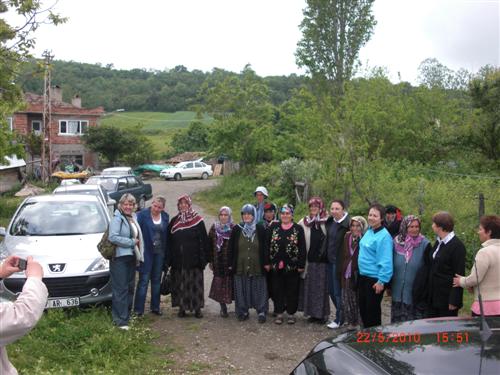
  • RWE AG Germany to build 770 MWe Turkish power plant in Denizli

    Dear Energy Professional, Dear Colleagues,

    German power company RWE AG announced that they have signed an agreement to build a new 775 -megawatt thermal power plant in Denizli, western Turkey, with their local joint venture Turcas. Financial details were not released yet by the investors but RWE, based in Essen, said they would probably make its final investment decision in the first quarter 2010.

    We have further reviewed and evaluated the EIA reports in their web site
    http://www.rweturcasdenizlienerjisantrali.com/index2.html

    We noticed that Chamber of Mechanical Engineers is missing from the list of local stakeholder NGOs. We are not so happy about that.

    Metka, a Greek power plant builder/ constructor with in-house basic engineering capability, will be responsible for construction, and Germany’s Siemens AG will supply major components, including gas and steam turbines, RWE said in a statement. The plant, to be finished in 2012, will be a 775-megawatt combined cycle gas turbine plant.

    “The Turkish market is attractive, and we wish to carry out a few more projects in order to participate in the growth opportunities the country offers,” Leonhard Birnbaum, RWE’s chief strategic officer said.

    Germany’s energy titan RWE and Turcas Guney Elektrik Uretim A. S have awarded METKA the contract for the construction of a 775 -megawatt power plant near Denizli, Turkey, an official announcement said by METKA’s Press Release.

    The budget for this project is at approximately 600 million Euro, of which 450 million Euro plus a 40 million Euro option for EPC contractor while the backlog of projects contracted to the METKA Group now stands close to a total of 2.3 billion Euro. This is a major achievement for the Greek company which will for the first time cooperate with RWE, one of the leading energy companies. Details are as follows

    Project Owner: RWE & Turcas Guney Elektrik Uretim A. S. – the newly established joint venture formed by the leading European utility company, RWE AG and Turcas Elektrik Uretim A.S., a subsidiary of Turcas Petrol A.E. (Turcas), a major energy player in South East Europe.

    EPC Contractor: METKA S.A. Greece- with in-house basic engineering capability. METKA has a long background in the Energy sector, with particular strength and experience in the construction of power generation facilities. Building on its long standing industrial manufacturing and site construction activities in the power generation field, METKA has successfully developed its capabilities to become the leading EPC contractor in Greece, with a growing profile in the region and beyond.

    METKA has completed significant thermal power generation projects on EPC basis including the “Endesa Hellas” Co-Generation Plant and the Lavrio Unit-V natural gas fired Combined Cycle Plant, as well as several open cycle gas turbine power plants for the islands of Crete and Rodos. Recent international projects include the Petrom 860 –megawatt combined cycle project in Romania and the Korangi 220 -megawatt combined cycle power plant in Karachi, Pakistan.

    The Company has experience related to lignite fired power plants, having played a very significant role in the construction of most of the lignite fired units in Greece. The most recent example of this activity is for the new 330 -megawatt unit at Florina in Northern Greece.

    For lignite fired units it is also important to mention the recent EPC contracts for environmental upgrades of existing units, such as the installation of new fly-ash electrostatic precipitators and the upgrade of existing precipitators at Kardia and Agios Dimitrios, plus the replacement of the electrostatic lignite precipitators at the Megalopolis power plant. In each of these cases METKA was the majority partner in the consortium established to carry out the EPC contract.

    Denizli Key Project Characteristics: Turn-key engineering, procurement and construction for state-of-the-art natural gas fired combined cycle power plant with a net power output of 775 megawatt. The plant will be based on Siemens SGT5-4000F gas turbine technology, using a multi shaft concept: 2 on 1 configuration of two gas turbines, two heat recovery boilers and one steam turbine.

    Schedule: The project will be executed in phases, with a first phase for engineering and activities related to permitting the plant, followed by the full project construction phase. Commercial operation of the plant is planned for the end of 2012.

    Budget: METKA’s scope represents an amount of approximately Euro 450 million with various options which may be exercised up to the end of the first phase with a total amount of approximately Euro 40 million.

    METKA says that they are proud of this new award by a client with such strong credentials, representing a significant further recognition of its capability as a major EPC contractor at the international level.

    Your writer feels happy to get such news on new energy investments in our local energy market, provided that they are environmentally friendly, they have completed all obligations for Environmental Impact Assessment Reports, they receive their updated license from the Local Regulatory Board, design by local engineering companies as much as possible, fabricate in the local fabrication plants as much as possible, install by our local contractors, commissioned and supervised by our local engineering power, operated by our own staff, and regularly checked by our own Labor force in programmed maintenance.

    Your writer sincerely feels that energy investors deserve all our support to complete those power plant investments. They deserve since they risk their own property in order to get proper “Corporate Financing” at reasonable interest rates, and payment terms.

    Hence your writer also tries to avoid them to make any technical mistakes in their power plant design, furthermore to avoid incorrect selection of the necessary equipment, wishes them to operate the plant for many years, to generate electricity which will push our economic prosperity.

    There are not much project details; only already known details are disclosed. We learn that the output capacity is 775 -megawatt. Siemens will supply the major equipment, Siemens SGT5-4000F CGG configuration will be in the scope. Suppliers are expected to install air cooled cooling system. That means they will not use much underground water. That is good for nearby ongoing agricultural activities. As a matter of fact, water is scarce at the neighboring site.

    Foreign investor should be comfortable here that we are ready to help them. We should warn that they should not get involved in any fraud for speeding the public procedures, getting EIA and EPDK license updates.

    Local investor should feel comfortable that we shall be warning them in proper design, sourcing fabrication, site installation, logistics, and public approvals.

    We all expect that these energy investments should bring prosperity, employment and peace to the site. Maximized local manpower, maximized local engineering/ fabrication/ site installation capabilities should be employed.

    After brief review of the project, we feel that the investor group should need answers to the following questions as a stress test of the investment project;

    We need to learn the origins of the basic equipment, gas turbine, steam turbine, heat recovery steam generator, condenser, cooling tower. Since the foreign investor is from Germany, we understand that the gas turbine will be of Siemens 2 each SGT5-4000F.

    Similarly steam Turbine will also be purchased from Siemens. What are the budget figures? When are they going to be delivered to site? How are they transported from which sea port?

    Since there will be space limitations at project site, the heat recovery steam generator will be of vertical gas pass, forced circulation type with supplementary firing. Who will be designing the forced circulation type HRSG (CMI- Belgium?), who will be the fabricator?, who will be the local construction company for site installation?

    In EIA certification and Local regulatory board for license updating, there should not be any deviation of the information they will be declaring in the local information meeting and the information they will be furnishing to the public administrations.

    Since the selected site is 545 meters above sea level, they need to have supplementary firing in their heat recovery steam generators in order to reach 775 -megawatt electricity generation output. We would be too pleased to learn the details of their burners, burner management systems, emission controls.

    We shall be too pleased to learn where they will be purchasing the cooling towers, air cooling system design and equipment. As we all know similar size thermal power in Baymina Temelli project, they could not install air cooling systems since the towers would be in the airplane landing route to Murted air force airport.

    Investors are to check if the plant air cooled cooling towers are free from airplane landing routes of Denizli Cardak International Airport which is only 20kms far, as well as emergency landing site at nearby highway. Red lights on the high cooling towers may not be sufficient for the air traffic. Foreseeable Risks are to be clearly defined at this point.

    We need to know who will be the site constructor, what is the budget figure? They should be local companies. Local labors will be needed at the site for smooth and fast execution of the construction.

    We need to know the estimated project period, the importance milestones; we expect that 28-30 months could be a reasonable period.

    We need to know who will be making and paying the new 380 kV transmission and new natural gas incoming pipeline to the site.

    We need to know when the major equipment land transportation will be made; do we have sufficient roads for that transportation, which will be making the road reinforcement to enable the transportation?

    Do they have long term natural gas purchase agreement with respective organizations; do they have long term electricity sale agreements?

    Do they/ investors consider any capacity extension in the long term in 10-20 years time? Do they have enough space/ land for that extension??

    It is known that Siemens SGT5-4000F gas turbine is also suitable for IGCC. Do investors consider any IGCC application in future by gasification nearby Aydin, Yatagan indigenous lignite mines to avoid any energy supply risk?

    Generally we observe that after plant construction and generation of income in 3-5 years, the foreign party decides to sell her shares to the local partner and leave the project/ country. That was the case in Enron in Trakya, selling all her shares to her local partner, Steag in Sugozu. How is the long term policy of the foreign party in this case?

    We will be too pleased to learn if the local party will be thinking to create local engineering department to carry out necessary basic engineering in the long term.

    We only get pleased to read investment, and sincerely feel that energy investors deserve all our support to complete those power plant investments. On the other hand, there is great risk in project finance of such investments due to public response.

    Partners should make the risk assessment for long term gas supply and electricity sales.

    Those companies, who are ignorant of local workforce employment expectations, and neglecting local engineering contribution, neglecting world class environmental limitations, will surely deserve the highest level of local resistance in legal platforms. They may have too much of a headache during project execution; therefore, the project finance institutions should make their risk assessments carefully.

    We would like to warn them not to make any technical mistakes in their power plant design, avoid incorrect selection of the necessary basic equipment, as well as environmental requirements, and wish them to operate the plant for many years, to generate electricity which will push our economic prosperity.

    The investors should feel comfortable that we shall be warning them for proper design, sourcing fabrication, site installation, logistics, and public approvals. We all expect that these energy investments will bring prosperity, employment and peace to the site. Maximized local manpower, as well as maximized local engineering/ fabrication/ site installation capabilities should be employed.

    May God bless them with wisdom for all those who need. May God save you and forgive you for making any mistakes in your risk assessment. God bless you all.


    Haluk Direskeneli, Ankara based Energy Analyst