After a week of uncertainty, the skies above Europe have finally opened (albeit slowly) to air traffic. Thanks to this pesky plume of volcano ash from Iceland, all of Europe has come to a complete standstill. At a micro level, I have been enjoying the quiet — no jet engines screeching overhead every few minutes. At a macro level, this couldn’t have happened at a worst time for a recovering world economy. According to the Daily Telegraph yesterday, more than 17,000 flights to and from the European airspace had been canceled and it is estimated that the airlines have lost about $1.7 billion. The same publication cited today that the travel ban has cost the economy £1.6 billion.
Now I know that the powers that be have our safety in mind. After all, the issue isn’t just visibility. The real problem has to do with the small fragments of volcanic glass being spewed in the air. If I understand it correctly, this volcanic ash is not only abrasive but also so fine that it can get into all sorts of crevices, jam engines and mess with electronic components. In an article on yahoo.com yesterday titled “To fly through ash or not?”, the writer cited the case of a Boeing 747 which flew through volcanic ash over Alaska back in 1989. All four engines failed and the plane dropped 2 miles in 5 minutes. Talk about a white-knuckle ride.
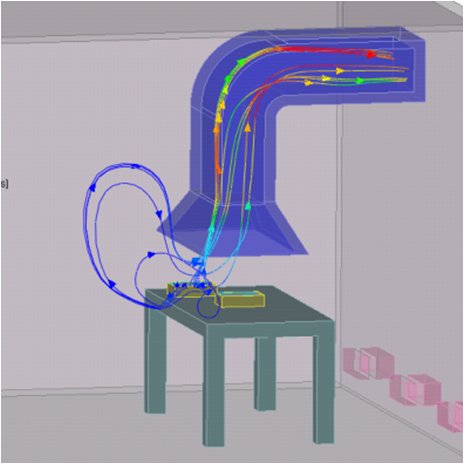
Use CFD to understand complex flow fields including exhaust. Image courtesy of Mentor Graphics.
So I thought this would be a good topic for our discussion today. No… I’m not going to talk about using mechanical CFD to simulate volcanic eruption. Instead we can talk about something a bit more commonplace — all the other types of situations where we have little particles floating in air contaminating the local environment ie exhaust from chimneys, factories and ship diesel engines. Simulation can be an invaluable tool for understanding complex flow fields. For example, FloEFD can simulate particles floating in air including fine ash as small as 6 microns in diameter. So with the help of FloEFD, you could better understand the complexities of fluid flow in designs – including understanding where all the dust settles (so to speak) so you can start clean-up operations. If you’d like to learn more about how CFD can help visualize and understand flow fields, please watch this short on-demand presentation titled: Simulating and Optimizing Flow Fields.
Now I hear the airports around London will be opening up soon so I’m going to dash home, sit in my garden in the sun and enjoy the quiet for a few more hours.
Until next time,
Nazita