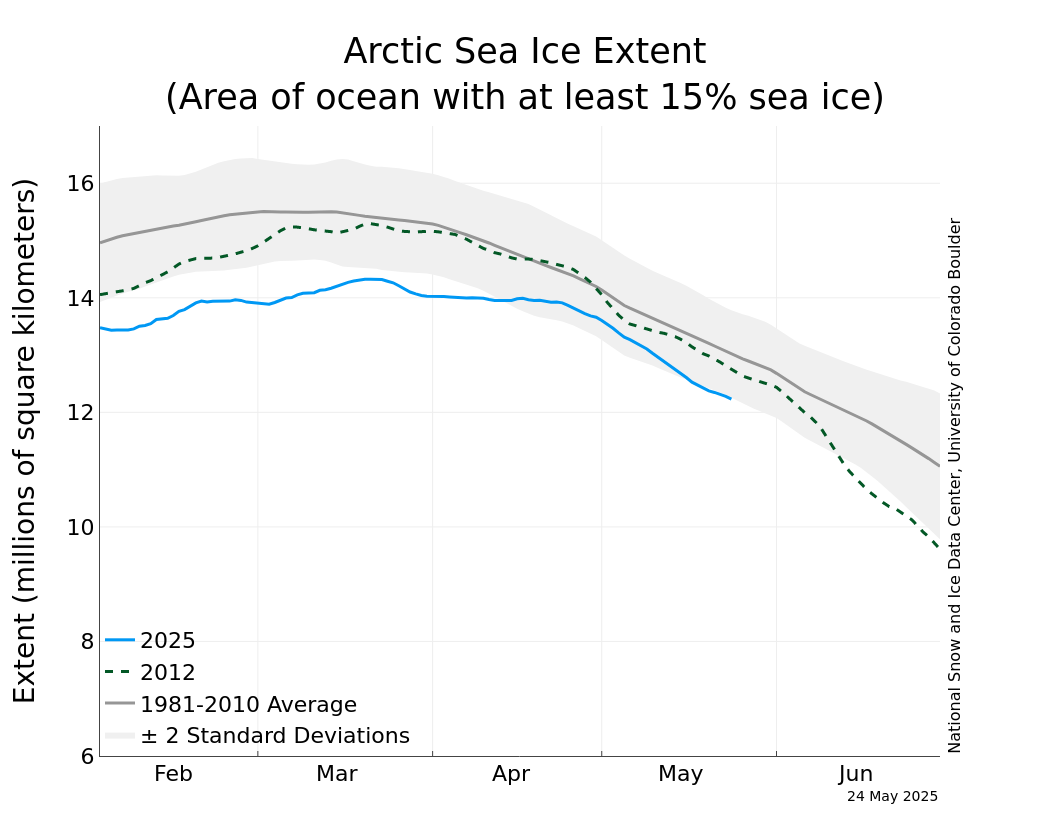
The big climate news up north is the Arctic double stunner: Sea ice extent (area) is now below 2007 levels, while the even more important metric of ice volume appears to have hit a record low for March.
Data from both the Japan Aerospace Exploration Agency (JAXA) and National Snow and Ice Data Center (NSIDC) show Arctic sea ice extent shrinking below the level of 2007 at a rapid pace:

Canada’s Globe and Mail headlines their story, “Arctic sea ice heading for new record low,”
The latest satellite information shows ice coverage is equal to what it was in 2007, the lowest year on record, and is declining faster than it did that year.
“Could we break another record this year? I think it’s quite possible,” said Mark Serreze of the National Snow and Ice Data Center in Boulder, Colo.
“We are going to lose the summer sea-ice cover. We can’t go back.”
… Dr. Serreze said winds, cloud cover or other weather conditions could slow the melt, but he points out that the decline is likely to speed up even more in June and July.
And “one of Canada’s top sea-ice experts suggests things might even be worse than Dr. Serreze thinks” (see New study by Barber et al. supports finding that “the amount of [multi-year] sea ice in the northern hemisphere was the lowest on record in 2009″).
His data could be underestimating the collapse of summer ice cover, said David Barber of the University of Manitoba. Researchers can’t learn anything from satellite data about the state or thickness of the ice.
“What we think is thick multiyear ice late in the summer is in fact not,” he said. “It’s heavily decayed first-year ice. When that stuff starts to reform in the fall, we think it’s multiyear ice, but it’s not.”
Arctic explorers and scientific expeditions are finding more open water and untrustworthy ice ever, Prof. Barber said.
He pointed out the Arctic continued to lose multiyear ice even in 2008 and 2009, when total ice coverage rebounded somewhat.
True multiyear ice – the thick, hard stuff that stops ships – now comprises about 18 per cent of the Arctic ice pack. In 1981, when Prof. Barber first went north, that figure was 90 per cent.
“This is all just part of a trajectory moving toward a seasonally ice-free Arctic,” he said. “That’s happening more quickly than we thought it would happen.”
The article notes:
In April, the centre published data showing that sea ice had almost recovered to the 20-year average. That ignited a flurry of interest on climate change skeptic blogs.
But the most widely read of those blogs, WattsUpWithThat, seems oblivious to what’s happening, even though it keeps issuing regular “news” updates for its readers! In Sunday’s, “WUWT Arctic Sea Ice News #6,” Watts posted a piece by Steve Goddard that opens:
The Arctic is still running well below freezing, and as a result there just isn’t much happening….
Huh.
Yet just a month ago, Goddard saw fit to “inform” his readers that:
Arctic ice extent is normal….
The Arctic Oscillation remains negative, so circulation is clockwise – as seen below in the buoy drift map. This pattern is keeping older, thicker ice from the Canadian side inside the Arctic Basin, and bodes well for another summer of increased ice thickness and extent – relative to the record melt of 2007….
People counting on bad news from the Arctic to keep their agenda alive are staring at a long, (rhetorically) cold summer……. The good news is that they can keep raising the red flags about Montana glaciers, if the Arctic refuses to melt.
So it’s okay to disinform readers with the “news” about how sea ice thickness had supposedly rebounded, when in fact March 2009 had seen record low volume.
But when the reality sets in — the supposed multi-year ice was in fact very thin and melted away rapidly — well, dear WUWT readers, it’s time to move on, there’s nothing to see here.
Related Posts:
- Study: “It is clear … that the precipitous decline in September sea ice extent in recent years is mainly due to the cumulative loss of multiyear ice.” (3/22)
- Met Office’s Richard Betts incorrectly asserts “the dramatic decline in Arctic sea ice in 2007 … was then partly reversed in 2008 and 2009.” (1/12)
- Where on Earth is it unusually warm? Greenland and the Arctic Ocean, which is full of rotten ice (1/6)