Just in time for its birthday, Facebook has rolled out a brand-new design which is a pretty big step from the previous one. A number of features have been changed, updated or even removed so it’s more than a given that a lot of users aren’t going to like it, the ones that complain about each single update Facebook has made throughout the years. The re… (read more)
Author: Serkadis
-
Facebook Sets Loose the Latest Big Redesign
-
Nook firmware 1.2 coming to stores ‘this week,’ current owners a bit later on

Keeping up a fine tradition, Barnes & Noble has today let slip an internal memo that discusses a forthcoming version 1.2 firmware update for the Nook. There’s not much in the way of info on fresh new features or optimizations, but we do know that B&N retail locations will be getting the update “this week” alongside new units shipping with v1.2 preloaded onto them. We’re also told that the update would be an effortless side-loading affair via USB, but the bit about “prior to the software being released to customers” suggests that perhaps we won’t all be riding the latest software by this weekend. Let’s just be patient and do what we usually do: fantasize about what the future may hold.
[Thanks, Anonymous tipster]
Nook firmware 1.2 coming to stores ‘this week,’ current owners a bit later on originally appeared on Engadget on Fri, 05 Feb 2010 03:41:00 EST. Please see our terms for use of feeds.
Permalink | | Email this | Comments
Buy This Item: [Click here to buy this item]
-
Photovoltaic circuit makes solar-powered touchscreens possible, not yet plausible

What’s cooler than the latest in technology? How about the latest in self-powering technology? University of Pennsylvania researchers have put together what seems like the world’s first photovoltaic circuit, which is to say that the electronic parts of your devices will no longer have to just consume energy, they’ll be able to harvest it directly from the sun. The most obvious application for this would be in smartphone touchscreens, which could recharge themselves while you sip your latte at the local sun-drenched coffee shop. Of course, such practical uses are still a fair distance away, as the team can generate only minuscule amounts of power at present, but the theory is in place and so is our attention. Don’t let us down, Penn!
Photovoltaic circuit makes solar-powered touchscreens possible, not yet plausible originally appeared on Engadget on Fri, 05 Feb 2010 03:07:00 EST. Please see our terms for use of feeds.
Permalink
 Inhabitat, Discovery |
  Dawn A. Bonnell Research Group | Email this | Comments
 Buy This Item: [Click here to buy this item]
-
Jay Leno Meets Morgan Aero SuperSports [VIDEO]
 As you know by now, in 2009 Morgan Motor Company celebrated its 100th anniversary with the launch of the special version of the Aero SuperSports, "a "truly special model" as it was called by its creator.
 At the time, all we had to go on were the details provided by the builder and a few sets of photos. That was the case until Charles Morgan, the company’s head, took the SuperSports to Jay Leno’s Garage for a drive, a test and a review.
What came out from this "utterly… (read more)
-
Ferrari 599XX track debut with Felipe Massa
Felipe Massa defines the Ferrari 599XX as a “splendid” car in this track debut video. The 599 XX first appeared at the 2009 Geneva motor show as a lighter version of the 599 GTB Fiorano. The XX has a massive 690 hp, but according to Massa it is really easy to drive, given its great stability.
The engine of the 599XX is lighter, but other features have also reduced weight such as the carbon ceramic brakes and extensive use of carbon-fibre and alluminium in the chassis. The track event for the 599XX was part of Ferrari’s Corse Clienti program (racing customers) where ‘ordinary’ customer folk get technical assistance and whatnot to drive around the track. It’s likely that the 599XX will get to America and Asia as well, as part of the Corse Clienti program.
Ferrari 599 XX track debut with Massa


-
Content is Not King. Self Promotion Is. [Voices]
By Lisa Barone, Blogger, Outspoken Media
While I was at the airport last week, Dr. Pete sent me a link to his post on SEOmoz about SEO cliques and asked for my thoughts. The post talked about the various groups that exist in SEO, how not friendly the industry can be sometimes (The Internet is mean!) and attributed ‘being loud’ in social media to having no other skill (worth noting: That statement came later in the comments, not from Dr. Pete.). I don’t want to touch the whole “SEO is a clique” debate because it’s been done and it’s sad watching people strain themselves to climb atop those high horses.
Read the rest of this post on the original site
Buy This Item: [Click here to buy this item]
-
The Failure of Empathy [Voices]
By Mike Monteiro, Design Director, Mule
I went back for a second helping of Avatar this Sunday. There’s a scene early on in the movie where one of the scientists walks across the lab carrying the “mobile computer slab of the future.”
We’ve seen one of these in almost every sci-fi movie of the last 50 years.
Read the rest of this post on the original site
Buy This Item: [Click here to buy this item]
-
Why Have So Many Internet People Lost Touch With Reality ? [Voices]
By Mark Cuban, Blogger, Blog Maverick
Sometimes its hard to tell if people are trying to be funny, mean, interesting, provocative or are just plain stupid or completely out of touch with reality. I know I get accused of being all of the above all the time.
The other day in New York I gave a speech at the AlwaysOn Conference which AdWeek summarized nicely here.
Read the rest of this post on the original site
Buy This Item: [Click here to buy this item]
-
What Is A Mimosa Drink?
A mimosa drink is basically a cocktail kind of drink. It is usually prepared with the help of three different parts of champagne and also two portions of chilled orange juice. It is served in a very conventional type with the help of a tall champagne flute along with a morning brunch. This drink is usually served at weddings.
On rare occasions this drink is also served with Grenadine and a cherry. Sometimes even Orangina or a tablespoon of Grand Marnier is added to it. However, in the Untied Kingdom this drink is also known as “Buck’s fizz”. It is stated that this drink is been reportedly brought in by Ritz Hotel in Paris, France circa 1925.
-
Nationwide Casting Call For Boy To Join Hugh Jackman In “Real Steel”
DreamWorks Studios has embarked on a nationwide search for the next great child star! The studio is hoping to cast a boy between the ages of 10 and 14 to star alongside Wolverine actor Hugh Jackman in the forthcoming film Real Steel.
While hopefuls may audition for the part by submitting a video to RealSteelCasting.com, there will also be two open casting calls; the first on Sunday, Feb. 14 in Chicago and a second on Saturday, Feb. 20 in New York City.

-
Ralf Schumacher Reveals Talks with Stefan GP
 While Campos Grand Prix is constantly playing down the rumors about them losing the Dallara license for the 2010 car, Stefan GP is moving fast in their plans to secure a decent, competitive team for this season’s Formula One Championship.
Long story short, the Serbian outfit already confirmed their car launch and maiden winter test in Portimao – from February 25 to 28 – their presence at the season opening Bahrain Grand Prix, the potential signing of Kazuki Nakajima – that was actually our gu… (read more)
-
NHTSA Opens Investigation on Prius’ Faulty Brakes
 Following some 100 reports regarding problems with the brakes in Toyota’s Prius hybrid, and perhaps as a result of the media frenzy stirred by this latest development, the National Highway Traffic Safety Administration (NHTSA) announced yesterday it is opening a formal investigation of the 2010 Toyota Prius.
According to the NHTSA, the main goal of the investigation is to find out whether allegations that the Prius experiences momentary loss of braking capability while traveling over an uneve… (read more)
-
Conrad Murray, Michael Jackson Doctor, Surrenders Friday

Dr. Conrad Murray will surrender to authorities at a Los Angeles courthouse today at 1:30 PM PST — although its not clear when he’ll be charged in the King of Pop’s death — Murray’s spokeswoman told The Associated Press Thursday.
Word that Dr. Murray will turn himself in comes after haggling between prosecutors, defense lawyers, and law enforcement officials over whether the physician — accused of supplying singing legend Michael Jackson with a a deadly dose of Propofol — should be arrested or allowed to turn himself in.
-
Microsoft to discontinue Xbox Live for original Xbox
 It has had long run, but Microsoft announced today that it will discontinue the online game service Xbox Live for the original Xbox game console that it launched in 2001.
Xbox Live for the original console debuted in November, 2002. But by April 15, Microsoft is going to discontinue that service, according to an open letter posted by Xbox Live general manager Marc Whitten. That’s likely going to enrage the fans of multiplayer Halo 2, which has persisted as a fan favorite since the game launched in 2004.
No doubt the fans who didn’t upgrade to the Xbox 360 — which debuted in 2005 — are going to be steamed at Microsoft. The Halo 2 fans can at least migrate to Halo 3 multiplayer on the Xbox 360.
On the one hand, Microsoft is turning its back on loyal customers who paid good money assuming that their consoles would have a long lifespan. Sony, by contrast, has supported the PlayStation 2 console since 2000. But I suppose you can’t expect Microsoft to support its older products forever, given the costs of doing so. On the operating system side, for instance, Microsoft has been moving to cut its costs by ending tech support for obsolete operating systems. Microsoft appears to be justifying the shutdown by offering more features in the future for its online fans. The company says that future changes, which will bring new features, are going to be incompatible with the original Xbox.
“We did not make this decision lightly, but after careful consideration and review we realize that this decision will allow us unprecedented flexibility for future features,” Whitten said.
Buy This Item: [Click here to buy this item]
-
Tesla takes us on a wild ride
 Tesla has been throwing a few curve balls at us lately. Between the almost half-billion dollar government loans, the IPO (which contains a “no Roadsters will be built after 2011″ announcement) and now a right hand drive Roadster being announced, we have as many questions as answers.
Tesla’s IPO late last month created an instant buzz. The heady mix of electric cars, clean energy futures and lots and lots of money had most of us at VentureBeat feeling fine. A small detail, though, escaped our first glance. A few pages in to the filing you’ll read “Prior to the launch of our Model S, we anticipate our automotive sales may decline, potentially significantly as we do not plan to sell our current generation Tesla Roadster after 2011 due to planned tooling changes at a supplier for the Tesla Roadster.”
The supplier being mentioned is Lotus, which builds the Tesla’s chassis. When Lotus re-tools for a new model, the Tesla is homeless for manufacturing. The Roadster is expected to be built again though not before 2013. With the Model S slated to begin production in 2012 at the earliest, there could be a year or more without any new Teslas on the road.
Of course, after Tesla took a low interest $465 million loan from the DOE last June, Tesla is likely to survive a year without sales just fine. Tesla’s profitability is already suspect, never having posted an entire quarter in the black. Sure, a month here or there — but Tesla is still a far cry from thriving off of its vehicle sales. The company is also an active player in the parts supply business for other electric auto makers, not that Tesla manufactures many of them. Tesla’s expertise is in design and technology. It buys batteries from Panasonic, has the chassis built by Lotus. As long as Tesla is ahead of the pack in technology the company has a product to sell.
The Model S, planned for 2012, will be Tesla’s first step towards the middle class. It will likely cost $50,000 after federal incentives. If the move to a lower cost vehicle is big, the move to in-house construction is bigger. Instead of using Lotus to build the chassis, Tesla will build the Model S itself. Rumors indicate a possible coupe and crossover being introduced as well. Even if the Roadster never resurfaces, a full lineup of electric vehicles and in-house production would put Tesla in the same game as Nissan or GM, if not the same league.
Even as the Roadster is preparing to be a used-only vehicle, Tesla is introducing it as a right hand drive. The company didn’t rush this one, as it comes about a year after the first London show room. Still it appears that Tesla is looking to broaden its European and possible Australian adoption before going in to hibernation at the end of 2011.
Another guess on my part would be that Tesla is shopping for manufacturing space overseas in which to build Roadsters. After all, there has been plenty of demand for the cars even with the wheel on the “wrong” side. Whatever the exact reason for releasing the RHD Roadster just before stopping production, it can only increase Tesla’s market presence.
If you have any other ideas on where Tesla might be heading, let us know in the comments section below.
Buy This Item: [Click here to buy this item]
-
Bill Gates on Energy Innovation
 First we are not quoting the text from Bill’s blog here. You will have to chase that elsewhere. However Sean is making some very good points here and is a reminder of thing we all should understand.I have spent much of the past few decades advising and assisting business innovation and startups. It is only recently that it has become possible to actually fund the sort of budgets needed to properly explore innovative industrial solutions.Launching an innovative business such as Microsoft was done for chump change and there were no capital barriers to the project that were significant.Now suppose you have an innovative method to massively improve the manufacture of pulp and paper. I use this example because I was there. The operational test requires two to five million in capital improvements and then a plant shut down and switch over for at least six months costing half the year’s sales. Your task is to convince the board of directors that they should do this. By the way the improvement is modestly incremental in terms of profitability but removes that nasty sulphur smell around the plant bothering all the local residents. The point is that the money will not exist in these circumstances unless the industry itself bands together to create a shared solution. That is a pretty tall order for a couple of lab rats and a garage.It is easy to talk innovation in capital intensive industries, except the process is naturally glacial because of exactly this problem.North America and Europe is in the midst of an industrial innovation period right now (that means the snail appears to be moving) because we just shipped every obsolete factory we could locate off toThe visible innovation is coming in heavy manufacturing and aerospace and the energy industry. None of it is happening in a garage though.Bill Gates thinks about energy innovation2 FEB 2010 11:24 AM
BY SEAN CASTENBill Gates has written on his blog that we need “innovation, not just insulation” in order to reduce CO2 to manageable levels. His motivation is robust, but his thinking is … far from clear. Because he’s Bill Gates, this is sure to attract attention, but even if he weren’t, this is worth talking about. It illustrates the deep misunderstandings that most of us have about the energy sector, the possibilities for reform, and—at a much larger level—how our economy works.What Gates gets rightLet’s start with his core thesis: Gates argues that while we might get to 30% CO2 reduction by 2020 with lots of efficiency and small-scale tweaks to the system, the long-term goal of 80% reduction by 2050 is going to be much harder—indeed, impossible without massive changes in the way we use energy, the types of energy we use, and the technologies we use for energy conversion. Ergo, we need to focus our efforts on large-scale innovation in zero-carbon technologies.At an abstract level, this is an important point worth screaming from the rooftops. No one should define success solely by our ability to meet intermediate goals. Passing CO2 legislation is a critical first step. Hitting 2020 targets is a key second step. But neither of those steps matter if we fail on the long-term objective. This approach to long-term planning was ubiquitous amongst political leaders in an earlier era (George Marshall, anyone?) but sadly absent today. My God, do we need more of that.What Gates gets wrongUnfortunately, having spotted a problem, he gets the diagnosis wrong, in ways that are far too common among damned near every Serious Person who thinks about our energy system but doesn’t live in its trenches. It’s too flat for me to ski anywhere near my home inGates is guilty of nothing more than a common habit of mind: We see the way that hard work, entrepreneurship, and innovation drive large-scale, socially beneficial change (especially in consumer electronics) and conclude that this recipe must apply to other industries. Ten years ago, I didn’t own a cell phone, but today I have a Blackberry. Meanwhile, that coal plant down the road is 60 years old and competitive. Can’t we just innovate to make it obsolete?Yes and no.Yes, the industry is devoid of real innovation. Write a list of the great technological and entrepreneurial leaders in the energy industry and you’re likely to end up with a list of cadavers. Edison, Tesla, Westinghouse … great men all, and all dead. Where are the Bill Gates, Michael Dells, and Fred Smiths of this industry? Where is the “killer app” of the last 30 years? How much greater would our lives be if this industry attracted the innovation we’ve come to take for granted in the rest of our economy?But no, the solution to this is not to throw money at innovation. Rather, it is to understand why smart, ambitious, innovative entrepreneurs have consistently elected to pursue career paths in other industries.The Atlantic recently asked whether CEOs matter and noted that some industries (like Mr. Gates’) depend hugely on their CEOs while others (like electric utilities) don’t, because in the former case the CEO is “unconstrained” while in the latter case they are no more than “titular figureheads.” Now suppose that you are an ambitious entrepreneur, seeking to change the world. Would you rather be unconstrained or a titular figurehead? Is it any surprise that innovation is absent in such a industry?This, at core, is why efficiency matters—and why it’s so troubling to hear Mr. Gates to write off energy efficiency with lines like “you can never insulate your way to anything close to zero.”Of course you can’t. But there are two huge holes in that statement. First, it assumes that efficiency is simply about how people use energy rather than how we generate useful energy. When our electric sector is only 1/2 as fuel efficient today as it was in 1910, generation efficiency is key. You may not be able to insulate your way to zero, but you can make up at least half the ground between here and zero simply by deciding to stop throwing fuel away.The second point is more critical: we have piles of efficient, profitable technologies that aren’t being deployed today, for a host of reasons ranging from utility regulation to environmental permitting rules—all of which may have been appropriate for an earlier era but are hopelessly obsolete today.Given that reality, what would it mean if we innovated some great new technology? That’s easy—we’d simply throw another technology on a line of undeployed (but otherwise really cool) technologies.That’s a hard pill to swallow. It flies in the face of our perceptions about the efficiency of our economy, and it flies in the experience of leaders like Gates who have spent their careers in rapidly changing, competitive, relatively low barrier-to-entry industries where the kind of stasis seen in the energy sector would drive you to obsolesence, then bankruptcy. But the discomfort of the reality has to be confronted. Like it or not, we are generating and distributing power with the equivalent of a 1980 Wang computer. And while an Intel 386 chip with Office 1995 isn’t the end goal, understanding and removing the barriers to deploying that particular technology is a prerequisite for all that follows.In short, energy efficiency is the canary in the coal mine. Once we remove the barriers to innovation in the energy sector, we’ll see a flood of efficiency, a flood of sexy CEOs (pick me!), and a flood of those new technologies. But the cart can’t lead the horse. -
Ford Brake Recall: 2010 Ford Fusion and Mercury Milan
 With Toyota’s recalls driving us crazy, every single safety report that reaches our ears – or eyes, respectively – makes us think about the Japanese manufacturer. However, what we have here is actually a Technical Service Bulletin for approximately 18,000 2010 Ford Fusion Hybrid and Mercury Milan hybrid models which are apparently affected by a brake malfunction.
Specific details are not available at this point but a report by leftlanenews.com suggests that some Ford and Mercury drivers infor… (read more)
-
Paris Hilton Israeli Lottery Commercial Filming [Pics]

Heiress Paris Hilton was photographed on the streets of Manhattan Thursday afternoon, where she filmed an Israeli TV commercial for an Arab lotto sweepstakes — in which one grand prize winner will get an opportunity to join the socialite on a high-end shopping spree.


-
Forests Growing Faster
 Son of a Bitch!!! We have real data here folks that is properly gathered and massaged. I have been getting awfully tired of the paucity of proper data in the climate game in particular, particularly after discovering just how terribly compromised the national weather data is. This is actually better than good. The twenty year mapping over a range of populations and ages allows the production of a pretty secure set of data curves.We know that the climate itself is warmer during this past twenty years and the longer growing season is a result of that. We also know that the CO2 content has risen and it is here quantified here at 12%. Both factors are natural growth drivers and are certainly at work. Again I remind my readers that this does not actually link the two factors. At present we are having the climate cooling on the northern continents while CO2 continues to rise unabated.Even more interesting, he has defined the sustainable annual forest production of wood fiber. I do not know if that also includes the expanded root mass which will be an equal amount. It is a good working number for forest management. It tells us that we can thin a forest an average of ten to fifteen tons every several years which is actually a good removal rate and may possibly be superior to clear cutting procedures. That would include waste converted into wood chips.We may see forests returned to well managed private woodlots sooner than we think. This sort of economic model starts to work and can be integrated into large operations rather well. In fact I think the major problem in forest management is the cost of appropriately spaced trees at the beginning of the cycle. Once that is done, nature takes care of the rest.Forests Are Growing Faster, Ecologists Discover; Climate Change Appears to Be Driving Accelerated GrowthScienceDaily (Feb. 2, 2010) — Speed is not a word typically associated with trees; they can take centuries to grow. However, a new study in the Proceedings of theFor more than 20 years forest ecologist Geoffrey Parker has tracked the growth of 55 stands of mixed hardwood forest plots inParker’s tree censuses have revealed that the forest is packing on weight at a much faster rate than expected. He and Smithsonian Tropical Research Institute postdoctoral fellow Sean McMahon discovered that, on average, the forest is growing an additional 2 tons per acre annually. That is the equivalent of a tree with a diameter of 2 feet sprouting up over a year.Forests and their soils store the majority of the Earth’s terrestrial carbon stock. Small changes in their growth rate can have significant ramifications in weather patterns, nutrient cycles, climate change and biodiversity. Exactly how these systems will be affected remains to be studied.Parker and McMahon’s paper focuses on the drivers of the accelerated tree growth. The chief culprit appears to be climate change, more specifically, the rising levels of atmospheric CO2, higher temperatures and longer growing seasons.Assessing how a forest is changing is no easy task.By grouping the forest stands by age, McMahon and Parker were also able to determine that the faster growth is a recent phenomenon. If the forest stands had been growing this quickly their entire lives, they would be much larger than they are.Parker estimates that among himself, his colleague Dawn Miller and a cadre of citizen scientists, they have taken a quarter of a million measurements over the years. Parker began his tree census work Sept. 8, 1987 — his first day on the job. He measures all trees that are 2 centimeters or more in diameter. He also identifies the species, marks the tree’s coordinates and notes if it is dead or alive.By knowing the species and diameter, McMahon is able to calculate the biomass of a tree. He specializes in the data-analysis side of forest ecology. “Walking in the woods helps, but so does looking at the numbers,” said McMahon. He analyzed Parker’s tree censuses but was hungry for more data.It was not enough to document the faster growth rate; Parker and McMahon wanted to know why it might be happening. “We made a list of reasons these forests could be growing faster and then ruled half of them out,” said Parker. The ones that remained included increased temperature, a longer growing season and increased levels of atmospheric CO2.During the past 22 years CO2 levels at SERC have risen 12%, the mean temperature has increased by nearly three-tenths of a degree and the growing season has lengthened by 7.8 days. The trees now have more CO2 and an extra week to put on weight. Parker and McMahon suggest that a combination of these three factors has caused the forest’s accelerated biomass gain.Ecosystem responses are one of the major uncertainties in predicting the effects of climate change. Parker thinks there is every reason to believe his study sites are representative of the Eastern deciduous forest, the regional ecosystem that surrounds many of the population centers on the East Coast. He and McMahon hope other forest ecologists will examine data from their own tree censuses to help determine how widespread the phenomenon is.Funding for this research was provided by the HSBC Climate Partnership.
 -
Super Hard Diamonds Found
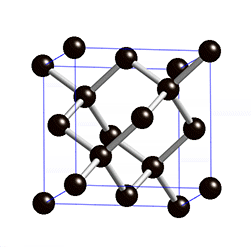 This discovery is effectively predicted by work done on graphene in which superior strength was observed. Here nature has welded together stacks of graphene to form diamonds and yes they are decidedly stronger.Now imagine a cutting edge formed by stacking sheets of graphene together to produce a blade like structure and somehow compressing them to form a diamond structure. We can at least imagine it and it provides additional goals for research.No one has had luck in quantizing all this yet and I am sure it will be a while. At least we now have a device able to test a diamond by scratching it 🙂Super Hard Diamonds Found in MeteoriteThe ultra-hard rocks may not end up on your finger, but they could help scientists learn how to create harder diamonds in the lab.By Larry O’Hanlon | Tue Feb 2, 2010 04:17 AM ETTHE GIST:· Two new ultra-hard types of diamond have been found in a meteorite from· The ultra-hard carbon crystals were created out of graphite under the intense heat and pressure of the meteorite impact.· Though the new diamonds are definitely harder than regular diamonds, the crystals were too small to test for their exact hardness.Researchers using a diamond paste to polish a slice of meteorite stumbled onto something remarkable: crystals in the rock that are harder than diamonds.A closer look with an array of instruments revealed two totally new kinds of naturally occurring carbon, which are harder than the diamonds formed inside the Earth.“The discovery was accidental but we were sure that looking in these meteorites would lead to new findings on the carbon system,” said Tristan Ferroir of the Universite de Lyon inFerroir is the lead author of a report in the new diamond in the Feb. 15 issue of the journal Earth and Planetary Science Letters.The researchers were polishing a slice of the carbon-rich Havero meteorite that fell to Earth in“That in itself is not surprising,” said diamond researcher Changfeng Chen of theBut what apparently happened in the Havero meteorite is that graphite layers were shocked and heated enough to create bonds between the layers — which is exactly how humans manufacture diamonds, Chen explained.Ferroir’s team took the next step and put the diamond-resistant crystals under the scrutiny of some very rigorous mineralogical analyzing instruments to learn how its atoms are lined up. That allowed them to confirm that they had, indeed, found a new “phase” or polymorph of crystalline carbon as well as a type of diamond that had been predicted to exist decades ago, but had never been found in nature until now.“The new structure is very interesting,” Chen told Discovery News. “It gives us some clues so we can try to make it in the laboratory, and then investigate it.”Among the things that would be interesting to learn, Chen said, is how hard are the new kinds of diamonds. The sample from the meteorite was far too small to test for hardness, except to show that it is certainly harder than regular diamonds.“The only evidence we have for a higher hardness than diamond is the fact that we polished the rock section with a diamond paste and that our polymorph and polytypes were not polished by this material,” said Ferroir. “This why we do think that its hardness is harder than diamond.”However, there is no way at the present to compare them to the artificial ultra-hard diamonds known as lonsdaleite and boron nitride, Ferroir said.