Author: Serkadis

  • Hynes concedes democratic governor primary to Quinn

    Comptroller Dan Hynes has conceded in Illinois’ Democratic primary race for governor, giving the party nomination to Gov. Pat Quinn, who already declared victory.

    Spokesman Matt McGrath says Hynes called Quinn to concede on Thursday morning.

    Hynes had refused to bow out of the race the day after Tuesday’s primary, saying he was going to hold on until every vote was counted.

    Hynes had trailed his rival for the Democratic nomination by a few thousand votes Tuesday, and Quinn’s lead has grown as more ballots have been counted.

    With the Democratic race decided, the spotlight remains on Republicans, who have also been waiting for a primary winner to emerge in the governor’s race.


  • Here Are The Most Short-Abused Stocks In America Right Now

    Given that markets are tanking today, here’s a list of the top ten shorts in the U.S., according to short-interest research firm Dataexplorers. Note they also attempt to highlight the three stocks most at risk of a short-squeeze.

    As always, pretty much another black box here, but it’s a starting point:

    Chart

    Chart

    Chart

    Join the conversation about this story »

    See Also:

  • Remarks by the President at the National Prayer Breakfast

    02.04.10 07:00 AM

    Washington Hilton
    Washington, D.C.

    9:08 A.M. EST

    THE PRESIDENT: Thank you. Thank you very much. Please be seated.

    Thank you so much. Heads of state, Cabinet members, my outstanding Vice President, members of Congress, religious leaders, distinguished guests, Admiral Mullen — it’s good to see all of you. Let me begin by acknowledging the co-chairs of this breakfast, Senators Isakson and Klobuchar, who embody the sense of fellowship at the heart of this gathering. They’re two of my favorite senators. Let me also acknowledge the director of my faith-based office, Joshua DuBois, who is here. Where’s Joshua? He’s out there somewhere. He’s doing great work. (Applause.)

    I want to commend Secretary Hillary Clinton on her outstanding remarks, and her outstanding leadership at the State Department. She’s doing good every day. (Applause.) I’m especially pleased to see my dear friend, Prime Minister Zapatero, and I want him to relay America’s greetings to the people of Spain. And Johnny, you are right, I’m deeply blessed, and I thank God every day for being married to Michelle Obama. (Applause.)

    I’m privileged to join you once again, as my predecessors have for over half a century. Like them, I come here to speak about the ways my faith informs who I am — as a President, and as a person. But I’m also here for the same reason that all of you are, for we all share a recognition — one as old as time — that a willingness to believe, an openness to grace, a commitment to prayer can bring sustenance to our lives.

    There is, of course, a need for prayer even in times of joy and peace and prosperity. Perhaps especially in such times prayer is needed — to guard against pride and to guard against complacency. But rightly or wrongly, most of us are inclined to seek out the divine not in the moment when the Lord makes His face shine upon us, but in moments when God’s grace can seem farthest away.

    Last month, God’s grace, God’s mercy, seemed far away from our neighbors in Haiti. And yet I believe that grace was not absent in the midst of tragedy. It was heard in prayers and hymns that broke the silence of an earthquake’s wake. It was witnessed among parishioners of churches that stood no more, a roadside congregation, holding bibles in their laps. It was felt in the presence of relief workers and medics; translators; servicemen and women, bringing water and food and aid to the injured.

    One such translator was an American of Haitian descent, representative of the extraordinary work that our men and women in uniform do all around the world — Navy Corpsman Christian [sic] Brossard. And lying on a gurney aboard the USNS Comfort, a woman asked Christopher: "Where do you come from? What country? After my operation," she said, "I will pray for that country." And in Creole, Corpsman Brossard responded, "Etazini." The United States of America.

    God’s grace, and the compassion and decency of the American people is expressed through the men and women like Corpsman Brossard. It’s expressed through the efforts of our Armed Forces, through the efforts of our entire government, through similar efforts from Spain and other countries around the world. It’s also, as Secretary Clinton said, expressed through multiple faith-based efforts. By evangelicals at World Relief. By the American Jewish World Service. By Hindu temples, and mainline Protestants, Catholic Relief Services, African American churches, the United Sikhs. By Americans of every faith, and no faith, uniting around a common purpose, a higher purpose.

    It’s inspiring. This is what we do, as Americans, in times of trouble. We unite, recognizing that such crises call on all of us to act, recognizing that there but for the grace of God go I, recognizing that life’s most sacred responsibility — one affirmed, as Hillary said, by all of the world’s great religions — is to sacrifice something of ourselves for a person in need.

    Sadly, though, that spirit is too often absent when tackling the long-term, but no less profound issues facing our country and the world. Too often, that spirit is missing without the spectacular tragedy, the 9/11 or the Katrina, the earthquake or the tsunami, that can shake us out of complacency. We become numb to the day-to-day crises, the slow-moving tragedies of children without food and men without shelter and families without health care. We become absorbed with our abstract arguments, our ideological disputes, our contests for power. And in this Tower of Babel, we lose the sound of God’s voice.

    Now, for those of us here in Washington, let’s acknowledge that democracy has always been messy. Let’s not be overly nostalgic. (Laughter.) Divisions are hardly new in this country. Arguments about the proper role of government, the relationship between liberty and equality, our obligations to our fellow citizens — these things have been with us since our founding. And I’m profoundly mindful that a loyal opposition, a vigorous back and forth, a skepticism of power, all of that is what makes our democracy work.

    And we’ve seen actually some improvement in some circumstances. We haven’t seen any canings on the floor of the Senate any time recently. (Laughter.) So we shouldn’t over-romanticize the past. But there is a sense that something is different now; that something is broken; that those of us in Washington are not serving the people as well as we should. At times, it seems like we’re unable to listen to one another; to have at once a serious and civil debate. And this erosion of civility in the public square sows division and distrust among our citizens. It poisons the well of public opinion. It leaves each side little room to negotiate with the other. It makes politics an all-or-nothing sport, where one side is either always right or always wrong when, in reality, neither side has a monopoly on truth. And then we lose sight of the children without food and the men without shelter and the families without health care.

    Empowered by faith, consistently, prayerfully, we need to find our way back to civility. That begins with stepping out of our comfort zones in an effort to bridge divisions. We see that in many conservative pastors who are helping lead the way to fix our broken immigration system. It’s not what would be expected from them, and yet they recognize, in those immigrant families, the face of God. We see that in the evangelical leaders who are rallying their congregations to protect our planet. We see it in the increasing recognition among progressives that government can’t solve all of our problems, and that talking about values like responsible fatherhood and healthy marriage are integral to any anti-poverty agenda. Stretching out of our dogmas, our prescribed roles along the political spectrum, that can help us regain a sense of civility.

    Civility also requires relearning how to disagree without being disagreeable; understanding, as President [Kennedy] said, that "civility is not a sign of weakness." Now, I am the first to confess I am not always right. Michelle will testify to that. (Laughter.) But surely you can question my policies without questioning my faith, or, for that matter, my citizenship. (Laughter and applause.)

    Challenging each other’s ideas can renew our democracy. But when we challenge each other’s motives, it becomes harder to see what we hold in common. We forget that we share at some deep level the same dreams — even when we don’t share the same plans on how to fulfill them.

    We may disagree about the best way to reform our health care system, but surely we can agree that no one ought to go broke when they get sick in the richest nation on Earth. We can take different approaches to ending inequality, but surely we can agree on the need to lift our children out of ignorance; to lift our neighbors from poverty. We may disagree about gay marriage, but surely we can agree that it is unconscionable to target gays and lesbians for who they are — whether it’s here in the United States or, as Hillary mentioned, more extremely in odious laws that are being proposed most recently in Uganda.

    Surely we can agree to find common ground when possible, parting ways when necessary. But in doing so, let us be guided by our faith, and by prayer. For while prayer can buck us up when we are down, keep us calm in a storm; while prayer can stiffen our spines to surmount an obstacle — and I assure you I’m praying a lot these days — (laughter) — prayer can also do something else. It can touch our hearts with humility. It can fill us with a spirit of brotherhood. It can remind us that each of us are children of a awesome and loving God.

    Through faith, but not through faith alone, we can unite people to serve the common good. And that’s why my Office of Faith-Based and Neighborhood Partnerships has been working so hard since I announced it here last year. We’ve slashed red tape and built effective partnerships on a range of uses, from promoting fatherhood here at home to spearheading interfaith cooperation abroad. And through that office we’ve turned the faith-based initiative around to find common ground among people of all beliefs, allowing them to make an impact in a way that’s civil and respectful of difference and focused on what matters most.

    It is this spirit of civility that we are called to take up when we leave here today. That’s what I’m praying for. I know in difficult times like these — when people are frustrated, when pundits start shouting and politicians start calling each other names — it can seem like a return to civility is not possible, like the very idea is a relic of some bygone era. The word itself seems quaint — civility.

    But let us remember those who came before; those who believed in the brotherhood of man even when such a faith was tested. Remember Dr. Martin Luther King. Not long after an explosion ripped through his front porch, his wife and infant daughter inside, he rose to that pulpit in Montgomery and said, "Love is the only force capable of transforming an enemy into a friend."

    In the eyes of those who denied his humanity, he saw the face of God.

    Remember Abraham Lincoln. On the eve of the Civil War, with states seceding and forces gathering, with a nation divided half slave and half free, he rose to deliver his first Inaugural and said, "We are not enemies, but friends… Though passion may have strained, it must not break our bonds of affection."

    Even in the eyes of confederate soldiers, he saw the face of God.

    Remember William Wilberforce, whose Christian faith led him to seek slavery’s abolition in Britain; he was vilified, derided, attacked; but he called for "lessening prejudices [and] conciliating good-will, and thereby making way for the less obstructed progress of truth."

    In the eyes of those who sought to silence a nation’s conscience, he saw the face of God.

    Yes, there are crimes of conscience that call us to action. Yes, there are causes that move our hearts and offenses that stir our souls. But progress doesn’t come when we demonize opponents. It’s not born in righteous spite. Progress comes when we open our hearts, when we extend our hands, when we recognize our common humanity. Progress comes when we look into the eyes of another and see the face of God. That we might do so — that we will do so all the time, not just some of the time — is my fervent prayer for our nation and the world.

    Thank you, God bless you, and God bless the United States of America. (Applause.)

    END
    9:25 A.M. EST

    White House.gov Press Office Feed

  • Worst voter turnout in 32 years

    If McHenry County’s voters are angry about a state government mired in ethical scandals and facing economic catastrophe, they did not express their displeasure at the ballot box Tuesday.

    Just short of 18 percent of county registered voters cast ballots in the February primary, County Clerk Katherine Schultz said.

    The turnout was the lowest since 1978, when only 17.5 percent of voters participated in the primary.

    Tuesday’s turnout was almost 10 percent less than the last non-presidential primary in 2006.

    Schultz had predicted less than 20 percent turnout after disappointing shows for early and absentee voting in the month leading up to the election.

    That took her a bit by surprise, because of public discontent over the economy and problems in Springfield.

    “To me, those kind of things should generate more interest,” Schultz said Wednesday. “If people are upset about these things, wouldn’t you think that the first place they would go is to the polls to vote?”

    Illinois State Board of Elections Director Dan White had estimated before the primary that statewide turnout would be below the 30 percent average, but numbers were not available Wednesday.

    The state record for low turnout in a primary for statewide offices was 25 percent, set in 1978 and again in 2006, according to election board data.

    Some experts were taken aback at Tuesday’s turnout, given the stakes.

    The governor was impeached a year ago after his arrest on federal corruption charges. One of his final acts was his unpopular appointment of Roland Burris to the U.S. Senate seat previously occupied by President Obama and now up for grabs.

    What’s more, voters are angry about the sluggish economy and the fact that one Illinois resident in 10 is out of work. Add to that the record $13.2 billion budget deficit that the General Assembly is dealing with.

    The state of affairs might have been the very thing that kept voters away from the polls, said David Yepsen, director of the Paul Simon Public Policy Institute at Southern Illinois University at Carbondale.

    Yepsen said the economy, unemployment and a sense of helplessness about cleaning up a state famous for graft might have prompted people to consider voting in the primary a futile gesture.

    But Yepsen and Schultz blamed something else as well – the fact that the primary was in early February instead of late March.

    The General Assembly moved the primary up six weeks starting in 2008 to help Obama’s presidential aspirations. Critics called the move an “incumbent protection policy” that would make it harder for challengers to win elections.

    Yepsen said Tuesday’s turnout proved that critics’ concerns were justified.

    “By discouraging turnout, only the most loyal of party regulars, the zealots and the activists in both parties, are going to show up,” Yepsen said. “The law of unintended consequences is always at work in these things.”

    The low county turnout does not mean that voters maintained the status quo.

    Voters in three of the McHenry County Board’s six districts sent Republican incumbents packing Tuesday. District 1 incumbent Yvonne Barnes, R-Cary, lost her bid for a second term, as did District 6 incumbent Dan Ryan, R-Huntley.

    District 2 incumbent Lyn Orphal, who has served since 2000, came in last in a five-way race with only 9 percent of the vote, according to unofficial totals.

    That almost equaled the four total GOP board incumbents ousted in the five previous primaries. One incumbent each lost in 2000 and 2006.

    Two lost in 2002, mainly because the redistricting after the census pitted five incumbents in one district for four seats.

    Republicans made up 72 percent of the voters on Tuesday. Twenty-seven percent of voters pulled Democratic ballots, and less than 1 percent pulled Green Party ballots.

    Slightly more than half of the county’s voters in 2008 pulled Democratic ballots in the traditional GOP stronghold, likely because of the excitement over the presidential race between Obama and Hillary Rodham Clinton.

    Totals available Wednesday did not include late absentee and provisional ballots.

    By KEVIN P. CRAVER, [email protected]

    Read the original article from the Northwest Herald.


  • Activists Breach Security at Kleine Brogel [18]

    Holy crap.

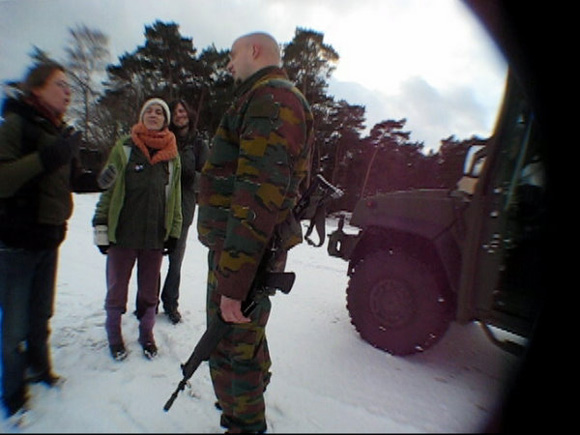
    If you watch this video on YouTube it is very clear that a group of Belgian peace activists not only got inside the wire at Kleine-Brogel Airbase — where some US nuclear weapons may be stored — but they also got into the area where the hardened shelters are located (within the shelters are aircraft and WS3 storage vaults with US B61 nuclear gravity bombs.)

    Between the Youtube video, a pair of stories on the Der Standard and Neusblad websites, their Facebook page and website, and Google Earth, it is pretty easy to recreate their path. (Hans K came to the same conclusion.)

    Here are some images, with annotations linked to the time stamps in the video.

    It looks like the activists approached Kleine-Brogel from the farms to the south of the airbase. Indeed, another group hopped the fence in November 2009. Apparently, they planned to go out on the runway and get arrested just like the previous group in November 2009. But, according to the group’s website “to their surprise, they were able to walk for over an hour on the runway.” (One of the press reports suggests it was forty minutes.)

    The base is surrounded by signs indicating that the area is patrolled by guard dogs, but Milou was nowhere to be found.

    Eventually, they noticed an open gate to the area where US nuclear weapons are believed to be stored. Belgian peace groups had previously identified the area based on a map handed out an airshow. (As you can see from their website, they had very good maps.)

    It looks like this was a side gate — apparently it had been left open to keep from freezing shut — so the activists were able to enter the secure area and approach one of the hardened aircraft shelters from the rear. If you could get inside, it would look something like this.

    Well, I suspect the vault (with the bomb) would be in the floor.

    The activists defaced the shelter with stickers and then emerged onto the concrete plaza in the center of the area.

    They then walked the length of the plaza — having traversed both the width of the base, and now the width of the secure area for nuclear weapons — when security force finally showed up.

    The “security force” appears to comprise one moderately annoyed-looking Belgian guy with a rifle. (Which RAJ47 observes is unloaded.) The effect would only be more comedic if he had some powdered sugar on his face and maybe a little bit of waffle stuck to his uniform.

    How The [REDACTED] Did This Happen?

    The reality is that significant shortcomings exists in the security of European airbases where US nuclear weapons are stored. That was made absolutely clear to me on my visit to SHAPE — and it was reported in the 2008 Air Force Blue Ribbon Review. Host-nations are supposed to provide security but they often cut corners. This is basically confirmed by the Belgian commander of the base, who explained that he just doesn’t have enough security forces:

    Onze luchtmachtbasis is in totaliteit 450 hectare groot. Een derde is bosgebied waarin ik me drie weken kan bevinden zonder te worden gezien. Vandaar dat we onze bewaking, gelet op onze getalsterkte, concentreren op enkele gevoelige zones.

    That works out to, more or less, “Our airbase is 450 hectares in size. A third is wooded areas in which I could stay perfectly well for three weeks without being seen. That is why we concentrate our surveillance on a few sensitive zones where there are aircraft and equipment.” (The translation is by the Open Source Center.)

    Mort Halperin tells a funny story about when, in the late 1990s, then-German Foreign Minister Joschka Fischer called on NATO to adopt a policy of no-first use, widely seen at the time as the beginning of a discussion about withdrawal of nuclear weapons from Germany. Mort, then serving in the Clinton Administration, told a colleague that the German government had opened the door to the removal of US forward-deployed nuclear weapons. His colleague retorted: “You are not talking to the real German government.”

    What Mort’s colleague meant was that there is — and has been for many years — a gap between Europe’s public, represented by elected leaders, and the so-called “real” governments — the national security bureaucracies in NATO and the European allies. So while NATO and European defense ministries make the case privately that forward-based nuclear weapons are politically and militarily essential to NATO, European political leaders have declined to make that case to their constituents for the money to modernize either aircraft or to keep up security.

    What Should We Do?

    As excuses go “It’s a big, wooded base and I don’t have that many troops” doesn’t cut it. In fact, when we are talking about nuclear weapons, it frankly sucks. When it comes to securing nuclear weapons, the United States Air Force has standards for both denial and recapture. If the Belgians and other NATO members won’t provide the forces and equipment necessary to meet both standards, then it is time to put the weapons on a US airbase.

    The most direct route to securing US nuclear weapons in Europe is to immediately — like yesterday — consolidate all remaining forward deployed nuclear weapons to just one or two US airbases in Europe. Take your pick from Aviano, Incirlik, Lakenheath and Ramstein. This would immediately improve the overall security of the weapons, while starting a dialogue about whether forward-deployed weapons are really essential to maintaining NATO’s nuclear character twenty years after the fall of the Berlin Wall. This is a point that several of us made in a letter to the President

    The actual removal of such weapons should await formal consultations within NATO and may, in part, depend on arms control negotiations with Russia. But a useful first step would be the immediate consolidation of remaining forward-deployed nuclear weapons to one or two U.S. airbases in Europe.

    The classic argument for leaving US nuclear weapons on European bases has always been burden-sharing — there is a value to forcing European governments to make the public case for spending money on NATO’s nuclear mission. Of course, that assumes that the governments actually make the necessary investments, rather than skimping on security.

    Given the appalling state of security at Kleine Brogel, that argument seems unpersuasive today.

    Update | 6:40 pm K-Reif reminds me that I outlined precisely this scenario at the Carnegie Endowment:

    [T]he dominant character … of those weapons in Europe is that we don’t talk about them. I think NATO countries have been incredibly reluctant to make the public case about why they need U.S. nuclear weapons on their soil. And as a result … you see a corresponding lack of funding for security at the sites at which the European allies provide security

    [snip]

    I worry very much about a singularity, an event. It could be a security event. Our friends from Peace Action Belgium, could get in the wire with a cell phone and take a picture of a [hardened shelter].

    [snip]

    I do worry that something could happen that will deny NATO its preferred option of not talking about this, and then force the participants into a very ugly public debate in which the result would be the rapid, disorganized, uncoordinated withdrawal of the weapons amidst recriminations. And to me that would be much worse than beginning the dialogue about what the optimal posture is and whether that includes weapons.

    [Emphasis mine]

    It’s a little weird that I called Peace Action Belgium — that is sheer coincidence.

    Update | 8:34, 5 February 2010 I somehow missed that Stephen Schwartz and Noah Shachtman were first — so many social media and blog pages, so little time!

  • Kate Gosselin To Co-Host “The View”

    Kate Gosselin is getting a redo with the ladies of The View.

    The reality Octomom will co-host the ABC gabfest on Thursday, March 11. Kate is no stranger to The View — she first appeared as a guest co-host on the Emmy-winning daytime talk show for three days last September.

  • Surprise Knife In Lenovo Box Cuts Reader

    Reader Christian says he opened his recent Lenovo purchase only to get a nasty surprise: a deep cut on his finger from a box cutter left inside the package.

    UPDATE: Lenovo wrote Christian back to say sorry and offer him a free battery.

    When he called customer service to complain, they put him on hold for 10 minutes before coming back to say that they would make sure it never happened again, and was there anything else they could help him with today? Christian was hoping for something more heartfelt. His email to the Lenovo COO also went unanswered. C’mon, the guy deserves a price cut on his next purchase. Or maybe at least a coupon for some bandaids.

    Be careful when you open up your shipments, you never know when the company might toss in some bonus Hepatitis.

    Lenovo has not yet responded to a request for comment.

    UPDATE: After this post went up, Christian got this email from a Lenovo customer advocate:

    “Dear Sir,

    I am responding to your email note to Lenovo’s President, Rory Read,
    received on Monday. We appreciate you bringing this to our attention. I
    want to assure you that Lenovo takes our customers’ satisfaction, and even
    more importantly our customers’ safety, very seriously. We have forwarded
    the details of the incident you reported to our team responsible for
    manufacturing and fulfillment for their attention and action.

    We regret any inconvenience this incident or your subsequent calls to our
    customer service team may have caused you. As a token of thanks for
    raising your concerns and as a valued customer, Lenovo would like to send
    you an extended-life battery, at no charge to you. Please reply to this
    email with the address to which you would like us to send the battery.

    With appreciation and best regards,

    Terry McCarthy”

    To this, Christian says, “I’m glad that they acknowledged it. I wasn’t necessarily
    expecting anything from them, except maybe a coupon for 10% off my next laptop that I may or may not purchase from them in another 3 years. It was a nice gesture to give me a free battery.

    The conspiracy theories in the comments are entertaining – I guess that piece of red tape does kind of look like fake blood, and I did take the picture with my phone.”

  • Bell police fatally shoot man after chase ends in South Gate

    Ois

    Bell police are searching for the alleged accomplice of a man they shot and killed early Thursday morning after a car chase in South Gate.

    Police were following a white car from Bell to South Gate shortly after midnight when it crashed at Seville Avenue and Santa Ana Street, authorities said.

    Police and the car’s occupants fired at each other, and one of the officers hit the man, who was pronounced dead at the scene, according to the Los Angeles County Sheriff’s Department, which is investigating the incident.

    The other man escaped and authorities were still looking for him, officials said. No officers were injured.

    Authorities did not disclose what caused police to follow the men in the first place or what caused the officers to open fire.

    — My-Thuan Tran

    Photo: Investigators from various law enforcement agencies at the scene of the officer-involved shooting in South Gate. Credit: Irfan Khan / Los Angeles Times

    Learn more about more than 100 fatal officer-involved shootings in L.A. County since January 2007 on The Times’ interactive Homicide Report, which documents all deaths determined by the county coroner to be at the hand of another person.

    Maptease

    More breaking news in L.A. Now: 

    Negotiations underway for surrender of Michael Jackson’s doctor

    41 people cited in one hour for using cellphones while driving in Torrance, police say

    Casey Johnson died of diabetes-related condition, L.A. County coroner says

    Brittany Murphy’s death ruled accidental by L.A. County coroner’s office

    LAPD arrests alleged Melrose Avenue serial burglar

    Former Pico Rivera councilman arrested on perjury charges

    Aerialist who fell at Beverly Center broke numerous bones, spent 7 weeks in wheelchair

  • Garmin-Asus Nuvifone M10 on video, coming to CHT

    ASUS and Chunghwa Telecom announced a partnership to launch the Asus M10 on  their network.  The device will also be supported with access to CHT’s Hami eBook service.

    The device will go on sale on the 9th February, and will be on sale on a reduced cost plan until the 31 March 2010.

    It is not known if this smartphone will be released in the west or not.

    Share/Bookmark

  • DirecTV Serial/USB Channel Changing for Hauppauge HD-PVR using DVBLink

    A few months ago David shared his step-by-step, how to setup the Hauppauge HD-PVR on MediaCenter with DVBLink.  Today he takes that how-to a step further and shows his method for channel changing – read on for all of the details.

    NOTE:  This is a guest post by DavidBasic guidelines for writing and submitting your own guest post at GeekTonic can be found here.


    Many people have trouble setting up serial/usb channel changing using DVBLink, DirecTV and Windows 7 Media Center.  I am going to show you the software, hardware and steps I used to get channel changing that is 99% accurate (sometimes it misses the NFL Sunday Ticket HD sub channels).

    Software used

    • HDPVR IrBlaster Bridge – This is a drop in replacement for the Hauppauage IR Blaster DLL. It currently supports talking directly to the DirecTV STB via the serial port.
    • (Optional) DirecTV Channel Control v1.0– This is a utility that will allow you to change channels and control your external direcTV set top box using the low speed data connection (home control) port in the back of the receiver.  This is only needed for the NFL Sunday Ticket HD

    Hardware used

    • DB9, F/F, Null Modem Mini Type – monoprice
    • 2 USB to Serial Convert Cables (DB9M/USB B female converter and USB A/B cable) – monoprice

    Steps to setup

    Install HDPVR Ir Blaster Bridge.

    Connect the USB to Serial Convert Cables to the DB9 Null Modem and install the drivers.

    Setup DVBLink to use the HDPVR IrBlaster Bridge or the custom hooks(Optional).

    Optional

    NFL Sunday Ticket and some of the other DirecTV sports packages use sub channels for the HD channels (ex. 703-1).  I had to use the following to allow me to be able to correctly change channels to the sub channels.

    Download DirecTV Channel Control.  Extract it to a folder, I just put the directv.exe in C:\ to make it easy to find.

    Edit the change-channel.cmd file located at C:\Program Files\DVBLogic\DVBLink\Data\HDPVR\Hooks.  My channel-change.cmd code change-channel.

    Conclusion

    After following the above steps I was able to have 99% accurate channel changes through USB.  It was faster and more reliable than using an IR blaster and it only cost about $18 for the extra cables and adapters.

    About the author:  David is an HTPC and Home Theater enthusiast.  He has a Bachelor’s of Science in Computer Science and is currently working at a Private College in Virginia as a Web Technical Analyst.  He has built a theater in his basement from scratch.  He did 80% of the work himself.  After starting with XBMC on the original Xbox, he moved to an HTPC running SageTV, then now to Windows 7 Media Center.

    Read more of David’s HTPC writings on his website


  • Australian Court Says Men At Work’s ‘Down Under’ Infringes On Folk Song; Only Took Decades To Notice

    Well, apparently not all Australian courts are sensible when it comes to copyright rulings. While we recently wrote about the wonderful iiNet decision, in the comments, someone pointed to a bad decision made on the same day. It’s a case we wrote about last year involving the famous song Down Under by the band Men at Work — a big hit back in the 1980s. But in 2007, after seeing a joke on a TV trivia program about that song’s similarities to an old Australian folk song, the publisher who held the copyright on the folk song sued. Yes, this was decades after the song was popular, and the publisher, Larrikan Music didn’t notice any similarities at all. It seems like this should be an open-and-shut case. The “use” was minor, at best, and didn’t do any damage to the market for the original song, “Kookaburra,” which is popular among schoolkids, apparently. There’s simply no harm done and anyone with an ounce of common sense should see that.

    But… that’s not what the court found. It’s ruled that Men at Work infringed on Kookaburra, and now the band members and their record label need to pay up — potentially huge sums. It’s difficult to see how this makes sense under any sort of copyright regime.

    Permalink | Comments | Email This Story


  • Woodstock Opera House supporter, resident Chris Burden dies

    WOODSTOCK — One of the Woodstock Opera House’s most longtime, avid supporters has died.

    Woodstock resident Chris Burden, well-known for his work with the Friends of the Opera House, will be missed, friends and community members said Tuesday.

    Burden died Sunday. He was 84.

    “He was a terrific friend and mentor,” said John Scharres, managing director of the Woodstock Opera House. “He would always be there to help with whatever needed to be done.”

    Burden died at Centegra Hospital – Woodstock. His wife, Angela Burden, a former reporter, died in 1997.

    Born in England in 1925, Burden served in World War II with the British Army’s Coldstream Guards. He married Angela in 1949 in Upminster.

    Burden came to Woodstock shortly after being made vice president of sales and marketing for the Howard Rotavator Co. and transferred to the United States division in 1959.

    Burden’s work with the Woodstock Opera House was broad in scope. He helped fundraising efforts for the nonprofit group by building birdhouses replicated after the opera building, which were raffled off.

    Burden, a skilled woodworker, also built a playhouse-sized replica of the building for children and a model replica for donations.

    “He had a great sense of humor,” friend Bill Elman said. Many others agreed.

    “Chris was an all around nice guy,” said Ted Poehlmann, another friend. “We shall miss him.”

    Burden leaves behind a daughter, son, brother, sister and six grandchildren, among others.

    A memorial has been planned from 1 to 4 p.m. Saturday at the Stage Left Caf, 125 Van Buren St., Woodstock. Memorials can be made to the Friends of the Opera House, 121 Van Buren St.

    By BRETT ROWLAND, [email protected]

    Read the original article from the Northwest Herald.


  • Campus Couture: Kayla, Lakehead

    [While everyone is fabulous in their own right, we thought we should celebrate the campus fashionistas of the world for their continued excellence in not looking like a hot mess for class. So, we started stalking those girls on campus (like Taylor at Ryerson!) to get a few pics and get some tips on their personal style.

    And maybe a restraining order or two.

    But it’s worth it to highlight fresh, unique wardrobe choices that show personality and the courage to wear what you believe in.]

    I actually met Kayla when we were about 8 years old in ballet class. We became fast friends and continued to be so through high school and now university. Kayla and I also happen to work together on campus, share an office and work side-by-side for 35 hours every week in the summer months. We see A LOT of each other, which is great, because I love her. It also means I am constantly a witness of her wicked style.

    I consider myself to be somewhat of a fashionista (as voted in my high school yearbook – fist pump!), and let me tell you, Kayla is one of the most fashion-conscious girls on Lakehead’s campus. My favorite thing about her style is her willingness to take risks:

    White jeans in the winter? Yup, Kayla does it.
    Super high, super bright heels to work? Mmmmhmmm, she works it.

    Kayla wears clothing and accessories that I could never dream of and she pulls them off with confidence! She also has a knack for pulling random things together, like active wear and casual wear. Somehow Kayla manages to pull off pairing Lululemon athletic tops with designer accessories. It is truly mind-blowing.

    I totally admire her style and have to admit, it’s nice to have such a stylish co-worker and friend. I can say that, without a doubt, the Orientation Office is the most stylish on campus.

    Name: Kayla
    Year: 3rd
    Major: Molecular Biology

    1) Describe your personal style.
    Preppy meets Southern cowgirl. I try to ensure that my day-to-day clothing choice is flexible for my active lifestyle, yet presents itself in a unique way. Similar to my music choice, I like all colors and pretty much all fashion styles. One secret, though: sometimes I dress for the day based on my hair. Bad hair day = try-hard fashion!

    2) You can’t leave your house without….

    My brown leather boots from New Zealand.

    3) What is your favorite store to shop at?
    Probably American Eagle.

    4) Who or what is the biggest influence on your style?
    Myself. I don’t really try to follow what is “in style.” I like looking at some store websites to see how the models wear the clothes and mix and match, but for the most part, I’m the fashionista.

    5) What is your favorite trend, past or present
    [This is] obviously from the past: Bright stretchy clothes!

    On Kayla:
    Necklace: American Eagle
    Dark blue sweater: American Eagle
    Plaid long shirt: Just Jeans (NZ)
    White Jeans: American Eagle
    White tanktop: Lululemon
    Belt: Jacob
    Boots: Aldo

    [You know someone who’s got great style? Think the world needs to see what she can do?  Send us an email with some photos and she could be the next fashionista celebrated right here.]

  • Sony quarterly financials: PS3 up; PS2, PSP down

    Sony has gone up to the platform and revealed their quarterly financials. To no surprise at all, the PS3 did so much better than the previous year, largely thanks to the cheaper slim model. Unfortunately, Sony can’t

  • Former Pico Rivera councilman arrested on perjury charges

    A former Pico Rivera city councilman has been arrested on charges of perjury and conflict of interest related to contracts he voted for and gifts he allegedly accepted, prosecutors said.

    Ron Beilke, 50, voted from 2006 to 2008 to approve three construction contracts for an intersection near his Wienerschnitzel restaurant and a coffee shop he planned to open, according to the Los Angeles County district attorney’s office.

    An arrest warrant was issued for Beilke, but he surrendered in court Wednesday and was released on his own recognizance. His arraignment is scheduled for March 8.

    Beilke voted to approve a contract with Krikorian Theatres, and in 2008 allegedly accepted movie tickets valued at more than $3,400 from the company, prosecutors said.

    He underestimated the tickets’ value on a conflict-of-interest form certified under penalty of perjury, a deputy district attorney said. Beilke used some of the tickets and gave some to family members and Wienerschnitzel employees, the prosecutor said.

    Beilke was voted onto the City Council in 2005 but lost his reelection bid in November.

    — Raja Abdulrahim

  • Mornin’ Crunch Crumbs: Anderson Cooper Adopting Haitian Orphan? Jill Scott Sued By Record Label; Brandy Dating Flo Rida?

    -Anderson to the Rescue! The National Enquirer has outed Anderson Cooper by claiming that CNN’s Silver Fox and his beau are in the process of adopting a Haitian orphan…..

    -The Chinese Government is stealing my little cutie Tai Shan!

    -A little birdie claims that Brandy is secretly hooking up with Flo Rida…..

    -Speaking of Brandy, now that Baby Brother Ray J has made them (somewhat) relevant, The Norwoods have inked a deal to appear in their own VH1 reality series…..

    -The cast of Jersey Shore hit NYC Fashion Week? We didn’t know guidos were so in style! Here’s a list of all the possible Season 2 locations for the hit MTV series. As long as they keep away from Jones Beach, Brighton Beach, or anywhere along the Delaware Shore, I’m a happy camper…..

    -Coca-Cola will be unveiling two new “Open Happiness” commercials slated to debut on Super Bowl Sunday –including one that features characters from The Simpsons. Visit Facebook.com for a sneak peek and to find out how you can help the Boys & Girls Clubs of America! Share a virtual Coke…..

    -Wives and mothers of the Super Bowl teams spoke on The Early Show Thursday…..

    -Miss America on Wendy Williams…..

    -Neosoul pioneer Jill Scott is being sued by her former record label….

    Olympians spoof The Real Housewives….

    Leno Replaces Conan’s Head on the official NBC mural……

    -With millions of cars being recalled and sales of some models halted, Toyota, “you in danger, girl!”

    -Mary J. Blige coming to Wal-Mart Soundcheck Feb. 15


  • Ron Paul to Obama: Don’t Assassinate American Citizens

    Date: Jan/Feb 2010
    Location: unknown

    Transcript:

    Ron Paul: The post 9/11 atmosphere that really worries me. It worries me about how much our CIA is involved overseas. And this week I could not believe a headline that said the president was considering the legality of assassinating an American citizen. No, it’s true. It’s true. He was born in this country, and he’s a Muslim and he’s identified to be with people who don’t like us. So they want to declare him an ‘enemy combatant’ which they can do like the attorney general of the president says, “Oh, he’s an enemy combatant, and therefore he has no rights. But he’s a terrorist.” Well, no. He is maybe a suspect, and nothing has been proven. He might be a bad guy, but is that the way you take care of bad guys? Talking in the White House about assassinating this guy?

    I mean, what happens if conditions get really bad and we start talking to each other about some of the terrible things that Washington DC is doing to us. Are we going to be ‘enemy combatants’ because the precedent has been set already for American citizens to be imprisoned indefinitely?

    This is why we should protect the civil liberties of all suspect and we shouldn’t be putting people in prison in secret rendition and without a trial, without due process, without an attorney. And then on top of that, add on torture. That, to me, is not what America is all about.

    So these fears that I have and that you may have are connected to the economic system. Because if the economic system breaks down, then there are going to be more challenges. Most Americans, endorse the idea that after 9/11, “Oh, we’re under attack. What do you want us to do?” and just so many times I would hear even if going through the lines at the airport, “Well, if this is what it takes, you know, we have to give up some of our freedoms to be free.”

    And, you know, it was said a while ago, which I strongly endorse, that you don’t have to give up your liberties to be free. Matter of fact, if you give them up, you can’t be free. And yet a lot of people believe that and if we have trouble in this country, the same thing is going to happen. Yes, there will be a lot of poverty and a lot of problems and law-and-order breakdown. They’ll say, “Well, do whatever you can to make us safe and secure”. Governments can’t make you safe and secure. You think you’re safe in your house because there’s a policeman guarding your house? You’re probably more safe in your house because of the second amendment than you are because of a policeman.

    But because of the threat and the undermining of our civil liberties and the possibility of losing the right of Habeas Corpus and the potential of our system breaking down, this is why the monetary system so important.

    Share/Bookmark

    Related posts:

    1. Ron Paul to Congress: Stop The Wars, Stop The Spending Location: House Floor Date: 1/27/2010 Transcript: Ron Paul: I…
    2. Ron Paul Opposes $96.7 Billion War Spending & Pandemic Flu Supplemental Bill Date: 5/14/2009 Bill: HR 2346 Transcript Ron Paul: I…
    3. Ron Paul on Torture Date: 5/12/2009 Transcript Ron Paul: Dick Cheney is in…
  • 10 reasons to pass on the iPad? TUAW fact check

    Filed under: , ,

    Over at TechRepublic’s 10 Things blog, Debra Littlejohn Shinder has posted an article called “10 reasons why I’ll be passing on the iPad.” Some of her reasoning is sound, but quite a few of her points are easy to refute. It’s worth looking at her post and the points it tries to make, because it’s indicative of a widespread misunderstanding of not only the iPad’s capabilities, but also its intended consumer base.

    1. There’s no physical keyboard

    Debra’s correct that the iPad has no physical keyboard. But what she fails to account for is that not only will Apple sell a keyboard dock for the iPad, the device can also be paired with any existing Bluetooth keyboard. Apple’s reasoning for not including a physical keyboard on the iPad is even more compelling than for the iPhone, because unlike the iPhone, you at least have the option of pairing the iPad with a physical keyboard. In order to put a physical keyboard on the device itself, there’d be two options: keep the iPad the same size and sacrifice a third of the screen’s real estate, or increase the iPad’s size beyond what some (including Debra) already consider unwieldy in order to include a keyboard.

    In landscape orientation, the iPad’s virtual keyboard is nearly the size of a conventional keyboard, too, so while touch typing is going to be a challenge, it’s a fair bet that typing on the iPad will be much faster and easier than the high end of 30 – 35 WPM thumb typing many people (myself included) achieve on the iPhone’s far smaller keyboard. The lack of a physical keyboard on the iPhone hasn’t measurably affected its sales; the iPad isn’t likely to suffer many lost sales from this, either.

    Check out the other nine points by clicking the Read More link below.
    2. One size doesn’t fit all

    Debra claims that if the iPad is supposed to be a niche device positioned between a phone and a netbook, it should have a screen size midway between the two — in other words, smaller than a 9.7″ screen. However, that’s not how Steve Jobs positioned the iPad at all during the keynote; Jobs’s Keynote slide clearly showed the iPad filling a gap between the iPhone/iPod touch and a 13″ MacBook. It’s puzzling that in one sentence Debra complains about the iPad being too large to fit in your pocket, while in the next sentence she extols the virtues of Sony’s VAIO X netbooks, which are almost exactly the same size – in terms of weight and thickness anyway. The VAIO X has an 11.1″ 16:9 display, which actually makes it quite a bit larger than the iPad. One other thing about the VAIO X is quite a bit larger than the iPad: the price, which starts at $1299 — far more expensive than even the priciest iPad.

    While it’s true the iPad won’t fit in your pocket, it’s still far more portable than even a MacBook Air. Stephen Colbert even managed to pull one out of his jacket at the Grammys, so while the iPad is larger than an iPhone, it’s far from the unwieldy monster many people are trying to claim it is.

    3. It runs a phone OS

    One thing many pundits fail to account for is that the iPhone OS is actually a version of OS X adapted for a touchscreen device. No, there’s no Finder, Dock, or menu bar. No, there’s no Exposé, Spaces, or Time Machine. But the underpinnings of the iPhone OS are exactly the same as those of the Mac version of OS X. So when people complain the iPad doesn’t run OS X, they’re really pining for OS X features like the ones I already mentioned — the Finder, Dock, menu bar, etc. However, none of those OS X features are particularly suited to a touchscreen device, especially one with a 9.7″ screen. Tablet PCs running the full version of Windows have already demonstrated the pitfalls of running an OS meant for a larger device with a traditional point-and-click interface, and as a result, almost all of those devices have failed to gain traction in the market.

    Debra and others also cite the iPad’s lack of multitasking as a strike against it. On this point, at least, I agree with them. While iPhone OS already allows for limited multitasking among Apple’s own apps — Phone, Messages, Mail, Safari, and iPod can all run simultaneously in the background — third-party apps are still restricted to workarounds like push notifications. While restricting multitasking makes a kind of sense on devices like the iPhone 3G, with limited processing power and RAM available, on the iPad those technological limitations don’t fly as an excuse. You can argue that not having multitasking on the iPad makes it easier to use for Grandma and other non-techies, but it also limits the device’s potential utility. Granted, the iPad isn’t positioned as a replacement for a MacBook, but the ability to run even one or two third-party apps in the background would make the device far more versatile.

    Personally, I would be very surprised if Apple doesn’t introduce at least a limited form of multitasking in iPhone OS 4.0. Of course, I also said the same thing last year about iPhone OS 3.0, so who knows. One point bears mentioning, though: despite the introduction of iWork for the iPad, Apple is still pushing the device as a platform for consuming media, not as a productivity platform. To get any serious work done, Apple still expects you’ll use your main computer, whether it’s a MacBook, iMac, or PC.

    4. There’s not enough storage

    The most important question to ask on this point is, “For whom?” Debra says the 64 GB model might have enough capacity for her purposes, but she also grouses about the price of that model, comparing it to cheaper netbooks with “four times the storage.” I will say that I’m puzzled at Apple’s decision to top out the iPad’s capacity at 64 GB, especially considering that’s where the iPod touch currently tops out. A 128 GB iPad would have been very tempting indeed; unfortunately, given the price of flash memory, it also would have probably cost more than $1000.

    But what does 64 GB allow you to store? In my case, a 64 GB iPad would hold my entire 39 GB music library — 19 days worth of music — plus my entire iPhoto library of over 7000 photos, which, when optimized for the iPad’s screen, would probably take up somewhere in the neighborhood of 5 GB, plus or minus a GB or two. At my most app-crazy I had about 2 GB of apps on my iPhone 3G, and “Other” space, presumably including the OS itself, takes up just over 1 GB. Added up, that equates to 47 out of 64 GB. In my case, that leaves over 15 GB of space for document storage, videos, and so forth. Let’s say I store my entire Documents folder on the iPad (I wouldn’t — I use iDisk and Dropbox for that) — 4300 documents taking up just over 2 GB of space. Now we have 13 GB left over for videos and whatever else. Even if I left myself a 3 GB buffer for whatever reason (including accounting for the GB versus GiB difference), that’s still 10 GB of space for videos — enough to store 10 two-hour films at a decent bitrate, or almost an entire season of an hour-long TV series.

    Let me break that down again — a 64 GB iPad would store:

    – 19 days of music
    – 7000 photos
    – Well over 100 apps
    – A 2 GB Documents folder with 4300 items
    – 20 hours of video
    – Around 3 GB of space left over for whatever else (temporary photo storage, e-books, accounting for the difference between binary gigabytes versus decimal gigabytes, etc.)

    Granted, there are people out there with music and photo libraries larger than mine, but most of my Mac-using friends only have, on average, 1500 items in their iTunes libraries, a thousand or so photos, and maybe three pages of apps on their iPhones. 64 GB may not sound like much on paper, but practically speaking, it lets you pack around a lot of media. Unless you’re going to spend weeks at a time away from your main computer, the iPad should be able to carry around enough media to keep almost anyone entertained for days on end.

    5. There’s no HDMI output or camera

    Debra claims you can’t output the iPad’s video to an HDTV without an HDMI connector. That simply isn’t true; with a VGA adapter, you can output the iPad’s full 1024 x 768 video signal to an HDTV. With a component connector, you can output a 576p PAL signal or a 480p NTSC signal to your TV. Okay, fine, it’s not 1080p ultra-high-def video, but where exactly are you going to find video of that resolution anyway (besides Blu-Ray and Bittorrent)? I’ll admit that it would have been nice to have at least 1366 x 768 video (1080i, in other words), but I’m betting that the vast majority of consumers aren’t going to even bother hooking the iPad up to their TV at all when it’s far easier to just put the screen on their laps and watch a movie on the iPad itself instead.

    Another point Debra brings up is the iPad’s 3:4 aspect ratio, which is less than ideal for video. This has been argued all over the internet, including here at TUAW, but as many people have pointed out, the 3:4 aspect ratio is ideally suited to pretty much every other function on the iPad except video: books, documents, web pages, and photos are all laid out far closer to a 3:4 or 4:3 ratio than 16:9. Using a 16:9 ratio on the iPad would not only make the device larger than it already is, it would also leave all other forms of media on the device at a disadvantage compared to video.

    The iPad’s lack of camera is another point Debra and others have brought out against the device, but like multitasking, this is one point on which I agree. A back-facing camera like the iPhone’s doesn’t make a lot of sense on the iPad — it would be a bit unwieldy trying to take pictures or video with a device this size, rather like trying to hold up a MacBook Air to take photos with its iSight. Most people probably have a standalone point-and-shoot camera that would take better stills and/or video than the iPad’s hypothetical back-facing camera anyway, and you can load those pictures directly onto the device with either the iPad-specific camera connector or SD card reader. But a front-facing camera for video conferencing definitely would have been a killer feature. Apple apparently thought so, too, because it actually included a space in the iPad for exactly such a camera, only to withdraw it for reasons known only to Apple. Whether the company is waiting for the next-gen iPad to introduce a camera or pulling a big switcheroo like it did with the original iPhone — which was originally supposed to ship with the scratch-prone plastic face of previous iPods, but was replaced with nearly scratch-proof glass in the six months between its announcement and release — no one can say.

    6. There are no USB ports

    Debra’s main complaints against the lack of USB ports are that you can’t hook up a flash drive or a USB keyboard. As far as the keyboard goes, I’ve already mentioned the fact that you can purchase a keyboard dock or use a Bluetooth keyboard. As for not being able to hook up a flash drive? I can see why some people might want to do this — expanding the iPad’s storage, transferring files, etc. But I’m willing to bet that for most people this isn’t going to be an issue. While I run the risk of sounding like Bill Gates’s infamous “640K should be enough for anyone” by saying so (although Gates never actually said that), 64 GB of space on a device like the iPad really should suit most users’ needs — at least for the next couple of years, anyway. As for transferring files? I can think of a number of existing, cloud-based solutions, the most simplistic of which is e-mail. No, you can’t transfer several gigabytes of files at a time through e-mail or “the cloud,” but most people don’t transfer that much data all at one go even a handful of times with a portable device, much less on a regular basis.

    I’m not going to go full fanboy and say it’s a good thing the iPad doesn’t come with USB ports. In fact, I’m kind of with Debra and the others on this one in wishing that Apple included at least one USB port. While I probably wouldn’t use the port very often (if at all), it definitely falls into the category of “nice to have.” I’ve been an iPod user for almost five years and an iPhone user for a year, and I can count the number of times I’ve needed/wanted a USB port on one of those devices on exactly no fingers… but I’ll admit that I might sing a different tune with a bigger device like an iPad. But for most of the people who are likely to buy the iPad, i.e., the non-geek, non-techie, “I just want internet and music and movies” folks, they’re probably not going to miss USB ports at all.

    7. There’s no flash memory slot

    No, the iPad doesn’t have a flash memory slot. You can buy an SD card reader attachment, though, although Debra and others rail against the added cost of the connector, claiming that in order to reach “the functional equivalent of a netbook, you may end up spending a bundle.” A lot of the same arguments for or against USB apply here as well; most non-geeks aren’t going to miss an SD slot at all. Transferring documents via SD cards in 2010 reeks of the “sneakernet” we thought we were abolishing along with dot-matrix printers and 2800 baud modems; let’s just say that most users are going to have photos and/or videos on their SD cards, most users are going to wait until they get home to their main computer to upload those files, and most users aren’t going to care that the iPad’s missing a dedicated SD slot any more than they cared about the iPod missing one. If anything, the argument for an SD slot is far weaker than the argument for USB.

    8. The price is not right

    Debra claims the iPad “costs twice as much as the Kindle and other ebook readers.” That’s flat-out false. The $499 iPad does cost almost twice as much as the standard Kindle, but compared to every other e-reader out there, the iPad’s pricing is extremely competitive once you consider all the things the iPad does that the other readers iDon’t. A $489 Kindle DX, for example, while $10 cheaper than the cheapest iPad, doesn’t have a color screen, has only 4 GB of storage, doesn’t have a touchscreen, doesn’t run apps, doesn’t have e-mail, music, and so on, and so forth. The iPad’s price is the one aspect of the device that few pundits have complained about; in fact, the pricing has Wall Street and other financial analysts doing cartwheels.

    You don’t even have to compare the iPad to other companies’ similar products to see how good a deal it is. The 16 GB iPad costs $300 more than an 8 GB iPod touch. That $300 gets you twice the capacity, a much larger and higher-quality screen, a more powerful CPU, better Wi-Fi including 802.11n, vastly improved battery performance, a built-in speaker and microphone, and, eventually, access to a host of apps designed to take advantage of the iPad’s larger screen and higher performance. A 32 GB iPad has the same $300 price difference compared to a 32 GB iPod touch, as does the 64 GB model. Once you tack on an additional $130 for 3G wireless the price difference widens, but so does the device’s utility — access to wireless broadband anywhere there’s an available 3G network, which, as iPhone users already know, is invaluable.

    Debra compares the fully kitted-out $829 3G-enabled iPad to “a powerful compact laptop that runs a full-fledged operating system and multi-tasks and that has USB and SD and Ethernet connectors, 4 GB of RAM, and 250 GB of storage.” The “full-fledged operating system” she’s talking about isn’t OS X, however, and the laptop she’s talking about definitely isn’t manufactured by Apple. That might not make a difference to a lot of people, but if you’re already in the “Macs cost too much” camp, it’s no wonder the iPad doesn’t hold much appeal compared to that Windows Home Edition running, plastic, bargain-bin quality laptop from Dell or HP that’s almost certain to stop working in two years or less. Yes, I recognize the extremely fanboyish sound of that sentence. No, I don’t apologize for it. Cheap laptops are exactly that: cheap. Call it elitism, fanboyism, Kool-Aid drinking, whatever: I’d much rather put up with the iPad’s shortcomings than those of the “powerful” but oh-so-cheapo laptops of other manufacturers.

    9. It’s locked in

    “You have to buy your apps from the App Store,” Debra notes. Yes, you do: from a store that has over 140,000 apps available, most of them for free, and capable of doing almost anything. Hate the App Store for some reason? Fine. Jailbreak the thing and use Cydia instead. Apple may not want you to do this, and they may go out of their way to prevent it, but if you’re of the jailbreaking mindset already, that’s not going to stop you, is it?

    A very vocal minority of people love to complain about “vendor lock-in” when it comes to the iPhone/iPod touch/iPad, even though those same people have likely been playing around with video game systems from Nintendo, Sony, and Microsoft for decades — all platforms with “vendor lock-in” even more pervasive and insidious than that of Apple’s platform. What these people don’t seem to realize is that same vendor lock-in is precisely what keeps Apple’s portable platforms from being riddled with viruses, malware, and apps made of more crap than code. “Security through obscurity” may be a valid(ish) argument to fall back upon with the Mac, but with 75 million plus people using the iPhone OS, it’s a very high-profile target for virus writers. That same “walled garden” that Linux proponents and “open internet” evangelists whine about is what keeps the iPhone platform from being an unusable nightmare. Yes, the App Store approval process has in many cases been a pain in the nether regions, but things are improving — apps that might have once taken days or weeks to get approved are now getting through the approval process in a matter of hours. Has the App Store’s “lock-in” affected sales of the iPhone one iota? No. In fact, sales of the iPhone took way off after the App Store’s arrival.

    Yes, “Apple as gatekeeper” gets the George Orwell fans riled. But someone has to keep the gate, because the instant the iPhone OS becomes a truly “open” platform like some people are espousing, that’s the same instant the Russian mafia remote-hijacks your iPhone from a basement in Vladivostok because you just had to download that “Siberian Honeys” app from the dark alleys of the internet.

    Other aspects of dreaded “lock-in” that Debra’s concerned about are riddled with falsehoods. “You can’t run Skype to make phone calls,” with the iPad, she claims. “We wouldn’t want to cut into the iPhone market, after all.” Say what? That must be news to the Skype team, who’s already investigating an iPad-specific Skype app. It must be news to Apple, too, who no longer restricts the use of VoIP over 3G. “Nor can you download Flash to install on the browser, which means you won’t be watching those YouTube videos.” Say what again? Since when is the iPhone/iPod touch/iPad incapable of watching YouTube videos? Oh right: since never. No, you can’t put Flash on the iPad, but according to our informal poll, 75% of people planning on buying one either don’t care or are outright glad Flash isn’t making an appearance.

    What about hardware “lock-in?” Debra says that “you can’t even remove and replace the battery yourself,” which has been true of every single iPod since 2001 and hasn’t stopped people from buying them by the millions. She goes on and says, “if you were flying to Australia and wanted to bring along an extra battery for the extra-long flight, forget about it.” Um. A two-second Google search for “iPhone external battery” might have been a good idea. Plus, speaking from personal experience, if you stay awake for a full flight across the Pacific Ocean, you’re going to have a lot more pressing issues to worry about than your iPad’s battery, like the fact that you’re going to feel like you got run over by a truck after the plane lands. Take it from one who knows: Trans-Pacific flights are best spent in blissful unconsciousness.

    10. The network

    Yep, the iPad’s 3G connection is only available on AT&T’s network… if you live in the United States. If, like me, you live in what’s known informally as “the rest of the world,” this argument against buying a 3G-enabled iPad holds no water for you. But let’s stick to the States for a moment and analyze Debra’s argument against AT&T’s network. No, AT&T isn’t everyone (or possibly even anyone)’s favorite US network, but the pay-as-you-go, completely contract-free plans available for the iPad are very compellingly priced. You can get 250 MB of data for $14.99 (not the $20 Debra claims in her article), which is more than enough for casual data usage. 250 MB doesn’t sound like a lot on paper, but that’s what my iPhone plan started out at here in New Zealand. I never once went over 100 MB or so of monthly data usage until I started using iPhone tethering, and I’d consider my data usage fairly robust. The “unlimited” AT&T plan at $30 a month is an even better deal, and even if “unlimited” only means 5 GB, you’re not going to burn through that much data unless you’re using the connection every waking hour of the month.

    Debra’s argument against these plans is that it’s another bill to pay on top of your cell phone bill, but that’s the beauty of the iPad plans: without a contract to commit to, you can cancel the plan whenever you want. If you start out with the $30/month “unlimited” plan on the iPad, only to find out your usage isn’t topping 250 MB, rather than being locked in to that plan for another 23 months, you can downgrade to the $15 plan. If you find that you don’t need the 3G coverage at all, you can always buy the Wi-Fi only iPad. “Here’s wishing you good luck on finding those Wi-Fi hot spots,” Debra says in response to that idea, which sounds about right for us in New Zealand, where free Wi-Fi is about as rare as gold, but makes much less sense in the US, where free Wi-Fi is usually only a library or café away.

    If you absolutely must have 3G on the iPad, absolutely must not use AT&T, and are prepared to spend twice as much for the privilege of going with Verizon, you always have the option of hooking the iPad up to a MiFi (possibly — we’ll have to wait until the iPad’s actually released before we know if this will work or not). Additionally, just because the iPad isn’t available on Verizon right now (now now NOW) doesn’t mean it never will be; Apple and Verizon are reportedly “still talking” about bringing the iPad and/or iPhone over to the network.

    We’ve come to the end of Debra’s ten points, but not to the end of mine. My final point, the one that sums up all of this: like the Mac, like the iPod, and like the iPhone, the iPad is not for everyone. It’s not even for me — despite all the words I’ve just spent defending it, I’m not buying an iPad until next year at the earliest, and only if I decide against replacing my current, aging MacBook Pro with the same computer rather than an iMac/iPad combo.

    The bottom line is that the iPad can’t be all things to all people. It’s not meant to replace a full-fledged Mac or PC — it’s meant as an ultraportable extension of a larger device, and one with a far simpler and more intuitive interface, a “computer for the rest of us,” if you will. And make no mistake: for every Debra Littlejohn Shinder, for every “open internet” geek who screams “vendor lock-in” every time Apple’s name is mentioned, for every “no multitasking, no Flash, no sale” techie, for every dismissive pundit who shrugs and says, “It’s just a big iPod touch,” there’s at least one person who has been waiting for a device just like the iPad, and those people are the ones who will make it a success. Whether you like it or hate it, the iPad is indicative of the future direction of computing.

    But, just for the sake of argument, let’s say we can cook up a portable computer far “better” than an iPad, a dream device that has USB, 1080p output, a removable battery, runs the full version of OS X, has a front-facing camera, isn’t dependent on AT&T, isn’t “locked in” to the App Store, has a physical keyboard, widescreen-formatted display, and has more than 64 GB of storage. What might such a device look like?


    Oh. Right.

    TUAW10 reasons to pass on the iPad? TUAW fact check originally appeared on The Unofficial Apple Weblog (TUAW) on Thu, 04 Feb 2010 10:00:00 EST. Please see our terms for use of feeds.

    Read | Permalink | Email this | Comments

    Buy This Item: [Click here to buy this item]

    Read Original Article

  • Obama’s African aunt to see Mass. judge; Second bid for U.S. stay

    BOSTON — President Barack Obama’s African aunt is going before a Massachusetts immigration judge for a second time to argue she should be allowed to stay in the United States.
    Kenya native Zeituni Onyango is scheduled to appear Thursday in U.S. Immigration Court in Boston.

    Onyango moved to the United States in 2000. Her first asylum request was rejected. She was ordered deported in 2004.

    But she didn’t leave the country and continued to live in public housing in Boston.

    Her status as an illegal immigrant was revealed just days before Obama was elected.

    Obama says he didn’t know his aunt was living in the country illegally. He says laws covering the situation should be followed.

    A judge agreed to reopen the asylum case.

    Read the original article on DailyHerald.com.