Author: Serkadis

  • ICYMI: Connected lightbulbs (yes!), T-Mo’s no plans, and the makers of Indie Game

    Better than a hollow chocolate bunny: Catching up with the GigaOM Podcasts is the best way to fill your Easter basket!

    Weekly Wrap Up: T-Mo’s no plan, SummlYahoo and everyone’s a paparazzi

    (Download the Weekly Wrap Up)

    Internet of Things: Trust us when we say you’ll want an internet-connected lightbulb

    (Download the Internet of Things show)

    Call-in Show: What’s the best keyboard for Android?

    http://traffic.libsyn.com/gigaom/09_CALL_IN_SHOW_T-MOBILE_IPHONE.mp3

    paidContent: How Indie Game stayed “indie” and became a hit

    (Download the paidContent podcast)

    Research: How enterprises can build successful BYOD programs

    (Download the Research podcast)

    Related research and analysis from GigaOM Pro:
    Subscriber content. Sign up for a free trial.

  • Help another county’s residents say NO! to fluoridation

    The people in the towns and farmland of Sonoma County are facing a battle over fluoridating the currently un-fluoridated public water supply. Petitions are circulating to keep Sonoma County’s public water supply un-fluoridated, but the pro-fluoridation wing within the…
  • James Holmes, and how the CIA hid their MKULTRA mind-control program

    (NaturalNews)Back in the early 1990s, I interviewed John Marks, author of Search for the Manchurian Candidate. This was the book that exposed the existence of the infamous CIA MKULTRA program. I bring up this interview now, because James Holmes may well be on the receiving end…

  • Imminent proliferation of drones in American skies requires widespread civilian debate

    The country is set to become a nation of drones in the coming years, as experts predict an explosion of unmanned aerial vehicles numbering in the tens of thousands that will literally turn the U.S. into the surveillance society futurists have warned about. What’s…
  • Is your organic produce really pesticide-free?

    The incredible success and sustained growth of the organic movement over the past several decades has led to many positive changes for the general food supply, which include the increased availability of clean food. But there is a common misperception among many in the…
  • Is the modern western lifestyle responsible for the increase in autism?

    There have been literally hundreds of research projects looking into the possible causes of autism. Many have linked autism to vaccines, diet and chemicals in our environment. Others have linked autism to other, more bizarre causes such as jaundice and sociological issues…
  • What are ‘food drugs’ and how much are you taking?

    If you took an antibiotic every day, your body would build up immunity to it, and the antibiotics would no longer work. Just the same, if you were to use drugs, like cocaine or heroine every day, your body would break down, leading your heart and cleansing organs to…
  • Suspicious motives: Is ‘Big Food’ behind Whole Foods’ GMO labeling decision?

    The recent decision by Whole Foods Market to label all genetically-modified organisms (GMOs) sold in its stores by 2018 has gotten mixed reactions — some say it is too little, too late, while others applaud the move as a progressive step towards full transparency in…
  • Hybrid grapefruits being developed for people on Big Pharma drugs

    A growing number of people are reportedly unable to eat grapefruits because the tangy citrus fruit contains natural compounds that interfere with the effectiveness of statins, antibiotics, and other pharmaceutical drugs. But rather than look for ways to help people get…
  • Hormone imbalances and belly fat

    Increased belly fat, a carry over of the late 20th century, has become an ever present scourge of the average western waistline. Watching most infomercials or just walking the streets bears testament to this statement. Belly blasters, abdominal contraction gizmos and…
  • Wake up to insomnia (opinion)

    (NaturalNews)Right now, 25 percent of all Americans are regularly taking sleeping pills, with $18 million being spent on prescription drugs and an additional over $600 million spent on over-the-counter pills. Not only do these figures emphasize the seriousness of the insomnia problem…

  • Ocean Cleanup Array developed by 19-year-old could save millions each year, and impact human health

    Plans were unveiled by Boyan Slat, founder of The Ocean Cleanup Foundation, for an Ocean Cleanup Array, brought on after launching a school project that analyzed the amount and size of the plastic particles in the ocean’s garbage patches. The Ocean Cleanup Array project…
  • The Dash Car Dongle Wants To Make You A Better Driver By Syncing With Your iPhone

    dash-kickstarter

    I love my tiny little Mazda, but I’ll be honest — I still don’t completely understand how it works. That’s never really bothered me before (I’d much rather geek out over a phone or something) but a Kickstarter project from a small team in Boston has me itching to pay more attention to what’s really going on under the hood. Long story short, Dash combines a Bluetooth 4.0-enabled dongle that plugs into your car’s on-board diagnostics port with an iPhone app that gives you up-to-date information how on your car is holding up.

    Yes, I know that probably sounds very familiar.

    We’ve seen a few startups tapping into that particular port recently — Carvoyant inked deals with local auto dealers to more broadly distribute its always-on diagnostics and tracking gadget earlier this year, and Y Combinator-backed Automatic got plenty of attention for taking a similar concept and combining it with an awfully handsome iPhone app interface. Dash’s approach seems to resemble the latter slightly more than the former, but at their core they’re all trying to accomplish the same mission: to improve the driving experience by shining light on data that wasn’t always easily accessible.

    So should you consider Dash over something like the ultra-slick Automatic when both devices are both slated to cost around $69? That all comes down to how you feel about the little tricks that set Dash apart from the oft-hyped California startup’s service.

    In addition to tracking fuel usage, passing along notifications when your car’s components have gone awry and letting people locate their cars on a map, Dash users can use their smartphone as a secondary display of sorts for realtime information like current speed, engine RPM, and fuel economy. The big idea behind latter is that you’ll be able to find an environmentally-friendly sweet spot while cruising along, though chances are you’ve already got some sort of indicator telling you how fuel-efficient your driving is if you’re driving a more recent car. Still, since U.S. cars from as far back as 1996 have ODB ports there are plenty of drivers who could stand to benefit from this sort of info.

    Oh, and a side note: if Dash appeals to you because your car’s built-in speedometer and tachometer don’t work, you should really get that taken care of first.

    In case you were hoping to bring your social fixation into your car too, all that driving data can be automatically uploaded to an associated online Dash account. From there people can compare their own metrics to their fellow Dash users and pick up on best practices for squeezing optimal performance out of their rides (sadly, there doesn’t seem to be a way to mock them mercilessly for driving like your grandmother). What’s more, users can also record and share in-car video with speed and engine information overlaid on top of it, well, just because.

    Those of you looking to make your iPhone an extension of your car have to consider that the Dash still seems like a long way from fruition. At time of writing the team’s Kickstarter campaign has raised just over $15,000 from backers, and is ultimately shooting to top $750,000 before May 11. Should the Dash team meet that lofty goal though, they hope to get the first batch of dongles out sometime this June — just in time for summer roadtrip season. Sadly, just like with Automatic, Android users will have to wait until later in the year to get their mobile car diagnostics on.

  • Digital Inclusion Events in Minneapolis April 11

    I know it’s not in everyone’s backyard, but I thought folks might have an interest in the following. In my experience the NTEN events are very good. I’m hoping to attend the happy hour myself…

    By special arrangement, here are two April 11 events that are free and open to all interested in working to improve digital literacy, engagement, and access to technology and the Internet. We hope some Technology Literacy Collaborative members and friends will take advantage of this unique opportunity to network with people from across the country and from across organization types, while the national, NTEN Nonprofit Technology  Conference (NTC) is in Minneapolis. RSVPs are requested, but conference registration is not required for these events! Free and open to all!

    Building Bridges that Span the Digital Divide NTEN CommTech Gathering Thursday, April 11, 2013, 4-6pm (Central Time) Hilton Minneapolis, The Gallery

    1001 Marquette Ave S, www.hilton.com/Minneapolis

    Tens of thousands of nonprofit and library professionals work each day to bridge the digital divide, but where are the bridges between the professionals? We’re all so busy that it can be a challenge to step back and see what other people are doing that may be beneficial to our efforts to bring technology training and access to our communities. Join us during NTC where computer trainers, library staff, volunteers and program managers will share successes and challenges related to their work with digital inclusion, BTOP, and digital literacy training. Hear about national efforts to develop a resource portal that will help us all improve our programs.

    By special arrangement with NTEN, this program event is free and open to locals and anyone interested, even if you’re not attending the NTEN conference!

    RSVP requested for planning purposes, not required. Walk-ins welcome.

    To RSVP: http://tlc-mn.org/sites/tlc-mn.org/modules/civicrm/extern/url.php?u=1971&qid=29478

    Co-Convenors: Kami Griffiths, Community Technology Network (San Francisco), and Mary Ann Van Cura, Minnesota State Library Services and Technology Literacy Collaborative (MN)

    Get Inclusive Happy Hour

    Thursday, April 11, 2013, 5:30-8:00 pm (with lingering…) (Central Time)

    Devil’s Advocate Bar (half block from Downtown Hilton Minneapolis)

    Join national and local supporters of inclusive digital engagement along side the national Nonprofit Technology  Conference in Minneapolis at this unofficial rogue networking event. This is a great opportunity for local community members and conference attendees interested in digital inclusion, online community engagement, online neighbor connecting and immigrant integration with local social media to mix it up.

    Click here to find out more and to RSVP, http://tlc-mn.org/sites/tlc-mn.org/modules/civicrm/extern/url.php?u=1972&qid=29478.

    Host: Steven Clift, e-democracy.org

  • Room 237 Director Loses His Voice On Opening Weekend

    The much talked about Room 237 opens this weekend, and Rodney Ascher, who directed the documentary about Stanley Kubrick’s The Shining and the theories about hidden contexts within, has lost his voice. How’s that for timing?

    Ascher tweeted this afternoon:

    Reviews of the film have been quite positive for the most part .There has been some criticism (including from Kubrick’s assistant) about some of the themes discussed in the film, but people seem to find them quite interesting anyway. Here’s a snippet from a New York Times review:

    That makes the theories fair game for a sober assessment. And who better to provide one than Leon Vitali, who is listed in the closing credits of “The Shining” as personal assistant to the director? Mr. Vitali had an acting role in Kubrick’s 1975 movie “Barry Lyndon,” went to work for him soon after and remained on his payroll for decades. Mr. Vitali’s first task as an assistant was to fly to the United States to cast the role of Danny, the child of Jack (Jack Nicholson) and Wendy Torrance (Shelley Duvall). He was present during the 13-month filming at sound stages near London, and throughout postproduction.

    Mr. Vitali, 64, is a Briton who now lives in Los Angeles, where he works on his own and other film projects. He was recently sent an advance copy of “Room 237,” and not surprisingly it elicited a strong response.

    “I was falling about laughing most of the time,” he said by telephone. “There are ideas espoused in the movie that I know to be total balderdash.”

    The film currently has a 95% on Rotten Tomatoes. The Shining itself only has a 90%.

  • Free Encryption for Text and Files

    As the name clearly suggests, VSEncryptor is an encryption application. Its purpose is to help you protect files and text strings from prying eyes by scrambling the content up and making it available in its original form only if the right password is provided.

    The program is free of charge and the version we review is the portable one, which spares you of going t… (read more)

  • How to make your mark in professional basketball at 5′ 9″

    Growing up in India, Vasu Kulkarni was the self-proclaimed “biggest basketball fan in the world.” He watched a lot and he played a lot. He dreamed, like so many kids around the world, of playing professional basketball.

    When he headed off to college at the University of Pennsylvania, Kulkarni tried out for the team. He was 5-feet, 9-inches and weighed 130 pounds. He didn’t make it.

    But Kulkarni would find another path to basketball success. He never got to don a Dallas Mavericks or Houston Rockets hat on draft day, but he did get a shot to hobnob — and impress — Mavericks owner Mark Cuban and Rockets General Manager Daryl Morey at this year’s MIT Sloan Sports Analytics Conference.

    Kulkarni technically studied computer engineering and entrepreneurship but, he joked when I asked the question, “I like to say basketball.” Even though it doesn’t appear on his transcripts, there’s no denying he did his hardcourt homework.

    No budget, no problem

    Although he didn’t make the varsity basketball team, Kulkarni did play junior varisty ball at Penn — and in doing so spotted a golden opportunity. Penn is the ninth-winningest college basketball program of all time, but it’s no longer a powerhouse and, Kulkarni noted, Ivy League schools simply do not fund athletic programs like some other Division I universities do. There wasn’t a whole video department dedicated solely to processing and analyzing game film. Kulkarni watched the head coach prep for games largely by himself, poring over film to find a few shining examples of good or bad plays that could serve as teaching points.

    And then a lightbulb went off for Kulkarni: There must be a whole lot of small colleges and high schools suffering from the same problem. So, in 2008, he launched Krossover.

    The company’s flagship service is pretty self-explanatory. Coaches upload their game film after each game. Krossover’s team of hundreds of college students gets to work breaking it down. When the coach wakes up, the last night’s game is online and he can examine just about anything he wants — statistics, individuals plays, where on the field or court most of the action took place. It quite literally analyzes everything that’s quantifiable, and in some cases visualizable, by studying game film. (You can experiment with it yourself here.)

    Krossover's shot chart.

    Krossover’s shot chart.

    That’s really cool if you’re a high-school or lower-level college coach — and Kulkarni said more than 1,000 of them currently use Krossover — but it’s probably not going to impress too many professional or big-time college coaches. It’s certainly not going to impress the sports-stats superstars that flock to the MIT conference every year. To reach this audience, Krossover needed something new.

    Are you smarter than Kevin Durant? (Hint: No)

    Hence the startup’s latest idea, an iOS app for testing people’s on-the-court sports knowledge, called sIQ (or sports IQ). Kulkarni said the inspiration for sIQ came while watching Krossover board member and then-head of analytics for the Oklahoma City Thunder NBA franchise Ben Alamar talk about the differences in brain activity between weekend warriors and professional athletes. The biggest is that while wannabe pros make conscious decisions about what to do next, professional athletes just react — they see and they do without hesitation.

    Can Kevin Durant do this? Source: Krossover

    Can Kevin Durant do this? Source: Krossover

    When you’re measuring someone’s sports IQ, the faster and more-accurately they react, the smarter — in theory — they are. Kulkarni’s first question to Alamar upon hearing this: “Can I take this test and if I do better than Kevin Durant can I get a 10-day contract?”

    Funny, yes, but also telling about the mentality of guys who watch a lot of sports — and, like Kulkarni, might still play a lot — and hold out hope in the back of their minds they’re in some way on par with professional athletes. Kulkarni had a hunch the app would go over well at the MIT Sloan event, which is full of, as he described them (and, by proxy, himself and me) “a bunch of sports nerds who probably can’t play worth a damn but know everything about sports.” They could settle a lot of bets over who’s a smarter athlete by watching plays unfold on an iPhone, then when video pauses, predicting the outcome.

    So, he told one his developers to take two weeks earlier this year and get something ready for the conference, which took place the first week of March. While there, the Krossover team met Daryl Morey, a former Wall Street quant turned Houston Rockets general manager — an extreme version of Moneyball inspiration Billy Beane in that Morey has no basketball experience and relies almost solely on numbers to make his decisions. He loved the app and quickly dragged over Dallas Mavericks owner (and entrepreneur and investor and blogger) Mark Cuban to play with it. At NBA All-Star Weekend in February, ESPN basketball columnist Bill Simmons played sIQ. Poorly.

    By contrast, when Kulkarni gave sIQ to a 15-year-old basketball phenom at the gym where they both play, the kid got the highest scores Kulkarni had ever seen. And not only did he answer correctly, his average response time was about 1 second — about 4 times faster than the guys at Sloan were able to respond.

    The fact that it works, as evidenced by the teenage natural’s performance, has some NBA and NFL executives already spotting an opportunity in sIQ. Professional teams — including Alamar’s new employer, the Cleveland Cavaliers — are testing it out as a method to gauge college players’ sports IQs as part of the draft preparation and to train players to react better by using with the app as a way to predict what will happen next in any given situation.

    Maybe, Kulkarni suggested, sIQ could become part of the highly publicized NFL Combine and replace the controversial Wonderlick test for gauging draft prospects’ intelligence. It should almost certainly provide a more-compelling platform for high-school coaches trying to get their athletes to study game film.

    The positive feedback has Krossover building sIQ as a platform rather than as a just an app. Yes, sports fans will be able to download it and test their IQs, but the company also hopes to build versions specifically for applications like testing and training real athletes. It will start off in basketball, but sports like football, volleyball, soccer, wrestling, boxing and maybe even mixed martial arts are on the horizon.

    Taking analytics from the front office to the field

    And whether or not sIQ turns out to be the game-changer Krossover hopes it will be, the company seems to be on the right path. Sports analytics is becoming a huge business, but primarily in the front office where executives are trying to figure out who they want on their teams and how much they’re willing to pay. Handicapping the annual NCAA March Madness basketball tournament is a popular pastime, too. (As evidence of how hot the space is right now, Kulkarni said Krossover has raised $4.5 million primarily through angel investors — including some professional athletes — who want to get in on what they see as a sexy business.)

    Statwing breaks down the NFL.

    Statwing breaks down the NFL.

    However, as I noted when profiling Statwing recently (its full-time-statistician and part-time-sports-geek founders recently uploaded a trove of NFL data for people to play around with), the analytic mindset has yet to trickle down to the coach’s office in most situations and affect decisions such as what type of play to call in what situations. Aside from golf, perhaps, it certainly hasn’t made its way onto the field of play to actually improve players’ performance.

    And that was Kulkarni’s major takeaway from the MIT Sloan conference this year: while teams and companies like his are collecting “an obscene amount” of data on every single aspect of nearly every single sport, they’re struggling to find ways to make sense of it.

    “The thing everyone’s trying to figure out is: Is there a way for you to find the two or three or four things that will guarantee you a win or at least tip the scale in your favor at any given time,” he said.  “I don’t think anyone has cracked the code.”

    Related research and analysis from GigaOM Pro:
    Subscriber content. Sign up for a free trial.

  • ‘Lady At The O.K. Corral’ Author Ann Kirschner Speaks At Google

    Ann Kirschner, author of the Josephine Marcus Earp biography, “The Lady at the O.K. Corral,” recently spoke at one of Google’s “Authors At Google” . Google has now made video available for all to enjoy.

    Here’s how the book is described on they YouTube video page:

    Josephine Sarah Marcus Earp (1861-1944) was an American part time actress and dancer who was best known as the wife of famed Old West lawman and gambler, Wyatt Earp. Known as “Sadie” to the public in 1881, she met Wyatt in the frontier boom town Tombstone, Arizona Territory when she was living with Cochise County Sheriff Johnny Behan. She became Earp’s common-law wife for forty-eight years. Yet, while Wyatt Earp is a popular culture hero, the details of Josephine’s life are still remarkably shrouded in mystery. Now, for the first time, Ann Kirschner sets out to answer some questions, such as: What inspired five decades of adventure-seeking that took Earp from the Arizona Territory to California, Nevada, Alaska, and then, finally, to Hollywood? And what sustained her lifelong partnership with a man of uncommon charisma and complex heroism? Curiosity became obsession and Kirschner wound up falling in love with Josephine, the restless romantic with a persistent New York accent that she took with her from coast to coast and even to the northernmost corners of Alaska. Woman of the West brings Josephine Earp to the forefront of her own story, and along the way, sheds a new light on a very exciting time in American history.

    More recent At Google Talks here.

  • I’m sick of being a Google+ lab rat

    Complexity creep is ruining Google’s social network, much like Facebook before the recent, and quite exciting, redesign. I use G+ mainly on mobile devices, and that experience is in the outhouse — and, whew, does it stink — following this week’s app update. Just four days ago. It seems like four years. My use of the service has collapsed. There is too much clutter, too much distraction. The user experience on Nexus 10 is analogous to going from a vast, wide-open forest to thicket and bramble.

    But the larger problem is change, change, change. Google constantly modifies the Plus user interface — experiments really — and users are lab rats.

    I tweeted three days ago: “I’m sick of being a Google+ beta tester. How many more times will the mobile app design change? I love new things, but this…” To which Adam Hall (who works for Microsoft) replied: “What’s the foot traffic like now? Population growth? I took a peek early on but was a ghost town so gave up”. I answered: “There is plenty of foot traffic. But Google keeps rearranging rooms and putting up new walls. Is that a door or closet?” He suggested “maze”. I answered: “LOL. Yes! Lab rats running the maze. So is it some quirky Google intelligence test?”

    Google geeks gone wild — that’s how the situation looks to me. Maybe the constant redesigns are an IQ test from the math whizzes in Mountain View, Calif. Worse, maybe the people building this thing can’t make up their minds — or there’s a committee somewhere, essentially a group mind, that can’t decide anything. Can you say “Borg”, baby? Perhaps Google takes too much community feedback or, worse, there is no plan at all, which wouldn’t be uncommon in Silicon Valley. Big brains think up little feature enhancements and throw them in the pot without considering how they might affect the stew’s taste.

    Cha-cha-cha-changes

    Maze is apt analogy, because the path keeps changing. I’m amazed at the radical makeovers taking place every few months — that’s to the website, too, but mobile is far more dramatic.

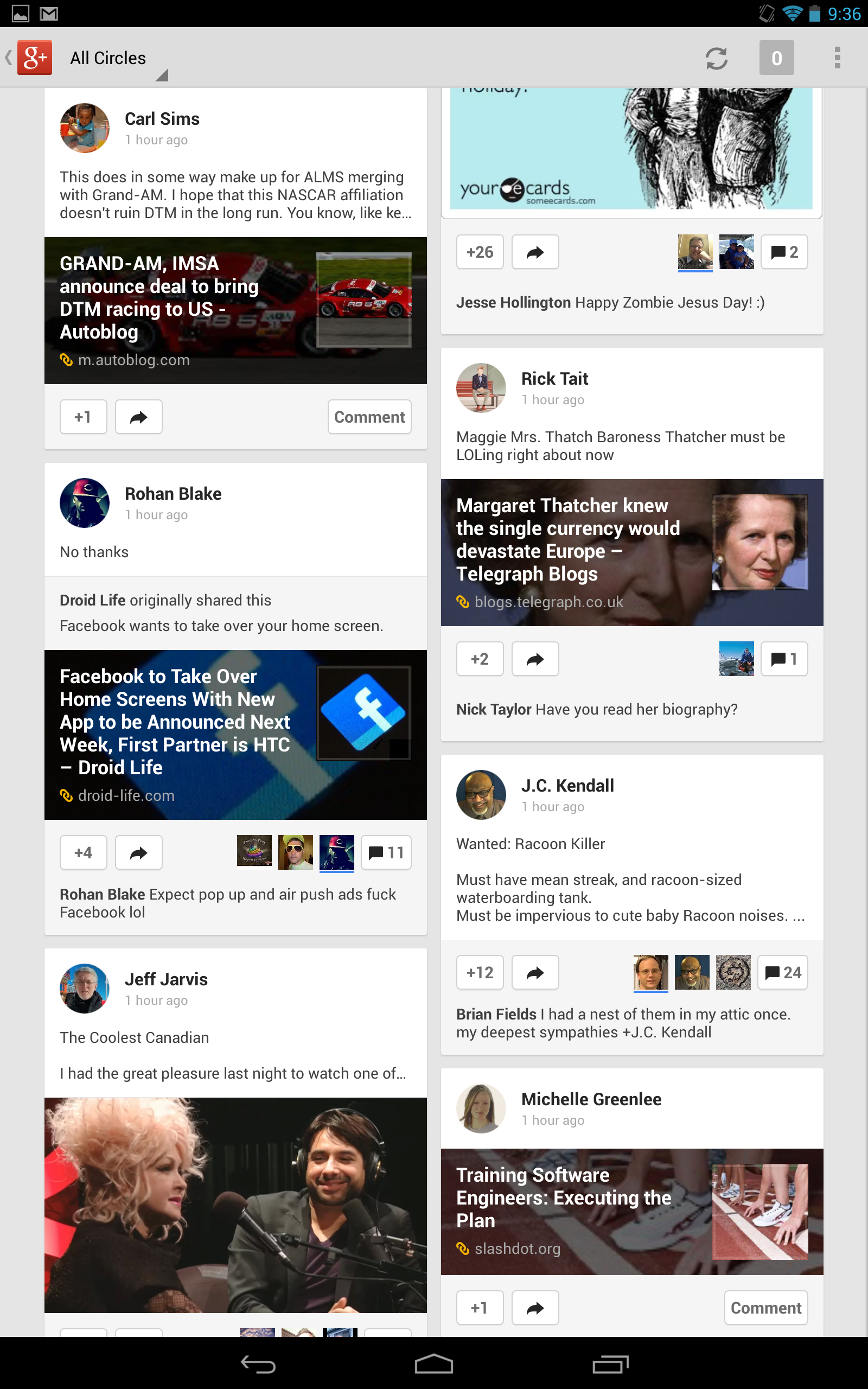
    In December, when reviewing Nexus 10, I boasted: “I much prefer Google+ on a tablet to the service running in a PC browser”. I sure as hell can’t say that now. Take a look at the screenshot above, captured this morning. There is a whole lot of clutter, more posts per page and distracting movement from comments that flash by underneath post images.

    Consider the May 2012 update, for which Google’s Vic Gundotra posted screenshots from a smartphone and compare to images of the newest design here. (There are also two screenshots below — darker is the older and lighter is newer.) These are quite different designs in less than a year, and I simply single them out. The dramatic changeovers are more frequent.

    The big, December Google+ update isn’t so radical (screenshots here and here) from this week’s, on smartphones. The bigger change came months earlier. Little more than a month after the May 2012 Android update, Google radically redesigned the mobile app.


    The screenshot left is how Google+ for Android looked in May 2012. The one right is the appearance following the big, March 2013 update.

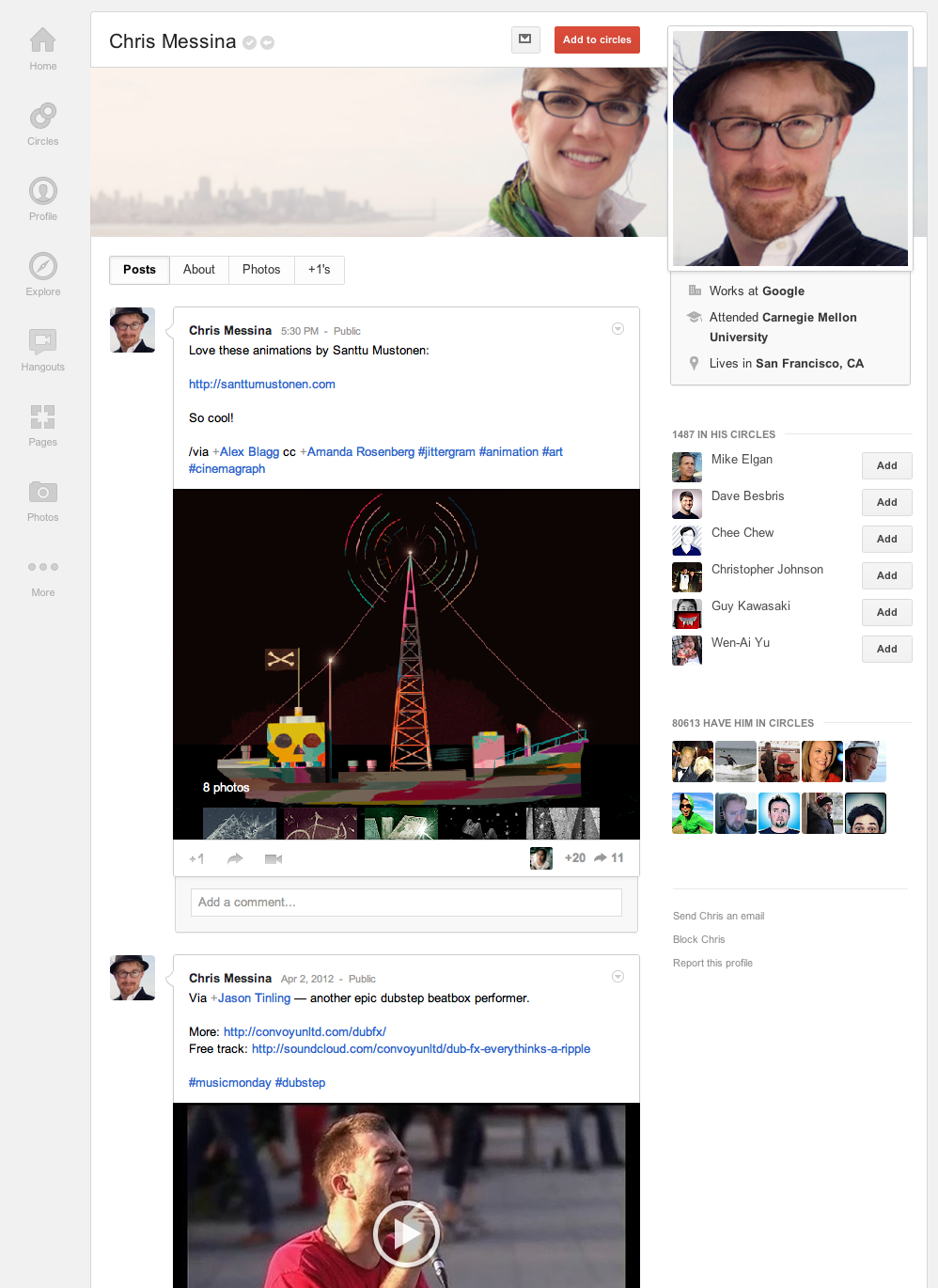
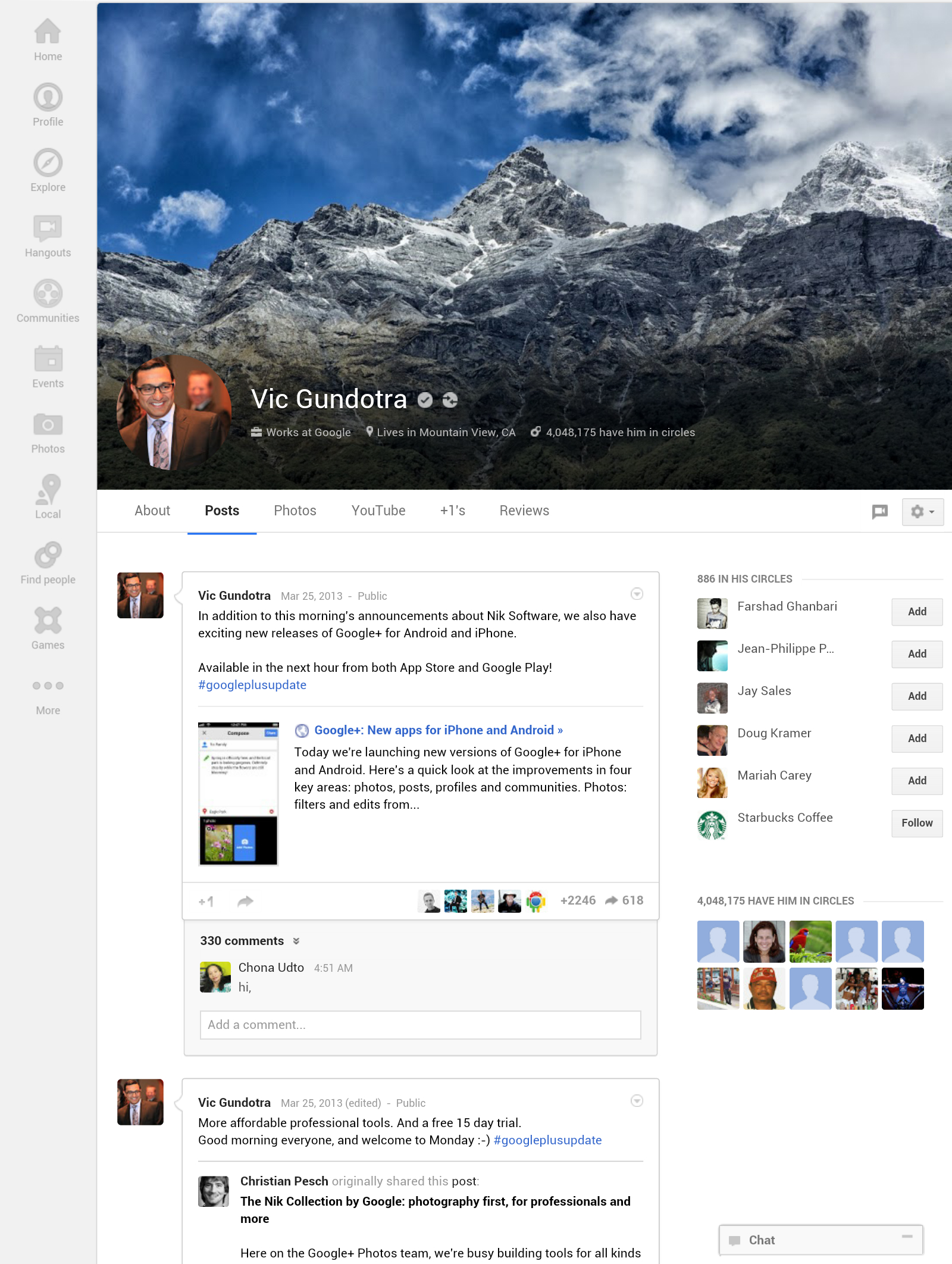
    Google+ clutter creep comes to the website, too. Consider how the user Profile looked in April 2012 compared to major changes Google made earlier this month.

    I’m a big supporter of change and have past praised Google for improving the social network, regularly. But there is a whole lot more clutter and distraction today than a year ago. Much of that is more tolerable on the web, but, in my view, unacceptable on mobile. Google asks too much of the eyes.


    Image left is the Google+ profile in April 2012 and the right March 2013, as viewed on the web.

    The problem is bigger, and this goes back to the idea of the ever-changing maze. There are very good reasons why smart companies think through and implement user motifs they keep for years. Most people balk at change, finding comfort in familiar motifs around which they develop habits that speed interaction. Facebook is the criminal of constant, cluttered redesigns. Social network street punk Google is little better.

    For me, realization of my lab rat status and seeing no spoils in the new maze ahead is actually liberating. I will start spending more time on other social networks in the coming weeks, and less on Google+. I’m not abandoning or boycotting, just reallocating my time.

    Change is good, right?

  • Country Band ‘Ambushes’ Google Street View Car

    Country music group Gunnar & The Grizzly Boys have a new video for their song “Could Be Me,” which looks like they hijacked Google’s Street View imagery by appearing in a set of photos.

    Oh, and the video is actually called, “Redneck Country Band Ambushes Google Street View Car!”

    On the YouTube page for the video, it says, “To protect our friends at Google who bent the rules to make this video possible (and their jobs), we can’t disclose when and where this was filmed.”

    The video was submitted to reddit, and as the top comment on reddit points out, “It’s not really Google Street; it’s just some clever guys. The first tip off is that no one’s face is blurred out.”

    “It is from Rob Bliss a guy from my old home town who designs viral events,” notes another redditor. ” “He has done alot of this in grand rapids MI.”

    Indeed, Rob Bliss Creative’s site and Facebook Page are promoted on the video page.

    Either way, well done.

    [via reddit]