Author: Serkadis

  • Veterans’ Affairs names Carmi resident as state of Illinois’ January 2010 “Veteran of the Month”

    CARMI –- The Illinois Department of Veterans’ Affairs (IDVA) today named Carmi resident and U.S. Army Veteran Glen Holtzclaw as the State of Illinois’ January 2010 “Veteran of the Month” for his unwavering dedication to the state’s military heroes and for service to local community.

    The “Veteran of the Month” award is a distinction that is given monthly to military Veterans who give back to their community and continue to serve other Veterans.

    IDVA Director Dan Grant presented Holtzclaw with the prestigious award this morning during a ceremony at American Legion Post 224, 1206 Oak Street, Carmi.

    “Glen Holtzclaw is a true friend to Illinois Veterans and is a tireless public servant,” IDVA Director Grant said.

    “He distinguished himself through 25 years of service to the United States Army, and continues to serve Veterans in White County and statewide through the American Legion and the VFW.”

    Holtzclaw served in the United States Army from 1943-1968, during three conflicts: World War II, and the Korean and Vietnam Wars.

    Holtzclaw was awarded the Purple Heart, World War II Occupation Medal, Korean Defense Medal and Vietnam Medal, among others.

    He is a member and past commander of American Legion Post 224 in Carmi, and is also a member of VFW Post 3851. Holtzclaw has also served as District 24 Chaplain.

    About the Illinois “Veteran of the Month”

    The “Veteran of the Month” award highlights the work of community activists who are also military Veterans.

    Each month the Department recognizes a different person or group that contributes to the betterment of communities across the state of Illinois.

    To nominate a “Veteran of the Month,” please visit IDVA’s Web site at veterans.illinois.gov or call IDVA at (312) 814-5538 to obtain a list of guidelines and a nomination form.


  • East Coast Hydrogen Highway Planned by SunHydro

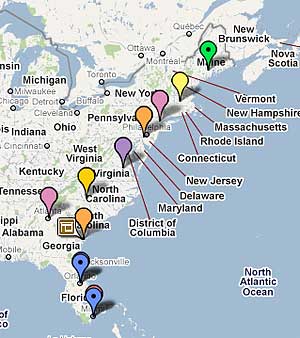
    Two weeks ago Proton Energy Systems and SunHydro announced plans to build a public hydrogen fueling station in Wallingford, Connecticut. This week SunHydro announced the plans to build an East Coast Hydrogen Highway system.

    Presumably this would exclude other companies that build hydrogen fueling stations since 4 operational hydrogen fueling stations in New York, and 1 operational hydrogen fueling station in Washington DC is excluded from the plan they’ve mapped out.

    The SunHydro East Coast Hydrogen Highway system is supposed to start in Portland, Maine and end in Miami, Florida. The other cities along the route include Braintree, MA, Wallingford, CT, S. Hackensack, NJ, Claymont, DE, Richmond, VA, Charlotte, NC, Atlanta, GA, Savannah, GA and Orlando, FL.

    The SunHydro fueling stations will be powered by solar energy and will create hydrogen by the electrolysis of water. This is much greener than some other H2 stations that reform natural gas to create hydrogen.

    According to Mapquest, the distance between Portland, ME and Miami, FL (not considering the locations of the H2 stations in-between) is 1610.72 miles. This would mean on average the 11 fueling stations would be 145 miles apart, well within the range of most hydrogen cars. I didn’t chart every leg of this journey so there will be some variation.

    But, at least H2 cars like the Honda FCX Clarity with a range of 240 miles and the Toyota FCHV Adv with a range of well over 400 miles will have no problem with this route. Building an East Coast Hydrogen Highway system is well overdue. The West Coast has already taken a big lead in this arena. But, it’s good to see a company like SunHydro stepping up to make this happen.

  • How to Expand Urban Agriculture


    The National Building Museum’s well-known “For the Greener Good” series featured a panel on urban agriculture, including Josh Viertel, President, Slow Food USA, Liz Falk, Director and co-Founder, Washington D.C.-based Common Good City Farm, and Steve Cohen, food policy and programs, City of Portland’s Bureau of Planning and Sustainability. The panel was moderated by Allison Arieff, Food and Shelter Ambassador, GOOD and “By Design” columnist, The New York Times.  

    Chase Rynd, Executive Director, National Building Museum, framed the discussion by saying how and where we produce food has an enormous ecological impact. ”How we produce, transport, and store food has a huge impact. Food is directly related to the built environment.” Because of industrial food systems, people are losing their connection with nature. Bringing vegetable gardens back to communities, shortening food transportation times (and lowering the environmental costs of food transportation), can help improve the urban environment and make communities more engaging and “aesthetically pleasing.”

    Allison Arieff, the moderator, asked a set of questions:

    Do we need farms in urban areas?

    Josh Viertel, President, Slow Food U.S.A.: Yes, local urban food is more sustainable. It also helps create new connections to the land in cities – ”learning connections” that create better environmentalists who are stewards of the land.

    Liz Falk, Director and co-Founder, Common Good City Farm: There are no downsides, except, possibly, rats. But if you plan well and compost, you won’t get rodents.

    Steve Cohen, food policy and programs, Portland Oregon’s Bureau of Planning and Sustainability: There is now a disconnect with food in urban areas. In many cities, you can’t grow food outside your door. Eating food you’ve grown yourself is a visceral experience. We need to look at government land for urban food production as well.

    Is there a viable business model for urban agriculture?

    Arieff noted that there are more than 100 urban farms throughout San Francisco, which have formed into neighborhood farm collectives. However, the business model failed. People have gotten invested, but there isn’t enough money in this. Does urban agriculture need to move towards a non-profit model?

    Liz Falk: We need to connect the dots between schools, chefs, farmers, and local residents. We need to work collaboratively. There are lots of job opportunities. Non-profits can turn into businesses. Urban farmers can also produce higher value jams, tea, etc.

    Steve Cohen: There are lots of models out there. Philadelphia’s SPIN farming is a great model that allows for 3-4 planting seasons. You can plant over and over again. In other cities, small backyard farmers are delivering produce by bicycle. Some organizations come into your garden and provide advice on what to plant (for a fee) or even farm your yard for you. For one organization, they add one employee for every 75 urban farms they work on.

    Josh Viertel: Van Jones recently said urban farm jobs stink, so he was not going to promote a push for urban farming jobs on Capitol Hill. In Viertel’s own experience with an urban farm, he made some $11,000 per year working 90 hour weeks. The business model didn’t work for him.

    How do we create more viable partnerships with businesses, government?

    Liz Falk: Our food programs for low-income residents in Washington, D.C. require partnering with the communities. We get feedback from the community and see what works. Micro-credit to expand micro-enterprises, a model created by Muhammad Yunus’ Grameen Bank, can work for moving low-income urban residents into farming.

    Josh Viertel: Does urban farming have to create a profit? Parks don’t turn a profit but they provide valuable environmental services. Urban agriculture has a public health value, can provide a carbon sink, store waste water. These farming spaces can provide a range of hard-to-quantify services.

    Q & A: What about green roofs and urban agriculture?

    Liz Falk: Washington D.C. has an innovative green roof incentive program — turning existing roofs into green roofs will get you a $5-per square foot rebate. You can add vegetable gardens on these green roofs. There are lots of opportunities to put farming on roofs.

    Steve Cohen: There are lots of successful examples. Green roofs have usually been used to capture stormwater runoff. They can be used for food production — these goals are complimentary.

    Josh Viertel: Moving from impermeable to permeable and dark to green roofs is a good thing.

    What about residual soil toxicity?

    Josh Viertel: You need to test your site before you plant. If the soil is toxic, you can plant above the soil or truck in new soil. If the soil is really toxic, you can remove the soil and replace, which is expensive.

    Liz Falk: Mushrooms are great at removing pollutants. There are other plants that can also decrease soil toxicity.

    In many cities, urban agriculture breaks local zoning codes. What is the best way to reform zoning codes?

    Liz Falk: In Montgomery country, Maryland, the council is currently reviewing zoning changes that will enable the use of yards for urban farming. However, there has been pushback – it’s a wealthy county. It’s important to find allies in government councils.

    Allison Arieff: Home resale value is hugely important, and lawns are important for this. Many people don’t care about their lawns but think it’s important for increasing the resale value. Perhaps resale value has become less of an issue with housing prices falling? This may create new opportunities for urban farming.

    Josh Viertel: There are now millions of people planting urban farms in the U.S.. The trend is up 35 percent over the past year. 15 percent of the U.S. now has a backyard garden. Out of a country of more than 300 million people, this is a huge trend.

    The panelists made a range of other points:

    More than 50 percent of food is now wasted. Composting needs to be increased. The overall food system needs to incorporate and reuse food waste. “We are throwing away a huge resource.” In San Francisco, more than 70 percent of food waste is now composted. The local government has realized there is money in this. Additionally, yard waste — leaves, which are just raked into the street and end up clogging gutters, are a huge resource. Wood chips from felled trees can also be used for urban gardens.

    To move from unsustainable lawn practices, which require toxic fertilizers and other products, to productive urban farming landscapes, localities can inhibit the purchase of lawn products that have negative environmental effects. “We can also vote with our dollars.”

    The food system currently hurts the poor and people of color the most, but these people aren’t going to farmers’ markets and buying locally-produced food. The Slow Food movement needs to broaden its appeal. The selling points need to be: this food is good for your kids and doesn’t hurt the environment. We need to address food and security. Local solutions need to be bottom-up, not top-down, and not funded by some outside foundation.

    Food is the “gateway drug” to sustainability. We can access these markets through kids in schools first, then parents. Local, healthy food creates positive externalities.

    Detroit has so much open space and they’ve created networks of local community gardens.  There are two models at work in Detroit: huge farmers across many small plots and small independent farmers. Some smaller farmers resent the growth of large-scale farming in Detroit.

    Urban agriculture may place pressure on urban water systems. Water is becoming the “next oil,” a resource hard to come by and expensive. We can collect rainwater through cisterns. Drip irrigation systems also improve water efficiency.

    “Big dig”-type stormwater management infrastructure projects are expensive. Localized, decentralized stormwater approaches, including more green roofs and urban gardens, are a less expensive way to alleviate pressure on overstressed urban stormwater management systems. “Stormwater management is the new sexy area in sustainability.”

    Through local organization and advocacy, communities can change zoning rules and create a national movement that makes urban farming acceptable. It needs to be bottom-up.

    Image credit: Edible Estates / Lenape Edible Estate, Hudson Guild at Elliott-Chelsea Houses, NY, NY

  • Confirmed: Toyota expands sticking pedal recall to Europe

    Filed under: , , , ,

    Just as we reported yesterday, Toyota has confirmed the recall announced last week for sticking accelerator pedals will be expanded beyond the U.S. and soon include Europe.

    Up until now, the recall had affected only eight models built in North America at plants that were supplied defective accelerator pedal mechanisms by Indiana-based CTS Corp. Certain other models, specifically all Lexus and Scion models, were excluded from the recall because they are built in Japan and use a similar part but from a different supplier. It’s unclear exactly where Toyota’s European assembly plants got the defective mechanisms, from CTS Corp. or another supplier manufacturing the same defective part.

    As of yet, Toyota isn’t certain how many vehicles in Europe will be affected by the sticky accelerator recall, saying “the models and exact number of potentially affected vehicles is under investigation.” However, unlike here in the U.S. where production for all eight recalled models is being halted for a week on February 1, production in Europe will continue as a replacement part has already been implemented in the production process.

    Until the official recall is issued, Toyota is encouraging concerned European customers to contact customer service for assistance. Follow the jump for the announcement from the company’s UK headquarters.

    [Source: Toyota | Image: Stan Honda/AFP/Getty]

    Continue reading Confirmed: Toyota expands sticking pedal recall to Europe

    Confirmed: Toyota expands sticking pedal recall to Europe originally appeared on Autoblog on Thu, 28 Jan 2010 10:29:00 EST. Please see our terms for use of feeds.

    Permalink | Email this | Comments

  • PHOTOS & Official Guest List for First Lady Michelle Obama’s Box at the 2010 State Of The Union

    President Obama delivered his first State of the Union Address last night. If you have ever wondered who was sitting next to the First Lady, this is your chance to find out. Here is the official guest list for First Lady Michelle Obama’s box courtesy of the White House Press Office

    Dr. Jill Biden

    Clayton Armstrong (Washington, DC) Clayton was a DC Scholar with the White House Office of Intergovernmental Affairs during the summer of 2009. He is currently a freshman at the University of Arizona. Clayton grew up in Southeast Washington, DC and graduated from Ballou High School where he was the captain of the football team.

    Li Boynton (Bellaire, TX) Li is a 18-year-old senior from Bellaire, Texas whose passion for science and global health has led her to new and potentially ground-breaking methods for testing the quality of drinking water. Almost one billion people lack access to safe drinking water, and 3.5 million people die each year from water-related diseases. Observing the limitations and significant expense of conventional chemical-specific tests, Boynton saw a need for a broader, more efficient assay for testing – and developed a bacteria bio-sensor. Li’s work, which has the potential to be significant in improving public health worldwide, received the Intel International Science and Engineering Fair award for 2009.

    Li has always had a passion for science and invention: in 5th grade, she designed a solar-distillation device after reading Life of Pi in case she ever got stranded in the middle of the ocean. Li is also an avid painter and participates in high school debate, which is where she originally developed her environmental interests.

    Jeffrey Brown (Philadelphia, PA) Jeffrey Brown is the founder, President and CEO of Brown’s Super Stores, Inc., a growing ten-store supermarket chain trading under the ShopRite banner. As one of the leading supermarkets in the Philadelphia area, the company employs 2,300 associates who are committed to making a difference for their customers and the local communities they serve.

    Brown graduated from Babson College, Massachusetts with a degree in entrepreneurial studies. He resides in southern New Jersey with his wife Sandy and their four sons Joshua, Alex, Lenny, and Scott.

    Mayor Mick Cornett (Oklahoma City, OK) Mick Cornett became Oklahoma City’s 35th mayor on March 2, 2004, and was re-elected on March 7, 2006. In 2007, he was elected as a Trustee of the U.S. Conference of Mayors. Cornett is also the national President of the organization representing Republican Mayors and Local Officials.

    Cornett is a graduate of the University of Oklahoma, where he earned a degree in journalism, and after graduation embarked on a 20 year career in broadcast journalism. In 2001, Cornett was elected to City Council, where he served until becoming mayor.

    Cornett was born and raised in Oklahoma City, and together, he and his wife Lisa have raised three sons – Michael, Casey and Tristan.

    Tina Dixon (Allentown, PA) Tina is currently employed by Lehigh Valley Health Network as a Technical Partner Trainee, a job that she was able to secure through the EARN program (Employment Advancement and Retention Network – a program focused primarily on Paid Work Experience placement) at the Allentown, Pennsylvania CareerLink in preparation to re-enter the workforce after years as a stay-at-home mother to three girls, Olivia, Allison, and Lauren.

    It was at CareerLink that Tina met President Obama on the first White House to Main Street Tour in December 2009.

    Gabriela Farfan (Madison, WI) Gabriela is a 19-year old from Madison, Wisconsin whose passion for geology started at a young age – collecting rocks as a seven-year old with her father. In 2009, as a senior in high school, her hard-work and research won her one of the top awards in the Intel Science Talent Search, winning a scholarship for her independent research describing why certain gemstones appear to change color when viewed from different angles—a finding that directly affects the gemstone industry and may have applications in the nano and materials sciences. Gabriela is now in college as a freshman at Stanford University, and a declared geology major.

    Gabriela is also a National Hispanic Scholar awardee, has two very proud parents, Abigail Farfan and Carlos Peralta, and has a real dedication to the arts: singing, drawing, painting, speaking French and Spanish, and following operas and musicals.

    Julia Frost (Jacksonville, NC) Julia is a former Marine bandsman trumpeter, a wife of an active duty Marine, and current student at Coastal Carolina Community College. She served a four year term with the United States Marine Corps stationed at Marine Corps Base Hawaii. Her husband, Sergeant Ryan Frost, is also a Marine bandsman, stationed at Camp Lejeune North Carolina.

    With the aid of the GI Bill, Julia is currently enrolled in the Elementary Education program through a partnership between Coastal Carolina Community College and the University of North Carolina, Wilmington. Julia hopes to complete her associate degree this summer and bachelors in the spring of 2012.

    Dr. Biden, a community college professor, first met Julia when she visited her campus last October as part of the Administration’s ongoing efforts to support America’s community colleges and their students.

    Ping Fu (Chapel Hill, NC) Ping Fu co-founded Geomagic, a company which pioneers technologies that fundamentally change the way products are designed, engineered and manufactured around the world from automobiles to medical devices. Geomagic, under her leadership, has been an active participant in the SBA’s Small Business Innovation Research (SBIR) program. Fu has led Geomagic to deliver broad-based economic impact to the US economy with tangible results – the company tripled its customer base and employment while achieving high growth and profitability. As such, the NSF awarded Geomagic the prestigious Tibbetts Award for exemplifying the very best in SBIR.

    Fu has more than 25 years of software industry experience in database, internet technology, and visual computing. Before Geomagic, she was the Director of Visualization at the National Center for Supercomputing Applications and is also, actively involved in promoting entrepreneurship and women in mathematics and sciences.

    Janell Holloway (Washington, DC) Janell was a DC Scholar with the White House Domestic Policy Council during the summer of 2009. She is currently a freshman at Harvard University where she is a member of the Harvard College chapter of the American Red Cross, dances with the CityStep dance troupe, and is active in the Black Student Association. Janell is interested in the connection between child abuse and youth violence and has served as a volunteer at Safe Shores: DC Children’s Advocacy Center for more than three years. She is a native of Washington, DC and graduated from Benjamin Banneker Academic High School.

    Ambassador Raymond Joseph In 1990 Raymond Joseph was called to be Haiti’s Chargé d’Affaires in Washington and his country’s representative at the Organization of American States. After helping with the first democratic elections in December 1990, he returned to the Haiti Observateur where he remained until he was called back to Washington in March 2004, where he is currently the Ambassador.

    Joseph is a graduate pastor from the Moody Bible Institute in Chicago, a B. A. holder in Anthropology from Wheaton College, Wheaton, Illinois. He also has a Master’s degree in Social Anthropology/Linguistics from the University of Chicago.

    Don Karner (Phoenix, AZ) Don Karner is the President, CEO, and Co-Founder of eTec (Electric Transportation Engineering Corporation). As President of eTec, Don provides strategic direction, conducts research and leads the company’s development of new products and services.

    eTec received $99.8 million from the Recovery Act’s Battery and Electric Vehicle Grant program, which the company will match with another $99.8 million in locally raised funds. The funding will be used to manufacture and implement the charging infrastructure for an 11 city pilot program intended to research electric vehicle charging infrastructure. Cities involved are Phoenix, Tucson, San Diego, Salem, Portland, Eugene, Seattle, Nashville, Knoxville, and Chattanooga. The award will create at least 50 new permanent clean economy jobs working directly at eTec, has already saved numerous positions, and will require construction workers across the country to implement the project.

    Don participated in a Recovery Act roundtable discussion with Vice President Biden in Phoenix in November 2009 where they discussed the importance of the public/private partnership to a green economy.

    Janell Kellett (Sun Prairie, WI) Janell has served as a lead volunteer within the Wisconsin Army National Guard for approximately six years, including during her husband’s fifteen month deployment from 2005-2006 and recent twelve month deployment from 2009-2010. Janell’s husband, Major Michael Hanson, serves with the 32nd Infantry Brigade Combat Team and recently returned home to Wisconsin. During Major Hanson’s deployment, Janell served the 3,200 families of the 32nd Brigade and over 50 volunteers of the 32nd Brigade with dedication. Janell was honored for her service with a 2009 Wisconsin National Guard Volunteer of the Year award by the Wisconsin State Family Program. Under Janell’s leadership, the 32nd Brigade was selected for the prestigious Department of Defense Reserve Family Readiness Award in December 2009 for the Army National Guard. Additionally, Janell served as the Battalion Volunteer for the 2nd Battalion, 128th Infantry when it received the same award, the Department of Defense Reserve Family Readiness Award, in 2006.

    Janell and Michael have two children, Jaclene and Lucas.

    Rebecca Knerr (Chantilly, VA) Rebecca is representing her husband, Captain II Joseph Knerr, the Task Force Leader of Fairfax County’s Virginia Task Force 1 serving in Haiti. Having worked as a Fairfax County Firefighter for 15 years, Joe currently serves as Station Commander at Fairfax Fire and Rescue Station 18. He initially joined the USAR team in 1998 serving in a variety of operational capacities and now in leadership positions. Joe is also involved in the coordination, teaching and training of other international rescue teams. A former Fairfax County Firefighter and Paramedic herself, Rebecca works as an Emergency Physician’s Assistant in a Northern Virginia Hospital and for Fairfax County Fire and Rescue Department developing and delivering emergency medical services education to uniformed personnel. Rebecca, 24 month old son Jackson, and 12 week old daughter Grace are eager to welcome Joe home.

    Chris Lardner (Albuquerque, NM) Chris Lardner is a patient service manager at the New Mexico Heart Institute and her husband, Scott, owns a small family business. Together they have three children, two daughters in college at Regis University in Denver, Danielle and Caitlin, and a son in 7th grade, Sean. As a result of the economic downturn they resorted to paying for some of their daughters’ education with a credit card. Lardner realized she was close to reaching the card limit, so she contacted the college to change the card on file. The school mistakenly charged another payment to the original card, which then put her above the limit. In response, the credit card company more than tripled her rate to nearly 30 percent, despite of record of responsibility with her finances and payments. Lardner submitted a letter to the President online expressing her frustration with the rate hikes leveled as a result of the mistaken charge.

    Chris shared her story when she introduced the President at a Town Hall in May 2009 – since that time her issue with the credit card company was eventually resolved; their rate was lowered to 7 percent and the company returned the over-the-limit fees that had been charged.

    In May 2009, President Obama signed the credit card reform bill that bans credit card companies from unfairly raising interest rates on existing balances, protects against unfair fee traps (including requiring the consumer’s permission before processing an over-the-limit transaction), and increases accountability and transparency from credit card companies.

    Anita Maltbia (Kansas City, MO) Anita Maltbia is a native of Kansas City, Missouri, and has over 30 years experience in city government, and community activism. In August 2009, at the request of Congressman Emanuel Cleaver II, Anita assumed the director position of the Green Impact Zone. This initiative works with the residents of a 150 square-block area in the urban core of Kansas City to raise the quality of life environmentally, economically and socially. Energy efficiency and environmental conservation, including home weatherization and energy upgrades are critical goals as is job training and acquisition.

    The Green Impact Zone in Kansas City, Missouri is an urban success story that reflects President Obama’s national urban policy vision of breaking down silos and building strong communities of opportunity that will, in turn, contribute to the economic prosperity and the sustainability of cities and metropolitan areas.

    Kimberly Munley (Killeen, TX) Kimberly was born and raised in North Carolina. In 1999, she completed Basic Law Enforcement Training and began her career in law enforcement. Kimberly spent the next 11 years working as a University of North Carolina, Wilmington undercover vice/narcotics agent, a Wrightsville Beach uniformed patrol officer and beach patrol officer, a Special Police Officer for New Hanover County Regional Medical Center, a Chemical, Biological, Radiological, and Nuclear Operations Specialist Soldier in the United States Army, and is currently a federal police officer serving on the Special Reaction Team for the Fort Hood Police Department in Fort Hood, Texas.

    Cindy Parker-Martinez (Belle Isle, FL) Cindy is a mother of two young children, who shared her story of the problems her family faces with the current health care system at a Health Care Community Discussion held at the University of Central Florida in Orlando, one of thousands of discussions held nationwide in December 2008. In April 2008, Cindy, her husband, and her son were all denied insurance coverage on the individual insurance market because of pre-existing conditions. Her 11-month old daughter was also denied coverage due to an insurance company age requirement of 12 months. Both Cindy and her husband are currently uninsured because they cannot afford the insurance offered at her husband’s employer. Although they previously paid their premium, they could not afford to keep up the monthly payments after receiving thousands of dollars in medical bills from her husband’s unexpected 6-day hospital stay for pneumonia. Their family’s income is too high for them to qualify for Medicaid. Cindy and her husband currently have no insurance and have thousands of dollars in medical debt.

    Deborah Powell (Hugo, OK) Deborah Powell is a Native American Development Specialist for the Housing Authority of the Choctaw Nation of Oklahoma. Having earned only a high school diploma, Powell built her experience outside of college and soon became interested in accounting and finance. After spending 43 years of her life in her hometown of Flagstaff, Arizona, she moved to Oklahoma in April 2004 for a change of pace and is currently working on a project funded by the Recovery Act. A member of the Choctaw Nation, she is currently helping to track budgets and ensure bids for independent elderly homes. This project, which is still under construction, will provide homes for more than 86 elderly people in the Choctaw Nation. Powell is recently remarried, and enjoys hunting, fishing, and spending time with her family.

    Sergeant First Class Andrew Rubin (Savannah, GA) Sergeant First Class Andrew Rubin entered the Army in 1997 from Boston, Massachusetts and completed One Station Unit Training, Airborne Training and Ranger Assessment and Selection at Fort Benning, Georgia before becoming a Ranger assigned to the 75th Ranger Regiment.

    Andrew has spent his entire military career serving in the 75th Ranger Regiment in positions of increasing responsibility. He is currently assigned to 1st Battalion, 75th Ranger Regiment, headquartered in Savannah, Georgia, which recently redeployed from a combat tour supporting operations in Iraq and Afghanistan in December 2009.

    SFC Rubin currently leads 45 Rangers as a Rifle Company Platoon Sergeant. In the Regiment, he has also served as an anti-tank gunner, sniper, sniper team leader, sniper section leader, and rifle squad leader, Ranger Assessment and Selection Instructor, and Rifle Platoon Sergeant.

    SFC Rubin has served four combat tours in Iraq and two combat tours in Afghanistan. He has been involved in countless fire fights, was wounded on two separate occasions and has received two awards for Valor. During his recent deployment to Iraq, he was shot by enemy forces while risking his life to save one of his Rangers who lay wounded and immobilized in the streets of As Sadiyah, Iraq during an intense firefight. For that action, he received the Bronze Star with Valor and the Purple Heart. Previously, he was wounded in Afghanistan when he was hit by a rocket propelled grenade during an enemy ambush.

    SFC Rubin and his wife Megan have three children, Michael, Joseph and Kendal.

    Mark Todd (Killeen, TX) Mark Todd was born and raised in San Diego, California. Todd enlisted in the United States Army as a Military Policeman in 1985. He was selected to attend Military Working Dog Handlers Course and later assigned as a K-9 handler at Fort Devens, Massachusetts, Fort Polk, Louisiana, and Wurezburg, Germany. Later he was assigned as a K-9 Trainer and Instructor at Lackland Air Force Base Texas. Todd earned an Associate in Applied Science – Instructor of Technology and Military Science from the Community College of the Air Force in 1997. His last two assignments were Grafenwoehr, Germany and Fort Hood, Texas. In 2007, he joined the Directorate of Emergency Services and is currently the Lead Police Officer, Military Working Dog Branch – Acting Chief at Fort Hood Texas. Todd is married to Lisa Dalton and together they have three children; Jennifer, Mark Jr., and Kristyn; and two grandsons.

    Army Specialist (ret.) Scott Vycital (Ft. Collins, CO) Specialist Scott Vycital served as a paratrooper in the 82nd Airborne Division. Vycital spent 8 months deployed in Iraq as a Specialist with 2nd Platoon, Bravo Company, 3-505 Parachute Infantry Regiment and was medically retired due to injuries received in defense of Operation Iraqi Freedom. On February 15, 2004, while on patrol of suspected mortar sites, his fire team was engaged by enemy fire and he sustained gunshot wounds on the right side of the face, neck, and shoulder. As a result of his injuries, the right side of SPC Vycital’s face has been paralyzed and he lost the hearing in his right ear. After spending some time rehabilitating from injuries, SPC Vycital returned to school and with the assistance of the VA and the Army Wounded Warrior (AW2) program. He completed his degree in Business Administration with an Accounting concentration from Colorado State University in December 2008. Following graduation, with the help of his AW2 advocates SPC Vycital landed a position within the Federal Highway Administration. He has since been promoted to the position of Programs & Planning Financial Specialist and will have been with the Agency for one year in March. The President’s executive order on employing Veterans in the Federal Government has made employing Veterans like Vycital a priority. Vycital resides in Fort Collins, CO with his wife of 7 years, Jarah, and has a 4 year old son, Breccan, and a 17 month old daughter, Micah.

    Trevor Yager (Indianapolis, IN) Trevor Yager began his career in 1995 while in college by founding TrendyMinds, a full-service advertising/public relations firm. He earned a Bachelor of Arts degree in psychology from Anderson University and went on to work with various motor sports sponsors, team owners and sanctioning bodies. Today, at TrendyMinds, Yager provides strategic planning, business development, marketing and technology guidance and support to various local, national and international clients. In 2009 the agency grew by more than 200 percent, doubled the number of employees and gained 15 new accounts. Yager credits President Obama’s welcoming climate for small businesses, including the many initiatives under the Recovery Act, for this success.

    He is also passionate about helping non-profits and TrendyMinds is committed to giving back to the community by donating in-kind services to organizations throughout Indiana.

    Yager resides in Indianapolis with his partner of seven years, Tyler Murray. The two have recently started the process of adoption and look forward to adding a new member to their family.

    Juan Yépez (Lawrence, MA) Juan Yépez, and his brother Luis, are Ecuadorian-natives, who in ten short years, have built a successful and growing commercial real estate company in addition to growing Mainstream Global, a worldwide distributor of computer products, consumer electronics, and electronic components, in mills once inhabited by earlier generations of immigrants.

    The Yépez brothers were the recipients of the 2009 Small Business Administration Phoenix award for recovering from a major flood that destroyed almost $400,000 of inventory while still managing to flourish in the midst of an economic downturn. They believe that doing business in an area hit by 17 percent unemployment is more than just giving back and that hiring first generation Americans like themselves who want to work and contribute to society is the cornerstone of long-term success.

    Phil Schiliro, Assistant to the President and Director, Office of Legislative Affairs

    Tina Tchen, Deputy Assistant to the President and Director, Office of Public Engagement, Executive Director, White House Council on Women and Girls
     Posted by Aminah Hanan 

    President Obama Delivers State Of The Union Address

    President Obama Delivers State Of The Union Address


    President Obama Delivers State Of The Union Address

    President Obama Delivers State Of The Union Address

    President Obama Delivers State Of The Union Address
    U.S. President Obama delivers his first State of the Union address on Capitol Hill in Washington

    Post to Twitter Post to Plurk Post to Yahoo Buzz Post to Delicious Post to Digg Post to Facebook Post to MySpace Post to Ping.fm Post to Reddit Post to StumbleUpon

  • Why You Should Think Twice About Freelancing

    You’ll see a lot of encouragement to start freelancing on tech-obsessed blogs (ahem), often pitched with an eye toward some kind of ultimate freedom. The Freelance Folder blog drops a bit of work-from-home reality on would-be freelancers.

    Photo by blmurch.

    If you think working from home means being better able to adjust your schedule for your kids, your housework, and other non-work commitments, you’re probably thinking about the life you’ll have years from now, when you’re established and billing at the rate you want. At the beginning, however, freelancing is a long, lonely journey toward establishment, as Freelance Folder writes.

    And as for saving money by not having to commute to the office, well, there’s a balance there, too:

    While it’s true you’ll no longer have to fight morning or evening traffic, that doesn’t mean you can sell the car and save lots of money. It gets lonely in your own office so you’ll want to work remotely a few times a week.

    … After you factor in this spending money and gas, plus the extra money you’ll spend on electricity and water now that you’re home more often, freelancing can easily add up to be more expensive than a nine to five job.

    I once spent a ton of money at Target when I had no money coming in because I was “bored” from being at home all the time. Don’t make the same mistake!

    It’s not that freelancing isn’t a great thing for the right kind of worker, with a particular set of skills. It’s that reality checks like this are a good thing to have on hand.

    Buy This Item: [Click here to buy this item]

    Read Original Article

  • Ferrari leads the way with new F10 for 2010 F1 season

    Filed under: , ,


    2010 Scuderia Ferrari F10 – Click above for high-res image gallery

    With nearly all the seats accounted for and the first group test at Valencia (scheduled for February 1) fast approaching, the time has come once again, boys and girls, for the unveiling of the 2010 F1 cars.

    A couple of months ago, it looked like all the teams would get together under the auspices of the Formula One Teams Association to unveil their cars in one massive exposition concurrent with the Valencia test session, but that won’t come to fruition. Several teams are expected to debut there still, while others are doing their own thing once again. And Ferrari is first among them.

    Unveiled at the team’s headquarters in Maranello, the new F10 is the chariot with which Fernando Alonso and Felipe Massa will be contending for the championship against other top-rated challengers from Mercedes GP, McLaren and Red Bull, to say nothing of the other ten teams on the grid. The latest Prancing Horse – whose Santander-dominated red and white livery we saw a few days ago – is the product of several months of development, as the Scuderia stopped development of last year’s car half-way through the season after realizing it was way off pace and concentrated on this year’s car instead.

    You can have a look at the initial batch of photos in the gallery below, but don’t expect to see much of the rear end of the car. Ferrari kept its diffuser design – of the double design that caused controversy last year but won’t be banned until next – hidden from prying eyes for the time being. Stay tuned for the more as the teams roll out their latest.

    [Source: Ferrari]

    Ferrari leads the way with new F10 for 2010 F1 season originally appeared on Autoblog on Thu, 28 Jan 2010 09:55:00 EST. Please see our terms for use of feeds.

    Permalink | Email this | Comments


    Buy This Item: [Click here to buy this item]

    Read Original Article

  • Aussies get Mini John Cooper Works Challenge Edition

    Filed under: , , , ,

    Mini John Cooper Works Challenge Edition (Australian Market)
    2010 Mini John Cooper Works Challenge Edition – Click above for high-res image gallery

    Minis deliver fun on a sliding scale. Lower budget? The Cooper’s a gas. Got more dough to play with? Buy a Cooper S, and wait for the turbo to paint a grin on your mug. Then there’s the John Cooper Works cars, which pack the strongest performance punch along with an assortment of visual tweaks that let the informed know you’re rolling in Mini’s range-topper. Now, word comes down that well-to-do Miniphiles in the land Down Under can now add the John Cooper Works Challenge Edition package to any JCW ride – Cooper, Clubman, or Convertible.

    The look basically apes that of the Mini Challenge racers, as the package raids the accessory catalog to include the areo kit, rear wing, aluminum strut tower brace, and a variety of Alcantara-shod interior trim bits. Oh yeah, buyers also get the requisite “CHALLENGE EDITION” badging to let everyone know they dropped an additional $2,500 AUD (approx. $2,246 USD) on top of of their JCW car’s MSRP. That’s a discount over what the additional parts would cost if added in the usual, sticker-price-exploding a la carte manner, though, according to Mini. The JCW Challenge package is a limited-run deal and is exclusive to Australia. Mini’s PR is pasted after the jump and high-res images are ready to be ogled in the gallery below.

    [Source: Mini]

    Continue reading Aussies get Mini John Cooper Works Challenge Edition

    Aussies get Mini John Cooper Works Challenge Edition originally appeared on Autoblog on Thu, 28 Jan 2010 09:26:00 EST. Please see our terms for use of feeds.

    Permalink | Email this | Comments


    Buy This Item: [Click here to buy this item]

    Read Original Article

  • Engineering E. coli to produce biodiesel

    Scientists have found that it is possible to alter the genetic makeup of the bacterium E. coli to and induce it to produce biodiesel. Most microbes, including E. coli, make and process fatty acids, one of the ingredients of biodiesel; however, what they do with it often leaves something to be desired when it comes to fuel production. By modifying E. coli, scientists are able to make it produce fatty esters, which are the primary components of biodiesel.

    Engineering bacteria to do a scientist’s bidding is a good way to obtain desired materials, such as natural compounds for drugs, or in this case, fuels. Since E. coli is a well known and often-studied microorganism, and is able to produce fatty acids before any alteration, it is an excellent workhorse for synthetic biology. 

    The changes performed here include removing the enzymes involved in some competing pathways in order to enhance fatty acid production. Additional pathways were added in to convert those fatty acids to fatty esters, which make for better biofuel material. Finally, enzymes that break down the cellulose in plant matter were added in, allowing the E. coli to work directly on biomass.

    The altered E. coli can receive various inputs, including partially processed material like glucose and ethanol, and produce fatty acid methyl esters, or biodiesel. The bacteria also produce some fatty alcohols, waxes, and simple sugars that may be harvested and used for other purposes. The authors of the paper argue that the process has advantages over corn ethanol and other plant oil-derived biodiesels, as its production doesn’t require the use of anything that could be a food source, which means no issues with higher prices or questionable land use practices.

    Nature, 2010. DOI: 10.1038/nature08721


    Buy This Item: [Click here to buy this item]

    Article

  • Oracle's Ambitious Plans for Sun

    The Oracle – Sun merger was finally made official yesterday after several months in the making. Oracle announced that it planned to acquire Sun for $7.4 billion in April 2009, but the deal was blocked off by regulators until very recently. Oracle said the acquisition was a done deal and also laid down some plans for the two companies. The tone was very optimist… (read more)

  • Dovizioso Wants to Get Involved in Bike Changes

    Repsol Honda rider Andrea Dovizioso is currently putting pressure on Honda to allow him to get involved in the RCV 212 bike development. Last season, Dovizioso and Pedrosa finished sixth and third in the standings, which made the 23-year-old rider call for more.

    The Italian strongly believes the team should follow his advice for 2010 if they expect better results in the next MotoGP world championship season.

    "For me, 2009 was the first year I felt a door slamming in my face," he … (read more)

  • Adobe Responds to the iPad’s Lack of Flash [Flash]

    As you’re probably aware, the Apple iPad, like the iPhone and iPod Touch, doesn’t support Flash. Apple has its reasons for this, but clearly Adobe isn’t happy about it. Here’s their response.

    It looks like Apple is continuing to impose restrictions on their devices that limit both content publishers and consumers. Unlike many other ebook readers using the ePub file format, consumers will not be able to access ePub content with Apple’s DRM technology on devices made by other manufacturers. And without Flash support, iPad users will not be able to access the full range of web content, including over 70% of games and 75% of video on the web.

    If I want to use the iPad to connect to Disney, Hulu, Miniclip, Farmville, ESPN, Kongregate, or JibJab — not to mention the millions of other sites on the web — I’ll be out of luck.

    Adobe and more than 50 of our partners in the Open Screen Project are working to enable developers and content publishers to deliver to any device, so that consumers have open access to their favorite interactive media, content, and applications across platform, regardless of the device that people choose to use.

    The main arguments against Flash running on the iPad are that it’s a resource hog and a security risk. Both true! Hopefully the web is moving away from relying on Flash for videos and ugly menus, with HTML5 acting as a more-than-adequate replacement. But we’re not there yet. While I can appreciate the fact that Apple is trying to keep the iPad more stable by not including Flash, the fact that it kills off most online gaming and video streaming in the process makes the tradeoff questionable. [Adobe]


  • President Obama’s Clean Energy Renewable Power Turkey

    Last night in the President’s State Of The Union Address, he mentioned ‘Clean Energy’ ten times, also hyping up Renewable power.

    I want you to picture this.

    You buy a brand new car straight off the showroom floor.

    Each day of the week you drive that car to work. Out of the five days in the week you do this, your brand new car will only achieve the task once. The other four days you have to rely on alternative transport.

    So! Do you think you would be happy about that?

    I don’t think so.

    Renewable power, be it wind power or the two versions of solar power have this same reliability. 20%.

    Twenty Percent.

    But hey, please don’t believe me. Believe the same Government who wants to sink hundreds of billions of your dollars into this highly unreliable form of generating electrical power. That same Government releases highly detailed statistics every month detailing exactly how much electrical power is generated from every source.

    So then let’s look at Wind power first.

    The U.S. has recently taken over from Germany as the largest producer of electrical power from this source. This is a link to the Wikipedia site, which in actual fact is quite up to date with the total Nameplate Capacity power produced from this source. Scroll half way down the page to where the chart table is. It shows the installed Nameplate Capacity of Wind Power in the U.S. as 35,159 MegaWatts. (MW) This is around the equivalent of 17 large coal fired or nuclear power plants, which can produce 2000MW of Nameplate Capacity power. So it actually seems to be quite a lot of power really.

    However, that’s not how the power is consumed. It is consumed in KiloWattHours (KWH), and I’ll refer to it in that manner because that’s how you will all see it on your electrical utilities bill.

    To work out how much usable power is made available to consumers is an easy calculation, although it looks complex.

    The formula is NP X 24 X 365.25 X 1000. NP is Nameplate Capacity. 24 for the hours in a day. 365.25 for the days in a year, leap year included, and then multiply by 1000 to convert from MegaWatts to KiloWattHours.

    So for all the wind power in the U.S. the formula comes out like this.

    35,159 X 24 X 365.25 X 1000 which comes to 308 Billion KWH, if those wind turbines were to run at their maximum all the time. Now, we all know that they don’t so just how much power do they produce.

    This link shows that exactly, and these figures are as of January 15th from the Government’s own website for electrical power, The Energy Information Administration.

    Scroll to the bottom left there. That figure is expressed in Thousand MegaWattHours, which is the same as Million KWH, so the figure is 64.144 Billion KWH

    So, if the feasible maximum total power is 308 Billion KWH, and the actual power delivered is 64 Billion KWH, then the overall efficiency rate of delivery of actual power amounts to 20.7%. What that effectively means is that it is delivering power for just on five hours a day, or the same as for the car analogy I used above, one day in five.

    So tell me. Are you happy with that?

    To put it in further perspective, see the Nameplate Capacity is the same as for 17 large coal or nuclear plants. The actual power delivered is around the same power produced by three and a half of those 18 plants.

    Are you happy with that?

    You may think I’m being selective, so let’s then look at Nuclear Power. It delivers its power at the efficiency rate of 93%. Even coal fired power delivers its power at close to 88% when referenced to Nameplate Capacity and using the same formula.

    That delivered power of 64 Billion KWH amounts to only 1.6% of the total power consumed in the U.S. There is positively and absolutely no way, ever, that total will even closely approach the hoped for 20%, and you could try until 2050. It will never reach 20%.

    Look on that same page at Solar Power. Even with all the advances made in Solar Power in the last few years consumption of power from Solar generated sources actually fell, but then, who would really notice. This total amount of power produced from both solar sources amounts to 733 Million KWH, or 0.02% of the total power consumed in the U.S. To put that into some context, this is the same amount of power produced from ONE coal or nuclear plant every FIFTEEN DAYS. That is for every solar power plant in the Country. Solar power is currently delivering its power at the efficiency rate of around 12 to 15% at the absolute best, or around 3 hours a day. Try as you might it’s no point filling up the Deserts in the South West and in Texas with solar panels or mirrors, because there is no way you can then transmit that power the vast distances to where it is needed the most, in the North East. How much power would have been produced over the last few months of snow and blizzards in that North East? Zero. In fact, building them in the North East will never happen because of that.

    Are you happy with those figures from Solar power?

    Add the solar to the wind, and the total still only comes to 1.62%. Almost nothing.

    This is not some imaginary political point I’m trying to make. This is just a bald statement of the facts.

    These renewable plants are in the vicinity of five to seven times more expensive to get to the power delivery stage than for any other plant. They are more maintenance intensive and they only last for a third to half the time as for a large coal or nuclear plant.

    All that aside, that power delivery rate of only 20% at the absolute best should be enough to convince you that these things are next to useless. The only way they can even get off the ground is with the injection of huge amounts of money in the form of Government subsidies. The only thing that they can absolutely ensure is that the cost of electricity to the end consumer will be much more expensive.

    The analogy about the car at the top of the post is a relevant thing to allude to. Would you as a consumer but a car that you KNOW absolutely is only going to work one time in five.

    Why should the same thing not apply here with renewable power.

    This is one great big turkey that is never going to fly, no matter how much money you throw at it.

    Taking into account that 20% power delivery rate, that means you will just have to rely on getting the required power for the remainder of the time from those other sources, so in all reality, the construction of these wind plants and solar plants at an alarmingly ever increasing rate will not really result in the saving of all that much in the way of Carbon Dioxide emissions anyway, as those coal fired plants will have to stay running to provide power for the bulk of the time these so called renewable plants are just not even working at all.

    You can construct another million of them, and that percentage will not change.

    So when the President is given a standing ovation for mentioning ten times the phrase renewable power and clean energy, this is one turkey that will just never fly. He can hope and change all he likes, but nothing will change that 20% figure.

    This is most definitely not B+ material, In fact, if this paper was marked, an F would be a fair result, and in fact even an F is probably too high, and thankfully, the only reason it does get an F instead of just being thrown in the rubbish bin unmarked is that he actually did mention nuclear power generation as an option.

    Filed under: 111th Congress, America (USA), Barry Soetoro (aka Barack Hussein Obama), Blundering Bureaucrats, Climate Alarmists, Climate Change, Conniving Politicians, Democrats, Environment, Environmental activists, Fear-mongering, Fraud/Waste, Global Warming, Liberals, Lily-Livered Liberals, Limp-Wrist Liberals, Political Prostitutes, Politics, Power Hungry, Propaganda, Spine Donor Politicians Tagged: Clean Energy, Climate Change Hypocrisy, Climate Change Religion, Global Warming Hype, Global Warming Madness, Obama State Of The Union Address, Renewable Power Plants, Renewable Power Targets, Solar Power Generation, U.S. Electrical Power Consumption, Wind Power Generation

  • Half of Ward’s “10 Best Engines 2010” Use BorgWarner Components

    BorgWarner, an automotive components producer, has announced that five of Ward’s 10 Best 2010 engines use its components. This includes turbochargers, timing systems, emission control devices, glow plugs and control modules. Some of this engines were specifically designed to follow the downsizing trend while others just deliver good performance via turbocharging.

    "Consumers are making fuel economy and lower emissions a top priority, but are not willing to compromise on performance. BorgW… (read more)

  • Full Spectrum Resistance! Events and protest against the 13th European Police Congress, Berlin, February 2010

    from email, 21 January 2010: “In February 2010 the European Police Congress, a meeting of international police functionaries, politicians and various actors of the security industry, is again going to take place in Berlin. It is the 13th convention and just like the Congress on European Security & Defence, it is being organised by the publishing group “Behörden Spiegel”. According to the organisers, last years convention was visited by 1800 participants from 70 countries…” more

  • Ford Supplies Fiesta to AA Driving School

    The British love Ford. So it’s only natural the company would supply cars for the AA Driving School fleet, especially as they’ve been doing this for a few years now. The car manufacturer has been providing cars on an exclusive basis for the past 12 years.

    According to the new contract, Ford extended its partnership until 2012 and will supply the AA Driving School with 2,700 cars each year. Alongside the 1.6-liter Focus, the AA Driving School will also get 1.4-liter Fiestas.

    Ford and the AA… (read more)

  • Chinese Sovereign Wealth Fund Gunning To Lock-Up Commodities In Brazil And Mexico

    Mexico City

    China’s massive investment fund China Investment Corp (CIC) is preparing for an all out commodities offensive on Brazil and Mexico.

    They have already pumped over $10 billion into commodity-related companies during 2009, and that’s just the tip of the iceberg:

    China Daily: CIC has had “early” talks for direct investments in Brazil, the world’s second-biggest iron-ore exporter, and Mexico, the No 2 silver producer, Chairman Lou Jiwei said at the Asian Financial Forum in Hong Kong on Jan 20. Lou pumped about $10 billion into commodity-related companies in the second half of 2009, according to data compiled by Bloomberg.

    With China’s reserves at $2.4 trillion and swelling by an average of $37.8 billion a month last year, CIC has asked the government for another $200 billion, the Economic Observer reported on Nov 21, citing a person it didn’t identify.

    Read more here >

    Join the conversation about this story »

    See Also:

  • Gov. Quinn announces funding for NIU’s Cole Hall construction, Stevens Building Renovations

    Rebuilding Will Improve Campus; Help Community Move Forward

    Gov. Pat Quinn today announced that Northern Illinois University (NIU) will get $8 million to renovate Cole Hall, which on Feb. 14, 2008 was the tragic scene of an unprovoked attack where five students were shot and 19 were wounded.

    An additional $2.3 million will be used to plan for the renovation of Stevens Building.

    “We can never fully put this tragedy behind us but it is important to move forward,” said Gov. Pat Quinn.

    “Renovating Cole Hall, along with the funding for Stevens Building construction planning, provides a vital step in helping the NIU community heal from the impact of this senseless shooting.”

    On Feb. 14, 2008, five students were shot and killed in an unprovoked attack on a NIU Geology 104 class that was meeting in Room 101 of Cole Hall.

    Nineteen students were wounded in that attack: some have recovered and returned to classes while others sustained injuries that require additional surgeries and hospitalization.

    Cole Hall, which contains two of the school’s primary large lecture halls, has been closed since the attack, and classes have been temporarily relocated.

    Prior to the tragic events of 2008, Cole Hall was used heavily by the NIU students and community. This high-usage building was in daily operation from 8 a.m. until 9 p.m. Cole 100 had 17 classes scheduled and Cole 101 had 15 classes scheduled in the spring of 2008.

    In the aftermath of the campus shooting, more than 5,000 members of the NIU community offered opinions on the use of Cole Hall.

    The campus-wide discussion resulted in widespread support for Cole Hall’s preservation, but also called for completely remodeling and reconfiguring the building, including having no formal classroom instruction in Room 101, where the shootings occurred.

    Room 101 will be remodeled to support non-classroom activities, such as a computer lab, offices and commons. In turn, a replacement 400-seat lecture hall will be built as part of Stevens Building.

    “We are most grateful for these funds, which will address two of our most pressing facilities-related issues,” said NIU President John G. Peters.

    “The money for Cole Hall will not only help us remodel and reopen one of the busiest academic buildings on campus, it will also enable the continued healing from the events of February 14, 2008. We can also begin work to rehabilitate the Stevens Building into a facility befitting the quality of the outstanding programs it houses.”

    Funding for both programs comes through Illinois Jobs Now!, a job-generation and capital improvement program that will revive the state’s ailing economy by creating and retaining over 439,000 jobs over six years.


  • App Review: What the Doodle?!

    WTD?!

    As some of you may already know, ‘What the Doodle?!’ was one of the overall winners of ADC2.  And it’s with good reason too. Simply defined, it’s an online multi player drawing game similar to Pictionary, except no board or dice required!

    It consists of five players and ten rounds per game in a regular mode. Players get two rounds in which they draw a random phrase given to them and the rest of the players try to guess what that phrase is. The player whose turn it is to draw, of course can’t type, but has the aid of a ‘Close Guess! button which vibrates all other player’s phones and helps them out! This person gets points if another player guesses the phrase correctly, but loses points if nobody guesses before the time runs out (So use your ‘Close guesses’ with care!). The player that guessed the phrase correctly also gets points and it’s another person’s turn to draw. The player with the most points by the end of all 10 rounds is declared the winner. At the end of each game the winner’s doodle is displayed (Each player gets to draw a small ‘Face Doodle’ to be displayed as kind of a contact card and to show off when he/she wins) along with the game’s final scoreboard.

    The game is pretty complete, it’s extremely intuitive and has great menus and graphics. On top of that there are different levels and options: Easy, Medium, Hard, Team Medium, Team Hard and a Freestyle mode. Unfortunately, not many people actually play anything else but easy… I’ve tried it myself on medium and hard, but some things are a little TOO hard to draw. Of course depending on the person that might also add to the fun, but most people don’t seem to enjoy it as much.

    The games run smoothly assuming you have a good 3G connection (thank you Verizon) or a good WiFi connection. Other than that, you’re better off just not playing because you might get frustrated and break your phone like I almost did once with my G1. WTD has friend list support which allows users to invite other people they’ve befriended to join games that haven’t been filled/started yet. There’s also a chat box one can pull out from the bottom of the screen to use while waiting for a game to start as well as during a game. It proves useful at times when you miss the phrase or want to chat and add friends. As always with these kinds of things that give everyone the opportunity to be creative you can expect there are lots of users out there that are up to no good. Fortunately, there’s features to help prevent that. One can report users in game that draw profanity and there’s also a profanity filter option in the settings which blocks most bad words from the chat.

    Now the weak points. There’s only a few of these and in the Dev’s defense these things are kind of unavoidable, but they’re worth talking about. For starters, it drains your battery if you’re on it too long which only makes sense because it’s constantly using data connections. It can also slow your phone down a bit, and rarely it will force close. The main issue is the keyboard. The game is more enjoyable with a slide out keyboard since one can guess away while still seeing the screen perfectly. However without it, one cannot see the drawing and type at the same time which is an obvious disadvantage.

    WTD is out on the Android Market right now for £1.00 as an early bird price, I suggest you go out and buy it NOW. There’s also a Lite version if people want to try it out before purchasing. The lite version only let’s you play on easy without the ability to make a custom Face Doodle. Still very much worth it. WTD is a winner from ADC2… what else do I have to say? Go out and get it! It’s a wonderful game that promises not to disappoint; it’s simple but well designed methods make this a game enjoyable for all.

    This App Was Tested Using: T-Mobile G1 (Android 1.6)/ Motorola Droid (Android 2.0.1)
    Presentation: The work of a professional, appropriate and pleasing to the eye. Colors, fonts, graphics and anything you can think of looks great. No sounds but they’re not really necessary, you can set it to vibrate on certain useful events. More than good enough.
    Value: I’d be willing to pay more for it.
    Stability/Resources: Very stable, it uses lots of resources but it does so effectively. Kills battery if you play too much. It’s designed to be used at home with WiFi.
    Bottom Line: –
    A must have app that won’t disappoint. It promises tons of fun. Go out and get it is our advice to you.

    Got the QR code from mplayit.com. Add them on Facebook! It’s a nice little market alternative.

    Might We Suggest…

    • App Review: Astraware Solitaire
      One of the biggest gripes about the Android platform has been the lack of good games.  Generally speaking, people tend to think that to qualify as a good game you should have 3D graphics and visuals t…