 |
March 25, 2013 marked a historical day where thousands of midwifery supporters protested a landmark decision which outlaw independent midwifery by October 2013. Women from across the country marched to Westminster House of Commons as part of the Choose Your Midwife,… |
Author: Serkadis
-
UK government tries to shut down independent midwives: Supporters fight back!
-
Hate condoms but like sex? Bill Gates to fund the next-gen condom

In an effort to make a better condom, the Bill and Melinda Gates Foundation is offering up to $1 million (with an initial funding of $100,000), for anyone that can complete the task. Condoms today are widely available, highly recognizable globally, and arguably easy… -
Study shows insulin injections more than double risk of death in Type II diabetics

According to the World Diabetes Foundation, nearly one-third of all Type II diabetics take daily insulin injections as part of their prescribed treatment protocol. But a new study published in The Journal of Clinical Endocrinology & Metabolism reveals that this quintessential… -
The art of living and communicating with intention: Here’s how

The greatest obstacle to living freely and intentionally that you face may be a simple lack of good choices. From the moment you gain consciousness each day, you have the potential to make choices in how you think and act. Without a doubt these choices will determine… -
Eight nutritional supplements you should be taking

In a perfect world, humans would easily get all the nutrition we need from basic foods. But since the world is far from perfect, dietary supplementation is often necessary to overcome the nutritional shortfalls we face as a result of nutrient-depleted soils, environmental… -
VA uses tranquilizers on over 30 percent of veterans with PTSD despite clinical warnings against their use

Doctors and medical professionals at the Veterans Affairs are handing out dangerous tranquilizers such as Xanax and Valium to military service members diagnosed with Post Traumatic Stress Disorder though they have been repeatedly advised not to do so because of the potential… -
New research: Acupressure and yoga help serious heart problems

Have a serious heart rhythm problem and trying alternative and complementary approaches to help? If so, the odds are you might well be told by your mainstream doctor and even family and friends that those therapies are “quackery” and you need to totally rely on Big Pharma… -
Brand new GMO food can rewire your body: more evil coming

It’s already bad. Very bad. For the past 25 years, the biotech Dr. Frankensteins have been inserting DNA into food crops. The widespread dangers of this technique have been exposed. People all over the world, including many scientists and farmers, are up in arms about… -
Probiotics transform emotional response and affect your brain activity

The health effects of our friendly bacteria of our gastrointestinal tract are rarely fully understood by most in the medical field, and even less appreciated by the general public. The population’s minority of health conscious consumers do understand the intestinal… -
People who eat processed junk food are angry, irritable, say scientists

The things you eat have a direct effect on your state of mind, and even have the power to drastically alter your behavioral patterns. These are the findings of a new study out of Oxford University in the U.K., which revealed that processed junk food consumption can lead… -
Money-hungry cancer centers red-flagged for refusing patients and skewing survival rates

Being diagnosed with cancer is perhaps the most emotionally traumatic thing that can happen to someone. What’s more, it is a diagnosis that leads to a feeling of desperation as patients search in vain for any and all available treatment options, with many, if not most… -
Inflammatory bowel disease linked to higher rates of processed meat consumption

A growing number of studies are implicating high dietary intake of meat and omega-6 fatty acids as a significant risk factor in the development of inflammatory bowel diseases (IBD) such as ulcerative colitis and Crohn’s disease, while also suggesting that higher vitamin… -
DHS excuses for buying so much ammo don’t add up

Just move along, folks. There’s nothing to see here. That’s the attitude of the Department of Homeland Security chief Janet Napolitano when it comes to scrutiny of her agency’s massive purchase requests for billions – that’s right, billions – of rounds of ammunition… -
Switching from AT&T to T-Mobile Simple Choice will save me $80 per month
 Late last night, after sitting stunned before T-Mobile USA’s website, I hauled down to the local corporate store to confirm the new Simple Choice plan would really save so much in monthly fees. I was more surprised the shop wasn’t overrun by people rushing to take advantage of the new rates.
I still can’t believe them. Simple Choice? I am simply stunned. My last phone bill with AT&T, after tax and fees, was about $295 for Mobile Share plan with 10GB data. I tried to reduce to 4GB shared, but an AT&T rep said the bill would be the same ($270 before tax and fees). WTH? At T-Mobile I added three lines with unlimited talk, text and web for $120. I won’t move the other two lines until iPhone 5 comes to T-Mobile on April 12. That will add another $70 to the monthly fee, which should work out to about $90 less than AT&T soaks me for now, perhaps more.
T-Mobile introduced the new rate plans on Sunday but gave them the big kick-off today during the “Un-carrier” event also announcing iPhone’s imminent arrival. Under the new guise, subsidized phones are no more, while calling and data plans are surprisingly simplified and affordable. Under the scheme we’re all used to, AT&T sells you iPhone 5 for $199 but pays Apple $649. To the buyer, the real price is hidden — it’s a fiction. For his or her pretend price, AT&T demands 24-month contractual commitment. When the time period is over, monthly fees stay the same.
Simple Choice is different. There is no contract or subsidy. Consumers pay full price for the phone, which can be spread out, after $99.99 down payment, interest-free for 24 months. For iPhone 5 that’s $20 a month or $18 for BlackBerry Z10. When the subscriber finishes paying off the phone, the monthly fee goes down, simply to the regular service fees. For someone bringing his or her own unlocked devices, T-Mobile really heaps on the savings compared to rivals.
Simply Shocking
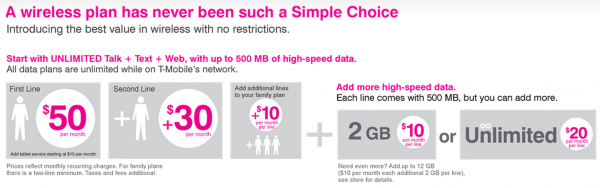
The pricing works like this: The first phone is $50 a month for unlimited text, talk and web. The first 500MB data is high-speed, and throttled thereafter. The second line is $30 and $10 for each after, up to five total. Upgrade to 2GB of data is another $10 per line a month and unlimited for 20 bucks.
My wife and I both have the Nexus 4 and mom Galaxy Nexus, which T-Mobile’s network better supports than AT&T. Costs for three phones, unlimited text, talk and web is $90 — $50 + $30 + $10. Mom doesn’t need more than 500MB per month. My wife wouldn’t likely ever exceed 2GB, and I opted for unlimited. That’s $10 + $20 for the initial data, which gets to the $120. Rather than the typical $35 activation fee, T-Mobile charged $10 per line.
When iPhone 5 is available next month, I’ll spend $199.98 ($99.99) for the handsets (one for my 91 year-old father-in-law and the other my college-age daughter). Financing will add $40 ($20 x 2) per month plus $10 service each per line and another $10 so my daughter has 2GB monthly data. Total then before tax and fees: $190. No activation fees and lower upfront cost for iPhone 5 (half other carriers) is icing on the cake.
Mobile Share
In fairness to AT&T, I tried several different plan changes to reduce my fees but couldn’t get anywhere close to T-Mobile and meet the family’s text, talk and data needs. The AT&T 550 family plan starts at $59.99 per month, with each additional line $9.99 but only up to three. I need five. The 700-minute plan is $69.99 per month and $9.99 per additional line. For five that works out to $109.95 before adding data. For 300MB data for two smartphones, monthly cost is $40 more ($20 x 2) and 3GB data $90 ($30 x 3). That’s $239.95 before tax and fees, without unlimited text message, which we would need.
AT&T’s Mobile Share 4GB plan starts at $70 per month and each smartphone is an additional $40. That’s where the rep got $270 — $70 + $200 ($40 x 5). AT&T tiers pricing that makes buying more data more attractive. The 10GB plan also is $270 — $120 base fee and $30 per phone ($150 for five).
No matter how I slice the numbers, AT&T costs considerably more per month. For my family. Your mileage may vary. If I bought five phones, my T-Mobile bill would be higher.
Some of my AT&T lines are still under contract and subject to early-termination fees, which are discounted based on the amount of time left on the 24 months. By selling the iPhones my daughter and father-in-law will surrender and comparing my current monthly fees versus the reduced ones, I should be ahead after two months, despite ETFs. Possibly three. AT&T prorating and paying a month ahead makes exact calculations tricky.
When the iPhones are paid off, assuming we don’t change any phones meanwhile (whom am I kidding), the bill would go down $40 per month, or to just $150.
Photo Credit: koya979/Shutterstock
-
PC apocalypse: Emerging market buyers move from smartphones to tablets
 IDC continues to send smoke signals that a blistering fire rages across the planet, sure to scorch the earth where PC manufacturers hoped to plant new computer sales. Emerging markets are engulfed in a blaze of smartphone and tablet adoption that leaves little hope for a desktop or notebook revival. I simply cannot overstate the speed this thing moves.
Eight days ago, the analyst firm revised downward PC shipment forecast for 2013, singling out changing buying patterns among emerging markets. Today IDC reaffirmed the forecast, while releasing final full-year 2012 PC, smartphone and tablet shipments. The data is grim pickings.
There is a long-standing trend of what I call technology skip, where emerging markets jump over something established for something new. For connected devices that means smartphones being adopted first before PCs. But still personal computers, eventually. Uh-oh. The trend is now something else.
“In emerging markets, consumer spending typically starts with mobile phones and, in many cases, moves to tablets before PCs”, Megha Saini, IDC research analyst, says. “The pressure on the PC market is significantly increasing and we can see longer replacement cycles coming into effect very soon and that, too, will put downward pressure on PC sales”.
So in mature markets, buyers hold on to PCs longer, often buying tablets meanwhile. Elsewhere, tablets replace PCs as the step up from smartphones. Best case scenario, computer purchase is delayed but more likely, worst case, will never come to be. Turns out, 2012 was a record-breaking year for tablet shipment growth everywhere, but nowhere like emerging markets.
IDC now counts together PCs, smartphones and tablets as “smart connected devices”, of which there were 1 billion shipped in 2012, generating $576.9 billion revenue. Tablets, which units grew by 78.4 percent year over year, largely accounted for the market’s expansion. Shipments surged by 111.3 percent in emerging markets and 62.8 percent in mature ones, outpacing other categories.
Laptops fell by 8.1 percent and 0.8 percent, respectively, in mature and emerging markets, while desktop PCs declined by 4.8 percent and 3.8 percent. Meanwhile smartphones soar, with shipments up 20.6 percent in established regions and by 69.7 percent in emerging markets.
Looking at 2013, growth cools for the more-portable devices, but still greatly exceeds PCs. The analyst firm expects smartphone and tablet shipments to grow by 35.1 percent and 60.7 percent, respectively, in emerging markets, while desktops fall 3.5 percent but laptops rebound to 4.1 percent.
IDC predicts that tablet shipments will surpass desktops this year, and notebooks in 2014. The forecast contradicts another by NPD DisplaySearch, which contends tablets will out-ship laptops this year.
Many analysts had expected emerging markets to be fertile ground for PCs following Windows 8’s launch. But converging events, some economic, others technological, make tablets good-enough alternative — and more familiar.
The importance of familiarity cannot be understated. Tablets running Android or iOS, for example, are easy transitions from smartphones — versus PCs where buyers must learn something new. Meanwhile, consumers carry forward their time and monetary investment in apps rather than having to buy and learn new ones.
The PC is by no means dead, but the tablet trend accelerates across the globe now.
Photo Credit: Milkovasa/Shutterstock
-
The Pint-Sized ‘Fuel’ Phone Charger Is As Useful As It Is Adorable

Most of us have faced that sense of dread that comes when our phones lay drained and dysfunctional right when we need them the most. Sure, we could beat ourselves up for not charging them as long as we should have (or perhaps making a bad choice of phones), but that’s where this particularly cute Kickstarter project comes into play. Devotec’s Fuel micro charger is a terribly tiny rechargeable external battery for when a smartphone’s charge goes south at an inopportune moment.
How small is it? Think “clip it to your keychain small.” And it’s shaped like a little gas can! How quaint.
As you could probably guess from its size, there’s only so much juice you’ll be able to squeeze out of this thing. The Fuel’s internal battery is only capable of holding about 500mAh worth of charge, which Devotec figures will give your smartphone up to a half hour of extra talk time — more than enough to fire off a few frenzied emails or to make a brief emergency call or two. I’ve come to appreciate bulkier fare like Mophie’s PowerStation Duo, but folks looking for a pint-sized lifesaver that won’t weigh down their bags will find something to like here.
For this first production run, Devotec is focusing mostly on churning out Fuel chargers with microUSB connectors, but the team is also plugging away on Lightning versions for the iPhone 5s in your life. There’s still no ETA on when to expect them though, so iPhone 5 owners may want to look elsewhere for now — after all, the first-party microUSB-to-Lightning adapter costs nearly as much as the Fuel itself.
Devotec’s Kickstarter campaign launched less than a week ago and the team has already blown past its $20,000 funding goal, but you can still lock in your order for a microUSB model for around $18 at this point. The final retail version will cost $25, so the cheapskates among you may want to jump on this now (like I just did).
-
Google PageRank-Inspired Cancer Research Published
Google’s PageRank algorithm is the inspiration for a new lung cancer study published in the journal Cancer Research.
Researchers fron the University of Southern California (USC), Scripps Clinic, The Scripps Research Institute, University of California, San Diego Moores Cancer Center and Memorial Sloan-Kettering in New York used an algorithm described as “similar to the Google PageRank and to the Viterbi Algorithm for digital communication” to gain insnights about spread patterns of lung cancer.
“This research demonstrates how similar the Internet is to a living organism,” said USC Viterbi School of Engineering Professor Paul Newton, Ph.D., the lead and corresponding author of the study. “The same types of tools that help us understand the spread of information through the web can help us understand the spread of cancer through the human body.”
In fact, this isn’t the first time we’ve seen PageRank used to study other areas of science or even cancer. A Washington State University chemistry professor claimed to have adapted the PageRank algorithm to help determine molecular shapes and chemical reactions. Then, a study came out last year looking at improving outcome prediction for cancer patients by network-based ranking of marker genes, using the PageRank concept.
We first reported on this new study in December, but now the results are out.
The team learned that metastatic lung cancer doesn’t progress in a single direction from the primary tumor site to distant locations, according to a news release on the findings. They also say they learned that the first site to which the cells spread plays a key role in the progression of the disease, with the study showing that some parts of the body serve as “sponges” that are unlikely to further spread the cancer cells to other areas of the body. The study did identify other areas as spreaders for lung cancer cells, with the main spreaders being the adrenal gland and kidney, and the main sponges being the regional lymph nodes, liver and bone.
More on the study here.
-
Google Maps Project Maps Amazon Funds
Google has been working with Brazilian nonprofit organization, Amazonas Sustainable Foundation (FAS), and the two have now announced the Bolsa Floresta Platform, an online tool that lets you explore social, environmental and economical datasets for areas in the Amazon.
“One FAS’s most significative initiatives is the administration of the Bolsa Floresta — Brazil’s first internationally-certified incentive program for the preservation of traditional communities and environment in the Amazon rainforest,” says Gabriel Ribenboim in a guest post on the Google Maps blog. “As the largest payment for environmental services program in the world, Bolsa Floresta serves over 35,000 people, 15 state-protected reserve territories and covers an area of more than 10 million hectares.”

“Institutional transparency is a challenge for NGOs across the world,” says Ribenboim. “Tools that help track the impact of our efforts and present them in an accessible way are rare and normally require a significant investment. The Bolsa Floresta platform, built on Google technologies such as Google Maps Engine, Google Drive, YouTube and Street View helped us organize this kind of dataset in a way that is easy to visualize, understand and share with little in the way of programming complexity or investment.”
You can check out the map here, and toggle on and off layers for economics, social development, and cash payment for environmental services. Community organization is coming soon.
-
Introducing new solar gear that could change the game
Inverters are the silent workhorses that convert power from devices like solar panels and batteries into usable power. There’s been considerable innovation around solar panel inverters in recent years, as some solar roofs have started moving from a single large central inverter to smaller “microinverters” embedded on each panel. But now year-and-a-half-old chip startup Empower Micro Systems has been pushing that solar inverter innovation even farther and has developed a new low voltage solar microinverter based on its new chip designs that it said
costs less and is more reliable andefficient than the current ones on the market.Empower Micro Systems CEO Jon Bonnano told me that the company’s inverter tech “is a quantum change in how solar is done.” It can be attached to a solar panel system, on the rack or the frame, or embedded at the individual solar module level. Bonnano says the inverter is five times more reliable, five percent more efficient and costs 20 percent less than traditional “string” inverters, which have been used for decades. The potential of a lower inverter cost, is that the entire cost of the solar system could be lower, in addition to the recent dramatic drop in solar module prices.
Empower Micro Systems doesn’t plan to manufacture the inverter box itself. The company is a fabless chip firm and it sells its integrated circuits and architecture design to manufacturers like inverter makers and solar module producers. In that respect it’s adopting Intel’s mode,
churning out the chips inside the inverter devices.Bonnano is pretty confident of the disruptive power of the inverter tech, called the “Universal Micro Power Inverter.” He thinks it can “replace all solar inversion options, hands down.” The key technologies of the inverter are how the system on a chip synchronizes and controls the power flow at a low voltage, as well as the design of the inverter box itself.

Enphase Energy’s tech
Microinverters use energy storage tech to temporarily store the DC power from the solar panel and decouple it from the AC grid power. The Empower Micro System’s inverter uses a next-gen solid state capacitor for this energy storage tech, while other systems more commonly use more traditional liquid-filled electrolytic capacitors.
The next steps for any startup are bringing this hardware to market. Bonnano says the company has already signed one agreement with a “top-three” module maker, and is in discussions with many more module makers and power supply vendors. Just this Sunday, Bonnano said the company’s field trials went live with solar installers. This year the inverter will be certified and could be produced in pilot production by the third quarter of 2013.
The technology has attracted a list of angel investors including Jurgen Krenkhe, recent President & General Manager of SMA Americas, Ken Lawler, General Partner at Battery Ventures and Silicon Ventures, Kiki Tidwell, Kauffman Fellow and cleantech investor, and Eugene Zhang, Managing Director at Tsinghua University Executive Entrepreneur Club. Chinese module manufacturers will be key for the company’s market strategy. Empower Micro Systems is currently in the process of raising a $5.5 million series A round.
There’s a lot of competition in the solar inverter space. Not only are there the new microinverters companies like Enphase Energy, and power optimizer tech from the likes of Solar Edge and Tigo Energy, but also the traditional inverter giants like SMA dominate the market. The company will need to launch and scale to prove a competitive edge.
But Empower Micro Systems plans are actually even more audacious than just replacing solar inverters. The technology can be applied to energy storage and electric vehicles, and Bonnano says one day down the road they hope to move into those markets, too.

Related research and analysis from GigaOM Pro:
Subscriber content. Sign up for a free trial.- After Solyndra: analyzing the solar industry
- The opportunities for the Internet and clean power
- Green IT Overview, Q2 2010


-
Google’s Cutts Talks About Blocking JavaScript
For the second day in a row, Matt Cutts answers a question from a fellow Googler in a Webmaster Help video. This one comes from Webmaster Trends analyst John Mueller:
“Googlebot keeps crawling my JavaScript and thinking that text in my scripts refers to URLs. Can I just disallow crawling of my JavaScript files to fix that.”
Long story short, he wouldn’t advise it. If there’s one individual JavaScript file that’s the source of the problem, you could disallow that, he says.
Also, don’t block CSS.
He says, “It turns out, as we’re executing JavaScript, we do look at the attributes, so you can actually use JavaScript, and put like a nofollow attribute on individual URLs, and so it is the sort of thing where you can do link level granularity there. And you can block, for example, and individual JavaScript file, but in general, I would not recommend blocking all of your JavaScript files.”
Cutts has talked about blocking Google from crawling JavaScript, and how it can hurt your rankings, in the past. Watch that video here.