Author: Serkadis

  • Spell Check Improvements Come To Chrome Stable

    A month ago, Google announced Chrome 26 Beta with improved spell check capabilities as it refreshed the dictionaries the browser’s default spell check uses, and started supporting proper nouns. It also started supporting Korean, Tamil and Albanian.

    Spell Check

    Google announced the improvements to the stable release today.

    “In addition, users who add custom words to the dictionary can now sync their settings to bring those changes to all the devices where they use Chrome,” says Google software engineer Rachel Petterson.

    The ‘Ask Google for suggestions’ spell checking feature, powered by the same technologies used by Google search, now supports grammar checking, proper nouns, homonyms, and context-sensitive spell checking in English,” she adds.

    Windows, Linux and Chrome OS users will get the enhancements in the coming weeks, as Google continues to work on Mac support.

  • Samsung Galaxy S 4 hits T-Mobile around May 1 for $99 plus monthly payments

    Although Apple’s iPhone 5 was a spotlight hero at T-Mobile’s “UnCarrier” press event on Tuesday, a rival phone was also announced. On May 1, T-Mobile will begin selling the Samsung Galaxy S 4, which will support the carrier’s brand new LTE network, falling back to HSPA+ 42 speeds when required. With other carriers widely expected to debut their Galaxy S 4 for at least $199 with contract, might T-Mobile’s contract-free approach along with a $99 up-front payment be more appealing?

    Indeed, T-Mobile is using a similar pricing model for the iPhone 5: Customers pay $99 for the handset and tack on $20 per month to their bill to pay off the handset over 24 months. Even if the T-Mobile consumers opt for the most expensive Simple Choice plan — $70 for unlimited talk, text and mobile web — the interest-free hardware payment plan keeps the bill to a manageable $90 or so per month.

    I suspect customers in the first seven official T-Mobile LTE service areas will initially be more apt to choose the T-Mobile version of the Galaxy S 4 or iPhone 5 going forward. But the company plans to have 200 million covered by LTE by year-end, so an aggressive LTE rollout schedule could increase potential customers for either of these phones.

    And depending on the amount of the monthly payment — I anticipate it to be $20, just like for the iPhone 5 — T-Mobile’s Galaxy S 4 could cost less than the same phone model from its peers, pending their official pricing, of course. In the case of the iPhone 5, that price is $579, which is $70 cheaper than buying a full-priced iPhone 5 from another carrier.

    Related research and analysis from GigaOM Pro:
    Subscriber content. Sign up for a free trial.

  • Bonanza Just Registered Its Millionth User

    Online marketplace Bonanza announced today that it celebrated its one millionth registered user this week. To celebrate, sellers organized a give-away contest to promote their stores, with over a hudred sellers offering gifts for the one millionth member.

    The company, formerly Bonanzle, says it has seen steady growth in membership, traffic and revenue since launching in 2008. It attributes this mainly to its fee structure.

    “We’re happy to let Amazon and eBay argue over whose pricing scheme is ‘best for sellers,’” said CEO Bill Harding. “Meanwhile, our fees average 70% lower than theirs. We aim to make selling online simple enough for my grandma to do it, and yes,
    that ‘one million’ number includes Grandma Harding.”

    eBay announced last week that it is launching free listings for all sellers.

    In 2010, Bonanzle acquired artisan merchandise site 1000 Markets and changed its name to Bonanza. The combined company would take aim more at Etsy than eBay, specializing in “unique and non-mass-produced items”.

    Etsy had 1,025,124 new members join in February alone. The site saw 1.49 billion page views during the month.

  • Microsoft BUILD 2013: ‘If you’re going to San Francisco…’

    Suddenly San Francisco is the hot developer ticket of the year. Say, can I just rent a room in your house for May and June? Today, Microsoft announced that BUILD 2013 will take place from June 26-28 at the Moscone Center in the city on the bay. Google will be there, same city and venue, with I/O from May 15-17. Apple usually holds its developer conference there in early June but hasn’t announced. Big Three trio would be a helluva travel schedule for anyone flying in from anywhere else, particularly outside North America. Choose your event(s) wisely.

    I just have to ask: Did Microsoft bump Google? Last year, I/O moved from its more typical May schedule to late June — 27th-29th. Did Steve Ballmer and Company book early and lock in the dates? I don’t really care, and it’s not news, but speculation is delicious given the rivalry between these two companies.

    As for BUILD 2013, there is little doubt now that Windows Blue is coming really soon. The question is this year or next? Microsoft generally aligns its developer conference with new platform releases, and we all know about the weekend’s Blue leak. The OS is out of the bag, all over the Internet and presumably humming on millions of PCs. My colleagues Alan Buckingham, Mihaita Bamburic and Wayne Williams all are true Blue.

    End-of-June BUILD doesn’t bode well for Windows Blue this year, but Microsoft is picking up the pace with regards to updates. So throw out any past measure. We all could still be BUILD and Blue in 2013.

    Steve Guggenheimer, Microsoft chief platform evangelist, offers some context: “We saw more than 100 million downloads from the Windows Store in the first two months after GA, we crossed the 1 billion downloads mark in the Windows Phone Store, we saw a doubling of Windows Azure compute usage in just the last six months and much more”.

    Registration opens April 2 at Noon EDT. The first 500 people pay $1,595 and everyone else $2,095. Microsoft could really show up Google by handling the load. I/O registration crapped out for the majority of people trying to register 13 days ago.

    By the way, Google charges less ($900 for developers, $300 students) and gives away more (media streaming device, smartphone and tablet last year). Microsoft doesn’t generally share developer swag with news media attendees, unlike Google. Following BUILD 2011, I really wanted to test Windows 8 Developer Preview, which Microsoft only provided on Samsung tablets. I’m not asking for handouts, just opportunity to use the stuff before writing about it. I strongly suspect Blue will be available to download, which, if so, makes the whole issue moot.

    BUILD is much bigger than Windows, which Microsoft teases on the site home page: Azure, Internet Explorer, Office 365, Visual Studio, Windows Phone, Windows Server and Xbox. New game console arrives this year (or so we all believe), and there Microsoft looks to increase development synergy with PC, smartphone and tablet operating systems. But Windows Blue and Windows Phone 9 (hey, even 8.5) will be top of many peoples’ minds.

    What I’m thinking about: Apple, Google and Microsoft possibly all converging on the same venue within weeks of each other. The old Mamas and the Papas lyric “If you’re going to San Francisco, be sure to wear some flowers in your hair” needs some kind of gadgety update for this generation. Wear smartphone on your belt? Carry laptop in your sack? Bring Surface Pro in your bag? Or Chromebook Pixel? Or MacBook Air?

    I wasn’t serious about that room rental, but do offer someone coming from out of town.

  • Google Analytics Gets New Social Reports

    Google announced today that it has redesigned Google Analytics social reports, adding two new ones for Data Hub Activity and Trackbacks. Activity in social reports comes from Google’s Social Data Hub partners.

    “The activity stream was previously available via drill down from the Network Referrals or Landing Pages reports,” says Google Analytics product manager Linus Chou. “We have now made it a standalone report. By navigating to the Data Hub Activity report you’ll see a timeline of the number of activities that have occurred in the Social Data Hub and the raw activities in a list below. You can also filter this list by any specific networks you choose.”

    “We’re also excited to announce that Trackbacks are now available in a standalone report,” adds Chou. “Trackbacks are all of your inbound links across the web, so you’ll be informed if anyone from a small to blog to the New York Times posts a link to your site. Additionally, we are providing context for the significance of each of these trackbacks by displaying the number of visits that were driven by each endorsing URL during the reporting period. You’ll see this number presented alongside the trackback.”

    Social Reports

    Social Data Hub partners include: Allvoices, Badoo, Blogger, Delicious, Digg, Diigo, Disqus, Echo, Gigya, Google+, Google Groups, Hatena, Livefyre, Meetup, Read it Later, Reddit, Screen Rant, SodaHead, TypePad, VKontakte, and Yaplog.

    More on Social Data Hub here.

  • How researchers are fighting lung cancer using PageRank

    Google’s PageRank algorithm has forever changed the way we access information by putting the best stuff first, and now researchers are using the same mathematical models that Google uses to fight the spread of lung cancer within the human body. While there’s no “best” when it comes cancer cells, the aim is to identify tumors more likely to metastasize and then hit them with targeted treatment before the cells have a chance to spread.

    The researchers — who come from the University of Southern California, Scripps Clinic, the Scripps Research Institute, the University of California, San Diego Moores Cancer Center and Memorial Sloan-Kettering — combined autopsy data from 163 cancer cases (all from before the advent of radiation therapy in order to analyze the natural spread) with applied mathematics in order to carry out their study. What they found, according to a press release about the research is that

    metastatic lung cancer does not progress in a single direction from primary tumor site to distant locations, which has been the traditional medical view. Instead … cancer cell movement around the body likely occurs in more than one direction at a time.

    How cancer cells spread. Source: PLOS One

    How cancer cells spread. Source: PLOS One

    Moreover, they found certain organs tend to spread cancer cells more aggressively, while others tend to act as sponges for cancer cells. These sponge organs might still grow tumors, they just don’t disperse the cells.

    The PageRank analogy

    The mathematics involved here — called Markov chain models — are similar to what Google uses to determine what web pages are the highest-quality for any given search query. Only whereas Google uses the number and quality of links to determine the probability of a web surfer landing on any given page, these researchers are trying to predict the PageRank of tumors, if you will. So, generally speaking, a kidney would likely have a higher PageRank than a liver because the kidney is more likely to spread cancer cells throughout the body (or, in web-search terms, generate a lot of links to itself).

    The network path of cancer cells from lung to liver. Source: PLOS One

    The network path of cancer cells from lung to liver. Source: PLOS One

    As data volumes proliferate and relationships between data points become more complex, Markov models are actually becoming pretty popular. Netflix uses them in order to predict the movies users will want to watch next.

    The weighted connections between various states or web pages or whatever someone is ranking are often expressed as the nodes and edges of a graph. Graphs, of course, have become part of the everyday web lexicon thanks to the various social graphs and interest graphs that analyze who we’re connected to (and how) and the types of topics we browse online.

    The web as a data science proving ground

    So in the end, perhaps, the most-important contribution of the worldwide web won’t be the revolution in terms of how we access information, but the web’s function as a proving ground for advanced statistical methods starring very large and complex data sets like those found in the medical world. Already, for example, another group of medical researchers has used a Markov variant in order to create a model they think can prescribe better treatment plans because it analyzes the costs and patient outcomes usually associated with a given treatment for a given symptom.

    Tracking a cholera outbreak across a river network. Source: Physical Review Letters

    Tracking a cholera outbreak across a river network. Source: Physical Review Letters

    Last year, a group of Swiss researchers developed an algorithm that, having access to a relatively small amount of data, can track anything from Twitter rumors to disease outbreaks back to their source. A company called Syapse uses the graph structure to chart the relationships among words across different medical specialties.

    One would also be remiss in ignoring the computing and data-storage innovation spurred by the web that has improved our ability to handle massive amounts of genetic and other data. As the lung cancer researchers explain in their paper:

    One of the strengths of such a statistical approach is that we need not offer specific biomechanical, genetic, or biochemical reasons for the spread from one site to another, those reasons presumably will become available through more research on the interactions between CTCs and their microenvironment. We [have created] a quantitative and computational framework for the seed-and-soil hypothesis as an ensemble based first step, [that] then can be further refined primarily by using larger, better, and more targeted databases such as ones that focus on specific genotypes or phenotypes, or by more refined modeling of the correlations between the trapping of a CTC at a specific site, and the probability of secondary tumor growth at that location.

    The long story short is that the more data we have and the easier we can analyze and map it, the better we can treat — and perhaps even cure — cancer and other complicated diseases.

    Feature image is a network map of how lung cancer spreads between organs, where each numbered node correlates with a specific organ.

    Related research and analysis from GigaOM Pro:
    Subscriber content. Sign up for a free trial.

  • $5 ‘Just Looking’ Fee At Store Draws Sarcasm From reddit

    Celiac Supplies, a Brisbane area-based gluten free shop, has become a viral phenomenon, but not in a good way. As previously reported, reddit user BarrettFox posted an image of a sign the store posted on its front door, and it quickly became the subject of a great deal of mockery on and off the social news site.

    The sign (as seen above) reads:

    Dear Customers,

    As of the first of February, this store will be charging people a $5 fee per person for “just looking.”

    The $5 fee will be deducted when goods are purchased.

    Why has this come about?

    There has been high volume of people who use this store as a reference and then purchase goods elsewhere. These people are unaware our prices are almost the same as the other stores plus we have products simply not available anywhere else.

    This policy is in line with many other clothing, shoe and electronic stores who are also facing the same issue.

    BarrettFox’s image came under the title, “When they open tomorrow I’m going to see how many times I can walk in and out without paying the toll.”

    Comments from redditors include:

    “This store seems desperate to go out of business.”

    “The thing that confuses me is: How is this allowable? Someone walks in, looks around, decides not to buy anything and starts to leave. They berate them until they pay? What if they hadn’t noticed the $5 fee sign and don’t have any money on them? If it was me, I’d say “Screw you.” and not give them a dime, walk out and refuse them any future business. They are asking to go out of business.”

    “I don’t have my glasses. Does it say ‘Going Out of Business Sale’?”

    “”Introducing the new loyalty program! Every $100 you spend you get 20% off your next purchase” Fixed that. I’m a small retailer, I have to compete with the internet, but many of my customers come to me because I make my store a positive and enjoyable experience. Most of them don’t even want a discount.”

    At least one person sees where the store is coming from, commenting:

    “Eh, I’ve been to a store before and then gone to Amazon to see their price. Amazon had a higher price but it was only by a buck or two, certainly more even after tax was applied. But I was already home, and it’d be delivered to my door, so I just ordered through Amazon.
    Now I have a smartphone and just check the price in the store. Also, now Amazon charges tax.”

    The store’s owner assumes people are leaving without buying anything and going to buy products at a supermarket chain or online. Perhaps one alternative for the store would be to sell products online (they have a site, just apparently not one that sells products), and advertise that site on a sign on the door.

    By the way, this story comes from reddit’s WTF section.

  • Study shows adult Minnesotans have increased their use of smartphones for Internet access

    Some interesting stats from Connect Minnesota…

    ST. Paul, MN – New data from Connect Minnesota shows that approximately 2.1 million (51%) adults in the state use the Internet on their cell phones or subscribe to mobile wireless service for a laptop or tablet computer. The previous year’s survey showed that 39%, or 1.6 million adults in the state, used mobile Internet service; a 12 percentage point increase.

    In 2011 and 2012, Connect Minnesota conducted residential technology assessments in Minnesota to measure the growth of mobile Internet. The study shows that the reasons Minnesotans do (or do not) choose to access mobile Internet on their cell phones are multi-faceted. In addition we explored questions that have been raised nationally, such as the impact of data caps on mobile broadband adoption and usage.

    This survey was conducted in support of Connect Minnesota’s efforts to close Minnesota’s digital gap and explores the barriers to adoption, rates of broadband adoption among various demographics, and the types of activities broadband subscribers conduct online, among other findings.

    The data are available via an interactive widget on the Connect Minnesota website.

    “Connect Minnesota’s research shows that mobile broadband plays an ever-increasing role in how Minnesotans get online,” said Connect Minnesota State Program Manager Bill Hoffman. “As we look ahead, I think mobile broadband will continue to be an integral part of Minnesota’s broadband landscape.”

    Among the key findings of the residential survey are:

    • Among Minnesotans who use mobile Internet and subscribe to home broadband service, 13% say they use their home broadband service less frequently now that they have mobile Internet.
    • Minnesotans who use mobile Internet but do not subscribe to traditional home broadband service are younger, have a lower median household income, and are more likely to reside in rural areas of the state than Minnesotans with home broadband subscriptions.
    • Approximately 557,000 cell phone owners cite wanting to access the Internet while away from home as their main reason for using mobile Internet service.
    • Among Minnesota adults who subscribe to mobile Internet service, 37% say that their plan comes with “data caps,” or restrictions on how much data they can use.
    • Nearly one in three Minnesota adults who have mobile Internet plans with data caps say they had gone over their limit in the previous year. Geographically, 27% of suburban Minnesotans with an Internet cell phone plan have gone over their monthly data limit at least once in the past year. That’s a lower percentage than urban or rural residents.
    • Of the 1.4 million Minnesotans not subscribing to Internet on their cellphones, 27% say that the main reason they do not use mobile Internet service is because they do not want or need it.

    Connect Minnesota’s 2012 Residential Technology Assessment was conducted in late 2012 and includes responses from 1,201 residents. The survey was conducted as part of the State Broadband Initiative (SBI) grant program, funded by the U.S. Department of Commerce, National Telecommunications and Information Administration, and by the American Recovery and Reinvestment Act of 2009.

    For a quick comparison, I’ll remind folks of the Pew report on teens and technology I mentioned recently, they reported…

    • 78% of teens now have a cell phone, and almost half (47%) of those own smartphones. That translates into 37% of all teens who have smartphones, up from just 23% in 2011.

  • T-Mobile Lets You Put $99 Down On iPhone 5

    Not only did T-Mobile announce the availability of the iPhone 5 today, but it announced that consumers can put $99 down on the device, with monthly payments to make up the difference ($20 per month for 24 months). And that’s with no annual service contract plus unlimited talk, text and Web and 4G.

    The device will be available from Friday, April 12.

    In addition, T-Mobile is offering the iPhone 4S for $69.99 down and $20 per month for 24 months and the iPhone 4 for $14.99 down and $15 per month for 24 months.

    While the 4S and 4 will be available in select markets, the iPhone 5 will be available nationwide.

    “This is an important day for people who love their iPhone but can’t stand the pain other carriers put them through to own one,” said John Legere, president and CEO of T-Mobile USA. “We feel their pain. I’ve felt the pain. So we’re rewriting the rules of wireless to provide a radically simple, affordable iPhone 5 experience — on an extremely powerful network.”

    T-Mobile also announced today a new simplified rate plan, and eliminated the need for customers to enter into contracts.

  • T-Mobile USA gets iPhone!

    America’s fourth-largest carrier finally goes Apple, and you’ve got to wonder what that means for all the Androids on shelf. T-Mobile USA broke the long-anticipated news this morning, a day after announcing new, unlimited rate plans that ditch subsidies. iPhone comes with 4G LTE roll out in select cities and expanded HSPA+ coverage to the 1900MHz band. Subsidy-free plans, network expansion, iPhone availability and MetroPCS merger are all part of a bold “bet the company” strategy.

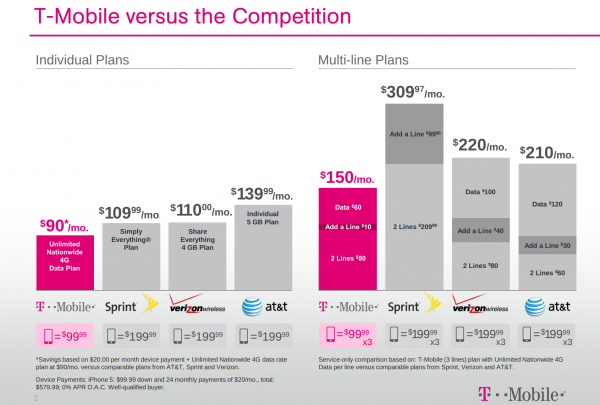
    T-Mobile will start selling iPhone 5 on April 12, for the lowest upfront-price among major carriers: $99.99. The rest is paid off in monthly payments and for full price of the handset and no contract. Rivals charge $199.99 up front with 24-month contractual commitment and hefty subsidy should customers change carriers before the term expires.

    iPhone 5 for Less

    “This is an important day for people who love their iPhone but can’t stand the pain other carriers put them through to own one”, John Legere, T-Mobile CEO, says. “We feel their pain. I’ve felt the pain. So we’re rewriting the rules of wireless to provide a radically simple, affordable iPhone 5 experience — on an extremely powerful network”.

    Ross Rubin, Reticle Research analyst, says the price “seems too good to be true”. That’s T-Mobile’s big carrot, perhaps more than the new data plans. Customers walk out the door spending upfront for iPhone 5 what competitors sell the 4S for. One C-note.

    To support iPhone and other smartphones, T-Mobile is expanding its 4G network beyond HSPA+. LTE launch cities are: Baltimore, District of Columbia, Houston, Las Vegas, Kansas City, Phoenix and San Jose. (Damnit, not San Diego). The carrier promises nationwide coverage by end of year. HSPA+ supporting iPhone 5 is available in 229 metro areas, according to T-Mobile.

    iPhone is U.S. market share leader, according to Strategy Analytics. While Android rules the world, iPhone rules the roost. T-Mobile has good reasons for coveting the iconic handset, which could unlock lots of customer upgrades while stemming some customer losses to competing carriers. That certainly was the case for Verizon, but less so Sprint. During fourth quarter, AT&T sold 10.2 million smartphones and activated 8.6 million iPhones. Surely T-Mobile would love even a small percentage of such sales success.

    Un-carrier Plans

    The above chart is T-Mobile’s comparison of its no-contract plans to options available from competitors. Does this jive with your real-world experience?

    Supporting Simple Choice plans offering unlimited text, talk and data and no contractual commitment, T-Mobile assumes label “The Un-carrier”, by placing emphasis on choice and freeing customers from forced lock-in. The new rate plans are a huge risk that, if successful, could fundamentally change how Americans buy cell phones — particularly if any of the Big Three offer something similar.

    Typically, carriers pay Apple huge amounts up front — say $649 for 16GB iPhone 5 — and sell the mobiles subsidized for much less, while locking customers into two-year contracts. Under T-Mobile’s new plan, there are no subsidies, but customers pay full price, either upfront or by monthly payments over X number of months, usually 24. There also is option for people to bring their own phones. I haven’t done a first-plush comparison but looks like the savings are more for people buying cheaper handsets with little data. For costlier smartphones and data plans, savings are iffy — or so I say after only cursory comparison, without really number crunching.

    During a press event, Legere tried to explain the new Simple Choice plans to dimwits like me. He makes a good case for greater transparency and simplicity about billing and customer costs. I have to agree — then there is the whole subsidy model, which favors Apple and a few other manufacturers reaping big margins by invisibly keeping device prices high. That $199 you pay masks the $649 the carrier dishes out.

    Broken Business Models

    Legere claims that the wireless industry is broken, and he gets no dispute from me — and judging from the live Twitter responses today — nor from many other cell phone users. But complexity and hidden costs cut different ways. T-Mobile’s iPhone 5 pricing looks like less than other carriers, but there is still monthly commitment to pay off the phone. That works out to $20 over 24 months, or about $580 when adding the initial money down.

    Reporter Brian Chen asks my question (via Twitter), too, when looking over the new plans. “Despite T-Mobile’s campaign to be a transparent ‘un-carrier’, I’m confused about the two-year device fees and the restrictions on phones. The phone can’t be unlocked until the two-year device fee is paid off. How is this different?”

    Difference is choice. Still, I’m on AT&T (for now) and the early termination fee decreases month by month during the contract period, so walking away and paying the ETF isn’t so different from leaving T-Mobile and paying off the rest owed on the phone.

    Jason Snell, Macworld editorial director, answers Chen (and indirectly me): “Different because when you’re done paying (after 2 years), your bill actually goes down. And you can BYOP and not pay fee”.

  • T-Mobile launches LTE with a bang, the iPhone 5 and no contracts

    T-Mobile’s transition to the “un-carrier” is complete. The last of the big four U.S. network carriers has an LTE service to call its very own: T-Mobile officially flipped the switch for its LTE network on Tuesday. At a press event in New York City, T-Mobile announced the first 7 cities that support the fast mobile broadband service: Baltimore, Houston, Kansas City, Las Vegas, Phoenix, San Jose, and Washington, D.C. New York City is expected to have LTE service by early summer.

    The carrier says it will deliver LTE speed to 100 million Americans by the middle of this year and 200 million by the end of 2013. LTE devices will include Apple’s iPhone 5 on April 12, plus the Galaxy S 4, BlackBerry Z10, HTC One and, after a recent software upgrade, the Samsung Galaxy Note 2. A new Sonic 2.0 Mobile Hotspot also joins the list of LTE-capable devices.

    Earlier this week, T-Mobile announced Simple Choice plans that don’t have contract terms. Instead, customers will choose from a rate plan including unlimited text, talk and various capacities of high speed mobile broadband service:

    “Customers start with one line at $50 per month for unlimited talk, text and Web with 500MB of high-speed data. Customers can add a second phone line for $30 per month, and each additional line is just $10 per month. They can also add 2 GB of high-speed data for $10 per month more per line. Unlimited 4G data is only $20 more per month per line.”

    The benefit here is that service is unbundled from the phone due to the lack of contract: Instead of sticking consumers with a phone for 24 months or more, phones can be upgraded at any point in time with no change in rates, nor any time commitments.

    Related research and analysis from GigaOM Pro:
    Subscriber content. Sign up for a free trial.

  • Kleiner Perkins backs energy comparison startup Choose Energy

    While venture capital firm Kleiner Perkins appears to be retrenching its cleantech investments, the firm also continues to make small investments in young startups focused on the cleanweb, or IT-based cleantech. On Tuesday a Plano, Texas-based startup called Choose Energy announced that it has raised a $4 million Series A investment from Kleiner Perkins and Stephens Capital Partners.

    Eight-year-old Choose Energy has developed a service that offers consumers and businesses in deregulated markets options for retail electricity and gas plans. The site is active in Texas, New York, Ohio, Pennsylvania and Illinois, and the company says it will eventually work for the 19 deregulated energy states and 22 deregulated gas states.

    While deregulated energy markets have proved to be controversial in some states in the past, as GigaOM Pro analyst Adam Lesser has written, further deregulation could also support business models in areas like smart grid analytics and clean power. It’s been more than a decade since the California electricity crisis and the Enron disaster.

    Choose Energy says it is also building tools for retail energy providers to acquire customers based on techniques from telecom, travel, media and other web-heavy industries. The tools used by the cell phone companies to entice new customers to their network are much more sophisticated than what standard retail energy providers are using today. The startup says it has helped 100,000 consumers switch energy suppliers.

    Related research and analysis from GigaOM Pro:
    Subscriber content. Sign up for a free trial.

  • Why data without a soul is meaningless

    While on my way back from New York, for some odd reason I started playing around with Foursquare and plotting my check-in data using a handful of apps. Very quickly I realized two things: the amount of time I spend in airplanes has doubled every year since 2009, and when I am in San Francisco, I lead a very predictable life and go to only a handful of places — a lot.

    Except for one small thing: While the data shows that I lead a pretty boring life, it doesn’t reflect the “emotions” behind the data. Why, you might ask, is this important? The answer is that as we move towards a quantified society, one shaped by data, we start to dismiss things that aren’t easily quantifiable. Empathy, emotion and storytelling — these are as much a part of the business as they are of life. Without these, we might as well residents of starliner Axiom.

    nansenseThe problem with data is that the way it is used today, it lacks empathy and emotion. Data is used like a blunt instrument, a scythe trying to cut and tailor a cashmere sweater. Some folks do a better job of making data interesting — like the fine folks at Foursquare. They use cutesy phrases to remind me of my coffee addiction and occasionally point out that Jared Kim and I are besties when it comes to eating ramen noodles or visiting Hakkasan, but they don’t really tell the whole story and they need to do more.  I will get to that in a minute.

    The idea of combining data, emotion and empathy as part of a narrative is something every company — old, new, young and mature — has to internalize. If they don’t, they will find themselves on the wrong side of history.

    The Uber-side Story

    Let’s explore this idea further with what is my most used service: San Francisco-based local transportation startup Uber. As someone who doesn’t drive and doesn’t own a car, Uber has been a godsend. And that is why I am hoping that they stay in business — for a long time. Selfish, much? Of course! That is why I am perhaps harder on them than any other startup, poking holes in their strategies, ranting on Twitter and occasionally praising them for their awesomeness.  Time and again, Uber finds itself in the eye of the (public relations) storm, and to me the reasons are pretty obvious.

    If you look at the relatively young history of Uber, you would see that it is a company that has done many things right and a couple of things very wrong. It has figured out how to remove friction between a traveler and transportation by reducing it to mere minutes. In doing so, Uber has also become the first next-generation commerce company to use connectedness to its advantage. It has also figured out how to organize what is a disorganized and poorly managed business: local transportation.

    Uber cars black car town car driver riderUber’s secret weapon is the data it is collecting, but what it has failed to use that data in the most powerful kinds of ways. Data tells the service that there are fewer cars on the road and massive demand, and out comes surge pricing. This makes perfect business sense — except when it is in New York City battered by Hurricane Sandy. Ooops! The company failed to factor in the “emotion” and “humanness” in its data.

    A better approach would have been to give people discounts based on the time they had to wait, and make up the difference to the drivers (or even give them bonuses for working around the clock). Yes, it would have been costly, but it would have cemented the “Uber cares” sentiment.

    The whale theory

    Uber (and I don’t mean to pick on them, because it applies to all companies) should be thinking about using data to create positive experiences. A good way to start is to take a cue from the casinos (or Zynga): make the “whales” happy.

    Shutterstock/Dan Kosmayer

    Shutterstock/Dan Kosmayer

    If someone is a big spender on their service, then they should get to the front of the line and get an Uber car before everyone else. Sure, they can create loyalty discounts, but time saved (and a clean experience) is what’s more important to an Uber customer. (This shoe store in Manhattan knows how to use data to make customers happy, and perhaps others should take a hint from them.)

    Uber should give the whales an experience that puts a higher premium on their time than that of occasional users. Match up these whales with the best cars and the top-ranked drivers so they will keep spending. In other words, use data to shape experiences.

    Some might say that this is yet another example of data darwinism at work – and in one sense it is — but big spenders get big perks from casinos and hotels (and some airlines). Uber wouldn’t be doing anything wrong if it followed suit, as I don’t think of them as an essential service. I am and will remain wary of the idea of data darwinism creeping into essential services.

    Using data to shape experiences has to become the default for all startups, regardless of whether their focus is on consumers or large companies. Almost every day I come across an app that has an astonishingly beautiful interface, only to find it incredibly vapid and unintelligent. A lovely interface comes alive when married to data and the insights and context it brings.

    Coffee and empathy

    What will it take to build emotive-and-empathic data experiences? Less data science and more data art — which, in other words, means that data wranglers have to develop correlations between data much like the human brain finds context. It is actually not about building the fanciest machine, but instead about the ability to ask the human questions. It is not about just being data informed, but being data aware and data intelligent. Sean Gourley, co-founder of Quid, in his keynote speech at Structure: Data, noted:

    Data scientists are presented with a set of parameters to optimize over, yet they don’t take the time to step back and say, should I even be optimizing this at all. Data science, I believe, we need to re-imagine it, because data is incredibly powerful. We need to step back from the scientific notations and start thinking of it as data intelligence. Data intelligence has a slightly different philosophy that embraces some of the messy and unstructured nature of the world that we do live in.

    lovecoffeeLet me explain by using my favorite coffee shop as an example. The raw number of check-ins at the coffee shop tells me that I am boring and predictable. Anyone who doesn’t know me well will draw the same inference. But parse the data in more granular manner and correlate it with other information and you start to see a picture that understands the emotional value of that data.

    Let’s run with this example. The service needs to realize that I visit said coffee shop first thing in the morning (something that can be inferred from the time of the check-in.) It also needs to learn that the coffee shop is a few miles from my home, which tells you that I go out of my way to go there.

    The service also knows that I check-in with a handful of people, whose relationship to me can be inferred from the social graph. Add to the mix the fact that I have left tips and taken photos at that spot. Now, compare it to all other coffee shops I have checked into and how they rank against this one location. Add all of them up, and you end up with a rudimentary conclusion: I don’t go to this coffee shop simply because it’s an interchangeable part of my daily routine, or because it’s on my way to work. I visit it because it is my happy place, my one cup (or dozen) of zen. And a company like Foursquare could use that fact to package even more compelling experiences for me.

    Data needs stories

    The key to getting the context is to think in terms of stories. Sean put it best when he said:

    “Data needs stories, but stories also need data. Data, when its put up in front of you as a number, it gets stripped of the context of where the data came from, the biases inherent in it, and the assumptions of the models that created it.”

    The symbiotic relationship between data and storytelling is going to be one of the more prevalent themes for the next the few years, starting perhaps inside some apps and in the news media. I was reminded of the future filled with data narratives when I saw this visualization – Out of Sight, Out of Mind, by Pitch Interactive. It takes data about drone attacks and makes them visual and easy to understand, and in doing so, elicits a strong reaction.

    But it merely scratches the surface — presenting a slight improvement on an infographic that might have appeared in the pages of a magazine. In a future where we have tablets and phones, packed with sensors, the data-driven narratives could take on an entirely different and emotional hue.

    As for Uber and Foursquare, they should start by thinking, how do we make our customers feel special?

    Related research and analysis from GigaOM Pro:
    Subscriber content. Sign up for a free trial.

  • Online Sales Tax Law Closer To Reality?

    Last week, Senators Mike Enzi and Dick Durbin were accused of trying to “sneak” through legislation similar to the controversial Marketplace Fairness Act as a budget amendment. They succeeded in getting that through the Senate.

    The basic premise of the legislation is that it would enable state governments to collect sales tax from online retailers that don’t reside in their state for purchases from residents in their states. As previously noted, the main difference between the actual Marketplace Fairness Act and what was just passed in the Senate, is that the amendment doesn’t include mandatory simplification, and is non-binding. Still, supporters of the Marketplace Fairness Act are considering it a win.

    Would such a law be good for businesses? For consumers? Share your thoughts.

    CNET’s chief political correspondent Declan McCullagh put it well: “It appears to be intended as a clever political hack: secure plenty of votes on a non-binding Internet tax amendment, then use those vote totals to argue there’s sufficient support for S.336 when it’s up for a binding vote later.” This is a sentiment shared by opponents of the legislation, such as eBay.

    Wired quotes Durbin as saying, “Today’s vote proves that an overwhelming majority of Senators support this bipartisan legislation to level the playing field for brick-and-mortar retailers.”

    It’s important to note that the Senate didn’t just vote on this issue. It was only one of many amendments to the bigger budget proposal, so it’s hard to say how much real support there was for this legislation itself.

    Chris Morran at The Consumerist said on the day the vote took place, “The amendment is one of numerous budget amendments being put before the Senate and passed late Friday afternoon by a vote of 75 to 24. If that number maintains through the voting process on the actual Act, it means that opponents would not have the numbers to force a filibuster. However, it is worth noting that today’s vote does not bind the senators to voting the same way if and when the Act comes up for debate.”

    The Alliance for Main Street Fairness, a coalition supporting the Marketplace Fairness Act, shared some reactions to the vote from small business owners:

    “It’s about time small business owners like me got some good news from Washington,” said Tee Miller, owner of Black Mingo Outfitters in Georgetown, South Carolina. “Now that the Senate has voted in support of the Marketplace Fairness Act, it’s time for Congress to act quickly and pass this much-needed legislation so I can finally compete fairly with online-only retailers who have enjoyed an unfair price advantage for far too long. Thank you, Senator Graham for showing South Carolina retailers and small businesses your support.”

    “I want to applaud Senator Jerry Moran for standing up for Main Street businesses by voting in favor of the Marketplace Fairness Act,” said Wayne DeBey, owner of The Floor Nook in Salina, Kansas. “Today’s vote is a good step toward providing a level playing field for our small businesses and the thousands of retailers across Kansas. It’s important that we promote competition and fairness in the marketplace by closing the online sales tax loophole.”

    “Thank you to all of the Senators who showed their support for e-fairness today – and especially to Senators Sherrod Brown and Rob Portman for siding with Ohio’s small business owners,” said Jayson Waits, owner of Bloomtastic Florists in Columbus, Ohio. “Small businesses are the economic backbone of our communities, and when Congress closes the Internet sales tax loophole these businesses will finally have the chance to compete on a level playing field with online-only retailers. It is crucial that fairness and competition are promoted in the marketplace and Ohio took a big step toward in that direction today.”

    “Today, Senators Warner and Kaine voted with Virginia’s local businesses to close the online sales tax loophole,” said Sarah Pishko, owner of Prince Books in Norfolk, Virginia. “Their vote in support of the Marketplace Fairness Act is the first step to ensure taxes are applied fairly and government isn’t picking winners and losers by making some businesses collect taxes while others get a free pass. I want to thank them on behalf of Virginia business owners for voting to support Main Street.”

    The coalition itself calls the vote a “win” on the Marketplace Fairness Act. Again, this topic was only one of many amendments.

    R Street, a Washington-based think tank, has an open letter to Congress calling for opposition to the Marketplace Fairness Act (via Forbes). It was written earlier this month, before the vote. Here’s a sample from that:

    Despite what some supporters claim, this legislation is bad news for conservative principles and the cause of limited government. It would dismantle proper limits on state tax collection authority while causing serious damage to electronic and interstate commerce.

    S. 336 would countenance an enormous expansion in state tax collection authority by wiping away the “physical presence standard,” a baseline protection that shields taxpayers from harassment by out-of-state collectors. Current law dictates that a state can only require a business to collect its sales tax if it is physically present within its boundaries. Far from a “loophole” intended to advantage the Internet, it is the result of a Supreme Court decision grounded in a bedrock foundational principle of tax policy: states must not be allowed to extend their taxation and regulatory authorities beyond their borders. Dismantling this protection for remote retail sales would create a very slippery slope for states to attempt collection of business or even income taxes from out-of-state entities.

    Furthermore, the bill would create a decidedly “unlevel” playing field between brick-and-mortar and online sales. Brick-and-mortar sales across the country are governed by a simple rule that allows the business to collect sales tax based on its physical location, not that of the item’s buyer. Under the “Marketplace Fairness Act,” that convenient collection standard would be denied for online sales, forcing remote retailers to interrogate their customers about their place of residence, look up the appropriate rules and regulations in thousands of taxing jurisdictions across the country, and then collect and remit sales tax for that distant authority.

    Imposing this unworkable collection standard on remote retail sales but not on brick-and-mortar retail sales would not only be unfair, it would result in enormous complexity while damaging interstate commerce. Online sellers would be weighed down by substantial compliance burdens associated with the existence of over 9,600 separate taxing jurisdictions, each with its own unique definitions, holidays, and rates. The bill’s paltry “small seller exception” of just $1 million (when the Small Business Administration sets the limit as high as $30 million in some cases) in remote sales does little to mitigate the damage.

    In addition to R Street, it has signatures from American Commitment, Americans for Prosperity, Americans for Tax Reform, Campaign for Liberty, Center for Freedom and Prosperity, Center for Individual Freedom, Competitive Enterprise Institute, Digital Liberty, FreedomWorks, The Heartland Institute, Institute for Policy Innovation, Less Government, National Taxpayers Union, Rio Grande Foundation and Taxpayers Protection Alliance.

    If it becomes law, the Marketplace Fairness Act would only allow states to determine whether or not they want online businesses to collect tax. It would not require states to collect sales tax from online businesses. Either way, it’s going to amount to more taxes for online shoppers. Some believe it’s unlikely that it will make it to law given the fierce debate.

    Should this become law? Do you think it will? Let us know what you think in the comments.

  • Reminder: Last Chance To Register For Hardware Alley

    hardware-alley

    I love hardware. That’s why I want you guys to bring some of the coolest hardware projects imaginable to Disrupt NY this year. That’s why I want you guys in our Hardware Alley. And now time is running out.

    Hardware Alley is a one-day celebration of hardware startups both young and old. The goal has always been to show off amazing hardware that we have written about over the past few months, as well as a few surprises. Last Disrupt we featured the guys from Thermovape, Makerbot, and Lit Motors. This year we want to fill Disrupt NY with more amazing companies.

    We will close applications shortly, so hurry hurry. We’re nearly full as it is.

    For more details on Disrupt head over here. We’re looking for new or even unlaunched products, as well as potential Kickstarter projects. Prototypes are fine as long as they’re amazing.

    You can see the previous Hardware Alley participants here. You can sign up here. Bootstrappers can contact me directly at [email protected] if you need a break on price. Hope to see you in the alley… the Hardware Alley.

    Our sponsors help make Disrupt happen. If you are interested in learning more about sponsorship opportunities, please contact our sponsorship team here [email protected].

  • Gears of War: Judgment Review (Xbox 360)

    Roadie run still looks ridiculous, the characters should feel the effects of steroid use, weapons are not so much killing tools as carnival effect dispensers and many elements of the game feel lifted straight out of the space marine mythology.

    But Gears of War remains one of the most important shooter franchises of the current console generatio… (read more)

  • Brocade Reveals Fabric Vision Technology

    Brocade (BRCD) has introduced its Fabric Vision technology, a storage area networking (SAN) hardware and software solution that simplifies SAN deployment and management, and provides improved visibility into the storage network. The solution is a mix of tools and features that enhance the company’s Gen 5 Fibre Channel portfolio.

    “Our customers run their most critical applications and store their most important data on Brocade Fibre Channel infrastructure to support highly virtualized and emerging cloud-optimized data centers,” said Jason Nolet, vice president of the Data Center Networking Group at Brocade. “They depend on Brocade to continue innovating and developing solutions that solve real-world problems today and that can adapt to evolving requirements into the future. Today’s announcement underscores our investment and laser-focus on leading the Fibre Channel industry with innovative technology and solutions built upon standards-based networking and management.”

    Brocade’s Fabric Vision technology is comprised of policy-based tools, management tools, monitoring tools, customizable health and performance dashboard views, and cable and optic diagnostic features. It combines Brocade hardware capabilities, the embedded Brocade Fabric OS operating system, and Brocade Network Advisor management software. It provides administrators with the ability to anticipate and preempt problems before they impact operations, accelerate application deployments and dramatically reduce operational costs.

    Brocade is committed to develop new SAN solutions based on components that conform to the Gen 6 Fibre Channel industry standard, which is expected to be finalized by the end of 2013. It has already initiated research and development for Gen 6 Fibre Channel technology to address the evolving storage networking needs of enterprise data centers. Brocade is also working with the OpenStack Foundation to develop open source software that will simplify management of Fibre Channel fabrics in cloud architectures.

    Brocade 6520 Switch

    Brocade also announced a high-density fixed-configuration SAN switch. The new Brocade 6520 Switch features  96 Fibre Channel ports in a 2U form factor, delivering industry-leading port density and space utilization for data center consolidation projects. The density of the new 6520 means fewer inter-switch links, fewer cables and fewer switches to manage – resulting in more reliable fabrics and lower overall costs. The new Brocade 6520 Switch and new Brocade Network Advisor 12.0 are available now through Brocade OEM partners Fujitsu, HP and NetApp, as well as through Brocade channel partners. These new products will be offered later this year by other OEM partners, including Dell, EMC and HDS.

    “Increasing infrastructure complexity continues to drive requirements for ongoing consolidation and simplification of IT resources,” said Dan Iacono, Research Director, Storage Systems, IDC.  ”Storage Area Network (SAN) management software, such as Brocade Fabric Vision technology, can improve the administrator’s ability to better monitor, manage and operate their storage networks, which can allow more time for the administrator to provide value back to the business.”

    “Transitioning to virtualization or IT-as-a-Service stresses legacy storage architectures and outdated networks, often causing system downtime and limited application performance,” said Tom Joyce, Vice President, Marketing, Strategy and Operations, Storage at HP. ”Modern converged storage designs such as HP 3PAR StoreServ Storage, coupled with high-performance Gen 5 Fibre Channel technologies from Brocade, minimize workflow disruptions by accommodating today’s unpredictable workload demands, enabling organizations to drive innovation while delivering exceptional customer service.”

  • As OpenDNS focuses on security, investors offer a Series B

    OpenDNS, the domain-name-server-provider-turned-security-company, has raised an undisclosed second round of capital as a Series B, and added Stefan Dyckerhoff from Sutter Hill Ventures to its board. The company, which last year expanded from DNS services to providing security optimized for today’s cloud environment, has seen its customer base grow significantly from 3,500 to 7,000 enterprise customers. The funding will help it add staff and data centers to support the Umbrella security offering.

    Domain name servers are an integral part of the internet, containing the IP address of domain names you type into a browser. When a user types in a URL, the computer sends the request to a DNS server that then tells your computer the site’s IP address. When it comes to security, control of DNS servers allows OpenDNS to provide a level of security no matter where the person logging into a network sits, because a company can enforce its policies at the domain name server, essentially refusing employees access to questionable or malicious sites before the content ever gets to the device. It also stops attacks way out in the internet as opposed to on the corporate network.

    For those who want to know more about security threats facing corporations here’s a video interview with OpenDNS CEO David Ulevitch discussing how the adoption of the cloud and geopolitical instability has led to a new level of security threats:

    Related research and analysis from GigaOM Pro:
    Subscriber content. Sign up for a free trial.

  • Research suggests popular diabetes drugs can cause abnormal pancreatic growth in humans

    Individuals who had taken a type of drug commonly used to treat Type 2 diabetes showed abnormalities in the pancreas, including cell proliferation, that may be associated with an increased risk of neuroendocrine tumors, according to a new study by researchers from UCLA and the University of Florida. Their findings were published online March 22 in the journal Diabetes.
     
    The researchers, from the Larry L. Hillblom Islet Research Center at UCLA and the Diabetes Center at the University of Florida, found that cell mass was increased approximately 40 percent in the pancreases of deceased organ donors who had Type 2 diabetes and who had been treated with incretin therapy. This widely used type of treatment takes advantage of the action of a gut hormone known as glucagon-like peptide 1 (GLP-1) to lower blood sugar in the body.
     
    Although there have been conflicting reports on the effects of the incretin class of drugs on the pancreas in animal studies, this is the first study to note such changes in the human pancreas. The research was made possible by a unique research consortium called nPOD (Network for Pancreatic Organ Donors with Diabetes), led by Dr. Mark Atkinson, a professor of pathology and pediatrics at the University of Florida. The network, which is funded by the Juvenile Diabetes Research Foundation, obtains pancreases from deceased organ donors, with permission of their next of kin, to better understand diabetes by investigating tissues of those with the disease.
     
    “There is an increasing appreciation that animal studies do not always predict findings in humans,” said Dr. Peter Butler, director of UCLA’s Hillblom Islet Research Center and chief of the endocrinology, diabetes and hypertension unit. “The nPOD program is therefore a very precious resource.”
     
    The researchers examined the pancreases of 20 deceased organ donors with Type 2 diabetes. Eight had been treated for at least a year with incretin therapy, while the other 12 had received therapies that didn’t include incretin-based drugs. The researchers also evaluated 14 pancreases from a control group of non-diabetic individuals of similar age.
     
    The pancreases of the individuals who had been on incretin therapy were larger than those of patients on other types of diabetes therapies, and this larger size was associated with increased cellular proliferation. Incretin-treated individuals showed an increase in pancreas dysplasia, an abnormal form of cell proliferation that is a risk factor for pancreatic cancer, as well as an expansion of alpha cells, endocrine cells that make the hormone glucagon.
     
    This latter finding is likely a consequence of GLP-1–based therapies’ suppression of the release of glucagon by alpha cells, since decreasing the availability or action of the hormone glucagon has been shown in a variety of prior studies to induce a proliferation of pancreatic alpha cells. This alpha-cell expansion has been associated with the development of pancreatic neuroendocrine tumors. Three of the eight incretin-treated individuals had microadenomas and one has a neuroendocrine tumor composed of alpha cells.
     
    Of the eight donors who were on incretin therapy, seven had been taking sitagliptin, sold in pill form as Januvia and marketed by Merck, and one had been on exenatide, sold as Byetta by Bristol-Myers Squibb. These and similar drugs are currently under investigation by the U.S. Food and Drug Administration for their possible links to pancreatitis and pancreatic cancer.
     
    “These findings lend additional weight to concerns regarding the effects of long term GLP-1–related therapy, with respect to both unintended proliferative actions on the exocrine pancreas and now also a possible increased risk of neuroendocrine tumors,” the researchers write. “In addition to the surveillance previously recommended for the potential association of GLP-1– based therapy and pancreatic cancer risk, the current data imply that surveillance for a possible increased risk of pancreatic neuroendocrine tumors is warranted.”
     
    Such surveillance approaches might include MRI imaging of the pancreas and screening for neuroendocrine tumors, Butler said.
     
    “The present studies are only from a small number of individuals, and while the findings do raise concerns, it will be important that other approaches are now used in a larger group of living individuals to further investigate these findings,” he said.
     
    A recent study led by Dr. Sonal Singh of Johns Hopkins University School of Medicine and Public Health and published in JAMA Internal Medicine suggested a doubling in the risk of hospitalization for acute pancreatitis with the GLP-1–based therapies and also recommended further research.
     
    “Since most risk factors for acute pancreatitis are also linked to an increased risk of pancreatic cancer, these findings of changes in the human pancreas are very concerning,” said Singh, an assistant professor of medicine and international health. “Now that GLP-1–based therapies have been shown to increase the risk of pancreatic inflammation and abnormal cell proliferation, further studies are needed to urgently clarify whether these linkages lead to pancreatic cancer with long-term use.”
     
    Study co-authors, in addition to Butler and Atkinson, are Alexandra E. Butler, Tatyana Gurlo and David W. Dawson, all of UCLA, and Martha Campbell-Thompson of the University of Florida.
     
    Grants from National Institute of Diabetes and Digestive and Kidney Diseases (DK059579, DK061539 and DK077967), the Hillblom Foundation, and the Peter and Valerie Kompaniez Foundation funded this study. The Juvenile Diabetes Research Foundation funds the nPOD program.
     
    For more news, visit the UCLA Newsroom and follow us on Twitter

  • Google Announces Opt-Out Tool To Keep Content Out Of Its Specialized Search Engines

    Google has launched a new way for sites to opt out of having their content show up in Google Shopping, Advisor, Flights, Hotels, and Google+ Local search.

    Matt Cutts announced the feature in a very brief post on the Google Webmaster Central blog, saying, “Webmasters can now choose this option through our Webmaster Tools, and crawled content currently being displayed on Shopping, Advisor, Flights, Hotels, or Google+ Local search pages will be removed within 30 days.”

    This is obviously not a feature that Google would want a ton of people to use, because the less content that appears in these services, the less useful they are. Perhaps that’s why Cutts hasn’t tweeted about the tool (maybe not, but perhaps). At least with the short announcement, they have something they can point to.

    The feature is a direct response to an investigation by the Federal Trade Commission. When Google settled with the FTC, one of the voluntary concessions Google made was a feature that would let sites opt out of Google’s specialized search engines.

    As Danny Sullivan notes, the feature doesn’t let you choose which search engines you wish to opt out of. If you use the feature, you’re opting out of all of those mentioned.

    On a help page, Google says, “This opt-out option currently applies only to services hosted on google.com and won’t apply to other Google domains.”