Author: Serkadis

  • Climate science on thin ice by Cameron Stewart, Associate editor The Australian

    Article Tags: Himalayan Glacier Data

    THE prediction, if true, was an apocalyptic one. The “rapid melting” of thousands of glaciers across the Himalayas would lead to deadly floods, followed by severe long-term water shortages across the food bowl of central Asia.

    The melting glaciers would cause havoc to water supplies feeding Asia’s nine largest rivers, including the Ganges, Mekong, Yangtze and Yellow rivers, affecting hundreds of millions of people.

    The result, according to a 2005 report by environmental group WWF, would be “massive eco and environmental problems for people in western China, Nepal and northern India”.

    The WWF’s claim the 2400km Himalayan range was experiencing a rapid retreat in its glaciers was supported in stronger terms only two years later by the peak UN body on climate change, the Intergovernmental Panel on Climate Change.

    In its 2007 report, the IPCC concluded: “Glaciers in the Himalaya are receding faster than any other part of the world and, if the present rate continues, the likelihood of them disappearing by the year 2035 and perhaps sooner is very high if the earth keeps warming at the current rate.”

    Source: theaustralian.com.au

    Read in full with comments »   


  • Samsung Announces Ultraportable TL110 Digital Camera with 14.2 Megapixels

    samsung 300x218 Samsung Announces Ultraportable TL110 Digital Camera with 14.2 MegapixelsSamsung has announced the new TL110 with 14.2 megapixels, 2.7 inch LCD, 5x optical zoom and it is only 0.65 inches thin. Its super portable and the perfect compliment to any party dress as it comes in the colors orange, blue, black, and silver. Samsung’s TL110 features an improved 27mm wide-angle lens which is paired with Dual Image Stabilization (IS) to help reduce image blur by combining both Optical and Digital Image stabilizers to produce sharp images. New special effects include Fisheye and Lomo and HD video recording at a resolution of 720p / 30fps which is also an impressive addition. Expected availability of the Samsung TL110 will be in February however, pricing is TBD.

  • Media Gadget Showcase – Rothgar’s MythTV Setup

    It’s time for the first of 2010’s GeekTonic Media Gadget Showcase Series.  Today Rothgar shares with us his experience with HTPCs – in particular his current MythTV HTPC setup. 

    NOTE:  This is a guest post by Rothgar.  To read more about how to submit your photos and/or write-ups for the GeekTonic Media Gadget Showcase Series, read this.  Basic guidelines for writing and submitting a guest post at GeekTonic can be found here.


    Let me start with the specs of my media setup.

    Equipment
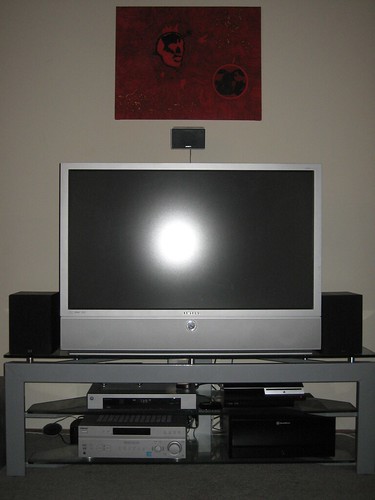
    TV: Samsung 43" DLP HLN4365WX
    Receiver: Sony STR-K670P
    Storage: HP MediaSmart Server ex485 (2.75 TB)
    Remote: Harmony 550
    Gaming: 40 GB PS3

    This is what the system originally looked like in 2005. I know it isn’t much but I started piecing this together while a senior in college on a limited budget.

    mmmmm...TV
    I bought the TV and receiver in 2005 with left over student loan money. My wife agreed that I could have $2,000 to buy everything needed for our home entertainment. At the time that included the TV, receiver, NTSC set top box, speakers, TV stand, speaker stands, and any other misc stuff I needed for the setup. That is not a lot of money, especially for 2005 when HDTV was still really new, but using eBay and some fancy sales I got everything I needed, even was a little under budget. My original plans was just for OTA HD but in just a few years I have gone way beyond that.

    My HTPC path has included many different machines and I’ve tried a lot of software suites (both Windows and Linux). Most of my previous HTPC’s were built using free/retired computers from work which meant they were always kinda slow. I started using MythTV back in 2006 and keep coming back because of the cost (free), hardware support, and features. You can see some of my HTPC history here as well as a couple other blog posts.

    But I didn’t want to dwell on my history with HTPC’s.  Here is my current machine setup:

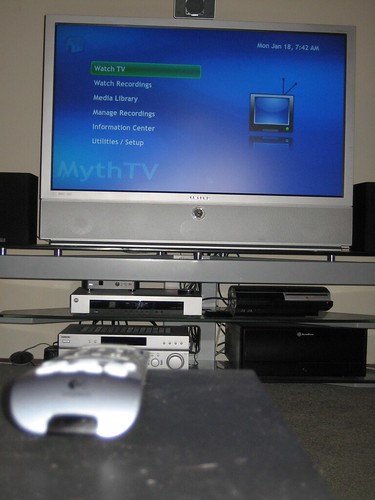
    Currently the system looks a little bit different and looks like the picture below.


    PIPs


    mythtv 

    Current HTPC Setup Specs:

    HTPC
    Case: Silverstone LC13-B
    Motherboard: Gigabyte GA-EP45-UD3P
    Processor:  Intel Core 2 Duo E8400 Wolfdale 3.0GHz
    Ram: 24 GB DDR2
    Video Card:  Nvidia 9500 GT 512 MB PCIe (fanless)
    Hard drive(s): 160 GB system drive, 250 GB media drive
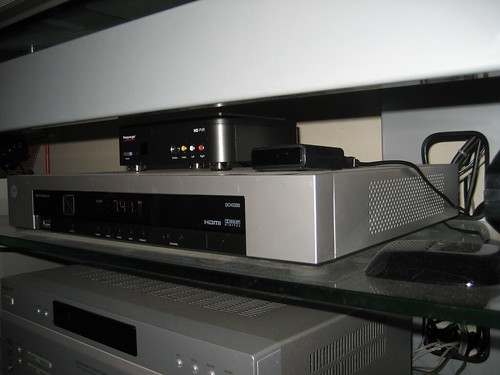
    Capture card(s): 1 SiliconDust HDHomeRun Dual Digital HDTV Tuner, 1 HD-PVR, Hauppauge HVR-1600
    Remote: Windows MCE receiver
    Other: Battery backup, Motorola DCH-3200 STB

     
    Operating System: Mythbuntu 9.10 x64, Windows 7 Ultimate x64 (but I have only booted into it once).
    Software: Mythbuntu 8.10 with MythTV 0.22 (Planned to include XBMC, Boxee?, and Hulu Desktop)

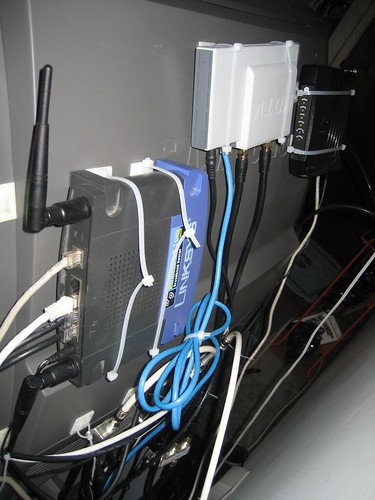
    networking

    The whole HTPC probably cost me about $900-1000 including tuners which has made this build really more of a budget build than anything. Most of the items came from selling/trading things or gifts for Christmas or birthdays.
    Currently my HTPC is plugged directly into my TV using DVI with my HDHomerun and HD-PVR plugged directly in with ethernet and USB. The HD-PVR is plugged into a Motorola DCT3200 cable box and channel changes are done via firewire and the Mythchanger software. Recorded TV is stored on my 250 Gb hard drive and archived TV and other media is stored on my HP MediaSmart server. The MediaSmart server is mapped to ~/Music, ~/Pictures, ~/TV, ~/Movies, and ~/Videos which allows me to easily access any of the stored media.

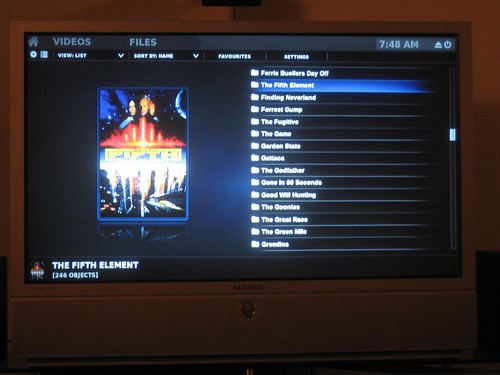
    As for software, I am using the standard MythTV 0.22-fixes frontend installed with Mythbuntu 9.10 because it was the easiest and fastest way to get up and running. When the main TV is being used I also use my laptop as a remote frontend which allows me to watch live TV and recordings anywhere I have wireless access. I plan on moving over to MythBox once XBMC 9.11 officially comes out. I also hope to switch between XBMC and Boxee/Hulu Desktop just for more features if I ever decide I want them. Or there are a couple of plugins in development that might make these programs unnecessary.
    Right now the setup is great. Commercial flagging was as simple as checking a box, and adding and managing 5 tuners is much easier than I expected it to be.

    xbmc movies

    I look forward to the next release of MythTV 0.23 in Q1 2010 and hope that Nvidia continues to improve their VDPAU drivers. Right now I will just continue supporting the best open source media center software and look forward to new releases. Follow my how-to’s and reviews on my blog, my daily adventures on Twitter, or my Linux talks on the mintCast podcast I co-host.


    receivers 

    tv with art

    About the Author:  Rothgar first got into media gadgets with the KISS DP-600 DVD player which could stream DivX from a file server. From then on I was hooked on media gadgets and all things home theater. I really got into Xbox hacking with Xbox Media Player (now known as XBMC) and have modded more Xbox’s than I can count. As the hardware started to show it’s age, and the growing desire to be able to record live TV I made the natural jump to HTPC’s. I started with MythTV, GotAllMedia, Media Portal, XP WMC, and tons of other software. I always stayed on the free side of things because I was putting myself through college and dirt poor. Hardware specs were also very important to me because I always was building systems on second hand hardware. While I am now out of college, and currently working full time for the university I graduated from, I still like to keep my expenses modest and almost every HTPC and tuner I have used has been a gift or from selling a previous HTPC system.
    The cost to feature ratio has always kept me coming back to MythTV (the hardware requirements and flexibility help) and that has opened up a whole new world of computing. I currently co-host the official
    Linux Mint podcast and frequently talk about Linux and HTPC’s on my blog, twitter, and youtube.


  • Climate Cools But Arctic Ice Scares Continue by Dr. Tim Ball, Canada Free Press

    Article Tags: Tim Ball

    My badge of honor is an attack by Phil Jones, disgraced and displaced Director of the Climatic Research Unit (CRU) whose leaked emails showed how they falsified climate science. On May 22, 2009 Jones wrote to Mann, “Our web server has found this piece of garbage – so wrong it is unbelievable that Tim Ball wrote a decent paper in Climate Since AD 1500. I sometimes wish I’d never said this about the land stations in an email. Referring to Alex von Storch just shows how up to date he is.” The article in CanadaFreePress was one of eleven in a series written before the CRU exposé. The first two were written with Tom Harris, the rest are mine.

    They’re a history of the Intergovernmental Panel on Climate Change (IPCC) and indirectly control by the CRU gang.

    “Climate Since AD 1500” is a collection of articles edited by Jones and Bradley (J&B) published by Routledge in 1992. My chapter is titled, “Historical and instrumental evidence of climate: western Hudson Bay, Canada, 1714 ‚—1850”. Articles show the degree to which climate changes in short periods. Despite this J&B are already setting the focus on human causes. In a summary they claim two positions emerge from the evidence, but both “perspectives provide fuel for arguments over the veracity of anthropogenic greenhouse-gas-induced climatic change.” They argue, “To resolve this controversy, further modeling and paleoclimate studies are needed” (page 674). Their summary, analysis, and recommendation are distortions of the evidence.

    A.E.J. Ogilvie’s article examined climate change in Iceland from AD 1500 to 1800. It notes, “Iceland’s position within the range of the Arctic drift ice is also of major importance to the country’s climate.” Modern data defines “normal” when the drift ice spreading from Greenland is 90 to 150 kilometers from the northwest coast, “mild” when it is 200 to 240 kms. Severe is closer than 90 kms.

    Click source to read FULL report by Dr. Tim Ball

    Source: canadafreepress.com

    Read in full with comments »   


  • CDG’s LaForge Joins AirHop’s Advisory Board

    Bruce V. Bigelow wrote:

    San Diego’s AirHop Communications, a 2007 startup that specializes in SON, or self-organizing networking technology, says CDMA (Code Division Multiple Access) industry leader Perry LaForge joined AirHop’s advisory board. LaForge is founder and executive director of CDG, the Costa Mesa, CA-based CDMA Development Group, a trade association comprised of more than 100 of the world’s leading wireless operators and manufacturers. As I reported in November, AirHop’s technology is intended to simplify and coordinate the operation of 4G wireless networks while minimizing radio interference and maximizing mobile data rates.


  • Climategate Scandal Deals Blow to Global Warming Fears by Sterling Burnett, Heartland Institute

    Article Tags: ClimateGate, Sterling Burnett

    A series of e-mails between scientists who serve as gatekeepers for the United Nations’ Intergovernmental Panel on Climate Change leaked from the University of East Anglia Climate Research Unit has caused a firestorm of controversy that has yet to die down several months after the news first broke.

    Smoking-Gun Emails

    The incident, which has come to be known as “Climategate,” revealed longstanding efforts to manipulate, hide, and destroy scientific data that cast doubt on global warming alarmism. The late-November document leak also exposed pernicious tactics used to strong-arm the peer-review publishing process in order to keep skeptical scientists from publishing their findings.

    Evidence of data tampering includes an email from Climatic Research Unit (CRU) head Phil Jones to fellow global warming alarmists reporting he had “just completed Mike’s Nature trick of adding in the real temps … to hide the decline.”

    Source: heartland.org

    Read in full with comments »   


  • Climategate: The Truth Hurts When It Hits You in the Head by Dexter Wright, AmericanThinker.com

    Article Tags: Dexter Wright

    The joke on the internet these days is “What do Tiger Woods and Phil Jones of East Anglia University in Britain have in common? They both got hit in the head by a model.”

    In 2007, Professors David Douglass, John Christy, Benjamin Pearson, and Fred Singer wrote a scientific paper in the International Journal of Climatology, which compared Global Climate Models (GCMs) with real observed data. GCMs were theoretically designed to forecast how greenhouse gases (GHGs) are warming the planet.

    There are certain rules that must be followed in scientific investigations in order to ensure that the results and conclusions are not erroneous. Basically, the process requires an investigator to operate under multiple hypotheses so that he is not blinded to facts that might contradict one of his hypotheses and leave him with a dead end. An investigator should start by working from the known to the unknown, from the simple to the complex, and always bend the theory to fit the facts — not the other way around. This is exactly how the four scholars led by Professor Douglass conducted their investigation into the accuracy of the GCMs.

    Click source to read FULL report by Dexter Wright

    Source: americanthinker.com

    Read in full with comments »   


  • PollDaddy Hits 1 Billion Page Views a Month, Major Updates Coming Soon

    According to WordPress founder Matt Mullenweg, poll/survey web service PollDaddy has just hit the one billion monthly page views mark.

    Other than Gravatar, this makes the PollDaddy network the second Automattic web property – excluding Gravatar – to reach this milestone. Automattic’s holdings inlcude content management system and blogging software WordPress.com, spam blocker Akismet and more.

    Sponsor

    PollDaddy’s traffic, according to Quantcast, also shows a decent breakdown of regulars frequenting the site:

    Moreover, users of the company’s WordPress.org plugin will now be able to add PollDaddy’s rating feature. This feature allows users to place ratings on their blog posts, pages and comments, like so:

    Mullenweg writes, “Watch for some other major updates coming up soon.” As frequent users of PollDaddy on this platform, he can be sure we’ll keep an eye out for news about this service.

    In honor of this momentous traffic milestone, we present you this commemorative poll, powered by PollDaddy:

    What other Automattic web property has achieved one billion monthly pageviews?(survey)

    Discuss


    Buy This Item: [Click here to buy this item]

    Read Original Article

  • Mac Pro and Xserve firmware, restore CD updated

    Filed under: , ,

    Mac Pro and Xserve owners, take note — Apple has released the following updates today:

    Xserve EFI Firmware Update 1.2 for Xserve (Early 2009)

    • Improved compatibility with virtualization products utilizing VT-d
    • Improved system reliability during the boot process
    Mac Pro EFI Firmware Update 1.4 for Mac Pro (Early 2009)

    • Improved compatibility with virtualization products utilizing VT-d
    • Improved storage performance under Windows XP for Boot Camp users
    • Improved system reliability during the boot process
    • Restoration CD for the following products: Mac Pro (Early 2009), Xserve (Early 2009).
    • Addresses reliability issues, targeting the use of multiple Unitors.
    The updates are now available via Apple’s support downloads page and via Software Update.

    Thanks for the tip, Jeff!

    TUAWMac Pro and Xserve firmware, restore CD updated originally appeared on The Unofficial Apple Weblog (TUAW) on Tue, 19 Jan 2010 00:00:00 EST. Please see our terms for use of feeds.

    Read | Permalink | Email this | Comments

    Buy This Item: [Click here to buy this item]

    Read Original Article

  • Deadly Earth, Deadly Humans by Alan Curuba

    Article Tags: Alan Caruba

    Image Attachment

    The earthquake in Haiti is a perfect example of the arrogance of environmentalists who are always running around crying “Save the Earth” or making claims that any or all forms of life are going extinct.

    For three decades we have listened to these charlatans claim that the Earth was heating up to a point where, if we didn’t cut back or replace all forms of energy, oil, natural gas and coal, it would become a vast desert devoid of life.

    Then, in 1998, the Sun began yet another of its eleven year cycles of low sunspot activity, a diminution of magnetic storms on its surface, and the completely predictable result was a new, perfectly natural cooling cycle, a prelude perhaps to a predictable new ice age.

    Source: factsnotfantasy.blogspot.com

    Read in full with comments »   


  • Check out this over cool PS3 slim mod

    Now we’ve seen some pretty impressive PS3 mods before but this one definitely takes the cake. Take a look at flasheur’s nifty PS3 Slim mod after the jump.


  • PlayStation 3 is Castlevania: Lords of Shadow’s Lead Platform

    Identifying a game’s ‘lead platform’ has gained importance this generation, as games like Bayonetta have turned out to be markedly inferior on one platform on another. But while the PS3 will be the lead platform for the upcoming Castlevania: Lords of Shadow, it seems that fans can rest easy.

    “PS3 is the lead platform but the game is identical on both formats,” producer David Cox wrote via Twitter.

    Cox also confirmed that the camera will be fixed in Lords of Shadow. Sounds like it will have a bit in common with God of War, which should lend the action a more cinematic feel.

    Buy This Item: [Click here to buy this item]

    Read Original Article

  • Yammer Founder David Sacks Joins Scribd Board Of Directors

    Scribd, a site that lets users and publishers upload and share documents, has a new board member. David Sacks, the founder of Geni and Yammer (and former COO of PayPal), joins the company as a director as of today.

    Scribd had 8.1 million unique worldwide visitors in November 2009 (Comscore). They’ve raised $12.8 million in three funding rounds. Sacks is already an investor in the company.


    Buy This Item: [Click here to buy this item]

    Read Original Article

  • Top Five Trends in the Future of Work

    Brent Frei wrote:

    We are increasingly a knowledge-based economy in the U.S., and work can be delivered digitally from anywhere. Take NightHawk Radiology in Coeur d’Alene, ID, for example—they are providing radiologists to any hospital that needs real-time availability and lower costs. They work online from Switzerland and Australia, but it could just as easily be Wenatchee or Usk, WA. These are often the jobs that create other jobs. An Amazon, Microsoft, or RealNetworks software technician for example, creates two to four other jobs within the communities they live.

    This has all been made possible by the following 5 trends/innovations of the past decade:

    1. Expansion of broadband throughout the U.S. and abroad.

    2. Maturing of Web development tools and standards.

    3. Usable Web access via handheld devices.

    4. General acceptance of financial transactions over the Web as being safe and secure.

    5. Emergence of online work and worker marketplaces.

    I believe that a huge portion of the highest paying jobs in the next 10 years will be served across the wire, with less and less dependence on physical location. [Disclosure: The author is the co-founder of Smartsheet, an online collaboration and work management firm—Eds.] Small towns across the Northwest are currently growing with telecommuting professionals moving toward lower costs, higher quality of life, and less city hubbub.

    The past decade’s innovations coupled with the increasing base of knowledge workers leads to my predictions for the coming decade:

    1. Migration of professional people from high tax & regulation states to low tax & low regulation states.

    2. Explosive expansion of work marketplaces and paid crowdsourcing for all kinds of jobs.

    3. More productive people will work for themselves by shopping their considerable talents around the world via work marketplaces.

    4. Job performance and work quality will become transparent as people’s work is reviewed online much as products are today.

    5. Average earnings for high performers will be more than double the average earnings in their category.

    Virtual assistants, a job category that is growing 50 percent a year, is already demonstrating these trends. More and more people are timesharing executive administrators. Most are home-based women (98 percent of V.A.s are women) who are now picking up extra income, or building full businesses.

    I expect that we’ll look back in 10 years and wonder why we spent over $4.2 billion to move a relatively small amount of Washington state’s population less than 10 miles through a new tunnel [to replace the Alaskan Way Viaduct in Seattle—Eds.]. Had we spent half that much on schools, high-speed Internet access, and infrastructure across the whole state, it would have been a much bigger boon for the state’s economy.

    Ten years from now, where you live will be a matter of lifestyle choice, not proximity to work.


  • Kiva’s Robots Go to Work Sorting Medical Devices at Boston Scientific

    A Kiva Systems Mobile Drive Unit, Carrying a Shelf
    Wade Roush wrote:

    Robotics startup Kiva Systems of Woburn, MA, and medical device giant Boston Scientific (NYSE: BSX) said today that Kiva’s robots will be used to automate order fulfillment in two Boston Scientific warehouses, one in New England and one in the Netherlands.

    It’s a big win for Kiva, whose shelf-toting robots are increasingly common in the warehouses of consumer goods distributors like Zappos, Staples, and Diapers.com, but which has never before landed a customer in the health or medical sectors, where there’s less room for error.

    “Accuracy in order fulfillment is important if you’re doing office supplies or T-shirts, but if you are supplying medical devices to operating rooms, it’s an imperative,” says Mick Mountz, Kiva’s CEO and founder. In Boston Scientific’s existing warehouses—as in most traditional distribution centers—human pickers roam the aisles, grabbing products from bins. Making sure that each outgoing shipment contains exactly the right products involves time-consuming double and triple checking, steps that aren’t needed in Kiva’s largely automated system. “Kiva naturally provides a more efficient way to achieve that super-high accuracy,” says Mountz.

    In a Kiva-equipped warehouse, central command software sends orders wirelessly to a fleet of squat, wheeled robots. A robot’s job is to navigate to the mobile shelving unit that contains the requested product, lift up the whole shelf, and transport it to a picking station, where a human operator grabs the product and transfers it to a box for shipping. (The process, which is quite beautiful to watch, is described in more detail in this April 2008 profile.)

    Such a computerized system has a special advantage when it comes to handling highly regulated products such as the stents, catheters, and myriad other medical devices that Boston Scientific manufactures by the thousands. “The FDA sends out notifications quite frequently about [devices] that need to be double-checked or put on hold, and that is very disruptive to a manual operation,” says Mountz. “What we can do, just before we present something to the operator, is ask the host system, ‘Is this still okay?’” That way, products that have been flagged for regulatory reasons never make their way into boxes for shipping.

    Kiva’s robots are also adept at carrying a large assortment of product packages, from very small to very large, which, according to Mountz, makes them more flexible than the competition: “automated storage and retrieval systems” in which transportation is typically provided by a bucket sliding along a conveyor. Ken Pucel, executive vice president of operations at Boston Scientific, backs up that point. “Other material handling approaches would have required us to integrate different technologies to handle units, cases, and pallets, as well as a wide range of product sizes,” Pucel said in today’s announcement. “Kiva is able to provide us a proven solution with the flexibility and ease-of-use of a single technology for our needs.”

    Kiva will be installing its system as part of a multi-year “rolling upgrade” to existing Boston Scientific warehouses in Boston and Kerkrade, the Netherlands, according to Mountz, who says the deal represents an important foothold for Kiva in the medical-device market.

    “We think the message is already out there that this is the highest-fidelity way you can do order fulfillment,” says Mountz. “What we excited about now is bringing that message that we have FIFO-style [first-in, first-out] workflow and inventory management to the medical device industry, the pharmaceuticals market, and other device suppliers. That is a big and growing opportunity for us.”


  • Mother to newly diagnosed 11 year old

    My daughter was just diagnosed with Type 1 diabetes in November. It has been a whirlwind in education, fear, and learning as we go. I have been through many stages of grief. I was very angry at first and I still am at times, but things are getting better. Now I am accepting of her diagnosis and want to ensure that she can live a happy and full life despite needing to be on insulin.

    I joined this forum in the hopes of learning more and learning from individuals who actually have the condition.

  • Conociendo la Provincia de Cordoba

    Estuve unos dias de vacaciones en esta hermosa provincia y no pare de sorprenderme con la cantidad de maravillas y atractivos que posee. Es en mi opinion la provincia mejor preparada para el turismo, y creo todavia no ha sido descubierta por el turismo internacional en gran escala.

    Posee una ciudad capital muy atractiva y desarrollada, y una serie de pueblitos y pequeñas ciudades con sierras, rios, arroyos y embalses ideales para conectarse con la naturaleza, sin dejar de lado las comodidades que cualquier turista puede pedir.

    Empiezo mostrando fotos de Cordoba Capital, una ciudad muy subestimada en el imaginario colectivo argentino, y lo digo por experiencia propia, me lleve una increible sorpresa con esta ciudad. Me la imaginaba menos brillante, menos atractiva y tiene zonas muy desarrolladas, que dan imagen de primer mundo. Se la ve muy organizada, sin estar invadida por villas o asentamientos ilegales como otras grandes ciudades del pais.

    Entrando a la ciudad en auto

    Amplias y arboladas avenidas te reciben y te guian hacia el barrio mas lindo de la ciudad: Nueva Cordoba

    Algo que me llamo la atencion, es que en este barrio, todos los edificios son nuevos y con buenos diseños.. no hay mezcla de fechas de construccion y estilos como pasa en Bs As

    El espacio publico y mobiliario urbano, asi como la limpieza son impecables, al nivel de ciudades europeas

    El Palacio Ferreyra es una joya de edificio

    El barrio me recuerda a algunas ciudades españolas, especialmente esta avenida

    Esta iglesia es hermosa y esta muy bien conservada

    Enfrente esta el Paseo del Buen Pastor, un lindisimo lugar de encuentro entre amigos o familia

    Un edificio nuevo que me gusto mucho en frente del paseo

    A unas pocas cuadras de nueva Cordoba encontramos la plaza principal, muy bien mantenida y rodeada de espectaculares edificios historicos, como la Catedral

    y el Cabildo

    Un paseo comercial peatonal muy elegante

    Anochece en Cordoba y de vuelta a la modernidad del barrio mas lindo de la ciudad. Esta torre me encanta

    y por ultimo, la decoración navideña le sienta muy bien al paisaje urbano

    Espero que les gusten las fotos y se sorprendan tanto como yo, con esta linda ciudad que tenemos a unas pocas horas de Buenos Aires. Si me equivoque en algun dato, que algun forista cordobes me corrija. La idea es mostrar otras ciudades de la provincia el proximo posteo

  • CrunchDeals: A slightly-used NASA Space Shuttle

    atlantisIf you just so happen to be in the market for a second hand space craft, NASA has a deal for you, pal. The Space Shuttles Atlantis and Endeavour are currently for sale with a price tag of $28.2 m each. Just think, you could park one of these bad boys in your trailer park and relieve its glory days. It’s probably best that you take the shuttle to a qualified space ship mechanic before you commit though. The last thing you wanna do is drop that kind of cash on a lemon.


    Buy This Item: [Click here to buy this item]

    Read Original Article

  • Open Thread: How Are Your Social Media “Causes” Actually Helping Anyone?

    Today, Americans are celebrating a very somber but inspiring national holiday: Martin Luther King, Jr. Day.

    As Twitter co-founder Biz Stone wrote in a blog post a few days ago, “People all over the United States are urged to honor Dr. King’s legacy by making this holiday a national day of service.” Stone reminded us of this wonderful quotation by King: “Life’s most persistent and urgent question is: What are you doing for others?”
    But often in my sojourn through the social Web, I find myself with no decent answer for that question as I watch hordes of well-meaning people throw their supposed social capital at hashtags and fan pages without doing anything more meaningful than that. What do you think: Is your “whuffie” enough of a donation to a good cause?

    Sponsor

    “What are you doing?” “What’s going on?” The questions most often asked of us by the social web are essentially navel-gazing. In a recent post about a startup devoted to self-reference, I wrote, “Answering questions all about you, your preferences, your past, your thoughts, your wishes and hopes, your regrets, what you eat and where you live – nothing is more intoxicating to the average social media user. From our first LiveJournal entries to mid-2000s MySpace chain surveys to our latest tweets, we clearly love talking about ourselves.”

    If the visibility of humanitarian topics in social media is any indication of a trend, we clearly love aligning ourselves with good causes, as well. Sometimes, it seems to me that the latest global tragedy or incurable disease is used as simply another hue on the social web’s palette – something we use to paint pictures of ourselves.

    For example, in 2009, I saw waves of green Twitter avatars and locations of “Tehran” as #iranelection peaked on Twitter’s trending topics. But what did any of us actually do to help the citizens on the ground there? The green pro-free Iran icons really did nothing to help the folks getting wounded and killed in Iran. And the new “censored” Twitter avatars we’re seeing? Well, since Twitter’s blocked in most countries that are aggressively censoring web content, it does absolutely no good.

    As Kiva fellow and social media philanthropist Sloane Berrent told me a few months ago, “People are so fast to click a button, and that can be great. Retweeting, forwarding and Facebook walls are great engagements. But what’s more difficult is the donate button. That’s the big hurdle and disconnect.”

    In other words, from Haitians to humanitarians, they all wish we’d put our money where our mouths (or status updates) are.

    Our latest international disaster was Haiti’s earthquake last week. I’m sure many of the folks reading this post did a lot to help via donations to the Red Cross and other organizations, but how often can we say that our social media or other actions are truly doing something for others? And how often are those actions as ineffective as a lapel pin on a politician or as meaningless as a prayer on the lips of a hypocrite? In many cases, the social media user is doing nothing for others, but is instead highlighting his own awareness and sociopolitical “involvement.”

    There are some organizations such as SocialVibe (scroll to the last part of the post) that allow brands to foot the bill for humanitarian fundraising as users simply point and click their way through web interfaces to show their support. And there’s no doubt that social media tools have made it easier for struggling groups to communicate their needs for help. But by and large, I believe that our social media actions don’t do nearly as much for others as they do for us ourselves.

    Perhaps, before we fire off rant-replete blog posts or make our avatars into 50 x 50 pixel political statements, we should ask ourselves the question Dr. King posed so many years ago: “What does my action DO for others?” And on the flip side of that coin, “What does my action do for me?”

    If the answers to those questions embarrass you, take a step back, make a sizeable donation to a related humanitarian organization, then post away and tell others how much you donated and to whom, and create channels for others to do the same.

    What do you think? Am I completely wrong; is awareness and communication through social media the “new” currency for donating to a good cause? What points have I missed in my thought process? Let me know your opinions in the comments, and also share how you plan to make your actions count for others today.

    For another perspective on this topic, see Mashable editor Ben Parr’s column on CNN.com, or check out ReadWriteWeb’s Charity & Social Good archives.

    Discuss


    Buy This Item: [Click here to buy this item]

    Read Original Article

  • World Cup 2010 Promotions to Use Augmented Reality

    There’s still 142 days, 18 hours and a few minutes until the 2010 World Cup launches in South Africa but the first use of cutting-edge promotional technology is already making an appearance. Sports have been where a lot of technology in the new Augmented Reality category first went mainstream – from Sportvision’s down-line TV overlays to IBM’s Wimbeldon Seer.

    Augmented Reality (AR) is technology that places data on top of our view of the world around us. The first World Cup 2010 AR made an appearance at a small event in London last week.

    Sponsor

    This screenshot is of a prototype of a system that will be found in public spaces around the world in the months leading up to this year’s tournament. Passers-by will see video reflections of their own faces but with the flags of randomly selected World Cup competing countries overlayed on top of their faces. When they see that image, the country’s national anthem will play.

    It’s not terribly interactive, but it is a fascinating experiment in trying to build international camaraderie by making fans imagine themselves as if they were fans of another country’s team. How would they feel if they had that other country’s flag painted on their faces and heard its national anthem? Were they from that country, they would probably feel proud. How does the AR make them feel? Perhaps like a more worldly, sympathetic person. That sounds like a positive World Cup experience.

    We’re told that the system was built by long-time Augmented Reality market leader Total Immersion, in partnership with CrossPlatform.tv. The face being augmented is Simon Grice, founder of MashupEvent. The screenshot was sent to us by “an anonymous source, who was very impressed.”

    Who’s World Cup AR will we see next and what will it do? We look forward to seeing the world’s most popular sport become an experience all the richer.

    Discuss


    Buy This Item: [Click here to buy this item]

    Read Original Article