On December 1, 2011, Google announced a “monthly series on algorithm changes” on its Inside Search blog. From there, Google started posting monthly lists of “search quality highlights,” looking at changes (many algorithmic) the search engine had implemented in the previous month. This did continue on a monthly basis for some time.
At some point last year, Google slowed down on putting these lists out. They started coming every other month, with multiple lists released at a time. It’s now over a week into February, and we haven’t seen Google put out one of these lists since October 4. This is the longest they’ve gone, by far, since they started doing it.
The lists were an attempt by Google to “push the envelope when it comes to transparency”. That’s cool. It gives the rest of the web a glimpse at the kinds of things Google is taking into account when making algorithm changes, even if it doesn’t give away Google’s entire secret sauce (which would likely be he downfall of any search result relevancy).
But where are the last four months worth of highlights?
One thing is for sure. If Google gets back to putting these lists out, we’re going to have a whole lot of info to dig into for the time that has passed.
The Powerball jackpot is currently back at $40 million as a ticket in Virginia won the $217 prize in Wednesday’s drawing. The winning ticket was sold in Richmond, and represented the biggest single prize won since the record $588 million prize in Novmeber, which was split between two tickets.
The winning numbers for Wednesday’s drawing were: 5, 27, 36, 38, 41, Powerball: 12.
There was also a $2 million Match 5 Power Play winner in Rhode Island, and winners in Arizona, Connecticut, Illinois, Kentucky and New York for the $1 million Match 5 prize. There were a total of 1,150,522 winners on Wednesday. Non-jackpot prizes amounted to $15,648,360.
Odds of winning the jackpot, according to the Multi-State Lottery Association, are 1 in 175,223,510.
Let’s face it: HTC may have its hopes pinned on its not-so-secretive M7 smartphone, but sooner or later the company is going to have to drop the codename and let it fly under another banner. As it turns out, that new name may be more familiar than expected — prolific leaker EvLeaks noted on Twitter just a little while ago that it would debut simply as the HTC One later this month.
I say “may,” of course, because ersatz leaks are just par for the course this close to an HTC unveiling. Then again, the Taiwanese company isn’t exactly great at keeping these sorts of things under wraps. If you’ll recall, the revelation of the original One series devices was spoiled just about this time last year, well ahead of HTC’s big Barcelona press conference at Mobile World Congress. HTC never puts much effort into debunking these sorts of claims (unlike, say, Samsung) so you can expect the company to remain stoic on the matter, but EvLeaks’ generally strong track record lends this rumor a fair amount of credence.
Granted, the move is a pretty clever one if true — HTC has spent the last year establishing the One series moniker as one worth paying attention to, and giving it up after making as much headway as it has would just be silly. Plus, simply calling its new flagship The One lends the device a certain cachet — it would be the culmination of the all the prowess expertise that went into crafting the already-impressive One series.
Oh, and in case you needed a little more to chew on, AndroidCentral points out that HTC CEO Peter Chou attempted to whip his employees into a frenzy at a recent year-end party by having them repeatedly chant “HTC,” “M7,” and yes, “HTC One.” Was it an awkwardly enthusiastic bonding exercise, or something more telling? Either way, the answer should be revealed very shortly.
ESPN uploaded a video to YouTube today in which star Detroit Lions wide receiver Calvin Johnson (known to many as “Megatron”) tries to catch eggs as Sportscenter’s Lindsay Czarniak throws them to (at?) him. He’s better at catching footballs, but he does feel he has also earned the nickname “Eggatron”.
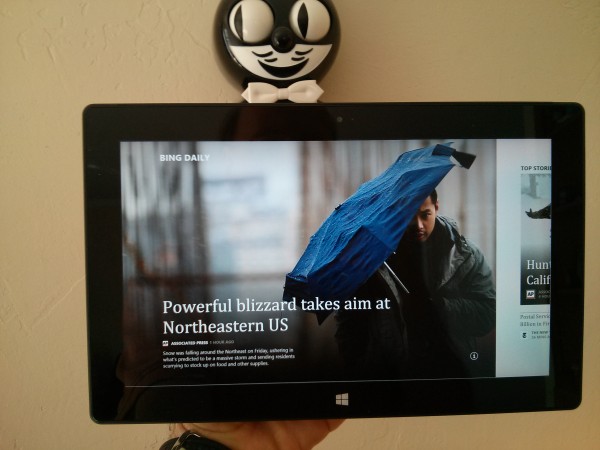
I should say the big launch event planned for New York City. Can you say bad weather? In October Hurricane Sandy sandbagged (absolutely no pun intended) Google’s Nexus device unveiling, also in the Big Apple. The search giant announced products anyway. Likewise, Surface Pro sales will go on, in stores around Canada and the United States and online.
“Surface Pro launch activities in NYC have been cancelled due to weather; our best wishes for everyone impacted by the blizzard,” a Microsoft spokesperson tells BetaNews. Surely there’s a metaphor here somewhere. What Microsoft’s top brass must want — desperately hope for on knees with hands clasped high — is a blizzard of Surface Pro sales. A storm of people rushing into stores or pounding keys online to buy one of the two models, 64GB ($899) and 128GB ($999). If we were all characters in a novel, the blizzard would foreshadow future events — or so Microsofties can only hope.
In the Shakespearean tragedy version, however, the blizzard symbolizes the gods’ wrath. CEO Steve Ballmer’s flaw is ego, and he fires Windows 8 head honcho Steven Sinofsky only to have Surface go all to hell in the end sans his leadership. Ballmer is lost in a whiteout — having gone to the City for the launch event — and isn’t seen again until 2087, when construction unearths his remains.
In the real world, the product has a leader, Panos Panay, corporate vice president, who says that the “launch of Surface Pro marks a pivotal moment”. That’s an understatement, because Microsoft has so much hinging on the touchscreen tablet’s success. I agree with company executives whining about the lineup of Windows 8 PCs for the holidays. Few really excited (honestly, none for me).
Surface Pro is a new beast — a little of this and a little of that, tablet, laptop and sketchpad. The tablet could be the defining Windows 8 device, although I struggle to comprehend why cold, wet or snowy February is the right month to launch in this hemisphere.
Surface Pro shouldn’t be confused with sibling RT, which price starts at $499. “Surface family, customers will be able to choose a combination of devices that best suit their needs: Surface Pro, which provides the power and performance of a laptop in a tablet package, or Surface RT, which offers the convenience of a tablet with some laptop capabilities so you can get things done”, Panay says.
The tablet coming February 9 competes with Windows ultrabooks and MacBook Air, and runs Windows 8 Pro on an Intel Core i5 processor. The other uses ARM architecture, starts at much lower price ($499) and competes with tablets like iPad and Nexus 10.
Americans and Canadians can buy Surface Pro from one of Microsoft’s nearly 70 permanent and pop-up company stores or Best Buy. Also: Future Shop north of the border and Staples south of it. Just in time to swoon sweethearts, Surface RT sales expand to Austria, Belgium, Denmark, Finland, Ireland, Italy, Luxembourg, the Netherlands, Norway, Portugal, Spain, Sweden and Switzerland on Valentine’s Day.
Three limited-edition Touch Covers go on sale as well, in cyan, magenta and red, for $129.99 each. A Surface wedge mouse sells for $69.95. Additionally, Microsoft adds a new Windows RT SKU, 64GB for $599 without keyboard cover.
If you haven’t read my Surface Pro first-impressions review, please do — and watch for a follow-up story today about who should (or shouldn’t) buy the tablet.
As for that pesky blizzard, I’ve seen several weathermen compare this one to the colossus of February 1978. I remember that one well. The university closed for the first time in seven years, for weather. Guys jumped out from my dorm’s second-story windows into snow banks. Buddy and I hitched rides on slow driving cars, hanging off back bumpers and sliding our shoes on the snowy road. I got a reprieve on two exams because of that storm.
Bing announced today that it has partnered with FOX News Channel and Foxnews.com to launch Bing Pulse, enabling users to give real-time feedback to President Obama’s State Of The Union address.
This is part of a new political destination site from Bing at Bing.com/Politics, playing off Bing’s Elections offering. The company describes it as “a non-partisan online destination designed to meet this growing need for up-to-the-minute political information and second-screen experiences.”
At this destination, users will be able to watch the speech live with commentary from FOX News pundits and “other political experts” via Twitter. They’ll also be able to participate in the Bing Pulse survey, filter news from left, center and right-leaning national and local news sources, according to Bing. Users will also be able to access original videos of Jimmy Carter and Newt Gingrich talking about the State of the Union address.
“The Bing Pulse will allow people to join the conversation by ‘voting’ every five seconds on their reactions to the President’s speech,” Mark Penn, Corporate Vice President, Microsoft. “Real time results of the Bing Pulse will be shown at Bing.com/Politics and on FOX News Channel. We think this will be the largest live online poll in history.”
Bing.com/Politics is also unveiling its “social sentiment tracker” called Bing Beat. This will analyze social sentiment on Twitter associated with the address – topics like immigration, gun control and the fiscal cliff.
The new Bing.com/Politics will launch on Saturday.
Microsoft says it could take a few hours for Spotify to show up in the store — here it is in the online Marketplace — as it rolls out across various regions. Note too that the app requires Windows Phone 8, so older devices running WP 7, 7.5 or 7.8 likely aren’t supported.
Spotify, which boasts 20 million songs, does offer a free trial on the new Windows Phone 8 client. To try the service, you need to create a Spotify account first, then log in on the app. Without a credit card or any other details, that gets you 48 hours of free music. To extend the trial to a full 30 days, Spotify says to follow the email instructions it sends after account creation.
Aside from listening to tunes on Windows Phone 8, you can create and share music playlists, download music for offline playback and explore what your friends are listening to on Spotify, regardless of what mobile or desktop platform they’re using with Spotify.
This past week, Microsoft launched a new “Scroogled” campaign. In case you don’t recall, the company launched a campaign under that name during the holiday season, calling out Google Shopping for its paid Google Shopping model (a move that has been controversial). This time, Microsoft is using the “Scroogled” brand again to attack a decade-old feature of Google’s Gmail – the one that Google uses to target advertising to users by algorithmically scanning emails.
Are you concerned about Gmail’s ad targeting practices? Do you consider them to be a violation of privacy? What is your opinion of the ads themselves? Share your thoughts in the comments.
We had a conversation about Microsoft’s latest attack on Google with Stefan Weitz, Microsoft’s senior director of Online Services (also one of the more well-known faces of Bing). While Microsoft recently launched a new mail product – Outlook.com – many find the timing of this attack a bit strange, given that Gmail has operated this way since its inception.
“We want to make sure people understand how much of their privacy they are giving up when they use Gmail,” Weitz tells WebProNews. “If people understand they are giving up their privacy and they wish to do so, that’s their choice. But we want to make sure they understand this is going on. What surprised us, even after a decade of this practice, is that over two-thirds of people don’t know what is happening and when they find out, nearly 90% say it should stop. People are saying it doesn’t seem right. It seems creepy. The question users have to ask is: Do you want one company to have that much information about you?”
Google did alter its privacy policies last year, essentially consolidating them into one that spans across its various products, making it easier for the company to use data from one of its services in another.
Of course, Microsoft does scan users’ emails. Just not to serve ads.
“We do not scan the contents of user emails for the purpose of showing ads,” says Weitz. “Like many email providers, Outlook.com scans the content of your email to help protect you and prevent spam, gray mail, phishing scams, viruses, malware, and other dangers and annoyances. It is just like how the postal service sorts and scans mail and packages for dangerous explosive and biohazards. Of course, Outlook.com
“Outlook.com uses other information like user profile information people submit when signing up (age, zip code, gender), but we even give users an option to opt out of personalized ads for free,” he adds. “Gmail doesn’t.”
In a previous article, we looked at what Google says about privacy in Gmail. Google’s PR has been sending around this comment:
“Advertising keeps Google and many of the websites and services Google offers free of charge. We work hard to make sure that ads are safe, unobtrusive and relevant. No humans read your email or Google Account information in order to show you advertisements or related information. An automated algorithm — similar to that used for features like Priority Inbox or spam filtering — determines which ads are shown.”
You can read a much lengthier set of relevant comments from the company from an old help center article in that article.
It should be noted that Google has fired employees in the past after they were caught (in separate incidents) spying on user emails and chats. You can take that two ways: 1. It has happened before. 2. Google does not tolerate such behavior. Presumably, these incidents had nothing to do with ad targeting.
Microsoft’s new Scroogled ads almost make Google’s ad targeting relevance seem like the subject of the attack in some parts. See the dead cat example in this one:
“Who wants a free pet exam coupon when the family cat has been put down?” the ad asks.
“First, it’s important to keep in mind that Google’s practice of earning money by reading personal e-mails is not exclusive to Gmail users,” says Weitz. “This also impacts those who don’t have a Gmail account. If you use another email provider but you send an email to someone else’s Gmail account, Google goes through that too. That’s why we’re also asking consumers to sign the petition on Scroogled.com and tell Google to stop going through their emails to sell ads.”
“Second, Outlook.com is committed to protecting users’ privacy and offers users the experience they’re seeking in their email provider,” he continues. “Last, I’m not sure how making their targeting even more exact is going to make the 90% of Americans who say it should stop any happier.”
In case you’re wondering if Microsoft has ever targeted ads based on email message content, Weitz says, “We have never targeted ads based on the content of email messages. Our privacy policy is very clear on this. The bottom-line is we don’t eavesdrop on private communications. We still have ads in Outlook, but the difference is we don’t scan your mail to sell those ads. We think we can still make revenue to pay for the service even if the ads are not directly targeted or related to the private communications that you have. And we give users the option to opt-out, which is a big difference from Gmail.”
Microsoft told us during the original holiday themed Scroogled campaign that the name “Scroogled” was about “Scrooge” (as opposed to “getting screwed by Google” or something along those lines). We could buy it at the time, given the holiday context. Bing even went out of its way to make A Christmas Carol references in its announcement of the campaign. Now that we’re into February, it’s starting to feel a little more like “screwed by Google”.
“You can interpret it however you would like, but Outlook.com’s ‘Don’t Get Scroogled’ campaign is purely about prioritizing privacy and making people informed,” says Weitz. “When polled, over two-thirds are unaware that Google reads their e-mails to make money from targeted ads. ‘Don’t Get Scroogled’ is simply a national consumer awareness campaign to educate Americans about Google’s practice of going through the contents of personal Gmail email messages to sell and target ads. That, and the term has entered the lexicon to generally refer to unseemly practices by Google.”
On a different note, given the rivalry between Google and Microsoft and Microsoft’s relationship with Yahoo, many are wondering what Microsoft thinks about the newly announced deal between Google and Yahoo for contextual ads.
“I’d say I wonder how Google is using the content [of] your private communications in Gmail to serve ads in other places,” says Weitz on the subject.
“We’ll have more to say about new ad products in the future but it’s important to note that they are just that – new ad types,” he says. “As we always do, we will clearly highlight when something is an ad versus organic.”
The IPO of solar installer SolarCity — one of the only successful IPOs to come out of the cleantech and clean energy sectors in 2012 — was so touch and go that in the 11th hour the team decided to shelve the IPO and at one point even booked tickets to fly back to San Francisco from New York, according to SolarCity CEO Lyndon Rive during a talk at the Cleantech Investor Summit on Thursday.
Rive said that it was only after they booked their tickets to go home that they ended up confirming with two institutional investors that the investors wouldn’t sell if they saw weakness in the stock on the debut day. After that, it was “game on,” said Rive.
Late 2012 was a difficult time to go public for a solar company, to say the least. Dozens of solar manufacturing companies had gone bankrupt over the year, due to rock bottom solar cell prices. Even though SolarCity is an installer and financier, and not a manufacturer, Wall Street was hesitant to support any type of solar IPO. As a result, during SolarCity’s roadshow it had to reprice its estimated IPO price range from $13 to $15 per share down to $8 per share.
SolarCity actually had a term sheet ready for a private round valuing the company at $8 per share, said Rive in his talk. The company was ready to raise money privately if it couldn’t get the valuation it wanted when going public. And even though it had a private round that matched their eventual IPO price, if it went public and the stock tanked from $8 down to $5 in IPO morning trading, “it would have devastated the company,” said Rive.
But SolarCity went for it and took a chance. It helped that the company’s current investors, Elon Musk, DBL Investors and DFJ, agreed to buy a bunch of shares in the offering. On the morning of the debut, SolarCity’s shares soared 40 percent in morning trading.
Though, SolarCity was the exception last year. Rive told the audience of cleantech investors and entrepreneurs that for any of the cleantech companies looking to go public in 2013, be forewarned: “it’s not easy.”
TED has launched a big update to its iOS app, adding faster speed and streaming subtitles. While users will no doubt appreciate the speed improvements, TED is really excited about the latter feature, which the organization calls “the real star of the show”.
According to TED, the app is the largest content provider to use iOS6′s new subtitles feature on its streaming video service. The subtitles will follow you to Apple TV with Airplay.
“This release is a very important one to us. Our talks are translated by a team of volunteer translators worldwide. For the first time ever, their work is now available on iOS, our largest mobile platform right now,” says TED’s Thaniya Keereepart, who led the update. “The subtitle piece utilizes iOS6′s new HLS services. Our engineers have been working very closely with Apple to make it possible.”
Subtitles are available in 90 languages right from the video player.
Those of you with multiple connected devices but no way to integrate them under one app might want to consider supporting UBE. The Austin, Texas startup launched an Indiegogo campaign on Wednesday that aims to take any IP-connected device and let you control it from a smartphone.
As the number of connected devices in a person’s home rises, it’s becoming apparent that the number of apps they have to use to control those devices increases as well. But UBE, which is launching a smart dimmer as well as an application, wants you to run all of your connected devices on their app. It will work with the WeMo, Wi-Fi connected TVs, consoles and a variety of other devices, says Glen Burchers of UBE.
“So if you want to connect your TV and lights, then when you sit down to watch TV, you can dim your lights,” Explains Burchers about what the app and Smart Dimmer can do. “Or you can set up your AC to raise or lower when you turn on the Kinect to do yoga.”
Setting the “scene” for home automation.
The CEO and cofounder of UBE comes from the high-end home automation industry where people hire companies to program certain “scenes” associated with living in a highly automated home. So when your garage door opens, your lights could turn on and music might play softly. The UBE app hopes to enable consumers to create these same scenarios using the UBE app and whatever IP-enabled device is out there.
It also hopes to use the tools to build ways to track energy consumption and then adapt the home’s lighting and other devices to conserve power. While, not exactly demand-response, since the homeowner is setting it up, the idea is that people will want to conserve if they have the tools to make it easy. And while UBE is building many of these apps, it’s keeping an open API so others can build devices and apps to work with the gear.
After the SmartDimmer the company has plans to release a wall plug if its Indiegogo campaign is successful.
The internet of things has a new funding model
UBE was founded in April last year and has so far raised $300,000 in seed funding as well as a $1 million check from winning the People’s Choice Award at the DEMO conference. The company has chosen to use Indiegogo to raise $700,000 to help fund production and to score customers ahead of raising a later round of venture funding at a better valuation.
That strategy is becoming a more common theme as it becomes easier to launch a hardware startup thanks to the proliferation of smartphones, 3-D printing and platforms like Kickstarter and Indiegogo. But another reason is that venture capitalists are eager to put money into companies pitching themselves as internet of things plays, while also being aware that the competition this realm consists of giant household consumer brands and hundreds of other startups.
Thus, VCs are both eager to invest — or listen — but they also want to see some traction before they invest and they tend to offer lower valuations based on what I’ve been told by entrepreneurs (although I take that with a grain of salt). So for UBE, it decided that before taking venture funds it wanted to try the market with a prototype and its story.
After about a year of training its Watson system on more than 600,000 pieces of medical evidence and 2 million pages of medical research, IBM is now offering a cloud-based Watson service to help oncologists develop the best-possible treatments for cancer patients.
Watson schooling our own Stacey Higginbotham at Jeopardy
Watson, if you’ll recall, was designed as a question-answering system that defeated two Jeopardy! champions on primetime television in 2011. A complex set of technologies including natural-language processing, machine learning and other data-analysis techniques let it understand written questions, then analyze them against the source material to find the best possible answers.
In the case of cancer research, IBM is working with Memorial Sloan-Kettering in New York to load Watson’s database with those millions of pieces medical records and research that it can learn from and analyze questions against. Sloan-Kettering is also training Watson on 1,500 real-world lung cancer cases, helping it to decipher physician notes and learn from the hospital’s expertise in treating cancer.
Making this service available via the cloud means it’s accessible by more doctors and hospitals that won’t have to buy a system themselves. Having to purchase, deploy and manage this type of system might be cost-prohibitive, as it takes a lot of storage capacity to handle all that data and a lot of computing power to process it in a hurry.
More generally, IBM is also offering a Watson system designed for patient care, which is derived from its work with insurance provider Wellpoint. This service helps speed the approval process for medical procedures and other treatments by analyzing them against medical data as well as Wellpoint’s approval guidelines.
IBM has grand plans for Watson outside health care, too. In January, for example, IBM expanded its university partnerships on Watson by giving the Rensselaer Polytechnic Institute a Watson system all its own. IBM has its own ideas for how Watson might work in other industries, and the hope is that university researchers and students will help it find even more.
Google announced some new changes to Google Drive today, aimed at helping users discover and use Drive-enabled apps more easily.
The Create menu now puts third-party apps at the same level as Google’s own apps (Docs, Sheets, etc.). This is huge for developers creating Drive-enabled apps.
Users can add apps to their menu by clicking “Connect more apps.” There’s also a new “Connect more apps” dialog.
“If your app is already Google Drive-enabled and listed in the Chrome Web Store’s Drive collection, you don’t have to do anything new to take advantage of these new features,” Google’s Nicholas Gamier tells developers. “We will automatically pull all the information from your existing Chrome Web Store listing.”
Standing out from the crowd of applicants vying to get into Stanford University’s Computer Science undergraduate program is no easy task. That’s not surprising, given the high rankings Stanford has: U.S. News rated it No. 2 for Computer Science in 2012, for example. With such a reputation, the competition for admission is fierce. So how does one think outside the box and grab the attention of admissions officers? Write an iPhone app!
That’s exactly what Alex Greene did, which I think is brilliant and gives new meaning to the phrase, “There’s an app for that.” Greene’s software isn’t something that anyone else would use, as it’s very specific. Basically, in a fun way, it explains who he is and why he wants to attend Stanford after high school.
Have a look:
Is the app glitzy and full of features? No, not at all. But in building the app, Greene would have my attention if I were on the admissions committee. Greene spent the time to add something extra to his application package while at the same time demonstrating that he’s got a passion for his intended course of study. Apparently, there really is an app for everything.
Actually, the real title is Creative Director, as Anheuser-Busch has appointed him as such for its Bud Light Platinum brand. Timberlake will provide “creative, musical and cultural curation” for the brand.
Here’s what Timberlake had to say about it: “Bud Light Platinum brings a refined, discerning aesthetic to beer that plays well with what I’m doing. I’m looking forward to not only being a part of the creative process, but in bringing other talented musicians to the forefront as well.”
“Justin Timberlake is one of the greatest creative minds in the entertainment industry, and his insights will help us further define Bud Light Platinum’s identity in the lifestyle space,” said Paul Chibe, vice president of U.S. marketing, Anheuser-Busch. “Since launching Bud Light Platinum last year, we’ve worked to align the brand closely with music, including leveraging tracks by Kanye West and Avicii in our first ads. Partnering with Justin as he makes his return to music brings a new level of relevance and credibility to the brand.”
The partnership was developed with ad agency, Translation. It begins with the Grammy Awards this Sunday with a sixty-second Bud Light Platinum ad, called “Platinum Night.” The spot will feature the above song.
Google is paying homage to Indian Ghazal singer/musician Jagjit Singh with a doodle on its home page in India. Singh died in 2011. Today would have been his 72nd birthday.
Here’s a performance:
The Economic Times reports that Jagit Singh tops the list of popular singers in his genre, according to Google Search Trends data.
Singh has a huge discography and an extensive list of film scores. You can see both here.
Facebook experienced a glitch late on Thursday, which took down a whole lot of sites temporarily, illustrating just how much power Facebook holds over the web.
Users would visit a site, and then it would redirect to an error message on Facebook.com.
Sites affected by the bug include: Hulu, CNN, MNSBC, Gawker Media sites, ESPN, Reuters, Yelp, Business Insider, Soundcloud and the Washington Post, to name a few.
The statement Facebook has been sending around to various publications is:
“For a short period of time, there was a bug that redirected people logging in with Facebook from third-party sites to Facebook.com. The issue was quickly resolved, and Login with Facebook is now working as usual.”
The bug didn’t last long, and might not seem like that big of a deal to some, but when businesses all over the web have sites that are connected to Facebook, it’s a big deal to know that their sites (and potentially transactions/conversions) can be compromised simply because Facebook experienced some problem.
Really, even though it was Facebook this time, who’s to say it couldn’t happen because of any other service that millions of sites are connected to in one way or another, like Google or Twitter? Twitter is practically famous for having site issues, though I don’t recall anything of this nature in the past.
It’s unclear how many sites on the web are actually connected to Facebook. This isn’t one of the stats that Facebook displays in its stats section. Back in June, Pingdom reported that 24.3% of the top 10,000 websites in the world have some form of official Facebook integration on their homepage. Frankly, I’m surprised that number isn’t higher, though it may very well be by now anyway.
Still, these services have become important components of how a large portion of the web operates – how businesses operate. For many, simply disconnecting from them is not an option, and they are left to the mercy of these higher Internet powers.
It is Facebook’s massive reach across the web that may soon prove to be a hugely powerful weapon in the search space. As you may know, Facebook recently unveiled its new Graph Search tool in beta. It’s still rolling out, and Facebook is working to bring many more features to it. During the announcement, Mark Zuckerberg indicated that Facebook’s Open Graph would be added in the future. One has to imagine that Facebook-related activity (which could be any number of things as long as people are logged in) on sites across the web will be part of the equation, which could actually play a major role in ranking content.
Internationally respected UCLA eye surgeon Dr. Leonard Apt, who co-developed an inexpensive antiseptic eye drop that substantially reduced the incidence of blindness in children in developing countries, died Feb. 1 at UCLA Medical Center, Santa Monica, after a brief illness. He was 90.
A founding member of the Jules Stein Eye Institute at UCLA and an emeritus professor of ophthalmology, Apt was the first physician in the world to become board-certified in both pediatrics and ophthalmology. He devoted his career to preventing blindness in children.
Together with longtime collaborator Dr. Sherwin Isenberg, Apt identified povidone–iodine as a safe topical antimicrobial agent. Prior to their research, no previous studies provided a standard for sterilizing the surface of the eye before surgery. Known commercially as Betadine, the eye drop is now used throughout the world to prepare patients for eye surgery and prevent infection. Apt and Isenberg also demonstrated that Betadine was safer, cheaper and more effective than silver nitrate or antibiotics in preventing eye disease in newborns.
“Leonard described himself as ‘a man of firsts,’ and he really was,” said Isenberg, UCLA’s Laraine and David Gerber Professor of Ophthalmology and chief of ophthalmology at Los Angeles County Harbor–UCLA Medical Center. “He had very clever ideas and constantly looked for meaningful ways to improve patient care on a large scale. His prolific research resulted in innovations in pediatrics and ophthalmology that are now used all over the world.”
Born to a wealthy family in Philadelphia on June 28, 1922, Apt entered the University of Pennsylvania at age 14 and graduated with highest honors. After earning his medical degree from Jefferson Medical College in Philadelphia in 1945, he trained in pediatrics at Harvard University and pathology at the University of Cincinnati and completed a National Institutes of Health ophthalmology fellowship at Columbia University.
Apt joined the UCLA faculty in 1961 and founded the first full-time pediatric ophthalmology and strabismus division at a U.S. medical school. He was co-founder and co-director of the UCLA Center to Prevent Childhood Blindness, which ran an extensive preschool vision-screening program.
Over his long and productive career, he invented several diagnostic tests, including the widely used Apt test, which distinguishes between fetal and maternal blood after birth. He was the first to use plastic tubing for blood transfusions, to develop a method for predicting allergy to catgut and collagen sutures prior to surgery, to pinpoint a formula for the eyes’ proper position under anesthesia, and to identify several new diseases.
“Leonard made the world a better place,” said Dr. Bradley Straatsma, a professor emeritus at the Jules Stein Eye Institute who met Apt 50 years ago while a medical resident at Columbia University, where Apt was pursuing an ophthalmology fellowship. “He was a brilliant physician–scientist, a tireless advocate for the eye care of children, a generous philanthropist and a true friend.”
In addition to publishing more than 300 articles that left a major impact on pediatrics and ophthalmology, Apt received many honors and awards, including the American Academy of Pediatrics Lifetime Achievement Award, the UCLA Alumni Association Award for Excellence and the UCLA Dickson Emeritus Professorship Award. To honor him, the American Academy of Pediatrics created an annual lecture that bears his name. In 2010, he was selected National Physician of the Year by Castle Connolly Medical Ltd.
Apt was a passionate UCLA philanthropist and staunch supporter of eye research, the arts, student scholarships, the humanities, college athletics and many other initiatives across campus. He endowed both a chair and a fellowship at UCLA’s Department of Ophthalmology. An ardent Bruins fan, he always had great center-court seats at UCLA basketball games.
“Leonard was a true Renaissance man: a scholar, clinician, educator, scientist, philanthropist, patron of the arts, sports enthusiast and wine connoisseur. His accomplishments and achievements were legendary,” said Dr. Bartley Mondino, director of the Jules Stein Eye Institute at UCLA and chairman of ophthalmology at the David Geffen School of Medicine at UCLA. “On a personal level, he was charming, engaging, humorous and generous.”
Preceded in death by three sisters, Apt is survived by two nephews, Kenneth Rappaport of San Diego and Robert Hersh of Thousand Oaks, Calif. Services were held Feb. 5 in Los Angeles. Donations in his memory may be made to the UCLA Foundation, c/o Gail Summers, Development Office, Jules Stein Eye Institute, 100 Stein Plaza, Room 1-124, Los Angeles, Calif. 90095-7000.
The Chinese smartphone market is dominated by five top manufacturers, none of them Apple, Canalys reveals. As I’ve warned a couple times recently, despite CEO Tim Cook’s prognostications about China’s importance or his company boasting 2 million first-weekend iPhone 5 sales, competitors rapidly close out the market for costly fruit-logos.
China is the biggest market for mobiles, largely dominated by smartphones — 73 percent of the total in fourth quarter, up from 40 percent a year earlier. Shipments soared 113 percent to 64.7 million units, or 30 percent of all smartphones globally. Samsung captured the top spot, followed by Lenovo, Yulong, Huawei and ZTE.
Losing China
“China is a massive growth prospect, but Apple is not making the market share impact there that it is in other markets”, Nicole Peng, Canalys China research director, says. “The lack of a device on the China Mobile network is a big drawback, combined with high price points. Addressing these issues with the combination of a TD-SCDMA device and a cheaper model would open the flood-gates”.
China accounted for 13 percent of all Apple revenues during calendar fourth quarter. Referring to sales following iPhone 5’s release, “we saw our highest growth in China and it was into the triple digits, which was higher than the market there”, Cook says (during last month’s earnings call). More broadly: “It’s clear that China it’s already our second largest region as you can see from the data that we have given you and it’s clear, there is a lot of potential there”.
Yes, but iPhone is the big revenue generator, and the handset faces increased — and fast-growing — competition mainly from Chinese phone manufacturers, many of which ship Android devices.
Lenovo was the quarter’s big gainer. Shipments grew 216 percent year over year, but mostly to the one country. “China made up 98 percent of Lenovo’s shipments with a handful of emerging markets making up the rest”, Jessica Kwee, Canalys analyst, says. “Its struggle to gain a foothold in markets outside of China means that it may be forced down the acquisition route — as it was with its PC business — hence the speculation about BlackBerry”.
Holding the World
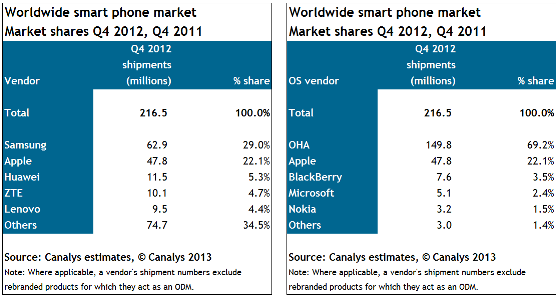
Globally, Asian manufacturers, mainly from China, dominated the top-5 during Q4. But there, Apple made strong showing, lifted mainly by more mature markets like the United States where smartphone saturation slows sales compared to many other geographies. Samsung led, followed by the fruit-logo company, Huawei, ZTE and Lenovo. Samsung’s lead is solid but tenuous, with 29 percent share to Apple’s 22.1 percent. But the Others category, which includes white-box makers shipping Androids to China and other emerging markets, was larger, with 34.5 percent share.
Smartphones accounted for 49.4 percent of all handset shipments — 216.5 million and 438.1 million, respectively.
Android shipped on 34 percent of all handsets during fourth quarter, according to Canalys, compared to 11 percent for iOS. The number is greater for smartphones (69.2 percent). However, the green robot lost share sequentially, from 74 percent, largely due to iPhone 5’s strong first-full quarter of sales. Share of Apple’s mobile operating system rose to 22.1 percent from 15 percent quarter on quarter.
“When we look at the whole of 2012, Nokia remained the number three smartphone vendor, shipping 35 million units, but Apple in second place shipped 101 million more handsets”, Pete Cunningham, Canalys principal analyst, says. “First-placed Samsung shipped 74 million more than Apple — the gaps are colossal. But there is still a big opportunity as smartphone penetration increases around the world”.
He emphasizes: “Vendors left in the wake of the top vendors must at the very least improve their portfolios, time-to-market and marketing, as well as communicate their differentiators. Microsoft, BlackBerry and other new OS entrants, such as Mozilla, must make the OS switch as simple as possible and drive and localize their respective app and content ecosystems”.