Author: Serkadis

  • Bin Laden Death Photos Won’t Be Released, Thanks To Court Ruling

    Three judges on the U.S. Court of Appeals for the District of Columbia Circuit unanimously ruled today that the U.S. government can keep death photos of Osama bin Laden secret. There are apparently over fifty of them.

    Bin Laden was killed on May 2nd, 2011 and President Barack Obama revealed shortly thereafter that the death photos would not be released.

    “The risks of release outweigh the benefits,” Obama said at the time. “Conspiracy theorists around the world will just claim the photos are doctored anyway, and there is a real risk that releasing the photos will only serve to inflame public opinion in the Middle East.”

    “Imagine how the American people would react if Al Qaida killed one of our troops or military leaders, and put photos of the body on the internet,” he added. “Osama bin Laden is not a trophy – he is dead and let’s now focus on continuing the fight until Al Qaida has been eliminated.”

    In January, the U.S. Court of Appeals for the D.C. Circuit heard oral arguments in the case, which stems from a Freedom of Information Act (FOIA) request made by the group Judicial Watch. The group appealed the decision of a U.S. District court, which ruled that the images could harm national security. The group had said in a brief:

    Specifically, Defendants have failed to provide any evidence that all 52 images, including those depicting bin Laden’s burial at sea, pertain to “foreign activities of the United States.” Defendants also have failed to provide any evidence that images depicting the burial at sea actually pertain to “intelligence activities.” Nor have they demonstrated that the release of images of a somber, dignified burial at sea reasonably could be expected to cause identifiable or describable exceptionally grave damage to national security.

    The U.S. Justice department said there were obvious “sensitivities” with the situation, and that releasing the images could lead to violence against Americans.

    Reuters reports that the court ruled today that the risk of violence is indeed a justification to keep the images classified.

    There are some fakes out there, however, easily found with a Google image search.

  • Microsoft Confirms That The Xbox One Will Come With An Incredibly Sensitive New Kinect

    Xbox_Consle_Sensr_controllr_F_TransBG_RGB_2013

    The Xbox One was just unveiled at Microsoft’s Redmond campus and, true to multiple reports that circulated before the official reveal, the new console will indeed come with a Kinect.

    And what a Kinect it is! The rumors of a vastly improved Kinect sensor array were right on the money — this next-generation model is capable of tracking motions as minute as wrist rotations, and Microsoft’s Marc Whitten said the new Kinect would even be able to read users’ heartbeats when they’re exercising or when players shift their weight. The new Kinect’s main camera is capable of recording 1080P RGB video at 30 frames per second (for a bit of perspective, the original model could only capture VGA video). Perhaps most importantly, the Xbox One will be capable of chewing on all the data the newfangled Kinect (no one has dropped an official name for the thing yet) captures at a rate of about 2GB of per second, which is probably partially why the onstage demos looked so brisk.

    We got a brief glimpse of the new Kinect in action when Microsoft SVP Yusuf Mehdi called out commands and used minute hand gestures to manipulate content on the Xbox One — commands like “Xbox on” and “go to video” allow for near-instantaneous switching between running applications, and the Kinect is apparently also able to differentiate between users based on their voices.

    In short, it’s a massive, massive upgrade compared to the venerable original model, which often exhibited issues with basic limb and motion tracking. Granted, demos we saw today were carefully staged, but the Kinect reacted to Mehdi’s commands and inputs without a hint of technical hesitation — if the new Kinect works in the living room as well as it did onstage, Microsoft may really have something here. And frankly, that’s saying something considering Microsoft managed to move 10 million of the original camera/sensor arrays between November 2010 and March 2011.

  • Going green: Nation equipped to grow serious amounts of pond scum for fuel

    A new analysis shows that the nation’s land and water resources could likely support the growth of enough algae to produce up to 25 billion gallons of algae-based fuel a year in the United States, one-twelfth of the country’s yearly needs.

    The findings come from an in-depth look at the water resources that would be needed to grow significant amounts of algae in large, specially built shallow ponds. The results were published in the May 7 issue of Environmental Science and Technology, published by the American Chemical Society.

    “While there are many details still to be worked out, we don’t see water issues as a deal breaker for the development of an algae biofuels industry in many areas of the country,” said first author Erik Venteris of the Department of Energy’s Pacific Northwest National Laboratory.

    For the best places to produce algae for fuel, think hot, humid and wet. Especially promising are the Gulf Coast and the Southeastern seaboard.

    “The Gulf Coast offers a good combination of warm temperatures, low evaporation, access to an abundance of water, and plenty of fuel-processing facilities,” said hydrologist Mark Wigmosta, the leader of the team that did the analysis.

    Wooing algae as fuel

    Algae, it turns out, are plump with oil, and several research teams and companies are pursuing ways to improve the creation of biofuels based on algae — growing algae composed of more oil, creating algae that live longer and thrive in cooler temperatures, or devising new ways to separate out the useful oil from the rest of the algae.

    But first, simply, the algae must grow. The chief requirements are sunlight and water. Antagonists include clouds, a shortage of water, and evaporation.

    A previous report by the same team looked mainly at how much demand algae farms would create for freshwater. That report demonstrated that oil based on algae have the potential to replace a significant portion of the nation’s oil imports and drew the attention of President Obama.

    The new report focuses on actual water supplies and looks at a range of possible sources of water, including fresh groundwater, salty or saline groundwater, and seawater. The team estimates that up to 25 billion gallons of algal oil could be produced annually, an increase of 4 billion gallons over the previous study’s estimate. The new amount is enough to fill the nation’s current oil needs for one month — about 600 million barrels — each year. The study’s authors note that the new estimate is exactly that — an estimate — based to some degree on assumptions about land and water availability and use.

    “I’m confident that algal biofuels can be part of the solution to our energy needs, but algal biofuels certainly aren’t the whole solution,” said Wigmosta. Most important, he notes that the cost of making the fuel far exceeds the cost of traditional gasoline-based products right now.

    Big ponds, big potential

    An algae farm would likely consist of many ponds, with water maybe six to 15 inches deep. A few companies have built smaller algae farms and are just beginning to churn out huge amounts of algae to convert to fuel; earlier this year, one company sold algae-based oil to customers in California. Players in the algae biofuels arena range from Exxon-Mobil, which launched a $600 million research effort four years ago, to this year’s teenage winner of the Intel Science Talent Search, who was recognized for her work developing algae that produce more oil than they normally do.

    The availability of water has been one of the biggest concerns regarding the adoption of broad-scale production of algal biofuel. Scientists estimate that fuel created with algae would use much more water than industrial processes used to harness energy from oil, wind, sunlight, or most other forms of raw energy. To produce 25 billion gallons of algae oil, the team estimates that the process annually would require the equivalent of about one-quarter of the amount of water that is now used each year in the entire United States for agriculture. While that is a huge amount, the team notes that the water would come from a multitude of sources: fresh groundwater, salty groundwater, and seawater.

    For its analysis, the team limited the amount of freshwater that could be drawn in any one area, assuming that no more than 5 percent of a given watershed’s mean annual water flow could be used in algae production. That number is a starting point, says Venteris, who notes that it’s the same percentage that the U.S. Environmental Protection Agency allows power plants to use for cooling.

    “In arid areas such as the Desert Southwest, 5 percent is probably an overstatement of the amount of water available, but in many other areas that are a lot wetter, such as much of the East, it’s likely that much more water would be available,” says Venteris.

    “While the nation’s Desert Southwest has been considered a possible site for vast algae growth using saline water, rapid evaporation in this region make success there more challenging for low- cost production,” Venteris added.

    Venteris and colleagues weighed the pluses and minuses of the various water sources. They note that freshwater is cheap but in very limited supply in many areas. Saline groundwater is attractive because it’s widely available but usually at a much deeper depth, requiring more equipment and technology to pump it to the surface and make it suitable for algae production. Seawater is plentiful, but would require much more infrastructure, most notably the creation of pipelines to move the water from the coast to processing plants.

    The team notes that special circumstances, such as particularly tight water restrictions in some areas or severe drought or above-average rainfall in others, could affect its estimates of water availability.

    The work was funded by the DOE’s Office of Energy Efficiency and Renewable Energy. In addition to Venteris and Wigmosta, PNNL scientists Richard Skaggs and Andre Coleman contributed to the project and authored the study.


    Reference: Erik R. Venteris, Richard L. Skaggs, Andre M. Coleman, and Mark S. Wigmosta, A GIS Cost Model to Assess the Availability of Freshwater, Seawater, and Saline Groundwater for Algal Biofuel Production in the United States, Environmental Science and Technology, http://dx.doi.org/10.1021/es304135b.

  • How to watch live streaming video of Microsoft’s big Xbox launch event

    Xbox Launch Event Live Stream
    After years of leaks, rumors and speculation, Microsoft’s next-generation Xbox will finally be unveiled on Tuesday during a press conference in Redmond, Washington. Recent reports suggest that the new “Xbox 720,” “Xbox Infinity” or whatever else it might be called will feature vastly improved specs such as an eight-core processor, 8GB of RAM, an 800MHz graphics processor, a 50GB 6x Blu-ray drive, gigabit ethernet connectivity and enhanced TV features. The new console may also require an always-on Internet connection to play games, though reports on that front have conflicted. We’ll know all there is to know shortly, however, and here’s how to watch all the action live from your computer, Xbox or smartphone:

    Continue reading…

  • Suddenly, I care about Yahoo again

    My oldest email address, circa 1996, is with Yahoo — just three letters. I joined Flickr in October 2005 and Tumblr in May 2008. Three years ago, I stopped paying for Yahoo Mail, mostly abandoned the photo-sharing site and essentially stopped blogging at the social network. But I’m psyched now. Maybe former Googler Marissa Mayer can save the grandpa dot-com after all.

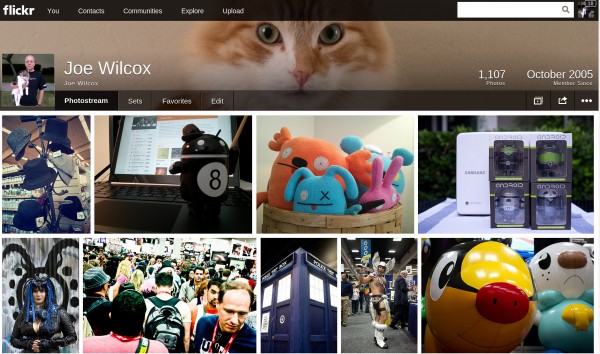
    Today colleague Wayne Williams asks: “What will it take for people to care about Yahoo again?” “May 20th” is my answer. On the same day that Yahoo bought Tumblr for a cool $1.1 billion cash, the rickety dot-com gave Flickr the biggest makeover ever. Subscribers get 1TB of storage, on a site suddenly beautifully modern and supported by a hot, Android app. Google CEO Larry Page, Mayer just thumbed her nose at you.

    Cloud before Many

    No one should underestimate Yahoo, which was cloud before anyone used the term to describe the kind of services the dot-com delivers. Like Google, college buddies founded Yahoo — in 1994. The company grew up with the World Wide Web. Mosaic Netscape, in beta, debuted the same year. The browser is gone, but the early web destination that David Filo and Jerry Yang founded remains.

    Yahoo is a survivor, long lacking leadership worthy of it. Perhaps Mayer is better answer to Wayne’s question. She assumed CEO responsibilities in mid July 2012. Days later, Wayne listed “8 things Marissa Mayer needs to do at Yahoo NOW“. So far, she has done nearly all, fulfilling “launch, or better yet buy, a great new product” and “make Flickr awesome again”, yesterday.

    I care about Yahoo again, and you should, too.

    • Yahoo is an iconic brand. The dot-com’s services are tenacious, popping up in the strangest places. My AT&T U-verse uses Yahoo for email and serves up Flickr on the big screen.
    • Yahoo is infrastructure — vast server farms, and experience running them going back decades. Few cloud companies today can make such a claim.
    • Yahoo is nostalgia. That’s a brand quality both nurtured and innate — the latter because of connotations associated with the name — and one remembered; many oldsters took Internet baby steps on Yahoo (no one admits to starting on AOL).

    What Yahoo isn’t: A clear digital lifestyle alternative to Apple, Google, Microsoft, Samsung or Sony, among others. But Yahoo can be, as it once was, the glue for many other companies needing cloud services to offer customers. That means making more Yahoo co-branded services available everywhere. The company could easily be the service uniting many digital lifestyle brands, while spreading its own far and wide. There is newfound opportunity, too.

    Google is increasingly a silo — that’s the real takeaway from last week’s developer conference. Rather than release a new Android version, the search and information giant upgraded its apps and services. The approach tackles the fragmentation problem, by essentially upgrading Android’s core without revving another version that won’t reach the market for many months. But Google also steps back from so-called openness, by making more closed products (meaning not open source) the centerpiece of the Android experience.

    Yahoo is the quintessential horizontal company, even if its services aren’t necessarily open (by the purist definition). As Google goes vertical, space opens for a competitor to fill the gap. Yahoo has the chops and infrastructure, whether technical or logistical (including branding and marketing).

    Old Dog Learns New Tricks

    The massive Flickr makeover and Tumblr acquisition put fresh paint on the Yahoo brand. Big as they are, Mayer and her team face a daunting task. Yahoo needs a better mobile strategy and must cross-integrate more services, starting with the photo-sharing site and social network. The portal sucks and reminds everyone of the Yahoo we all grew to loathe. The same applies to Messenger. Every property must look as good as the new Flickr and offer as many benefits.

    Most importantly, Mayer must recover search from Microsoft. Four years ago, I called Yahoo’s search deal with Microsoft a gift to Google and accused the dot-com of giving up its crown jewels. Yahoo must take them back and reinvigorate the business model Google perfected, but did not pioneer. Yahoo was a search leader long before there was a Google and in 2003 acquired Overture, which pioneered the keyword search business that Page and Company imitated.

    But search separation must be surgical, done over time. Fracturing Bing and Yahoo could create more opportunities for Google, and during the transition lead to even greater market share gains. Perhaps a new partnership is workable, where Yahoo regains its crown jewels but works with Microsoft on co-branded search.

    Mayer clicks the right boxes, particularly the acquisitions that fill in gaps Yahoo desperately needs to fill. The stake in Dailymotion made sense (too bad about those French regulators). But there are nearly a dozen other acquisitions, since she assumed her duties. Be sure that she’s only just started shopping.

    Somebody likes what Mayer is doing. Since August 31 through mid-day trading today, Yahoo shares are up 85 percent. Flickr and Tumblr are reasons to get really excited. Something to think about: Flickr is as much social network as photo-sharing site. Long before Facebook opened to the public or Google waved the Plus flag, there was Flickr — one of the oldest, thriving social networks. Tumblr makes Yahoo social all the better.

    Yesterday, I uploaded a bunch of photos to my Flickr, about which I am really excited after long hiatus. My Tumblr will get a fresh makeover and postings sometime this week. Suddenly, I care about Yahoo again. You should, too.

    Hey, Marissa. Make us proud and buy Vimeo. You need a web browser, too. But mostly you need to stay the course started.

  • Banderas To Play ‘Super Mario’ In Upcoming Film

    Antonio Banderas will portray “Super Mario” in an upcoming film. No, it’s not a Super Mario Bros. reboot, but a film about the 33 Chilean miners who became trapped for over two months back in 2010.

    Mario Sepúlveda (aka “Super Mario”) is considered the public face of the 33 men. That is, according to 33miners.com, a blog chronicling the activities of the men after being rescued.

    The film is called “The 33,” and is expected to be released in 2014. It’s being directed by Patricia Riggen, whose previous work includes: Girl in Progress, Lemonade Mouth, Revolución (segment “Lindo y querido”), Under the Same Moon, Family Portrait (documentary short) and The Cornfield (short).

    The film’s description (IMDB) is simply: “Thirty-three miners are trapped in a collapsed mine shaft for more than two months.”

    The 33 is written by Mikko Alanne and Jose Rivera. Alanne’s writing credits include 5 Days of War, History Undercover: Terror Strikes Moscow, Voice of Dissent (documentary short), Breaking Dawn (short) and Sleep, the Monster Whispered (documentary short). Rivera’s include On the Road, Letters to Juliet, The Winged Man (short), The Tape Recorder (short), Trade, The Motorcycle Diaries, and The Jungle Book: Mowgli’s Story, to name a few. He also did an episode of Family Matters.

    Leopoldo Enriquez and Carlos Eugenio Lavin are serving as executive producers and Edward McGum and Mike Medavoy are producers. Carla Hool is responsible for casting.

    The addition of Banderas as Super Mario was announced at the Cannes Film Festival.

  • Leaked benchmarks suggest Intel could power Samsung’s Galaxy Tab 3 10.1

    Intel may be poised to get its silicon inside Samsung’s popular brand of Galaxy tablets based on online benchmark test results. The GFXBench site, which gathers user-submitted device performance test data from a benchmark app, shows a “Samsung Santos 103″ tablet with the product designation GT-P5200 running Android on an Intel Clovertrail chip. The various product designations all allude to Samsung’s third-generation Galaxy Tab 10.1 slate.

    T-Mobile Galaxy Tab 10.1According to the testing details, the device in question uses a 1280 x 800 display and is running Android 4.2.2. The processor can run between 800 MHz and 1.6 GHz clock cycles and uses a PowerVR 533 for graphics, which fits the bill as an Intel Atom chip, possibly the newest CloverTrail+ that Intel recently announced.

    So does this particular device perform? Based on the benchmarks: Quite good. Here’s a comparison of the graphics performance of the tested Galaxy Tab 3 and last year’s Galaxy Tab 2 model, for example.

    Galaxy Tab 3 test

    And SamMobile recently noted a different benchmark test of the Tab 3 using the Antutu test, finding that the device scored the highest ever for an Android tablet in terms of overall performance.

    So why would Samsung, which makes it own chips for smartphones and tablets, consider an Intel inside its newest Galaxy Tab? Samsung could be keeping the Exynos for its own handsets, such as the new Galaxy S 4, because it sells more handsets than tablets. The company’s tablets wouldn’t like suffer any performance hit by using Intel’s silicon either; at least not if the early benchmarks are valid.

    If Intel’s Atom does power the Galaxy Tab 3, it would be one of the biggest mobile design wins yet for Intel. The chipmaker does power a few smartphone products, but hasn’t yet cracked the U.S. market with a top-tier hardware partner such as Samsung.

    Related research and analysis from GigaOM Pro:
    Subscriber content. Sign up for a free trial.


  • Meta, The World’s First Entry-Level AR Glasses, Hires The Father Of Wearable Computing As Chief Scientist

    e0a9a95c6682ab3898a0013b9caee78a_large

    The Meta 1 is a pair of augmented reality goggles that performs some very unique and useful tricks. While they are still in beta stage, the glasses are coupled with a Kinect-like camera to sense objects in real space and allow users to interact with virtual worlds with the swipe of their hand.

    The company founder, Meron Gribetz, says that the company is on track to create a mass produced solution shortly, but until then they have brought on Steve Mann, a real cyborg and wearable computing researcher, to act as a chief scientist. You’ll recall that Mann was assaulted in a Parisian McDonald’s for wearing a Google-Glass-like headset.

    “We brought Mann on board because of his expertise in two key areas: miniaturization and mediated reality. Mann has been developing a Google Glass-like device for years but recognized now was not the right time for something of that scale, because of the limitations of such a device. Rather than a phone accessory, Mann is keen to work with us to develop a fully fledged new interface for computers,” said Gribetz.

    “His scientific leadership in mediated reality will be a huge advantage for us when delivering an immersive augmented experience. Occlusion (hiding or modifying real world objects) is a key part of full augmented reality and Mann’s experience in mediated reality will allow us to bring the best solution to market in this area.”

    Gribetz is a Y Combinator alum and the project, which is still on Kickstarter, is nearly funded with 26 days to go. Users can receive a Dev Kit for $550. Epson will help build Meta’s next-generation VR glasses which will look considerably less DIY than the beta developer version.

    “The entrance into consumer wearables needs to be a high powered immersive device capable of fully replacing the computer and more. Heads up notification systems have their use cases, but they won’t be game changers. Mann’s commitment to a fully wearable future is why he chose to join us,” said Gribetz. Considering Mann has been wearing his computing power for most of this decade, it seems like a good fit.

  • The future is mobile

    Smartphone Tablet Sales
    “Mobile is eating the world,” according to industry analyst Benedict Evans. Ahead of a presentation to be given later this month at Book Expo America, Enders Analysis’ Benedict Evans published a draft of his slide deck. The presentation paints a wonderfully clear picture of where industry growth has come from over the past few years thanks to companies like Apple and Samsung, and where it will likely continue to come from over the next few years. In a word: mobile. Several charts in the deck to a good job of illustrating the mobile explosion, which ramped up in 2010 as PC industry growth started to flatline. A few particularly interesting slides follow below, and Evans’s full presentation can be viewed on his blog.

    Continue reading…

  • MacFarlane Won’t Return For Oscars, Tweets To ‘Traumatized Critics’

    Comedian Seth MacFarlane will not be returning to host the Oscars. He does have some suggestions for the role, however. On Monday, MacFarlane tweeted the following:

    This doesn’t come as much of a shock, as MacFarlane indicated back in February that he wouldn’t host the Oscars again.

    MacFarlane’s Oscars ceremony was the most controversial one in recent memory, thanks to things like songs about celebrities’ boobs, but the ratings were there, so it would not be out of the question for the Academy to want him back. According to reports, the broadcast was up 20% over the previous year in the 18-49 raring. It was also 3% higher in overall viewers, hitting 40.3 million.

    Despite the controversy, MacFarlane’s performance had plenty of fans as well. Just look at the reactions to his February tweet about not returning.

  • 18-year-old’s invention can recharge a cell phone in 30 seconds

    Cell Phone Charging Tech
    A teenager from Saratoga, California took home one of the top prizes at the Intel International Science and Engineering Fair late last week after showing off her invention, which can fully charge a cell phone in 30 seconds or less. Eesha Khare was given the Intel Foundation Young Scientist Award and a $50,000 prize for being runner-up in the competition, which was won by a 19-year-old who unveiled a new spin on self-driving car technology. Khare’s battery technology requires a new component to be installed inside the phone battery itself, and Intel notes that it also has potential applications for car batteries.

  • Brrr: The chilly conditions that quantum computers need to run

    The quantum computers that Lockheed Martin and Google are buying — and that startup D-Wave is building — have some pretty extreme operating conditions: they need to run at near zero temperatures for the quantum effects to work.

    Investor Steve Jurvetson next to a pulse fridge that cools a D-Wave quantum computer

    Investor Steve Jurvetson next to a pulse fridge that cools a D-Wave quantum computer

    As you can see in this photo from venture capitalist Steve Jurvetson, D-Wave uses a pulse fridge to cool the quantum computer to .02 degrees above absolute zero, and they use Helium-3 in the cooling process.

    Quantum computers use a different type of processing compared to traditional computing. As GigaOM’s Jordan Novet explained it earlier this year, “rather than working with binary yes-or-no questions — ones and zeros — quantum computing is more probabilistic, also allowing a combination of zero and one to simultaneously answer many questions with quantum bits of information, or qubits, and tell users more about the likelihood of a situation. It’s not necessarily useful for all kinds of computing, but it could solve problems that current computers can’t.”

    Keeping quantum computers that can perform such functions cool can be a tricky process. It’s highly energy intensive and can get expensive. But if the quantum computers are not cooled down the molecules — which are being manipulated to store data — move around chaotically and can’t be manipulated and read.

    Earlier this year physicists at UCLA developed a new cooling process that immerses charged barium chloride molecules into a super cold cloud of calcium atoms. That research is being funded by the Army Research Office and the National Science Foundation.

    Related research and analysis from GigaOM Pro:
    Subscriber content. Sign up for a free trial.


  • Can Yahoo Keep Its Promise Of Not ‘Screwing Up’ Tumblr?

    On Monday, Yahoo announced that it has signed an agreement to acquire the massively popular social blogging platform Tumblr for $1.1 billion. Like most major Internet acquisitions, the move has proven controversial.

    Is this acquisition going to be good or bad for Tumblr users? Good or bad for Yahoo? Let us know what you think in the comments.

    Even before the acquisition was announced formally, a lot of users who got wind of the deal started jumping ship to alternative platforms. WordPress Founder Matt Mullenweg wrote a blog post on Sunday night about a huge spike in imports from Tumblr.

    “Imports have actually spiked on the rumors even though it’s Sunday: normally we import 400-600 posts an hour from Tumblr, last hour it was over 72,000,” he wrote.

    He later updated the post to say that some people are reading too much into those numbers, adding, “I don’t think there will be an exodus from Tumblr.”

    In the comments section, he said, “I don’t think there will be any sort of exodus from Tumblr. For most folks habits overcome internet-outrage. Even if a million people left, that’s just about a week’s worth of signups.”

    We haven’t seen an update on the number of imports now that the deal has been officially public for a day, but my guess is that it has increased significantly.

    A petition to “Stop Yahoo! from Buying Tumblr” quickly racked up nearly 169,000 signatures. Of course there is no way that this will actually keep the deal from happening, but it does show that there is a great deal of discontent among users (and you have to think there are many more with a similar attitude who did not bother to sign, or even see the petition).

    User concerns have ranged from “Yahoo is going to make Tumblr uncool” to “Yahoo is going to clutter up Tumblr with ads” to “Yahoo is going to eliminate porn on Tumblr” among other things.

    Yahoo and Tumblr have both indicated from the start that they “promise not to screw it up”. Here’s a line straight out of the press release:

    Per the agreement and our promise not to screw it up, Tumblr will be independently operated as a separate business. David Karp will remain CEO. The product, service and brand will continue to be defined and developed separately with the same Tumblr irreverence, wit, and commitment to empower creators.

    Yahoo says Tumblr will deploy Yahoo’s personalization technology and search infrastructure to “help its users discover creators, bloggers, and content they’ll love”. This could actually be a good thing for Tumblr, as its current content discovery features could use a great deal of improvement.

    “Tumblr is redefining creative expression online,” said Yahoo CEO Marissa Mayer. “On many levels, Tumblr and Yahoo! couldn’t be more different, but, at the same time, they couldn’t be more complementary. Yahoo is the Internet’s original media network. Tumblr is the Internet’s fastest-growing media frenzy. Both companies are homes for brands – established and emerging. And, fundamentally, Tumblr and Yahoo! are both all about users, design, and finding surprise and inspiration amidst the everyday.”

    “Our team isn’t changing,” said Tumblr CEO David Karp. “Our roadmap isn’t changing. And our mission — to empower creators to make their best work and get it in front of the audience they deserve — certainly isn’t changing. But we’re elated to have the support of Yahoo! and their team who share our dream to make the Internet the ultimate creative canvas. Tumblr gets better faster with more resources to draw from.”

    His statements in a blog post were a little more colorful.

    So, let’s address some of those concerns users have.

    1. Will Yahoo make Tumblr uncool?

    Well, this is obviously subjective. To some, simply being part of a major corporation makes you uncool. It certainly didn’t help Myspace. Yahoo itself hasn’t exactly been considered “cool” by portions of the Internet in recent years either, however, the company is making a lot of moves (particularly since Mayer took over as CEO) to change things. That includes some big acquisitions and some new apps.

    In fact, even since the Tumblr announcement, Yahoo announced a major revamp of its popular photography service, Flickr. This is a property that has historically had a massive following, and has remained one of Yahoo’s bright spots throughout the dark times, but through the revolving door of CEOs in recent years, many think Flickr has been neglected. Well, no more. You can read about the new experience here.

    Other recent Yahoo acquisitions include: Loki Studios (mobile gaming), MileWise (travel search), GoPollGo (real-time surveys), Astrid (productivity), Summly (news aggregation/summarization), Jybe (social recommendation), Alike (social recommendation), Snip.it (social), OnTheAir (video chat) and Stamped (recommendation). These are all under Mayer. Tumblr makes 11 acquisitions (or at least announcements) since October. The company made only that many from February 2008 all the way up to this past October, with the last one before October coming in November, 2011.

    So while it remains to be seen if Yahoo can truly become cool again, it is at least trying its damnedest, and spending a lot of money to do so. Whether that translates into making Tumblr uncool, I guess we’ll just have to wait and see.

    Hunter Walk, the director of Product Management at Google, who focuses on YouTube, wrote an interesting blog post called, “Don’t Mess Up Tumblr: Five Lessons Learned From YouTube”. In a nutshell, his lessons are: protect Tumblr from “helpful” Yahoos, avoid locality bias in product development, stop short term monetization that won’t scale, infrastructure (tech, process) on Tumblr terms, and separate identity/separate space.

    “When Google purchased YouTube there was lots of skepticism and outright derision,” Walk recalls. “Today analysts estimate its enterprise value is approaching $20 billion. So I guess it all worked out, eh? Being one of the first Googlers to join YouTube after the acquisition taught me a lot about what works, and doesn’t work, when you bring a fast growing community property into a larger entity. There are clearly parallels between our situation in 2007 and what Tumblr will experience with Yahoo. Marissa is a friend from our time together at Google and I’m impressed, but not surprised, by her decisiveness and vision. I don’t know David Karp but we share a number of mutual friends and at a 2012 group dinner he passed me the salt, so we’ve got that.”

    He goes on to elaborate on each of the lessons.

    2. Is Yahoo going to clutter up Tumblr with ads?

    I guess it depends on your definition of clutter, but it does look like Tumblr will be getting some new ads. At least one report indicates that they could come as soon as today.

    Mayer said flat out in the announcement that the two companies will be working together to create advertising opportunities that are “seamless and enhance user experience”.

    Business Insider has some more from the conference call about deal:

    Mayer says that Yahoo released “Yahoo Stream Ads” in May, which take text ads and put them in the news stream on Yahoo.com. She says you can expect more of that on Tumblr. On Tumblr, there is the dashboard, which is like Facebook’s News Feed or inbox. Today, Tumblr does some advertising there. Yahoo would like to “introduce a very light ad load” there. Yahoo also might work with some bloggers who want ads on their blogs. That would only be done with permission. Mayer says the ad units will be native and follow the form and function of Tumblr. She says that you can tell interests of users.

    In fact, Business Insider also managed to obtain Tumblr’s ad sales pitch deck describing the ad experience to potential clients.

    “With Tumblr’s newest ad product, brands finally are front and center, with the world’s greatest creators,” one of the slides says. “Welcome to the richest content stream in the world.”

    According to the pitch deck, the ads will be delivered directly in the native dashboard streams of millions of users. The “Web In-Stream” product is in beta, and Tumblr is offering an exclusive launch partnership opportunity to a handful of select brands for the ad unit’s debut, according to the slides, which say that all Tumblr post types are supported. Partners are apparently being offered category-exclusivity.

    For $200K, according to the slides, partners can get ten desktop Radar posts within a 30-day span (between May 21 and July 21), 24 hours each for 5% of all Dashboard page views, support from the Tumblr team, U.S. guaranteed impression serving only, over 25 million dashboard impressions ($8.00CPM on Radar impressions), and multi-week exposure as premier sponsor in Spotlight. They also get ninety-day access to Tumblr Analytics and three weeks as an exclusive beta in-stream launch sponsor partner with ten in-stream posts within a 21 day span (June 1 and June 21).

    Regardless of what users think of the ads, businesses will certainly have new opportunities with Tumblr’s massive audience.

    3. Is Yahoo going to eliminate porn on Tumblr?

    Regardless of whether or not you consider porn to be a taboo subject, it makes a big difference in Tumblr’s stats. Tumblr is full of it. If Tumblr gets rid of it, it’s going to drive away some percentage of users, not to mention become less cool to some percentage of users.

    Mayer was asked about it at the Flickr event on Monday evening. She said they will not censor content. “No, we won’t,” she is quoted as saying. “It’s the nature of user-generated content.”

    It doesn’t stop YouTube, but, Mayer probably earned some “cool” points with that one.

    Tumblr currently has over 300 million monthly unique visitors, and gets 120,000 signups every day. It sees 900 posts per second and 24 billion minutes are spent on the site each month. Over half of its users are using the mobile app, and on average, participate in seven sessions per day. Yahoo expects the acquisition to grow its audience by fifty percent to over a billion monthly visitors, and to grow traffic by about twenty percent.

    The acquisition is subject to customary closing conditions, and is expected to close in the second half of the year.

    Was this a good acquisition for Yahoo? Will this hurt or benefit Tumblr users? Can Yahoo become cool again? Is Yahoo already cool again? Let us know what you think in the comments.

    Image: NMA (YouTube)

  • Powermat marries PowerKiss, vows to use same wireless charging standard

    Travelers between the U.S. and Europe have one less barrier to deal with when it comes to wireless charging a mobile phone or tablet. Powermat, a joint venture with Duracell, and Helsinki-based PowerKiss reconciled their differences and became one on Tuesday. The two wireless charging companies previously used incompatible technologies, but are both committed to the PMA standard and will be combined under the Powermat Technologies name.

    Powermat triple

    Between the two, they have more than 2,500 wireless charging installations at public locations such as airports, coffee shops, malls and arenas. PowerKiss recently added some charging mats at select McDonalds Europe locations. The idea behind these installs is to allow customers to place their mobile device on a wireless charging pad and add juice to the battery. Of course, the device has to natively support wireless charging, such as Nokia’s Lumia 920, or be compatible with an add-on product such as a wireless charging cover.

    Overall, the ability to recharge a device by placing it on a special mat really hasn’t taken off with the mainstream public. Part of the reason is a battle over the technology standards: If you have a device that supports wireless charging but doesn’t work with a compatible charging mat, you’ll have to plug in your device, of course.

    PMAPowermat Technologies is part of the PMA, or Power Matters Alliance, which boasts that 80 percent of its partner members represent the entire wireless install base. That sounds good, so what’s the issue?

    Well, there’s another body, the Wireless Power Consortium, that’s been at this longer than the PMA by about four years and uses the Qi-branded standard. Even worse: Some partners are members of both groups. So while the PMA gained a new member through marriage, there are still plenty of fish in the sea using a different wireless standard.

    Related research and analysis from GigaOM Pro:
    Subscriber content. Sign up for a free trial.


  • You Have To See This Incredible Video Of The Oklahoma Tornado Forming

    There has been a lot of terrifying imagery of the tornado that terrorized the Oklahoma City area on Monday, but this incredible video shows the formation of the storm in Newcastle, OK.

    “The birth of the May 20, 2013 tornado at Newcastle, OK. It Moved from there to Moore where it turned into an F4. God be with its victims,” says Charles Cook in the YouTube video description.

    The video is currently the top entry in reddit’s r/video subreddit, under the heading: “Incredible video my Dad took of the May 20th tornado FORMING and destroying everything in its path near Newcastle, OK (0-F4 in seconds)”

    User solvitNOW, who submitted it, says, “He was out that way for work today and just happened to be in the right place at the right time. He was worried it was going to come back at him and was searching for a way to scoot out it’s way once he was able to gauge how insanely close it was to him. He hung in there, though. Unbelievable.”

    See some photos of the aftermath here.

  • Video: Samsung’s Galaxy S4 Active leaks again

    Samsung Galaxy S4 Active Video
    After being revealed on camera for the first time on Monday in a series of leaked photos, Samsung’s unannounced Galaxy S4 Active has leaked once again. This time the upcoming smartphone has been given a quick preview in a video published by a MobileTechReview forum user. The S4 Active is a ruggedized version of Samsung’s popular Galaxy S4, featuring shock-proofing, dust-proofing and slightly less impressive specs; it looks like the phone will forego the global S4’s eight-core processor and will also include an 8-megapixel camera instead of the original model’s 13-megapixel unit. The video of Samsung’s Galaxy S4 Active follows below.

    Continue reading…

  • Oklahoma Tornado Photos Are All Over Reddit

    A tornado, which reached an estimated width of two miles at one point, ripped through Oklahoma on Monday afternoon, leaving at least 51 people (including at least 20 children) dead, and an enormous path of destruction in its wake. On Tuesday morning, emergency workers continue to search for more victims. Update: apparently some of the victims were somehow counted twice, and the death toll has been reduced to 24 confirmed (7 children).

    According to a recent update from CNN, personnel have rescued over a hundred people from the rubble in metropolitan Oklahoma City. According to CBS News, there are still two dozen missing children from an elementary school that was destroyed.

    Photos and videos of the tornado and its destruction have flooded social media, giving the whole world a glimpse of the terror that ripped through the area.

    Reddit, in particular, has a plethora of photos (mostly hosted on Imgur) of the aftermath. Here are a few of the top photos from the r/pics subreddit with their reddit headlines:

    Oklahoma City Tornado photo

    Teachers Carrying Elementary Students out of School Leveled by Tornado in Moore, Oklahoma (soonerguy11)

    Oklahoma tornado photos

    A teacher finds one of his students among the rubble caused by the tornado in Moore, OK (robbinsc).

    Oklahoma Tornado photos

    Picture taken in the tornado rubble in Moore, OK. (Fritoontheradio)

    Oklahoma Tornado photos

    My brother’s friend after the tornado standing in front of his former house. (stratola)

    Oklahoma Tornado photos

    Picture from my backyard of May 20th tornado that hit Oklahoma today. (BrokenRayn)

    More at reddit.com/r/pics, reddit.com/r/oklahoma, and no doubt countless other subreddits.

  • Is Bigger Better? Why Scale Matters in Data Center Economics

    dft-acc5-chillers-2-470

    The DuPont Fabros ACC5 data center in Virginia has 16 huge chillers to provide cooling to the data halls, which house servers for some of the Internet’s largest companies. (Photo: DuPont Fabros)

    ASHBURN, Va. – Hossein Fateh has a head for numbers. When the discussion turns to the cost of building and operating a data center, he can quickly run through the cost of individual line items in the cost equation.

    Fateh, the President and CEO of DuPont Fabros Technology (DFT), believes these numbers point to a huge shift ahead, as more companies shift their IT operations to third-party facilities built by developers that specialize in data center construction and operations. In a cost-averse world in which Internet growth is creating an explosion of demand for data center space, he believes the economics favor huge facilities operated by small teams of specialists.

    An example is ACC5, a data center here in Ashburn, Virginia which is more than 1,100 feet long, and has more than 36 megawatts of power – enough to power a small city. ACC5 is the largest building on a campus that houses thousands of servers for Internet giants such as Facebook, Microsoft, Yahoo and Rackspace – but only until the even larger ACC7 comes online next year at 41.6 megawatts.

    Few companies can afford to built 40 megawatt IT facilities to capture those operating savings. So DuPont Fabros will build them, and pass the savings on to their tenants. ”With operating expenses, our scale is a benefit to our clients,” said Fateh. “As our size grows, we have more and more buying power.”

    218 Megawatts of Server Power

    That power is growing steadily. DuPont Fabros operates more than 2.5 million square feet of data center space across four cities, providing 218 megawatts of electricity to power their tenants’ Internet and IT operations. It is one of a small but growing group of companies that provide “wholesale” data center space, consisting of pre-built suites of raised-floor space to house servers.

    This approach has won over some of the largest Internet players, companies like Apple, Facebook and Rackspace that comprise the new breed of “super wholesale” users -companies that have the capability to build their own data centers, but have opted to lease server space, swayed by the economics of buying versus building.

    The big question: having proven itself with large tenants, can the wholesale model win over the legions of enterprise companies that build and maintain their own data center space? The wholesale players compete vigorously with one another for major deals, but they say the largest untapped audience is the companies that operates their own facilities, often on corporate premises or in small stand-alone facilities.

    Culture, Compliance are Resistance Points

    These companies have many reasons for sticking with in-house data center operations, including the need to control digital assets tied to compliance requirements and mission-critical business operations. There are also cultural issues, including in-house IT staff perceiving third-party providers as threats to their role in the organization.

    These are powerful influences. But enterprises have been rethinking past assumptions in recent years, as the financial shock of 2008 and the emergence of cloud computing have prompted C-suite executives to consider a broader set of options for data center operations. That includes both “retail” colocation and wholesale data center space, as well as public cloud services.

    Fateh believes large wholesale data centers can offer economies of scale that few companies can achieve. DuPont Fabros builds its massive facilities for between $7 million and $8 million per megawatt, well below the $12 million to $20 million per megawatt seen in smaller enterprise projects. The area where scale really kicks in is in operating costs, particularly as multi-tenant buildings expand beyond 18 megawatts.

    Economics Improve as Scale Increases

    “Our operating costs will go down when the Phase II of the asset leases up,” said Fateh. “So we may have, for example, labor of six people handle the entire Phase I of one of our data centers. When we double the size of the building and go to Phase II, we may only increase by one additional person, meaning seven DFT staff plus security, and that labor force is spread over 36.4 megawatts. So when you look at the operating costs, when we hit the Phase II, the operating costs of the building drop.

    “We show that to some of our tenants, and they very much appreciate it,” he said.

    But will those savings convince enterprises to give up their in-house data centers are move their gear into third-party space? Thus far wholesale data center space has leased more slowly in geographic markets that are heavy on enterprise users, such as New Jersey, where DuPont Fabros has struggled to attract tenants for a large facility in Piscataway. Part of the reason for that, Fateh says, is that enterprises simply have a longer decision-making cycle.

    “In New Jersey, we’re dealing with maybe 15 people making a decision within that company,” Fateh said. “And instead of two or three tours, we may have 10 tours of the same tenants before they make a decision. Much of the growth in the three of our four markets is revenue-driven, if the tenant doesn’t have additional data center space, it will impact revenue. In the New Jersey market, many of the tenants’ decision-making is solely surrounded on consolidation and trying to reduce cost by consolidating. So it’s a different tenant.”

    But Fateh says DFT is committed to the New Jersey market. In a cost-sensitive environment, Fateh says, the math is shifting in favor of buying instead of building.

  • Apple and Google to lead charge as wearable tech becomes $30-$50 billion market

    Wearable Technology Market Opportunity
    Recent estimates suggested devices like Google Glass and Apple’s upcoming “iWatch” could be the start of a wearable tech explosion that generates as much as $6 billion annually by 2016. According to newly published research from Credit Suisse, however, that estimate is ridiculously low. In a research note picked up by Business Insider, Credit Suisse analysts predict that the wearable technology market will balloon from the current $3 billion to $5 billion range to a whopping $30 billion to $50 billion in the next two to three years. The firm believes Apple’s upcoming iWatch will generate $10 billion annually on its own, and the growing health and fitness market will play a key role as well.

  • Devastating tornado in Oklahoma begs the question: Why don’t schools and families build tornado shelters anymore?

    A mile-wide tornado with 200mph winds tore through the suburbs of Oklahoma yesterday, killing 51 people and broadcasting a rude reminder of the fragility of human life and human civilization. Here at Natural News, our hearts go out to the family members of those killed…