Author: Serkadis

  • LA 2009: Subaru Impreza WRX STI Special Edition is sportier, less expensive

    Filed under: , , ,

    2010 Subaru Impreza WRX STI Special Edition – Click above for high-res image gallery

    So often, the tag of “Special Edition” comes with a not-so-special price increase. Fortunately for Subaru fans, the newly-introduced Impreza WRX STI Special Edition is actually less costly. At $32,995 it’s actually $2,000 cheaper than the base price of the standard STI.

    Of course, buyers of the Special Edition will have to go without certain features, namely HID headlights, premium audio, and automatic climate control. It’s not just a de-contented package, though, as the car also comes with the suspension from the spec C model in Japan that includes a thicker rear stabilizer bar, stiffer bushings and stiffer springs.

    Initially, each car will be painted in Aspen white with the charcoal-colored 14-spoke wheels also cribbed from the spec C. Just 125 examples will be built in the first quarter of 2010, although Subaru says that more will be available later in the year in additional colors. High-res gallery below, pricing press release available after the jump.

    Photos copyright (C)2009 Drew Phillips / Weblogs, Inc.

    Continue reading LA 2009: Subaru Impreza WRX STI Special Edition is sportier, less expensive

    LA 2009: Subaru Impreza WRX STI Special Edition is sportier, less expensive originally appeared on Autoblog on Thu, 03 Dec 2009 12:29:00 EST. Please see our terms for use of feeds.

    Permalink | Email this | Comments

  • In Vitro Meat

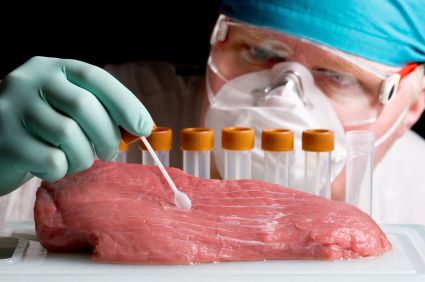
    testtubemeat In Vitro MeatWhen Winston Churchill, in the 1932 essay “Fifty Years Hence,” mused that “we shall escape the absurdity of growing a whole chicken in order to eat the breast or wing by growing these parts separately under a suitable medium,” he may have been more prescient than credited. Alexis Carrel had already been keeping a cultured chunk of chicken heart “alive” in a Pyrex flask for the past twenty years by feeding it nutrients (though Carrel was only interested in whether cell death was inevitable, not whether meat could be grown in a lab for human consumption). Sci-fi author Frederik Pohl was one man who took the idea of in vitro meat seriously enough to write about it – in the novel The Space Merchants, where cultured meat is the primary source of protein. That was science fiction, sure, but most good sci-fi is borne of the author’s honest opinion of what the future might hold and it’s usually inspired by the scientific advancements of the day. And sometimes, science fiction comes true. Like this time.

    Dutch scientists were able to grow pork in a lab test tube. They extracted myoblast cells from the muscle of a living pig, incubated them in a piglet fetus-blood-nutrient solution, and got “a soggy form of pork.” No one’s tried the “pork” due to lab rules, but it’s derived from the same myoblast cells that generate muscle in response to tissue damage in an actual animal – ideally, this would taste exactly like pork muscle meat. They’ve even got plans to “exercise” the tissue, which could conceivably do away with the sogginess and provide a meatier chewing experience.

    The Dutch scientists weren’t the first; four years ago, a research paper detailed plans to engineer in vitro meat on a massive, industrial scale, and others have been trying in vain for years to produce a decent lab-grown steak. The soggy pork is perhaps the closest they’ve gotten. Every researcher runs into a couple basic issues. First, there are generally two accepted methods for growing in vitro meat: the generation of either loose muscle cells or structured, “real” muscle. The latter is the ideal path, because it might make cohesive cuts of meat possible, but it’s also the most challenging. Real muscle growth depends on perfusion, or the delivery of arterial blood bearing nutrients to biological tissue, and a similar system might be required for “real” lab grown muscle. Until then, only thin sheets of muscle meat have been grown. These can be compressed into meat sheets or ground up, but a three-dimensional, juicy rare steak is still far off. The easy way out is to grow loose muscle cells, but unless you’re prepared for a future of unrecognizable meat products, you might want to wait for that soggy pork to firm up.

    Where do I stand on the idea of in vitro meat? Well, I’m more than a little skeptical as you might imagine. Natural animal reproduction already does a pretty good job at growing meat, and major deviations from the natural order have a spotty track record. Big Pharma, for example, represents one big attempt after another to replace the natural order. It gets things right from time to time – I won’t argue against that – but it also creates unnecessary products that purport to protect patients from conditions that could otherwise be handled through lifestyle modifications. Both Big Pharma and the in vitro meat researchers are trying to understand incredibly complicated physiological processes that took millions of years to develop naturally. The vast interplay between hormones, nutrients, and environmental factors (including exercise, diet, and drugs) in the human body is difficult – if not impossible – to parse, but that’s exactly what medicine tries to do. When you take a drug, you’ve got to hope pharmacists took every possible factor into account. They can make educated guesses, and they’re often right, but not always. Statins, as prescribed, do a helluva job at lowering cholesterol (a pretty pointless gesture, but they do what they say they’ll do – note that they don’t promise reductions in actual heart disease), but they do so by interrupting the same passages used by other important bodily players – like CoQ10. It’s a complex thing, the human body.

    Animal bodies are no different, and a steak isn’t just a matrix of muscle cells. It’s got fat (several kinds!), blood vessels, collagen, and different textures (which depend on the activity level of the animal; the lab meat cubes better have access to treadmills). Nutrients have to be shuttled in and waste out (grass-fed in vitro meat?). If you want a real steak with a bloody center, how is that achieved in the lab? Blood pockets? What’s the blood made of? What if I want a cowboy ribeye, bone-in – are they trying to grow bone, too? And I worry about the saturated fat content. One scientist mentioned replacing the Omega 6s with Omega 3s, which sounds promising, but I can only think the next step is to replace the saturated fats with even more Omega 3s (or, shudder, canola oil). Will it even taste the same?

    At the same time, I remain open-minded. If they’re able to grow meat with perfect Omega 3/Omega 6 ratios, no hormones, no antibiotics, on a “diet” that recreates real grassy pasture, that tastes like meat, has the same texture as meat, the same saturated fat content as meat – I might be convinced to give it a shot. And if it’s cheaper than grass-fed meat, easier on the environment than industrial farming, and easy to produce on a mass scale without sacrificing quality, why wouldn’t I support it? Remember: I don’t glorify the ancestral, natural ways because they are ancestral and natural. It’s just that paying attention to evolution and being wary of modern “improvements” has paid off. The Primal Blueprint works. If in vitro meat works (and it’s proven beyond a doubt that it’s identical to real meat – a tall order, I grant you), why shouldn’t we give it a shot?

    Still, I can’t help but doubt it. It’s not so much that I’m wary of processed food, because perfect in vitro meat that recreates actual meat is theoretically different than HFCS, boxed goods, and industrial vegetable oils, and it has the potential to revolutionize food (you mean I get to eat a black panther steak? Sign me up!); it’s that following the natural order has been so good to me. I eat according to human evolution, I exercise in accordance with my body’s design, and things have generally worked out well. Eating real steak raised the way it was intended to live has also worked out okay. I’ll keep my real meat for now and watch warily from the sidelines, curious and always skeptical.

    Both Pohl and Churchill were undoubtedly inspired by Carrel’s experiment, but the prevailing public opinion was that the decades-old chicken heart was an abomination. It still lived when Carrel died, 28 years later, but the experiment was soon halted. If it weren’t for the negative public reaction, that chicken heart might still be pumping today. I suspect the initial public reaction to in vitro meat would be pretty similar, but what do you think?

    Note: There is a poll embedded within this post, please visit the site to participate in this post’s poll.

    If no, what would it take to convince you? Anything? Is there any possible scenario in which in vitro meat is a good thing for this world? Share your thoughts in the comment section!

    Get Free Health Tips, Recipes and Workouts Delivered to Your Inbox

    Related posts:

    1. Meat Lover’s Guide to Marinating Meat (plus 10 Primal Marinades)
    2. Raw Meat
    3. Did Grok Really Eat That Much Meat?

  • India Announces That it Will Reduce its Carbon Emission Intensity by 20-25% by 2020 from 2005 Levels

    800px-Tea_garden_in_dooars

    2009Dec3: India announces that it will reduce its carbon emission intensity by 20-25% by 2020 from 2005 levels by doing the following: imposing mandatory fuel efficiency standards for all vehicles by December 2011; enacting a building code that encourages energy conservation; passing amendments to laws to reduce energy intensity of industrial activities; monitoring the state of the forests; and adopting clean coal technologies (The Times of India).

    Reference: The Times of India http://timesofindia.indiatimes.com/india/Indias-2020-target-Reduce-emission-by-20-25/articleshow/5297073.cms

    Image Description: Hila Tea Estate, Jalpaiguri district, West Bengal, India. Photo by Rajibnandi, 2007June29. Image Location: Wikimedia Commons http://commons.wikimedia.org/wiki/File:Tea_garden_in_dooars.jpg Image Permission: This file is licensed under the Creative Commons Attribution ShareAlike 3.0 License. In short: you are free to share and make derivative works of the file under the conditions that you appropriately attribute it, and that you distribute it only under a license identical to this one. Official license.

  • Eric Schmidt Goes on the Offensive in the Google versus Newspapers Battle

    There’s been plenty of ink spilled, so to speak, over the whole Google versus newspapers debacle yet, for the most part, the search giant has been calm and unperturbed satisfied to issue out the occasional “you can always de-index” argument. Not anymore, it seems, as Google is on an all-out offensive, though usually with a peace offering at the same time, the latest of which comes straight from the man up top, Eric Schimidt. The CEO is making a case for the company with an op-ed in the News Corp.-owned Wall Street Journal of all places.

    He doesn’t really come out with anything new in the lengthy piece but he does go through all of the main arguments the company has been making for a while, Google doesn’t really make that much from news content, it’s not “stealing” the content and is actually sending news sites a lot of free traffic.

    “With dwindling revenue and diminished resources, frustrated newspaper executives are looking for someone to blame. Much of their anger is currently directed at Google, whom many executives view as getting all the benefit from the business relationship without giving much in return. The facts, I believe, suggest otherwise,” Schmidt starts off by acknowledging the problems the industry is facing.

    Even tho… (read more)

  • Martyn Day – Paul Hoffman speaking on: “Human rights lawsuits against companies – our experiences with victims, their families and businesspeople”

    Business & Human Rights Resource Centre is pleased to invite you to an event featuring leading human rights lawyers: Martyn Day (UK) & Paul Hoffman (US). Both have brought landmark lawsuits against companies. They will be speaking on the same stage for the first time, and fielding questions from the audience.

    Martyn and Paul will share: highlights of past cases; inside view of current cases; comments on what more should be done to hold companies accountable under law; and what they would say to companies wishing to avoid such lawsuits.

    This event is not only for lawyers – it is equally for those from NGOs, business, government, media, investment firms, academia, etc – for anyone with an interest in human rights.

    Martyn Day has brought human rights lawsuits against a number of companies during his career, including:

    . Trafigura over dumping of toxic waste in Côte d’Ivoire;

    . Cape plc & Gencor on behalf of South Africans suffering from asbestos-related diseases;

    . BP on behalf of Colombian farmers alleging severe environmental damage to their lands; Anglo American (re South Africa);

    . Thor Chemicals (re South Africa);

    . Gallaher & Imperial Tobacco (on behalf of lung cancer victims).

    Martyn is Senior Partner of London-based Leigh Day & Co Solicitors; he is also a Director of Greenpeace Environmental Trust. The Times named him one of the UK’s most powerful and influential lawyers. Chambers said of Martyn: “He has a ‘phenomenal’ reputation in public law, environment and personal injury.”

    Paul Hoffman has brought lawsuits against companies including:

    . multinationals that allegedly supplied critical support to South Africa’s government during apartheid;

    . Shell for alleged complicity in the Nigerian military government’s summary execution of Ken Saro-Wiwa and 8 others;

    . Unocal for alleged complicity in abuses by the Burmese military;

    . Bridgestone-Firestone (re Liberia);

    . Chevron (re Nigeria);

    . Occidental Petroleum (re Colombia);

    . Talisman (re Sudan);

    . Wal-Mart (re various countries).

    Paul is a partner at Schonbrun, De Simone, Seplow, Harris & Hoffman LLP, a law firm in California. He was named one of the 100 most influential attorneys in California, received the Clarence Darrow Award for outstanding First Amendment advocacy, and has argued cases before the U.S. Supreme Court. He previously was Legal Director of the American Civil Liberties Foundation of Southern California, and served as Chair of Amnesty International.

    Please RSVP to Joe Westby: westby business-humanrights.org; phone +44 20 7636-7774. Please forward this invitation to others who may wish to attend – they should contact Joe Westby to reserve a space.

    Business & Human Rights Resource Centre

    This is the Business & Human Rights Resource Centre’s third annual event in its “Sir Geoffrey Chandler speaker series”, named for Sir Geoffrey’s pioneering work in the field of business & human rights. Resource Centre staff and trustees would be pleased to see you at this event.

    The Resource Centre tracks the human rights impacts (positive & negative) of 4500 companies in over 180 countries, seeks responses from companies when concerns are raised by civil society, and provides tools and resources for everyone working in this field. The Centre’s Corporate Legal Accountability Portal highlights significant human rights lawsuits against companies in all parts of the world.

    The Resource Centre is a registered charity in England & Wales, and a tax-exempt non-profit in USA. Our mandate, requiring complete independence, prevents us from accepting donations from companies or corporate foundations. Donations from individuals are therefore particularly important in enabling us to continue our work and convene events like this. Please consider an online donation, or sending a cheque to our London or New York office payable to “Business & Human Rights Resource Centre”. Any support is greatly appreciated.

    Event details:

    Time: Thursday 3 December 2009

    6:00pm Arrival

    6:15-7:45pm Presentations – Questions & answers

    Followed by reception (light refreshments — Friends House does not allow alcohol on the premises)

    Place: Friends House (Large Hall), 173-177 Euston Road (opposite Euston Station), London NW1 2BJ

    Nearest underground stations are Euston and Euston Square. King’s Cross underground and St Pancras International Terminus are a 10-minute walk.

  • More Estavillo subpoenas – Lady Sovereign and Krayzie Bone

    Erik Estavillo banned Resistance player, lawsuit spammer, and adding to that list celebrity subpoena spammer. The plaintiff of the year promised not to make any more lawsuits, but he didn’t say anything about his notable

  • Three reasons to list CMIS in your Document Management RFP

    First off let me state boldly and clearly CMIS is an important document management (a.k.a., ECM) standard, the most important standard. But if your world is solely one of HTML and CSS then you can stop reading right here…

    CMIS (Content Management Interoperability Standard) was recently ratified by OASIS and is already appearing in many RFPs. Nevertheless, it is a little misunderstood by some, and at times gets overlooked or misplaced. So here are three concise and valid reasons for putting CMIS on your list of RFP requirements.

    1) If you have legacy document repositories, add CMIS to your list of requirements.

    Almost every large organization has a collection of legacy DM and ECM repositories, closing those down or migrating content out of them can be tortuous and expensive, sometimes near impossible. Building a CMIS interface and federating access and viewing (no matter how basic) may well be your best option.

    2) If the system you buy  has a CMIS API, then you go some way to avoiding vendor lock-in at a future point.

    CMIS in and off itself cannot resolve all the issues of vendor lock tricks, but its a great step in the right direction.

    3) (And don’t underestimate the value of this one) You demonstrate to the vendors on your shortlist your intentions and industry savvy.

    When a vendor sees a specification or standard such as CMIS or XAM on an RFP they know you have done your homework, they know you are aware that committing to a vendors proprietary system can be difficult and costly, and that you intend to do what you can to mitigate against that risk.

    Let’s be clear about this, CMIS is important for the sole fact that it is simple (today) and should actually work. It does have the support of all the major vendors in the sector, but their enthusiasm can wane at the drop of a hat. Particularly as CMIS is a standard that empowers buyers and users of the technology, but not the vendors so much — so the only way to ensure its success is for buyers to demand compliance from product vendors.

    We work with buyers and users of document management and ECM technology every day. We help them construct RFPs, we shortlist and hand-hold our advisory clients and subscribers all the way from initial strategy through to the conclusion of the selection process. Our world is not one of expensive dinners at the vendors’ expense and optimistic market forecasting.  It is a world spent at the coalface. The global organizations we are working with are dealing with the dull and grinding issues that relate to legacy, integration, migration, and implementation.  For them, CMIS is no silver bullet, but it’s far better than nothing. And nothing is exactly what we had prior to CMIS.

  • App Store World Domination in 2010: 300,000 Apps Strong

    IDC is making some bold predictions for 2010, one of the boldest being a tripling of the number of applications at Apple’s App Store. In reality, that might actually be a conservative guess.

    According to IDC, the App Store will have 300,000 applications by the end of next year. Looking at the history, that looks pretty good in a chart, except IDC is predicting even faster growth for Google’s Android Market.

    In its first year, the Android Market amassed about 10,000 applications, tepid growth compared to the App Store’s first year. The reason was pretty simple, not a lot of Android devices to choose from, not a lot of mobile providers carrying them. Going forward, the Android Market currently has about 15,000 applications, but the number of devices, from mobile phones to tablets to netbooks will be greatly increase in 2010. There may be as many as 50 devices, including mobile phones on networks all over the world.

    In contrast, Apple will still have only the iPhone and iPod touch, and maybe a tablet. Considering the propagation and availability of Android devices, it’s not unreasonable to see the Android Market at 75,000 applications by the end of 2010. That wold be a fivefold increase, two more folds than the App Store is projected to have, but there’s a problem with that projection. The number of devices available does not necessarily equate to more devices being sold.

    In June at WWDC, Apple announced that more than 40 million iPhone OS devices had been sold. Since then, the company has probably sold another 10 million iPhones. The iPod touch appears to be selling around half as many iPhones now, so that’s another five million iPhone OS devices. By the end of this year, there will easily have been more than 60 million iPhone OS devices sold.

    It’s widely expected that a Mac tablet capable of running applications from the App Store will be released early next year, as well as rumors of a Verizon iPhone in 2010. However, even without either of those devices, Apple will easily have sold 100 million iPhone OS devices before introducing new models of the iPhone and iPod touch around the middle of the year. What’s the best case estimate for Android device sales by that time? Five million, maybe ten?

    In the New York Times, IDC analyst Frank Gens made an interesting comment. “The market follows the applications,” Mr. Gens said. “That’s a message for the software industry, particularly for the PC industry.” I wonder if IDC has considered the reverse of that, that the applications follow the market, in this case the iPhone OS device market.

    300,000 apps in the App Store by 2010? Try half a million, minimum.


  • Jim Rogers: Commodities Will Go Up No Matter How The Economy Performs

    Jim Rogers

    Jim Rogers believes commodities prices will rise no matter which way the economy goes.

    Which would appear to make commodities completely unrelated to the economy.

    ABC News Australia: “If the world economy gets better, commodities will be a very good place to be, if not the best place, because the shortages continue to get worse,” he observed.

    “If the world economy does not get better, commodities are still going to be a great place to be because governments have printed so much money and are continuing to print so much money.”

    Join the conversation about this story »

    See Also:

  • LA 2009: Mini owns its inner Bulldog

    Filed under: , , , , , ,

    Leashed Mini Cooper S Clubman – Click above for high-res image gallery

    Mini may be many things, but stuffy they’re not. When your business consists of selling tiny hatchbacks with sports car handling at a near luxury price, you really can’t take yourself too seriously all the time. Mini ad campaigns have capitalized on that cheeky spirit to great effect. While at the LA Auto Show this week, we were treated to a preview of some of the newest commercials that will be getting airtime soon. Rest assured, the attitude is still there in abundance.

    A good example of that spirited personality is the car you see here. Playing on the old Mini’s Bulldog alter ego, the automaker has chosen to put this new Cooper S Clubman on a leash…with a spiked collar. Seriously. And they even went step further with some funny warnings painted into the danger hash marks on the floor around it. We can’t think of many other car companies that could pull this off, but on a Mini, that collar actually looks amusingly good. We’ve got more high-res pics in the gallery that can be unleashed by clicking below.

    LA 2009: Mini owns its inner Bulldog originally appeared on Autoblog on Thu, 03 Dec 2009 11:39:00 EST. Please see our terms for use of feeds.

    Permalink | Email this | Comments

  • Dismissing The Freeloading Myth

    A bunch of folks have sent in this column by freelance writer Anne Wollenberg claiming that there is no defense for file sharing and that free riders and freeloaders are simply bad, stop, end sentence. Oddly, looking over Ms. Wollenberg’s own website, we find links to many of her works, including PDF files and jpg image files of writeups done for publications that don’t have those writeups on the web. Some of those appear to be written up in magazines that require a subscription or a newsstand fee to view normally. Now perhaps she has permission to post these (or perhaps not), but even if she does, it certainly seems that she sees the value in having her works shared freely for the promotional value of her ability to write (not particularly well, mind you, but that’s a separate issue). Yet, oddly, her writeup seems to ignore the concept of promotional value of works shared freely online. Update: In the comments, Ms. Wollenberg was kind enough to let us know that she has permission for all of those works on her website. That’s great, even though we made it clear in the post that even if she does (in fact, we assumed she did), it does not change the fact that it negates much of the point she tried to make with her column.

    Instead, she tries to lump all who file share into a single camp of people who are pure freeloaders. Of course, she even gets the basics of freeloading wrong, focusing on the sociological issues, but ignoring the economic research on freeloading and the value of commons and sharing. That’s doubly odd considering that our recent Nobel Prize winning economist won that prize for her groundbreaking work showing that the simplistic thinking on “sharing” and “commons” simply isn’t accurate, and that communities will quite frequently create models where sharing is seen as beneficial and other structures make sure that fair compensation occurs.

    Now, I’m not one who believes that people should be sharing the files of those who don’t allow it (and I don’t participate in any unauthorized file sharing myself), but to write off the entire community as “freeloaders” without understanding what’s actually happening and without actually understanding the economic research on freeloading seems like a pretty weak argument.

    Permalink | Comments | Email This Story


  • Big Gains Predicted for Apple Market Share in 2010

    Investors should be seriously looking at putting more money into Apple stock, says one industry analyst. Robert Cihra of Caris & Company is predicting that Mac market share will grow by 26 percent in 2010, compared to only a 16 percent expansion in the general computing industry.

    Cihra predicts in a new research report (PDF download, requires registration) that Apple will have a 4 percent overall market share in the year 2010, which is actually around what it has now, according to numbers released in September. Apple’s pricing and profit model, however, give it a 10 percent share of worldwide revenue. Despite not seeing growth in terms of overall market share, Cihra still thinks Apple is the best stock available in the personal computing market.

    The report, as described by AppleInsider, sees Mac unit sales growing because of things like pricing and product line control:

    Cihra goes into great detail on his analysis in a note issued to investors Thursday morning. Due to Apple controlling its own product cycles, as well as pricing, he believes Mac units will grow at a rate of 1.6 times faster than the entire PC market. On average, the Mac has outpaced the PC market as a whole by 1.8 times over the last 12 quarters.

    In the report, Cihra also explains why Apple remains the best stock choice for investors interested in the computing sector:

    As the most (in fact only) innovative, highest-value (hardware+software) and profitable PC vendor, we estimate Apple having earned a Mac [average selling price] of $1,289 in CY09, down 10% [year over year] but still representing a premium of 1.8x vs. its Wintel peers. Even more meaningful, we estimate Apple Macs generating a gross profit-per-unit of nearly $340, which is 2-3x our estimate for its peers, keeping us focused on AAPL as the single best PC market investment.

    Apple’s success is due to a number of factors, but one in particular is the way in which it predicted the dominance of the notebook well before it had achieved that position with consumers. The price of Apple’s notebooks fell below those of its desktop offerings in around 2005, a full two years before the same thing happened at HP, one of the largest PC manufacturers. Many consumers these days, if they have only one computer, choose a notebook because while performance has caught up to desktop machines, portability and battery life in laptop computers have made significant gains.

    While Cihra doesn’t seem to mention it, if Apple does indeed release a tablet in 2010, and if it can price it reasonably, as recent evidence seems to suggest it will, there’s no telling what kind of gains we could see. If done well, Apple would essentially be creating a new market, which could provoke an uptick in its fortunes the likes of which we haven’t seen since the introduction of the iPod.


  • Mercedes and McLaren bid farewell to SLR, each other

    Filed under: , , ,


    Mercedes-Benz SLR McLaren range – Click above for high-res image gallery

    When the end of one’s life approaches, individuals are prone to reflect and wonder how they’ll be remembered. A car, on the other hand, can’t think for itself, so we’ll have to take up the task in its stead.

    A joint effort between Mercedes-Benz and its erstwhile Formula One racing partner McLaren, the SLR spawned five variants: the original coupe and roadster, the 722 coupe and roadster and the Stirling Moss edition… not to mention a racing version or two. Over the course of its five-year production run, more than 2,000 examples were built, making the SLR one of the most prolific supercars in automotive history. As the final examples of the Stirling Moss roll out of the McLaren factory in Woking, its parents are going their separate ways: Mercedes has sold its stake back to McLaren, acquired its own F1 team, and each has produced its own successor: the SLS AMG and the MP4-12C.

    So with its production run drawing to a close, we can’t help but wonder how will history remember the Mercedes-Benz SLR McLaren. As the purest embodiment of the Gran Turismo? A fitting tribute to the original 300 SLR that dominated racing in the Fifties? The flawed result of a conflict of interests? Or perhaps as the roadgoing product of one of the most intriguing partnerships in automotive history? Read through the history lesson in the press release after the jump and peruse the gallery of high-resolution images below and you’ll get Daimler’s perspective. We invite you to share yours in the comments section below.

    [Source: Mercedes-Benz]

    Continue reading Mercedes and McLaren bid farewell to SLR, each other

    Mercedes and McLaren bid farewell to SLR, each other originally appeared on Autoblog on Thu, 03 Dec 2009 11:20:00 EST. Please see our terms for use of feeds.

    Permalink | Email this | Comments

  • Inovio’s HCV Vaccine Trial Delivers Good Results

    A small study of Inovio Biomedical’s Hepatitis C vaccine employing electric pulse technology yields encouraging safety data.

    Inovio Biomedical’s hepatitis C vaccine progresses

    Philadelphia Business Journal – by John George Staff Writer
    Monday, November 30, 2009

    Inovio Biomedical Corp. said Monday its drug-development partner Tripep completed a phase-I clinical study of its hepatitis C DNA vaccine.

    Tripep of Sweden tested its vaccine, called ChronVac-C and delivered using Inovio’s electroporation technology, in 12 patients with positive results.

    Continue reading the entire article:
    http://philadelphia.bizjournals.com/philadelphia/stories/2009/11/30/daily1.html

  • AIR FILTERS TECHNOLOGY

    The MGT has place of busisness in Milan Italy and his activity has begun in 1973. From 30 years we take care in professional and dynamic way of the problems concerning the air filtration.
    The mature experience it allow us to be present on the italian and international market with innovative certificates products, destinated to user who always look for the most effective technical solution.
    The demand to offer products with technical characteriristic always more advanced, took us to plan and develop air filters wich characterize for low ambient impact, long service life and high yield.
    Innovation, competence and developement are reserved to the cogeneration’s field. The high performances of the MGT’s line barrier filters expects the demanding of the customers of power plants.

  • MEET YOUR SUCCESS WORLDWIDE WITH SAI

    The international spirit shown by SAI can be seen by its ever presence at leading power technology exhibitions around the world. The SAI group constantly reviews the changing needs of the hydraulics industry, by studying customer requirements in minute detail thus enabling SAI to provide the Advanced Hydraulic Power Technology that our Customers demand. SAI continues to achieve improving results worldwide, notwithstanding the current economic crisis, thanks to its continuous market dynamism. A prime example of this is demonstrated by the fact that, recently, SAI proudly attended 3 exhibitions concurrently each on different continents: Agritechnica in Hannover (Germany), Expo Pesca in Lima (Perù), and SMM in Mumbai (India). SAI’s approach to overcoming the current recession is to attack the market by constantly developing brand new products and introducing them to an international audience of specialized engineers. The very latest development of SAI hydraulic motors include variable-speed and dual displacement motors, integrated drive units, wheel drives and actuators. The exhibition season is going smoothly and positively, SAI also has great expectations for the next Excon, Eima India and Marintec, which are sure to be as successful as the 3 previously mentioned. All involved are already looking forward to meeting next spring during the Munich Bauma 2010, heralding in the new economic recovery!

  • Individually designed systems for fully automatic glass processing

    The production facilities at Cladtech in the Arab Emirate of Ras Al Khaimah are characterised by spacious premises and a quiet working environment. As in all Arab emirates, there is a lot of sunshine, sand and, above all, plenty of space. The company uses this space, amongst other things, for glass processing using machines from the Bystronic glass group.

    On a tour of the company’s premises on the edge of the Arabian Desert, the modern buildings of Cladtech catch the visitor’s eye. On the right-hand side of the hall, they accommodate the glass processing plant, including numerous state-of-the-art machines and installations from the Bystronic glass group. The glass plates are transported directly from the lorry to the automatic glass storage area and loading unit then from there on to the SMFR cutting table, which facilitates both shape cutting and edge deletion. Residual glass plates that are not required are stored temporarily in the residual plate storage. Following the automatic X, Y and Z breaking process, the first’sort sorting system automatically places the cut glass in harp racks.

    Individual planning perfectly coordinated
    Cladtech International is part of a Saudi Arabian investment group consisting of more than 400 individual companies. “In order to independently supply the group with all the necessary material without any delays or planning risks, it was decided in 2006 to enter into the glass processing business, amongst others”, explains Henrik H. Christiansen, President of Cladtech. Arif Khan, Manager of the Glass Sales Division adds: “As we designed the construction of the new hall in conjunction with the Bystronic glass machine concept, the premises are perfectly tailored to our needs and also offer enough space for a projected second expansion.”

    Quality and service are the key factors
    Glass edge processing is performed in parallel to the cutting area. The first’arris from Bystronic glass arrises glass plates automatically. This is followed by a hardening furnace, which is indispensable in the Middle East as fitted glass must be hardened due to the heat. After being prepared in this way, the glass plates now are further processed into laminated safety glass on the adjacent compact lamiline or pressed in the integrated climate chamber to form insulating glass units. In the glass processing area with almost 12,000 square metres of floor space, 29 employees produce about … (read more at www.bystronic-glass.com)

  • Hydrogen Cars Parade to Copenhagen Ahead of 2009 COP15 Summit

    Yesterday, a caravan of hydrogen cars decided to take a little road trip from Sweden to Copenhagen, Denmark ahead of the start of the COP15 United Nations Climate Change Conference 2009 that starts on December 7th. The 27-mile hydrogen car parade was intended to make an impact not only at the COP15 summit but also to highlight the Scandinavian Hydrogen Highway project.

    The cars in the convoy included the Honda FCX Clarity, TH!NK Hydrogen Car, GM HydroGen4, the Fiat Panda Hydrogen, and the Mercedes B-class F-CELL. The hydrogen cars made the trip from Malmo, Sweden to Copenhagen where they refueled at the new H2 fueling station just opened this past November 12.

    I’ve talked recently about the linking of Scandinavia to mainland Europe through Denmark and how Germany is at the forefront of building a hydrogen infrastructure inside of that country. This so-called “Bridge to Hydrogen” caravan was organized by the European Hydrogen Association.

    Another organization hoping to make a bridge to hydrogen is the PATH (Partnership for Advancing the Transition to Hydrogen) at hpath.org. According to a PATH press release, “…a coalition of 16 associations from around the world issued a joint statement to underscore how hydrogen technologies can help to curb global greenhouse gas emissions. The statement, addressed to the Executive Secretary of the United Nations Framework on Climate Change, Yvo de Boer, points out many significant benefits to the environment and other areas including the elimination of 80-percent of the emissions from light duty vehicles, according to studies by Japan, the European Union and United States.”

    In future conferences, I would like to see not only caravans of hydrogen cars carrying participants, but those same participants boarding hydrogen buses and hydrail trains as well. But, as Bill Murray said in the movie “What About Bob?” it will take “baby steps” at this point in time and we’ll get there eventually.

  • YouTube 'Feather' Takes No Prisoners in the Pursuit of Page Speed

    Google loves speed, it’s no mystery to anyone, and it also loves simplicity. With this in mind you’d think that its engineers can’t really do that much to get things significantly faster, certainly not for its main products. Yet, Google keeps on trying sometimes with surprising results. The Google homepage just got a significant update, technically it’s not faster, but it does take the company’s minimalistic approach to the extreme, but the YouTube team is also running an interesting test with a similar attitude, strip down everything to make the site faster and lighter.

    As the Google Operating System blog noticed, YouTube is running an experimental opt-in program dubbed Feather designed to see just how much can the designers can take out without affecting the experience. A lot, as it turns out, enabling the feature will get rid of the comments, share links, playlists – virtually any non-essential feature – and also remove most of the scripts from the page. HQ videos will also load in SQ by default.

    The result is a lightning-fast, “feather”-light page five times smaller than the original (about 65 KB versus around 300 KB) and loading three times as fast (from a little over 2 seconds to around 650 ms). The numbers were gathered Chrome’s recently updated dev tools and are just for one video, on one browser (the latest Chrome dev channe… (read more)

  • SE Xperia X2 now delayed till January 2010

    xperiax2delayed

    Sony Ericsson is not having much luck these days, and it has nothing to do with their choice of operating system.  In a week which saw their two flagship Symbian smartphones taken off the market due to bugs, it appears now that their Windows Mobile smartphone, the Sony Ericsson Xperia X2, has been delayed all the way to next year, missing any Christmas season boost they were expecting to receive.

    The smartphone was originally expected in “early Q4 2009” but now seems, according to Vodafone at least, destined to arrive only in January 2010, and of course even this is provisional.

    Due to repeated delays the smartphone continues to fall behind current technology, and is likely to look a poor second to HTC’s next generation of Windows Mobile business smartphones.

    Via PDA.pl.

    Share/Bookmark