Author: Serkadis

  • Google Bug On Document Sharing Highlights Communication Problems

    Hopefully this is just a big mistake, but Slashdot points us to a bunch of Google Docs users complaining that Google is blocking them from sharing their documents claiming “inappropriate content,” even in cases where the content is clearly fine, such as college class notes and homework assignments. Even assuming this is just some sort of bug, the bigger issue seems to be Google’s lack of response, despite the issue cropping up weeks ago. This charge has been raised about Google in the past, and it’s only going to become more important. As more and more people rely on Google for services, the company is going to need to improve its handling of customer service issues and communication.

    Permalink | Comments | Email This Story


  • United States Supreme Court Reaffirms That Defense Counsel Must Investigate for Mitigating Evidence in Death Penalty Cases

    The United States Supreme Court reaffirmed this week in a case from Florida, Porter v. McCollum, that a defense lawyer must conduct a reasonable investigation to uncover mitigating evidence in preparation for a capital trial.

    read more

  • LA 2009: Cadillac CTS Coupe vogues, dazzles

    Filed under: , , , ,

    2011 Cadillac CTS Coupe – Click above for high-res image gallery

    Cadillac invited us down to a dance hall south of downtown Los Angeles and the convention center for a little lunch and a lot of talk concerning their new CTS Coupe. In fact, they brought a CTS Coupe along with ’em. A production CTS Coupe we should point out. The exact same car you’ll be able to purchase from Cadillac in just a few short months (most likely May 2010 as a 2011 model).

    First thing is first and WOW – what a fabulously stunning automobile. Those of you in the LA area owe it to yourself to schlep down to the Staples Center just to see this here Caddy Coupe live in the flesh. Yes, it is another in a long lined-trend of modern vehicle that looks ten times better in person than in photos. For reals, this Caddy Coupe is a knockout. Make the jump to continue reading.

    Live photos copyright (C)2009 Drew Phillips / Weblogs, Inc.

    Continue reading LA 2009: Cadillac CTS Coupe vogues, dazzles

    LA 2009: Cadillac CTS Coupe vogues, dazzles originally appeared on Autoblog on Tue, 01 Dec 2009 18:24:00 EST. Please see our terms for use of feeds.

    Permalink | Email this | Comments

  • Royal Scam? UK license plate “D1ANA” expected to fetch £100,000 at COYS auction

    Filed under: , , ,

    Coys of Kensington will be hosting a True Greats auction on December 1, and among the items for sale will be an MG service manual (Lot 1), a Corvette poster (Lot 61), and some pre-WWII driving gauntlets (Lot 81). Oh, and there’ll also be the matter of Lot 142, a number plate reading “D1ANA” expected to pull down £100,000. That’s $164,174 to us here in the American system.

    That’s no small beer, certainly, yet while it might appear to be impressive, other less obviously impressive number plates have recently been fetching ridiculous amounts: aside from the UK tuner who bought the “F 1” plate for $870,000, earlier this year a gent – also in the UK – bought “1 D” for $513,000. And it’s not just our British pals in that game: “D1ANA” is far less fetching than the number “6,” which was bought by a Delaware man for $675,000. So there.

    The preliminary viewing was today, but it’s not too late to get in on the auction. Follow the jump for the press release, and get your pounds and pence ready.

    [Source: Coys]

    Continue reading Royal Scam? UK license plate “D1ANA” expected to fetch £100,000 at COYS auction

    Royal Scam? UK license plate “D1ANA” expected to fetch £100,000 at COYS auction originally appeared on Autoblog on Tue, 01 Dec 2009 18:01:00 EST. Please see our terms for use of feeds.

    Read | Permalink | Email this | Comments

  • Ravensword: Why Birds and Blades Don’t Mix

    Chillingo’s Ravensword ($6.99, iTunes link) is being touted as a Morrowind-type experience for the iPhone. That’s a lot to live up to. A full-fledged action RPG on my diminutive Apple portable seems like a dream come true, if it can actually hold a candle to its console counterparts. That’s a big if.

    The iPhone faces control issues and what seems like a natural reticence towards developing lengthy, in-depth game experiences on the iPhone. I say natural because most users still game only casually on the device, since that’s what a phone lends itself to. So does Ravensword manage to pull off an in-depth action RPG gaming experience? Read on to find out.

    Graphics and Audio

    At least superficially, Ravensword looks like the console and PC games from which it so clearly takes its inspiration. By default, you operate your character from a third-person perspective, and you can switch to first-person. That’s a standard borrowed from the Morrowind series, among others.

    It’s a little jarring to see some of the visual effects the game has in store. For example, everyone’s eyes are plastered open all the time, and look painted on and terrifying. Every time your character wakes up after having fallen in battle, I have to suppress a little scream.

    Ravensword’s soundtrack and effects sound a little pre-packaged and stock, but they don’t really hurt the experience, and you can always flick the silent switch is the soundtrack becomes too repetitive, as it did for me.

    Gameplay

    If you’ve ever played any kind of RPG before, the game mechanics of Ravensword will be familiar to you. Basically, you run around killing monsters and get experience for doing so. In most cases, the RPG mechanics are a little more structured and complex than that. In most cases. In Ravensword they are not.

    As soon as you venture out beyond the city walls, bad guys appear, and you hit them with whatever you happen to be wielding, then they die and you get experience, or you die and wake up in town. If you kill enough critters, you gain a level, and your stats are increased by a pre-determined amount. No level customization, no skill selection, nothing. To make matters worse, you don’t choose a class/race/gender etc., so you’re stuck as a human warrior whether you like it or not.

    Nor is combat challenging. The most you can do is switch between your bow and your sword when killing animals and forest creatures. Otherwise, you just hit the attack button like it’s going out of style. Also, you die a lot early on, since the game design is unbalanced.

    Plot

    It’s a bad sign when the first thing I have to say about a game’s plot design is to question whether or not it actually has one. To be fair, there is a story lurking somewhere in the background, about a kingdom in denial and a king who’s been missing for three years. Presumably, you’re meant to find out exactly what’s up with all of that nonsense at some point, but after spending quite a bit of time killing rats and warthogs, I just wasn’t convinced that finding out would be worth it.

    Verdict

    I was perhaps too excited to pick up Ravensword, since it seemed to have a lot of promise as an action RPG for the iPhone, but even if you aren’t expecting much, I’d definitely take a pass on this offering from Chillingo. Dungeon Hunter is a much better experience, and if you’re looking for a Morrowind clone, I’d suggest just waiting a few months since I’m sure Gameloft will get to copying it, too, in due course.


  • Watch: Red Dead Redemption "My name is John Marsten" trailer, take two

    PS3 (http://ps3.qj.net/category/Red-Dead-Redemption/cid/5481),

  • Who Lives Where? Income Demographics versus Rent in NYC

    who_lives_where.jpg
    The slick interactive map titled Envisioning Development: What is Affordable Housing? [envisioningdevelopment.net] solves the questions “Who lives where?” and “Who can afford to live here?”.

    Users are able to select individual neighborhoods in New York City and investigate the number of families in each income category on an animated bar-graph-like construct at the bottom of the page. Selecting the question ‘Who can afford to live here?’ allows for the exploration of more detailed rent price information.

    Housing is ‘affordable’ if one spends 30% or less of income on rent or mortgage payments.

    See also Social Explorer. Via @DataMasher.


  • School Tech Guy Fired For Running SETI@Home?

    SETI@Home, one of the earlier and (still) largest distributed computing projects was launched more than 10 years ago, and it’s still pretty common for lots of folks (geeks and non-geeks alike) to run the screensavers and work through the mounds of SETI data. That’s why it’s a bit surprising to find a News.com writeup by Chris Matyszczyk, about a guy fired for running the software written up as if SETI@Home were some sort of wacky new project by UFO enthusiasts. Basically, it sounds like the guy installed the SETI@Home software on a bunch of computers at the school, and that upset school officials. This isn’t the first time we’ve seen this sort of thing. Five years ago, we wrote about a similar firing of an employee by the state of Ohio.

    Still, if you look at the details of this particular firing the situation seems a lot different than the News.com report suggests (or than even the article from AZCentral suggests). There’s actually a criminal investigation going on, but the bigger issue (even though it’s downplayed in the article) is the fact that the school district claims the guy stole 18 computers from the district and had them in his home (turned up by a warrant). That seems a lot more understandable as an offense leading to termination. Separately, it appears he did not complete his job duties — such as installing firewall software that never showed up (oddly, the article never actually defines the guy’s job title, but it sounds like some sort of IT job). The whole SETI@Home stuff just seems exaggerated. This includes the claim, made in the article, that the guy’s actions cost the school district between $1.2 million and $1.6 million. While some of this may be tied to the missing computers, the article implies that much of it is from running SETI@Home, which the school claims was a burden on the computer systems. While he probably shouldn’t have been running the software on those machines without permission, that alone is hardly that big of a deal. It seems like most people at the school district and the writers of the articles linked above don’t understand how SETI@Home works, which seems to create an awful lot of confusion.

    Permalink | Comments | Email This Story


  • Mortgage related: Ira Has 2, Cram Downs 2, Upscale FHA, Reverse Mortgage Factsheet, Few Mods, Walk Away Morality, NY Foreclosure Protection

    Bill-Coppedge original content selection by MortgageNewsClips.com


    independent-institute   +  nyt1

    2 from Ira Artman – thanks Ira

    Government Responds to Economic Woes by Making More Bad Mortgage Loans – By Robert Higgs – The Beacon Blog at Independent Institute 

    Athletes and RE – For Athletes in Motion, Real Estate Can Be a Burden – By JANE McMANUS – Last season, the veteran fullback Tony Richardson came to the Jets as a free agent, but he remained tethered to Minnesota by real estate. As the house Richardson bought during his two seasons with the Vikings languished on the market, he began paying rent in New York. Brett Favre also joined the Jets that season, coming in a trade from the Packers and soon he and Richardson were bonding over the headaches of trying to sell in a difficult real estate market. So when Favre became a Viking this season, he knew exactly where to go … – NY Times

    ————

    beat-the-press american-prospect

    If Obama Flip-Flopped on Mortgage Cram-Down It Should Be Big NewsDean Baker’s Beat The Press Blog @ The American Prospect

    ————

    tombrown bankstocks

    On Long Island, a Dumb and Expensive Ruling – Thomas Brown  – In voiding a legitimate mortgage contract, a judge helps make borrowing a little harder for everyone – … This isn’t complicated. A mortgage is a legally binding contract. Both parties to the contract should expect that a judge will uphold the contract’s terms if they are challenged in court. But Judge Spinner didn’t do that. Instead, he tossed the mortgage aside, for no legally defensible reason … –Bankstocks.com

    ————

    washington-post

    The FHA goes upmarket – Washington’s latest benefit for the not-so-poor – … Legislation last year nearly doubled the maximum mortgage the FHA could insure, to $729,750 for single-unit properties and almost $1 million for multi-unit ones … and House Financial Services Committee Chairman Barney Frank (D-Mass.) has spoken of making both ceilings $100,000 larger and permanent. … – Washington Post

    good summary of our irresponsibility (BC) – The moral dimensions of ditching a mortgage – Kenneth R. Harney – Go ahead. Break the chains. Stop paying on your mortgage if you owe more than the house is worth. And most important: Don’t feel guilty about it. Don’t think you’re doing something morally wrong.  That’s the incendiary core message of a new academic paper by Brent T. White, a University of Arizona law school professor, titled “Underwater and Not Walking Away: Shame, Fear and the Social Management of the Housing Crisis.” – Washington Post 

    ————

    rmd1    rmdlogo

    Reverse Mortgage Factsheet, Moving in the Right Direction – Developing a simple way to explain reverse mortgages for consumers using one image isn’t an easy task, but that didn’t stop ReverseMortgage.net from trying.  The website created its own non-commercial visual with the help of the designers behind Mint.com – has link to 1 page chartReverse Mortgage Daily

    ————

    latimes

    Few mortgages have been permanently modified – By E. Scott Reckard – Lenders have temporarily restructured hundreds of thousands of loans, but long-term changes have proved elusive, raising the specter of a new wave of foreclosures.  – …Responding to an Obama administration initiative, lenders have temporarily restructured hundreds of thousands of mortgages, with hundreds of thousands more modified under the banks’ own programs.  But achieving longer-term changes in the terms of mortgages has proved elusive, raising the prospect of a bigger wave of home repossessions that could cause a fresh decline in home prices only months after they appeared to hit bottom. … – LA Times

    ————
    nyt1

    (NY) Foreclosure Protections for All – By BOB TEDESCHI – LAST year, a new law was put into place in New York to help protect subprime mortgage borrowers from foreclosure. Now the state is on the verge of extending similar protections to prime borrowers, too.  A bill passed by the State Legislature this month would require, among other things, that lenders give all borrowers 90 days’ warning before starting foreclosure proceedings and that they take part in settlement conferences with borrowers before proceeding with a foreclosure action. The bill also covers co-op owners. – NY Times

  • By the Numbers – November 2009: Strengthen Your Core Edition

    Filed under:

    Hyundai up 46%, Nissan up 30% and all GM core brands positive

    It’s pretty easy to stage a comeback when a prior year’s monthly sales are so dismal, but that still doesn’t dull the sheen off what happened last month for auto sales in the U.S.

    Not surprisingly, Hyundai continues its winning ways with the largest increase in sales by volume at 45.91 percent. Newcomers to the I Know How To Sell Cars In A Down Market list include Nissan, up 19.94 percent, and Mercedes-Benz, up 19.11 percent. Subaru and Kia again perform flawlessly, posting gains of 23.95 and 18.27 percent, respectively.

    Perhaps more interesting is the fact that all four core brands of General Motors (Chevrolet, Buick, Cadillac and GMC) posted positive sales numbers last month, and in the case of Buick rose 14.78 percent. Ford also continued to stay positive, but just barely posting 2.02 percent gain for the brand against a 0.04 decrease for the motor company. You can blame that on Lincoln and Mercury, both of which were down.

    As the U.S. auto industry continues to claw its way out of this recession, the Chrysler Group is seemingly being left behind. Of the multi-brand companies we follow, the Pentastar performed the worst (-25.45 percent). The next worst performer, BMW Group, was down only 7.54 percent. With sales down only 8.09 percent, the Dodge brand was the company’s best performer.

    *Brands and companies are displayed in descending order according to their percentage change in volume sales. There were 23 selling days in November 2009 and 25 selling days in November 2008, so the change in monthly sales volume will be different than the change in the average daily sales rate (DSR) for each brand/company.

    Brand Volume% Nov-13 Nov-12 DSR*% DSR Nov-09 DSR Nov-08
    Hyundai 45.91 28,045 19,221 58.60 1,219 769
    Nissan 29.94 50,644 38,974 41.24 2,202 1,559
    Subaru 23.95 16,988 13,706 34.72 739 548
    Mercedes-Benz 19.11 16,797 14,102 29.47 730 564
    Kia 18.27 17,955 15,182 28.55 781 607
    Porsche 18.00 1,626 1,378 28.26 71 55
    Buick 14.78 8,627 7,516 24.76 375 301
    Lexus 14.04 18,500 16,223 23.95 804 649
    Volkswagen 13.68 16,250 14,295 23.56 707 572
    Acura 11.17 8,769 7,888 20.84 381 316
    Cadillac 10.28 9,721 8,815 19.87 423 353
    GMC 5.38 21,301 20,214 14.54 926 809
    Volvo 5.15 4,631 4,404 14.30 201 176
    Chevrolet 4.46 100,023 95,756 13.54 4,349 3,830
    BMW 3.23 15,708 15,217 12.20 683 609
    Ford 2.02 105,133 103,055 10.89 4,571 4,122
    Toyota 0.98 115,200 114,084 9.76 5,009 4,563
    Mazda 0.86 14,255 14,134 9.63 620 565
    Audi 0.32 6,810 6,788 9.05 296 272
    Honda -4.55 65,234 68,345 3.75 2,836 2,734
    Dodge -8.09 24,268 26,404 -0.10 1,055 1,056
    Mercury -9.68 6,994 7,744 -1.83 304 310
    Lincoln -20.08 6,409 8,019 -13.13 279 321
    Jeep -24.45 15,339 20,302 -17.88 667 812
    Infiniti -26.04 5,644 7,631 -19.61 245 305
    Chrysler -37.33 12,544 20,017 -31.88 545 801
    Pontiac -38.83 7,426 12,140 -33.51 323 486
    Mitsubishi -42.60 2,925 5,096 -37.61 127 204
    Mini -43.59 2,564 4,545 -38.68 111 182
    Suzuki -52.11 1,540 3,216 -47.95 67 129
    Saturn -54.03 3,737 8,130 -50.04 162 325
    Saab -56.46 371 852 -52.67 16 34
    Smart -70.44 661 2,236 -67.87 29 89
    Hummer -84.80 221 1,454 -83.48 10 58
    COMPANIES
    Nissan NA 20.78 56,288 46,605 31.28 2,447 1,864
    Toyota Mo Co 2.60 133,700 130,307 11.53 5,813 5,212
    Ford Mo Co -0.04 123,167 123,222 8.65 5,355 4,929
    General Motors -2.23 151,427 154,877 6.27 6,584 6,195
    American Honda -2.93 74,003 76,233 5.52 3,218 3,049
    BMW Group -7.54 18,272 19,762 0.50 794 790
    Chrysler Group -25.45 63,560 85,260 -18.97 2,763 3,410

    By the Numbers – November 2009: Strengthen Your Core Edition originally appeared on Autoblog on Tue, 01 Dec 2009 17:29:00 EST. Please see our terms for use of feeds.

    Permalink | Email this | Comments

  • More about Windows Phones in Latin America

    Windows Phone with Windows Marketplace for Mobile is finally coming to Latin America. The local  Marketplace  will feature applications made in U.S. or Europe and local applications in Spanish and the catalog will initially be available in Mexico and Brazil only.

    Source: emovilPRO

    This post was submitted by teo.

    Share/Bookmark

  • Life: Obesity in America, Black Friday, Social Strata in Dubai, John Mauldin is Optimistic

    Bill-Coppedge original content selection by MortgageNewsClips.com


    surlyobesity surly-trader

    Obesity in America – Given that the gluttony of Thanksgiving has just ended, I think it is fitting to address the obesity epidemic in America and its financial impact on our economy. – … Obesity related health conditions will make up 21% of total health care spending in 2018, or $1,425 per person every year.   … – Surly Trader

    ————

    national-retail-federation

    Black Friday Verdict: As Expected, Number Of Shoppers Up, Average Spending Down – press release and survey resultsNational Retail Federation

    ————

    nick-gogerty

    great read – fascinating look at Social Strata in Dubai – Dubai is a lot like the bar in the first star wars film crossed with an American Shopping mall … – Nick Gogerty – Desinging Better Futures

    ————

    johnmauldin09 johnm-frontline

    Why I am an Optimist – John Mauldin’s Weekly E-Letter
    Subprime Dubai
    More Government Data Fun:
    Unemployment Claims Were Not Down
    Why I Am Optimistic About the Future
    The Millennium Wave

  • SquareUp iPhone payment service launched by Twitter co-founder

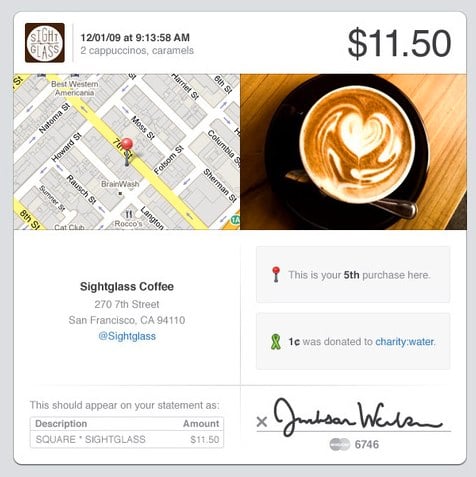
    SquareUp Receipt

    New iPhone credit card payment service SquareUp has finally been unveiled, and we’ve gotta say, it’s got our attention. The brainchild of Twitter co-founder Jack Dorsey, SquareUp aims to be a simple, sleek, inexpensive, and charitable credit card payment processing service. It works on the and , in conjunction with a credit card reader that plugs in to the audio jack. You get payer verification, receipts that can be sent via email or text message, and receipt signing using your finger. Even cooler, in our opinion, is that Square will donate one penny of every transaction to a charity of the seller’s choice.

    If Square plays their cards right, they will be a force to reckon with in the small business arena. The service is in limited beta right now, but Square says it’ll be fully open in 2010. We’ll see if we can’t get a beta account to give you a better look at how it all works.


    Tags:
    ,
    ,
    ,
    ,
    ,
    ,
    ,
    ,
    ,
    ,
    ,
    ,
    ,
    ,
    ,
    ,

    SquareUp iPhone payment service launched by Twitter co-founder originally appeared on Gear Live on Tue, December 01, 2009 – 1:51:27


  • Councilmember Bruce Harrell on race and inclusion

    Strongest candidates — regardless of race — will win

    Editor, The Times:

    I enjoyed Bruce Harrell’s well-written guest commentary “The value of inclusiveness” [Opinion, Nov. 28], but as a member of the white (privileged) majority, I take issue with a few points.

    Back in the 1990s I voted for Gary Locke, Norm Rice and Ron Sims and other elected officials of color. Could it be that my vote was cast in favor of the best-qualified candidates?

    In 2008 I voted for President Barack Obama because I hoped he would lead us from where we were. I think he was the stronger candidate. In 2009, I followed the same pattern, and voted for the candidates whom I thought were the most qualified.

    In doing so, I helped vote out a member of my group.

    When Bruce Harrell runs again, I plan to use the same criteria and vote for the person who fits my definition as the strongest candidate. I hope it’s Harrell.

    In the meantime, if Harrell speaks for candidates of color I can only provide my formula for bringing back more elected people of color — find and put up the strongest candidates. Good luck in this quest.

    — Larry Granat, Seattle

    Family is the factor in poverty

    Racial inclusion is a laudable goal, but Seattle City Councilmember Bruce Harrell’s approach to the issue troubles me.

    It appears Harrell has bought into the concept of white privilege. This is the idea that white people enjoy unearned social, educational and financial benefits simply by being white, although they may not be individually racist or even be aware of their advantages.

    Some proponents of this theory argue that social justice in America is impossible unless whites acknowledge that they’re part of an oppressive class and that they reject not only racism, but individualism and free enterprise.

    Has racial discrimination disappeared from our society? Unfortunately, no. Are there institutional issues yet to be addressed? Certainly. But I submit that in the 21st century, a far more important factor is the family. There’s a strong association between the percentage of minority kids living in poverty and those living in single-parent households.

    So let’s work to make sure the doors are open equally to everyone. Let’s do what we can to help families become more stable. Let’s emphasize the values of hard work, individual responsibility and education. And let’s reject the silly stuff — like white privilege.

    Trying to lay a guilt trip on any racial group is neither fair nor an effective way to solve our problems.

    — Phillip Johnson, Seattle

  • Marin Headlands Nike Missile Site, Batteries, and Bunkers

    Marin County, California | Subterranean Sites

    You might not expect to find WWII pillboxes, anti-aircraft gun mounts, and missile launch sites among the rolling hills and wetlands of the Marin Headlands, but at one time this was a highly fortified military defensive position.

    The hills overlooking the Golden Gate Bridge are riddled with bunkers, secret tunnels, and batteries designed to protect San Francisco from attack from as early as the Civil War period. On the Marin (North) shore there are three forts and several attack positions.

    Directly overlooking the Golden Gate Bridge, Battery Spencer actually predates the bridge significantly. Started in 1893 and connected to the nearest town by dangerous cliffside roads, the Battery was constructed as part of the overall fortification efforts known as the Endicott Period. President Grover Cleveland with his War Secretary William Endicott set out on a massive building and modernization project at 29 locations around the country, costing some $127 million in construction costs. Battery Spencer was constructed of concrete set into the cliffside and housed three M1888 12″ guns, including one aimed into the harbor mouth, as well as ammunition storage and support buildings. During WWI guns and ammunition were relocated to support the war effort, and in 1943 the remaining guns were scrapped to support that new war effort, effectively ending the life of the battery. Today, the buildings and gun mounts are deserted, but in good repair, painted a drab green, and surrounded by well manicured trails.

    Fort Barry and Bunker Road were also built up during the Endicott Period. There are five seperate batteries that are part of Fort Barry: Battery Mendell, Battery Alexander, Battery Smith-Guthrie, Battery Samuel Rathbone and Battery Patrick O’Rorke. The batteries are well hidden in undergrowth, and features the latest in turn of the century “disappearing carriage” technology, including guns that would raise up to fire, and then lower to a safer reloading position after discharge. These batteries remained active through WWII, upgraded with anti-aircraft weapons.

    Fort Cronkhite and Battery Townsend are more recent additions, built as part of the Harbor Defense initiatives in WWII. Located farther out along the coast, they look out onto the open waters outside the Golden Gate. The fort’s barracks, mass halls and support buildings now house park support staff and other businesses, but are preserved in an original state.

    Up the hill from Fort Cronkhite, Battery Townsend has some of the most impressive buildings. The construction of the batteries was secret, and designed to be hidden from view. Concrete behemoths are dug into the hillside, with only a modest tunnel entrance on one side, but a gaping maw surrounding a gun mount facing the water at the other end. Designed to acommodate two 16-inch caliber guns shooting armor piercing projectiles that reached more than 30 miles out to sea (past the Farallon Islands, visible in the distance), it was the first ever of its kind. Tests of the new guns in 1940 were a success, and plans were made to imitate the design along the coastline.

    The Cold War saw the addition of another super-secret military installation, the Nike Missile Base SF-88. Installed between 1953 and 1979 the anti-aircraft missiles were intended to fend off soviet fighters. It is now the only intact Nike base in the US open to the public.

    All of the forts and batteries can be visited by driving the roads on the Headlands. The paths are maintained and there is good signage, however the weather along the coast can be extremely gusty and/or foggy and the cliffs can be extremely dangerous, so explore with caution.

  • Memorial Stadium at the mercy of Seattle

    School Board lacks integrity

    Integrity. That is what the Seattle School Board lacks if it decides to demolish a memorial — Memorial Stadium — to those who gave their lives in service to our country [“The end for Memorial Stadium?,” page one, Nov. 25]. To replace something built to honor those who gave the last full measure of devotion with parking spaces and grass is dishonorable, reprehensible and wrong.

    May common sense prevail. May the Seattle School Board show some integrity and do the right thing. Show the public that it is better to fix Memorial Stadium, a monument built to honor brave men and women, than it is to demolish it.

    They are not clear where the $206 million to replace it would come from in the midst of a recession, and our soldiers are fighting and dying in two wars. Show us that you care.

    — Mike McHugh, Seattle

    Move the wall of names to some place nicer

    At least one writer seems to feel strongly that a ratty and decaying football field is a glorious memorial to World War II vets [“Do we really need another downtown parking garage?,” Opinion, Northwest Voices, Nov. 29].

    I think it’s kind of an insult.

    The wall with the names could be moved to some place else nice, where some actual respect for these memories obtains. Perhaps Discovery Park? There are many lovely places in Fort Lawton where this would fit in.

    — John Watt, Seattle

    A little history of Memorial Stadium

    As a former Seattleite, I read with interest The Seattle Times story “Seattle Center, schools reach pact to tear down Memorial Stadium” [Seattletimes.com, Local News, Nov. 25].

    The article mentioned former President Harry S. Truman speaking there, and that it is a memorial to the Seattle military lost during World War II.

    Readers might also be interested to know that it was from this stadium that KING-TV broadcast its first live television program of the 1948 Seattle high- school-football championship on Thanksgiving Day.

    It is also interesting to note that most people at that time did not own a TV set, so that aforementioned broadcast was viewed by most people from the windows and display areas of appliance stores.

    — Jim Schiller, Arroyo Grande, Calif.

  • Surveillance Shocker: Sprint Received 8 MILLION Law Enforcement Requests for GPS Location Data in the Past Year

    This October, Chris Soghoian — computer security researcher, oft-times journalist, and current technical consultant for the FTC’s privacy protection office — attended a closed-door conference called “ISS World”. ISS World — the “ISS” is for “Intelligence Support Systems for Lawful Interception, Criminal Investigations and Intelligence Gathering” — is where law enforcement and intelligence agencies consult with telco representatives and surveillance equipment manufacturers about the state of electronic surveillance technology and practice. Armed with a tape recorder, Soghoian went to the conference looking for information about the scope of the government’s surveillance practices in the US. What Soghoian uncovered, as he reported on his blog this morning, is more shocking and frightening than anyone could have ever expected

    At the ISS conference, Soghoian taped astonishing comments by Paul Taylor, Sprint/Nextel’s Manager of Electronic Surveillance. In complaining about the volume of requests that Sprint receives from law enforcement, Taylor noted a shocking number of requests that Sprint had received in the past year for precise GPS (Global Positioning System) location data revealing the location and movements of Sprint’s customers. That number?

    EIGHT MILLION.

    Sprint received over 8 million requests for its customers’ information in the past 13 months. That doesn’t count requests for basic identification and billing information, or wiretapping requests, or requests to monitor who is calling who, or even requests for less-precise location data based on which cell phone towers a cell phone was in contact with. That’s just GPS. And, that’s not including legal requests from civil litigants, or from foreign intelligence investigators. That’s just law enforcement. And, that’s not counting the few other major cell phone carriers like AT&T, Verizon and T-Mobile. That’s just Sprint.

    Here’s what Taylor had to say; the audio clip is here and we are also mirroring a zip file from Soghoian containing other related mp3 recordings and documents.

    [M]y major concern is the volume of requests. We have a lot of things that are automated but that’s just scratching the surface. One of the things, like with our GPS tool. We turned it on the web interface for law enforcement about one year ago last month, and we just passed 8 million requests. So there is no way on earth my team could have handled 8 million requests from law enforcement, just for GPS alone. So the tool has just really caught on fire with law enforcement. They also love that it is extremely inexpensive to operate and easy, so, just the sheer volume of requests they anticipate us automating other features, and I just don’t know how we’ll handle the millions and millions of requests that are going to come in.

    Eight million would have been a shocking number even if it had included every single legal request to every single carrier for every single type of customer information; that Sprint alone received eight million requests just from law enforcement only for GPS data is absolutely mind-boggling. We have long warned that cell phone tracking poses a threat to locational privacy, and EFF has been fighting in the courts for years to ensure that the government only tracks a cell phone’s location when it has a search warrant based on probable case. EFF has also complained before that a dangerous level of secrecy surrounds law enforcement’s communications surveillance practices like a dense fog, and that without stronger laws requiring detailed reporting about how the government is using its surveillance powers, the lack of accountability when it comes to the government’s access to information through third-party phone and Internet service providers will necessarily breed abuse. But we never expected such huge numbers to be lurking in that fog.

    Now that the fact is out that law enforcement is rooting through such vast amounts of location data, it raises profoundly important questions that law enforcement and the telcos must answer:

    • How many innocent Americans have had their cell phone data handed over to law enforcement?
    • How can the government justify obtaining so much information on so many people, and how can the telcos justify handing it over?
    • How did the number get so large? Is the government doing massive dragnet sweeps to identify every single cell phone that was in a particular area at a particular time? Is the government getting location information for entire “communities of interest” by asking not only for their target’s location, but also for the location of every person who talked to the target, and every person who talked to them?
    • Does the number only include requests to track phones in real-time, or does it include requests for historical GPS data, and if so, why did the telcos have that incredibly sensitive data sitting around in the first place? Exactly when and how are they logging their users’ GPS data, and how long are they keeping that data?
    • What legal process was used to obtain this information? Search warrants? Other court orders? Mere subpoenas issued by prosecutors without any court involvement? How many times was this information handed over without any legal process at all, based on government claims of an urgent emergency situation?
    • Looking beyond Sprint and GPS, how many Americans have had their private communications data handed over to law enforcement by their phone and Internet service providers?
    • What exactly has the government done with all of that information? Is it all sitting in an FBI database somewhere?
    • Do you really think that this Orwellian level of surveillance is consistent with a free society and American values? Really?

    These questions urgently need to be asked — by journalists, and civil liberties groups like EFF, and by every cell phone user and citizen concerned about privacy. Most importantly, though, they must be asked by Congress, which has failed in its duty to provide oversight and accountability when it comes to law enforcement surveillance. Congress should hold hearings as soon as possible to demand answers from the government and the telcos under oath, and clear the fog so that the American people will finally have an accurate picture of just how far the government has reached into the private particulars of their digital lives.

    Even without hearings, though, the need for Congress to update the law is clear. At the very least, Congress absolutely must stem the government’s abuse of its power by:

    • Requiring detailed reporting about law enforcement’s access to communications data using the Electronic Communications Privacy Act (ECPA), just as it already requires for law enforcement wiretapping under the Wiretap Act, and make sure that the government actually fulfills its obligations rather than ignore the law for years on end.
    • Requiring that the government “minimize” the communications data it collects under ECPA rather than keep it all forever, just like it is supposed to do with wiretaps.
    • Prohibiting the government from using in a criminal trial any electronic communications content or data that it obtains in violation of ECPA, just as the government is prohibited by the Wiretap Act from using illegally acquired telephone intercepts.
    • Clarifying that ECPA can only be used to get specific data about particular individuals and cannot be used for broad sweeps, whether to identify everyone in a particular geographic area or to identify every person that visits a particular web site.

    It’s time for Congress to pull the curtain back on the vast, shadowy world of law enforcement surveillance and shine a light on these abuses. In the meantime, we give our thanks to those like Chris Soghoian who are doing important work to uncover the truth about government spying in America.

    UPDATE: Sprint has responded to Soghoian’s report:

    The comments made by a Sprint corporate security officer during a recent conference have been taken out of context by this blogger. Specifically, the “8 million” figure, which the blogger highlights in his email and blog post, has been grossly misrepresented. The figure does not represent the number of customers whose location information was provided to law enforcement, as this blogger suggests.

    Instead, the figure represents the number of individual “pings” for specific location information, made to the Sprint network as part of a series of law enforcement investigations and public safety assistance requests during the past year. It’s critical to note that a single case or investigation may generate thousands of individual pings to the network as the law enforcement or public safety agency attempts to track or locate an individual.

    Instances where law enforcement agencies seek customer location information include exigent or emergency circumstances such as Amber Alert events, criminal investigations, or cases where a Sprint customer consents to sharing location information.

    Sprint takes our customers’ privacy extremely seriously and all law enforcement and public safety requests for customer location information are processed in accordance with applicable state and federal laws.

    This response provides some important answers, while raising even more questions. First off, Sprint has confirmed that it received 8 million requests, while denying a charge that no one has made: that 8 million individual customers’ data was handed over. Sprint’s denial also begs the question: how many individual customers have been affected?

    As for Sprint’s claim that in some instances a single case or investigation may generate thousands of location “pings”, that is certainly possible, but that doesn’t make the 8 million number any less of a concern, or moot any of the important questions raised by Soghoian in his report or by EFF in its post regarding the lack of effective oversight and transparency in this area.

    Even assuming that Sprint’s statement about “pings” is true, 8 million — or, in other words, 8,000 thousands — is still an astronomical number and more than enough to raise serious concerns that Congress should investigate and address. Moreover, the statement raises additional questions: exactly what legal process is being used to authorize the multiple-ping surveillance over time that Sprint is cooperating in? Is Sprint demanding search warrants in those cases? How secure is this automated interface that law enforcement is using to “ping” for GPS data? How does Sprint insure that only law enforcement has access to that data, and only when they have appropriate legal process? How many times has Sprint disclosed information in “exigent or emergency circumstances” without any legal process at all? And most worrisome and intriguing: what customers does Sprint think have “consent[ed] to the sharing [of] location data” with the government? Does Sprint think it is free to hand over the information of anyone who has turned on their GPS functionality and shared information with Sprint for location-based services? Or even the data of anyone who has agreed to their terms of service? What exactly are they talking about?

    These questions are only the beginning, and Sprint’s statement doesn’t come close to answering all of them. Of course, we appreciate that Sprint has begun a public dialogue about this issue. But this should be only the beginning of that discussion, not the end. Ultimately, the need for Congress to investigate the true scope of law enforcement’s communications surveillance practices remains. Congress can and should dig deeper to get the hard facts for the American people, rather than forcing us to rely solely on Sprint’s public relations office for information on these critical privacy issues.

  • Pat Robertson is at it again

    I know what the Bible, Quran really teach

    It was nice to read “I missed that verse” by Wendy Fosnight Dymoke [Opinion, Northwest Voices, Nov. 25] who had the courage to speak the truth about Pat Robertson [“In military, Muslims speak out,” News, Nov. 12].

    People like him, who have no knowledge about Islam, get on the TV and spread hatred. Isn’t he the same guy who, a couple of years back, told us let’s kill Venezuela’s Hugo Chávez? Based on the Bible that I have studied, I am sure his advice to kill was against the teaching of Jesus, and now slandering another faith is not advised by the Bible either.

    The violent Muslims, and Robertson promoting violence, are chips off the same block as they have no clue what Islam really is. King Ferdinand and Queen Isabella of Spain, Crusaders and Hitler used the name of Jesus and killed millions of Jews and Muslims. However, the history rightly blames the individuals and no one ever says Christianity is not a faith but a violent political system.

    Robertson is a very confused man and thus ends up misleading innocent people. He should do a favor to himself and his audience; let us meet and let me explain what the Bible and Quran really teach.

    — Yahya Malik, Kent

    Letter missed one important aspect of Islam

    While I quite agree with Wendy Fosnight Dymoke from Bainbridge that Pat Robertson is both a demagogue and a hypocrite, she misses the most important part of understanding Islam.

    It indeed is not just religion, but an all-encompassing set of imperatives that reach into all aspects of life — political, economic and personal.

    The true Muslim believes that Sharia law transcends elected governments and its institutions such as courts and legislatures.

    It is this failure of understanding by most Americans that represents the greatest danger to our institutions and way of life.

    — Howard Phelps, Seattle

  • Sprint Revealed GPS Data To Authorities 8 Million Times In The Last Year [Updated]

    This seems too insane to be true, but the EFF points us to a report, based on a Freedom of Information Act request, that claims Sprint provided law enforcement with GPS location data a staggering 8 million times in the last year. Sprint apparently set up some sort of portal that made such requests easier, and it sounds like law enforcement took advantage of that in a major way. The report also notes that this information should have been disclosed to Congress, under a 1999 law, but the Justice Department has ignored the law for the past five years. The rest of the report also looks at some other concerning factors, such as the fact that the government seems to regularly get all sorts of info from service providers, with little oversight. On top of that, it explains why so many service providers agree to it: they charge the government for such info, and it’s quite lucrative. As such, they actually have the incentive to encourage the government to ask for more information and to deliver it to them as quickly and efficiently as possible. However, you have to wonder how so many requests are being made with such little oversight — and how often this means the process is abused to spy on individuals with no legal basis. Update: Sprint is now trying to explain this by saying that the numbers represent number of “pings” and that can include thousands of pings per a single investigation. In a single investigation, once law enforcement has a court order, it can check someone’s location every 3 minutes for up to 60 days — and that’s what made the number so inflated.

    Permalink | Comments | Email This Story


  • Assassin’s Creed II DLC coming next year

    Ubisoft has announced the release windows for the Assassin’s Creed II DLC that they promised a while back. While details are still scarce, at least fa…