Author: Serkadis

  • RMS Titanic Memorial

    New York, US | Unusual Monuments

    Over fifteen hundred passengers and crew members lost their lives when the “unsinkable” RMS Titanic collided with an iceberg on the evening of April 14, 1912. It wasn’t until seventy-two years later, however, that Joseph Colletti decided to erect his own memorial for the steamship, once considered the largest in the world.

    Colletti, who felt inspired after watching Raise the Titanic, chose the exterior of his townhouse for the site of his shrine. Located near the Pulaski Bridge in Long Island City, New York, the RMS Titanic Memorial has stood as both a monument to the luxury ocean liner, as well as an eccentric local landmark for the Queens neighborhood.

    Since 1984, Colletti has been adding Titanic-related items such as old newspaper clippings and photographs of survivors to his brownstone’s facade. What has perplexed (and charmed) many, however, is the abundance of knickknacks that also adorn the memorial. Plastic frogs, flowers and squirrels; porcelain cupids and ship captains; even a “Photography Permitted” sign are neatly displayed at the site. The landmark has drawn so much attention from the locals that the Village Voice awarded Colletti the title of “Best Public Displayer of an Obsession.”

    Obsessed or not, Colletti’s efforts to memorialize the Titanic have not been in vain. As a member of the Titanic Historical Society, Colletti has spent much of his life collecting memorabilia and corresponding with survivors. Now — nearly a century later — after the last remaining survivor passed in June of 2009, the plaques and letters adorning the walls of Colletti’s home are some of the last relics from one of the 20th century’s greatest tragedies.

    Known by many as “Titanic Joe,” Colletti can be seen outside his home on most days, maintaining the memorial and waving to people on the street. A note to visitors, however: when he’s not outside, Colletti can sometimes be caught indoors, spying on guests from one of his three surveillance cameras. For some lucky visitors, he might even come outside and strike up a conversation.

    Another odd Titanic Memorial can be found at the Addergoole Titanic Monument, a monument erected in Addergoole, Ireland a small Irish village which suffered the greatest proportional loss of life when the Titanic sank, and pieces from the Titanic can be seen at the wonderful and bizarre

  • Final Fantasy XIII boxart released

    Nope, we’ve had our fill of vids and scans, although the last few have been quite good. For today, it’s the official boxart for the Xbox 360 and PS3 …

  • Skarð

    Europe, Globe | Ghost Towns

    “Tis the part of wise man to keep himself today for tomorrow, and not venture all his eggs in one basket” wrote Cervantes, in Don Quixote in 1605. While the sentiment has been challenged (most notably by Mark Twain who wrote “Put all your eggs in the one basket and watch that basket”) in the case of Skarð Village, in the Faroe Islands, the idiom is apt.

    On December 23, 1913 the day before Christmas Eve, all seven able-bodied men of the village climbed into a single fishing boat (quite possibly the only one in the village) and set out onto the North Atlantic Ocean presumably to catch a feast for the coming holiday. The men never returned.

    Without men (able-bodied ones at least, a young boy and an old man remained) the remaining women and children left the town for Haraldssund, and the last inhabitant left only six years after the accident, in 1919. Skarð remains a ghost town to this day, complete with crumbling stone houses. Haraldssund, where the Skarð villagers resettled, isn’t much better off with a current population of only 70.

  • More Windows Mobile 7 news leaked via LinkedIn – Motorola still in the game

    WMConceptMSFTKitchen have made their regular trawl of LinkIn profiles for Windows Mobile 7 and has revealed piles of goodies.

    First is that, while Motorola has not done a consumer Windows Mobile handset for a while, the company is still very busy working on Windows Mobile 7 and the software associated with it.

    The post confirms new UI controls in WM7, DirectShow components, the extensive use of Silverlight in built-in apps such as Bing and MSN, a new IE7 browser for Windows Mobile,  a new Media Transfer Protocol for WM7, the presence of USB OTG, a game user experience focus, work on a soft keyboard and Microsoft’s launch plans, which includes a Windows Mobile 7 Sharepoint website.

    All the job postings taken together indicate Windows Mobile 7 will be quite a tour de force and far from a small update, addressing most consumer issues such as browsing, gaming and media access, and that earlier rumours of user interface development using Silverlight are real.

    See all the individual posts at MSFTKitchen here.

    Thanks wreiad for the tip.

    Share/Bookmark

  • Get Chrome for OS X Early With Chromium Nightlies

    Google’s Chrome browser is fast, small, and “nearly” perfect. Using the same Webkit rendering engine as Safari, and its own custom V8 javascript engine, Chrome has been blowing away the competition on Windows for over a year. Google is finally nearing a release for the Mac, but since the browser is open source, you can get almost everything from Chrome in the Chromium Nightlies. These builds are separate from the official Google Chrome developers preview, they are in-development versions of Chrome, and are updated almost every night.

    I’ve been using the Chromium builds off and on for months, and have recently switched back to it as my primary browser. Chromium reminds me of when Firefox first spun off of Mozilla. It was then, as Chromium is now, small, bare-bones, devoid of feature bloat, and fast.

    Unfortunately. the Nightlies are not the easiest thing in the world to find, and Chromium doesn’t update itself when a new build is available. So, I used a little Automator and shell script action to build this tiny app that will download the latest version of Chromium to your Downloads folder. If you’ve got Growl installed it will also send Growl an alert that it is finished, but that’s it. That’s all it does, very simple, nothing fancy.

    You can download the “ChromeUp” Automator application here (45kb, ZIP).


  • CHART OF THE DAY: The Rest Of The World Owns Us

    button more charts
    button chart prev button chart next

    As this chart shows, foreign appetite for the debt of the Federal government has not been diminished by our recession.

    Pessimists might say that we’re increasingly reliant on international investors to fund our government. But we can just about squint our eyes up and see this as a vast improvement from the old “we owe it to ourselves” reassurance about government debt.

    We owe it to them and we’re too big to fail.

    federal debt held by foreign & international investors, chart of the day


    Get This Delivered To Your Inbox

    You can get this dropped in your inbox every afternoon as The Chart Of The Day. It’s simple. It’s convenient. It’s free. All we need is your email address (though we’d love your name and state, too, if you’re willing to share it).  Sign up below!

    Join the conversation about this story »

  • Girlfriend dumps Andy Murray for seven-hour PS3 sessions

    Andy Murray is currently Britain’s #1 tennis player, currently ranked #4 in the world based on the ATP rankings. But even tennis stars have other ga…

  • How Georgia Wonder Turned Lack Of Cash To Record Into An Opportunity

    Earlier this year, we wrote about the UK music act Georgia Wonder, who was thrilled to be listed as one of the “most pirated” musical acts out there — recognizing the power of good promotion. Since then, we’ve watched with interest how the group has continued to really interact with fans and use new tools and new marketing ideas to get heard and build a following. Rose M. Welch alerts us to the band’s latest smart move. As they wanted to record a new album, they realized (as plenty of others have) that it’s expensive to record an album — buying studio time, equipment and instruments. So they did something different. They teamed up with a local music equipment shop, called Nevada Music and worked out a deal:


    Both during store hours and after the store closes each night, they’ll be recording their next album dubbed “Made In Nevada” using all the gear the store has on sale.

    This benefits everyone. The band gets access to all the equipment and instruments they need, plus they get added attention for doing something cool and new. The store also gets a nice benefit in additional attention and marketing for itself and its products. What’s cool about this is that it’s yet another different way of going about things. One of the most frustrating responses we hear whenever we show examples of cool things that musicians are doing — is people saying “but everyone can’t do this.” But that’s the whole point. Musicians can keep coming up with cool different things to do. Frankly, the idea that they can’t come up with cool ideas is insulting. These are some of the most creative people around, and given the ability to express that creativity, it’s amazing what they come up with.

    Permalink | Comments | Email This Story


  • Global Sea Levels Likely to Rise by About 1.4 meters by 2100 as Polar Ice Melts

    Booth_and_Mount_Scott

    2009Dec1: Global sea levels are likely to rise by about 1.4m by 2100 as polar ice melts, according to a Scientific Committee on Antarctic Research (SCAR) report titled “Antarctic Climate Change and the Environment”. “Warmer water is getting under the edges of the West Antarctic ice sheet and accelerating the flow of ice into the ocean,” said John Turner from the British Antarctic Survey and lead editor of the report (BBC).

    Reference: BBC http://news.bbc.co.uk/2/hi/science/nature/8387137.stm

    Read SCAR’s Antarctic Climate Change and the Environment report http://www.scar.org/publications/occasionals/acce.html

    Image Description: Booth Island and Mount Scott flank the narrow Lemaire Channel on the west side of the Antarctic Peninsula. Photo by Stan_Shebs, 2001Feb. Image Location: Wikimedia Commons http://commons.wikimedia.org/wiki/File:Booth_and_Mount_Scott.jpg Image Permission: This file is licensed under the Creative Commons Attribution ShareAlike 3.0 License. In short: you are free to share and make derivative works of the file under the conditions that you appropriately attribute it, and that you distribute it only under a license identical to this one.

  • Rejected App Gets Special Approval From Steve Jobs Himself

    If there’s one thing you can count on about Apple’s App Store review policy, it’s that the process will be consistently inconsistent. Today, an app launches that was originally rejected for known and acknowledged use of private APIs, despite the fact that developers haven’t modified the app in any way since its rejection.

    Knocking Live Video, the app in question, makes use of Apple’s forbidden private APIs to enable live video streaming over Wi-Fi and 3G for the first time on the platform. Apple has made clear its policy on the use of private APIs, most recently via the introduction of an automated layer of the review process for app submissions that automatically checks all code for the presence of unauthorized API usage.

    Knocking’s usage of live streaming video is very particular, as Ars Technica explains, something which may have had something to do with it being approved while other apps like Qik haven’t been able to break down the streaming wall:

    Knocking Live Video uses an interesting take on streaming video. Unlike Qik, which is designed to stream video to multiple clients, Knocking streams from one iPhone to another. (…) You simply launch the app and “knock” another iPhone user with Knocking Live Video installed. That user will receive the “knock” via push notification. Once answered, you can then stream live video directly to them. An iPhone 3GS or iPhone 3G is required to transmit video, but other iPhones and iPod touches can receive and view the stream via WiFi.

    The app was initially rejected about a month ago for unauthorized use of the private APIs, but Knocking development Brian Meehan decided not to just take the refusal lying down. Instead, he went straight to the top, contacting Steve Jobs directly via email. Jobs has been known to actually respond to emails personally on occasion, so it was at least worth a shot. Meehan’s plea was not about self-interest, but instead focused on appealing to Jobs as a lifelong Apple user who wanted to create a better experience for other members of the community.

    The Monday following Meehan’s email, which was sent on a Saturday night in late November, he was contacted by an unnamed Apple executive who informed him that the app’s rejection had been reversed, and that the decision to allow it into the App Store had come “directly from the top.” It is now available for free in the App Store.

    Hopefully this means that Apple is at least considering expanding the pool of publicly available APIs. Access to the live streaming video API would allow a lot of applications that have been shelved to see the light of day. It proves one thing at least: Apple is listening to the iPhone development community, even though it may not always appear that way.


  • Sony Ericsson “XPERIA X10” vs. Apple “iPhone 3G S” Specs Comparison


    xperiax10iphone

    Sony Ericsson has a very strong play coming in 2010 – the XPERIA X10. With specifications straight out of Star Trek, this just might be the device to propel the Google Android operating system ahead of iPhone 3G S. The new XPERIA X10 (specs courtesy Sony Ericsson) is their most powerful phone ever, and we put it head to head with the iPhone 3G S (specs courtesy of Apple) in a detailed specs comparison. The North American market has been dominated by the iPhone 3G, and it is now even more powerful than before with the updated S version. Both phones have rich application environments – the iPhone with App Store, and the XPERIA X10 with the Google Android Market. We’ve read that the XPERIA X10 will come to the USA courtesy of AT&T (and labeled as the XPERIA X10a) in 2010; this could be one interesting matchup. We’ve highlighted the winner of each category in Green, the loser in Red, and neutral/subjective specs are in Yellow. Any categories left in White we couldn’t make a decision based on incomplete data, or felt was too trivial. Please leave a comment with anything we’ve missed.

    Please remember that there are some specifications and experiences not listed here. Click to learn more about the XPERIA X10 (link includes movies) and its incredible user interface that is light years beyond any other Android phone. Click to learn more about the advanced operating system experience of the iPhone 3G S. I have used an iPhone 3G for a very long time and believe its an incredible mobile experience. This will be tough for the consumer – it is truly important that both devices are tested (when possible) to ensure the right choice. The XPERIA X10 is already shaping to be such a “wow” product though..

  • 10 OS X Games for the Holidays

    Recently, my boss at my day job was considering getting a Mac and asked that fateful question: So, what about games?

    A few years ago, any response to that question would have been met with an awkward silence and an embarrassed look and a rush to change the subject to the weather. Now a days, thankfully, the answer is: Not that bad, actually. The switch to Intel processors, along with TransGaming’s Cider, has allowed companies to port their games to OS X.

    The bad news is, almost all the games on this list require a Mac with an Intel-based processor to run, and most of them either do not work on the old GMA 950 chip, or are severely limited.

    Massively Multiplayer Online Games

    I’ve got a weak spot for these enormous time sinks. They do come with a not-so-hidden cost of a monthly subscription fee and potential dirty looks from your spouse as you’re up until 3am trying go get “just one more level.”

    Warhammer Online
    Derived from the old Warhammer miniatures war games, we’ve covered this one previously. It’s still a good choice for someone who also likes bashing their fellow man in the face as well as computer-controlled monsters. You can download the endless trial, which will let you play a portion of the game for free, or you can also buy the retail Windows version for about $20 — you don’t need to install it, and the Mac version isn’t on the disc, but you can use the account key to create the account and then download the Mac client.

    Eve Online
    A space-themed MMO where you pilot your own ship is a nice distraction from the chicks-in-chainmail you find in fantasy games — really, that bikini has a high armor rating?  Riiiiiight. While my experiences with Eve are limited, from what friends have told me, “once you get over the learning curve, it’s quite fun.” So, if you’re tired of burly elves and svelte dwarves (or is it the other way around?), Eve Online might be worth a look. As with Warhammer, you can either download it online or pick up a box set at a retailer.

    World of Warcraft
    It’s hard to mention a gaming roundup without talking about the 800 pound gorilla of the gaming market. Recently celebrating its fifth anniversary and over 11 million subscribers, WoW shows no indication of slowing down this decade. Blizzard has always been a staunch supporter of the Mac, and the box you buy at the store will have the Mac installers on the disc. There’s even a handy iPhone app you can view your character and guild info with.

    Shooters

    Call of Duty 4: Modern Warfare
    In a break from the World War 2 theme of the earlier Call of Duty game, as you’d assume from the title, this one is set in the modern era. The single-player campaign is one of the best I’ve ever experienced — I’ve got a fairly low finish rate on games, and this once was interesting all the way to the end. You’ll play the part of two soldiers in different areas of the world (A British SAS trooper and an American marine) working on two plot lines. I found the level design varied and well-paced — each level felt bereft of the usual “padding” developers add to the game to make it longer. At around 12 hours long, the campaign is relatively short, but, frankly, I’d rather most games be this short and well done than inflated.

    Bioshock
    Yeah, I know, like Call of Duty 4, it came out a few years ago for consoles and PCs. This Art Deco themed shooter answers the question: What would happen if Ayn Rand built an underwater complex based on her Objectivist theories? Naturally, something goes wrong and you get to unravel it. As with Call of Duty 4, Bioshock is one of the few games that compelled me to finish it, and is one of the few games so scary it caused the hair on my arms to stand up.

    Sim Games

    Sims 3
    It’s hard to ignore the siren’s call of a game that lets you block off the bathroom and watch your Sims go mad. The Sims franchise is a guilty pleasure of mine. Apparently I’m not so busy micromanaging my own life, I need to micromanage a Sim’s virtual life, too. The Sims 3 has a few new features, like careers. Previously, when your Sim went to work, he or she disappeared into a black hole from which money spouted. Now, they can advance up a career path. I just wish they’d learn to use the bathroom at work.

    X-Plane
    Back in my PC gaming days, I was a huge fan of Microsoft’s Flight Simulator series. Unfortunately, Microsoft’s shuttering of that development group killed the program — not that we’d have seen a Mac version. X-Plane seems to be the Mac equivalent of it. I’ve yet to play it, and, sadly, any attempt at downloading the demo has failed. You can get it at the Apple store but the online store claims a 2-3 week shipping time.

    Strategy Games

    Civ 4
    The Civilization series has been a long staple in the strategy era, and Civ 4 is one of my favorites. Civ 4 adds a few new features over previous versions: religion is much more important, you can promote units, and now you can see your overall score. There is also a slimmed down iPhone version.

    Whimsical

    Lego Series
    If there’s something more fun than a Lego adaptation of Star Wars or Indiana Jones, I don’t know what it is. I love how they are both true to the source material, yet light-hearted. These are fun for the whole family.

    Peggle
    Part pinball, part blockout, part crazy, the idea behind Peggle is to eliminate the orange pegs. You are given 10 balls to complete this task. If the ball lands in the scoop at the bottom, you get a free ball. Most of my experience has been with the iPhone app, but I’ve been loving it.

    Any sort of a roundup like this is heavily biased on the author’s tastes: in my case, it’s apparent I like MMOs, shooters, and strategy games. Now it’s your turn: What games would you like to give or receive this holiday season?


  • Americans like White, the world likes Silver in new Color Popularity Report

    Filed under:

    DuPont has released its annual Color Popularity Report, and for the first time has converged data from across the globe to create a worldwide report on how we, as a species, prefer our cars to be colored. OK, maybe that’s a bit hyperbolic, but the new worldwide report confirms that Black, Silver and White reign supreme regardless of borders. The three colors are tightly packed in North America, where White is most popular at 17.8 percent with Black (17 percent) and Silver (16.8 percent) not far behind. Europeans, however, like the sleek look of Black at 27 percent compared to Silver at 19.9 percent and White falling pretty far behind at 10.2 percent. Different regions like different colors, but these three remain at or near the top across the board.

    Who knows why car buyers the world over seem averse to all the colors of the rainbow. Not us. While we dig a nice metallic Silver, other colors like Red, Blue and even shades of Green have a way of teasing out a car’s personality better than the grayscale stuff. If you were shopping for a new car (or are), what colors are at the top of your list? We’ve included a poll below to see if our audience thinks anything like a DuPont customer.

    View Poll

    [Source: DuPont]

    Continue reading Americans like White, the world likes Silver in new Color Popularity Report

    Americans like White, the world likes Silver in new Color Popularity Report originally appeared on Autoblog on Tue, 01 Dec 2009 14:57:00 EST. Please see our terms for use of feeds.

    Permalink | Email this | Comments

  • That Mythical ‘Information Wants To Be Free’ Crowd

    Jay Rosen is doing a brilliant job highlighting the rather silly trend among folks who think they’re “debunking” the economics of free to build up complete strawmen often identified as “the information wants to be free crowd.” However, as Rosen notes, none of those critics ever links to anyone in particular or defines who they’re arguing against or what it is they actually said. There’s a good reason for that, of course. Usually those folks are arguing against a myth. They don’t want to argue against the actual economics or what folks who understand where free fits into the wider economic landscape are actually saying. They want to throw up a punching bag (usually something along the lines of “everything must be free!”) which they can knock down without anyone punching back. But that’s not because they’re right, but because they’re arguing against a myth. No one claims everything (even information) must be free. Most (and in this group I include folks like Kevin Kelly, Chris Anderson, Stewart Brand and others) are simply pointing to the basic economic forces on information. If you don’t understand what those forces are, then you will be overwhelmed by them. But simply claiming that any one in that group is saying that everything must be free is flat out wrong.

    Permalink | Comments | Email This Story


  • HTC Touch.B/Rome appears

    Those earlier rumours about Leo/Click/Mega/Rome seem to have all turned in to devices apart from the Rome, though that’s about to change thanks to mobifrance.com

    imageVery little is known, apart from the fact it will apparently be running Android.

    The “Touch.B” looks a lot like the Pro.Three branding on the HD2 so this could just be some random text.

    mobifrance say they will have more news about the device tomorrow, so things could get interesting!

    Share/Bookmark

  • Tridion, Forms, and Interaction

    A press release was sent to me today with the title "SDL Tridion Puts Online Forms at the Heart of Interaction." Which made me smile, in a nostalgic sort of way.

    Nowadays, when we discuss interaction, we tend to quickly drift off to social media, networking, or collaboration. How do you deal with those bidirectional (or rather, multidirectional) streams of interacting content? Is a Web CMS really suited for this, especially those (like Tridion) that emphasize "publishing to" a delivery tier (in other words, pushing out the content like a fire-and-forget thing)? It’s not something you can reduce to "here’s the form, so there’s your interaction."

    For sure, web forms are often more important (and more complex) than you’d think at first glance. However, the Tridion module doesn’t actually process the form content, store it, or create a workflow around it. It just allows you to create the forms themselves, "to manipulate the form as if it were just another type of web content." Useful as that may be, it’s quite different from actually managing the interaction.

    So if web forms are at the heart of Tridion’s interaction, as the company’s marketing suggests, that’s a bit like Kafka 2.0. At least now, you can send in really pretty forms. In triplicate.

  • Watch Out: There’s No Shortage Of Uranium Anytime Soon

    (This is a guest post by Brian Wang, known as advancednano on The Oil Drum.  He is an MBA and editor of nextbigfuture.com. This post appears under a Creative Commons Attribution-Share Alike 3.0 United States License)

    Michael Dittmar recently wrote a series of posts about nuclear energy that was published on The Oil Drum.  In the first post of the series, he said that uranium “civilian uranium stocks are expected to be exhausted during the next few years” and “the current uranium supply situation is unsustainable”.

    It seems to me that this view is much too pessimistic, especially if prices rise from current levels.  In this post, I will explain why.  I will also talk about a bet with Dr. Dittmar regarding future production of nuclear electricity.

    In support of my view of growing uranium production, below is a graph shown on the Ux Consulting website regarding future production.  Ux Consulting describes itself as “The industry’s leading source of consulting, data services, and publications on the uranium, conversion, and enrichments markets.”

    chart1

    Forecast of future uranium production by Ux Consulting

    Based on this graph, Ux Consulting expects uranium production to grow rapidly between now and 2020, with especially large gains in Kazakhstan, Africa and Canada.

    The following is my summary of indications suggesting that uranium production is likely to rise significantly in the near future.  Please note that the Ux Consulting chart uses million pounds U3O8; most of the other numbers are in metric tons of uranium.  Historical data is given is a chart at the end of this post, in metric tons.  To convert from million pounds of U308 to metric tons of uranium, multiply by 384.6.

    Kazakhstan – Already starting to ramp up

    Ux Consulting is forecasting that Kazakhstan will increase its production to 40,000 tons a year by 2020–in other words to nearly as much as current world production of uranium. 

    There is evidence that a rapid ramp up in production in Kazakhstan is already taking place.  In 2008, Kazakhstan produced 8521 tons.  In the first 9 months of 2009, Kazakhstan produced 9535 tons, which is 61% more than the corresponding period for 2008.  Kazakhstan is expected to continue its growth through 2017, before plateauing at 40,000 tons a year (eyeballed from Figure 1). 

    Canada and Australia – Leading producers historically; Canadian delays now

    Canada’s production does look to be back up from 2008. Cameco (which produces most of Canada’s uranium) production at the end of the third quarter of 2009 was 9.3 million pounds U3O8 compared to 8.5 million pounds over the same period in 2008.  We continue to expect our share of production to be 13.1 million pounds in 2009.  The first 9 months are up 2700 tons of Uranium.  Canada should be up 3000 tons from 2008.

    Canada has had some delays because of water flooding problems at the Cigar Lake mine.  Also, the Midwest mine in Saskatchewan has been shelved until uranium prices are higher.  Currently uranium is at $45/pound.

    Another attempt is being made to dewater the Cigar Lake mine:

    The inflow on the 420 metre level that forced suspension of dewatering on August 12, 2008 has been remediated by remotely placing an inflatable seal between the shaft and the source of the inflow and subsequently backfilling and sealing the entire development behind the seal with concrete and grout.  The 420 level is not part of future mine plans.

    It is currently expected to take six to 12 months to dewater and secure the mine depending on what conditions are found in the shaft and the underground workings.

    The Olympic dam mine in Australia is expected to be expanded. A decision will be made by the Australian government by July 2010.

    There was an accident at the Olympic dam mine, but production is expected to be fully restored by the third quarter of 2010.

    Africa – Major ramp up; exploration is inexpensive

    In my analysis in September 2008 of expected future Uranium supplies, I showed two projects with over 1,000 tons or more of production planned for 2009.  Both of these new large 2009 projects were in Africa. 

    One of these planned projects was Namibia’s Valencia mine, expected to produce 1,000 tU/year.  It is now expected to open in 2010, which is a delay from 2009.  One of the issues in this and other delayed projects is the low price of uranium–now $45 ton.

    The other large project listed in my September 2008 post for 2009 was the Malawi Kayelekera project.  It began exporting uranium in Sept, 2009.  It is expected to produce 1,269 tons per year initially.  By calendar year 2012, production is expected to increase by 15%, with minimal capital investment, because it can utilize existing excess capacity. 

    In total (including Kayelekera previously mentioned), Paladin’s production from all its African mines is expected to amount to 5.6 Mlb U3O8 (equivalent to 2,153 tons uranium) to 6.1 Mlb U3O8 (equivalent to 2,346 tons uranium) this year.  It forecasts African production of 13.8 Mlb U308 (equivalent to 5,307 tons uranium) by mid 2014.  This would amount to more than double current production in five years.  Planned expenditures for this expansion are US$365 million.

    Niger is an area of Africa that appears to be able to ramp up production.  It appears to me that Niger is on a path to 10,000 tons per year of uranium production (around 2012-2014), if the price of uranium is high enough.  They are finding quality uranium mines in Niger using $5 million per year in exploration spending.

    In Niger, Areva is currently building a a big new mine, the Imouraren project, whose production was originally estimated as 5,000 tons.  According to Bloomberg, its cost is estimated to be 1.2 billion euros ($1.8 billion), and it is scheduled to come on stream in 2012.  The project is already delayed a year because of political turbulence in the country.  “We will decide in 2011-2012 whether we should scale it for 2,000 tons or 5,000 tons or even 7,000 tons,” Sébastien de Montessus, director of Areva’s mining business unit said.  The current uranium price (US$ 55 / lb U3O8) wouldn’t be enough to make an investment of $500 million to $1.5 billion profitable, De Montessus said.  “The market price has to go up to $70 to $80.”

    According to Extract Resources Limited, the new Rossing resource in Namibia appears to have great potential.  An October 7 release reads:

    We believe a total resource of 500 Mlbs (192,300 tons) is achievable from targets already defined.  The Company is now well advanced with the Rossing South Feasibility Study on Zones 1 and 2 and the project is shaping up to be one of the world’s largest uranium mines, capable of producing 15 Mlbs of U3O8 per year.  (5,769 tons uranium per year)

    According to a recent article by Mineweb

    :

    Namibia is mining friendly.  Paladin commissioned Langer Heinrich in 2007 on time and on budget, and continues with the process of ramping production to what could amount to 3000 tons of uranium a year, at a cash cost of USD 25/lb, by the second half of 2010.  .  .

    Namibia’s more recent potential was startlingly highlighted by the August 2007 purchase by French transnational Areva for USD 2.5bn of Uramin.  Trekkopje will be a big mine.

    More information on Trekkopje can be found in this infomine article.  This 2008 Mineweb article has the following to say about Trekkopje:

    But the uranium project could become the biggest in the country, and No.  10 in the world.  Leathley said US$920-million would be pumped into the project to bring it into production.  It will also be one of the top five low cost, open pit operations in the world.

    The company expects the property, which is located about 70 kilometres east of the coastal town of Swakopmund and quite close of Rössing and Langer Heinrich, to produce about 8.5-million pounds of uranium oxide (3,850 tonnes) a year.

    Energy Resources (Rio Tinto Subsidiary) reported uranium production for the first three quarters of the year was 4,100 tons, up 11% from 2008.

    Other Mines

    Berkeley Resources is developing uranium production in Spain.  According to this Mineweb article:

    Berkeley has 26m pounds of 450 parts per million uranium oxide at its Spanish projects; analysts familiar with the company reckon this resource will potentially triple in 2010 as Berkeley moves onto the Toronto Stock Exchange, and into production at around 1000 tons a year by 2012.

    Berkeley’s Salamanca project would be the restart of an old mine, one shut down in 2000 by Spanish state company ENUSA following sustained low uranium prices.  Relative to other projects with a similar deposit base, Salamanca rates as very low cost on capital expenditure, with operating expenditure likely to be around USD 30/lb. 

    Jordan is another place where uranium production is likely to expand.  According to this article:

    High grade uranium was discovered at very shallow depths, at some points no more than five feet, making future mining both cheaper and easier.

    Jordan already had a lot of uranium in phosphate deposits.  China National Nuclear Corporation General Manager Kang Rixin expects that the first batch of uranium from Jordanian resources will be transported home in 2010; the total quantity probably will be 700 tons.  (Caijing Magazine July 5, 2009).  It has been expected that the uranium from Jordan phosphate would scale to 2000 tons per year.

    In addition, the French giant Areva was expected to start uranium drilling in central Jordan in November to identify the locations of crude uranium, Toukan said in October.  Following a feasibility study after exploring, work will begin to usher in a uranium mine with actual production expected to start in 2012 at an annual rate of 2,000 tons, he added.

    On uranium in phosphates, he put the deposits at between 100,000 and 140,000 tons. 

    Wali Kurdi, Chairman and CEO of the Jordan Phosphate Mines Company said earlier in the year that the Jordanian phosphate used in manufacturing phosphoric acid contains about 50 to 100 parts per million (ppm) of uranium that can be extracted via modern technological methods.  (Jordan Phosphate Mines Co.)

    Russia is also developing new mines, including the Elkon mine and the Gornoe mine.  The Elcon mine will have “up to 5,000 tons” per year capacity.  Gornoe mine is expected to have 600 tons per year capacity.  Construction of Gornoe is slated to begin in 2010. 

    Predictions, Bets, and Why Even with Mine Delays the Power Plants Will Run All Out

    My view of future production, summarized

    This is my view of future production and other sources of future uranium supply:

    2009 can be expected to have roughly 50,000 tons of production, compared to 43,764 tons in 2008. 

    2010 should have 56,000+ tons of production.  This includes another 3000 tons from Kazakhstan, Valencia in Namibia, and a full year of Malawi production.

    World uranium production can be expected to exceed 100,000 tons of uranium per year in a business as usual mode before 2020.  A lot more uranium seems likely to produced than the IAEA/OECD projection for Kazakhstan.  The IAEA/OECD forecast for Canada is probably too high until Cigar Lake gets sorted out.  It also is likely to depend upon which projects proceed based on uranium prices.

    Backstopping regular mining is the large supplies of Highly Enriched Uranium (HEU) and Low Enriched Uranium (LEU) in Russia and the US (75,000 ton surplus at the DOE). Another backstop is the depleted uranium.

    Eventually prices will go up and some deferred projects like 2300/t per year Midwest mine in Saskatchwan, Canada and full scale up Imouraren in Niger will occur (smaller scale opening likely).

    I also predict that Cigar Lake will be producing 4000 tons per year or more before 2020.

    Africa and Kazakhstan will be where most of the new uranium production is added in the years leading to 2020.  There will be increases in Canada, Australia, Russia, Jordan and other places as well.

    Beyond the highly enriched uranium that Russia is supplying (downblended from decommissioned nuclear bombs or unmade bombs.)  The US Department of Energy (DOE) also has 75,000 tons of uranium1.  Shortfalls in uranium mining from delays can be made up for by nuclear utilities being willing to pay Russia enough or to make arrangements with the DOE.  The million tons of depleted uranium can also be enriched to make several tens of thousand tons of fuel.  (More about depleted uranium enrichment is detailed in an upcoming article that has been written with Engineer Poet.)

    Bet with Dr. Michael Dittmar regarding future uranium production

    Michael Dittmar has been getting some notice around the Internet and here at The Oil Drum about a claim that uranium supplies cannot/will not be increased from uranium mines around the world.  In Part 1, Dittmar offers a bet:

    For those interested, I am offering a bet that the 2009 and 2010 numbers will not be higher than 45,000 tons and 47,000 tons, respectively.

    I am willing to take those bets as stated.  I would win and be correct if the 2009 world uranium mining production numbers come out to 45,001 tons or higher and the 2010 production numbers to 47,001 tons or higher.  As indicated, I think 2009 and 2010 can be expected to show much higher production even with some delayed projects and the accident at Olympic Dam. 

    There is another series of bets with Dittmar already in play, based on a discussion between commenter advancednano and Dittmar in comments to Part 4 his series:

    Under the terms of the bet, $20 is to be paid via Paypal to the other person, and a note is to be written and published recognizing that the other person was right in his prediction.  (Note: Dittmar apparently is not willing to bet money.) Also I think if there is a near shutout (at least 8 out of 10 years), then there needs to be a public statement that the thesis of the losing side was wrong. 

    Each year: Loser must say: I lost to___ because _____ was more accurate in predicting nuclear power generation.  The winner gets to add 200 words on why they were right that gets included with the loser statement.

    The shutout or near shutout situation:

    Loser must say: I lost X out of Y to ___ because _____ was more accurate in predicting nuclear power generation.  The winner gets to add 1,000 words on why they were right and why they shutout or nearly shutout the loser.
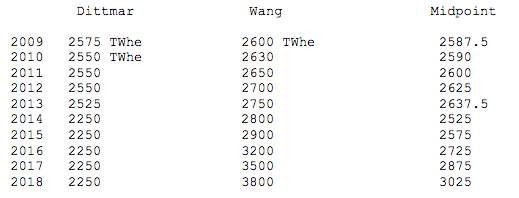
    The data to be used in determining this bet are the figures of the World Nuclear Association for the year, compared to the midpoint of the range.  The amount of production for each year is expected to be published the following year.  If the amount of the production is above the midpoint, Brian Wang is right, and advancednano is right and the winner; below the midpoint Dittmar is right and the winner for that year.  The figure is the TWH level of generation of commercial nuclear fission or nuclear fusion.

    The bet for 2009 will be close.  France’s production is down due to labor strikes and outages, plus electricity demand is down for the whole world because of the economy.  UK’s nuclear is up, and India’s nuclear is up.  Russia’s could be down.  Germany’s could be down.  Japan should be up.  US should be up a little.  China should be up slightly.  For either one of us to win or lose 2009 has minimal larger implications relative to the overall trend.  We are basically betting on the last quarter.  By 2011-2013 we are starting to move out of the random noise.  2014 is the clear divergence where the actual fundamentals will matter a great deal.  This is a link to a comment where advancednano summarizes his view of 2009 nuclear electricity production by country.

    Join the conversation about this story »

    See Also:

  • Video Calls on the iPhone, Courtesy of Fring

    As our sister site GigaOM reports, video calling has indeed arrived on the iPhone. It’s just a little one-way, is all. A new version of Fring supports video calls made using both its own and the Skype network, but you’re only able to receive video, not transmit it, since the camera on the iPhone 3GS still resides on the side of the phone opposite the screen.

    So long as you have iPhone OS 3.0 installed on your iPhone, you should be able to receive video calls with Fring from desktop and certain Nokia phone users once you install the update. As with everything cool on the iPhone, you’ll have to have a Wi-Fi connection to use video calling features, just as you must to make and receive voice calls, too. This despite AT&T’s announcement that it would allow VOIP on its network.

    Video calling works as advertised, but I’ll warn you that it can be an unnerving experience to talk to someone who can’t see you, but who you can see, for all parties involved. You can even initiate video calls from the iPhone, but obviously doing so still won’t enable video services on your end.

    It’s a neat trick, and handy if you’re on the road and haven’t seen a loved one for quite a while, but until Apple gets wise to this trend (if it is one; some think video calling will never catch on in the mainstream), I’ll be placing my iPhone Skype calls the old-fashioned way, to avoid the accompanying feeling of slightly creepy voyeurism that comes with watching without being watched. The video below will help you fathom the system if you’re not interested or able to give it a go yourself.


  • Feds punt on E15 waiver decision, want to test ethanol’s effect on more cars

    Filed under: ,

    There is some ethanol in almost all of the gasoline sold in the U.S. Usually, this amount is no more than 10 percent of the total and, if it’s more than that, it jumps all the way to 85 percent and is sold as E85. The U.S. Environmental Protection Agency was supposed to come down on one side or the other today of a possible increase across the board to 15 percent that Growth Energy and 54 ethanol manufacturers asked for, but instead announced that it needs more time.

    The EPA has been looking at the E15 issue all year and investigating all sorts of issues, but there are a lot of moving parts in this sort of decision. Everyone from farmers and their subsidies to grow the corn used to make most of the ethanol sold today to car makers who have tuned their engines to run on E10 but not E15 want to have their say. The EPA has heard the comments, and now says that it needs more time to test E15 in vehicles. Right now, it thinks that any vehicle built after 2001 will burn E15 just fine, but there are a lot of older vehicles still on the road. Cash For Clunkers didn’t get all of them off the road, after all. A decision is now expected in mid-June 2010.

    The postponement was met with approval by the Alliance of Automobile Manufactures, which said they want more government testing “to prove that increasing the allowable ethanol blend limit will not harm vehicle emissions, performance, and durability.” Read their full statement after the jump.

    [Source: Reuters, Auto Allliance | Photo: Scott Olson/Getty Images]

    Continue reading Feds punt on E15 waiver decision, want to test ethanol’s effect on more cars

    Feds punt on E15 waiver decision, want to test ethanol’s effect on more cars originally appeared on Autoblog on Tue, 01 Dec 2009 14:29:00 EST. Please see our terms for use of feeds.

    Read | Permalink | Email this | Comments

  • CBC’s Rodriguez wins East soccer MVP

    Published Dec. 1, 2009
    By the Tri-City Herald staff

    BELLEVUE — Columbia Basin College striker Julissa Rodriguez, who helped lead the Hawks to the NWAACC championship game for two straight seasons, was named the NWAACC East Region MVP on Monday.

    Rodriguez, a Kennewick graduate, led the NWAACC this season with 28 goals, a year after scoring 23 to lead CBC.

    Rodriguez is one of five CBC players to be named to the All-East team, including midfielders Jenn Johnston and Casey Demory, and defenders Sarah Milne and Nicki Grigg.

    Walla Walla women’s coach Chad Bodnar was named the East Region co-coach of the year.

    East-West Region all-stars

    Women
    East MVP–Julissa Rodriguez (Columbia Basin College)

    East Coach(es) of the Year–Chad Bodnar (Walla Walla), Jim Martinson (Spokane)

    West MVP–Ali Brown (Olympic)

    West Coach of Year–Dick Lowry (Olympic)

    Forwards–Rodriguez (CBC), Tabitha Grow (Spokane), Chelsey Thayn (Treasure Valley), Kati Lucas (WW).

    Midfielders–Jannely Quintana (Bellevue), Jenn Johnston (CBC), Casey Demory (CBC), Sholena Blackwell (Olympic), Cori Jo Young (Spokane), Nikita Johnson (Tacoma), Tahlia O’Loughlin (WW), Becky Reyerse (WW).

    Defenders–Sarah Milne (CBC), Nicki Grigg (CBC), Stephanie Hopkins (Spokane), Maile Cobb (Spokane), Sarah Weitz (Treasure Valley), Jennie Rasmussen (Treasure Valley), Dashia Huff (WW), Lena Miraglio (WW).

    Goalkeepers–Claire Pflueger (Spokane), Jordan Simkins (WW).

    Men
    East MVP–Alan Bosio (Treasure Valley). East Coach of the Year–Kenny Krestian (Spokane)

    West MVP–Steve Provost (Peninsula). West Coach of Year–Adam Fenster (Bellevue)

    Forwards–Josh Strasser (Bellevue), Andrew Mastronardi (Spokane), Bosio (TV), Marco Acevedo (WW).

    Midfielders–Radcliff McDougald (Bellevue), Matt Eronemo (Bellevue), Daniel Nam (Highline), Alex Bresnan (Highline), Steve Williams (Peninsula), Matt Miller (Spokane), Mikey Ramos (WW), Victor Navarro (WV).

    Defenders–Jesse Sorteberg (Bellevue), Mayron Trejo (CBC), Steve Prevost (Peninsula), Graham Lundgren (Spokane), Tyler Florez (Spokane), Jacob Bacon (TV), Brady Espinoza (WW), Jonathan Rodriguez (Wenatchee Valley).

    Goalkeepers–Ryan Skay (Spokane), Joey Pagan (WW).

    Volleyball
    NWAACC East All-Stars

    MVP–Brianna Claassen (Blue Mtn)

    Coach of the Year–Dave Baty (Blue Mtn)

    First Team–Nicole Graybeal (Spokane), Daria Winckler (WV), Rebecca Haight (Blue Mtn), Amber Durand (CBC), Kristen Garlie (Blue Mtn), Talia Venera (WV). Second Team–Megan Tompkins (WW), Kasey Jurich (Spokane), KC Schmit (Blue Mtn), Stephanie O’Connor (TV), Ashley Magee (WW), Beth Altena (Spokane).

    Additional news stories can be accessed online at the Tri-City Herald.