Author: Serkadis

  • Buffett: Nothing Is More Important To The U.S. Than An Independent Fed

    Warren Buffett warns that while some parts of the U.S. system need to be updated, there is “nothing more important to economic future of the country than to have an independent fed.”

    He believes this was proven over the course of U.S. history, and even during the latest crisis.

    “I think it’s done a good job over the years. I think it’s had good leadership most of the time. I think it has terrific leadership now. And I think that curbing the independence of the Fed could lead to a lot of mischief.”

    Join the conversation about this story »

    See Also:

  • Get Ready for a New Acrobat.com

    The future is looking bright for web apps with more and more players interested in the space and Google going all out with a dedicated operating system that will rely exclusively on web applications. Huge desktop software companies should start worrying or better yet start preparing for the paradigm shift like Adobe is doing with its suite of office apps over at Acrobat.com. Adobe says the site has been pretty successful so far but the company is preparing to launch a hugely revamped version of it any time now.

    Adobe hasn’t made the big official announcement yet but it has confirmed that the changes will begin to be implemented later today: “The team will be taking down Buzzword, Presentations and Tables at 6:00 PM Eastern time today (Friday, 11/20/09.) Share and CreatePDF will go offline at 8:00 PM Eastern time. ConnectNow will be up and running throughout the update window. All of the services will be up and running again by 11:00 PM Eastern time and open for business. The new look and changes in Acrobat.com are starting to get some good reviews. We invite you to come and check it out later today.”

    The new version comes with a lot of new features but one of the biggest is the new file organizer, which enables users to manage all of their files in one place regardless of their type. This has been one of the … (read more)

  • The Economy Is Too Bad To Get A Divorce

    miamioceansingle.jpg

    People are staying together in South Florida.  But not because they want to.

    Miami Herald:  With the economy sputtering, South Florida couples are staying together more or attempting do-it-yourself divorces rather than paying pricey divorce lawyers.

    As a result, local divorce lawyers say they are facing their slowest period ever, and are discounting rates, offering sliding payment scales and military discounts and accepting credit cards. One said her business is down 35 percent from last year.

    The article goes on to note that people report staying together because one spouse has health insurance or they own a home together that is now a liability, rather than an asset.  Some just cannot afford an attorney to represent them in a divorce.  

    The full article is here, and coverage by the ABA Journal is here.  

    What caught our eye is this paying-for-legal-services-via-credit-card idea.  We complain as much as the next person when the dry cleaners or, really, anyone, does not take cards.  It isn’t convenient.  

    But seeing as how legal fees can get quite expensive, it just feels strange — like this should be one of those cases where people are protected from buying what they cannot afford.  We like to think (though we realize this is up for debate) that lawyers do not want to take cases their clients cannot afford to bring, but if the bill is being paid via credit card every month, one would not necessarily know if that’s the case.

    So, we looked into the ethics of lawyers accepting credit cards.  It turns out, as of 2000, it’s ABA approved (pdf), as long, of course, as use comports with all other ethics rules.  

    Lawyers choosing to accept credit cards due to clients’ economic hardships, as the Miami Herald article indicates attorneys are, obviously raises a question of if access to a divorce, or any legal service, should require people to resort to credit risks to obtain legal services.  

    There is often a gap between those people eligible for pro bono services and those who can afford quality representation, or any representation.  

    The option of representing yourself in a divorce always exists, but any lawyer who has taken on a pro bono divorce case knows, it’s really not as simple as just saying “I Don’t.”  When you are not trained in the area, properly achieving a legal break-up is a whole lot more than filling in the blanks on a model form.  

    Join the conversation about this story »

    See Also:

  • Contest Video: Primal Blueprint Sprint Routine

    As part of our ongoing Primal Blueprint Fitness Video Contest readers Anders, Annika and Rob submitted their interpretation of a Primal Blueprint Sprint Routine (the latest contest theme). They’re in the running for a cash and Primal prize package and have a one in four shot of winning.

    If you liked this video be sure to check out other videos Anders has submitted: Bringing Home the Bacon and Primaldelphia.

    If you’d like to be featured on Mark’s Daily Apple for a chance to win Primal gear read the Primal Blueprint contest details and submit your video (fitness or recipe), real life Primal story or Primal recipe today!

    Get Free Health Tips, Recipes and Workouts Delivered to Your Inbox

    Related posts:

    1. Contest Video: Primal Blueprint Bodyweight Exercises
    2. Contest Video: Primal Blueprint Upper Body Workout
    3. Primal Blueprint Fitness: Sprint Routine

  • Microsoft’s Bad Image Should Be a Warning to Apple

    “I’m just wondering why your marketing group can’t do something to try to rein in this next generation, because you’ve got a real bad image out there.”

    So said a Microsoft shareholder to CEO Steve Ballmer at the company’s shareholder meeting yesterday. TechFlash reporter Todd Bishop notes that the same shareholder added that Apple’s TV commercials make Microsoft look “like a buffoon.”

    I’m relieved to hear this. I often look at Microsoft and wonder if its shareholders are as out-of-touch as the company itself seems to be. In just the last few weeks here’s what’s getting the most enthusiastic coverage in the tech press at a time when it ought to be 100 percent about the newly launched Windows 7.

    • A Microsoft manager claiming Windows 7 — Microsoft’s flagship product — is inspired by Mac OS X
    • Chief Software Architect Ray Ozzie’s bewildering assertion that “apps don’t matter” — despite everyone else on Earth knowing otherwise
    • Further redundancies that include long-time evangelist Don Dodge, and his subsequent post that, now that he’s free from Microsoft, he can admit, yeah, he has iPhone envy
    • And let’s not forget the bizarre PR misfire that saw the staff of Microsoft’s flagship retail store ignoring their customers for a full five minutes in favor of stomping their way, awkwardly and embarrassingly, through a dance routine

    The take-home message? It ain’t just the Apple commercials making Microsoft look like buffoons.

    How did CEO Steve Ballmer respond? Fear not, anxious shareholders, Ballmer has this to say to assuage your fears and calm your nerves:

    You take any country, including this one, and you say, how are we doing? The truth of the matter is, we do quite well. Even among college students, we do quite well. Do we have an opportunity for improvement? We do. Some of that is marketing some of that is phase of life. It is important to remember that 96 times out of 100 worldwide, people choose a PC with Windows, that’s a good thing. Even in the toughest market, which would be the high end of the consumer market here in the U.S., 83 times out of 100 people choose a Windows PC over a Mac.

    Hang on, back-up. “Some of that is phase of life.” Phase of life? Well, Ballmer sure knows his execu-speak. What galls me about this is how it illustrates perfectly that while Microsoft may be doomed to continue making embarrassing mistakes, it probably won’t suffer any actual harm as a result; it survives simply because of its mammoth install base. Nothing more than that. And that simple fact directly influences the attitude and reasoning of its CEO. Ballmer is tacitly admitting that, all things considered, yeah, Microsoft looks like a bunch of idiots but that doesn’t matter because they’ve got more customers than anyone else.

    Turn this around, and imagine that Apple does monumentally silly things that make it the target of much derision and ridicule among the tech community and consumers. Imagine you’re a shareholder, and you see a drop in quarterly earnings. You see the company laying off staff (including highly visible and respected staff they should keep). You see its executives sending conflicting messages to the public. And when you take them to task for it, Steve Jobs replies “Yeah, we’ve been a bit crap. But most people own an iPod, right, so, no worries.” Would you be satisfied with that?

    Ballmer added:

    Frankly, the economy is good for us, because people do understand that Macintoshes are quite a bit more expensive for essentially the same computer … we have opportunities to improve among exactly the constituency that you identify.

    Yep. Be happy there’s a recession, people, or else customers would be buying Macs!

    This isn’t actually a Microsoft bashing exercise (clearly, it does that to itself and needs no help from me). Instead, I look at this and wonder (fear) that Apple might be headed in much the same direction. Recent unpredictable behavior around the application approval process has seen Apple severely criticised by some of its most staunch supporters. Developers aren’t just frustrated, they’re now quitting the platform altogether. And not because the platform is flawed, but because Apple is horribly (and very visibly) mismanaging it.

    Apple needs to take a good long look at the Microsoft of today and ask if it isn’t starting to make the same mistake; stubbornly pushing ahead with flawed policies/strategies that are justified on the strength of product market share alone, despite the obvious (and loud!) protestations of the public, the press, and sooner or later, even its own shareholders.

    Sure, Apple isn’t as bad as Microsoft yet. But this is how it starts, people. Google Voicegate. Joe Hewitt. Rogue Amoeba. It’s not exactly dancing in an Apple Store, but it’s still embarrassing and potentially damaging, and it’s definitely a trend that won’t go away unless Apple does something to fix it.


  • Infoaxe’s Search Engine: More Current Than Real Time

    Updated: Infoaxe is revealing to the world today its alter ego: a search engine. Unlike other real-time search engines such as OneRiot, Infoaxe doesn’t depend on Twitter streams and the like (Update: OneRiot emailed to note that it also uses a panel in addition to social sharing streams). Instead, it anonymously harvests data from its millions (low millions, for now) of people who use its personal search history plug-in.

    The idea is to observe every page an Infoaxe user visits, not just the ones they share on social web services. This aggregate attention data adds 7 million URLs per day to its index, as compared to some 300,000 URLs on Twitter and 10,000 on Digg. Of course, those other sites’ URLs are shared for a reason.

    “Even though Twitter and Facebook have exposed the chink in Google’s armor, we don’t think they are the cure,” Infoaxe founder Jonathan Siddharth said in a recent interview. He and co-founder Vijay Krishnan met while doing their computer science masters’ degrees at Stanford a couple years ago.

    Infoaxe’s results are fresh, but they don’t form an up-to-the-second real-time stream, which is a plus for relevancy. Rather Infoaxe puts an emphasis on pages where its users have stayed for a while or revisited often — so it’s good at discovering things like product deals and hosted web streams of TV and movies — the kinds of query for which another search engine might deliver an outdated pile of spammy SEO junk, or a more timeless link like an IMBD page, respectively.

    As Infoaxe tries to secure deals to incorporate its results into larger search engines, it’ll be important that it has a good sample of users. And to some extent, that will never happen, because the people who contribute to Infoaxe will only be those who are motivated to save and parse their own search histories. However Siddharth and Krishnan brag that their 2.1 million registered users are starting to break out of the early adopter mold, with more total IE plug-in downloads than Firefox, and an even balance of men and women.

    Sunnyvale, Calif.-based Infoaxe has five employees; it raised $900,000 from Draper Fisher Jurvetson, Labrador Ventures, Band of Angels and Amidzad Partners in 2008.


  • First Drive: 2010 Mitsubishi Outlander GT is a CUV we can live with

    Filed under: , , ,

    2010 Mitsubishi Outlander GT – Click above for high-res image gallery

    Mitsubishi presented its best and brightest rides for us to drive over the course of an eight-hour event in the parched desert oasis of Palm Springs, CA. Everything from a tuned, 290-hp Lancer Sportback Ralliart to an electric i MiEV. And drive them we did. We rocketed up winding mountain roads and down gravel-caked trails. If they brought it, we pounded on it. Fairly hard, too. Odd then that the focus of this particular review – and in many ways the star of the party – isn’t some carbon fiber body kit-enhanced EVO X, but rather the new 2010 Mitsubishi Outlander GT.

    Yup, an SUV. Actually, a CUV, albeit one with lots of ground clearance. Mitsubishi first introduced the second generation Outlander in 2006 (replacing the more wagon-esque first gen.), and 2010 marks a major refresh. In GT trim, almost everything has changed, from the exterior to the interior to the quantity and quality of gadgets to the engine output to the transmission and finally, most importantly, its all-wheel-drive system. The 2009 Outlander was a fine, competent, utilitarian machine – perfectly adequate for schlepping kids and groceries. But let’s be frank, it didn’t set hearts on fire. And while the new Outlander GT won’t necessarily do that either, it’s most definitely not just another sedan on stilts.

    Photos copyright (C)2009 Drew Phillips / Weblogs, Inc.

    Continue reading First Drive: 2010 Mitsubishi Outlander GT is a CUV we can live with

    First Drive: 2010 Mitsubishi Outlander GT is a CUV we can live with originally appeared on Autoblog on Fri, 20 Nov 2009 11:57:00 EST. Please see our terms for use of feeds.

    Permalink | Email this | Comments

  • Downloadable PC Full Version Freeware Real-Time Strategy (RTS) League of Legends – Installers

    Found out that there are two types of installers for the game — US and UK. I alerted the LoL developers with a query.

    I’ve also updated my previous post; I’ve added the download link for the US version.

    The download links (to the US and UK versions and a tutorial video) after the jump.

    >>>Click here for the download links.

  • Murdoch’s The Times Accused Of Blatant Copying, Just As It Tells The World You Should Pay For News

    Just this week, James Harding, the editor of The Times (of London), a paper owned by Rupert Murdoch, tried to explain why the news is worth paying for, as the paper starts to put up a new business model to get consumers to pay for news. Unfortunately, Harding apparently didn’t get the message himself. As pointed out by Mathew Ingram, just days after making the case for paying for news, The Times has been accused of publishing an article that it copied without permission from a blog.

    You can’t make this stuff up.

    Yes, just as Rupert Murdoch is calling aggregators (sites that simply summarize and link to stories) parasites (even as he owns a bunch of aggregators himself), one of his papers didn’t aggregate, it flat out copied, without permission, a blog post that was written by Edgar Wright as a tribute to Edward Woodward, who recently passed away. The Times eventually put up a “clarification” online that had a link to the original site, but that hardly explains the original copying — especially during the very week that they’re trying to convince the world that news should be paid for….

    Permalink | Comments | Email This Story


  • Facebook Worth at Least $9.5 Billion

    Facebook is one of the biggest things in Silicon Valley at the moment and the social media giant is showing no signs of slowing down. It is being valued at several billion dollars, over 10, by previous transactions but since it’s a private company, no one can really tell what it’s worth. However, despite the fact that Facebook isn’t listed on any stock exchange, some shares end up on places like SecondMarket and SharesPost, which allow people who own Facebook common stock, mostly employees or former employees, to trade it. And prices for those shares have been going up over the past months to the point where Facebook’s common stock is now worth around $9.5 billion.

    That figure may be a bit misleading but it gives a rough estimate of what most people think the social network is worth. The $9.5 billion number is based on the price of shares currently being traded on SecondMarket, which has reached $21. The price has shot up 42 percent in the past four months, according to Bloomberg. This is just for the common stock though, as a chunk of the company is tied up in preferred stock, which is usually owned by venture capital investors so by this metric, Facebook may be worth more than $10 billion at the moment.

    The valuation does seem very high but it’s not the highest the social network has got; in fact, a couple o… (read more)

  • VIDEO: Disgruntled Volvo owner starts blog, crafts lament in her native Swedish tongue

    Filed under: , ,

    Click above to watch the video after the jump

    Freya Svensson feels like she’s getting screwed. According to her blog postings, she owns a still new-looking Volvo XC70 that has had more than its fair share of problems: a faulty transmission and an internal coolant leak that could have been caused by a cracked cylinder head or head gasket. To make matters worse, Svensson says the transmission, cylinder head and motor mounts (twice) have been replaced by Rusnak Volvo in Pasadena, California. Svensson further claims that when the transmission was replaced, she told Rusnak that it still didn’t feel right but the dealership allegedly wouldn’t take a look at it again. Now that the supposed defective tranny is out of warranty, the dealership wants to repair it. None of this tale is funny, odd, or different from some of the dealer/warranty horror stories that we hear about all the time. So why are we bothering to report on this one? As you might have guessed from the viking helmet and acoustic guitar show above, Svensson has no issue in pulling out all the stops in order to get her message across. She’s even got t-shirts. This amuses us.

    For starters, Svensson started up her own website, Rusmackedvolvo.com, which details her problems with Volvo North America and Rusnak Volvo. She took to Facebook to friend Volvo North America President Doug Speck, offering to help him add to his paltry friend total of 24 in exchange for free repairs to her Scandinavian lemon. To add a little flair, Svensson then took to YouTube to provide a video play by play of what is going on with her cursed wagon. The blonde haired, blue eyed Svensson plays up the Swedish connection by even singing an original composition, “O Rusnak Volvo” in her native tongue. Hit the jump to watch the clip, and don’t worry if you don’t speak Swedish – Svensson has been thoughtful enough to provide English subtitles.

    [Sources: Rusmackedvolvo.com; YouTube]

    Continue reading VIDEO: Disgruntled Volvo owner starts blog, crafts lament in her native Swedish tongue

    VIDEO: Disgruntled Volvo owner starts blog, crafts lament in her native Swedish tongue originally appeared on Autoblog on Fri, 20 Nov 2009 11:29:00 EST. Please see our terms for use of feeds.

    Read | Permalink | Email this | Comments

  • PSP Firmware Update 6.20 Introduces Extras, Digital Comic Support


    Sony has released a firmware update for the PSP family of gaming devices, which adds a new column in the XMB called “Extras.” Within this column you will now find the “Digital Comics” category, which will become fully functional in December when Sony starts offering digital comic books through the Playstation Store. Sony has also strengthened compatibility with Media Go software, allowing folks to enjoy their video and audio playlists that they created within Media Go.

    Extras

    • (Extras) has been added as a new category and (Digital Comics) has been added as an application under that category.

      With this application you can enjoy content such as comics and cartoon strips.>See details

    Other new or revised features in version 6.20

    Other

    • The XMB™ (XrossMediaBar) menu has been redesigned.

    music Photo

    • You can now import photo playlists that you created using the Media Go application and enjoy the playlists on your PSP® system. >See details

    video Video

    • You can now import video playlists that you created using the Media Go application and enjoy the playlists on your PSP® system. >See details
  • BlackBerry Pearl 9100 gets pawed

    BlackBerry 9100

    After RIM’s release of the BlackBerry Pearl 8220 flip-phone it was hard to tell what direction the former candy bar style handset was headed, and rumors of the models demise began to circulate around intertubes. However, the rumors of its death were greatly exaggerated as an updated 3G Pearl has been whispered for months, and it looks like RIM has gone back to the Pearl’s form-factor roots with its latest spin on the classic, the BlackBerry Pearl 9100 — code name Striker or Stratus. The 9100 prototype in question is a GSM device with RIM’s now standard optical trackball, SureType keyboard, 3G, Wi-Fi, and BlackBerry OS 5.0; it also incorporates many of the stylistic changes of the BlackBerry Bold 9700. We’ll stay on top of this one and provide you more details as they become available, but for now there is a short teaser video from salomondrin.net all queued up for you after the bounce.

    [Via CrackBerry]

    Read

  • Sony looks to finally open a single storefront for downloads

    By Tim Conneally, Betanews

    Sony yesterday discussed its plans to open a download shop similar to iTunes or Amazon Digital Downloads.

    Reportedly given the tentative name “Sony Online Service,” the online store would make the many different types of Sony digital content available in a single place. The company has a number of content portals already, but each is geared toward a related piece of hardware and run by a different business unit of the giant Sony conglomerate.

    For example, PlayStation 3 and PSP users can download new games, movies, and TV episodes from the PlayStation Network, but users of the Bravia Internet Link on Sony’s HDTVs get content directly from Sony Pictures services such as Crackle. Users of Sony’s e-Reader family can get content in The sBook Store from Sony, but users of Sony’s Walkman family of portable media players are encouraged to get their music from Sony MusicPass, which was launched to replace the defunct Connect music download shop that closed in 2008. There is also a substantial overlap in content with Sony’s mobile phone joint venture Sony Ericsson and itsPlayNow arena..

    Kazuo Hirai, Sony’s executive vice president for networked products and services, says the service will be modeled after the popular PlayStation Network, which now has more than 33 million registered users. Hirai however, expressed doubt to Businessweek that users of PlayStation Network would actually migrate over to a new service.

    Copyright Betanews, Inc. 2009


    Add to digg
    Add to Google
    Add to Slashdot
    Add to Twitter
    Add to del.icio.us
    Add to Facebook
    Add to Technorati


  • Freight Forwards Curve Warns Of Baltic Dry Index Collapse

    The Baltic Dry Index (BDI) has hit the highest point all year, staging a stunning rebound that is earning dry bulk shipping companies substantial amounts of profit for the time being. The latest BDI rally has been particularly spectacular given the massive amount of new vessel supply, which generally sinks rates all else equal, it has overcome.

    The sudden spike in new vessel supply this year is well by this chart from Johannes Moller at Danske Bank. Note the BDI rallied against this upward slope. This has been due to remarkably strong demand from China, plus some contribution from the grains trade which is seasonally strong right now.

    chart

    Yet while dry bulk stocks have rallied to some extent, they haven’t experienced the same strength as they have in the past when the BDI was at such high levels.

    For example, DryShips (DRYS), Eagle Bulk Shipping (EGLE), and Genco Shipping (GNK) are trading below their highs for this year, and dramatically lower to where they’ve been in the past when the BDI was above 4,600. The same is generally the case for dry bulk shipping companies in Asia. So what gives?

    While forecasting the BDI is a bit of fool’s game, the stocks haven’t run like in the past due to concerns that we may be set up for a massive BDI head-fake in 2010. This is because that supply chart you see above isn’t set to get any better. It is set to worsen.

    Danske Bank: We believe this [supply] trend should continue into 2010 when we believe quarterly deliveries are likely to be in the range of 15-20 m dwt, which is equal to an annualised fleet growth in the range of 13-18%.

    The dry bulk freight forwards curve confirms this. It is forecasting a decline in rates, especially around the second quarter of 2010:

    FFA

    BDI

    Join the conversation about this story »

    See Also:

  • REPORT: Ghosn still thinks Renault-Nissan should have partnered with GM in 2006

    Filed under: , ,

    With all the trials and tribulations General Motors has endured during the past year, we almost forgot that the Detroit, MI-based automaker nearly got itself tied up with Renault-Nissan. Back in 2006, the two companies discussed joining forces to become a singular global automotive juggernaut, but in the end, GM felt it was in its best interests to go it alone and face the quickly disintegrating global automotive market by themselves.

    While GM’s situation ultimately improved via bankruptcy and a $50 billion helping hand from the U.S. government, Renault-Nissan CEO Carlos Ghosn still thinks the partnership would have been “without a doubt” in everyone’s best interests. Ghosn reportedly made the comments during a meeting of the Council on Foreign Relations, adding that “there was a possibility to create something that would be extremely competitive.”

    Ghosn then went on to say that he wasn’t happy the two companies didn’t end up working together after GM nearly collapsed because “when you see the disaster and the waste of energy and skills and talent, nobody can be happy.” The charismatic CEO also said that Renault-Nissan was very concerned about GM’s precarious position earlier in the year due to the fact that his company uses many of the same suppliers. If GM had gone down, it would have probably taken more than a few suppliers with it, and Ghosn says that as a result, Nissan wouldn’t have been able to make a single vehicle in North America.

    While we can definitely understand why Ghosn would have preferred that the marriage of his company to GM was consecrated, we still don’t see how it would have helped The General in the long run. GM still would have been in a very uncompetitive cash situation, and Renault-Nissan doesn’t have much in the way of technology or platforms that the General doesn’t already the equivalents to.

    [Source: The Detroit News | Image: Raveendran/AFP/Getty]

    REPORT: Ghosn still thinks Renault-Nissan should have partnered with GM in 2006 originally appeared on Autoblog on Fri, 20 Nov 2009 11:02:00 EST. Please see our terms for use of feeds.

    Read | Permalink | Email this | Comments

  • FuelCon Fuel Cell Testing Equipment Could Lead to Quick Improvement

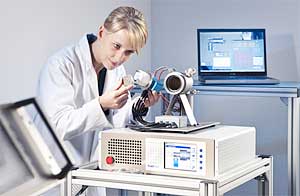
    Fuel Cell TestingOver the past few years it seems like I’ve talked about hydrogen fuel cells ad nauseam. I’ve spoken about fuel cells that are being developed with platinum nanowires, carbon, nitrogen, iron, doped nanotubes, mushroom enzymes, polymers, plastics, nickel, hydrazine hydrate and other enzymes.

    What I’ve neglected to talk about over time, however, is how researchers and manufacturers are supposed to test hydrogen fuel cells so that they may keep improving the size, weight, durability, life cycle and materials used.

    A company called FuelCon has developed an advanced testing system for the proton conductivity of fuel cells. According to FuelCon, “With the ‘TrueXessory-PCM Proton Conductivity Measurement’ market launch FuelCon provides a testing system for the development of more efficient fuel cell membranes. The new product allows highly reproducible in-plane measurements of the proton conductivity of PEM and DMFC membranes under defined humidification and temperatures up to 200°C. Designed as a tabletop system, complex hardware like a complete test station including gas supply is not required.”

    One of the problems that fuel cells for hydrogen cars have had in the past is a short life cycle. Some earlier prototype GM models had fuel cells that were only rated for around 50,000 miles. The U. S. Department of Energy (DOE) has stated that hydrogen fuel cells for cars will be ready for prime time when they have a durability of 5,000 hours (or roughly 150,000 miles).

    By having the tools to quickly test new methods and materials for creating fuel cells, the development time should be shortened considerably. Also, improved conductivity means more power and smaller fuel cells, which impact the weight of the vehicle and where the fuel cell system can be placed. Having the right tools to bench test hydrogen fuel cells is a positive step towards commercialization that should not be ignored.

  • Apple Patent Describes Smart Remote Technology

    The U.S. Patent and Trademark Office yesterday published a patent application Apple made way back in 2008 for “Pushing a User Interface to a Remote Device.” So, then…Smart Remotes. Cool!

    MacRumor’s Eric Slivka reports that the patent’s lead inventor is William Bull, now Yahoo’s Senior Director of Mobile User Experience, but once upon a time Apple’s iPod User Interface Manager. The so-called “father of the iPod,” Tony Fadell, is also credited.

    The idea is simple; portable media devices — such as iPods and iPhones, for example — have their own on-board Graphical User Interface (GUI) and, usually, a built-in screen. Thing is, we don’t always want to take our iPhone out of our pocket when we’re listening to music (or, if you’re me, catching up on podcasts while washing the dishes).

    Enter remote controls (referred to in this patent as “accessories”). Often they’re dumb little inline sticks with a few fiddly (not to mention tiny) buttons. They’re useful, but basic, offering perhaps only a half dozen simple controls. Some of the more elaborate remotes have their own little displays, which is all very well and good, except that they also employ their own little GUIs which not only fail to resemble the one on the device you’re trying to control, but often don’t provide full access to all the device’s functions. From the patent application:

    …existing remote GUIs are defined and controlled by the remote control device, and consequently, they may bear little resemblance to a GUI supplied by the portable media device itself Certain functions available on the portable media device (such as browsing or searching a database, adjusting playback settings, etc.) may be unavailable or difficult to find.

    Apple’s solution is to “push” the device’s GUI to a remote an accessory with a built-in display. Here’s the description from the patent application (I’ve shortened it to just the main points);

    The portable media device can provide the accessory with an image to be displayed on the video screen… [and] include various user interface elements that can resemble or replicate a “native” GUI provided directly on the portable media device. The accessory can send information to the portable media device indicative of a user action […] for example, that a particular button was pressed or that a particular portion of a touch-sensitive display screen was touched by the user. The portable media device can process this input to identify the action requested by the user and take the appropriate action. The action may include providing to the accessory an updated GUI image to be displayed, where the updated GUI image reflects the user action.

    Essentially this describes a touch-enabled screen, small enough (and dumb enough) to still be called an accessory, which effectively acts as a small auxiliary display/input panel for the device.

    I can’t see this making its way into an inline remote (it’s just not Apple’s style to make a wearable remote that’s big) but I can see a future revision of Apple’s current Remote that entirely does away with the buttons, replacing them with a capacitive touch screen.

    Future software updates would enable one to connect the remote to a nearby Mac mini, Apple TV, even an iPod touch, and switch between those devices the same way the iPhone Remote app does today. The GUI would change, depending on the selected device.

    The only drawback I can see to such a device (and remember, I’m just extrapolating here and imagining a potential future gadget — Apple’s patent application only describes a possible method and not an actual product) is that a remote with a capacitive touch screen will chew through its battery in next to no time. Is it conceivable we’ll be buying a charging dock for a future Apple MultiRemote?

    More compelling is the notion that Apple could build this technology into an entire ecosystem, licensing third-party developers to create compatible hardware; imagine a house where a smart display on the door of your refrigerator not only tells you when the milk needs replacing but also allows you to skip tracks on the album you’re playing over AirTunes…

    But am I thinking too small? Is this yet another patent application that will, ultimately, come to nothing, or could this be an early clue to a new Apple-tastic revolution?

  • Nokia to Consolidate Handset Lineup…Finally

    Nokia said today it’s slashing 330 research and development jobs in Europe as it looks to consolidate its handset lineup and focus on high-end smartphones. The move is a small one and long overdue, but it is a step toward getting Nokia back in the game.

    The Finnish company’s success selling low- to mid-range smartphones in developing markets is well documented, but Nokia continues to lose ground in the U.S. and Europe as superphones from Apple and Research In Motion chip away at its market share. And Nokia is increasingly threatened by Android, which has gained sudden momentum in the wake of its Verizon Wireless Droid initiative.

    Nokia may feel a pinch as it severs the R&D personnel, but the company will surely continue to innovate with its Maemo OS and S60 devices.  And it’s not like innovation has ever been a problem for Nokia — its struggles since the emergence of the iPhone have stemmed from its aging Symbian platform, its unwillingness to bow to U.S. carriers and an utter lack of affordable, iconic devices. Shifting its focus toward higher-end handsets that produce better margins will be a step in the right direction.


  • The 14 Craziest Foods In The Chinese CPI

    frozenduck.jpg

    For all the difficulty of measuring inflation, most countries use something similar to our CPI to do it.

    Obviously, though, the components are totally different, and so they provide a nice insight into what people are buying and eating all around the world.

    The food component of the Chinese CPI should be particularly amusing to most Westerners, who would think that carp is a key food item, and they certainly wouldn't think to differentiate two kinds of carp. (Americans use much more boring items like breakfast cereal, milk, coffee, and chicken).

    Courtesy of the Chinese Government's excellent and transparent economic statistics page, we present our 14 favorite items and what they cost.

    See the food >>

    Join the conversation about this story »

    See Also: