 Paul Hawken was the keynote speaker at the Sustainable Industries Economic Forum in San Francisco on Thursday. He had some inspiring talking points (the forum’s goal was to ‘reinspire the inspired’), but one of the key takeaways was in how we should be viewing sustainability. He started by saying that sustainability should be viewed as a easily defineable. Sustainability means we survive. Living unsustainably means we don’t. But it was how he suggested we view this that was really interesting.
Author: Serkadis
-
Viewing the world as a system will help us establish sustainability
-
Five improvements for IT managers in 2010
By Ed Moyle, TechNewsWorld
Every year around this time, everyone from antimalware companies to analyst firms line up to tell us about the top IT and security trends — what they are and why we should care. This year, chances are they’ll tell us all about cloud computing, virtualization, and social networking, and why these technologies are the new best (or worst) friends for security folks in 2010.
Now if you’re sensing a bit of snarkiness here, you’re right — I find these lists a bit frustrating. That’s not because of inaccuracies in the lists themselves (to the contrary, many of them are dead-on), but instead because they sometimes inappropriately drive how IT managers make budgeting decisions. Don’t get me wrong, keeping abreast of the new areas is always valuable — and I’m always fully on board with keeping us and our staff up to date and capable of reacting to new types of threats. But it’s also important to keep in mind that what’s new isn’t always what’s most critical. Where should you be investing budget dollars? At critical areas, not just what’s new and shiny.
To illustrate this, consider a firm that doesn’t use AV (antivirus) and also allows users to access social networking sites. The trend predictions are likely to clue us in about why social networking is something we should care about, but they might not mention malware at all (after all, that’s been around forever). But if your firm doesn’t yet have a cohesive antimalware strategy … well, you’ve got bigger fish to fry than how, when, or what your employees tweet. In other words, when it comes time to allocate budget for new projects, you need to consider both the new and the old — both the upcoming trends that Big Analyst Firm says are emerging, as well as the “tried and true” fundamentals that don’t get as much play.
In the field, it’s all about the basics. When you stop to think about it, how many of us are really where we need to be when it comes to the fundamentals? Which position would you rather defend: that your firm was hacked because of some newly emerging threat, or that you got hacked because you weren’t doing the generally accepted minimum practice?
So in the spirit of keeping one eye on the practical, here’s my New Year’s list — or, more accurately, my “reminder list”: a highly unscientific breakdown of the top five basics that are often overlooked in enterprise. These are things that you probably should be doing, but might not be — and things that you could probably do more with, but maybe aren’t.
1) Vulnerability Assessment. There are several reasons why you might not be doing as much vulnerability assessment as you could be: It can bring down critical systems, it requires some specialized knowledge to vet false positives, it has a high overhead in terms of care and feedback by staff members. As such, there are quite a few organizations that just don’t use it at all — and for companies that do, it’s often inconsistently deployed.
However, aside from this complexity, it’s also one of the most valuable areas of feedback that you can get about how your organization performs. Data about the effectiveness of your patch management processes, your password policy, and your system-hardening procedures are all directly and practically observable through the data coming out of vulnerability assessment results. If you haven’t deployed it yet, the technology is cheap, mature and commoditized.
2) Asset Inventory. How many of us have a detailed inventory of all the “stuff” on our networks? Organizations tend to grow their IT organically, so many of us are in the situation where going back to inventory what we have fielded is a huge, expensive undertaking. Even when we do have some idea of what’s out there, there are very often “gaps” in our understanding of our environments. For example, we may have a pretty clear idea of what desktops are fielded but not have tremendous insight about applications.
If you don’t have a clear idea of what you have fielded in your organization, now is the time to put together that inventory you’ve been putting off. Leverage existing tools like VA reports or business impact analysis documentation to put together a rough “map” of what you have fielded and keep it updated as changes occur. You don’t have to have a fancy system to do this. Start small and grow your inventory the same way you grew your network — organically.
3) Provisioning. We all know the ideal end state of user provisioning: defined roles that govern access to network resources and applications. But in practice, when the topic of provisioning comes up we wind up going down a path that involves deploying complicated systems or that involves significant effort parsing out users based on vague or poorly defined roles. While we wait for the dust to settle, the day to day business of assigning new users to applications moves ever forward — often with little or no assist from security staff and even less organization.
However, a solid map of roles doesn’t have to be complicated. Start by defining roles at the very highest levels, and get more granular over time. Don’t have a provisioning system deployed? Delegate responsibility for creating roles to subject matter experts who use the application all the time. Check in with them periodically to make sure they’re doing the right thing.
4) Audit and Monitoring. IDS systems are chatty, and the individuals who review alerts are often under significant stress and workload already. At the OS and application levels, staffers are often too overwhelmed to review log and activity reports as much as they should. So who has time to keep up? In many organizations, the day-to-day monitoring of audit and activity logs tends to fall by the wayside — for folks that even have auditing features enabled.
However, compliance mandates like PCI, HIPAA and others specifically require review of audit logs, so failure to make this happen is not an option. Step up what you review and how often you review it. Institute spot-checks to make sure that staffers are doing their jobs when it comes to reviewing this critical data.
5) Business Continuity Planning. Let’s face it, BCP is a lot of work. It involves participation from all areas of the organization — from subject matter experts to business to management. Because of the number of folks involved, very often we don’t have time for formal models, or when we do, very often our analysis goes without updates for long periods of time.
However, planning for contingencies is beyond critical, and all that data you’re getting about applications, systems and business processes can be recycled for other purposes within your security program, such as triage during an incident response exercise, risk analysis, and even asset inventory. So maybe now is a good time to do a refresh on this valuable data — or start doing it if you haven’t already.
Now maybe your company has already hit all these topics, and you don’t need me to remind you to “eat your vegetables.” If so, nice work — count yourself among the well-positioned minority.
However, if in reading through these items you see areas where you could be doing better, remember that boning up on the basics is just as important as looking for new ground to cover. After all, the basics might be “old hat,” but that doesn’t mean they’re not important.
Originally published on TechNewsWorld
© 2009 ECT News Network. All rights reserved.
© 2009 BetaNews.com. All rights reserved.
-
Sony Bringing Fee-based Subscription To Playstation Network

In Sony’s Investor/Analyst meeting today, they had a section in their slideshow called the “5 Key Advantages of Playstation 3,” which is a general overlook at the system and its advantages in the market. The usual information was present, including mention of the Motion Controller (that will have vibration feedback), Blu-ray capability, PSP integration, and 3D gaming. However, there was one slide that had several interesting items listed:
- “New revenue stream from subscription”
- “Q2 FY2010: release non-game software development kit”
I fully believe that this new subscription based service would not replace the free Playstation network access, but rather compliment it. I think that a free Playstation Network will always exist and has been a strength for Sony from the start. However, I do think that they will offer some sort of subscription service based on entertainment offerings, such as allowing you to download a preset number of movies, games or themes each month. There are many other possibilities as well, including increased download speed, a more detailed Playstation Network profile online, and other exclusive benefits.
It’s fair to say we will probably see this Playstation Network subscription offering in 2010/2011.
As for the non-game software development kit, we haven’t been able to get more information at this time. Very unusual!
-
Location, Location, Location: SimpleGeo, Twitter, Flook
 In my first week back on the web beat at GigaOM, one of the topics I wanted to focus on was location. Let’s just say that hasn’t exactly been a difficult task. Coming at us from Boulder, San Francisco and London, here are today’s top three geo-tagging developments:
SimpleGeo launched today, promising to build a contextual infrastructure of points and eventually polygons for the world so that people can build apps that incorporate where users are located. The company says it’s already received 600 beta inquiries in its first day out, and it also received both audience and judges’ choice accolades at the Under the Radar event where it debuted.
“We’re selling shovels at the beginning of a gold rush,” is how co-founder Matt Galligan put it on a call today. “You want to add location, just come to us — it’s done.” Though four-person SimpleGeo still measures its age in months, it already has a price sheet: free, $399/month for small businesses and $2,499/month for custom implementations. Galligan said he expects to announce a funding round soon. (BTW, this follows the launch of competitor PublicEarth, which calls itself “the wiki for places,” yesterday.)
While Boulder, Colo.-based SimpleGeo may have moved quickly in its short life, big social sites aren’t necessarily waiting for little startups to come fill their location-based needs. Today Twitter launched a geotagging API, at first only available as an opt-in feature for outside apps like Birdfeed, Seesmic Web, Foursquare, Gowalla, Twidroid and Twittelator Pro. When used, this feature associates a tweeter’s exact location (as best as it can be determined) at the time of tweeting with the tweet itslf.

And lastly, Ambient Industries debuted a social location app for the iPhone today called Flook. While there’s no lack of competition for fun iPhone apps that enable users to mark up the world, Flook is built to be quirky, easy to browse and contextual-ad ready. The basic interface consists of virtual geo-tagged “cards” with facts, photos and recommendations left at particular locations by Flook users. Users can swipe through cards and turn them over to leave comments in a jaunty orange and purple interface manned by cute little robots (see video demo above).
What’s interesting is that Flook comes from two Symbian founders, Roger Nolan and Jane Sales. Said Nolan on a call from London today, “Apple seemed to just do all the things that Symbian and Nokia should have done for a long time.” So he and Sales (they’re married) along with two other co-founders raised $1 million from Eden Ventures and Amadeus Capital and founded Ambient a year ago. Flook is the company’s first project.


-
PDC 2009: What have we learned this week?
By Scott M. Fulton, III, Betanews

 It ended up being a somewhat different PDC conference than we had anticipated, and even to a certain extent, than we were led to believe. Maybe this was due in part to a little intentional misdirection to help generate surprise, but in the end, the big stories here in Los Angeles this week were more evolutionary than revolutionary. That was actually quite all right with attendees I spoke with this week, most of whom are just fine with one less thing to turn their worlds upside down. It’s tough enough for many of these good people to hold onto their jobs every week.
We’ll start our conference wrap-up with a look at the flashpoints (remind me to call Score Productions for a jingle to go with that) we talked about at the beginning of the week, and we’ll follow up with the topic that crept in under the radar when we weren’t expecting.
Making up for UAC, or, making Windows 7 seem less like Vista. This was absolutely the theme of “Day 0,” which featured the day-long workshops. At this point, Windows engineers have absolutely no problem with the notion of disowning Vista, disavowing it, even though it was technically a stairstep toward making Windows 7 possible. But it is now perfectly permissible to acknowledge the performance hardships Vista faced, and let go of the past in order to move forward.
 Mark Russinovich leads the way in this department, and the fact that he’s appreciated leads others to follow suit. During his annual talk on “Kernel Improvements” — which he expanded this year to a two-parter — Russinovich spoke about the way that the timing of Windows’ response to user interactions was adjusted to give the user more reassurance that something was happening, rather than the sinking suspicion that nothing was happening.
In an explanation of a user telemetry service he helped get off the ground called PerfTrack, he told attendees, “We went through and found roughly 300 places in the system where you interact with something, and there’s a beginning and then an end where you go, ‘Okay, that’s done,’ and optimized the performance of those user-visible interactions. We instrumented those begin-and-ends with data points, which collects timing information and sends that up to a Web service…and for each one of these interactions, we define what’s considered ‘great’ performance, what’s considered ‘okay’ performance, and what’s considered Vista — I mean, uh, ‘bad,’” he explained, with a little grin afterward that appeared borrowed from Jay Leno. “And then if we end up in that ‘okay’ or ‘bad,’ what we do is, selectively turn on more instrumentation using ETW [Event Tracing for Windows] — instrumentation of file accesses, Registry activity, context switches, page faults — and then we collect that information from a sampling of customer machines that are showing that kind of behavior.
“We feed that back to the product teams, they go analyze those and figure out, ‘Why is their component sluggish in those scenarios?’ and optimize that.”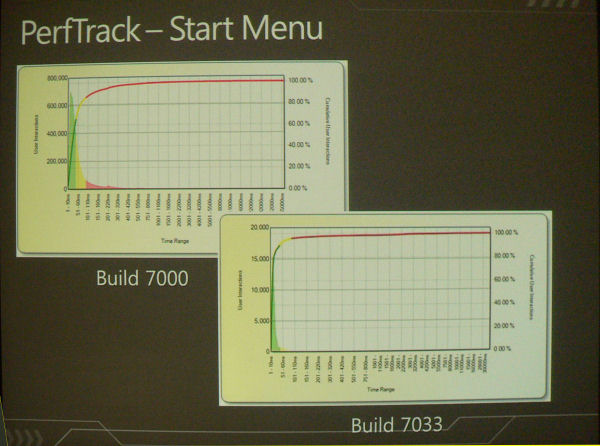
One of the results he demonstrated, shown here in this pair of charts, shows the number of user-reported instances of Start menu lag time leaning more toward the quick side than the slow side of the chart, between two builds of the Windows 7 beta.
The fact that performance matters was one of the key themes of PDC 2009, and attendees greeted that message with enthusiasm — or, maybe more accurately, with appreciation that the company had finally received the message. But there are still lessons to be learned here that can be applied to other product areas, if anybody out there is listening.
Why Windows Azure? The major theme of Day 1 was the ability to scale services up — scaling local services up to the data center, and data center services up (or down, depending on your application) to Microsoft’s cloud provider, Windows Azure.
Last year at this time, Microsoft went to bat with essentially nothing — no real definition of an Azure application, no clear understanding of who the customers will be, and absolutely no clue as to the business model. But now we know that services will be rendered on a utility basis like Amazon EC2, and we have a much clearer concept of the customer groups Azure will address. One is the small business that has never before considered data center applications; another is the class of customer that needs to plan for exceptional capacity traffic during unusual situations, but can’t afford to maintain that high capacity 24/7; and the third is the big customer building a new class of application that has never before been considered on any platform.
Channeling customers to Microsoft’s cloud will be “Dallas,” its code name for large-capacity data bank services typically open for mining by the general public, which should eventually be given a typically Microsoft-sounding name; and AppFabric, the company’s new mix-and-match component applications system built on the IIS 7 platform. But in neither of these cases is Microsoft particularly inventing the wheel; and as I heard from a plurality of attendees this week, Microsoft’s entering another crowded field of contenders (including SalesForce.com and IBM) where competition has already been saturated. Success in this venture is by no means assured.
Next: Office takes a backseat…
What will Office Web Apps do? Less than we once thought, apparently. The extent to which you can view “rich content” created with real Office applications, in Office Web Apps, apparently remains strong. But since O Web will be free to everyone (for sensible reasons) the ability to create the same depth of rich content online will be artificially limited.
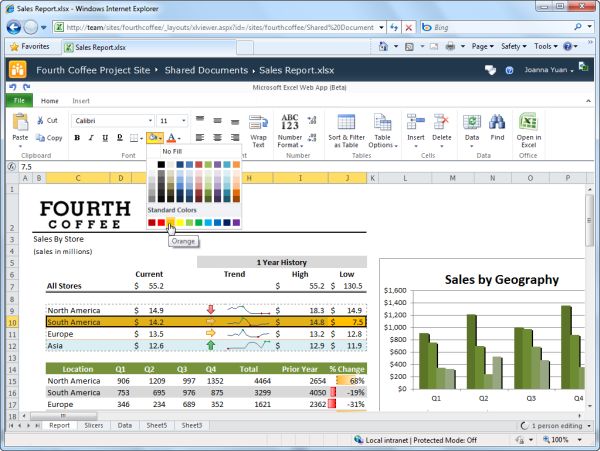
Since many businesses utilize Excel as a type of database, or as a window into their databases elsewhere, this means the utility of that product online will be most restricted. Word may suffer the least, however, as the need to compose respectable looking correspondence from anywhere one happens to be, is a pressing need that Word Web App can easily fulfill.
Making the case for Office 2010. We expected Microsoft Office to be the star of Wednesday’s keynote, with demos of new functionality that, if it wasn’t major, would at least have been advertised as fresh and new. It was not to be. Although we did have an opportunity to speak with an Office product manager (more on that in the coming days), the message Microsoft was sending this year was very different.
In the past, folks used to ask why a consumer applications suite was being prominently featured at a conference geared towards developers. The answer from Microsoft typically was, because Office is a platform, and developers build to platforms. The message Microsoft sent this year was that Office was not a platform. And that’s a problem, because if that’s true, there’s no conference for Office. The excuse for the lack of Windows Mobile news was that it was a topic for MIX, the conference for Web developers set for next spring in Las Vegas.
So does Office wait for TechEd? All of a sudden, this major profit center seems homeless.
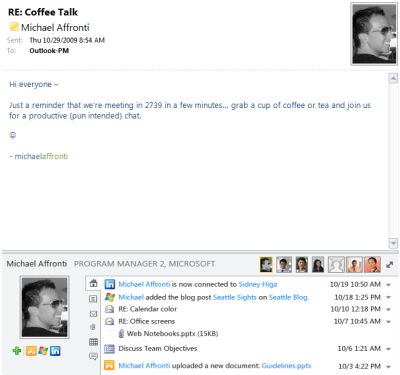 There was a little buzz devoted to something called the Outlook Social Connector plug-in, a new tool for integrating individuals’ social media contacts within Office’s communications app. Deals with social network hosts such as LinkedIn were announced. In one respect, that does address consumer concerns; in another, it’s a little ironic. Here we have a situation where people take the time to broadcast their identities over multiple social services on purposes as a way to spread out…only to discover the need for a kind of “identity vacuum” to pull them back in again to one cohesive chord.
What we did see from the Office 2010 public beta (released Monday, then released Tuesday, then “launched” Wednesday) let us know that if Microsoft truly is listening to its customers and acting on their telemetry, then the word they’re saying most often must be, “Whoa!”
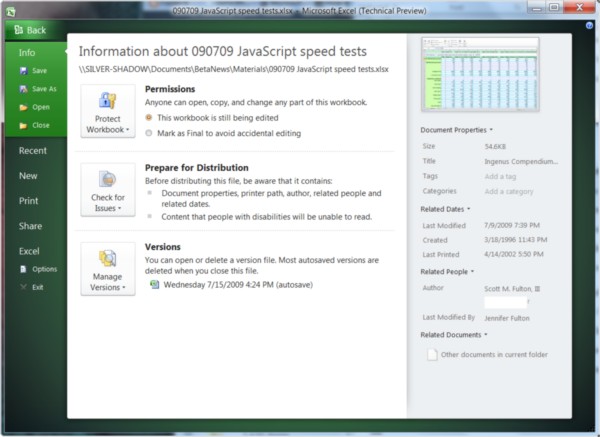
During the Technical Preview phase, Microsoft unveiled its BackStage concept — a way of organizing all the preparatory content of an application, such as print preview and preferences, in a more dimly-lit, cooler arrangement, making you almost want to whisper when you talk about it. The screenshot above shows BackStage in the Excel 2010 Technical Preview.
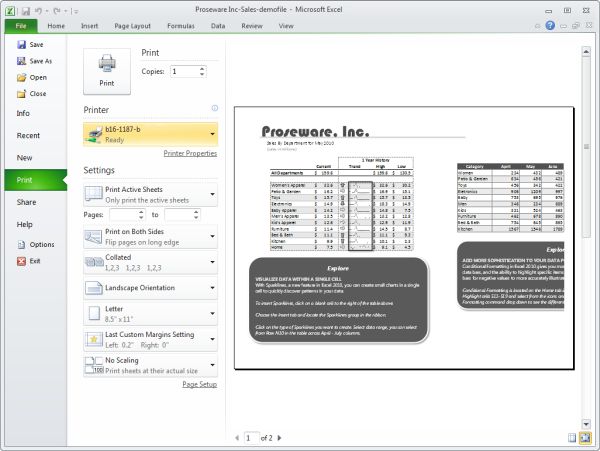
This is the same BackStage in Excel 2010 Beta 1. It’s more conservative in several obvious regards, including the staging. But notice also something very important: The “Office button,” which premiered in Office 2007 and which flattened down to become an icon menu tab in the Tech Preview, has now returned to being the File menu. If customers have been asking, “Where’s File/Save?” then you have to wonder when they started asking, and how long they’ve been at it.
The new flavor of Visual Studio is already the old flavor. When you’re dealing with a development platform unto itself, the beta version is often, unofficially but certainly, the working edition for many developers. And VS 2010 is already on Beta 2 now. More than one session presenter this week asked for shows of hands as to how many folks were already using Beta 2 as their development platform — and in each case, a majority of everyone’s hands were raised.
Will virtualization envelop Windows? Hell if I know. One of the hottest topics of prior conferences was something of a dud this year, and that’s not good for a company that is actually behind in its ability to virtualize 64-bit platforms on 32-bit systems — a feature Sun’s VirtualBox and VMware already provide. But once the problem of absence of live migration in Hyper-V was kicked, virtualization took something of a breather this year, though it wasn’t off the radar altogether.
The push toward online identity. Indeed, this ended up being the wildcard topic of the show. The principal security and architectural problem faced not only by developers but administrators as well, is enabling a secure single sign-on platform for local and remote applications. With multiple vendors supporting even more authentication protocols than there are vendors — or so it appears — this goal would seem impossible to achieve.
Microsoft is working to address this in its upcoming Windows Identity Foundation library, which will require the push of Active Directory Federation Services 2.0 — a way to get AD out there to servers that aren’t Windows. But just getting all hosted apps vendors on-board with AD is a colossal task, made more difficult by a “competitive” spirit among application and security vendors that works against the very spirit of communication and federation they need to accomplish the goal of common identity. We will be talking more about this in the coming days, because we learned a lot about this from PDC.
Now, there’s something I’m missing. Yes, Scott Guthrie, I know I missed you in my list of headliners…and I’m sorry, it was inadvertent, and I apologize. Though I do know Brian Goldfarb gave you heck about it. But there’s something else, let’s see, I’m trying to recall…help me out, Brian…
 Oh thank you, Scott, much obliged. Silverlight 4. This one should have been on our radar for certain. Silverlight stole the show on Wednesday, and was much of the talk among developers on Thursday. The new version will provide 1080p video, which everyone wanted. And it will provide authenticated access to system services outside the sandbox, which everyone wants.
If Office Web Apps were to run on Silverlight 4, you would get access to the right-click context menu — a critical feature of regular Office 2007 and Office 2010 that’s difficult to make up for with the ribbon alone. S4’s access to system devices will make it feasible for developers to craft iTunes-like smartphone applications for devices that are tethered to PCs…and maybe even devices running on smartphones themselves, and not just Windows Phones.
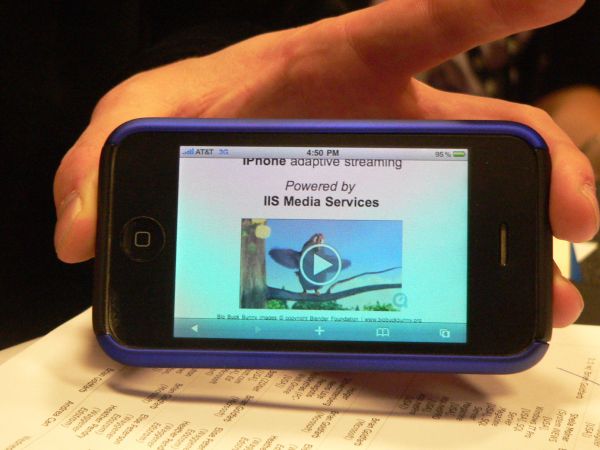
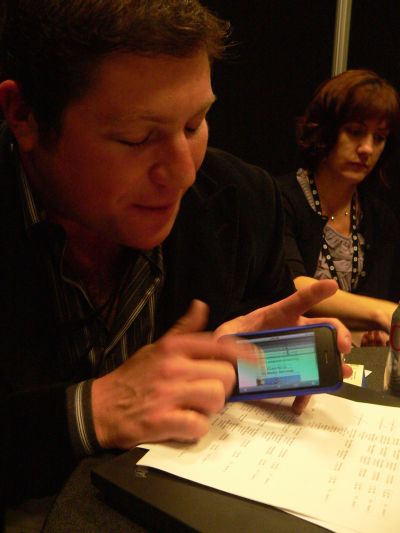 Which reminds me, there was that one Guthrie demo Wednesday that bit the bottom of the bit bucket, with that cool looking phone. Did anyone ever make that work…Brian Goldfarb to the rescue once again. Yes, it is indeed possible to perform adaptive streaming of movies to the iPhone using Silverlight. We talked at length with Goldfarb (more on that too in coming days), and here’s a preview of coming attractions:
“We’ve worked with Apple to create a server-side-based solution with IIS Media Services; and what we’re doing is taking content that’s encoded for smooth streaming and enabling the content owner to say, ‘I want to enable the iPhone.’”
 It was certainly more of an evolutionary than a revolutionary tone at this year’s PDC, but attendees seemed comfortable with that this time around. Here was one strange phenomenon we’ve never noticed before: Attendance increased with later days. Wednesday attendance was noticeably higher for sessions and the keynote than for the previous day, and that was despite news of the big laptop giveaway being kept under lock and key. And Thursday — which has often been a day for “leftovers” — ended up being packed as well, including with attendees who brought those shiny new Acer multitouch laptops with them.
Now, there’s something that hasn’t been touched on: Acer. Think about that for a moment. This is the same company that publicly dissed Vista in 2006 for being a non-event for consumers, practically leading the wave for the complaints that were to follow. And here it is lending its name to an event that not only promotes Windows 7, but prototypes its proper use (from Microsoft’s perspective) in all computing. Microsoft let Acer show everyone else how quick bootup and clean performance are supposed to be done.
That’s the biggest indicator of Lessons Learned we saw all week.
-
3D Coming To Many Sony Products, Including Digital Cameras, VAIO Computers

Sony has presented some information in their recent Investor/Analyst meeting that is simply stunning. They have outlined further their 3D strategy, and it is much larger than I thought. Originally, when Sony announced their 3D intentions, they had did it in a way that seemed like it would be somewhat limited to projectors, televisions, and other displays. But what I am seeing here in these slides leads me to believe that it will be an all encompassing effort.
In the slide above it is very clear to see that Sony is intending to bring 3D to their personal imaging line, including Cyber-shot cameras and their Alpha DSLR line. This would enable the creation of 3D photos. Sony also aims to bring 3D content to the home via the Playstation Network and the BRAVA Internet Video Link. There is also mention that Sony will release a 3D Blu-ray player (as expected, no word if previous models are upgradeable) and bring the technology to their VAIO Laptop (and possibly desktop) lines. Wow.
Juding from the presentation, these products and services should be expected throughout 2010 to 2012.

Sony is commited to providing a firmware update to the PS3 that will enable 3D gaming. Nice.

Sony also aims to have more than 3,000 3D projectors installed in theaters by the end of FY2010.
-
Microsoft Azure Walks a Thin Blue Line
 With Azure, Microsoft is trying to strike a balance between giving customers the ease of a platform as a service and the customization that power users need to build tailored applications — both in-house and in the public Azure cloud. In the wake of the Redmond giant’s developer conference, where it detailed more of its plans, it became clear that Azure is striving to be a general purpose cloud offering for enterprises that doesn’t make developers sweat the small stuff or compromise on bigger things.
If we compare it to infrastructure-as-a-service providers such as Amazon’s Ec2 or Rackspace’s CloudServers products, Azure attempts to handle more of the actual management and provisioning of virtual machines for a user. The biggest issue the target customer faces isn’t the hardware cost but the expense of managing an application on the hardware, Amitabh Srivastava, senior vice president at Microsoft with responsibility for Windows Azure, told me. So the goal was to allow Azure to run so developers don’t think about the underlying hardware as they might on a pure IaaS product.
This is where the idea of Azure as Microsoft’s OS for the cloud comes in. Azure is a platform-as-a-services play that seeks to leverage what Microsoft has learned through its OS dominance. First, it’s playing nice. Microsoft ensures that developers can use a wide variety of programming languages to build on Azure such as PHP, Eclipse and Java, which is pretty unique among platforms. Earlier this year, I spoke with Microsoft about its plans for Azure and came away with the clear sense that the company’s programs and .Net would really shine on Azure, even though other programming languages would also work. Now I get the sense that Microsoft is working hard to emphasize how suitable Azure is for programs built using a variety of languages, even those that have no ties to Redmond.
Second, Microsoft is hoping Azure can play on many machines. If we view the data center as akin to a machine, Microsoft wants folks to be able to create applications that can run on a Microsoft Azure cloud or internally on an in-house cloud. Newly launched AppFabric is the solution for that. AppFabric is software that folks can run in their own data center to create an internal cloud that can talk to and share information with the public Azure cloud if the client wants. Rackspace and IBM are both attempting to build these types of bridges between internal and their external clouds.
Finally, Microsoft is trying to keep its own offerings separate. Instead of bundling Microsoft products with Azure, Srivastava outlined a software-as-a-services strategy that will offer customers Microsoft Exchange on Azure or SharePoint on Azure as a service. This may explain why some offerings such as SharePoint Services and Dynamics CRM Services, announced last year, are now divorced and missing from the Azure announcement this year. However, competing software can be offered on Azure as well.
Larry Augustin, CEO of Sugar CRM, has chosen to offer customers the ability to host Sugar CRM on Azure, and says the platform was easy to build on, even though SugarCRM is built using PHP. He also mentioned that Microsoft’s database offerings were more complete than the newly launched Amazon Relational Database Service, and offered me a possible model for future clouds. In his vision, customers will be able to choose which clouds their software as a service are hosted on. This is the polar opposite of the vision espoused by SugarCRM’s biggest rival, Salesforce.com, which hosts its software on its own cloud. But the power of the modular and open approach is hard to deny, and Microsoft is smart to embrace that.

-
MTM Audi TT RS packs up to 424 horsepower, 185 mph top speed
Filed under: Aftermarket, Coupe, Performance, Audi

MTM Audi TT RS – Click above for a high-res image galleryGerman tuner MTM has a long history with Audi’s inline-five. In fact, company founder Roland Mayer helped develop the turbocharged five-banger for the Sport Quattro back in the mid-80s, and MTM produced a 400 horsepower version of the motor as one of their earliest performance packages. Nearly 20 years later the technology and the cars have changed, but MTM is still doing its thing.
Its latest project is Audi’s TT RS, which boasts 340 horsepower and 332 lb-ft torque in stock trim. MTM is offering three stages of engine packages ranging from 404 to 424 horsepower courtesy of tweaks to the engine control unit and and an upgraded exhaust system. Naturally, the Stage Three kit provides a substantial boost performance, including a top speed of 185 mph and a 0-100 km/h time of just 4.2 seconds. A variety of other upgrades are available as well, including MTM’s 19-inch Bimoto wheels, 15-inch brakes with eight-piston calipers, and lowering springs. Follow the jump for the official press release and check out the high-res gallery below.
Gallery: MTM Audi TT RS


[Source: MTM]
Continue reading MTM Audi TT RS packs up to 424 horsepower, 185 mph top speed
MTM Audi TT RS packs up to 424 horsepower, 185 mph top speed originally appeared on Autoblog on Thu, 19 Nov 2009 19:58:00 EST. Please see our terms for use of feeds.
-
Vito releases updated Communication Suite 2


VITO Technology has released a new version of Communication Suite. This version includes the latest updates of all 4 best sellers (Winterface 2.04, FunContact 3.01, SMS-Chat 1.25 and ZoomBoard 2.04). Winterface has gained many features that will allow you to customize your phone to your needs: change skins (10 new skins are available), background color or picture, headings for the icons and much more.
Winterface 2.04 now includes 10 new skins, changeable background, customizable headings and much more. Now the customization of the look of your phone can be done extremely quickly with quite a wide range possibilities.
FunContact3x is a great contact manage. Alongside with new features like categories, favourites with pictures, etc. FunContact has preserved unique features that none of the competitors have, for instance, you can edit and add new contact info straight in FunContact without going to standard WM interface.
SMS-Chat 1.25 apart from including all functions of messaging software has unique interfaces and functions that allow you to manage all SMS correspondences into threaded SMS conversations. This way all chats are separate, clearly shown and organized for each contact.
ZoomBoard 2.04 is a soft onscreen keyboard for quick and accurate finger typing. Every time you press a letter ZoomBoard displays the zoomed image of the pressed letter in a popping-up lens. You can also use it to zoom the whole keyboard. The letter is typed only after you release the finger so that your text input will always be accurate and quick.
Weather is a FREE weather forecast for Winterface with nice interface and good functionality.
Communication Suite is available for $24.95 at vitotechnology.com/communication-suite.

-
Pandora: 24% Of Our Users Signed Up on a Mobile Phone
 Perhaps no other digital music company this side of Apple has made the transition to the mobile sphere as seamlessly as Pandora, the Internet radio company that was fighting for its life as late as of this past summer before a royalty agreement stabilized its future. I chatted with CTO Tom Conrad this afternoon, and he shared a few stats that showed just how significant mobile uptake has been in the company’s growth — particularly in introducing the service to new users rather than converting desktop listeners to mobile ones.
Fully half of the company’s first-time users are now signing up via mobile devices, he told me, and since Pandora arrived on the iPhone in July 2008, 9 million people have created new accounts on smartphones, including iPhones, BlackBerrys, Palm and Android phones. That’s 24 percent of Pandora’s total user base, which is currently at 38 million and growing. Pandora has been installed on 13 million smartphones to date, meaning that about 70 percent of its smartphone users didn’t have desktop accounts previously.
Moreover, a quarter of the music streamed on Pandora currently goes to mobile listeners, and 25 percent of the songs bought by users clicking through to the iTunes or Amazon MP3 stores are acquired via mobile devices, suggesting a real movement toward mobile usage rather than just experimentation. New market research from Ando Media (PDF) suggests that Pandora is by several measures the most popular Internet radio provider in the U.S., even without the mobile listenership included. And while mobile ads don’t deliver as much revenue as desktop display ads do, Pandora’s extraordinarily popular mobile apps are surely familiarizing new users with its brand name — and driving them back to the desktop as well.

-
What Does It Say When A Comedy Show Does More Fact Checking Than News Programs?
Poynter has an interesting article, looking at The Daily Show as being a leader in media criticism, an area where it does an excellent job, even if that’s not its intention. But, what struck me most of all in the description of the team behind the show, was that it has a full-time researcher and fact-checker, who looks for multiple sources to verify the content that they’re using in the show. Now, in a typical news room, this shouldn’t be surprising. But, instead, we’ve actually seen the opposite. Fewer and fewer news operations have full-time fact checkers (or fact-checkers at all). Yet, here we’re talking about a comedy program, whose main job is to make people laugh, and it employs a fact-checker who verifies points with multiple sources. Doesn’t that seem backwards?
Permalink | Comments | Email This Story
-
Sony Gets Real, Defines Business Strategy For 2010 And Beyond

Under the leadership of its new executive management team established in April of this year, Sony has reformed its organizational structure in order to bolster profitability and transform its operations, with the aim of accelerating innovation and growth and optimizing business processes, particularly within its electronics and networked service businesses. As a result, approximately 80% of Sony’s targeted 330 billion yen (3.7 billion USD) of group-wide cost reductions for the current fiscal year ending March 31, 2010 compared to the previous fiscal year have been achieved in the first half of the current fiscal year. Furthermore, Sony is now positioned to launch a succession of competitive products from the end of this calendar year and into 2010.
This also means that Sony is becoming a quicker, leaner organization which is more responsive to the market. They have promised that they will no longer develop products based on underlying technologies, but rather focus on the user experience. Please keep an eye out for some exciting developments we’ve spotted in this presentation in future posts. In this blog post, I will simply outline their goals.
In order to permit further growth and continue to enhance profitability, Sony is implementing additional transformation measures centering on the following four initiatives:
– Target consistent profitability in core hardware businesses (TV, game and digital imaging)
– Provide new user experiences integrating innovative hardware, software and services
– Reach out to new customers and develop new geographic markets
– Increase Sony’s focus on environmentally conscious products and processesThrough these measures, Sony targets an annual 5% operating income margin and a 10% return on equity by the end of the fiscal year ending March 31, 2013.
Details of these initiatives are as follows:
Target consistent profitability in core hardware businesses (TV, game and digital imaging)
Regain the leading market position in LCD TV business
• Target returning the LCD TV business to profitability in the fiscal year ending March 31, 2011 and achieving a 20% worldwide market share on a unit basis in the fiscal year ending March 31, 2013.
• Create a new revenue model beyond conventional TV business models.
– Introduce “Evolving” TV that delivers new applications over the network.
– Develop new generation displays using proprietary Sony devices.Strengthen profitability of game business
• Target returning to profitability in the fiscal year ending March 31, 2011.
• Increase revenues by expanding hardware/software sales and enrichment of PlayStation®Network services.
• Improve profitability in the game business by cost reduction and other measures.Maintain leading position as the number one digital imaging brand in the world
• Strengthen business through outstanding product differentiation and cost competitiveness based on key devices such as image sensors and imaging engines.Provide new user experiences integrating innovative hardware, software and services
Network-connected products and services
• Further expand Sony’s networked service business by utilizing the rapidly growing PlayStation®Network services (over 33 million registered account users as of November 16, 2009) and by integrating attractive hardware, including new mobile products and other consumer electronics, with networked services. Target annual revenues of 300 billion yen from networked service business by the end of the fiscal year ending March 31, 2013.
• Strengthen and expand networked mobile business.
– Strengthen collaboration with Sony Ericsson Mobile Communications.
– Accelerate rollout of e-book (hardware and content) business.
• Expand Sony’s lineup of network-connected products. Target installed user base of 350 million units by the end of the fiscal year ending March 31, 2013.Expand 3D-related product businesses in the fiscal year ending March 31, 2011
• Engage Sony’s group-wide assets from content production to display devices and game to make available a wide variety of attractive content and hardware, and drive the creation of new 3D markets.
• Launch 3D-related products for the home, including TV, Blu-ray DiscTM players/recorders and 3D gaming on PlayStation3 in the fiscal year ending March 31, 2011.
• Provide solutions for 3D content production, distribution and theatrical projection to lead the field in broadcast and professional businesses.
• Target revenue from 3D-related products of more than 1 trillion yen (excluding content) in the fiscal year ending March 31, 2013.Growth strategies for lithium-ion battery business
• Secure high profitability in existing businesses.
• Analyze possible entry into new business domains (storage/e-Vehicle battery).Reach out to new customers and develop new geographic markets
• Strengthen direct marketing strategies.
• Promote Sony Group’s unified brand message “make.believe” globally.
• Continue to invest in emerging markets, including BRIC countries, to develop new customer bases.Increase Sony’s focus on environmentally conscious products and processes
• Target absolute 30% reduction in greenhouse gas emissions from Sony Group sites in CO2 emissions by the end of the fiscal year ending March 31, 2016, compared to the level of the fiscal year ended March 31, 2001*.
• Target 30% reduction of power consumption per product by the end of the fiscal year ending March 31, 2016, compared to the level of the fiscal year ended March 31, 2009*.
• Target zero environmental footprint throughout the lifecycle of Sony’s products and business activities as long-term goal. -
Pics Aplenty: Porsche Boxster Spyder
Filed under: LA Auto Show, Convertible, Performance, Porsche
 2011 Porsche Boxster Spyder – Click above for high-res image gallery
Porsche drivers don’t like waiting. That’s why they buy a Porsche, after all. So while a few weeks might not seem like a long time for most people, to a Porsche driver used to rocketing to 60 miles per hour in four-point-right-now seconds, the span of weeks must seem like an eternity.
Although we’re still weeks away from the LA Auto Show, where Porsche is set to unveil the new Boxster Spyder, Zuffenhausen has kept its enthusiasts placated with a fresh batch of photos showing its newest, lightest vehicle in all its glory. We’ll be on hand for the unveiling next month, but before then check out the updated high-res image gallery below.
Gallery: 2011 Porsche Boxster Spyder


[Source: Porsche]
Pics Aplenty: Porsche Boxster Spyder originally appeared on Autoblog on Thu, 19 Nov 2009 19:25:00 EST. Please see our terms for use of feeds.
-
Daily U-Turn: What you missed on 11.19.09


Choices: Nissan GT-R or Ford Mustang GT500?
We’ve been wrestling with a choice: GT-R or GT500? Now we’re asking you. Which two-door super coupe would you put in your garage?

Spy Shots: BMW 1 Series hybrid spotted in Munich
BMW is set to expand its hybrid offerings in the coming years and in addition to the ActiveHybrid variants of the X6 and 7 Series, BMW plans to offer a 1 Series hybrid by 2012. Here’s proof.

Buick confirms 2011 Regal 2.0T to come with manual transmission. Wait… wha?
The 2011 Buick Regal is on the way, and just as surprising as its turbocharged four-cylinder engine is the availability of a six-speed manual gearbox. This isn’t your grandfather’s Buick, indeed.
Also of interest:
- BMW’s V8-powered 550i Gran Turismo starts at $64,725
- 2011 Ford Mustang details leak out
- Chrysler pledges to be quality leader by 2012
- Ferrari preparing hardcore 599 GTO?
- Rolls-Royce edition Mini reportedly confirmed for custom order
- Toyota may ‘shorten’ gas pedals to fix unintended acceleration issue
- Another day, another racing 911: Introducing the Porsche GT3 R
Browse our archive of Daily U-Turn posts or subscribe to the RSS feed
Daily U-Turn: What you missed on 11.19.09 originally appeared on Autoblog on Thu, 19 Nov 2009 19:20:00 EST. Please see our terms for use of feeds.
-
Omnia Pro B7330 is Here!! Get yours

 The Samsung Omnia Pro B7330 is finally available for order from TotalPDA. The Omnia Pro has taken a while to become available to the general public, but but has finally shown up with Windows Mobile 6.5 in tow.
 Unlike its distant relative the Samsung Omnia Pro B7620 it does not come with a touchscreen, so it’s back to the days of using a D-pad instead. It also has the unusual 320 by 320 resolution, which many applications do not support.
The smartphone features Quadband GSM, AT&T 3G, full qwerty, 528Mhz processor, GPS, Bluetooth, 3G, Wi-Fi, 3.2MP camera and 1500mAH batteries.
The device is available from TotalPDA for £234.99.
Read more about the device at TotalPDA here
WM
-
OS update now available for Verizon Tours

Not too much to say here other than an OS update for the Verizon BlackBerry Tour 9630, 4.7.1.61, has started to trickle out. Although it’s already available to download from Verizon’s website and through BlackBerry Desktop Manager, we’ve been told that a handful of users will receive on-device update notifications throughout the night with general OTA availability tomorrow. No change log has been released. Let’s just hope that it’s not much longer until OS 5.0 drops for your beloved tuh tuh tuh TOUR (yeah, we remember).
-
Samsung Intrepid video review

Mobileburn have published a 2 part video review of the Samsung Intrepid smartphone currently available on Sprint.
While the reviewer is relatively happy with the device, he observes, and we concur, that the device does seem to be a bit dated for a brand new release at the end of 2009.
Read their text review here.
-
Romeo Ferraris 500 Abarth packs 360 tarmac-munching Italian stallions
Filed under: Motorsports, Europe, Hatchback, Fiat, Specialty

Romeo Ferraris 500 Abarth endurance racer – Click above to view in high resolutionThink you’ve seen the most hardcore 500 already? Sure, Abarth has churned out some pretty wicked versions of the retro-hatch, but even the 695 Tributo Ferrari and R3T rally machine can’t hold a candle to the beast above.
Given the name, you might think this latest Cinquecento was the result of another collaboration between Abarth and its big sister companies. But this 500 is actually a product of independent racing garage Romeo Ferraris, which has rebodied the 500 in carbon fiber and fitted it with a wing that looks big enough to sustain a jumbo jet’s flight path. If that’s not bonkers enough, Ferraris has squeezed out an insane output of 360 horsepower from the Abarth’s 1.4-liter turbo four. That’s more than 257 horsepower per liter, and rivals even the similarly insane 427 Cinquecento from SEMA for pure lunacy.
Drivers Aldo Cerruti, Michela Cerruti and Mario Ferraris will be taking turns behind the wheel at the upcoming 6 Hours of Vallelunga endurance race on November 22. We’d suggest everyone else get the hell out of the way.
[Source: CarScoop]
Romeo Ferraris 500 Abarth packs 360 tarmac-munching Italian stallions originally appeared on Autoblog on Thu, 19 Nov 2009 19:00:00 EST. Please see our terms for use of feeds.
Read | Permalink | Email this | Comments
-
Nordic Music Week: Optimism Galore And Found Songs
Last week, I had the pleasure of attending the NARM presentation), and had adjusted his presentation to be a response of sorts to mine. Except it wasn’t. His presentation was yet another great example of a musician who understood exactly what works in the industry, even as he thought he disagreed with me. We later chatted briefly about it, and realized we’re actually very much in agreement about where we stand on the industry. The confusion came about because he is really focused on the music, and felt that my presentation focused too much on the money aspect.
And, indeed, my presentation did focus somewhat on how to make money, but that’s because if I just focus on the music, people complain that no one will make money and then no one will make music. But, of course, that’s ridiculous. None of these models work particularly well if you don’t make great music. And Òlafur Arnalds makes great music — and once we started talking, even he admitted that in order to do what he does, he needs (and wants) to make a living (which he does). And his actual presentation was about how to do just that. It was all about how he closely connected with his fans and gave them a reason to buy (even if he didn’t like to think that way). Instead, he noted that he needed to come up with a good story to go with the music, that would help attract his fans, better connect them to him while also giving them a reason to support him monetarily.
So, with that idea (having a story behind the music) as his basis, he came up with a great project called ‘Found Songs’, where he would write, record and release a new song every single day for seven straight days. He did it all out of his bedroom. His fans then stepped up and created artwork for each song, and in some cases, amazing videos, such as this one below, which is truly beautiful, and within days had thousands upon thousands of views:
You can watch the videos, look at the artwork people created for the songs and even download all the songs for free as mp3s. But, there’s also a store where you can buy the beautifully packaged vinyl or CD versions of the album, and some higher quality digital downloads. In other words, it was yet another perfect example of connecting with fans and giving them a reason to buy (and, yes, it involved great music as well — which is, in fact, key). The importance of having a good story to go along with things, as we’ve seen with other projects, is a particularly good point. And, again, it shows how an infinite good (a good story) can increase the value of a scarce good (the products you’re selling). He also showed how his own fanbase increased massively after doing this project — much more so than when he was out opening for Sigur Rós. So, in the end, we absolutely agreed, and I found out about some more great music and yet another great story and example to go along with all the others.Beyond that, I met a bunch of fascinating people doing very interesting and unique things in the music industry in the Nordic region. All of the Nordic countries are working hard to help enable their bands to adapt to a changing music environment, and there are definitely some very creative indie labels, artists and managers who are thinking through and implementing some great ideas that left me quite enthusiastic for what comes next. I also got a chance to meet Moto Boy, who took part in our CwF+RtB experiment, and see him perform live (which was fantastic). Overall, a very encouraging trip.
Permalink | Comments | Email This Story
-
Formula Le Mans joins the big boys in the Le Mans Series

Formula Le Mans Oreca FLM09 – Click above for image galleryMost major racing disciplines around the world have a clear and comprehensive framework to allow aspiring drivers to learn the ropes. Pretty much everyone starts in karting, but from there F1 hopefuls go on to Formula Renault and other open-wheeled series; NASCAR aspirants to ARCA and the Nationwide Series; rally prodigees to local championships; and so on and so forth. But teams fielding Le Mans prototypes had to recruit from other disciplines. That is, until now.
Earlier this year, the Automobile Club de l’Ouest – the organization behind Le Mans and its associated series – launched Formula Le Mans, known in America as the Le Mans Prototype Challenge. The idea was simple: everybody driving the same cars, designed on the same model as LMP1 and LMP2 racers, in support races to existing LMS events. French racing team (and, since acquiring Courage Competition, chassis constructor) Oreca was contracted to design and build the cars and help organize the series.
The purpose-built chassis known as the FLM09 packs a Chevy LS3 tuned to 430 horsepower with Magneti Marelli engine management, driving an Xtrac six-speed sequential gearbox to Michelin slicks housing Brembo carbon-ceramic brakes. Eight teams participated in the inaugural season this year, fielding some 50 drivers at races at Spa-Francorchamps, La Sarthe, Algarve, the Nurburgring, Silverstone and Magny-Cours.
The opening season was a success, prompting ACO and Oreca to launch a winter series, currently under way. But for next year’s series, Formula Le Mans will be fully integrated into the Le Mans Series as another category, much as they’ve been run in the American Le Mans Series since their inception. In order to separate the FLM cars from the higher-level LMP2 and keep them running for the full race distance, however, the Oreca FLM09s be equipped with restrictor plates. The integration of FLM into the full series ought to make for some interesting racing and a more hands-on training ground for aspiring drivers when they join the grid next year, but for now you can read the full press release after the jump and browse the mega gallery by hitting the thumbnails below.
Gallery: Formula Le Mans Oreca FLM09


[Source: Formula Le Mans]
Continue reading Formula Le Mans joins the big boys in the Le Mans Series
Formula Le Mans joins the big boys in the Le Mans Series originally appeared on Autoblog on Thu, 19 Nov 2009 18:27:00 EST. Please see our terms for use of feeds.


