Recently, AT&T sued Verizon over its “There’s A Map For That” ad, that mocked AT&T’s 3G network coverage, while playing on the Apple iPhone slogan of “there’s an app for that.” It seemed like an odd thing for AT&T to do, as it really just called more attention to the ad and the differences in 3G networks. Now, to make matters even worse, a judge has refused to issue an injunction stopping the ad. That doesn’t stop the lawsuit, though, and the ad might still get taken down if AT&T wins, but it’s unlikely Verizon’s ad campaign is going to last until the lawsuit is finally decided, anyway. So for now, all it’s done is driven a lot more attention to the ad, in which Verizon comes out favorably.
Of course, the LiveScribe Pulse Smartpen is no ordinary pen. It can record and playback the ink you write on a paper with it as well as synchronize recorded sound with the ink. I bought my pen back in May and have been getting good use out of it.
The first page of paid apps for the Pulse Smartpen (21 apps) are mostly in the 99 cent to $2.99 range with the loan outlier being the $14.95 American Heritage Spanish Dictionary.
There are also 9 free apps in the store ranging in topics/functions from a video poker game to spanish travel phrases to guitar chords for beginners.
Google Maps is great for mapping out a trip, getting directions, or finding a Chinese restaurant near you, but Google Earth manages to make maps actually fun. The latest version of Google’s 3D mapping software just shed its beta tag after getting rid of most of the lingering bugs. With Google Earth 5.1 the focus is on speed, a recurring theme at the company.
“Two months ago, we released the beta version of Google Earth 5.1. The 5.1 release focused on one of our most important features: performance. The power of Google Earth is the seamless, immersive 3D fly-throughs that give you a sense of being “there,” so we made a lot of adjustments under the hood to make flying around the globe faster and smoother. Today, after a few more tweaks and bug fixes, we’re proud to say that we’re ready to remove the beta tag,” Peter Birch, Google Earth product manager, wrote.
The latest version is just an incremental update so most users won’t notice any change. The work has been done under the hood ironing out the kinks and making sure that the plug-in is stable enough. Of course, at Google the beta tag doesn’t really mean anything, Gmail was labeled as beta for five years, but it does meant that Google Earth users get a more polished experience.
The focus in Google Earth 5.1 as a whole was on the underlyin… (read more)
Ribbit Mobile is a Google Voice-like service that was acquired by British Telecom. It’s service, however, is available right here in the US of A (as they say). Unlike Google Voice, Ribbit does not offer the choice of using a unique Ribbit-provided phone number or your own cell phone number.
I was fortunate enough to get a Ribbit Mobile beta service account for testing recently and followed Ribbit’s instructions to auto-forward unanswered calls from the cell phone I use as my main voice phone to Ribbit.
The initial tests of calling my phone, letting it ring until it went to voice mail, and leaving a voice mail all worked fine. Ribbit recorded my message and sent an email notification. The problem turned up with the first actual incoming call I received after setting up the service (a call from my daughter). My cell phone rang once and then stopped. My daughter said she heard a strange sound on her end and then ended the call. Both my phone and Ribbit logged it as a “missed call”. A second test confirmed this odd behavior.
Fortunately, Ribbit provides clear instructions on how to deactivate call-forward-on-no-answer. My phone rang normally and let me pick up the call as usual after deactivating Ribbit.
My action plan is to activate Ribbit for testing once a month until it seems to work as expected and then begin longer term testing of the service. Let’s hope this happens soon.
I bought my Droid on its first day of availability with the idea that I might return it afer a few months (and pay the early termination fee). But, the more I use the Droid and learn how the Android ecosystem has changed since the first few weeks of the G1 back in October 2008, the more convinced that I’m going to stick with the Droid for more than a few weeks. One of my most frequently used web services is the Evernote note-taking and web-clipping service (among other features). Evernote’s mobile friendly site…
…looks pretty good on the Droid. However, unlike the desktop/netbook environment (where I prefer to use Evernote’s web page instead of their Windows and Mac apps), I prefer to use Evernote apps on my mobile devices (iPhone & Windows Mobile so far).
After a quick search, I found Evernote’s beta release of their Android client at…
Mention cloning to anyone and they will probably think of a little sheep called Dolly and a mad professor in a white apron. But the world of cloning has been going on a lot longer than most people realise and the crazy scientists have been really really busy. So here, after a brief introduction to cloning, is a list of some of the fake animals we know about that.
A brief introduction to cloning
The cloning of animals you’re thinking about is normally a specific form of cloning called somatic cell nuclear transfer (SCNT). A somatic cell is any cell in the body except sperm cells or the egg cells. Each somatic cell has two sets of chromosomes. The idea is kind of simple. Take a somatic cell from an adult animal. Remove its nucleus – the brain of the cell containing the DNA which makes the animal the way it is, then take an empty nucleus-less egg cell and insert the DNA inside it. Then do a little bit of laboratory business and insert the new egg into a surrogate mother animal. After gestation a new animal is born exactly the same as the animal which donated its DNA. Weird, yes. Incredible, yes.
Injaz the Camel
In April 2009 Injaz, or ‘Achievement’ in English, became the world’s first ever cloned camel. Injaz, a female one-humped camel, was born in Dubai on April 8, 2009 at the city’s Camel Reproduction Centre following investment from Sheikh Mohammed bin Rashid al-Maktoum – he of international horse racing fame. Injaz’s real mother was slaughtered for camel meat in 2005, but scientists saved the DNA and injected it into an empty egg cell of Injaz’s surrogate camel mother. With camel racing big business in Dubai the implications of camel cloning are significant. And if you’re thinking you’ve heard of the Camel Reproduction Centre before it’s because it produced the world’s first ever Cama, a Camel Llama hybrid.
The Cloned Carp
If you thought cloning was a relatively new phenomenon then you were wrong. Depending of course on your view of the word ‘relatively’. Because cloning was going on way back in the 60s. In China an embryologist called Tong Dizhou cloned a carp. It was the world’s first ever cloned fish and the first time such a complex organism had ever been cloned. Then ten years later he inserted the DNA of an Asian carp into a European carp mother – the world’s first ever cross carp. Although if you keep them out of water long enough…
Unfortunately for Europeans much of Dr Dizhou’s work was never translated into English meaning Western scientists had no idea such advances were being made.
Carbon Copy Cat
Carbon Copy or Cc surprised everyone when she was born because she didn’t look or act anything like her genetic mum. For a start she had a grey stripe running down her white back whereas her mother, Rainbow, sported more of a gold and brown style. Then, when Cc started to play, she was found to be rather frisky. Rainbow on the other hand had always been shy and disinterested. Rainbow was quite a solid kitty. Cc was sleek. And so the illusion of cloning was smashed. But not for the makers of Cc. Genetic Savings and Clone claimed this was evidence of what they had stated all along, that cloned cats and dogs don’t arrive with all the old tricks. Still for a company taking a mere $1000 from deluded pet owners seeking to revive their beloved dead pets it was all a bit of a nuisance.
Daisy, Millie, Emma – The Cloned Cows
Cow cloning has been going strong for a number of years although just what that number is appears to be a bit of a mystery. Japan claimed to have produced the world’s first cloned cows when in July 1998 a pair of calves were born using the same technique that produced Dolly the Sheep a year before.
One very important cow was born on July 7 1999. Daisy (the calf pictured above), a Holston heifer, was cloned from a 13-year-old cow named Aspen. Scientists had often worried that cloning the DNA of an elderly animal would result in health problems for the newborn animal. But Daisy proved doubters wrong when she was able to give birth naturally two years later.
Jersey females Millie and Emma were cloned in 2001 using standard cell-culturing, a slightly different technique to the ‘Dolly The Sheep cloning’ of most animals. Emma, an acronym of Experimental Manipulation of Mastitis Abatement, was born to help scientists discover the genetic susceptibility to the bovine disease mastitis. Cow cloning is money with improved beef and milk yields sought across the world. Unfortunately Millie died. But then what hope have you got if you’re born a cow?
Dewey the Deer
Dewey became the world’s first ever cloned deer when he was born on May 23 2003 at the College of Veterinary Medicine in Texas. Dewey is a white-tailed deer and became the fifth animal the college had successfully cloned, the others being a pig, cattle, goats and a cat. Dewey is a copy of a male white-tailed deer from southern Texas. He was created using fibroplast cells which were isolated from skin samples derived from the dead buck, expanded in culture then frozen and stored in nitrogen. And best of all he’s quite cute, isn’t he?
Snuppy the Afghan Hound
In Korea people eat dogs, so it was something of a surprise when in August 2005 scientists announced to the world they had successfully created the world’s first ever cloned canine, Snuppy. No, not Snoopy. Snuppy. It was a long and difficult process with scientists using nearly 2000 eggs to produce 1095 cloned embryos which were inserted into 123 dogs. Of these only three became pregnant and of these one miscarried, one was born but died after only 22 days, and then there was Snuppy, an apparently healthy cloned Afghan Hound born by a Golden Retriever!
The world later woke to the shock news that Korean stem cell scientist Dr Woo Suk Hwang had fabricated each of his major discoveries, all that is apart from Snuppy. Good boy.
Libby and Lilly Ferret
Libby and Lilly became the first cloned ferrets in 2004 to apparently help scientists study human respiratory diseases. Yes, your respiratory system is the same as a ferret’s. Lovely.
The Cloned Tadpole
Scientist John Gurdon claimed he cloned tadpoles way back in the 1970s. In techniques that would later be developed to clone Dolly, Gurdon successfully transplanted the nucleus of one frog into the egg cell of another. There has since been some scepticism surrounding the success of Gurdon’s attempts and it’s true that none of his tadpoles ever made it into frogs. But what he did do was show what could and would later be done. If that makes sense.
Mira, Mira and Mira – The Three Goats
America cloned goats first in 1999. And to prove it they gave them all the same name. Mira and Mira and Mira were all born within two months of each other. The aim was medical. The three Mira’s were created to produce a substance called antithrombin III in their milk, a protein which stops human blood clotting.
Noah the Gaur
Unfortunately Noah, the first endangered animal clone, died shortly after his birth. The baby bull gaur (a wild ox native to Asia) was born in January 2001 but due to complications surrounding his birth lived for only 48 hours. He died after suffering dysentery. It was a blow for scientists hoping to use cloning to save animals from extinction. But they’re still trying.
Prometea the Horse
Born on May 28 2003 Prometea (the female version of Prometheus) became the world’s first cloned horse. The Laboratory of Reproductive Technology in Italy created 841 embryos of which only 14 could be used and only four were implanted into surrogate mothers. Only Prometea the Halfinger foal was born. Horse racing has so far said no to cloning preferring the more traditional methods of reproduction but with millions of pounds being made on the mating rights of horses surely cloning is the nearly natural next step.
Masha the Mouse
So the sheep might have gotten all the fame but it was Masha the Mouse who really paved the way for mammal cloning. Back in 1986 Russian scientists Chaylakhyan, Veprencev, Sviridova and Nikitin cloned Masha from an embryo cell.
Much later, in December 1997 in Hawaii, a mouse called Cumulina (pictured above) became the first mouse to be cloned from an adult cell. During her life she gave birth to two litters and died naturally in her sleep in 2000.
Idaho Gem
Little Idaho Gem celebrated a double when he was born in May 2003 becoming both the world’s first cloned mule and the world’s first clone related to the horse family. Financed by a wealthy mule-racing magnate, Idaho Gem, along with another cloned mule, Idaho Star, was sent to a trainer for a successful career on the track.
The Five Little Pigs
Pigs and humans have more in common than a bacon sandwich. In fact the animals are now extremely important as providers of organs for human transplants. On March 5, 2000 an Edinburgh-based company called PPL Therapeutics announced it had successfully cloned five piglets – Millie, Christa, Alexis, Carrell and Dotcom. Since then science and technology have moved on and pigs are being specifically engineered so that their tissues are not rejected by the human body.
Dolly The Famous Sheep
The star of the show Dolly The Sheep, so famous her name is referred to in capitals, became an overnight sensation when in July 1996 she became the first ever mammal to be cloned from an adult somatic cell. However it wasn’t until a year later that scientists mentioned the news to an ignorant and cynical public. Television channels were full of Dolly eating grass, Dolly looking at the camera, Dolly standing in hay. She became the most famous sheep ever to walk the planet and the planet loved her and hated her in equal measure. After six years at the top Dolly succumbed to illness and died. It was a sad end but a not unfamiliar story of the new celebrity age.
ANDi Monkey
ANDi (inserted DNA, in reverse) was named as the first genetically modified monkey when he was born in October 2000. He was created specifically to carry one extra gene from another species. Born in the lab ANDi helped scientists pursue further tests for human diseases such as Alzheimer’s, diabetes and heart disease.
Snuwolf and Snuwolffy
In October 2005 two wolves in Korea defied the laws of natural selection when they were successfully cloned to avoid extinction. Snuwolf and Snuwolffy were born in the Korea Zoo where they still live. Well one of them does. Unfortunately Snuwolf died in August 2009 from an infection which was absolutely nothing to do with the cloning process according to the scientists.
The Android smartphone ecosystem has changed a lot (and for the better) between my brief T-Mobile G1 ownership period in October 2008 and today. While the Android app population is nowhere near the size of the iPhone’s, it is big enough and rich enough to keep things interesting. One big hole, though, is the lack of a decent Skype VoIP client. And, don’t get me started on that Skype Lite thing for Android. I don’t even know what to make of it.
Fortunately, even though Skype appears to be ignoring Android, fring is not…
The ACTA juggernaut continues to roll ahead, despite public indignation about an agreement supposedly about counterfeiting that has turned into a regime for global Internet regulation. The Office of the United States Trade Representative (USTR) has already announced that the next round of Anti-Counterfeiting Trade Agreement (ACTA) negotiations will take place in January — with the aim of concluding the deal “as soon as possible in 2010.”
For the rest of us, with access to only leaksandwhispers of what ACTA is about, there are many troubling questions. How can such a radical proposal legally be kept so secret from the millions of Net users and companies whose rights and freedoms stand to be affected? Who decides what becomes the law of the land and by what influence? Where is the public oversight for an agreement that would set the legal rules for the knowledge economy? And what can be done to fix this runaway process?
We wrestle with these questions in an essay on “The Impact of ACTA on the Knowledge Economy”(PDF here) in the Yale Journal of International Law Online. We explain how ACTA got this far, in this form, and propose four mechanisms for USTR transparency reforms, that will give the public a voice in ACTA, if U.S. citizens — and their elected officials — speak loudly and quickly enough.
In brief, the ACTA process has been deliberately more secretive than customary practices in international decision-making bodies to evade the debates about intellectual property (IP) at established multilateral institutions. The Office of the USTR has chosen to negotiate ACTA as a sole executive agreement. Because of a loophole in democratic accountability on sole executive agreements, the Office of the USTR can sign off on an IP Enforcement agenda without any formal congressional involvement at all. But the negotiations do not have to be secret, and the sole executive agreement process does have mechanisms for oversight: they have not been used in ACTA, but can and should be.
People remember how H1N1, commonly called Swine Flu, hit around 18 countries around the globe in 2009. Hundreds of people became very sick. It especially affected those people who have existing health conditions. It was why some schools and business establishments were temporarily closed due to fear of catching the highly communicable influenza virus. Travel overseas was even temporarily banned to avoid the flu from spreading out to other countries. To avoid this from happening again, a vaccine was formulated by four leading drugmakers. Sanofi-Aventis SA, CSL Ltd, Medimmune and Novartis AG were given clearance by the US Food and Drug Administration. GlaxoSmithKline Plc is also helping develop the H1N1 vaccine. These 5 drug manufacturing companies are willing to provide more than enough supply of vaccines for millions of people.
Although the vaccine is really intended to help resolve the H1N1 issue, people just can’t help but be doubtful. They think the vaccine isn’t safe enough. These people can’t be blamed. Their life is at stake. The Centers for Disease Control and Prevention is strongly encouraging people to get the new H1N1 shot. A recent campaign was done in order to increase people’s level of awareness regarding the availability of the vaccine.
The vaccine comes in two forms. One is through intranasal and the other one is through injection. It is mostly aimed at those people who are within the high risk bracket. People within the high risk bracket are those with present health conditions, pregnant women, kids and elderly people. Generally, these people have a low immune system. It makes them very susceptible to the influenza virus.
One of the specific reasons why there are people against the vaccine is because of its mercury component. Exposure to mercury is believed to cause mental defects to an unborn child or an infant. But people from CDC strongly deny this misleading information which is being tossed around. First of all, it was able to pass the quality standards of the Food and Drug Administration. This rule out the possibility of the flu shot to be unsafe. Also, they firmly believe on the safety of the vaccine based from past records. Basically, it was made on the basis of how past flu vaccines were done. The expected side effects were fever and soreness/redness where the injection was done. Apart from that, these public health officials believe that all should be well.
When you look at the bright side, this vaccine indeed helps a great deal. The vaccine makes us immune to H1N1. Those people who are expected to get the disease are those who are not immune to the virus at all. But the decision to get a vaccine is still yours. You have yourself and your family to protect. In case you have questions regarding this new swine flu vaccine, it is best to address your concern directly to the local health authorities. They may be able to supply documents supporting the history of the vaccine. So that finally, you can decide whether you want this new vaccine or not.
From: H1N1 vaccine
Online video means YouTube at the moment. There’s a huge number of other video sites and Hulu is coming up strong, but the Google site is on a completely different level. And, while no one is going to threaten its dominance any time soon, eventually there may be someone who could and its name shouldn’t really surprise any one. It’s Facebook of course, the social networking giant has now become the third biggest video site in the US.
Facebook has managed to get 217 million streams in October, almost double from the previous month according to Nielsen numbers. The social network had just entered the top ten most popular venues for video, in terms of the number of videos streamed last month, at number 10. A month later, it shut up passing many established players reaching the third spot only behind Hulu and YouTube. In total 31 million people watched at least one video on Facebook in the previous month.
At number two, professional content video site Hulu strengthened its position with 632 million streams up from 437 million in September. The number of unique visitors stayed flat. Hulu is seeing some very solid growth, but Facebook is storming up its rear at this point and, despite having three times less streams, if it manages to keep up the pace, the social network may soon overtake Hulu as the sec… (read more)
Anyone who knows me knows that I love lists (lists of pretty much anything amuses me), predictions for the next year, and conspiracy theories. As you might guess, I don’t much believe in some of these despite their entertainment value. Gartner Research is usually a good source of lists and predictions (not to mention magic quadrants). And, in this item, I’m even going to count them among conspiracy theorists since they use the term “killer applications”…
However, don’t be fooled by the title. Gartner doesn’t actually name a single app. This lists consists of mobile app categories like money transfer, location-based services, and mobile search (their top three categories). Despite their interesting and mostly well-thought out list, it misses the boat by a wide degree. Here’s what they missed.
1. Games! I know I’m going out on the limb here. But, I predict that people will buy games, lots of games for their mobile devices in 2012. What could lead me to make such wild speculation? Oh, I dunno. Just a hunch 😉
2. eBooks/eReading: I predict that the dedicated ebook readers (like the Amazon Kindle) will be viable but less important products by the end of 2010. General purpose mobile devices like the iPod touch/iPhone, Android smartphones, and netbooks will be the main ebook platform despite their less optimal reading environments (at least using today’s technologies).
3. Mobile Entertainment without traditional game features: This includes location-based social networking type apps and services that have become extremely popular over the past year
4. Apps that move traditional media (especially TV programming, newspapers, and magazines) to the “third screen” (mobile devices)
5. Augmented Reality: I know, I know. Most of what we see now are toy-apps or have limited functionality. This will change.
Let’s get back together in 2012 and see how Garter Research’s list fared against Ogasawara Seat-of-the-Pants Research’s list.
Contrary to the pedestrian screen shot we have seen earlier, Windows Mobile in motion must look much better, as SoloPalmari reports from Mobius:
Revolutionary, no need to take away: the next version of Windows Mobile, as shown by the leaks and the first screenshots of the new system, the Web will soon be spring, we are faced with an upheaval of the logic of interaction and not just a substantial revision of the interface. The concept of “applications”, as the programs continue to live their important identities, will bend to the principle of “user experience”.
Finally the performance, the fluidity in the display of screens, images and icons becomes a priority. As powerful and versatile Windows Mobile will be next, will never submit to slowdowns and delays in the response. How will, indeed, as they did to achieve this result is not yet technically clear. But developers say Microsoft is certain: the experience of use to forget the “old” Windows Mobile.
Sounds a bit like TouchFlo3D, doesn’t it?
Whatever was shown off must have been pretty impressive, as Ryan Block, former chief editor of Engadget reportedly said in a now deleted tweet:
@ryanblock watching a really amazing demo. Really. Amazing.
Hopefully whatever Microsoft is cooking up will reach market sooner rather and later.
We keep hearing stories of law enforcement officials, such as Sheriff Thomas Dart of Cook County Illinois, trying to blame Craigslist for the actions of its users, rather than recognizing that Craigslist can be a great tool for actually monitoring and tracking down crime. Some are realizing this, and Eric Goldman point us to the latest example of this. Police in Palo Alto, California (right in the heart of Silicon Valley, so it’s a good sign that they get this), used a Craigslist ad to help track down a bicycle thief. This is, obviously, a rather simple example, but it does make you wonder why more law enforcement agencies don’t regularly do similar things. It has to be better than suing (or threatening to sue) Craigslist for the activities of its users.
I always when smartphone newbies (at least I assume they are) are shocked and outraged at the price of unlocked phones. Here’s one from “Android and Me”…
Is the Xperia X10 really expensive? Sure, I wouldn’t pay $879 for it. But, if you take a look at other high-end unlocked smartphones, you will find similar high prices. In fact, let’s do this by taking a look at eXpansys Inc.’s US online store in this category found at:
– Motorola AURA $2,034.99 (this is not a typo)
– Apple iPhone 3GS $1,199.99
– HTC HD2 $829.99
– Sony Ericsson Saito $829.99
– Samsung OmniaPro $744.99
– Palm Pre $714.99
– Nokia N900 $699.99
Unlocked phones are also unsubsidized phones. Are this prices ridiculous? I sure think so. But, that’s how it is when you reach the rarified air of the unlocked phone market.
I should note though, that there are also relatively affordable unlocked phones. But, the high-end supercool ones are not usually in the “affordable” range.
Last week, Shakira announced that she had decided to launch her latest video using Ustream and Facebook called ‘Give It Up To Me,’ probably in an attempt to gain more fans on the social network and to part with the tradition of having used MTV for several whole years. It seems that the move was as innovative as it was inspired, since more than 95,000 visitors watched the new video when it was initially broadcast, while the following 24 hours brought around 500,000 viewers. In other words, Shakira’s fans all over the world have definitely appreciated her initiative, so they are likely to see more videos or singles released this way.
Ustream is gradually gaining more and more popularity as a live streaming website, and the audience is also increasing. This could also be due to the fact that the service broadcasts more than just recent music videos, including the memorial service for Michael Jackson, which gained about 4.6 million views, but also the inauguration of Barack Obama as President of United States, which was seen by 3.8 million users. On the other hand, these videos have lasted for hours, as opposed to Shakira’s ‘Give It Up To Me’ that has a length of only ten minutes.
Regarding Shakira’s choice to integrate Ustream into her Facebook page, it is probably motivated by the fact… (read more)
Smartphones in the U.S. provide voice service using either CDMA (Verizon & Sprint) or GSM (AT&T & T-Mobile). Wireless data is provided by a variety of 3G protocol types as well as slower network protocols like EDGE and GPRS. This rumored Google Phone apparently eliminates the traditional voice service (CDMA or GSM) entirely and, like the Amazon Kindle or netbook/notebooks, only have a 3G radio. You could somewhat simulate this situation today if you have, for example, a MiFi (3G/WiFi router) and an iPod touch (2nd or 3rd generation) with some voice over IP app installed.
Can even Google pull off a phone that doesn’t work over conventional cell services? It just might be able to if the phone were very inexpensive with cheap service to match (data only, no voice).
The Blandin Broadband conference started today. It started with a walking tour of Duluth. The weather could not have been better. We got a mini-walking tour of Duluth. It was fun to see the new places –and some of the old places. We ended up at Teatro Zuccone, a new spot in town with a couple of theaters and a bar. It looks like a great place to see a show or just hang out. Apparently it just opened this fall and has been very successful.
We saw the following presentation from Drew Digby of Minnesota Department of Employment and Economic Development (DEED) and heard from some of the locals. It was interesting to hear about what brought (or kept people in) people to Duluth. While many people enjoyed the outdoors, the arts, the size of the town, the colleges, – it was really the business opportunities that brought both people and businesses to the area.
I know when I’ve hurt a man’s feelings. In a segment of the technology business that has recently become fiercely competitive, it’s difficult to report bad news about a team that tries very hard to build a good Web browser. It was very apparent from our interview today at PDC 2009 in Los Angeles that Microsoft Internet Explorer General Manager Dean Hachamovitch has an emotional and personal investment in the product he’s building.
“If I had a script engine that was twice as fast as the one before, the Web should be twice as fast,” said Hatchamovitch today. “But if JavaScript is 10 percent of my site, at most, I’ll shave 5 percent off; and if the site was 1.8 seconds, yea, I’m not going to be able to tell…Yes, we understand that there’s a microscope on JavaScript performance. We’ve made progress on JavaScript performance — we’re all in the same neighborhood now.”
He was referring to the first news of development of Internet Explorer 9, which he confirmed only began weeks ago, but whose early builds — according to both Hatchamovitch and Windows Division President Steven Sinofsky today — were producing JavaScript performance numbers that were comparable to its competition for the first time since Mozilla released Firefox 3.5.
“That’s just going to re-emphasize that it’s the systems that come together. Because as all the JavaScript engines converge on their performance, people are going to notice the other 90 percent [of Web components] a lot more significantly.”
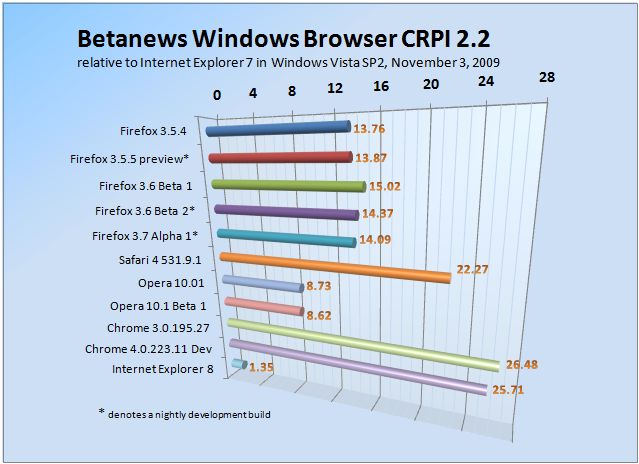
Betanews’ reporting on Internet Explorer in the past few months has not been kind. The October Patch Tuesday round of fixes included one for all versions of Internet Explorer that addressed a very serious, possibly exploitable issue. While we feel addressing this issue is absolutely necessary, we also noticed that applying the patch resulted in a noticeable slowdown in IE performance. At least, noticeable to us.
The most vocal reader response to our reporting could be grouped into three categories: One group vocalized that it did not care about Internet Explorer performance as a factor in computing, since it’s mainly a way to read news articles anyway, and voiced their opinion that we shouldn’t care either. Another group of readers took Microsoft to task for, in their opinion, not caring about IE performance, but added that it shouldn’t be expected to care because nobody else does (or at least, nobody of importance) and that we should drop the subject for that reason. A third group applauded our efforts to, in their opinion, expose Microsoft for not caring about browser performance.
None of these are groups that anyone at Microsoft would want to appear publicly aligned with. So perhaps part of Dean Hachamovitch was interested in speaking with me today, and another part — for absolutely understandable reasons — was dreading the thought.
But bravely, he made his company’s case, a valiant effort to split the difference: JavaScript isn’t the Web, he asserted, but just one of many subsystems. A multitude of other factors will contribute to users’ decisions.
“There’s performance, there’s interoperable standards, and there’s graphics,” said Hatchamovitch. Each component strikes a different chord with different groups of users, he said. Since the Day 2 keynote’s conclusion, he and his press handler had opportunities to ask individuals what they thought of the presentation — or more specifically, what did they remember from it?
“I asked some folks what they heard, and some just said, ‘Yea, you guys are doing a lot of compliance and interop.’ ‘Did you hear anything else?’ ‘No, not really.’ Talked to someone else, ‘So what did you hear?’ ‘You guys are doing some stuff around making the script engine faster.’ ‘Huh. Anything else?’ ‘No, not really.’ So what I’m finding is that this is the classic game of Telephone.”
What resonates with various attendees is essentially aligned with what they want to hear, Hatchamovitch went on…perhaps to illustrate the point that when he asked me the very same question at the start of our interview, I dove right into the performance aspect.
Rendering is another critical aspect, and we saw demonstrations of the changes IE9 will make in the rendering department. Specifically, the next edition of Microsoft’s browser will move away from GDI, the graphics library favored by Windows during the late 1980s, and toward the new Direct2D library which takes fuller advantages of the capabilities of the underlying hardware, including the GPU. In response to my request for a video that showed this performance, Microsoft asked us to include in our story the video you see embedded above, which is as close as the Web can come to approximating the speed and fluidity improvements attainable through Direct2D.
There is absolutely no question that, if IE9’s rendering improvements were to simply stay on the same level as they appear from these early demonstrations, through to the end of the product’s development, the result will be a perceptible qualitative difference that could be the deciding factor in whether Firefox or Chrome or Safari users switch back to IE — as important a factor as computational performance.
Hachamovitch showed us up close the map rendering demonstration seen from a distance during the Day 2 keynote. Shifting the same road map across the screen on a small Dell XPS laptop produced typical, perceptible jitters using IE8’s GDI graphics methodology, compared to a smooth, even flow using IE9’s Direct2D.
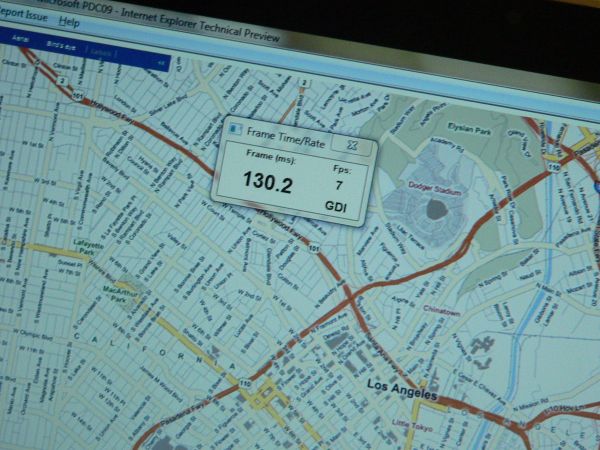
Some folks were confused by the meaning of the number in the demo, and why the slower, jittery-er graphic produced the higher value. This represented the number of milliseconds between frames — a number that plummeted from 130.2 ms as in this photo, or even much higher on occasion, to as low as 8 ms for Direct2D. Actual frames per second rises from around 7 (or lower) for GDI, to about 60 for Direct2D on the same machine.
“Now, that kind of difference — somebody said, ‘Oh, it’s like game-level animation!’ Yea, you can call it like it’s a Pixar movie or an Xbox game. But then they said, ‘But what does that have to do with the Web?’ It has everything to do with the Web. When you’re using Web mail or this mapping site, or you’re previewing photos — imagine going to a photo site, and you want to have 1,000 thumbnails up on the screen. Now we’re using the graphics card, so you’re not waiting on every piece of graphics that way. That’s a huge gain for performance, that’s a huge gain for developers because they can use all their old patterns — they didn’t have to rewrite their sites.”
So graphics does strike the performance chord with users and developers after all.
During the Day 2 keynote, Sinofsky said the IE9 team has been working for all of three weeks, and we were skeptical. Didn’t IE9 development really start after IE8 was released to general availability in March? What was going on all these months?
“There’s a lot of work that went into IE8 for sure,” Hachamovitch responded. “But realize, on March 19 we released IE8 in a few dozen languages. After March 19, we had several waves of languages for IE8 to get out, because it’s worldwide. There’s more than a few dozen languages of IE8. Then we had to finish Windows 7, and all the languages of Windows 7. So we’re three weeks past the general availability of Windows 7. In some ways, we’ve all been on call, ready, working through…well, several Patch Tuesdays since March 19.”
As Microsoft tries for a valiant comeback attempt for IE in the realm of qualitative measures, expect the company to demonstrate any number of various other aspects where the browser makes gains, and say this, too, is the Web.
And if those gains in one or two departments aren’t as significant, expect the message to be, “But that’s not all of the Web.”
We’ve asked Dean Hatchamovitch to join us in responding to your comments to this article.
Next: A word about Dean’s comments about our performance measurements…
A word about Dean’s comments about our performance measurements
It is no secret to the dozens of you who have followed my work over the past few decades that I am a speed fanatic. I give a damn about the performance of my automobile, my coffee maker, my wristwatch, and my Web browser, and my wife knows it doesn’t stop there. It might have something to do with why I edit a publication called Betanews.
The other reason I care is that I’m in the business of improvement, and you can’t improve until you’re ready to accept your own shortcomings. That goes for myself as well as everyone else. It is never fun to be on the losing side of a fair and competitive battle. It may even seem unfair when the reasons have to do with a legitimate effort to address a serious concern.
But as a high school journalism teacher I knew used to tell her students in the sports department covering one of the worst teams ever to take the field, if you can’t do the simplest job in the world — reporting the score — then you shouldn’t be a journalist but a cheerleader. Your heart may want you to change the score; but if you then do it, you’ve lost more than a game.
Dean Hachamovitch raised a few concerns about Betanews’ testing methodology, and I think they’re fair concerns that are worth discussing. First, he contended that it may be confusing to him and others, for us to use Internet Explorer 7 on Windows Vista as a relativity index. I told him I did not want to do as some readers suggested I do — use IE8 as the index browser — because that would be unfair to IE8, disabling its ability to be measured for performance at all. I also could not use any older series of browsers (for example, IE6 or Firefox 2) because they could not even run the tests in our performance battery. I know, I’ve tried.
He also suggested something else: that we go back to using clean installs of operating systems on virtual machines for our test systems, so long as those VMs were running on the same hardware. I explained to him why I changed to testing on physical platforms, mainly in response to reader requests. But I also explained that during our test of IE8 performance after the October Patch Tuesday fix, to validate the numbers I was seeing, I uninstalled the patch and tested again, and reinstalled it and tested again, to verify the values — they were spot on after the validation.
Hatchamovitch winced at this. He said that by uninstalling and reapplying the patch, I may have reduced the “signal-to-noise ratio,” to use his phrase, for IE7 and IE8 on Vista. In other words, I may have polluted the platform and hindered performance. The test results did not suggest that; but my methodology, he argued, could still produce doubt as to the authenticity of my results. This is a fair argument which I will put to the test myself.
Hatchamovitch also suggested we introduce the factor of variability into the test, a plus-or-minus factor, which is often seen in many other scientific measurements of performance. Of course, that’s not a bad idea either; on the other hand, I only want to report numbers that make sense to readers. If I’m “fuzzifying” the meaning of a result, I may not be giving readers data that they can use. It would be like putting a plus-or-minus estimate on the Dow Jones Industrial Average.
I stand behind my current methodology, but as you’ve already seen, I’m open to suggestions for improvement, and I have made improvements based on suggestions. But as I told BASIC interpreter vendors during the 1980s, who for years had seen their performance numbers in my tests slammed again and again and again by Microsoft — which dominated the interpreter market for as long as it was important — winning is not a relative state. Ask anyone who’s improved and come back to win the next round.
The moment IE9 marks a comeback for Microsoft’s Web browser in performance, you’ll read about it here. Yes, performance isn’t the entire Web just as the drivetrain isn’t the entire car. Maybe you don’t think much about the drivetrain every day, but that doesn’t mean it doesn’t exist. Just try riding in a car without one.
…the N97 may not be the very last of the high-end Nokia N-series S60 phones. But, it does apparently mark the beginning of the end. So, with the exception of RIM (BlackBerry) and Microsoft (Windows Mobile), all of the major smartphone platforms are Linux/UNIX based (Android, iPhone, Maemo, webOS).

 Google Maps is great for mapping out a trip, getting directions, or finding a Chinese restaurant near you, but Google Earth manages to make maps actually fun. The latest version of Google’s 3D mapping software just shed its beta tag after getting rid of most of the lingering bugs. With Google Earth 5.1 the focus is on speed, a recurring theme at the company.
  Online video means YouTube at the moment. There’s a huge number of other video sites and Hulu is coming up strong, but the Google site is on a completely different level. And, while no one is going to threaten its dominance any time soon, eventually there may be someone who could and its name shouldn’t really surprise any one. It’s Facebook of course, the social networking giant has now become the third biggest video site in the US.


 Last week, Shakira announced that she had decided to launch her latest video using Ustream and Facebook called ‘Give It Up To Me,’ probably in an attempt to gain more fans on the social network and to part with the tradition of having used MTV for several whole years. It seems that the move was as innovative as it was inspired, since more than 95,000 visitors watched the new video when it was initially broadcast, while the following 24 hours brought around 500,000 viewers. In other words, Shakira’s fans all over the world have definitely appreciated her initiative, so they are likely to see more videos or singles released this way.


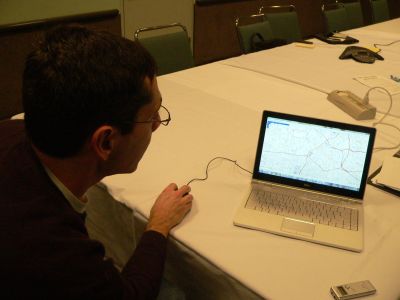 Hachamovitch showed us up close the map rendering demonstration seen from a distance during the Day 2 keynote. Shifting the same road map across the screen on a small Dell XPS laptop produced typical, perceptible jitters using IE8’s GDI graphics methodology, compared to a smooth, even flow using IE9’s Direct2D.