I’m sure I’m not the only one curious about what exactly Alexander is. Sometimes, he’s a castle, sometimes a machine, sometimes he’s like a statue. …
Author: Serkadis
-
The Trouble With iPhones
 The iPhone has not only changed the way people consume data on their mobile phones — thanks to its touchscreen, and the myriad of apps that make grabbing such info from the web on a small device easy — it’s changed assumptions as to which devices consume the most data on mobile networks. Bytemobile, a company that provides equipment for carriers to help deliver video and data to mobile devices using less bandwidth, issued a report today that shows the difference in data consumption by device among carriers that have the iPhone and carriers that don’t. It’s pretty significant.
Laptops are still consuming most of the data on carrier networks that don’t have iPhones on them, but once folks get a touch-based smartphone such as the iPhone (and right now it’s the most popular touch-based smartphone out there), the volume of data used by those devices far exceeds that of laptop usage. In other words, when it comes to the network and data consumption, the device does matter. The report also offers some self-serving data about video consumption on mobile devices that may help carriers save on bandwidth consumption. (GigaOM Pro, subscription required).

Cisco expects mobile data traffic to increase 63-fold over the next five years, driven in part by video. But while it’s clear that laptops and touch-based smartphones make video consumption easier, the rise may not be as steep as Cisco predicts. The report found that while the average video online is about 5 minutes in length, about half of the people only watch 60 seconds of a video, which means that sending the entire file to a user would be a waste of bytes and bandwidth. Only 31 percent of people watched all of a video, and 30 percent watched less than 10 percent. The rest of the viewers stopped watching somewhere in the middle. In addition to bandwidth consumption, such findings also could help determine where best to place ads. Although I for one hate getting pre-roll ads on my phone because that data consumed counts against my mobile bandwidth cap. But maybe I’m just super cheap.
Regardless, the problem with the iPhone is that it’s both a gateway drug for consumers, who’ve now tasted the mobile web and want more of it, as well as a canary in the coal mine, as it shows carriers what’s likely to happen as other touch-based smartphones become more popular on their own networks. Curtailing video, as suggested by the report, will solve some issues, but once you give folks a taste of broadband, they’re going to want more.


-
Terracotta Buys Quartz to Advance Java Scalability Mission
 Java scalability specialist Terracotta has acquired the intellectual property associated with Quartz, a popular open-source job scheduler, part of Terracotta’s mission to integrate common open-source Java application components into its middleware solution. Terracotta has already integrated SQL-query service Hibernate, and it acquired popular distributed caching solution Ehcache in August. These integrations make Terracotta a more formidable competitor in the quest to manage data in cloud or scale-out infrastructures, where it battles relational databases, proprietary caching solutions like Oracle Coherence and, increasingly, flash-based solutions.
As more Java applications make their ways into large-scale environments and private clouds, Terracotta wants to make it easier for users to scale these critical components. The company bases its business model around the “scale continuum” – easing the transition from one node to several nodes to, ultimately, a virtualized cloud environment. Potentially important on this front is the fact that Quartz is embedded into application framework SpringSource, which VMware recently acquired. Terracotta and VMware have partnered on customer implementations in the past, and the synergies between these two vendors and their new assets should make running Java applications in the cloud easier than ever thought possible.
Despite the fact that Quartz is a job scheduler, the database market might see the biggest effects from this acquisition. Terracotta’s bread and butter is in-memory data management, and bringing Quartz’s large user base into the fold exposes Terracotta’s method to an even greater audience. Quartz has tens of thousands of deployments already, including within companies like Vodafone, Cisco (c csco) and Adobe, and it is embedded in popular open-source application frameworks such as JBoss and the aforementioned SpringSource.

-
ASCAP, BMI And SESAC Continue To Screw Over Most Songwriters: ‘Write A Hit Song If You Want Money’
We keep hearing from folks how the collections societies in the US for songwriters and composers, ASCAP, BMI and SESAC, are supposedly the “good guys” in that they actually give money to the actual musicians, and they aren’t like the RIAA at all. But the evidence continues to be lacking on that front. In fact, it increasingly looks like they’re doing a lot more harm to most musicians. Earlier this year, we noted that their aggressiveness in getting just about any small venue to pay up fees was killing off open mic nights and other sorts of venues that allowed musicians to play live. Mike points us to the news that many venues are simply giving up on live music. The problem? Well, ASCAP, BMI and SESAC are all demanding huge fees. Even the restaurants that don’t bring in cover bands are being told they need to pay up, just in case a musician happens to do a cover in the middle of a wholly original set. The licensing organizations don’t seem to care, they just want you to pay, just in case. When asked how they know that covered music is being played, they admit they don’t:
“Basically, we don’t know,” said Dave Ascher, the SESAC Music Licensing Consultant who sent the letters. “To make a long story short, there’s no way, logistically, for us to know whether on a day-to-day basis they’re playing SESAC music.”
But, just in case, you need to pay up. Of course, rather than doing that, the venues are just giving up on live music, providing fewer places for musicians to perform, hone their craft, and build up a following (and a business model).
As for the claim that these organizations help bring in money for those musicians, well, that’s not seen either. We’ve already seen how they only give money to big name artists in most cases, because that’s all they’re able to track. In fact, the article talks to one musician who’s upset about all the venues closing, but is still registering his songs with ASCAP. When asked if he’s received any royalty check at all, the answer was no. So, how do the collections organizations respond? They tell them to become more famous:
“I’m sorry to hear that, but what I would like to tell him is that he needs to write a hit song,” BMI’s Bailey said.
How nice. They funnel all the money to big name artists, force venues to close so new artists can’t become famous, and then when asked about giving money to those up-and-coming artists, they flippantly tell them to become more famous.
At some point, musicians and songwriters need to learn that these organizations are not doing things in their best interests at all. They’re simply bureaucracies to funnel money to big names, while limiting the competition.
Permalink | Comments | Email This Story
-
Power Densities Likely to Drive Expansions

Average power densities continue to rise in data centers, and are affecting the lifespan of existing data center facilities, according to new survey data from Emerson Network Power. A majority of data centers say they will run out of capacity within two years, suggesting a wave of expansions is in the pipeline.
Thirteen percent of the members of Emerson’s Data Center User Group (DCUG) said the average power density in their data centers was 12 kilowatts a cabinet or higher, with five participants reporting average power loads exceeding 20 kw a cabinet. Eleven percent reported average densities between 8 and 12 kw, while the largest group of users – 36 percent – cited loads of 4 to 8 kw per rack.
Short on Power, Not Space
The survey reinforces the prevailing wisdom that data centers are running out of power before they run out of physical space. Thirty four percent of respondents cited power as the primary factor limiting data center capacity, while just 14 percent cited floor space.The results underscore the need for many data center operators to expand their data center operations to add additional capacity. Fifty six percent of DCUG members said they expect to run out of data center capacity by 2011, with another 18 percent projecting capacity constraints by 2013.
But decisions about how to expand are being shaped by the difficult economy and companies’ desire to conserve cash. This has boosted interest and colocation and wholesale “plug and play” data center space, while suppressing new data center construction.
Smaller and Smarter
Emerson says capacity-strapped data center operators are likely to respond by building smaller and smarter, while using hardware refreshes to improve their power density and squeeze more capacity out of a smaller facility.“Data center professionals are discovering the efficiency gains enabled by high-density environments,” Emerson notes in its analysis. “Sixty-three percent of the respondents to the fall 2009 DCUG survey indicated they plan to make their next data center new build or expansion a high-density (>10kW/rack) facility.”
Availability A Growing Concern
But energy efficiency isn’t the only motivator. Emerson also said that a series of high-profile data center outages in 2009 have heightened the focus on uptime, and are influencing decisions about tradeoffs between availability and energy efficiency.Fifty six percent of the members of Emerson’s DCUG cited availability as their chief concern, up from 41 percent just six months ago, the company reports. Emerson attributes this to media coverage of data center outages in 2009.
“High availability is no longer considered an insurance policy,” said Chuck Spears, presidnet of Emerson’s Liebert product line in North America. “One significant outage can wipe out years of savings achieved through incremental efficiency improvements. As we look ahead to the next decade, data center design and management must enter a new stage of maturity where organizations can reduce costs and improve efficiency without potentially risking performance.”
In examining potential tradeoffs between availability and efficiency, Emerson highlighted differences in uninterruptible power supplies (UPS), noting the availability advantages of online double-conversion UPS configurations. This emphasis is not without its competitive considerations, as Emerson competitiors are highlighting higher efficiency UPS power efficiencies though the use of multiple operating modes.
-
From HD to 3D – Sony upgrading PS3s for full 3D support in 2010
It has been the talk among video buffs for quite a while now, and it’s all very real. For Sony, full HD is a thing of the past. They’re now aiming t…
-
2,500 'Volunteers' Needed in AOL Layoff Program
 There are a lot of things happening at AOL as the once mighty Internet giant is going through some pretty tough restructuring. It’s about to get separated from Time Warner as an independent company listed in the stock market. It’s also trying to get rid off any business not crucial to its operation. And now it’s moving forward with the cost cutting plans, aka “massive firings,” which have been looming for months.
 “Project Everest,” as the program has been cunningly named, involves getting rid of thousands of employees to help the company get back on track. The first sign came last week when about 100 employees were let go, but the company said it was only a matter of time until the second phase would begin. This second step would involve “voluntary” layoffs, a suggestion CEO Tim Armstrong got from the company’s employees during his mythical 100 days of corporate “soul searching” when he went to visit all of the company’s businesses and properties.
The suggestion seemed like a good idea so AOL is trying this first, asking for up to 2,500 employees to step down on their own accounts. The move was revealed in a regulatory SEC filing. The program will begin on December 4, just five days before spinning off from Time Warner and six days before the new AOL st… (read more)
-
Cut the Drama: Private APIs, the App Store & You

I’ve had a rant building up for a few weeks. A rant about developer’s treatment at the hands of the App Store submission procedure. However unlike many rants on the topic, mine is not directed towards Apple. It is directed towards the iPhone developers who complain about the poor, unfair treatment they get, carrying their bleeding hearts in their palms while claiming Apple is bludgeoning the life out of them.
Two recent news headlines, seemingly separate, are intrinsically tied together and the synergy of them have made my eyes dislocated from the continued rolling they involuntarily perform.
The first headline, Facebook Developer Turns Back on iPhone relates how another high-profile developer has thrown their hands up in disgust over how Apple’s closed system runs against their principles. A direct quote from Joe Hewitt, developer of the popular Facebook application can be found on TechCrunch, and is most relevant. I will come back to this later:
I respect their right to manage their platform however they want, however I am philosophically opposed to the existence of their review process.
The second headline is Apple’s App Store Approval Process Now Includes an Automated Layer. The quick version is that Apple is now using an automated tool to determine if the Apps that developers submit to the App Store are using any Private API calls.
These two headlines are actually the same story, a fact that was made quite apparent by a popular direct iPhone-to-iPhone messaging App called Ping!. On Ping!’s Facebook Page, the developer announced that the much-anticipated version 1.2 of Ping! has been rejected by Apple:
Bad news is Ping! 1.2 has been rejected by Apple on Nov 14 due to a software library we used, developed by the Facebook company. This library is used by many apps including Ping! and the iPhone Facebook app itself. Unfortunately the most recent version of this library has violated some of Apple’s guidelines and has caused hundreds of apps to get rejected including Ping! 1.2.
So let’s get this straight. Ping! and hundreds of apps have been rejected because they used a popular development framework, a framework which used Private APIs. A framework, which was created by Joe Hewitt initially for use with the Facebook application and then made available to third-party developers.
Lets be clear about this; Joe Hewitt used Private APIs in his public framework, well-known to be against the rules of the App Store, and then acts all indigent when Apple slaps his framework down. Rather than disclosing his error, rather than saying “oops sorry about that,” he would rather ride the trendy wave of ‘blame Apple control policy’ and cite ‘philosophical differences.’ I rather wonder if these philosophical differences would still be present if his framework hadn’t been caught in this automated tool. If it were just other people’s frameworks that were caught, would he still have quit for ideological reasons?
Now I don’t mean to pick solely on Mr Hewitt, and maybe I’m being too harsh. But he is just the latest example in a blogosphere that increasingly seems to love taking the loud minority and say “Look! Here’s proof that the end is nigh!” Come on, the end isn’t nigh, it’s not even on the horizon. Out of the thousands of App Developers that exist, we’ve had a dozen, maybe two dozen make a public fuss and quit. Big deal! This is the real world; businesses start, some succeed and some can’t hack the brutal reality. Those just make excuses and quit. Just like everywhere else in the business world.
To summarize the full story that I see, it goes something like this:
- Apple publishes the rules for making iPhone Apps, including publishing and documenting the specific APIs which developers are allowed to use.
- Some developers ignore these rules and make use of Private APIs. Some Apps get through the cracks in the newly functioning App Store review procedures.
- Apple starts to crack down on private API usage. Developers who get rejected due to Private API use cry foul “Why are WE rejected but THOSE apps are allowed?” This was a fair question.
- In response Apple says “They shouldn’t have been allowed, we are working on a way to fill up the cracks in the system”
- Apple then goes ahead and fill the cracks with an automated (and thus unbiased) system to test of private API usage.
- Developers then cry foul, “It’s not fair, you’re a bully, it’s too hard.”
Cry me a river….
Before I get off my soap box, I’d like to add that there are times and places for Private API use. As a professional software developer working on proprietary custom embedded solutions on Windows Mobile devices for specific customers, I freely admit to using Private API calls at times. Sometimes its necessary to get a specific job done. The difference is scope and control. Our clients deploy the software under our care and guidance, with specific OS and hardware requirements. If they change devices or operating systems, we know about it well in advance and can prepare for it accordingly. Our clients don’t just upgrade the OS and expect everything to work.
The consumer market is a completely different kettle of fish, customers upgrade willy-nilly and expect things to just work, especially things related to Apple products. Private APIs are private for a reason, because they can not be relied upon to behave from one OS release to the next. This means that applications will break and the consumers, you and me, lose out.
In the brutal competition of any market place, and indeed the world in general, the strong will survive and the weak will perish. The App Store is no different and I’m constantly dumb-founded as to why some people expect it to be so.


-
FedEx Freight to Test Hydrogen Hybrid Tyrano Truck
I’ve talked a few times before about the Vision Industries Tyrano Truck that is a combination of a hydrogen fuel cell vehicle and a plug-in hybrid electric vehicle (HFCV-PHEV). A month ago I talked about how the hydrogen powered Tyrano was making a public appearance before California Governor Arnold Schwarzenegger in Sacramento.
Well, now there will be a high profile test of the H2 Tyrano Truck drivetrain technology by FedEx Freight. Of course, FedEx Freight is a well-known brand for regional and long-haul less-than-truckload (LTL) services. And LTL simply means the smaller trucks, not the long-haul tractor trailers one sees occasionally upon the highways.
Vision Industries will reconfigure a FedEx Freight LTL truck with its Tyrano technology and the vehicle will be tested for one year and then evaluated for the operational sustainability of the HFCV-PHEV technology.
According to FedEx Freight CEO Douglas G. Duncan, “It is our goal to be involved in projects such as this to further the advancement of alternative fuels that both reduce our dependence on foreign oil and are good for the environment. We are excited about technological advancements we see today in transportation and look forward to what the future holds in this arena.”
Of course FedEx is no stranger to testing hydrogen vehicles. In June 2005, FedEx partnered with General Motors to test the HydroGen3 fuel cell vehicle. Fleet testing of alternative fuel vehicles is common since the infrastructure needed is minimal. For the Tyrano fuel cell truck the testing by FedEx will closely simulate real world conditions as this hydrogen truck will also be used in a fleet setting at the Ports of Los Angeles and Long Beach, CA.
-
HTTPS Data Exposure – GET vs POST
Here is a quick chart showing the data exposure when considering GET vs POST and also HTTP vs HTTPS.
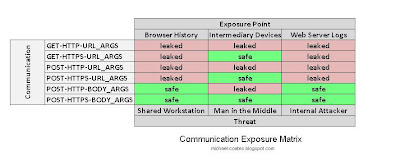
- URL arguments refer to arguments in the URL for GET or POST (e.g. foo.com?arg1=something).
- Body arguments refer to data communicated via POST paramaters in the HTTP request body.
NOTE: This chart does not address client side caching of temporary files. Caching is a separate issue from the protocol selection and should be addressed with appropriate cache-control headers.
A quick conclusion: The secure choice for transmission of any sensitive data is to use POST statements over SSL/TLS. Any other option will expose data at some point in the communication.This is a guest post by Michael Coates, a senior application security consultant with extensive experience in application security, security code review and penetration assessments. He has conducted numerous security assessments for financial, enterprise and cellular customers world-wide.
The original text is published on …Application Security…
Talkback and comments are most welcome
Related posts
OWASP Publishes Top 10 Web App Security Risks for 2010
Creating Your Own Web Server
Web Site that is not Easy to hack – Part 2 HOWTO
Web Site that is not that easy to hack – Part 1 HOWTO
Tutorial – Secure Web Based Job Application -
Rumor: BlackBerry Curve 8530 to launch December 10th
There are some rumors going around that the BlackBerry Curve 8530 will be launching December 10th. Barring some unforeseen testing issues, this date will probably stick. With an 8530 on the way to Verizon as well, this device is going to get a decent spotlight. Remember, this is the same 8530 that we discovered will feature OpenGL, so there is some awesome app potential. It will be interesting to see if the carriers even mention it.
© BlackBerry Cool for BlackBerry Cool, 2009
-
GIMP to be removed from Ubuntu?
 This could be an outstanding news by its significance. The next version of Ubuntu (Lucid Lynx or Ubuntu 10.04) won’t include GIMP (GNU Image Manipulation Program) by default due to its user interface that is too complex… What a #@^*?
Actually complex UI is not the only decision why GIMP should be vanished from Ubuntu so here is the full list:
- the general user doesn’t use it
- its user-interface is too complex
- it’s an application for professionals
- desktop users just want to edit photos and they can do that in F-Spot
- it’s a photoshop replacement and photoshop isn’t included by default in Windows…
- it takes up room on the disc
(taken from here)
Still sounds like fresh nonsense? What about F-Spot as a replacement? Well, an average user most probably claim that above mentioned reasons are true. Maybe that’s why GIMP already dropped from latest Fedora 12. But what should do people who use GIMP every day and loves Ubuntu???
Just execute ‘sudo aptitude install gimp‘

-
MindTouch’s Open-source Collaboration Platform Sits on the Cloud
 MindTouch, an open-source provider of enterprise collaboration software, announced today that its platform is now available in the cloud. You can find a video on how the platform, dubbed MindTouch Cloud, creates “a federated collaboration network” here. MindTouch competes with Microsoft’s SharePoint, but can eliminate many of the inflexibilities of proprietary collaboration software, and MindTouch Cloud’s prices are being kept low. A 10-user group can use it for $10 per month per user, 30 users can for $8 a month per user, and 50 users can for $7 a month per user, with lower costs for larger businesses.
 MindTouch Cloud incorporates desktop productivity tools, database adapters and more, as OStatic notes. “What sets it apart from other collaboration systems is the ability to use other popular enterprise systems atop this platform,” OStatic says. Web applications, ERP frameworks, Salesforce.com usage and so on can be integrated with MindTouch. Intel, Cisco, Mozilla and many other companies use MindTouch’s platform.
This has been a busy week for hosted collaboration tools, with Salesforce announcing its Chatter collaboration solution yesterday. You can read more about MindTouch Cloud here, and the company’s CEO, Aaron Fulkerson, did a guest column for OStatic on the future of collaborative networks here.

-
Kicking People Off The Internet Not Enough In South Korea, Copyright Lobbyists Demand More
If you thought that the entertainment industry would stop at having the ability to force ISPs to kick people they accuse (not convict) of file sharing offline, you might want to pay attention to what’s happening in South Korea. South Korea, of course, is home to very high broadband penetration, with exceptionally high speeds. And, not surprisingly, there’s a lot of unauthorized file sharing going on there. Of course, if you looked at the Korean cultural world, you’d immediately learn that smart entrepreneurs and entertainers quickly learned to adapt and take advantage of this new world. Entrepreneurs like JY Park recognized the changing marketplace, and adapted — and the massive success he’s had with artists like Rain and Wonder Girls, suggests that perhaps “piracy” wasn’t a big deal. All you need is some smart business people who can adapt.
But, of course, we’ve all seen what sorts of companies are afraid to adapt. The big record labels and the big movie studios couldn’t be bothered with the tricky proposition of actually understanding the new marketplace and adjusting their business model. So, they went to the US government and said “something must be done.” That “something” turned out to be a new “free trade” (ha ha!) agreement with South Korea, that had little to do with free trade, but plenty to do with pushing ridiculously draconian copyright laws on South Korea (i.e., protectionism for the entertainment industry, not free trade). Of course, these new laws went way beyond what any other country had, and included getting the government to shut down file sharing sites while restricting how user-generated content sites could work as well. Not surprisingly, once the law passed, various sites began restricting how they could be used, even limiting the uploading of any songs, even ones that users themselves had created. And, of course, with all that, a “three strikes” plan to kick people off the internet was also included.
You would think that the industry would be happy and leave well enough alone, right?
Of course not. Reader Dan alerts us to the news that some entertainment industry lobbyists are now demanding that all file sharing services must use content filters. Otherwise, they plan to sue. Just another reminder that for some of these folks, enough will never be enough. They will keep pushing for more and more, just as consumers keep pushing back on having their own rights stripped away.
And, don’t think this is limited to South Korea. Many of the “leaked” points about the needlessly secretive ACTA deal are supposedly “based on” the trade agreement that was done with South Korea. So take a look at what’s happening there and see if that’s how you think copyright law should work in the US.
Permalink | Comments | Email This Story
-
Rumored Apple Tablet Now Rumored to Be Delayed
 Ever entertaining—if unreliable—DigiTimes has not one, but two big tablet rumors today. The mythical device (subscription required) has been delayed from early 2010 to the second half of next year, and there will an OLED model. Seriously.
According to anonymous sources inside that the electronics supply chain, Apple changed the launch from March—as opposed to January—to “switch some components” and to add a model with a 9.7″ OLED screen. The OLED model will be manufactured with a display from LG Electronics, as part of a $500 million dollar contract with Apple. That model would be in addition to an LCD tablet with a 10.6″ display.
If making two tablets with different size screens seems a curious decision, the price of the OLED tablet is extreme. According to DigiTimes, a 9.7″ OLED display would cost about $500, and display price is typically a third of total cost, so $1,500 would be the price to manufacture the tablet. Even accounting for cost reductions by next year, the retail price could be as high as $2,000.
That’s probably about right (the price, not the rumor). The Sony XEL-1 TV has an 11″ OLED screen and retails for $2,500, but can be found for as “little” as $1,800. However, even with a subsidy from a wireless provider, there is no way Apple is going to recreate the Cube failure in two-dimensions by selling a tablet in the range of $2,000. Look for an LCD tablet for around $800 early next year.

-
AOL’s spinoff from Time Warner to shed 2,500 jobs
As Time Warner continues the process of spinning AOL off into a separate, independent company, AOL will lose a third of its workforce. The spinoff is expected to be completed on December 9. In filings with the Securities and Exchange commission earlier this month, Time Warner said the split will cost more than $200 million in restructuring charges.
Today, AOL has reportedly instituted a voluntary layoff program, asking for 2,500 employees to give up their jobs in exchange for severance packages. If this number cannot be reached, AOL will begin laying off people anyway. The soon-to-be spun off company is looking to reduce its operating expenses by $300 million.
AOL CEO Tim Armstrong will reportedly be giving up his 2009 bonus, which would have been more than $1.5 million.
“As a member of our team and the person who takes accountability for the results of the company, I am making the decision to forego my 2009 bonus,” Armstrong wrote to employees. “That decision is a personal one and is not a sign for the future payout of the overall bonus plan for employees.”
-
Unannounced unconfirmed Apple tablet gets delayed

We can file this one under rumor of a rumor — you’ve been warned — so please, proceed with caution. DigiTimes is reporting that Apple’s yet to be announced tablet device will be delayed until the second half of 2010 due to a last minute design change, specifically, the use of a 9.7″ OLED LG display. The report goes onto say that the delay is a strategic move by Apple due to the current cost of the OLED panels, which currently wholesale for around $500 a pop. The price of LG’s panels are expected to drop significantly in late 2010 as they revamp their production line with newer equipment. The report is oozing with speculation on release dates, price, manufacturer, and potential future models, so we’ll let you check out the dirt for yourself.
[Via Gizmodo]
-
MySpace to Get iMeem for Just $1 Million in Cash
 The rumors that MySpace is acquiring music streaming service iMeem for a bargain-basement price have gotten some more weight behind them and a deal looks pretty much certain at this point. The deal doesn’t paint a pretty picture for the music streaming business and it remains to be seen if MySpace has better luck with the teams of talented people it has been amassing lately. In any case, it now looks like MySpace will pay just $1 million in cash, though on the whole, the deal is worth at about $8 million plus considerable earnouts for the employees that stay with MySpace.
 There still isn’t anything official from any of the companies, but multiple sources confirm that the two sides have reached an agreement and that the negotiations are over for now. It isn’t exactly a done deal yet, but it’s very close to it. MySpace won’t completely assimilate iMeem – the company – but the social network turned media hub will get its hands on most of iMeem’s assets.
Some assets along with the good chunk of the money involved in the deal will be used to pay off some of iMeem’s debt which amounts to as much as $10 million. MySpace will also lose the licensing deals iMeem has signed with music labels as they become void as soon as the company changes hands. What the social network will be getting, though, is the service i… (read more)
-
RE5: Alternative Edition – screenshots, more details
Caught the Resident Evil 5: Alternative Edition details yesterday? For today, we’ve got a few screens so you can see what those new costumes and gam…
-
The Senate Health Care Bill Has its Eyes on Your Butt
 Yesterday Harry Reid emerged from the Senate with a 2,074-page health care bill, which covers everything from Sarah's family life in Alaska to her conflicts with the McCain campaign in- oh, sorry, reflex.
Anyway, the Senate has a health care bill, it runs 2,074 pages, and that is a source of great consternation. Why is this bill so long? Look at it! Why does it have all those words and numbers? Can't they just overhaul the American health care system with a Facebook note, like normal people? What outrageous things are the Democrats trying to hide with their writing and publishing?
To raise money for the health overhaul, Democrats are proposing a new 5% tax on elective cosmetic procedures. The tax was a surprise addition to the sweeping 2,074-page bill that Senate Majority Leader Harry Reid unveiled late Wednesday. It generates $5 billion over a decade for the plan, which is expected to cost $849 billion over a decade.
The tax would fall on the individuals who undergo the procedures. If they don't pay it when they’re billed for their surgery, then it falls to the provider who performed the procedure.
Outrage-o-meter says… 3. Maybe 4, max. Fun fact: since 2004, New Jersey has been the only state with its own cosmetic surgery tax law on the books.
Yet if you've ever gone down the shore in July, you'll notice that it's had zero impact in terms of putting bureaucracy, or even common sense, between patients and their plastic surgeons.
Aww, NJ, you know I love you. Next time I'm in Belmar, the pork roll-egg-and-cheese is on me.